Items Similar to Planting (Spring Plowing) - Watercolor Landscape Painting with Figures, c. 1939

Video Loading
Want more images or videos?
Request additional images or videos from the seller.
Thomas Hart BentonPlanting (Spring Plowing) - Watercolor Landscape Painting with Figures, c. 1939c. 1939-1940
c. 1939-1940
About the Item
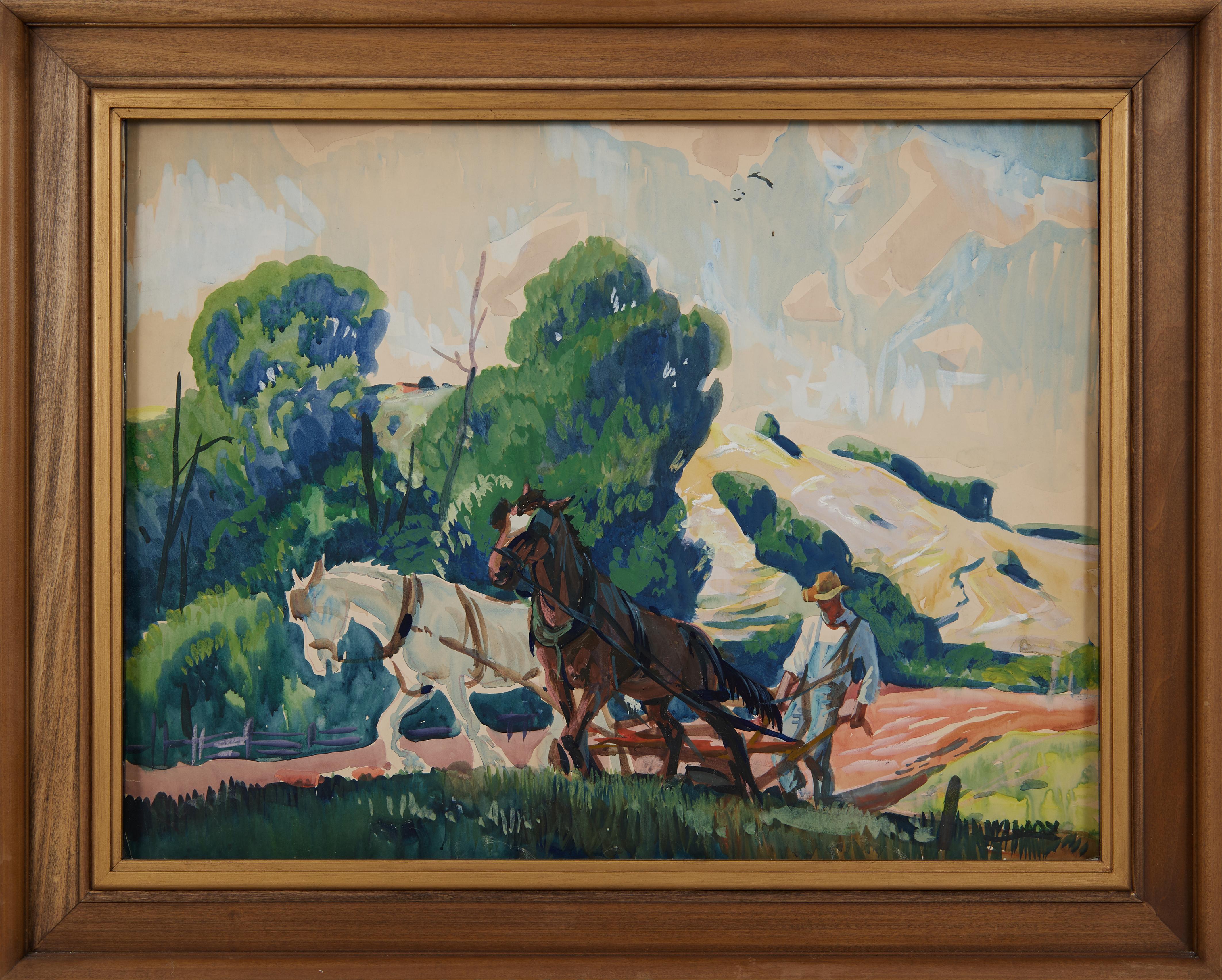
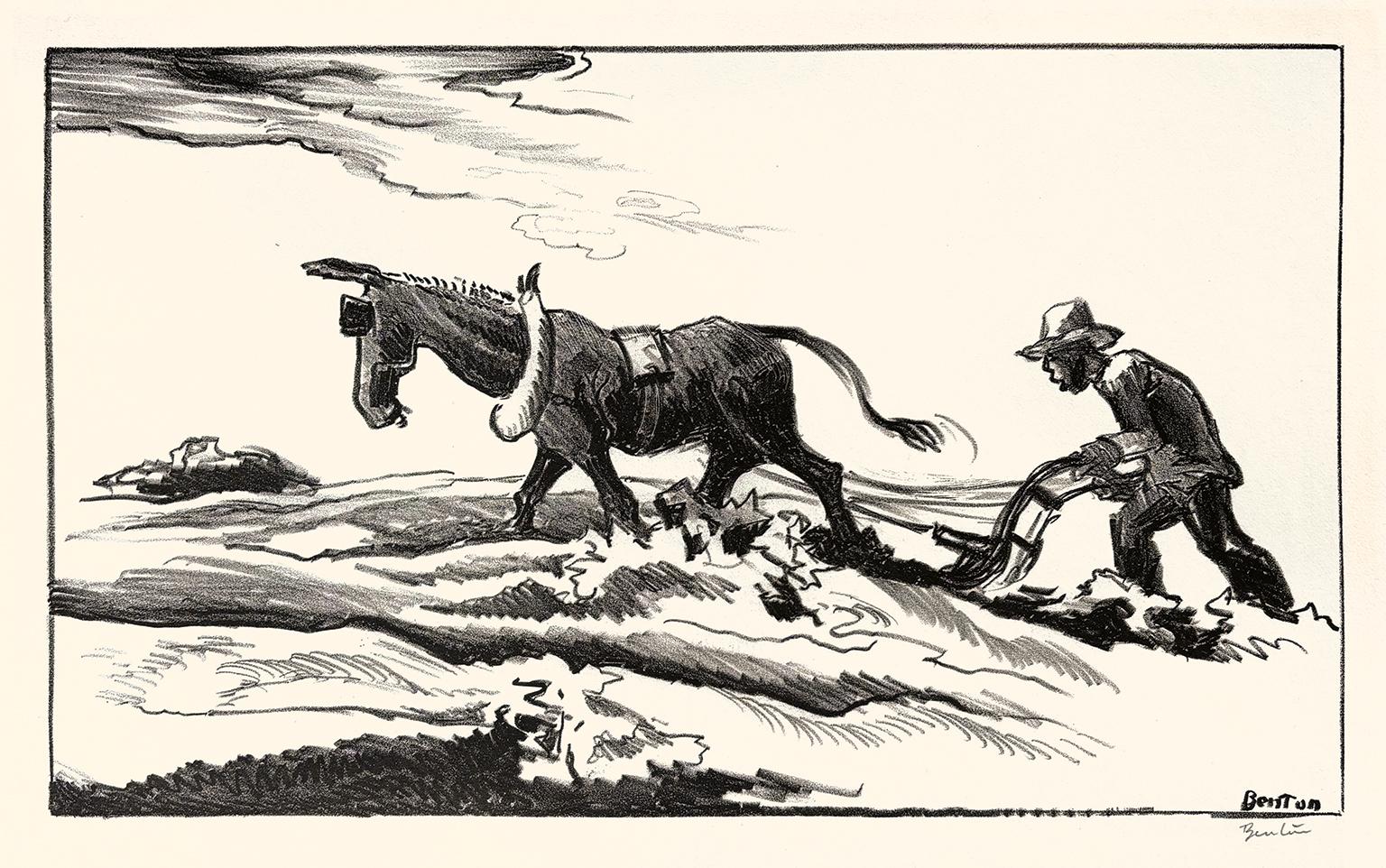
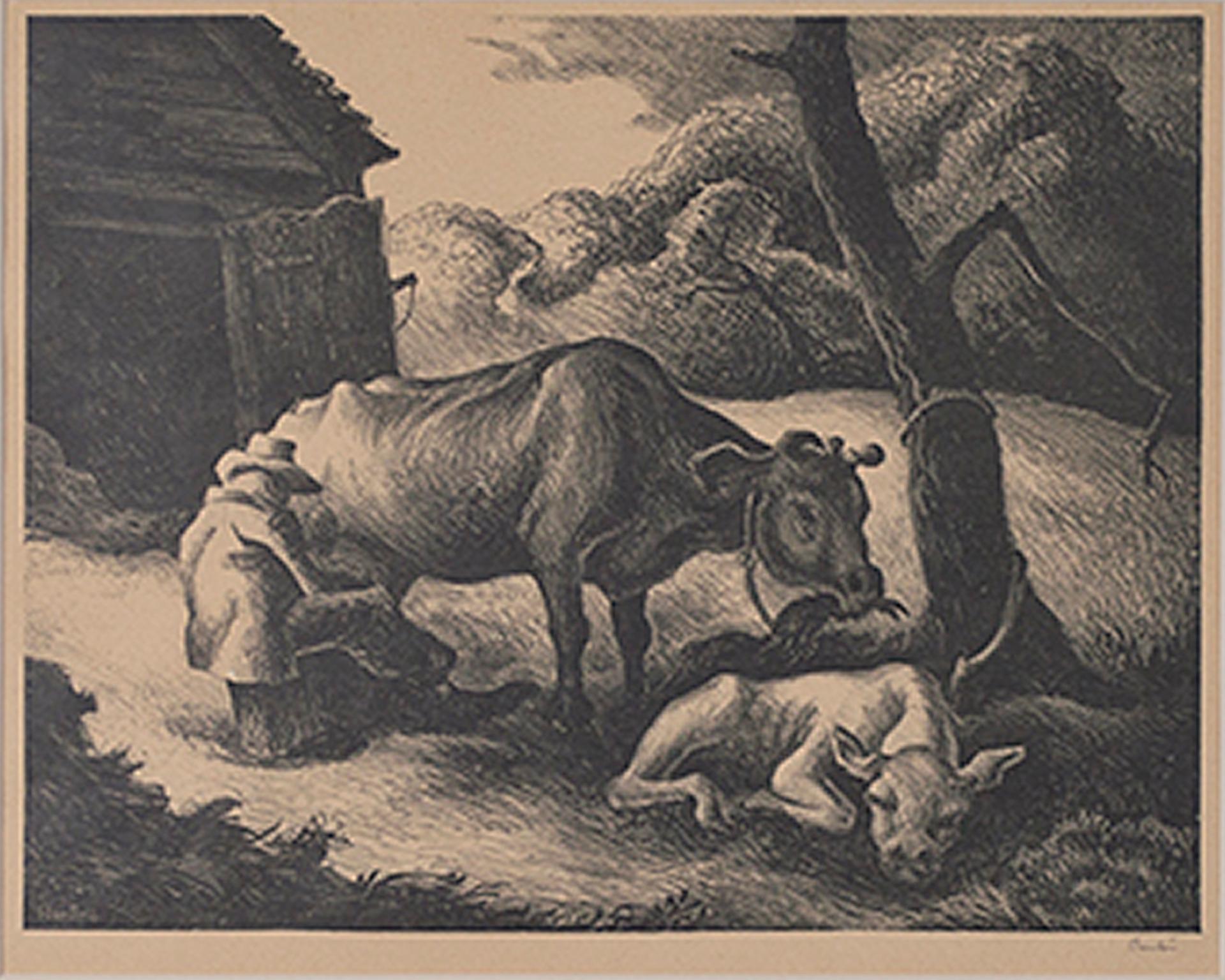
"Planting (Spring Plowing)", a vibrant watercolor and graphite on paper by Thomas Hart Benton, circa 1939-40, embodies the artist's signature Regionalist style. The work depicts a rural scene where two figures toil in a field, one guiding a plow pulled by a donkey, the other carrying a bucket, sowing seeds under a bright, cloud-streaked sky. The rolling, richly hued earth, painted in warm browns and oranges, contrasts with the lush green foliage and distant trees, while a small structure sits at the horizon, grounding the composition in everyday life. Benton's dynamic lines and fluid brushwork capture the rhythm of labor and the vitality of spring, infusing the scene with a sense of movement and purpose. The reverse image of this artwork was transformed into a lithograph in 1939, with notable examples housed in prestigious museum collections including the Smithsonian American Art Museum, Nelson Atkins Museum of Art, Minneapolis Institute of Art, and the Chazen Museum of Art. This print adaptation underscores the piece's cultural significance, reflecting Benton's influence on American art during the Depression era and the resonance of this particular subject celebrating the resilience and harmony of its people with nature. Created with a keen eye for detail and a deep connection to the land, "Planting (Spring Plowing)" showcases Benton's ability to blend realism with his hallmark muscular style. It is accompanied by two letters written by Thomas Hart Benton to Lon Ramsey, its original owner, and bears an inscription by the artist on the verso.
Provenance:
Lon and Wilmia Ramsey, Winnetka, Illinois, by 1968
Private Collection, by descent from above
Private Collection, Kansas
Exhibition:
New York, Associated American Artists Galleries, Thomas Benton, April 9 - May 3, 1941, no. 12
West Palm Beach, Florida, Ann Norton Sculpture Gardens, Figurative Masters of the Americas, January 4 – February 12, 2023
Thomas Hart Benton was an American-born painter best known for his depictions of the everyday life of the average, working-class American. Benton’s early travels and studies allowed him to meet and study with artists such as Diego Rivera, whose influence can be seen in Benton’s murals, and Stanton MacDonald-Wright, whose influence is evident in Benton’s Synchromist style. During WWI, Benton served in the Navy, and was instructed to give accurate representations of the warship’s camouflage markings, and of the activity on the docks. The need for accuracy in that work, which he felt was crucial to him as an American and as an artist, influenced his style in his later murals. He declared himself an enemy of Modernism and adopted his naturalistic and representational style, which is now known as Regionalism. Some of his works sparked controversy because he painted historical events or political undercurrents that some did not want publicized. Later in life, he taught at the Kansas City Art Institute, and mentored artists such as Jackson Pollock, until he was dismissed for his controversial political views.
- Creator:Thomas Hart Benton (1889-1975, American)
- Creation Year:c. 1939-1940
- Dimensions:Height: 18 in (45.72 cm)Width: 21.75 in (55.25 cm)
- Medium:
- Movement & Style:
- Period:
- Condition:
- Gallery Location:Palm Desert, CA
- Reference Number:Seller: 39755.b1stDibs: LU9317243722
Thomas Hart Benton
Thomas Hart Benton was born in Neosho, Missouri on April 15, 1889. Even as a boy, he was no stranger to the "art of the deal" or to the smoke-filled rooms in which such deals were often consummated. His grandfather had been Missouri's first United States Senator and served in Washington for thirty years. His father, Maecenas Benton, was United States Attorney for the Western District of Missouri under Cleveland and served in the United States House of Representatives during the McKinley and Theodore Roosevelt administrations. Benton's brother, Nat, was prosecutor for Greene County, Missouri, during the 1930s. As soon as he could walk, Benton traveled with his father on political tours. There he learned the arts of chewing and smoking, and while the men were involved in their heated discussions, Benton delighted in finding new cream colored wallpaper on the staircase wall, at the age of six or seven, and drew in charcoal his first mural, a long multi-car freight train. As soon as he was eighteen, even though his father wanted him to study law, Benton left for Chicago where he studied at the Art Institute during the years 1907 and 1908. He continued his studies in Paris, where he learned delicious wickedness, aesthetic and otherwise. Once back home, he became the leader of the Regionalist School, the most theatrical and gifted of the 1930s muralists and as Harry Truman described him,"the best damned painter in America." Detractors said that Benton was "a fascist, a communist, a racist and a bigot"; the ingenious structure, powerful use of modeling and scale and the high-colored humanity of the murals and easel paintings are retort enough. He was a dark, active dynamo, only 5 ft., 3 1/2 in. tall. He was outspoken, open, charmingly profane; he had a great mane of hair and a face the texture of oak bark. He wore rumpled corduroy and flannel, and walked with the unsteady swagger of a sailor just ashore. He poured a salwart drink, chewed on small black cigars and spat in the fire. Benton was once described as the "churlish dean of regionalist art." If you listened to a variety of art authorities, you would find them equally divided between Harry Truman's assessment of Benton as "the best damned painter in America" and Hilton Kramer who proclaimed Benton "a failed artist." The East Coast art establishment tended to regard Benton as memorable for one reason only: he was the teacher of Jackson Pollock. Benton was married in 1922 to Rita, a gregarious Italian lady, and they had a daughter and a son. At the height of his fame in the 1940s, Benton bungled the buy-out he was offered by Walt Disney and went his own way, completing his last mural in 1975 in acrylics the year of his death. He died in 1975.
Heather James Fine Art
4.8
Recognized Seller
These prestigious sellers are industry leaders and represent the highest echelon for item quality and design.
Established in 1996
1stDibs seller since 2011
120 sales on 1stDibs
Typical response time: 2 hours
- ShippingRetrieving quote...Shipping from: Palm Desert, CA
- Return Policy
Only orders placed on 1stDibs are protected if an item is damaged, isn't authentic, or isn't as described. Learn More