Engraving More Prints

to
21
169
114
112
29
7
Overall Width
to
Overall Height
to
41
37
29
28
3
2
2
1
58
26
13
12
10
199
95
99
38
4
1
4
3
4
28
38
3
6
153
246
182
3
12
5
5
5
4
3
3
3
2
2
2
2
2
2
1
1
1
1
1
1
4,882
3,620
2,872
1,276
1,235
57
93
215
106
Medium: Engraving
Sting Rays, engraving with original hand-colouring, circa 1815

Sting Rays, engraving with original hand-colouring, circa 1815

Located in Melbourne, Victoria

Sting Rays, engraving with original hand-colouring, circa 1815. From Bilderbuch Zum Nutzen und Vergnugen Der Jugend by Friedrich Justin Bertuch (1747-1822), an encyclopaedic collect...

Category

Early 19th Century Naturalistic Engraving More Prints

Materials

Engraving

Frankfort, Germany: A 16th Century Hand-colored Map by Braun & Hogenberg

Frankfort, Germany: A 16th Century Hand-colored Map by Braun & Hogenberg

By Franz Hogenberg

Located in Alamo, CA

This is a 16th century original hand-colored copperplate engraved map of Frankfort, Germany entitled "Francenbergum, vel ut alij Francoburgum Hassiae Opp" by Georg Braun & Franz Hogenberg, from their famous city atlas "Civitates Orbis Terrarum", published in Cologne, Germany in 1595. This is an English translation of an excerpt from the original text in the atlas: "Frankenberg or, according to others, Francoburgum, a town in Hesse. Charlemagne vested the town of Frankenberg with many freedoms and privileges, which it still enjoys to this day, and on account of its valiant and victorious soldiers awarded a signet, upon which there formerly appeared a golden castle with a tower, together with the letter F and a golden crown. Frankenberg, seen here from the northeast, lies on a hill above the River Eder. The hillside is covered with fields neatly separated by bushes and fences. Soaring above the town is the massive Liebfrauenkirche, which was modelled on St Elizabeth's church in Marburg. The New Town was founded in 1335 at the foot of the hill (right) and merged with the Old Town as late as 1556. Frankenberg was founded by Conrad of Thuringia in 1233/34 to prevent the archbishops of Mainz from expanding their sphere of influence...

Category

16th Century Old Masters Engraving More Prints

Materials

Engraving

Four Framed Hogarth Engravings "Four Times of the Day"

Four Framed Hogarth Engravings "Four Times of the Day"

By William Hogarth

Located in Alamo, CA

The four plates in this "Four Times of the Day" set were created utilizing both engraving and etching techniques by William Hogarth in 1738. Hogarth's original copper plates were refurbished where needed by James Heath and these engravings were republished in London in 1822 by Braddock, Cradock & Joy. This was the last time Hogarth's original copper plates were used for printing. Most were melted down during World War I for the construction of bombs. Printed upon early nineteenth century wove paper and with large, full margins as published by William Heath in 1822. The inscription below each print reads "Invented Painted & Engraved by Wm. Hogarth & Publish'd March 25. 1738 according to Act of Parliament". These large folio sized "Four Times of the Day" engravings/etchings are presented in complex gold-colored wood frames with black bands and scalloped gold inner trim. A majority of each thick impressive frame is covered with glass applied near the outer edge. Each frame measures 25.75" high, 22.25" wide and 1.88" deep. There are a few small dents in the edge of these frames, which are otherwise in very good condition. "Morning" has two focal areas of discoloration in the upper margin and some discoloration in the right margin, a short tear in the left margin and a short tear or crease in the right margin. "Noon" has a spot in the upper margin that extends into the upper image, but it is otherwise in very good condition. "Evening" has a faint spot in the upper margin, but it is otherwise in very good condition. "Night" is in excellent condition. The "Four Times of the Day" series is in the collection of many major museums, including: The British Museum, The Metropolitan Museum of Art, The Tate Museum, The Chicago Art Institute and The Victoria and Albert Museum. Through this series Hogarth is portraying early 18th century London street life at "Four Times of the Day". His characters are exhibiting their personalities, quircks, strange activities, but he also wants to draw attention the disparities between the wealthy aristocracy and the common working class. Plate 1, "Morning" depicts morning in Covent Garden in the winter in front of Tom King...

Category

Mid-18th Century Old Masters Engraving More Prints

Materials

Engraving, Etching

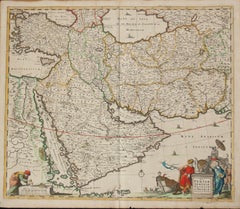
Persiae, Armeniae, Natoliae et Arabiae Descriptio per Frederick deWit 1666 map

Persiae, Armeniae, Natoliae et Arabiae Descriptio per Frederick deWit 1666 map

Located in Paonia, CO

Map of Persiae, Armeniae, Natoliae et Arabiae Descriptio per F de Wit 1688 engraving from: Atlas Contractus Orbis Terrarum Praecipuas ac Novissimas Complectens Tabulas. Amsterdam, N. Visscher, 1656-77. (Koeman III, Vis5-8) This highly decorative map of the Middle East is by the Dutch engraver, publisher, and map seller...

Category

1660s Realist Engraving More Prints

Materials

Engraving

Small Pinocchio Aquatint Etching Jim Dine Pop Art Print

Small Pinocchio Aquatint Etching Jim Dine Pop Art Print

By Jim Dine

Located in Surfside, FL

Jim Dine (American, b. 1935) Etching depicting Pinocchio Published by Enitharmon Press for Whitman College, London 1999 Hand signed in pencil lower right. Measures 9" x 7" sheet siz...

Category

1990s Pop Art Engraving More Prints

Materials

Drypoint, Etching

ANCIENT SCRIPT Original Etching, Abstract Hebrew Letters, Stone Tablet Red Black

ANCIENT SCRIPT Original Etching, Abstract Hebrew Letters, Stone Tablet Red Black

By Moshe Castel

Located in Union City, NJ

ANCIENT SCRIPT by the Israeli artist Moshe Castel (1909-1991) is an original etching and aquatint printed in colors with carborundum using traditional hand intaglio techniques on arc...

Category

1970s Contemporary Engraving More Prints

Materials

Engraving, Etching, Printer's Ink, Archival Paper, Aquatint

Sandwich Islands Canoe (Hawaii): Framed 18th C. Engraving Captain Cook's Journal

Sandwich Islands Canoe (Hawaii): Framed 18th C. Engraving Captain Cook's Journal

By John Webber

Located in Alamo, CA

"A Canoe of the Sandwich Islands, the Rowers Masked" is an engraving created by Charles Grignion, from a drawing by John Webber (1752-1793), who was the artist on Captain James Cook's 3rd and final voyage of discovery. It is Plate 65 in the atlas of "A Voyage to the Pacific Ocean Undertaken by the Command of His Majesty, for Making Discoveries in the Northern Hemisphere", the official British Admiralty sanctioned journal published upon completion of the voyage in London in 1784 by Strahan & Cadell. This famous image of ten Hawaiian rowers transporting a priest who is carrying a feather-covered image of Kukailimoku, the Hawaiian god of war. The priests and paddlers are all wearing gourd masks in their double-hulled canoe with an upright lateen woven sail. Each hull was shaped from a single large Koa log harvested from island rainforests, where they were carved before being transported to the coast. This engraving is presented in a Koa wood frame and a white mat. There are occasional faint spots, but the print is otherwise in very good condition. Koa is the same wood as was used to make the canoe. Koa wood is legendary in Hawaii. Not only is this amazing wood native to Hawaii, but it is known for the deep rich colors and varied grain pattern. Koa has an honored heritage in Hawaii and is highly revered and sacred. The word “koa” means “warrior” in Hawaiian. The warriors of King Kamehameha the Great, created canoes and weapons from a wood plentiful on the Big Island of Hawaii. This wood became synonymous with the warriors themselves, and it became known as koa. The frame measures 20.75" high, 26.75" wide and 0.88" deep. There are three other engravings listed from the official journal of Captain Cook's 3rd voyage available that are presented in identical Koa wood frames and mat (LU117324682022, LU117324684052, LU117324684062). They would make a wonderful grouping for a display of 2, 3 or 4 prints. A discount is available for a grouping depending on the number of items included. Hawaii was discovered by Captain Cook (1728-1779) during this voyage. Hawaii was originally called The Sandwich Islands in honor of The Earl of Sandwich...

Category

1780s Engraving More Prints

Materials

Engraving

Fish, engraving with original hand-colouring, circa 1815

Fish, engraving with original hand-colouring, circa 1815

Located in Melbourne, Victoria

Fish and seahorse, engraving with original hand-colouring, circa 1815. From Bilderbuch Zum Nutzen und Vergnugen Der Jugend by Friedrich Justin Bertuch (1747-1822), an encyclopaedic ...

Category

Early 19th Century Naturalistic Engraving More Prints

Materials

Engraving

Fish, engraving with original hand-colouring, circa 1815

Fish, engraving with original hand-colouring, circa 1815

Located in Melbourne, Victoria

Fish, engraving with original hand-colouring, circa 1815. From Bilderbuch Zum Nutzen und Vergnugen Der Jugend by Friedrich Justin Bertuch (1747-1822), an encyclopaedic collection of...

Category

Early 19th Century Naturalistic Engraving More Prints

Materials

Engraving

Purslane-leaved Aizoon. Henry Andrews antique botanical flower engraving print

Purslane-leaved Aizoon. Henry Andrews antique botanical flower engraving print

By Henry C Andrews

Located in Melbourne, Victoria

'Aizoon Canariense - Purslane-leaved Aizoon' Original copper-line engraving with original hand-colouring from Henry Andrews' 'The Botanist's Repository', 1797-1812. Accompanied by ...

Category

Early 19th Century Naturalistic Engraving More Prints

Materials

Engraving

Tournai (Tournay), Belgium: A 16th Century Hand-colored Map by Braun & Hogenberg

Tournai (Tournay), Belgium: A 16th Century Hand-colored Map by Braun & Hogenberg

By Franz Hogenberg

Located in Alamo, CA

This is a 16th century original hand-colored copperplate engraved map of Tournai, Belgium, entitled "Tornacum" by Georg Braun & Franz Hogenberg, in volume IV of their famous city atlas "Civitates Orbis Terrarum", published in Cologne or Augsberg, Germany in 1575. The map provides a bird's-eye view of the walled city of Tournai, the second oldest city in Belgium. It lies approximately one hour by car southwest of Brussels or from Ghent. The names of thirty of its streets, prominent buildings, churches and squares are listed in a key within a strap-work cartouche in the lower left. These locations are numbered in the key corresponding to their locations on the map. This colorful map of Tournai (Tornacum or Tournay as it was called in the 16th century) includes the title in Latin in a cartouche in the upper center. Three crests are present across the upper map. A man and two woman are standing on a hill in the foreground in the lower right dressed in the style of 16th century upper class residents of the town. This is an English translation of an excerpt of Braun's description of Tornai: “Tornacum or Turnacum is a city in Gallia Belgica, situated on the Schelde in the territory of the Nervii, called Tournai by its French inhabitants, but Dorneck by the Germans. Tournai has always been a large and powerful city, with an abundance of goods and commercial activities and wonderfully resourceful craftsmen, who invent new articles every day, and although some of these go out of use they constantly conceive of other new things, both useful and delightful, so that they have at all times something that provides work and a means of livelihood for the poor." ReferencesVan der Krogt 4, 4435, State 1; Taschen, Braun and Hogenberg...

Category

16th Century Old Masters Engraving More Prints

Materials

Engraving

Feve de St Ignace (Strychnos ignatii), French botanical flower engraving, 1818

Feve de St Ignace (Strychnos ignatii), French botanical flower engraving, 1818

By After Pierre Turpin

Located in Melbourne, Victoria

French botanical flower engraving, 1818. Colour-printed stipple engraving by J Lambert after Pierre Turpin (1775-1840) From Francois Pierre Chaumeton's 'Flore Medicale' which portrayed a variety of flowers, trees and herbs which could be used for treating illnesses. The engravings were produced during the great period of French colour printing using the stipple-engraving process pioneered by the great botanical artist Pierre-Jospeh Redoute. The artist is the celebrated Pierre Jean Francois Turpin...

Category

Early 19th Century Victorian Engraving More Prints

Materials

Engraving

Fish, engraving with original hand-colouring, circa 1815

Fish, engraving with original hand-colouring, circa 1815

Located in Melbourne, Victoria

Fish and seahorse, engraving with original hand-colouring, circa 1815. From Bilderbuch Zum Nutzen und Vergnugen Der Jugend by Friedrich Justin Bertuch (1747-1822), an encyclopaedic ...

Category

Early 19th Century Naturalistic Engraving More Prints

Materials

Engraving

Iris des Marais (Yellow Iris), French botanical herbal flower engraving, 1818

Iris des Marais (Yellow Iris), French botanical herbal flower engraving, 1818

By After Pierre Turpin

Located in Melbourne, Victoria

French botanical flower engraving, 1818. Colour-printed stipple engraving by J Lambert after Pierre Turpin (1775-1840) From Francois Pierre Chaumeton's 'Flore Medicale' which portrayed a variety of flowers, trees and herbs which could be used for treating illnesses. The engravings were produced during the great period of French colour printing using the stipple-engraving process pioneered by the great botanical artist Pierre-Jospeh Redoute. The artist is the celebrated Pierre Jean Francois Turpin...

Category

Early 19th Century Victorian Engraving More Prints

Materials

Engraving

White Stork "Ardea Ciconia": An 18th Century Hand-colored Engraving by Nozeman

White Stork "Ardea Ciconia": An 18th Century Hand-colored Engraving by Nozeman

This is a rare 18th Century hand-colored large folio-sized copperplate engraving entitled "Ardea Ciconia" (White Stork) by Cornelius Nozeman in volume II of his publication 'Nederlan...

Category

1780s Naturalistic Engraving More Prints

Materials

Engraving

Ancient Etruscan Greek vase painting. Early 19th century engraving, 1808

Ancient Etruscan Greek vase painting. Early 19th century engraving, 1808

Located in Melbourne, Victoria

Etruscan Vase-painting Copper-line engraving with later hand-colouring. 1808. From Millin's 'Peintures de Vases Antiques' published in Paris in 1808. Depicts scene from an ancient ...

Category

Early 19th Century Other Art Style Engraving More Prints

Materials

Engraving

"Space Oddity", Hand-Colored Etching, Decorative Motifs

"Space Oddity", Hand-Colored Etching, Decorative Motifs

By Katie VanVliet

Located in Philadelphia, PA

This piece titled "Space Oddity" is a limited edition piece by Kate VanVliet and is made from hand-colored intaglio with drypoint, aquatint, and soft ground on Rives BFK. This piece ...

Category

21st Century and Contemporary Contemporary Engraving More Prints

Materials

Drypoint, Etching, Aquatint

White Hamburgh Grape: A Framed 19th C. Color Engraving by George Brookshaw

White Hamburgh Grape: A Framed 19th C. Color Engraving by George Brookshaw

By George Brookshaw

Located in Alamo, CA

This is a 19th century colored aquatint and stipple engraving finished by hand entitled "White Hamburgh Grape", drawn and engraved by George Brookshaw and published in London in 1812 as plate 60 in his 'Pomona Britannica; or, A Collection of the Most Esteemed Fruits'. It depicts a cluster of pale green grapes still on the vine. The vine and leaves are shown in attractive shades of green and brown. The plant lays on a brown textured background with shadows to impart 3-dimensionality. The scene is reminiscent of an engraving in an 18th century artistically stylized human anatomy atlas. There is a light brown title rectangle in the lower center which is blank, suggesting this may be a more rare preproduction proof. There are wide white margins. This striking engraving is presented in a reddish brown decorative wood frame with a darker brown scroll-work outer trim and a gold-colored inner fillet and a thick light beige mat. The frame measures 26" high, 22" wide and 1.13" deep. It is glazed with UV conservation glass. There is a tiny spot in the lower margin on the left and another in the left margin. The print and frame are otherwise in excellent condition. There is a second Brookshaw engraving that is framed in identical moulding, although a slightly different size and a different color mat. It depicts a Silver Rock Melon. The two prints would make a striking display pairing...

Category

Early 19th Century Naturalistic Engraving More Prints

Materials

Engraving, Aquatint

Engraving more prints for sale on 1stDibs.

Find a wide variety of authentic Engraving more prints available on 1stDibs. While artists have worked in this medium across a range of time periods, art made with this material during the 19th Century is especially popular. There are many well-known artists whose body of work includes ceramic sculptures. Popular artists on 1stDibs associated with pieces like this include McKenney & Hall, Nicholas Sanson d'Abbeville, Guntars Sietins, and Henry C Andrews. Not every interior allows for large Engraving more prints, so small editions measuring 8.27 inches across are also available Prices for more prints made by famous or emerging artists can differ depending on medium, time period and other attributes. On 1stDibs, the price for these items starts at $85 and tops out at $85, while the average work can sell for $85.