October 11, 2026New York–based interior designer Young Huh is known for her maximalist gusto. She favors an aesthetic rich with vibrant colors and daring juxtapositions of patterns, and she has an abiding affection for fringe.
So, when a pair of first-time clients proposed a restrained color scheme for their newly acquired Park Avenue penthouse, the 1stDibs 50 designer faced an usual challenge.
“They basically only wanted cream and gold,” she says, adding that the couple, whose children are in college, envisioned a “modern and glamorous” feel for the four-bedroom, 4,000-plus-square-foot space. Stripped of much of her toolbox, Huh asked herself, “How do we create a lot out of a very limited palette?” Her answer: play with texture and form.
The result is what she calls a “grown-up apartment,” with rounded sofas, sculptural chairs and contemporary chandeliers, as well as the occasional carefully considered burst of color: lavender bedding in the primary bedroom, a graphic blue rug playing off a Jasper Johns piece in the den.
The penthouse project was far from the first hill Huh has climbed. Before becoming a designer, she had a brief career as an attorney, although she says she knew as soon as she began law school that the legal profession was not for her. After clerking for a trial judge in New York, she quit the law, unsure of what to do next. Her husband and the personality tests she subsequently took agreed that she belonged in a more creative field.
Born in Seoul, Huh grew up in Michigan. An artsy kid, for middle and high school she attended the state’s prestigious Cranbrook Schools, where art and design were enmeshed in the curriculum. “We were surrounded by art,” she says. “Just being in such an environment really informed my sensibilities. You become sensitive to how furnishings and architecture relate, and how light plays a huge part in that experience, and also how the outdoor spaces integrate.”
She loved weaving and ceramics, and at Smith College, in Massachusetts, where she majored in English, she took drawing and painting as electives. But her passion, she admits, exceeded her abilities in the studio. “So, interior design was the perfect solution,” she says. “In interior design, you can art direct anything.”
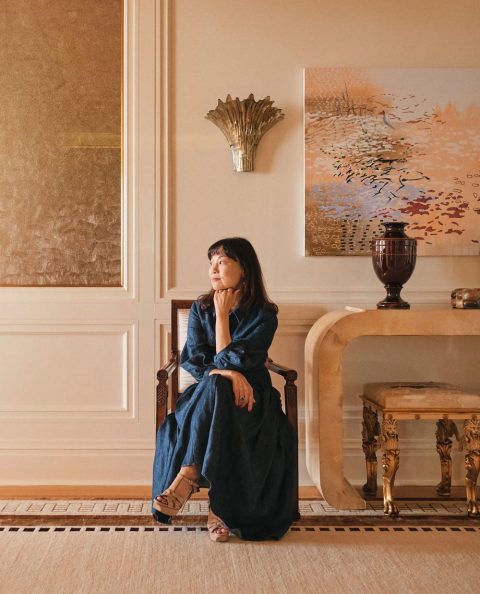
Her aha moment came at a cocktail party where, by chance, she met interior designer Jarret Yoshida. After talking to him all evening, she knew what she was meant to do. Huh asked Yoshida for an internship, and he said yes. “I convinced him [by promising] I would give him free legal services,” she says with a laugh.
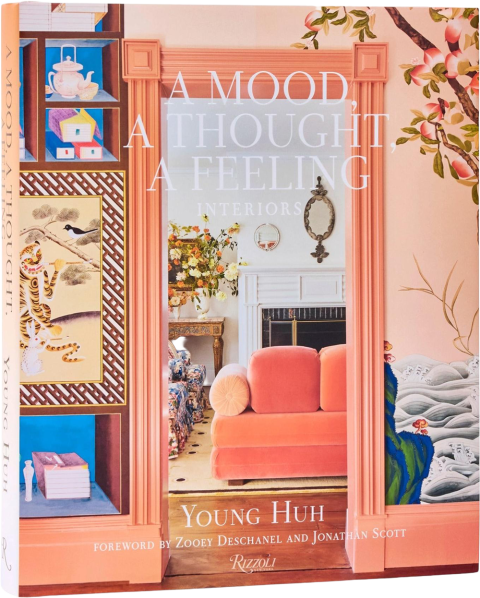
A couple of other jobs in the field followed, along with classes at Parsons School of Design, before Huh struck out on her own, in 2007. Since then, she has built a team of 11, currently working on residential projects on the East and West coasts of the U.S. and a series of hotels on the Turks and Caicos Islands. Her debut monograph, A Mood, a Thought, a Feeling: Interiors, in which the Park Avenue penthouse features prominently, was published by Rizzoli in March.
As a founder of the Asian American Pacific Islander Design Alliance (AAPIDA), she has also become a prominent advocate for that community. “It was during COVID, and there was just so much anti-Asian violence happening,” Huh says of her decision to start AAPIDA with her friend Jessica Davis, of Atelier Davis. Today, the group’s programs range from online seminars to mentorships and social events.
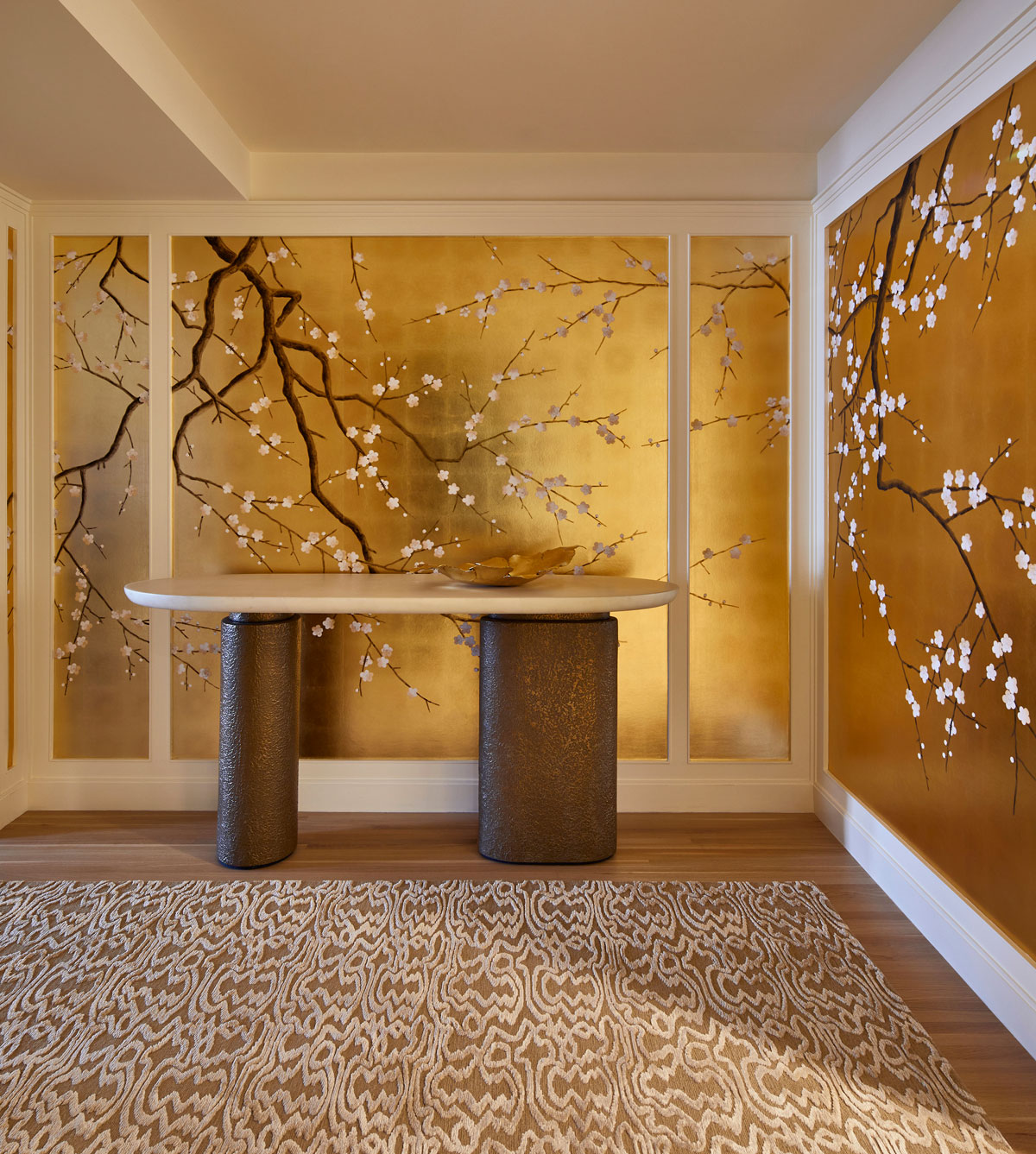
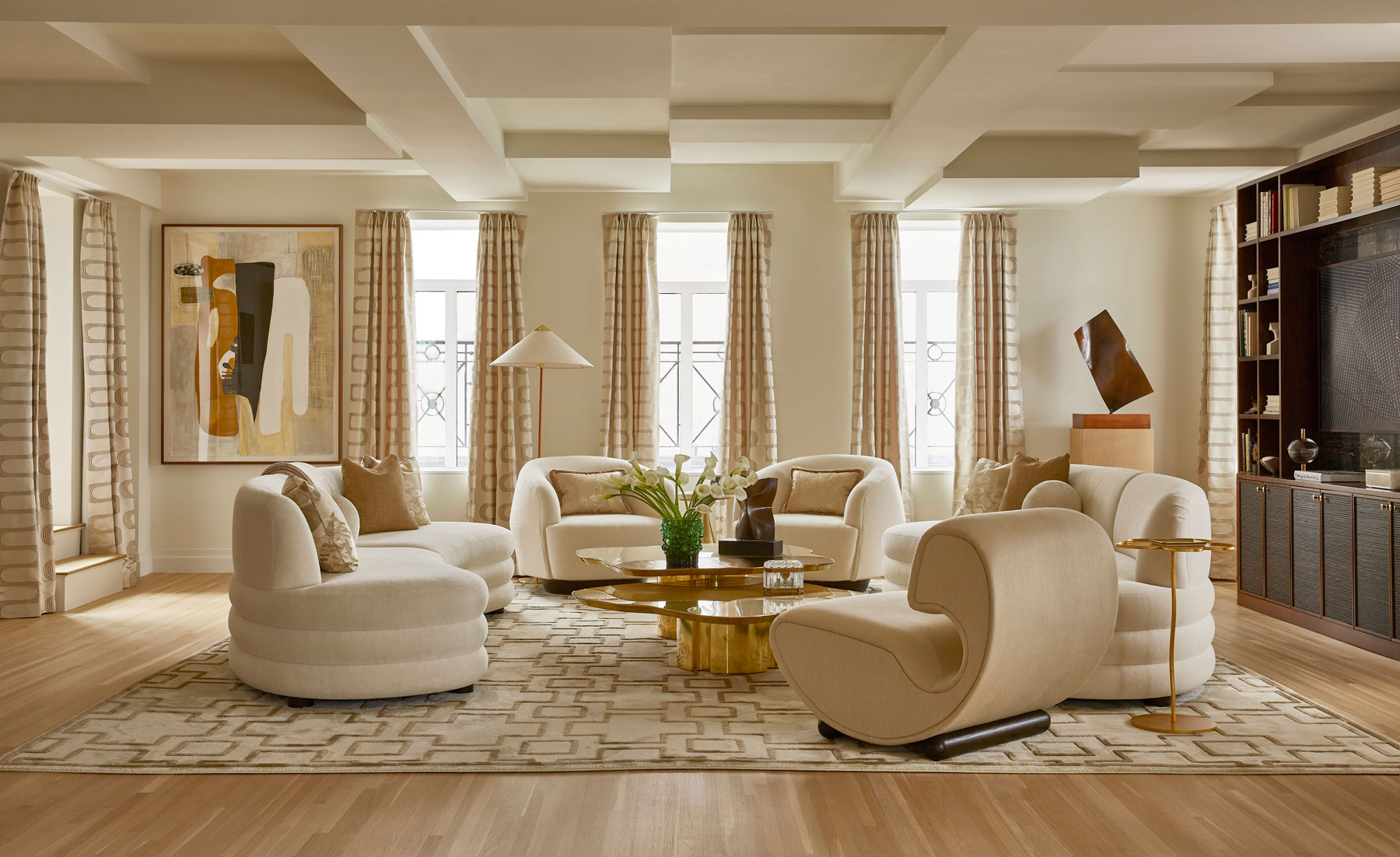
Huh frequently draws on her Korean heritage in her work. In the Park Avenue penthouse, she gave a classic Asian motif a glittering twist, covering large panels in the foyer with a gold de Gournay plum-blossom wallpaper. The entry segues to a larger gallery, which carries the gold hue on to the living room. There, a dense seating area comprising two custom curved sofas, a pair of rounded Holly Hunt lounge chairs and a chair resembling the letter C or a comma turned on its side surround shiny gold free-form nesting tables.
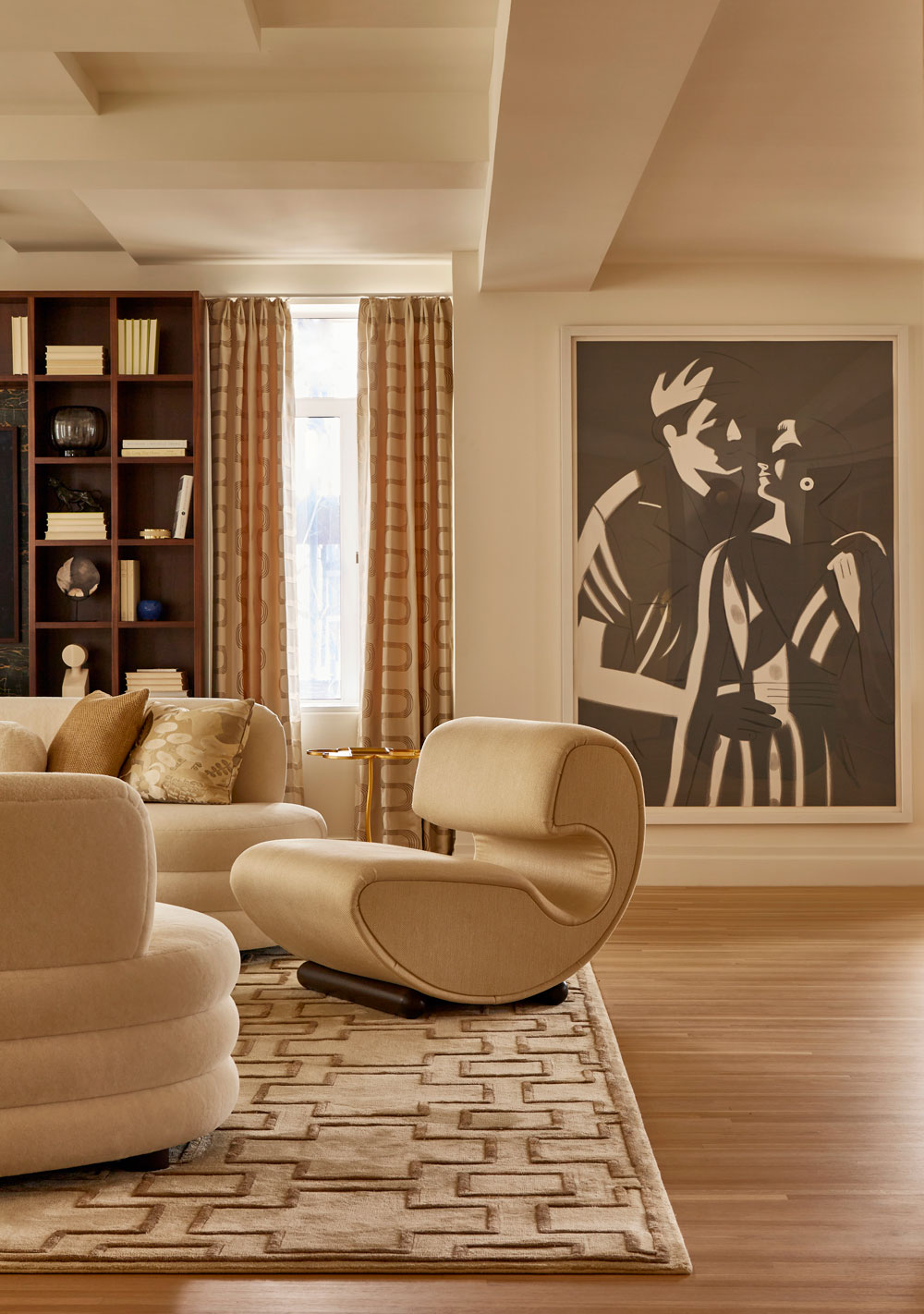
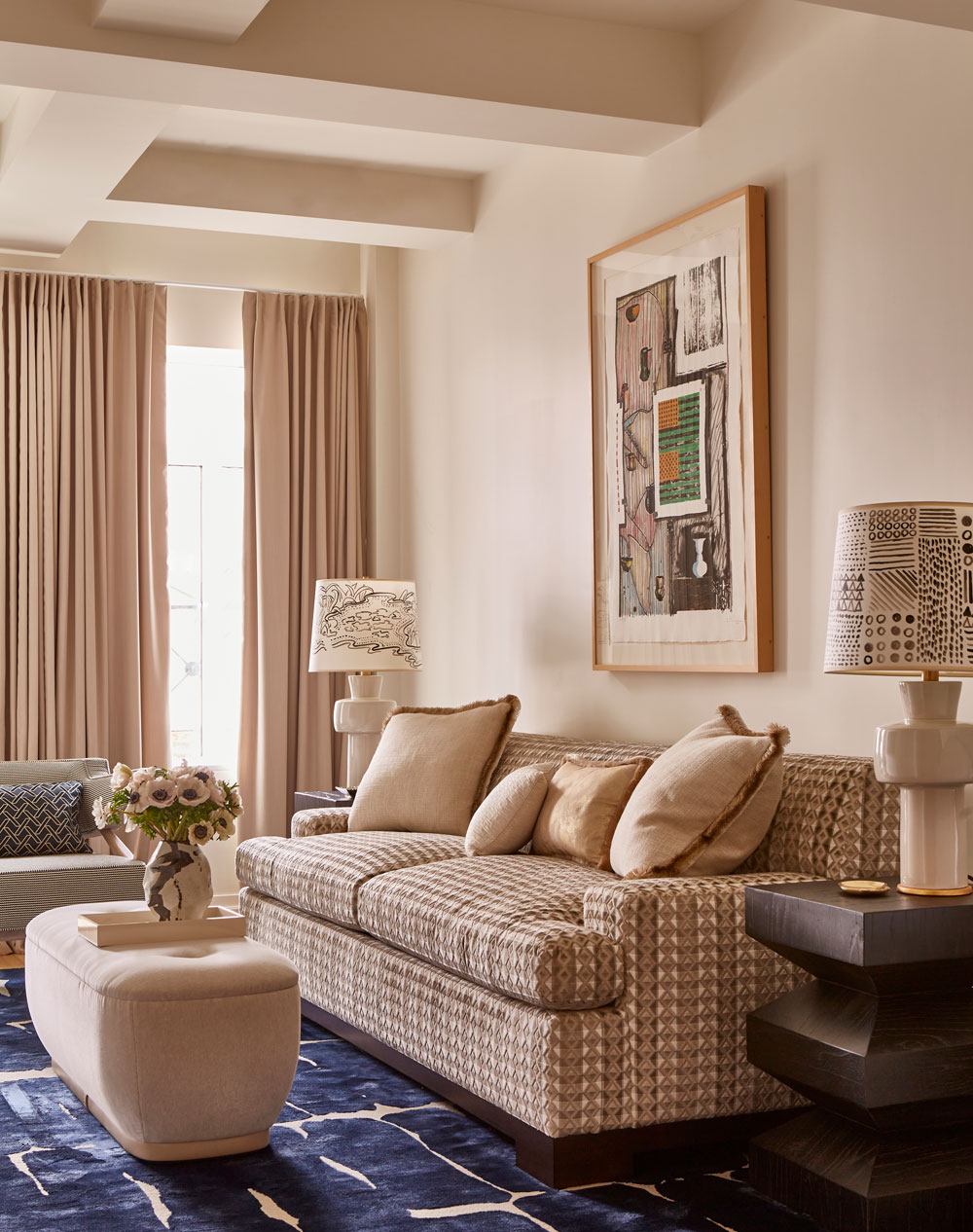
With the apartment’s ample wall space, Huh had no trouble finding places to hang the clients’ collection of contemporary artworks, including an Alex Katz double portrait and a Jasper Johns work on paper. But she was initially vexed by the oddly configured soffits, which protruded from the ceiling to conceal pipes. These potential blemishes fueled some of Huh’s most creative design solutions.
In the living room, for instance, she fashioned a Piet Mondrian–inspired grid of rectangles in relief to conceal the pipes and add visual interest. “We were like, ‘Let’s turn it into a piece of art and create all these different-size boxes,’ ” says Huh, who echoed the resulting geometric pattern in the rug and curtains to “ground the room.”
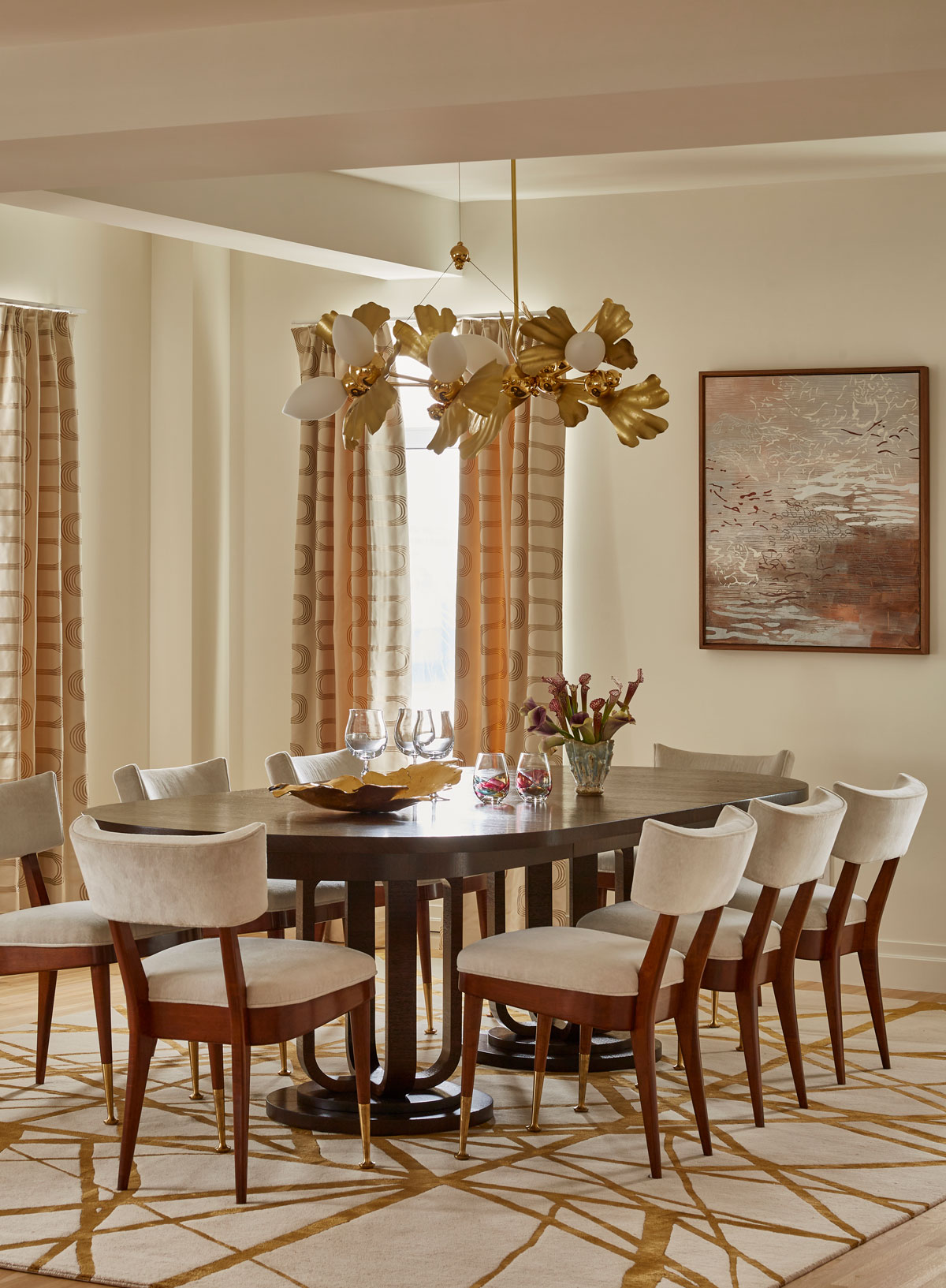
In the adjacent dining area, Huh teamed a custom twin-pedestal wood table with a set of slim-legged chairs beneath a graceful chandelier by Rosie Li. “She’s just amazing,” Huh says of Li. “We love how this feels linear and modern but also recalls the natural world with the gingko leaves. It’s a beautiful work of art.”
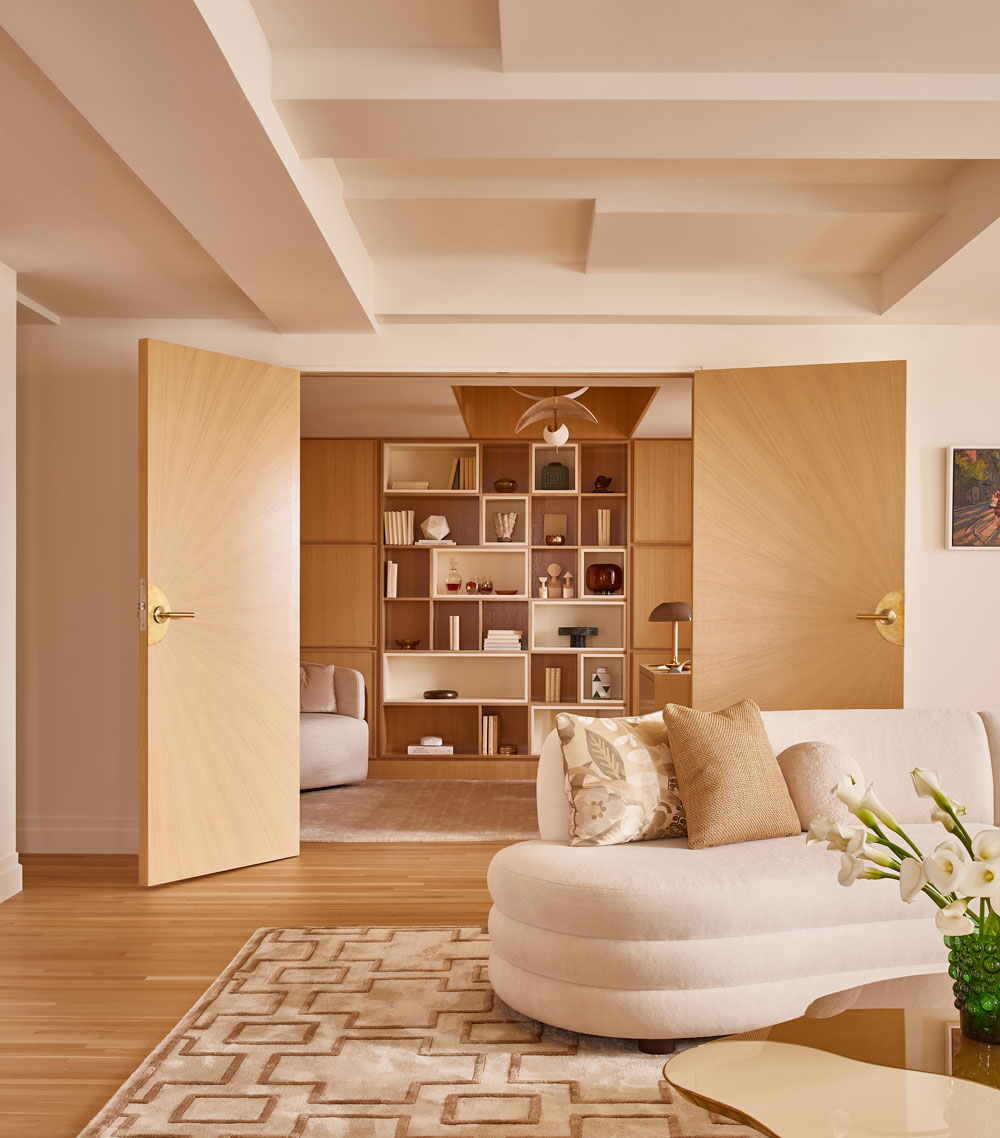
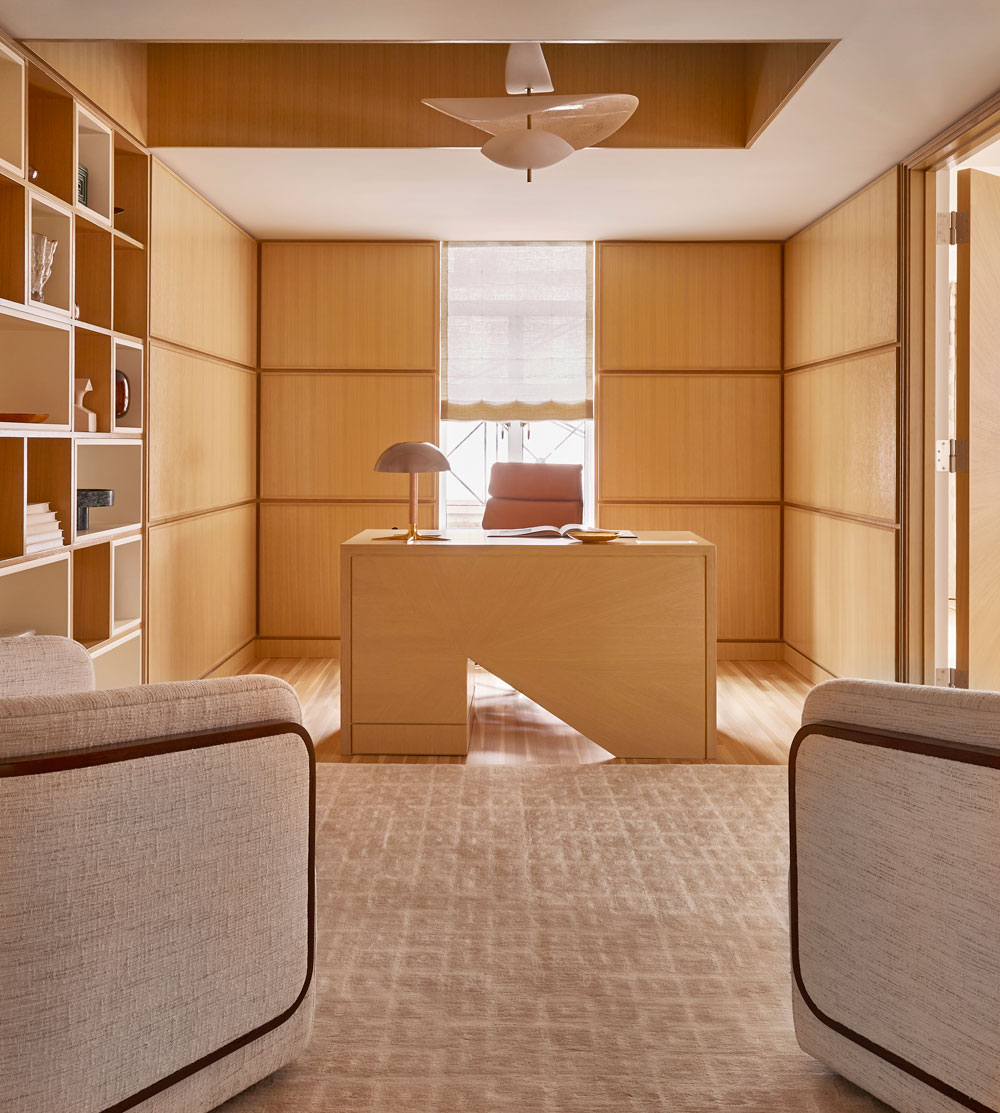
Double doors lead from the living room to the white-oak-paneled office, which the couple share. Huh furnished it with a pair of A. Rudin chairs and a wooden desk with a triangular cutout. To mask unattractive notches in the wall, she created chic cubbyholes — inset boxes in both oak and white lacquer that mirror a large rectangular recess in the ceiling — to hold books and objets.
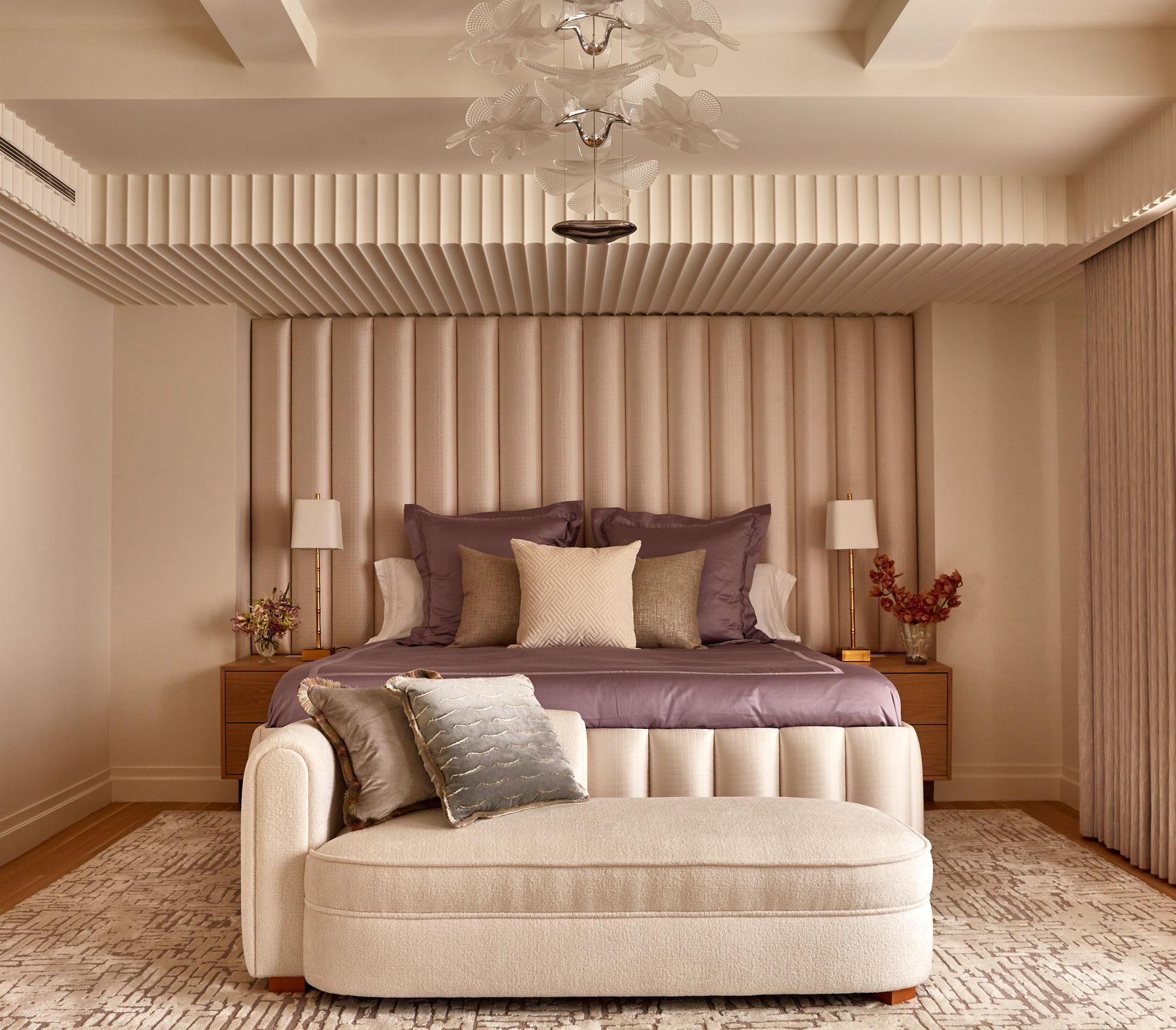
She conquered the primary bedroom’s strange soffits by making an alcove for the custom bed, channel-tufting both, then repeating that ribbed texture in a fluted ceiling overhang. A contemporary Buenos Aires chaise longue by Pierre Frey at the foot of the bed contributes to the space’s evocation of a Ginger Rogers boudoir in a 1930s classic. “It has this Old Hollywood glamour,” Huh says, “and there’s a little bit of sparkliness to the fabrics.” A tiered glass Chlorophilia chandelier by Ross Lovegrove for Artemide finishes the look.
Make no mistake: This apartment is not minimalist. “I love color, but this project shows that you can be maximal with a very tight palette,” Huh says. “The idea is not to overwhelm the senses but to create this very emotional experience of the space, whether it’s incredibly peaceful or incredibly joyful.”