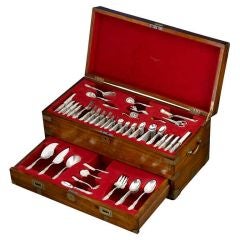
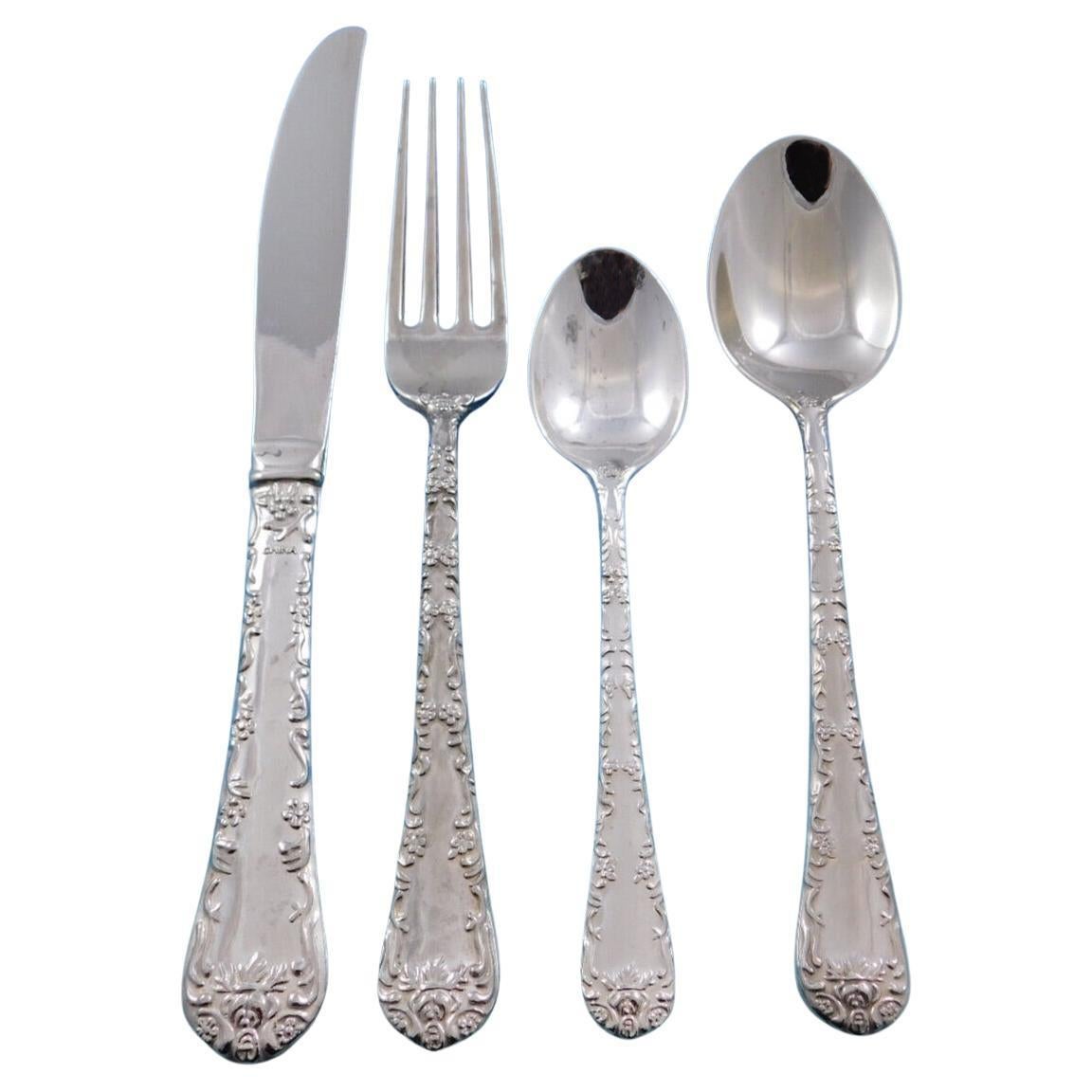
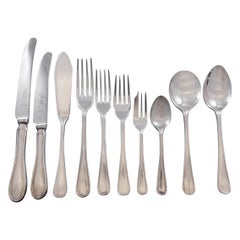
219-Piece Chrysanthemum Flatware Service by Tiffany & Co.
View Similar Items
Want more images or videos?
Request additional images or videos from the seller
1 of 8
219-Piece Chrysanthemum Flatware Service by Tiffany & Co.
About the Item
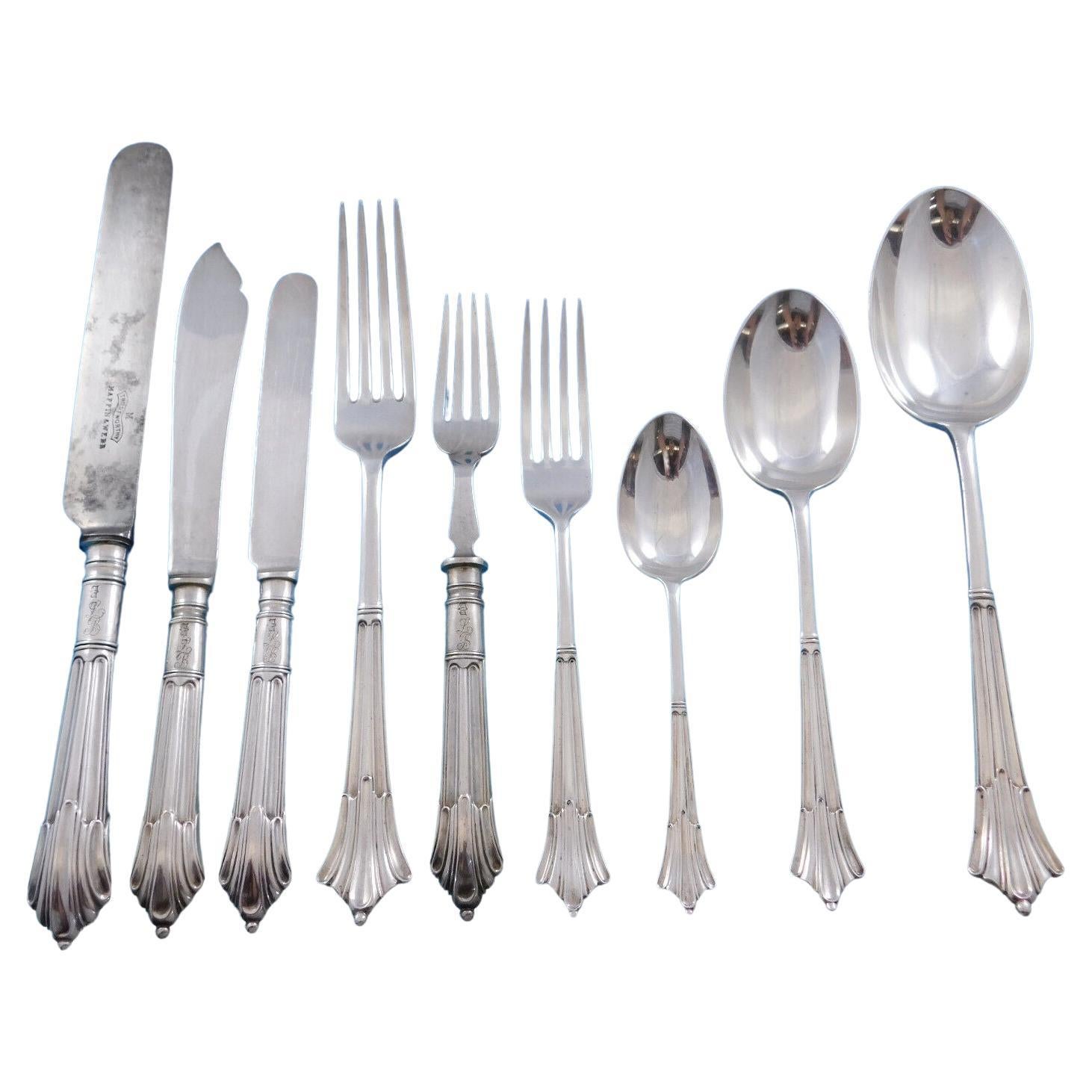
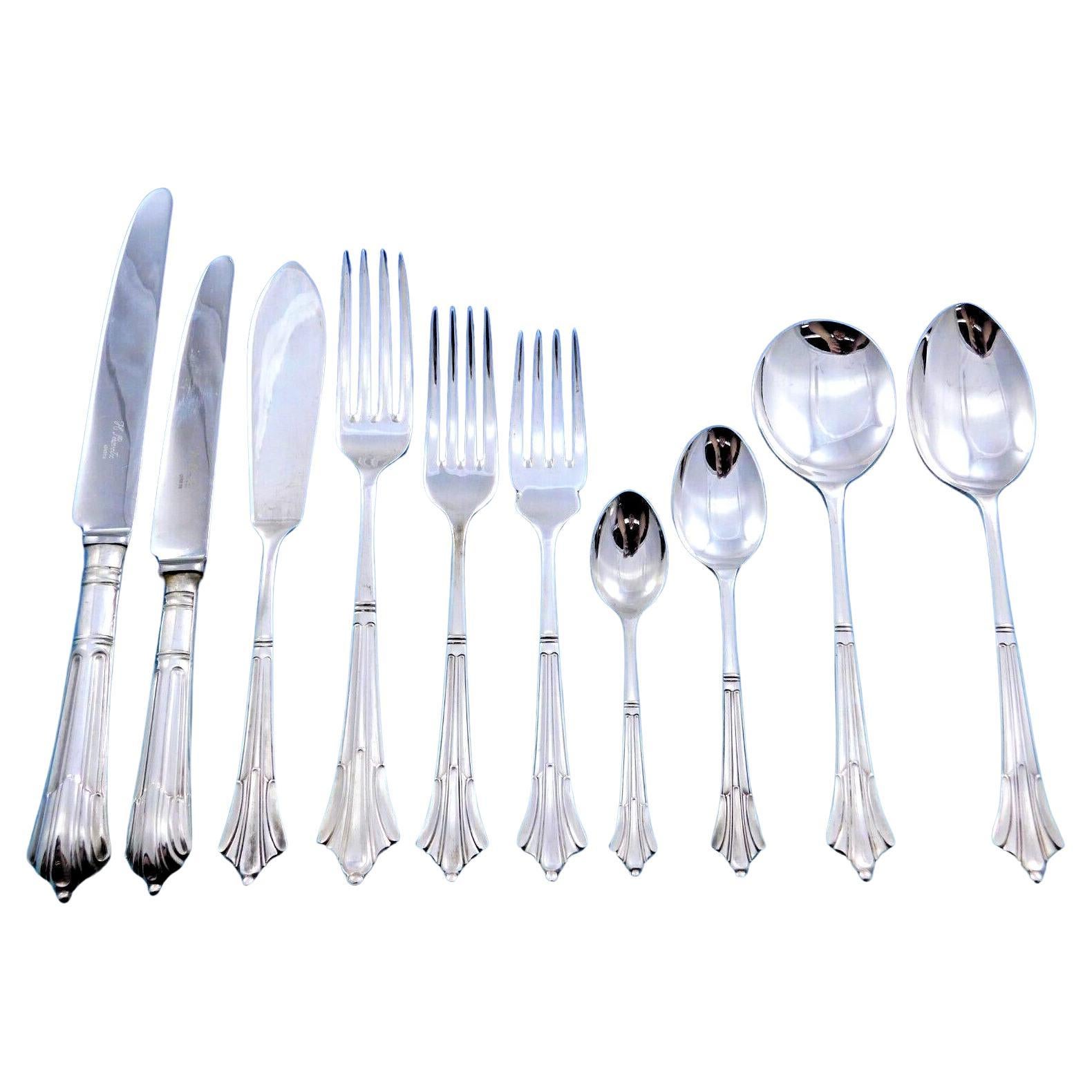
Pieces are marked "TIFFANY & CO/STERLING/PAT. 1880 M" and bear the monogram "NBH."
Circa 1900
Case: 35 7/8" wide x 17 1/2" deep x 15 1/2" high
This service-for-12 comprises:
24 luncheon forks
24 luncheon knives
12 dinner forks
12 dinner knives
12 teaspoons
12 tablespoons
12 salad forks
12 cream soup spoons
12 bouillon spoons
12 ice cream spoons
12 cocktail forks
12 two-prong citrus forks
12 fruit knives
10 butter spreaders
6 medium serving spoons
4 large serving spoons
2 sauce ladles
2-piece parcel-gilt salad service
2 serving forks
stuffing spoon
ice tongs
fish server
ice cream server
berry spoon
master butter
flat pierced server
oyster spoon
parcel-gilt master salt spoon
preserve spoon
grape sheers
The Chrysanthemum pattern was introduced in 1878 and patented on September 21, 1880 (patent no. 11968) by Charles T. Grosjean, one of the most influential silversmiths in Tiffany's history. The son of a silversmith who immigrated to the United States in 1836, Grosjean's father sold pieces to Tiffany & Co. during the 1850s. The younger Grosjean joined Tiffany as the manager of the company's Prince Street silverworks and he quickly became a driving force in the overall success of Tiffany's silver business.
Grosjean's designs are among the most enduring of the Tiffany patterns and include Chrysanthemum, Lap-over-Edge, and English King. Chrysanthemum, however, found particular favor with Victorian socialites and new brides despite the fact that it was one of the most expensive of the Tiffany patterns to produce. The pattern was carried over to many forms of hollowware as well, which also enjoyed tremendous popularity. Chrysanthemum is still considered the top pattern Tiffany & Co. ever produced.
References:
Tiffany Silver, 1978, Charles H. Carpenter, Jr. and Mary Grace Carpenter
Tiffany Silver Flatware 1845-1905: When Dining Was an Art, 1995, William P. Hood, Jr.
- Sold As:Set of 220
- Materials and Techniques:
- Place of Origin:
- Period:
- Date of Manufacture:Circa 1900
- Condition:
- Seller Location:New Orleans, LA
- Reference Number:Seller: 29-53111stDibs: U1104258911162
About the Seller
5.0
Recognized Seller
These prestigious sellers are industry leaders and represent the highest echelon for item quality and design.
Established in 1912
1stDibs seller since 2010
93 sales on 1stDibs
Typical response time: 7 hours
More From This SellerView All
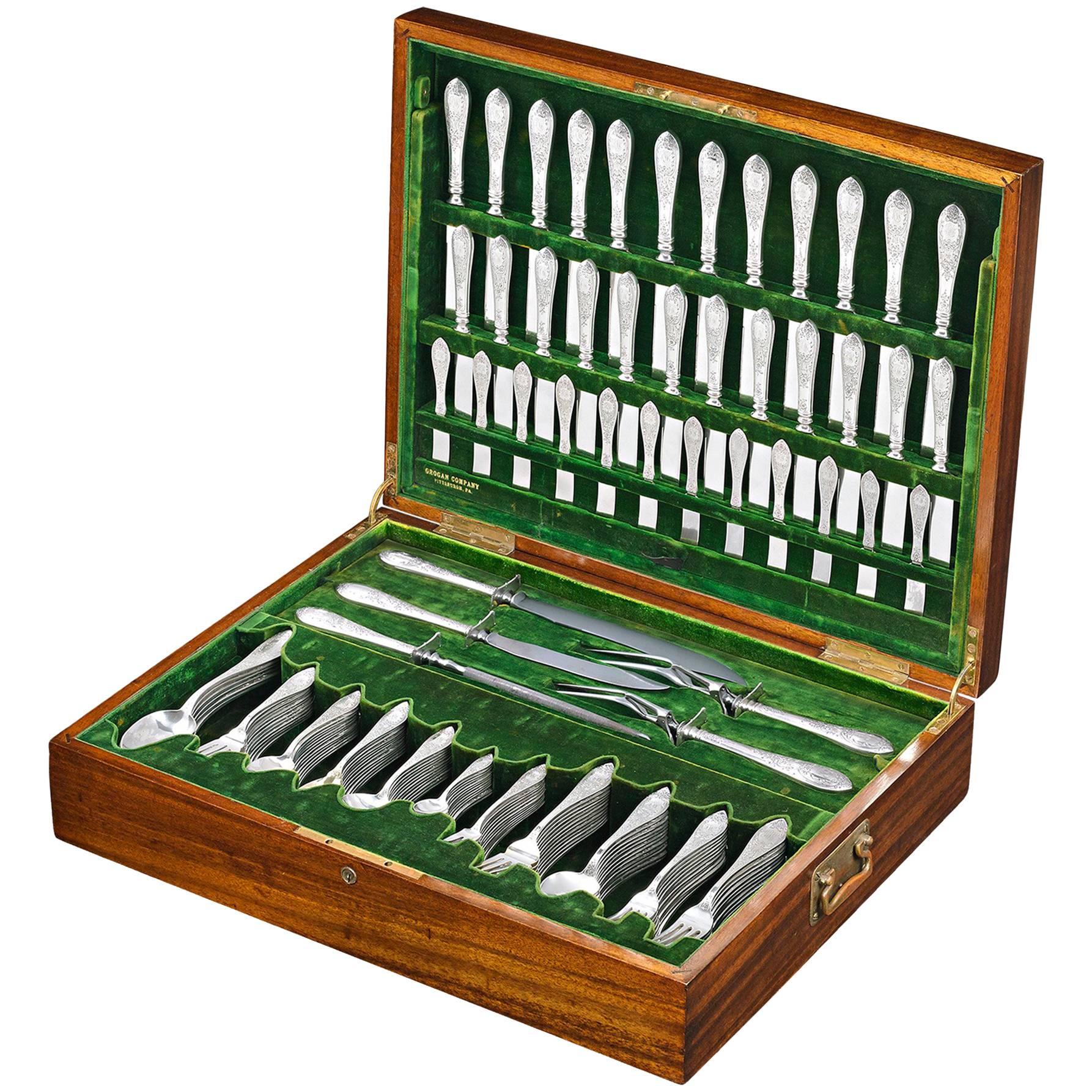
- Durgin Wentworth Flatware Service, 167 PiecesBy William B. DurginLocated in New Orleans, LAThis rare 167-piece Wentworth sterling silver flatware service was crafted by the celebrated William B. Durgin Silver Company. Each piece bears an intricate, hand-chased pattern featuring florettes, acanthus leaves, scrolls, and an open cartouche surrounding a monogram. Originally retailed by Grogan Company, the leading retail jeweler in Pittsburgh at the turn of the century, this set of 12 is truly exceptional. The set comes complete in its original fitted, suede-lined case. American, circa 1902 Marked "STERLING" with script "D" mark for Durgin and retailer's mark "Grogan Company" Case: 6" high x 23 1/8" wide x 18 7/16" deep This service comprises: 12 dinner knives12 lunch knives12 butter spreaders12 dinner forks12 lunch forks12...Category
20th Century American Other Tableware
MaterialsSterling Silver
 $32,500 / set
 - Chrysanthemum Silver Gilt Tazze by Tiffany & Co.By Tiffany & Co.Located in New Orleans, LAThis impressive set of four Tiffany & Co. silver gilt tazze displays the highly popular and distinctive Chrysanthemum pattern. Sheer brilliance of workmanship is what truly sets apart this timeless pattern, which is still considered Tiffany's finest and most elegant. The exuberant motif’s signature flower graces the scalloped rim of each dish, and extends down to the wide baluster stems and feet. Unlike most Tiffany Chrysanthemum silver...Category
20th Century American Art Nouveau Serving Pieces
MaterialsSterling Silver
 $34,500 / set
 - Tiffany & Co. English King Gilded Flatware Service, 216 PiecesBy John C. Moore, Tiffany & Co.Located in New Orleans, LAThis timeless 216-piece flatware set from the famed Tiffany & Co. includes place settings for 12, housed in its original Tiffany & Co. fitted chest. The set is further heightened by the inclusion of gilded utensils, an exclusive rarity. Fashioned to reflect the elaborate entertainment of the Gilded Age, English King...Category
20th Century American Tableware
MaterialsSilver, Sterling Silver
- Tiffany & Co. San Lorenzo Silver Flatware Service, 248 PiecesBy Tiffany & Co.Located in New Orleans, LAThis extensive 248-piece sterling silver flatware service was crafted by the legendary Tiffany & Co. in the classic San Lorenzo pattern. Inspired by and named after the famous Florentine Church of San Lorenzo, the motif displays a highly architectural design that is typical of the Renaissance Revival style. From the fine piercing to the gilt accents, the care and attention given to the crafting of each piece embodies Tiffany's commitment to extraordinary craftsmanship. The complete service for 12 is housed in its two-tiered, custom-fitted Tiffany & Co. chest. The silver flatware of Tiffany & Co. is among the finest in the world, as well as the most enduring. Each hand-finished piece incorporates the timeless designs and quality craftsmanship that makes Tiffany one of the world's leading silversmiths. Since their first international recognition at the 1867 Paris World's Fair, Tiffany has supplied silver to numerous royal families throughout Europe, as well as elite American families including the Astors and Vanderbilts. Each piece is marked "Tiffany & Co. Sterling Pat. 1916" with the date letter "m" for the directorship of John C. Moore, which dates this service between 1907 and 1947. Chest: 23 1/2" wide x 19 1/4" deep x 6 1/4" high This service comprises: 12 entree knives 12 luncheon knives 12 dessert knives 12 entree forks 12 salad forks 12 oyster forks 12 luncheon forks 12 fish forks 12 ice cream forks 24 teaspoons 12 tablespoons 12 gumbo spoons 12 cream / bouillon spoons 12 demitasse spoons 12 salt cellar spoons...Category
Early 20th Century American Renaissance Revival Tableware
MaterialsSterling Silver
- C.J. Vander 994-Piece Silver Flatware ServiceBy C.J. VanderLocated in New Orleans, LAPristine and immense in its breadth, this 994-piece silver set, created by the renowned C.J. Vander of London, is in a class of its own. When silver was the coinage of Great Britain, silver flatware sets became affirmations of economic prosperity and affluence. Only the most prestigious families could afford a set of twelve place settings. This complete Vander service comprised of almost 1,000 grapevine pattern pieces, with service for 60 people for a seated meal and service for 82 people for a buffet, was a monumental commission. All of the pieces are held in a remarkable seven-drawer velvet inlaid mahogany case, emphasizing the grandeur of this exceptional set. Vander created silver masterpieces using the time-honored traditions, now incredibly rare. Known for their elaborate designs and intricate engravings, Vander was one of the last remaining English flatware makers to employ the age-old method of hand forging flatware, where each piece of silver starts out as an ingot and is formed by a silversmith using a Hammer. After the pieces were forged, they would be hammered flat, polished, chased and decorated, and then polished again, all by hand. Though time-consuming, such craftsmanship ensured a product that was superior in every possible way. It was this firm's steadfast commitment to quality that made them the favorite of both royalty and nobility alike throughout Europe. Over 117 pounds of weighable silver, this 994-piece set includes: 82 table forks 82 soup spoons 82 table knives with stainless steel blades 82 dessert forks 82 dessert spoons 82 dessert/cheese knives with stainless steel blades 82 tea spoons 60 fish forks 60 fish knives 60 coffee spoons 60 pastry forks 60 grapefruit spoons 60 butter knives 37 table serving spoon...Category
20th Century English Tableware
MaterialsSilver
 $298,500 / set
 - Royal Tiffany & Co. Chrysanthemum Silver-Gilt and Glass RamekinsBy Tiffany & Co.Located in New Orleans, LACreated by special commission for a member of European nobility, these exquisite silver-gilt and glass ramekins are the work of the famed Tiffany & Co. The set of four was created in...Category
Early 20th Century American Art Nouveau Serving Pieces
MaterialsSilver
You May Also Like
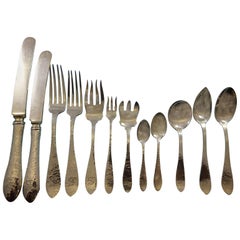
- 100 Piece Hammered Silverware ServiceLocated in NYC, NYCanteen of cutlery in partially hammered silver plated metal composed of 100 pieces: One punch ladle. 12 large spoons. 12 large forks. 12 large knives. Nine dessert spoons. 12 desert forks...Category
Vintage 1950s French Tableware
- Van Dyke By International Sterling Silver Flatware Set Service, S MonoBy International SilverLocated in Big Bend, WI10 Dinner Size Knives, with blunt silverplated blades, 9 7/8" 10 Dinner Size Forks, 7 1/2" 10 Regular Knives, with blunt silverplated blades, 9" 10 Regular Forks, 7" 10 Salad Forks,...Category
Early 20th Century Serving Pieces
MaterialsSterling Silver
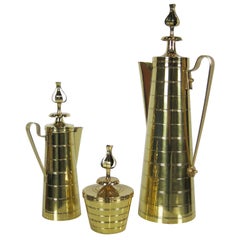
- 3 Piece Brass Coffee Service by Tommi Parzinger for DorlynBy Dorlyn Silversmiths, Tommi ParzingerLocated in Danville, CABrass Coffee Service by Tommi Parziger for Dorlyn Brass. The set consists of a tall lidded carafe, creamer, and lidded sugar bowl. The set has been professionally polished and lacq...Category
Vintage 1950s American Tableware
MaterialsBrass
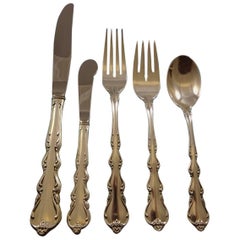
- Angelique by International Sterling Silver Flatware Set 24 Service Lunch Huge!By International SilverLocated in Big Bend, WI24 knives, 9 1/4". 24 forks, 7 1/8". 24 salad forks, 6 1/2". 24 teaspoons, 6". 24 hollow handle butter spreaders, 6 3/8". One gravy ladle, 6 3/8". Two serving spoons, 8 1/2". One pie...Category
Mid-20th Century Tableware
MaterialsSterling Silver
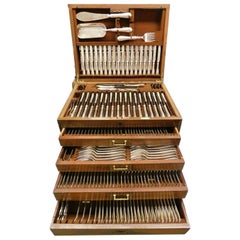
- Acanthus by Mappin & Webb Silverplated Flatware Set Service Dinner 328 PiecesBy Mappin & WebbLocated in Big Bend, WIMappin & Webb is a true British treasure with over 241 years of tradition and historical significance in the world of silver and jewelry. Renowned for combining timeless craftsmanshi...Category
Antique Late 19th Century Tableware
MaterialsSilver Plate
- Brittania by Arthur Price Silverplated Flatware Set Service Dinner 122 PiecesLocated in Big Bend, WIArthur Price is the UK's most desired cutlery brand with a reputation for unparalleled quality, craftsmanship and design since 1902. Outstanding monument...Category
20th Century Tableware
MaterialsSilver Plate
Recently Viewed
View AllMore Ways To Browse
Oyster Spoon
Tiffany And Co Bear
Flatware Service For 24
Antique Fruit Knives
Antique English Silver Serving Spoons
Cream Spoons Antique Silver
Antique Sterling Silver Fish Server
Antique Butter Spreader
Tongs For Ice
Carpenters Chest
Antique Sterling Silver Fish Set
English William And Mary Chest
Antique Serving Tongs
Antique Silver Serving Tongs
17 Century William And Mary
Victorian Bride
Silver Salad Tongs
Sterling Silver Flatware Set Service For 24