| In choosing 10 top antiques at the 58th Winter Antiques Show, which opens on Friday, I was not able even to investigate the offerings of exhibitor Nathan Liverant and Son, a Connecticut dealer known for fine 17th-, 18th- and early 19th-century New England antiques. Arthur Liverant, the third-generation owner and a man of impeccable integrity, said he could no longer help journalists writing previews.
“Inevitably, in the past, one of my collectors would see a piece illustrated in a article and buy it before the show,” he said. “Then I was not able to bring it to the fair, where everything must be for sale, even though I had saved it all year for the show. I’d rather disappoint you and be able to take my best things.”
That’s the kind of thinking that makes me love the WAS.
The Winter Antiques Show benefit preview tomorrow night at the Park Avenue Armory in Manhattan will be my 30th; I have never missed the fair because it is first-rate and full of surprises. You just never know what you will find, but whatever it is, you are guaranteed it is authentic, exactly what the dealer says it is. That’s because 160 (!) experts in 27 categories spend the day before the fair vetting the contents of the 73 dealers’ booths.
Despite the wonderful wealth of offerings from virtually every dealer, I decided to focus on 10 unique works, each chosen for a very particular reason. (For a preview of other treasures being brought by 1stdibs member galleries, click here.)
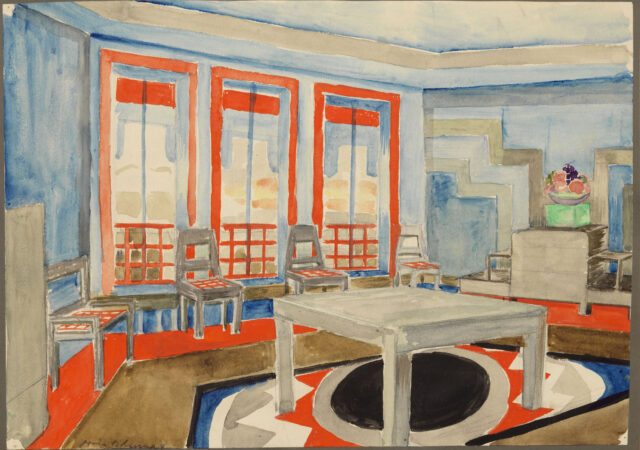
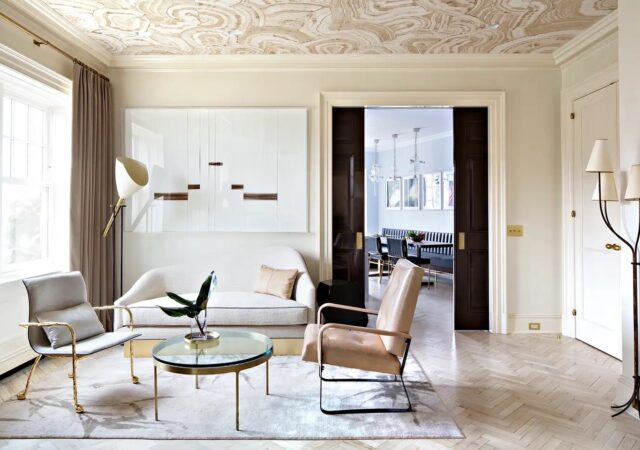
1. MYSTERY. The Art Deco set of furniture designed by Jules Leleu, 1933, at Maison Gerard.
Last year in Paris, Benoist F. Drut and Gerard Widdershoven, owners of the New York gallery Maison Gerard, were able to purchase an important privately owned set of furniture by the renowned French furniture designer Jules Leleu. The set included an armoire, desk and armchair. The lacquered armoire was deemed so exceptional it was exhibited at the Salon des Artistes Decorateurs in 1933, and Leleu featured it in his ads in Art & Decoration.
By reviewing Leleu’s original order book, Maison Gerard discovered the name of the client who commissioned the set but could not determine the artisan responsible for the exceptional lacquer work on the desktop and armoire. “We struggled for six months to find elements that could lead us with certainty to the maker,” Drut says.
They gave up and sent out the desk for restoration, which involved temporarily lifting off the lacquered top. Eureka! On the undersideITALS of the desktop was written “Hamanaka,” the name of an extraordinarily talented Japanese lacquerer who worked in Paris in the 1930s. Katsu Hamanaka may not have been as famous as his contemporary, the lacquerer Jean Dunand, but he was Leleu’s master lacquerer and always highly revered. (Having his name added great value to the set, as well.) Today, 70 years later, we know another secret about Hamanaka. Apparently, he led a double life. It turns out he was also a Paris-based secret agent for Japan. He rushed home only after Japan bombed Pearl Harbor in World War II.
The Leleu set, never before on the market, is of course a major discovery but, beyond that, “It has a bigITALS history,” Drut says.
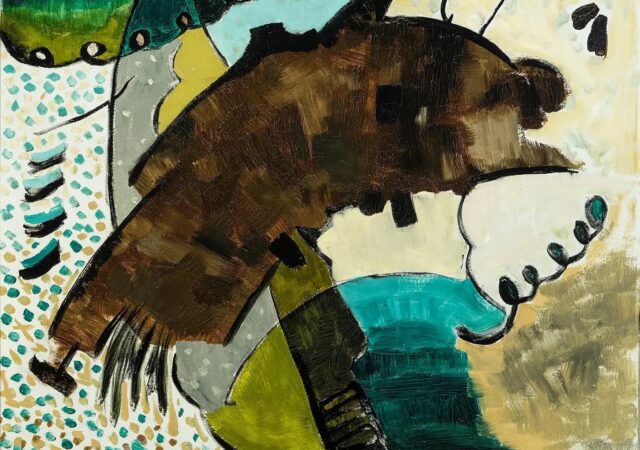
2. RARITY TO MARKET. Berlin Series, No. 1,ITALS 1913, oil on panel, by Marsden Hartley, at Jonathan Boos.
Boos, a Michigan-based picture dealer, is one of six showing at the WAS for the first time, and he is bound to make a splash with this painting. “Marsden painted a series of small modernist pictures with Native American symbols when he was in Berlin before World War I,” Boos says. “He was one of the great American modernists, right at the forefront. He only did four pictures in this series and the other three are in museums.”
3. UNCOMMON CHARM. A bronze recumbent greyhound from England, circa 1920, at Barbara Israel Garden Antiques.
“Greyhounds are a fairly common subject matter for garden sculptures, but normally the dogs are dead serious,” Israel explains. “This one is almost humorous with his slightly arrogant air. He’s very unusual in that his front paws are gently crossed and his tail is looped around his haunches. I love it when garden statues have a little tweak. He could go outdoors, but I can really see him indoors as a foil to a room that is otherwise quite formal.”
4. ROYAL CONNECTIONS. Miniature portrait of Louis-Philippe, Duc d’Orle[accent aigu]ans, (1773-1850), watercolor on ivory, with Versailles inventory number 633, early 1800s, by Jean-Baptiste-Jacques Augustin, royal painter to Louis XVIII, at Elle Shushan.
“On the back of the ormolu frame is the inventory number and the crowned initials “M.A.”, which stand for Marie Ame[accent aigu]lie, the Italian who married Louis-Philippe,” points out Shushan, whose booth has been designed by Ralph Harvard in tribute to a famous 18th-century portrait by Johan Zoffany (currently the subject of a major show at the Yale Center for British Art) of Lord Dundas and his GrandsonITALS). “This miniature came from a descendant of the sitter. It’s usually the Parma part of the family that sells off royal things when they need money.” The portrait is exquisite.
5. FURNITURE AS SCULPTURE. Iconic three-legged stool, oak seat and hickory legs, 1966, by Wharton Esherick, at Moderne Gallery.
Like Shushan, Bob Aibel is based in Philadelphia. He is a longtime specialist in the American Craft and Studio Furniture Movements, whose members included George Nakashima, Sam Maloof and Esherick, “who made more stools than anything, so this is a minor piece, but it’s an icon of his work,” Aibel says. “Esherick carved the oak seat himself; it was really a sculpture in his head.”
6. EASY EXOTICISM. Hot pink Chinese export wallpaper panel lined with Japanese paper, Canton School, ca. 1810-1820, at Carolle Thibaut-Pomerantz.
Paris-based Thibaut-Pomerantz normally specializes in period French wallpapers, but this panel is Chinese. Against a vibrant pink background, colorful pheasants hide in a flowering tree next to a blue (!) scholar’s rock. Weightless butterflies hover above luscious pink, yellow and purple tree peonies. “In its subject matter, it’s very typical of early Chinese Export trade wallpapers,” Thibaut-Pomerantz says. “But it is of such exceptional quality it was included in ‘China Trade in New England: A Connecticut Captain’s Journey,’ a 2005 exhibition at the Bruce Museum of Arts and Science. The concentration of the design and intensity of colors are at the bottom — that’s the way they did it at the beginning of the 19th century — and the top is silvery and vaporous.”
7. TEST THE EXPERTS. A Worcester lozenge-shaped botanical dish, soft paste porcelain, c. 1765, at Michele Beiny.
Beiny, a third-generation, by-appointment New York dealer in Continental and English porcelain, says: “This is not a shape Chelsea ever does, though the design on the plate is a copy of a Chelsea plate by Hans Sloane, with a botanical drawing by Georg Dionysius Ehret.” (Sloane was physician to King George II; Ehret, a German who moved to England, was considered the finest botanical illustrator of the 18th century.) “It’s very rare to get this decoration on Worcester,” Beiny continues. “I don’t know of any other example, nor do my expert friends.” One can guess why Worcester would copy Sir Hans Sloane’s paintings on Chelsea; they are precisely rendered in a rich palette of pinks, purples, greens and lemony yellows.
8. TOTALLY UNEXPECTED. Gilt chrysanthemum hall chair designed by architect/designer Thomas Jeckyll, painted and gilded cast-iron, made by Barnard, Bishop & Barnard in Norwich, England, ca. 1878, at Associated Artists.
Architect David Scott Parker is co-director of this Southport, Connecticut, gallery, which is known for its rare works from the 19th-century English Aesthetic Movement. This chair, with its intricate Anglo-Japanese gilded cloud-and-shell decoration, was first exhibited at the Exposition Universelle in Paris in 1878. “Jeckyll’s designs for furniture were among the first to assimilate Asian sources,” Parker says. “In 1878, critics noted the ‘novelty’ of the decoration and praised it as ‘a feat in casting which had never before been accomplished.’ The chair was cast in one piece!” It would make quite a statement in a garden.
9. THE 360-DEGREE ANTIQUE. Classic three-legged primitive armchair from Carmarthenshire, Wales, oak, ca. 1740, at Robert Young Antiques.
“These chairs are the kinds of things I live for; we love them for their imperfections,” says Young, a longtime London dealer who specializes in English folk art and country furniture. “When they are great, they always give you pleasure aesthetically, 360 degrees around.”
Such chairs were typically made by people who lived in the woods in Wales. “The ‘Bottomer’ made the seat by sawing tree trunks with a pit saw,” Young says. “The ‘Bodger,’ an old-fashioned woodland carver, whittled or turned the sticks on a spring-pole lathe.” Young explains why his chair has only three legs: “So the chair would be steady on uneven stone floors. Four legs never work. This example is remarkable for its physical weight and its semicircular arm, which is called a yoke, like an ox yoke.”
10. THE PLATONIC IDEAL. A chest-on-chest from the Townsend-Goddard School, mahogany, Newport, RI, ca. 1760-1780, at C.L. Prickett.
Pennsylvania-based Prickett has long represented the gold standard in Americana. The gallery is among the most trusted in the country. “This example is the epitome of the Newport chest-on-chest,” says Todd Prickett, a third-generation co-owner. “A rare and outstanding example displaying perfect proportions, original brasses, original flame finials, and a great provenance.” What more could you ask for? The chest-on-chest is a reason to see the WAS all by itself.
| |