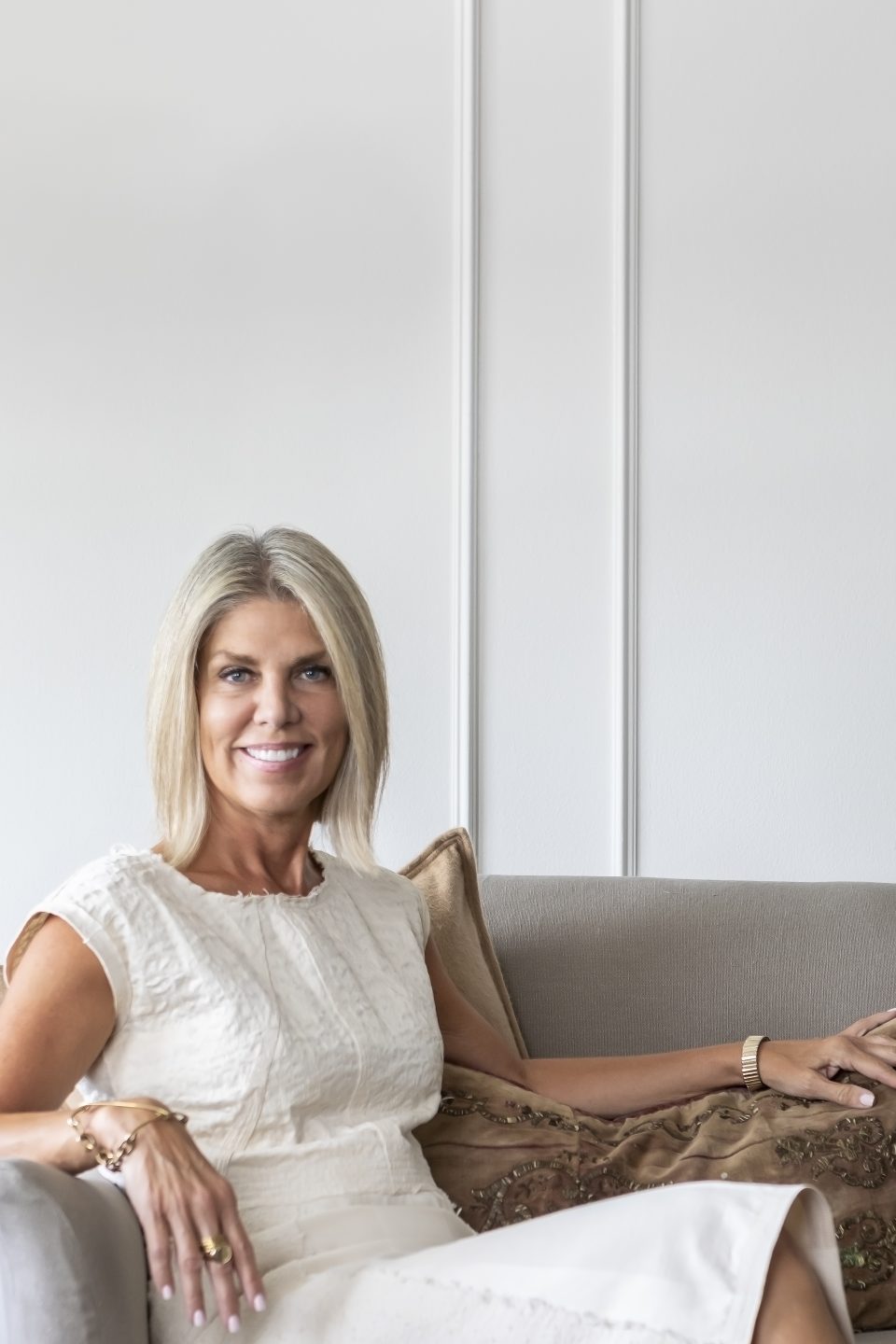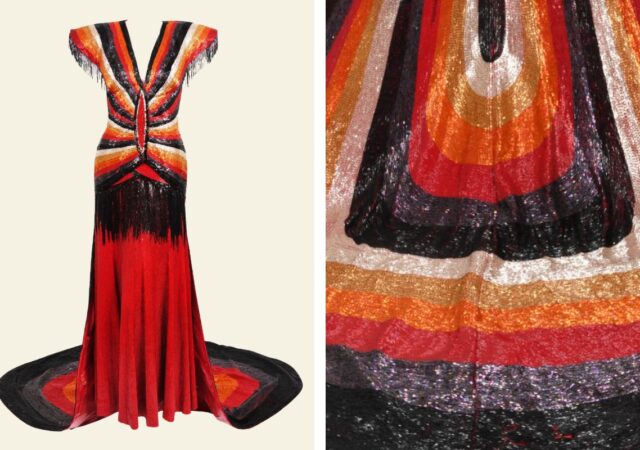
Shop Talk, The Way We Wore Memories indeed resonate after a visit to The Way We Wore on LA’s La Brea Avenue: From impeccable, Belle Époque high-collar gowns to chic rayon ’40s dresses to stacked-heel disco boots and beyond, the store is a veritable space-time fantasy unto itself. “Vintage invades your very soul,” says owner Doris Raymond. “I’m just the vehicle for presenting this wonderful obsession.” Raised in New York City, college-educated in Boston and a for a time holed up San Juan, Puerto Rico, Raymond landed in San Francisco in 1974 and put down stakes. “I was waitressing and I would take my tip money and go to vintage stores and buy anything — dolls, clothing, bookcases, beaded purses,” she says. “Eventually I downsized from a three-bedroom to a studio and had to clear most of it out, so I went to sell at the flea market in Marin and found that I could make money, and that’s where the seed was planted.” In 1981, she says she “gave birth” to The Way We Wore, primarily selling ’50s, ’60s and early ’70s clothing and accessories. “At the time I swore that if polyester ever became considered vintage, I would quit. Fortunately, I have not lived up to my threat — I have some beautiful examples.” Her discerning eye and couture-laden collection soon led her to become a trusted source for costume designers for film, which led to more collecting. She began focusing on higher-end couture pieces, but sometimes had trouble getting their true value across to customers. “I can’t tell you how many times someone would ask how much a gown was, I’d say seven-fifty, and they would hand me a ten-dollar bill.” She juggled costuming for film and the store until 1992, when, she says, “I went underground.” Underground meant closing up shop and focusing exclusively on film and television productions and vintage fashion expos. “The best thing about going underground was that it reduced my overhead tremendously, and I started to invest,” Raymond says. “I went to auctions in New York and started buying up large volumes of beautiful, beautiful things. After 12 years of that, I reached critical mass, and that’s when I decided to move down here.” It was 2004. Raymond put everything she had on the line to make it in LA: She sold her house in Marin County and used the equity to open the store. “It was do or die,” she says. She found a unique space that had originally been a linoleum store (with a true remnant of old LA: brass numbers inlaid into the floor in multiples of three, for precise measuring), and most recently a high-end shoe store, whose owner hung gold fabric in a sunburst pattern from the ceiling, padded the walls in tufted white vinyl and sheathed the stairs in leopard-print carpet. She soon found that in the brand-new, eclectic environment, The Way We Wore “filled a hole in Los Angeles. I had no idea what would happen down here, and we’ve achieved this level of acceptance and respect — it’s profound. LA has been so generous to me in so many ways…” Raymond pauses, to hold back emotion. “I’m so grateful.” She credits her success in part to her right-hand woman, shop manager and vintage expert Sarah Bergman. “Sarah was my guiding light, giving me a roadmap of sorts and helping me figure out what was appropriate for the type of business we were about to embark upon.” Bergman and the other employees, decked out in the best vintage selections and on any given day channeling anyone from Bettie Page to Ali MacGraw, move about the store both industriously and joyfully. One mends a gown and tends the register; another helps a customer, a third arranges jewelry. The elegant landscape at The Way We Wore is unmatched in its presentation of treasures. Downstairs, the dresses are hung in separate racks by decade along one wall, offering a valuable lesson in dress silhouettes from the teens through the ’70s. The floor racks are impeccably styled and arranged by category: vintage skirts, bathing suits, coats and the like, hung together with complementary accessories. A short walk up the leopard-print stairs that narrow as you get closer to the top, producing a blissful state of vertigo, leads to the couture section on the mezzanine, where a dizzying array of more notable shoes (Louboutin blue-velvet stilettos, YSL pumps, hand-stitched cowboy boots) surrounds pristine couture pieces, from beaded, impossibly heavy French ’20s gowns to a purple-and-orange beaded Galanos dress to a small fortune in Pucci. “This is the part of the boutique that makes my heart skip a beat,” says Raymond. Beyond the mezzanine is Raymond’s office, the place that reveals its owner’s more private — and protective — side, with a desk piled with clippings, magazines and receipts, and walls lined with some of the most historically intriguing and culturally diverse pieces. There’s a Schiaparelli ball gown hung near shelves stacked with Callot Soeurs acid-free dress boxes, which once, and likely still, hold some of the finest beaded examples from the noted French fashion house. “There are some nice things in those boxes,” Raymond says with a sigh, before turning her attention to a white embroidered peasant blouse from the 1960s. “Kate Hudson wore this in Almost Famous (ITALICS),” she remembers. “In the scene where she’s dancing onstage to Cat Stevens.” She then extracts a pink macramé A-line minidress that she recalls was worn in Apollo 13 (ITALICS), another in a long line of film productions Raymond has sold or rented costumes to (Age of Innocence, Austin Powers, Chaplin, Forrest Gump, O Brother, Where Art Thou?, Titanic… ALL ITALICS). Like so many dedicated collectors, Raymond has a near-photographic memory of each item’s provenance, or at least its recent history. There’s the Sonia Delaunay hand-stitched geometric Deco hat and scarf Raymond says she found 15 years ago and spent two years researching before verifying it through Delaunay’s grandson. There’s a formidable collection of highly collectible Vivienne Westwood pieces: “A knit dress from the Buffalo Gal collection, a few items from the Boulle collection and some pieces from the Seditionary collection.” She then reveals a punk rock pièce de résistance: one of Malcolm McClaren’s own T-shirts from the late ’70s, white with the arms cut low and the front bearing the image of a criminal, a motif he repeated in later designs with Westwood. Of course, Raymond has the backstory: “I got it from [fashion designer] Jean-Charles de Castelbajac’s [JC/DC’s] ex-wife. I believe Ms. Westwood and McClaren lived with JC/DC in the early days.” Next door, locked behind a protective iron front gate, is the shop’s closet, of sorts. This space allows Raymond to thrive in another important aspect of her business: It is where she keeps her stock of fabrics, decades-old pattern books, accessories, clothing, shoes, beads, baubles and books, all to inspire fashion designers. “A great deal of my business comes from fashion houses seeking inspiration from the silhouettes of the past,” says Raymond, who sells patterns to names such as Marc Jacobs, Maison Martin Margiela and Louis Vuitton. “The application of vintage in the fashion world is massive,” she says. “It’s inspiration for their next line.” “There’s also the everyday person that walks in the door,” says Raymond. “We get everyone from a 13 year old who knows her own personal style to an octogenarian who is an artist at heart and wants to express herself with unique clothing. And then there are the celebrities.” The list is massive and includes Angelina Jolie, Victoria Beckham, Katie Holmes, Scarlett Johansson, Sienna Miller (“We’re her favorite vintage store”) and Debi Mazar, “in head to toe The Way We Wore at this year’s Oscar parties.” Raymond’s intention, for plebeian or celebrity alike, is to “provide a warm, welcoming, awe-inspiring place. Of course we’re a business, but it’s not just about money — it’s about providing people with inspiration.”
1stdibs.com Inc. © 2001 - 2012