May 3, 2026Róisín Lafferty is no stranger to contemporary design. Dominating one end of her year-old, by-appointment-only design gallery in Dublin is a table consisting of a beachball-size sphere of Acquasanta, a spectacularly veined pink-and-gray marble, supporting a thin slab of the same material. Designed by Lafferty and produced in a limited edition, it’s so futuristic that it makes its companions in the showroom — a 1990s Medusa vase by the great Gaetano Pesce and an Alpha Chair by Made in Ratio — seem practically old-fashioned.
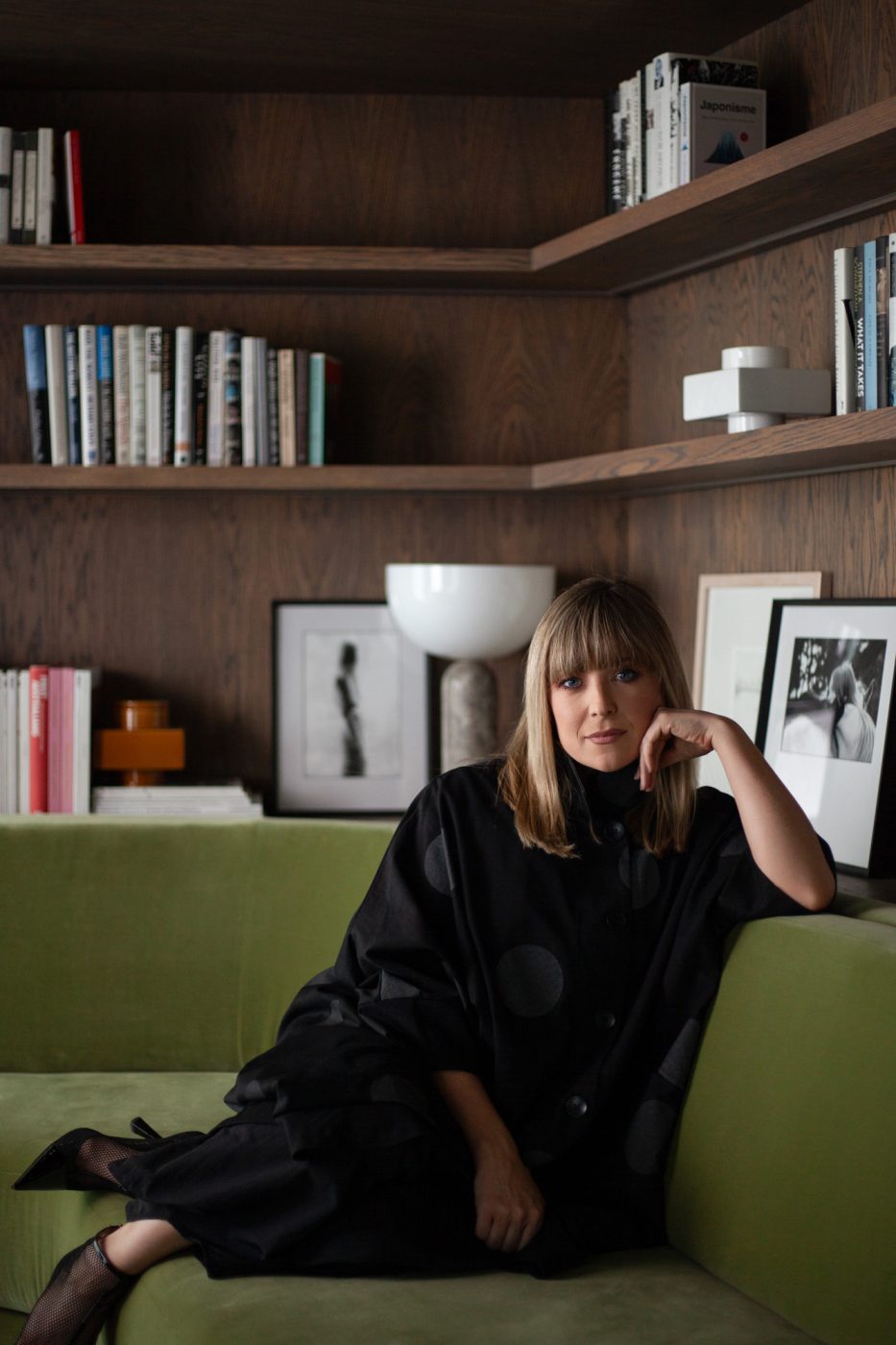
Through the gallery — which just launched its 1stDibs storefront — as well as her booming interiors business, Lafferty has helped bring the Dublin design world into the 21st century. Her extensive portfolio of projects includes one contemporary interior after another. So, the residence outside the city that she recently enlarged and renovated for a pair of longtime clients comes as something of a surprise: On the outside, the almost 200-year-old structure is a classic Georgian manor house, symmetrical and generously proportioned.
Inside, carved-marble fireplaces and all manner of millwork create interiors that would have pleased any of the 18th- or 19th-century King Georges. It’s only natural to ask Lafferty what drew her to this history-drenched project.
First, the designer responds, she’s always glad to do the opposite of whatever she did last, and tackling a traditional house was “a way to keep things interesting.”
Second, her clients, who entertain often, asked her to add a modern great room to the house — one with enough glass to be called an orangery. “They wanted the new wing to be different from the rest of the house, so there’d be a reason to go there,” Lafferty says. She complied, working with architect Kevin Coughlan to create a light-filled space with unornamented white walls and a heroically scaled fireplace.
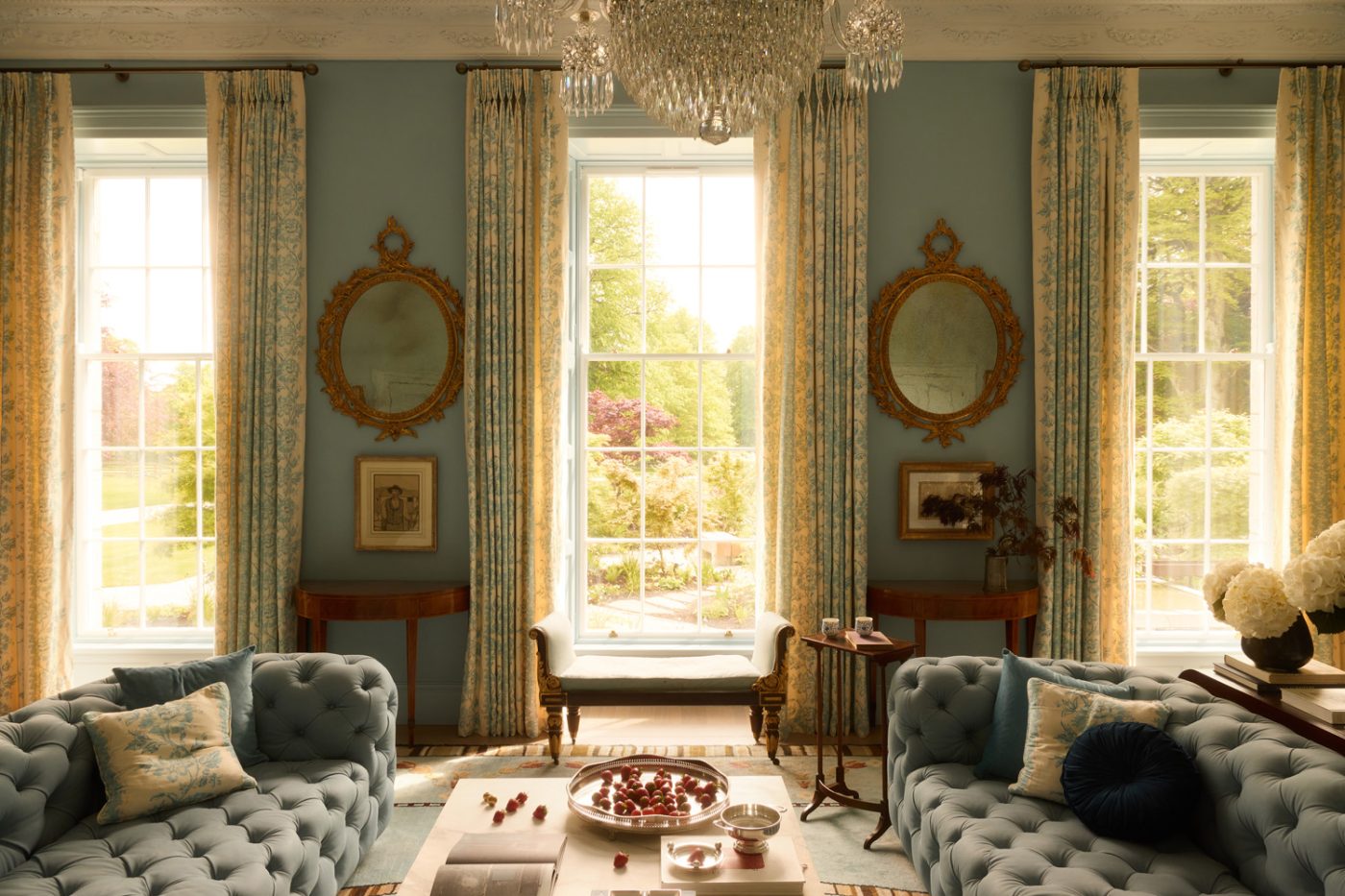
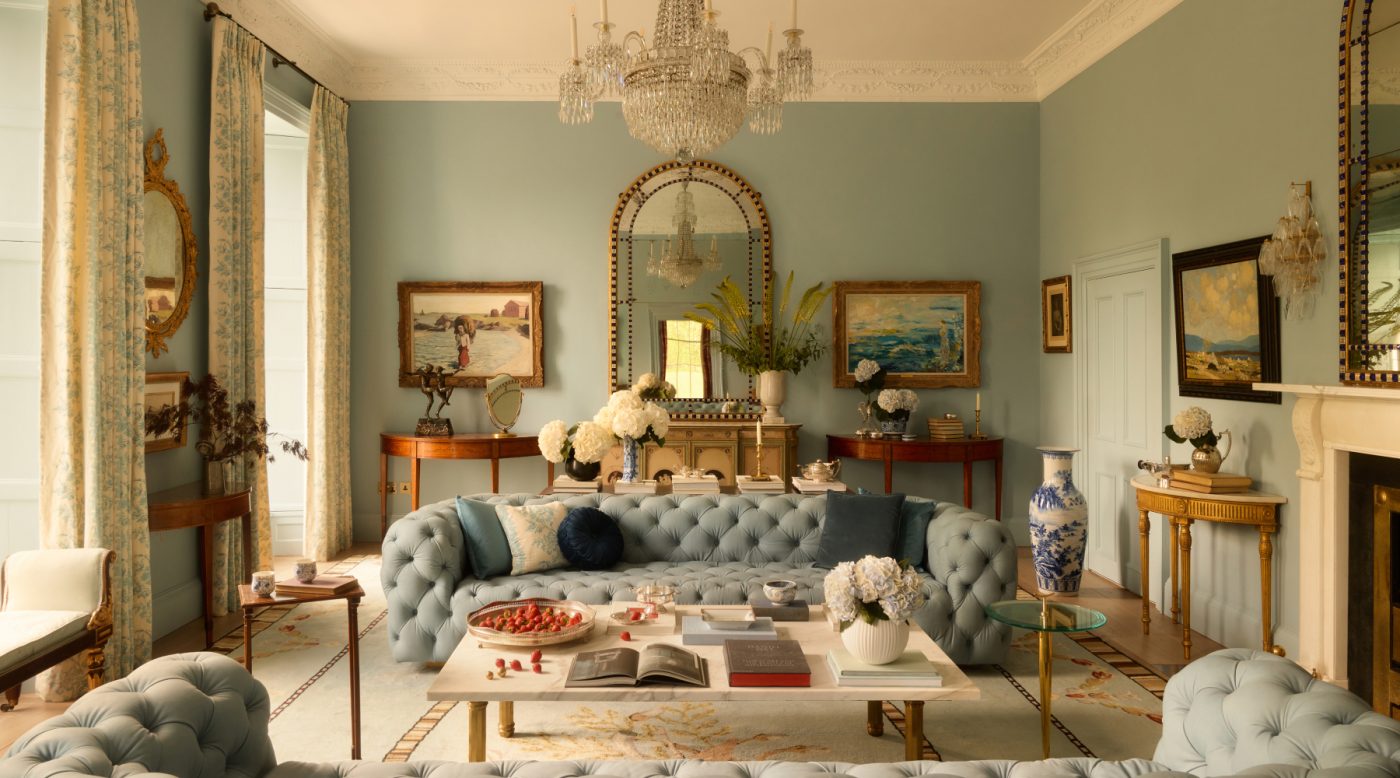
Third, even the most emphatically Georgian rooms in the house allowed Lafferty a little stylistic leeway. Take the large parlor at the heart of the old building. It has always been Wedgwood blue, and Lafferty wasn’t going to change that. Nor was she going to replace the original carpets and drapes; instead, she found experts to restore them.
Within this traditional envelope, however, Lafferty deployed a mix of antiques, some of which belonged to her clients, and newer pieces, including chesterfield-style sofas with decidedly modern proportions and a 1960s brass-and-glass coffee table from 1stDibs. Considered as a whole, it’s not your grandmother’s living room. Rather, Lafferty says, “it’s a modern living room with all the best things that your grandmother collected.”
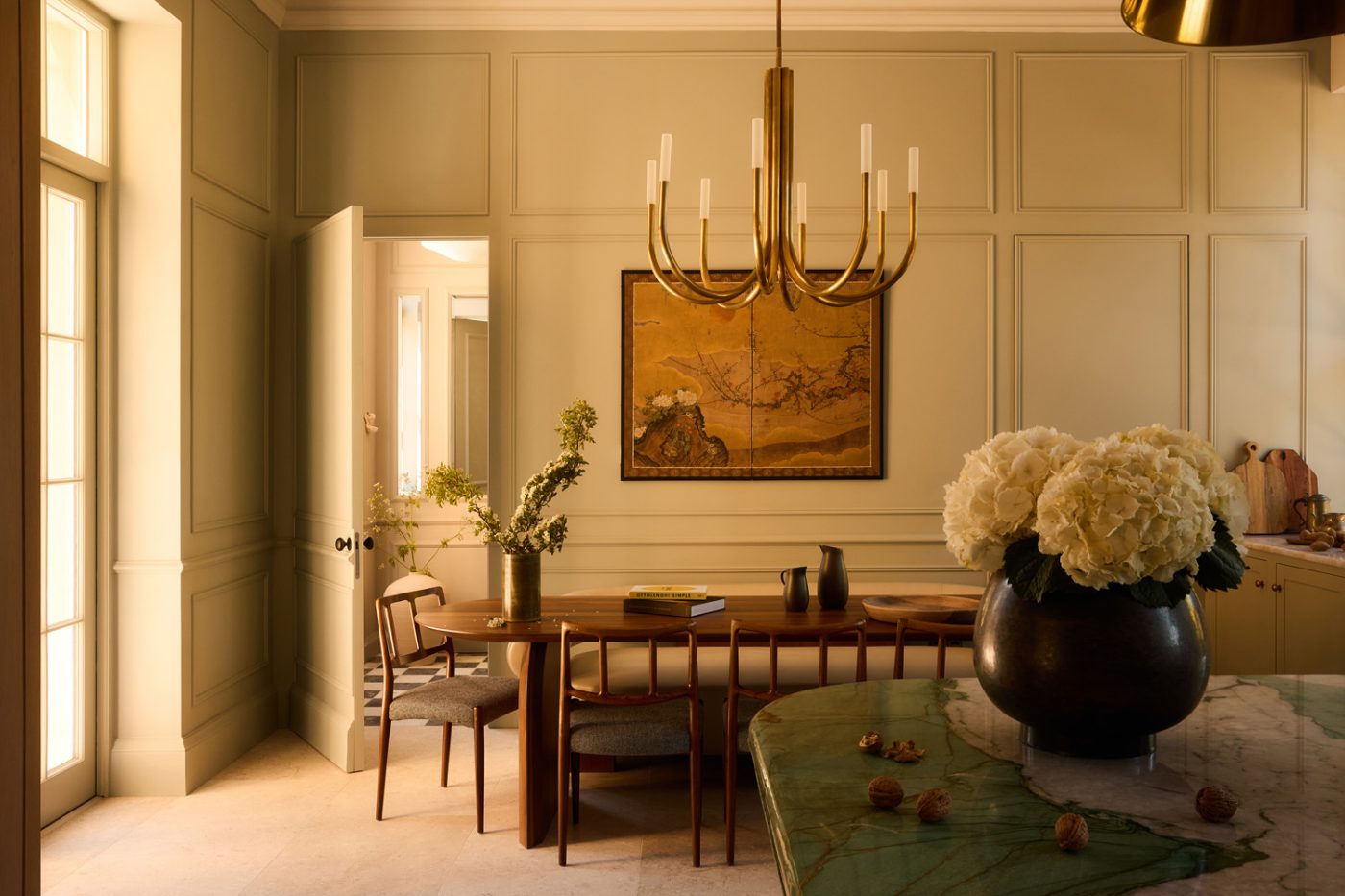
Then there’s the kitchen. It features a new but classic AGA range — resisting association with any style but its own — and cabinetry with enough variation to suggest that the room developed over time. A large island, with a top of heavily veined Tiffany quartzite, separates the cooking area from the family dining area. There, a circa 1880 Japanese screen, of mulberry paper adorned with mineral pigments and gold leaf, plus reupholstered rosewood dining chairs by Danish modern designer Johannes Andersen ensure that the room isn’t “too twee, too country kitchen,” Lafferty says.
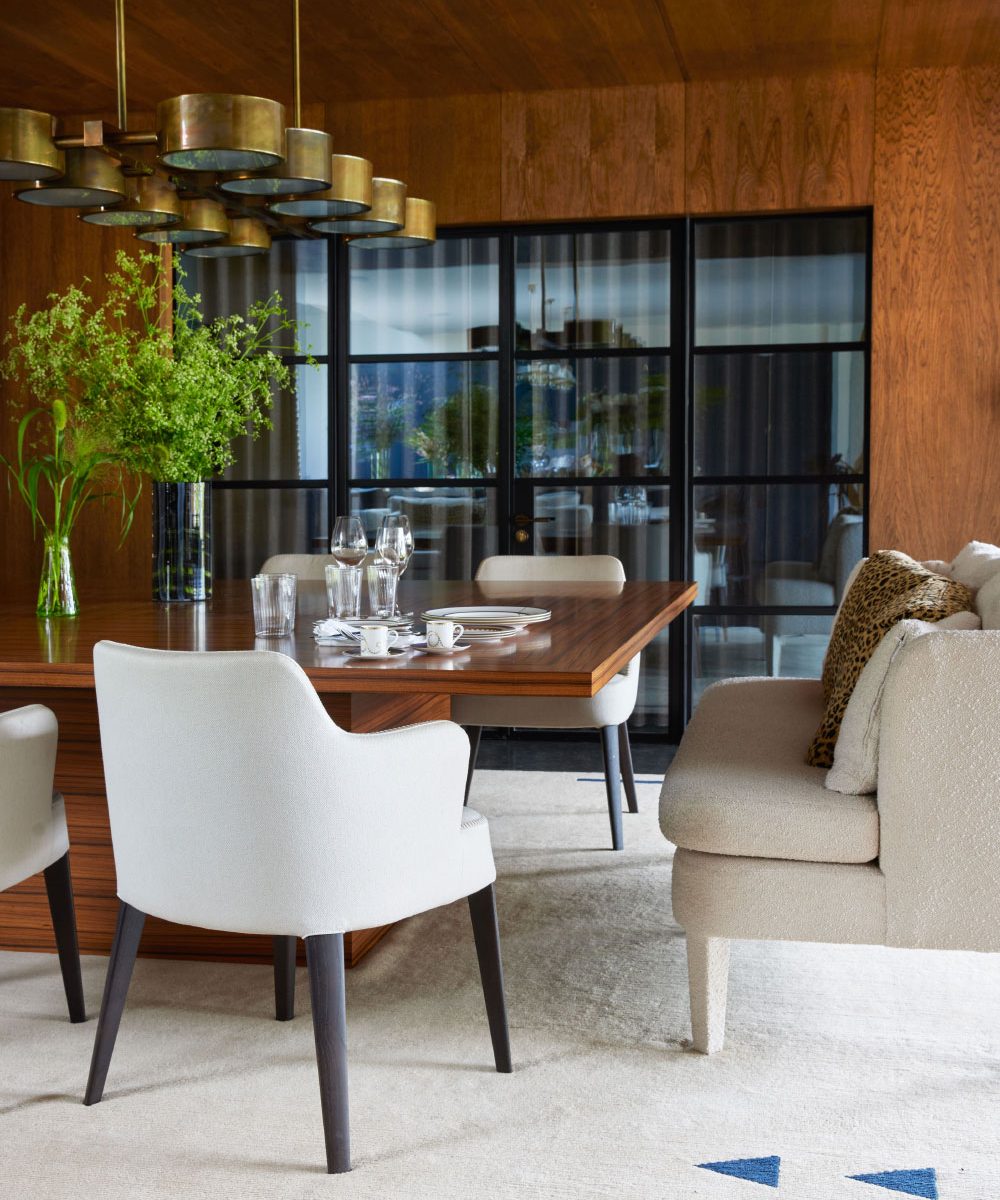
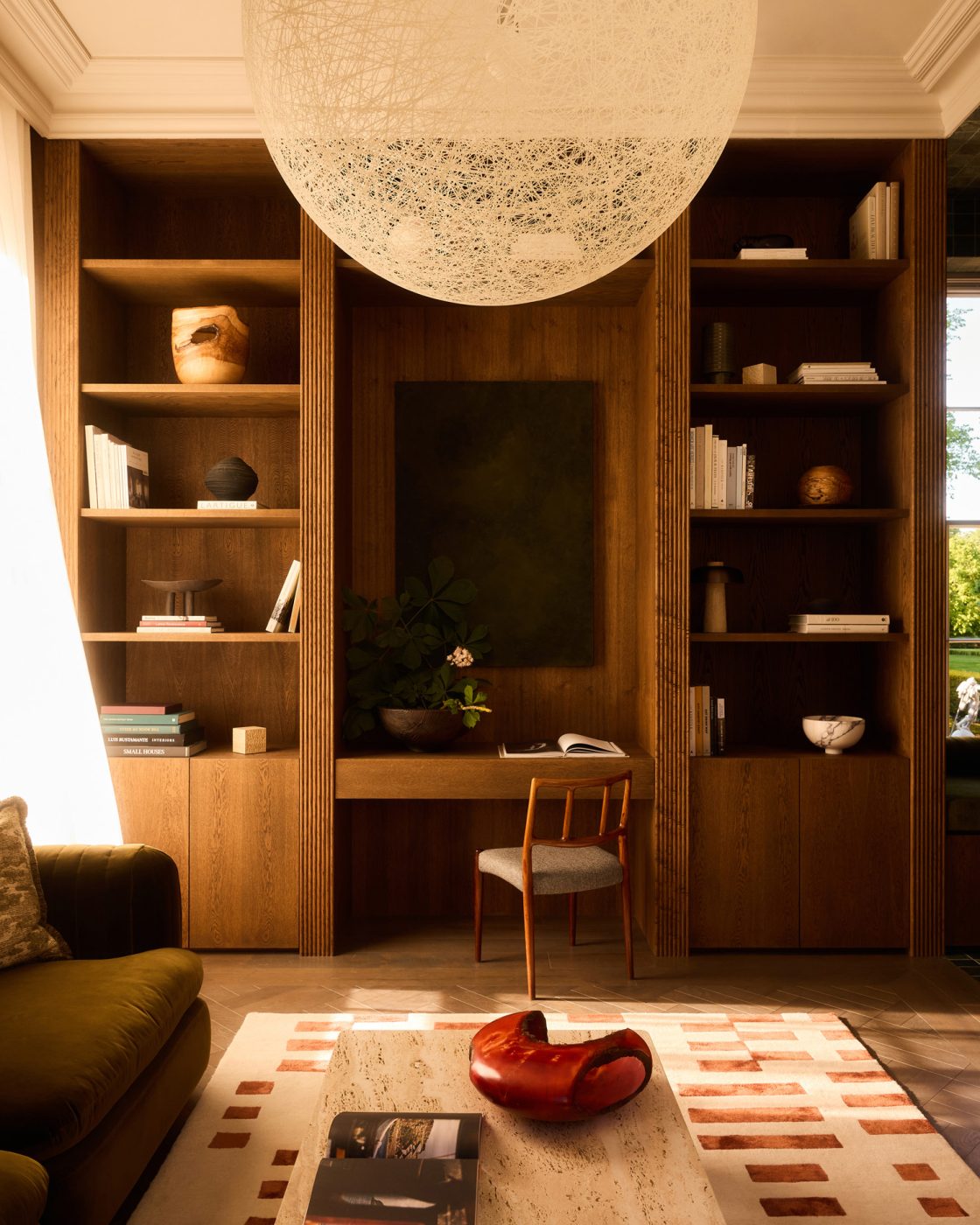
Behind the family dining table is a secret door, camouflaged by the paneling around it. It leads to a hidden room, where Lafferty’s clients — and their children and grandchildren — can curl up and watch TV or jam on their guitars. The decor is strictly modern, mostly light-wood built-ins with just a bit of fluting. Overhead, a spherical carbon-fiber light fixture, by Bertjan Pot for Moooi, is definitely present tense.
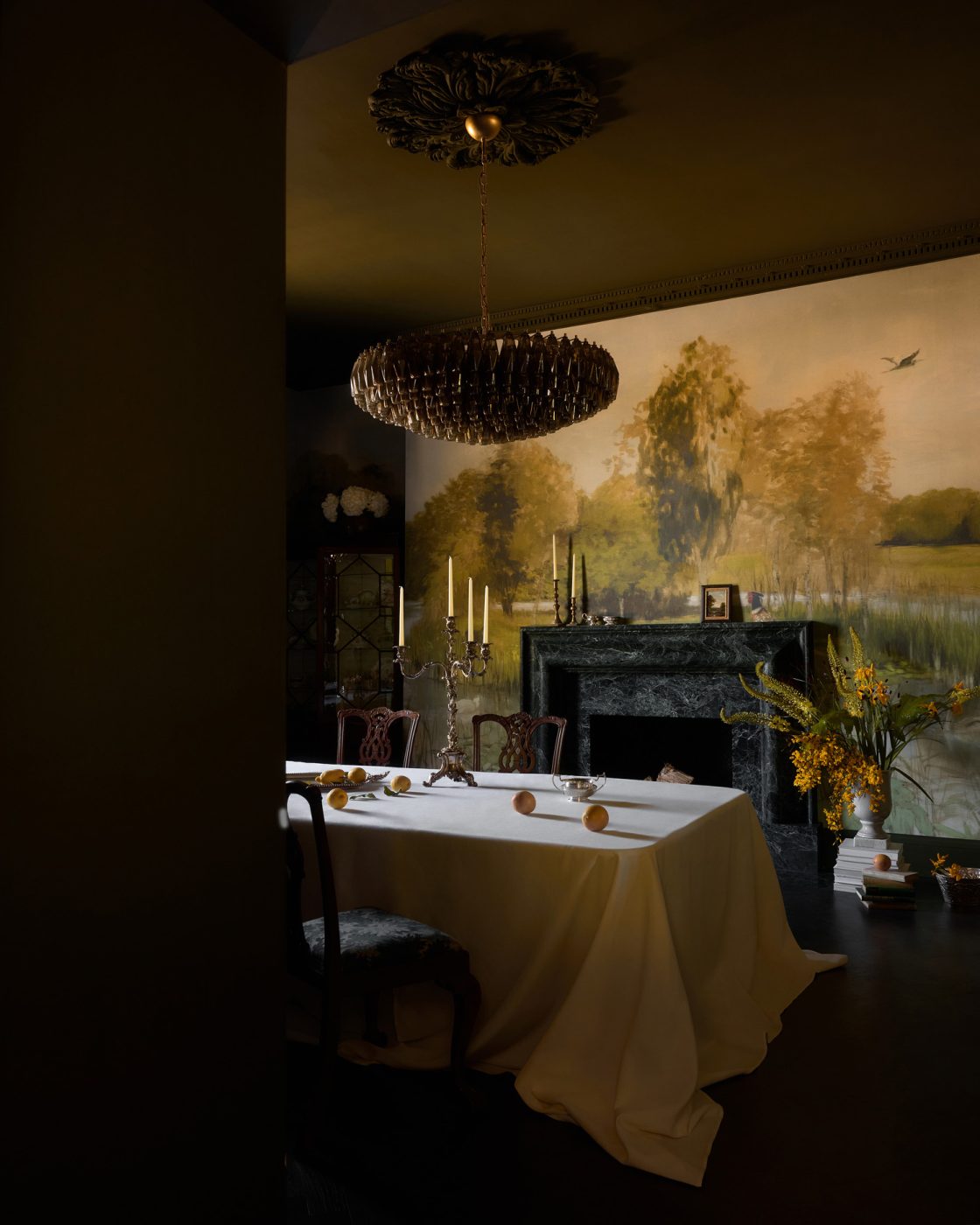
As if for balance, the other end of the kitchen leads to a very formal dining room, where Lafferty really exercised her decorative-arts chops: She commissioned Italian artist Elena Carozzi to paint murals based on the rich flora and fauna of the surrounding acreage. Then, she had the ceiling painted a green that’s almost black. “I love that it’s so dark,” she says, calling the room “deliberately dramatic.”
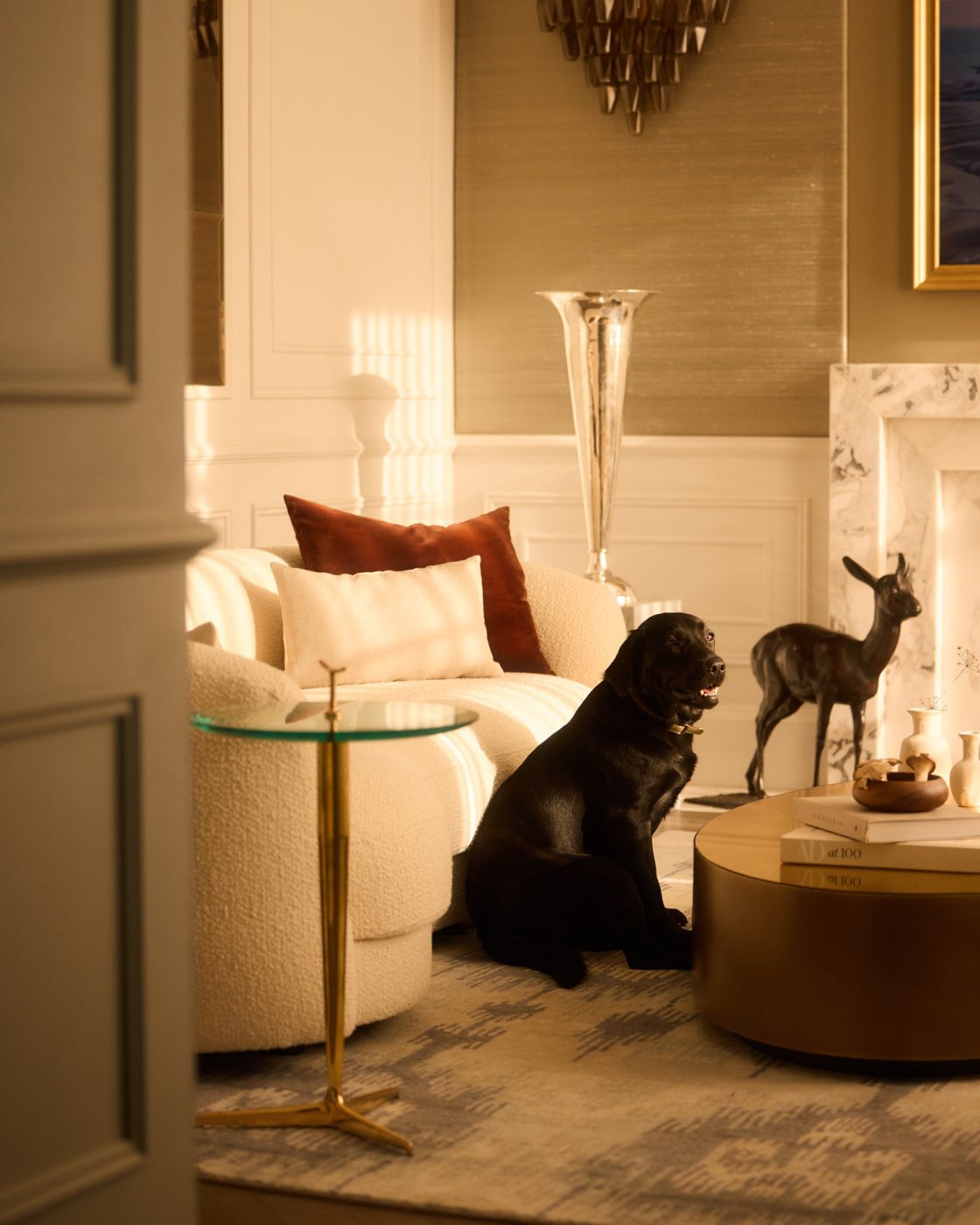
Next to the dining room is a lounge whose silk-paneled walls surround a contemporary fireplace, designed by Lafferty and popular with the family dog, who enjoys the companionship of a cast-bronze antelope nearby. Lafferty is particularly fond of the tiny circa 1950 brass tables, by Giuseppe Ostuni, which can be picked up and carried around. This, Lafferty says, is where the clients have their morning coffee. They wake up to a stylistic melange, which is just what she intended.
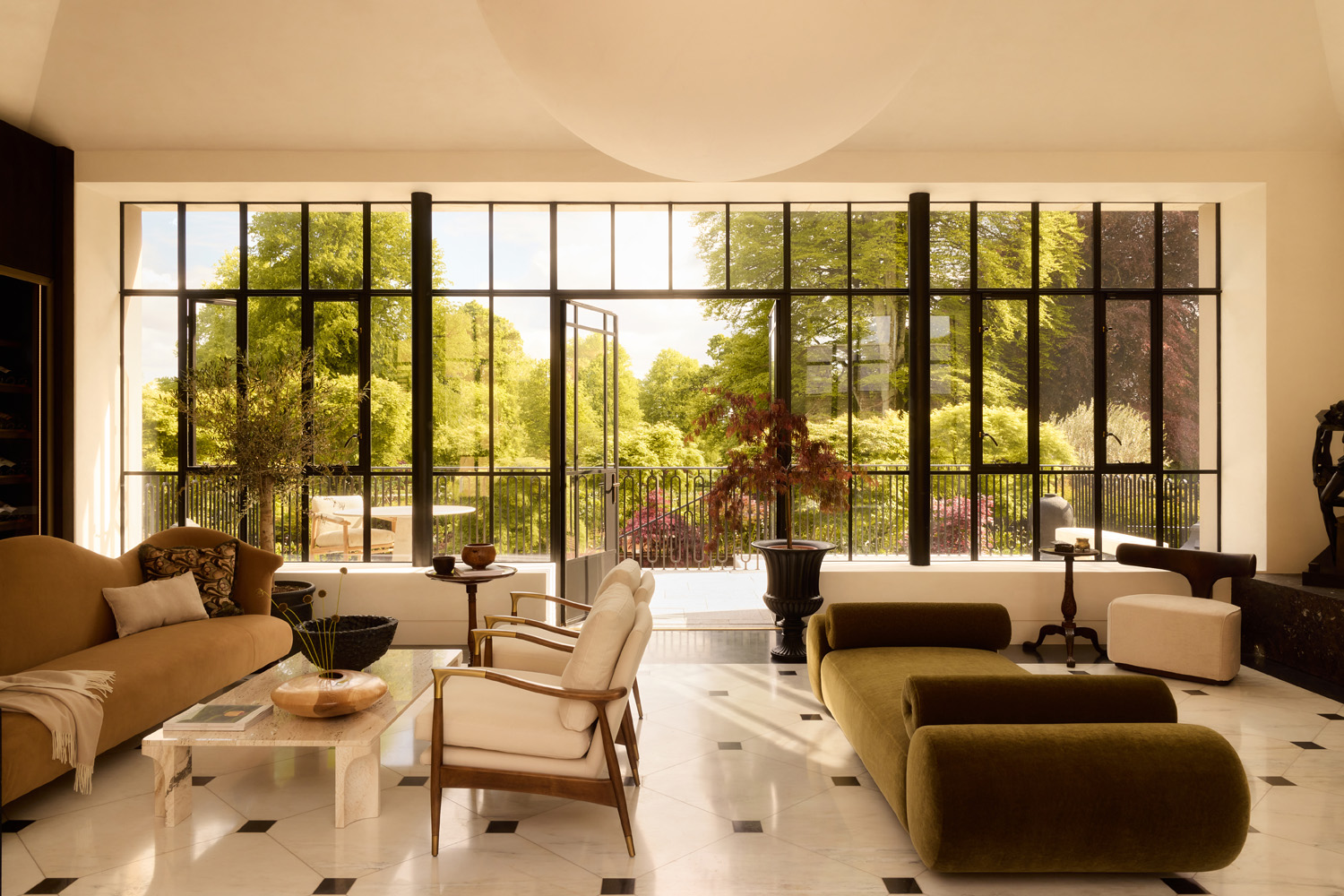
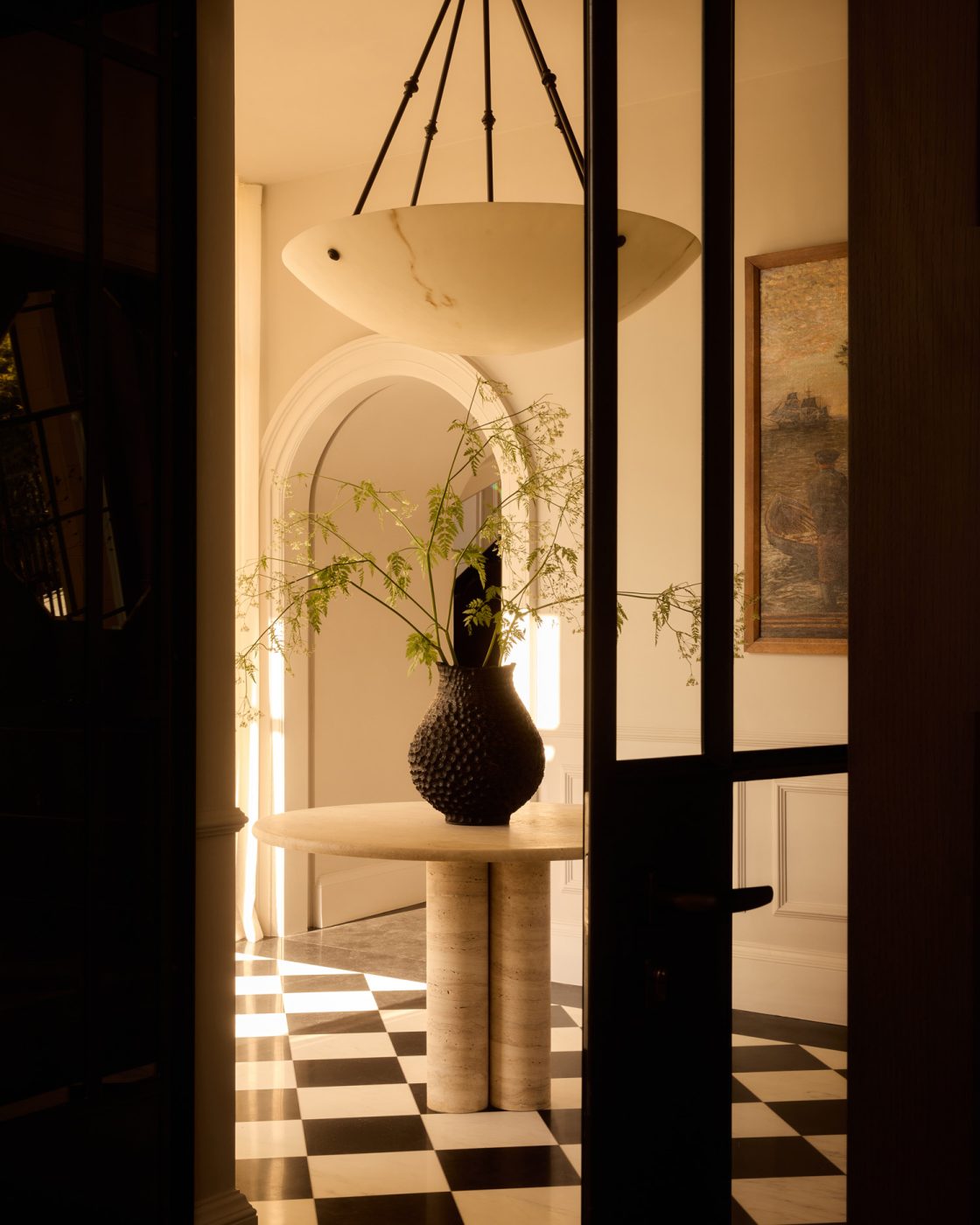
Beyond those rooms is a lobby from which one can enter the old or new parts of the house. To furnish it, Lafferty says, “we wanted one monumental piece, because it’s a very large room.” She found just what she needed — a 1930s rosewood sideboard with brass and Lucite handles — on 1stDibs. In the adjacent orangery, where the furnishings skew modern, a pendant six feet in diameter, by Davide Groppi, and a Doric travertine coffee table by GamFratesi, purchased on 1stDibs, respond to the scale of the space. Morelato’s Moby Dick chairs, so-named because of their whale-tail-shaped backs, are a far cry from the traditional furniture in some of the other rooms. Overall, Lafferty says, the house is “a dance of old and new.”
The same could be said of her career. Dublin-born, Lafferty studied interior design there and in London, graduating in 2009 into “a full-on recession,” she recalls. “There were no jobs at all.” So, she founded her own firm and spent three years working on the gut renovation and redesign of a large country house. “I never anticipated working for myself to start with,” she says. But the project was a success, and her business started growing.
She now has two dozen employees working above the Roísín Lafferty Gallery. And these days, she says, she’s able to choose the projects she takes on. They range from London and Dublin flats to a pair of beauty salons in the Middle East that are so futuristic they look like they could be on Mars. She has also designed a complement of “woodland suites” — she calls them treehouses — for the chic Montenotte urban resort, in County Cork.
“Creativity,” Lafferty says, “is just the only thing for me.”