
September 20, 2026Even top-notch interior designers sometimes lose out on a coveted commission.
About 20 years ago, Joan Craig relocated from New York, where she had an established firm, to Chicago, where her husband, architect Peter Ruggiero, had been made a partner at Skidmore, Owings & Merrill (SOM). She was still finding her bearings when she had what she recalls as a “wonderful” interview for the renovation of a prime Lake Shore Drive apartment. Alas, the owners went with someone else.
“I was crestfallen,” Craig says.
Making the loss even more disappointing was the fact that the property was in a stately prewar limestone high-rise designed by Rosario Candela — the only building in Chicago by the famed New York architect.
Then, several years later, the one that got away suddenly reappeared. The owners asked Craig if she’d be interested in helping them rethink the apartment for the next chapter in their lives. For Craig, it was an easy yes.
Unlike most projects, which have clear finish lines, the Gold Coast home is constantly evolving, responding both to the owners’ changing lifestyle and to their growing collection of works on paper by Henri de Toulouse-Lautrec and his contemporaries. Roughly 15 years on, Craig has completed several other homes in the Candela building, as well as its fitness center, but she continues to update the elegant rooms in this apartment to suit the clients’ latest needs.
The formal dining room is a perfect example of her approach. The couple still enjoyed entertaining, but they realized they felt lost when just the two of them ate at the large table. To create a more intimate setting for dining à deux, Craig added a much more diminutive, round stone-top table, placing it beside a trio of windows with an expansive view of Lake Michigan.


Craig says she’d tucked the idea away years ago, when she was in her 20s and working at Sotheby’s in New York. “One of my colleague’s parents had this very grand apartment on East End Avenue,” she recalls. “They had this long table — it seemed to go on forever — and then they had this little table by the window overlooking the water, and I thought, ‘I want to do that sometime.’ ”
Craig’s sensitivity to how people inhabit spaces took root even earlier. Beginning when she was seven years old, her family spent every weekend searching for their dream house outside Philadelphia. “Our real estate broker should be canonized,” she says with a laugh. “[My family] talked a lot about what makes a good family home — that was Sunday dinner every week. This went on for years.”
Her mom also took her to country auctions. “She always gave me a few bucks to buy something,” Craig recalls. “I had more broken cuckoo clocks, I think, than anybody else.”


When Craig was 14 and had spent half her life house hunting, her family finally moved into a new home — a small Quaker townhouse that her parents, much to her chagrin, did not take her design advice for. She left a few years later for Wesleyan University, in Connecticut, where she studied the history of art and architecture. Upon graduating, she landed a spot in Sotheby’s three-year training course, after which she worked in the house’s American-paintings department.
“It really gave me great exposure to decorative arts,” she says. But to fully satisfy her design bug, she decided to go to architecture school at Princeton, and, degree in hand, took a job at SOM, where she sat at the desk next to her future husband.
Eventually, her interest in the interplay between architecture and interior design led her to found her own firm, Craig & Company, which now has offices in both Chicago and New York and does everything from new-build homes to hospitality projects. Her first monograph, On Artistry: Architecture and Interiors, just published by Rizzoli, features this apartment among many other spaces Craig has thoughtuflly designed. (It also features a plethora of sidebars on the talented artisans and craftspeople her firm relies upon to truly customize each home.)
Craig also frequently flexes her art history muscle by advising clients on their collections. Although the Candela couple have long acquired Toulouse-Lautrec sketches, lithographs and posters independently, they rely on Craig to handle framing and installation. “Often, an entire wall [of art] will come down given a new purchase, and we’ll rescramble and reorient things,” she says.

Toulouse-Lautrec — and La Belle Époque more generally — have also informed some of Craig’s design gestures. In a guest bedroom, for instance, the curtains, ceramics and throw pillow all pick up the blue hues of an 1896 Paul Berthon poster for the Folies Bergère.
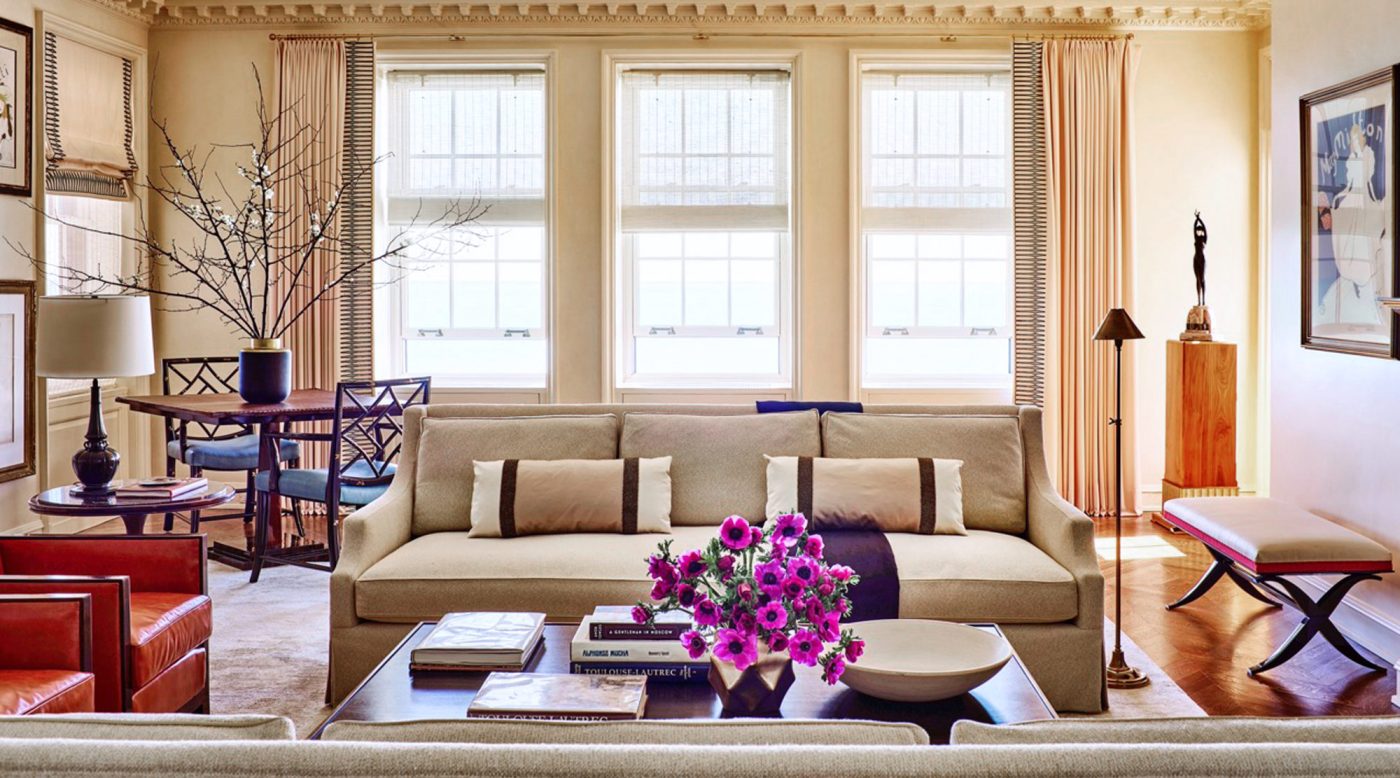
In the living room, the work of early-20th-century sculptor, furniture maker and interior designer Armand-Albert Rateau inspired a pair of round wooden side tables Craig commissioned with intricately carved pedestals and bases. These bookend two low-slung lounge chairs from the clients’ collection that Craig reupholstered in a rusty-orange leather. Twin clean-lined sofas in a cream-colored Holly Hunt fabric complete the seating area.

In a corner by the windows, Craig placed vintage Dessin Fournir chairs with delicate butterflies painted on their arms. She teamed them with a custom games table by artisan Michele Costello, who, taking cues from the clients’ art collection, tooled Art Nouveau–style motifs into its leather top.


The clients wanted to lighten the mood of the adjoining dining room — to make it “crisper and fresher and more modern,” Craig says — so she reupholstered the chairs in white leather with contrasting tweed backs, replaced the gold-and-ocher Fortuny fabric on the walls with white and ivory paint and lacquered the ceiling white to take advantage of the sunshine glinting off the lake. “They were sanding for I don’t know how many months — it was many, many coats,” the designer recalls. “But it looks beautiful, and I love the way it extends the height of the room and very softly reflects the artwork.”
In place of a dripping crystal chandelier, Craig installed a Roman Thomas fixture with a more modern sensibility. But mindful that the dining room should not look as if it had alighted from a wholly different apartment, she anchored it with four vintage posters that had hung in the living room. “That very much established the gestalt of the room,” she says, “and tied the rooms together.”
Centered between two of the artworks is a French marquetry mirror, which she describes as creating a “lyrical” connection between the dining and living rooms. Discovering it on 1stDibs, she notes, was as satisfying as inserting “the last piece into a puzzle.”
Craig quickly corrects herself: “I mean, not that we’re finished. We just installed a carpet” — referring to an Art Nouveau rug in the living room. “As their lives continue to change and they see new things they want to take on, we’re right there.”