
June 9, 2026In the 2015 Nancy Meyers movie The Intern, Anne Hathaway plays a fashion executive living in the Park Slope neighborhood of Brooklyn. Her home kitchen typified the industrial chic style then at its zenith: apothecary-style drawer pulls, open shelving on steel brackets, a commercial-grade range, white subway tile, ribbed-glass factory-like pendants.
Today, we have a broad range of styles, of which the industrial exposed-appliance look is merely one. For nearly 130 years, the storied German appliance manufacturer Miele — founded by engineer Carl Miele and businessman Reinhard Zinkann, whose descendants still own the company — has responded to consumers’ evolving tastes and lifestyles. Regardless of style, the products have consistently offered durability, performance, ease of use, energy efficiency and style. “Every design decision stems from a single founding principle: immer besser, or ‘forever better,’ ” says Søren Rye, president and CEO for Miele USA and Mexico. “This means that every product we release must be measurably better than what came before it.”

So, what do consumers want in a kitchen today? “People have gotten away from the industrial look and want it to feel more residential,” says the noted San Francisco interior designer Jay Jeffers, part of a coterie of industry-leading designers, known as Miele Masters, who champion the brand by highlighting it in their projects, social content and local showroom programming, as well as by representing Miele at key industry events. “It’s not just about the function. A lot of kitchens are open to family rooms, living rooms and other spaces. I like for them to bleed into those. They are more visually integrated and don’t scream ‘kitchen!’ ”
“When you look at a Miele appliance, you understand it intuitively, without reading a manual.”
The panel-ready versatility of Miele products enables designers like Jeffers and New York–based Adam Charlap Hyman, of Charlap Hyman & Herrero, to achieve this stealth look. “We almost always specify Miele dishwashers in our projects, among other Miele products,” Charlap Hyman says. “Aside from their performance, they can be seamlessly integrated into the cabinetry. We specified one for a modernist kitchen we recently designed, concealing it within the simple, geometric paneled cabinetry, which consisted of all different colors of painted wood. We were even able to use a clever installation method that hid the grate underneath, allowing us to preserve our colorful composition for this prominent elevation of the kitchen.”

According to another Miele Master, the Los Angeles–based Luis Fernandez, a further trend that has transformed kitchen-appliance design and innovation is the movement toward healthier cooking techniques, like sous vide and steaming. “Miele is a leader in kitchens, and they have been consistently developing products,” Fernandez says. “Now, they have a combi-steam oven, which is about healthier living and wellness. It’s more about water and less about oil.”
Here, we look at a quartet of kitchens designed by Miele Masters that show the vast array of styles into which the brand’s appliances can be integrated.
KITCHEN AS WORK OF ART
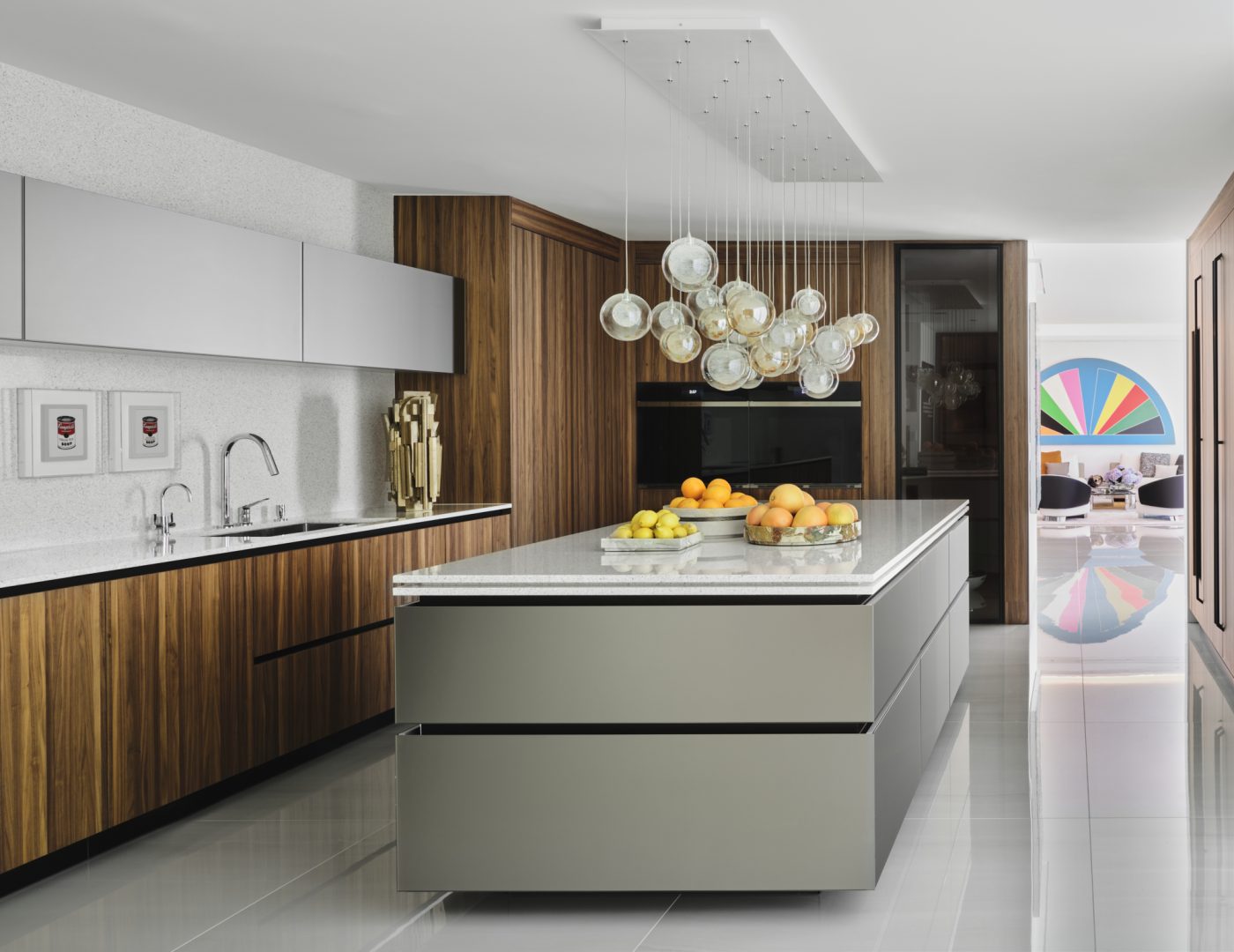
Miami-based Tamara Feldman created this Aventura, Florida, high-rise kitchen for Alan and Janice Lipton, founders of the Institute of Contemporary Art, Miami. Collectors themselves, they display in their residence works by, among others, Josef Albers, Dan Flavin, Donald Judd, Anish Kapoor, Yayoi Kusama, Roy Lichtenstein and Ugo Rondinone.

This collection inspired Feldman’s kitchen design. It had to be, she says, “an art form in itself.” All the appliances are Miele: refrigerator, ovens, stove, dishwasher, wine column. But to avoid distracting from the artworks, Feldman swathed the Eggersmann bespoke cabinetry and most appliances in walnut veneer. “The walnut brings warmth and richness but allows the art to be prominent,” she says. It is the perfect foil, as it happens, for the kitchen’s tabletop Louise Nevelson sculpture and two Campbell’s Soup works by Richard Pettibone.
The island and upper cabinetry are reverse-painted bronze-colored glass, which balances the veneer and complements the sleekness of the appliances that remain exposed, like the side-by-side Miele ovens (whose minimalist black-glass facades seem, in this environment, to reference Ad Reinhardt’s abstract black, or “ultimate,” paintings). Countertops are terrazzo, and floors are wide-format Onici marble–effect porcelain tile. The combination matches the high caliber of the art while being restrained enough not to fight for attention. From the kitchen, one can admire the living room’s large Frank Stella work mounted over a Minotti sofa and chairs, framed by expanses of luxurious walnut.
There is function to spare. Feldman cites the Miele dishwasher, which, she notes, “leaves not a spot on the glasses,” and enthuses over “Miele’s stovetop, which, because it’s frameless, transitions with other materials in a seamless way.” She also praises the firm’s appliances more generally, declaring that “they’re all user friendly.”
Another word for “user friendly” might be intuitive, which speaks directly to the priority Miele accords to clarity. “The instinct in product design is often to add more features, and more visual complexity as a signal of capability,” says CEO Rye. “At Miele, we do the opposite. Our design philosophy calls for a strikingly clear aesthetic with no distracting features and absolutely no complicated controls.”
REIMAGINED MID-CENTURY MODERN

When Fernandez purchased this 1962 Los Angeles house by architects Peter Kamnitzer and Donald Aris Pearl, his goal, he says, was to maintain “the connection with nature that was so important to mid-century modern design.” This necessitated a complete kitchen gut. Fernandez didn’t want to expose the kitchen to other rooms but did want to open the view to the back gardens. A wall of Henrybuilt cabinets that accommodates the sink and a Miele dishwasher and freezer column now frames a large opening through which he can take in the verdant landscape beyond.


When it comes to appliances, Fernandez’s first choice is always Miele. Although he finds many of their products suitable for display (“I personally love their in-wall coffee machine,” he says. “It’s functional, but it also looks great on a wall”), he, like Feldman, appreciates that “a lot of Miele’s models are panel ready, so you can hide them and work them into a more traditional kitchen,” thus expanding the kitchen styles to which they can be adapted.
Fernandez particularly admires the company’s new MasterCool refrigerators. “They’re super sexy, with dark stainless-steel interiors,” he says. “And they have a camera, so you can check what’s inside them from your app at the grocery store if you can’t remember whether you have milk.” What sets Miele apart, he believes, is the sweet spot they’ve found “between too much technology and not enough. Too much scares people off. Miele’s appliances have just enough to improve your user experience.”
Pared-down aesthetics complement the simple white palette of the original 1962 kitchen. But Fernandez avoided that color scheme’s potential sterility by injecting a sense of movement and pattern with Avalanche White marble countertops and backsplash. The brass Brides Veil stools by Reza Feiz convey a slightly more glamorous mid-century vibe (think Harry Bertoia and Warren Platner), and pendant lamps by Benjamin Hubert evoke the industrial chic of a more recent era.
GROUNDING THE 1980S
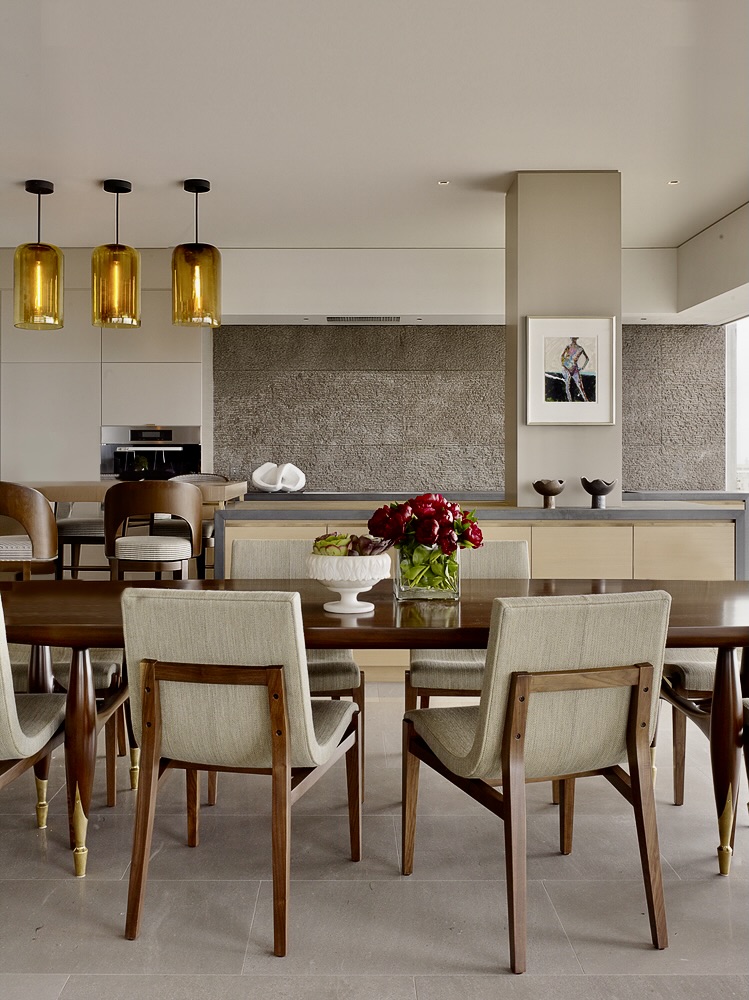
The original plan for this 23rd-floor corner apartment in a mid-century tower in San Francisco was created by the legendary Michael Taylor in the 1980s, notes Jeffers. The father of the California Look, Taylor famously mixed eras and styles in an airy, curated way. But Jeffers and architect Stephen Sutro wanted to design a decor for their clients with more continuity and consistency, which would cede attention to the spectacular San Francisco Bay views.

A reduced material palette — walnut, creamy lacquer and chiseled stone — infuse the interiors with understated sophistication, while leather-finish Absolute Black granite countertops impart subtle drama. This reliance on unadorned quality materials transports the spaces into the 2020s, rather than the 1980s.
Miele appliances brought in refined aesthetics and peak functionality. Jeffers likes “the new combi-steam oven, because it keeps foods moist, but it also browns,” he says, adding, “The dishwashers are the most reliable and best performing on the market. Many appliances also work with apps, which is very convenient, and their finishes are fabulous too. There’s a new obsidian glass that is beautiful.” The latter, he notes, heightens the material elegance of the kitchen.
Jeffers also installed a Miele in-wall coffee maker. “My clients love them,” he says. “They’re convenient and easy to use, and because the beans are ground right then, they’re fresh.” Many of these homeowners, he explains, are excellent cooks and “have opinions about what they want or have researched it themselves. Or they’re looking for acknowledgements and endorsements from other clients.” Miele, Jeffers says, consistently rises to the top.
ACCESSIBLE DESIGN

Leyden Lewis’s design for this UN Plaza apartment in New York had to stay within unique parameters. His client had a medical condition that makes bending difficult if not impossible. “I got very in touch with the limitations and degree of customization that was necessary,” he says.

Miele proved a perfect partner in this endeavor. Lewis raised the height of the countertops and deployed a Miele dishwasher that complied with standards set by the Americans with Disabilities Act. The company also offers what Lewis calls “muscular handles” on its ovens and refrigerators. “Because of the muscularity of the handles, [the client] could put his full weight into opening and closing the appliances,” says Lewis. “They’re durable enough, especially when you open the refrigerator, and there’s this suction that happens that can make the door swing back closed.” (Swivel handles, an innovation Miele introduced after the kitchen was completed, can make opening and closing an oven even easier.)
Additionally, Lewis says, “There’s nothing you can create on a big industrial-grade range that you can’t do on a Miele cooktop.” And because “the microwave over the cooktop didn’t work for my client’s range of motion,” Lewis lowered one of Miele’s combined convection-microwave speed ovens for easier access.
As in the other kitchens, panel-ready appliances were important. “I love looking for my refrigerator,” Lewis jokes. “I want the appliances to recede.” And here they do — behind white cabinetry with inset handles. Against this clean, uniform background, the Campbell’s Soup can pendant lights by Ingo Maurer feel fresh and surprising, adding whimsy to the sleekness and functionality made possible by Miele.