February 15, 2026High-impact minimalism. Warm, welcoming spaces punctuated by distinctive vintage furnishings and objects brimming with personality. These are the hallmarks of Evan Edward, the design studio founded by Josh Evan Goldfarb and Michael Edward Moirano.
The duo met a decade ago as neighbors in New York’s East Village. At the time, Goldfarb, who had spent years in fashion and entertainment publicity before cofounding a jewelry company, was building a vintage furnishings and interiors business, while Moirano was working as an architectural designer, mostly on residential projects. They immediately clicked and began collaborating on renovation commissions they picked up via word of mouth. In 2019, they formalized the partnership, combining their skills — and their middle names — in the newly minted firm Evan Edward.
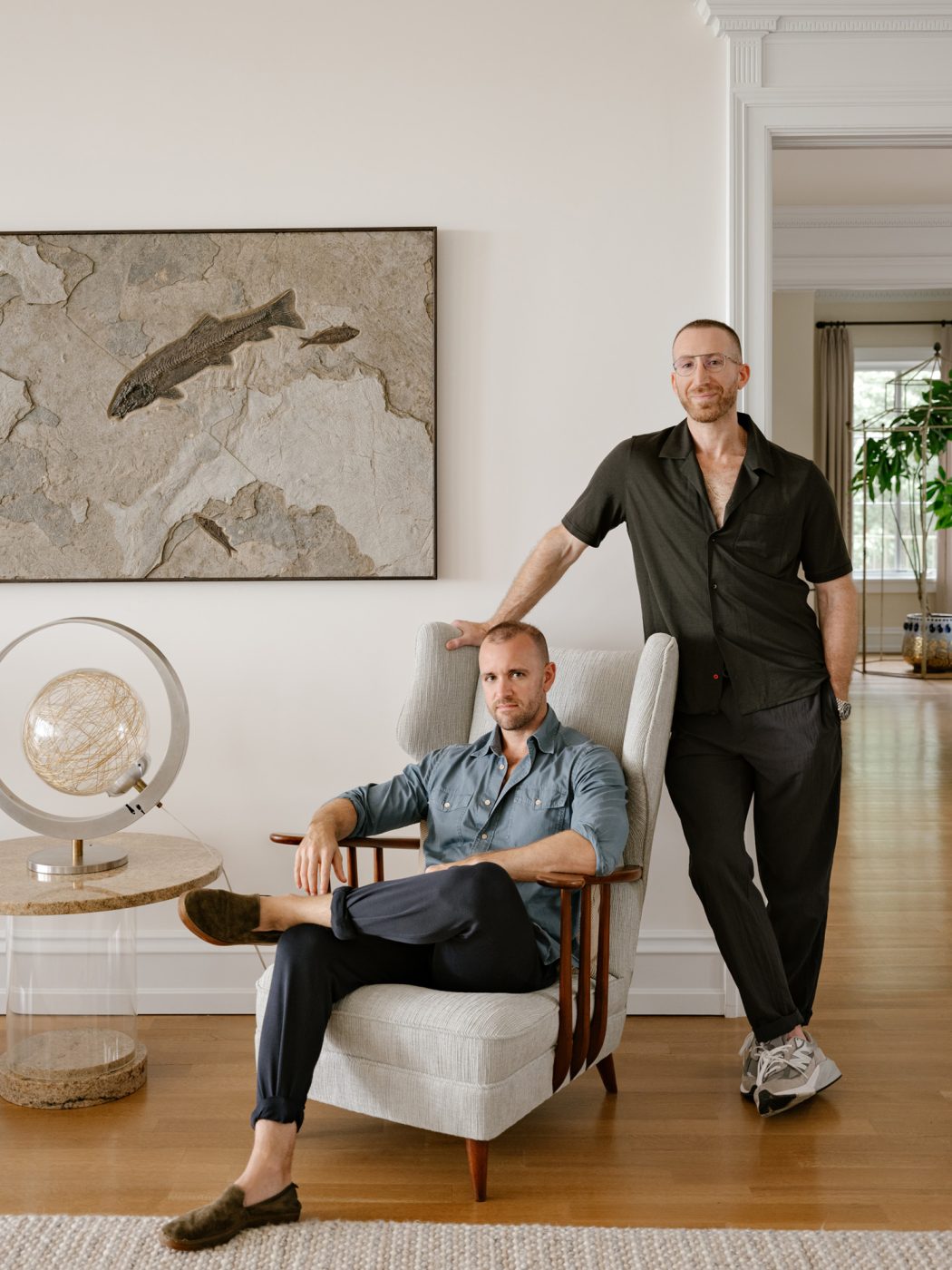
Goldfarb is now based in Miami, while Moirano remains in New York, but they handle every project jointly from start to finish. “It’s the two of us for everything,” says Moirano.
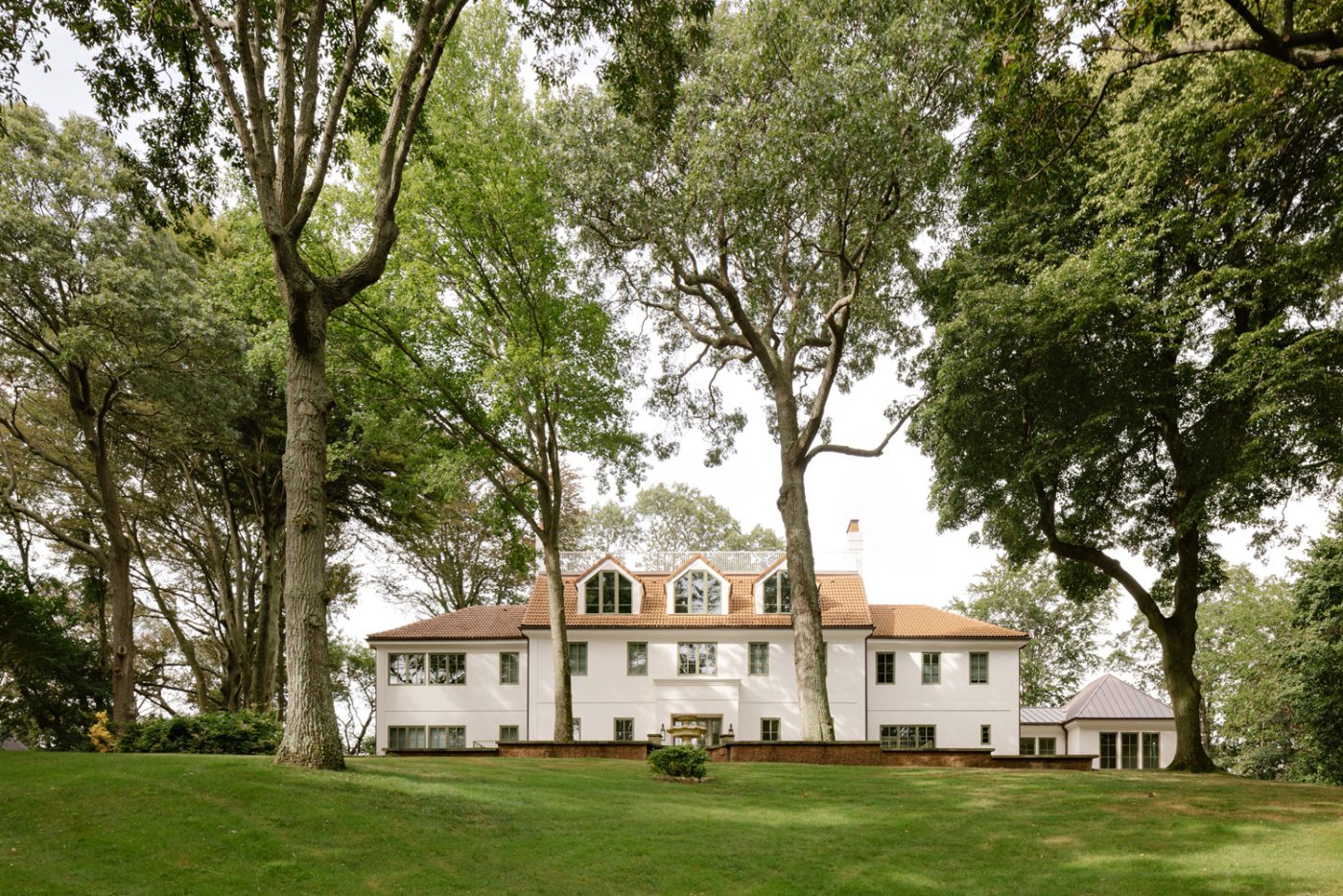
Just months after the pair launched Evan Edward, they landed a commission for what became a multiyear renovation, updating a historic mansion on the Gold Coast of Long Island’s North Shore. Built around 1910 for the Childs family, founders of the cleaning-powder company Bon Ami, the sprawling eight-bedroom house occupies a wooded bluff dotted with towering old beeches, enjoying open views of Long Island Sound. It had been given a “heavy-handed” makeover in the late ’80s that, says Goldfarb, evoked a “Tuscan villa fantasy,” replete with Italianate details and murals.
The new owners were looking to turn the property into a forever home to share with their large blended family of eight adult and young-adult children, plus the first of what they anticipated would be many grandkids. They were introduced to the designers through Goldfarb’s husband, who had worked with the wife. Drawn to Goldfarb and Moirano’s character-rich modern aesthetic, the couple enlisted them to undertake a major overhaul.
Although this would be the clients’ primary residence, they wanted it to feel “like a beach house, very family friendly and relaxed, but in an elevated way,” says Moirano. “They didn’t want it to feel at all stuffy or traditional.”
Goldfarb and Moirano began by paring down the facade, making it more contemporary and actually bringing it closer in spirit to the original white clapboard. In addition to stripping away pilasters, quoins and other ornamental details, they squared off the arched entry and windows and replaced the gold, red and brown color scheme with white stucco and sage-green trim that frames the windows and doors.
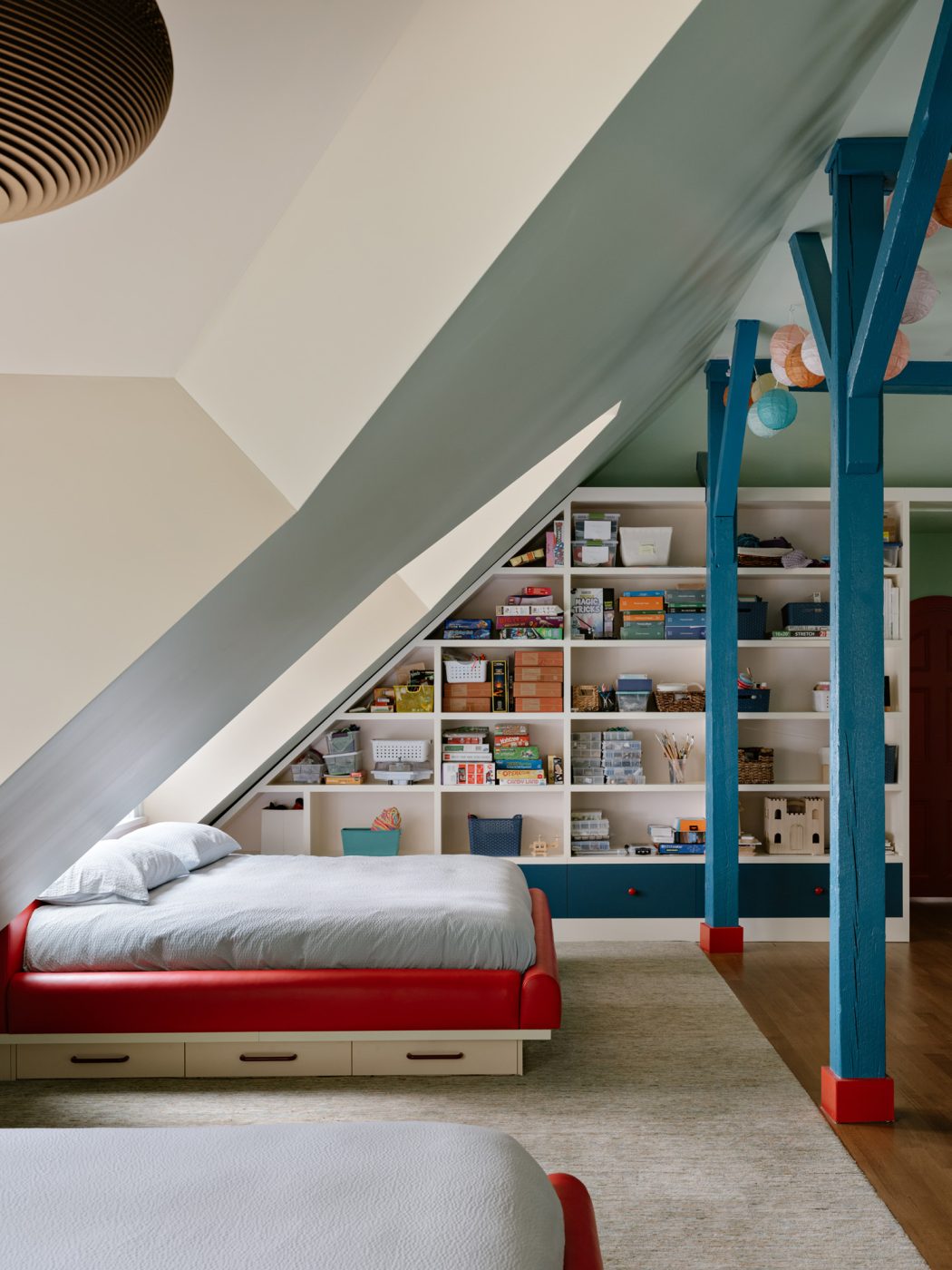
The designers also extended the kitchen and added a new wing with a garage and a gym. In the home’s third-floor loft space, they created a chic grandkids bunk room that’s the envy of the grown-ups. There, custom shelves are packed with games and books, a picnic-style activities table inspires creative play, and red-vinyl upholstered king-size beds tuck into each of the six dormer windows.
“Whenever the kids have sleepovers, they’re always up there — they love this room,” says Moirano. Adds Goldfarb, “I’m pretty sure it’s the wife’s favorite space in the house.”
In the main-floor entertaining spaces, the expanses of glossy stone flooring and dark earth-tone walls were traded for planks of warm oak and a palette of soothing soft whites, grays and blues. For the furnishings, the clients gave the designers carte blanche. “They really trusted us to run with it,” Goldfarb says.
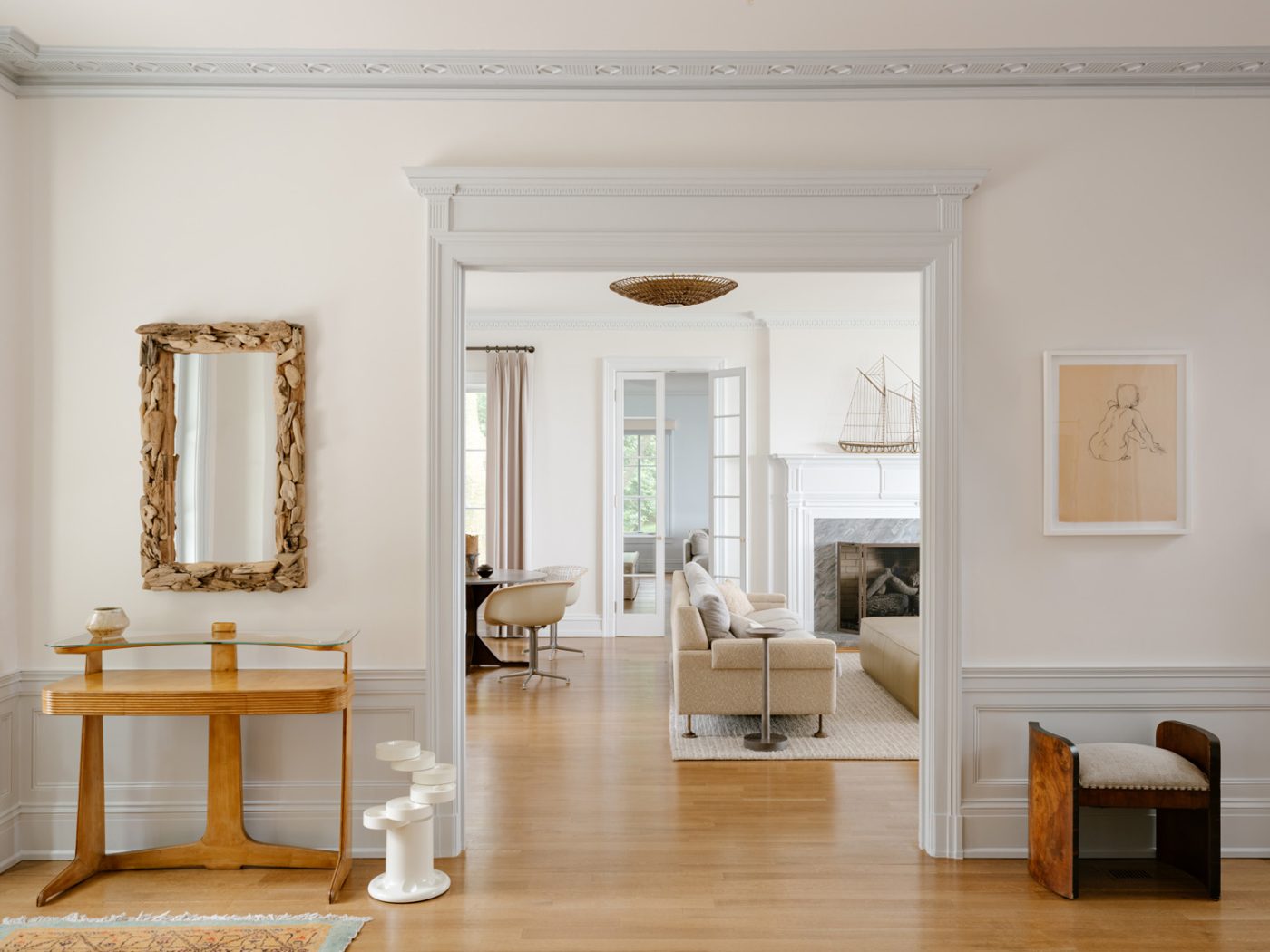
In the entrance hall and adjacent reception room, the designers set the tone with a sophisticated mix of idiosyncratic vintage furnishings, in spare compositions. Many were acquired through 1stDibs, including a sculptural 1950s Italian console table and a ’70s spiraling Giancarlo Piretti umbrella stand, which they placed just inside the front door, plus a mid-century Italian coatrack faced with intricately patterned hand-painted silk, installed on the wall opposite.
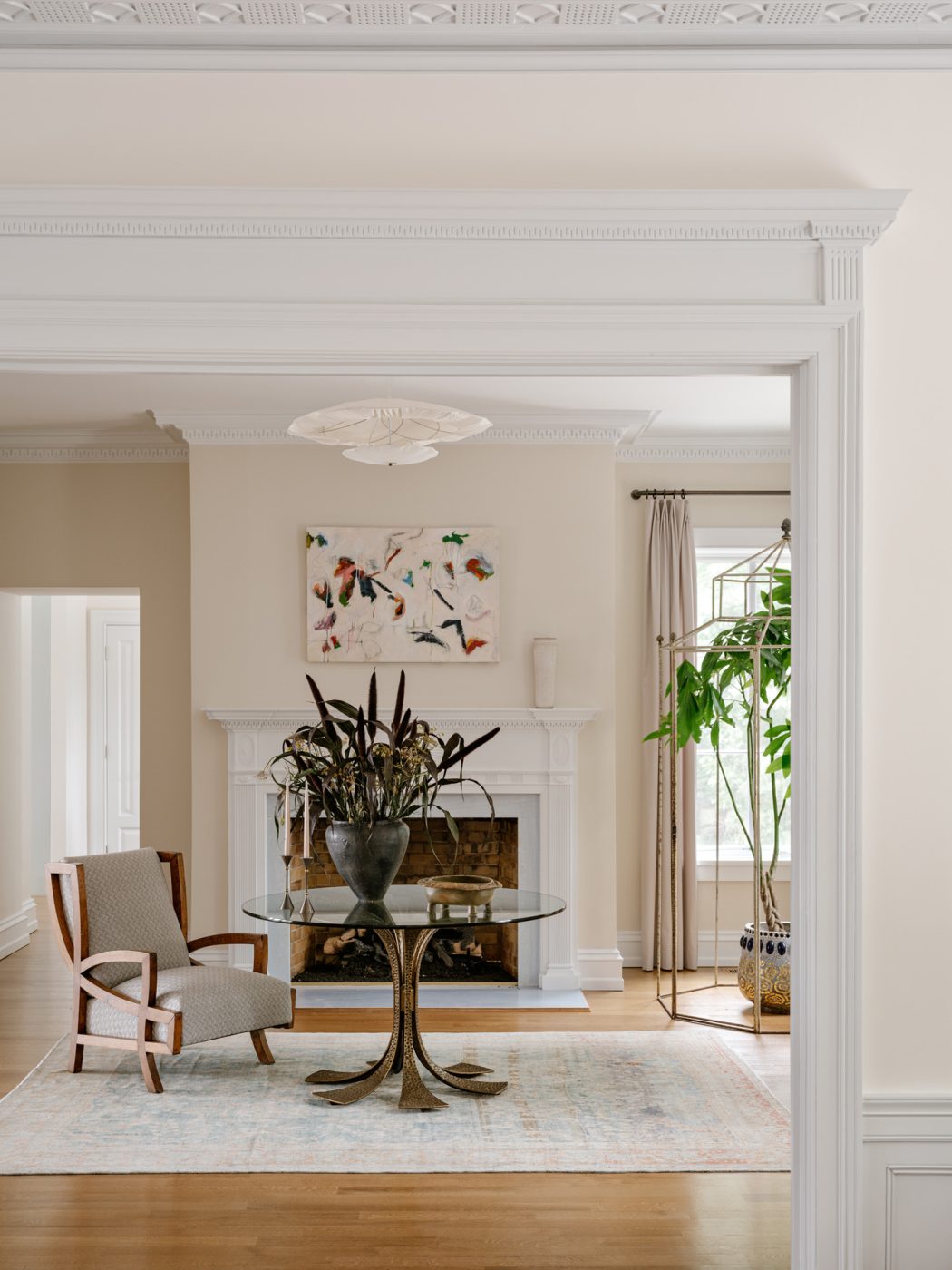
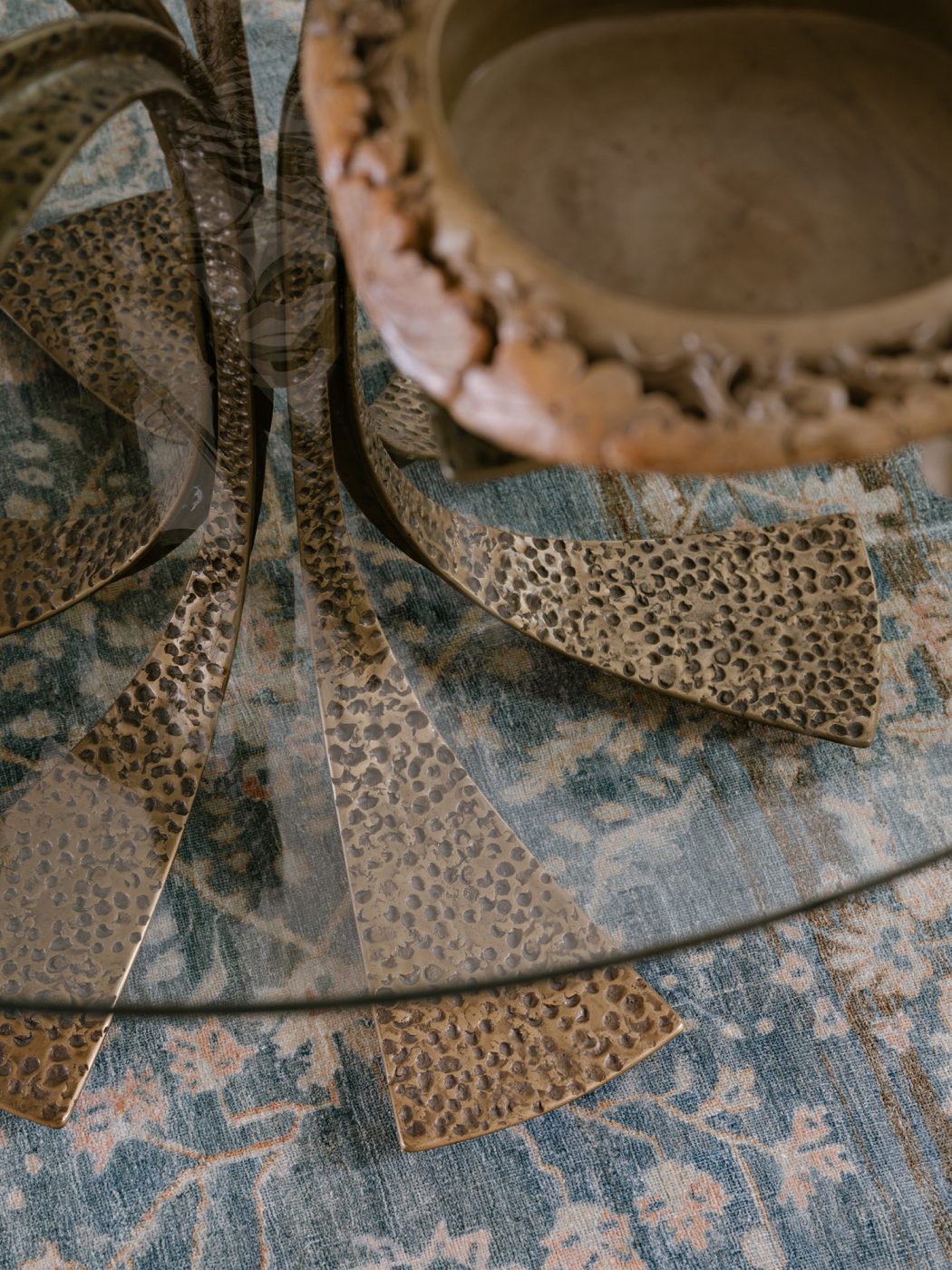
For the reception room, they turned to 1stDibs to source a 1940s Tore Ahlsén pendant light as well as a 1970s brass center table by Luciano Frigerio and an Italian lounge chair with a boldly sculptural framework, also dating to the ’40s. “We love vintage, and we love finding these things,” says Moirano. “It’s part of our brand.”
A particularly notable vintage find resides in one corner of the reception room: a large bird cage that Vladimir Kagan designed especially for his New York City apartment around 1970. A prime conversation starter, it now encloses within its fanciful iron frame a tree planted in a vintage jardiniere in the style of Garouste and Bonetti.
Goldfarb says he and Moirano selected pieces that would appeal to the couple’s science- and technology-oriented sensibilities. (The wife studied astrophysics, the husband has a PhD in mathematics.) As an example, he points to the circa 1950 Oscar Torlasco ceiling light that crowns the entry, its rectilinear branching form vaguely suggesting a very luxe satellite.
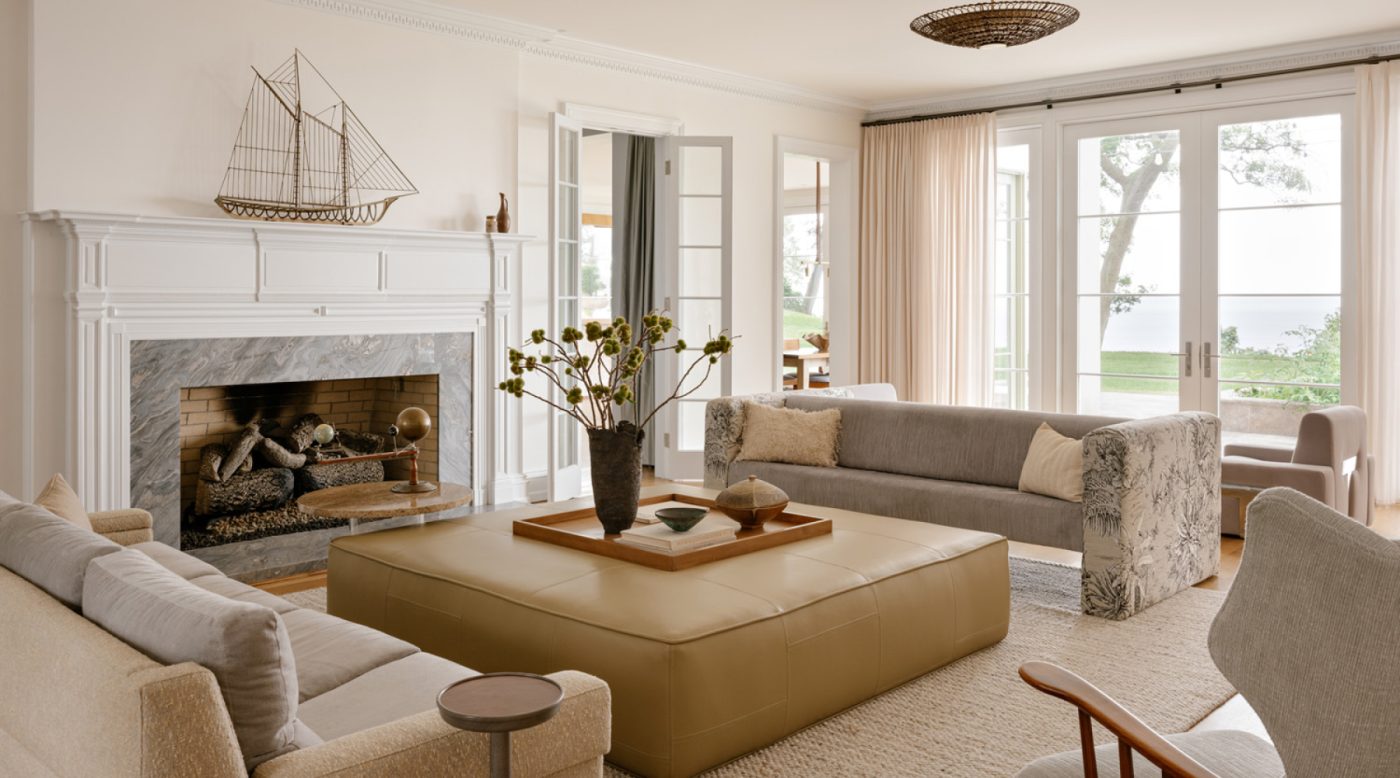
The clients’ interest in astronomy and fossils comes into play in the living room, where the designers mounted a 50-million-year-old slab of stone studded with fossilized fish — found on 1stDibs — above a handblown-glass lamp. The light perches on a 1970s acrylic and granite table that is flanked by a pair of Ico Parisi armchairs from 1950, also bought through 1stDibs.
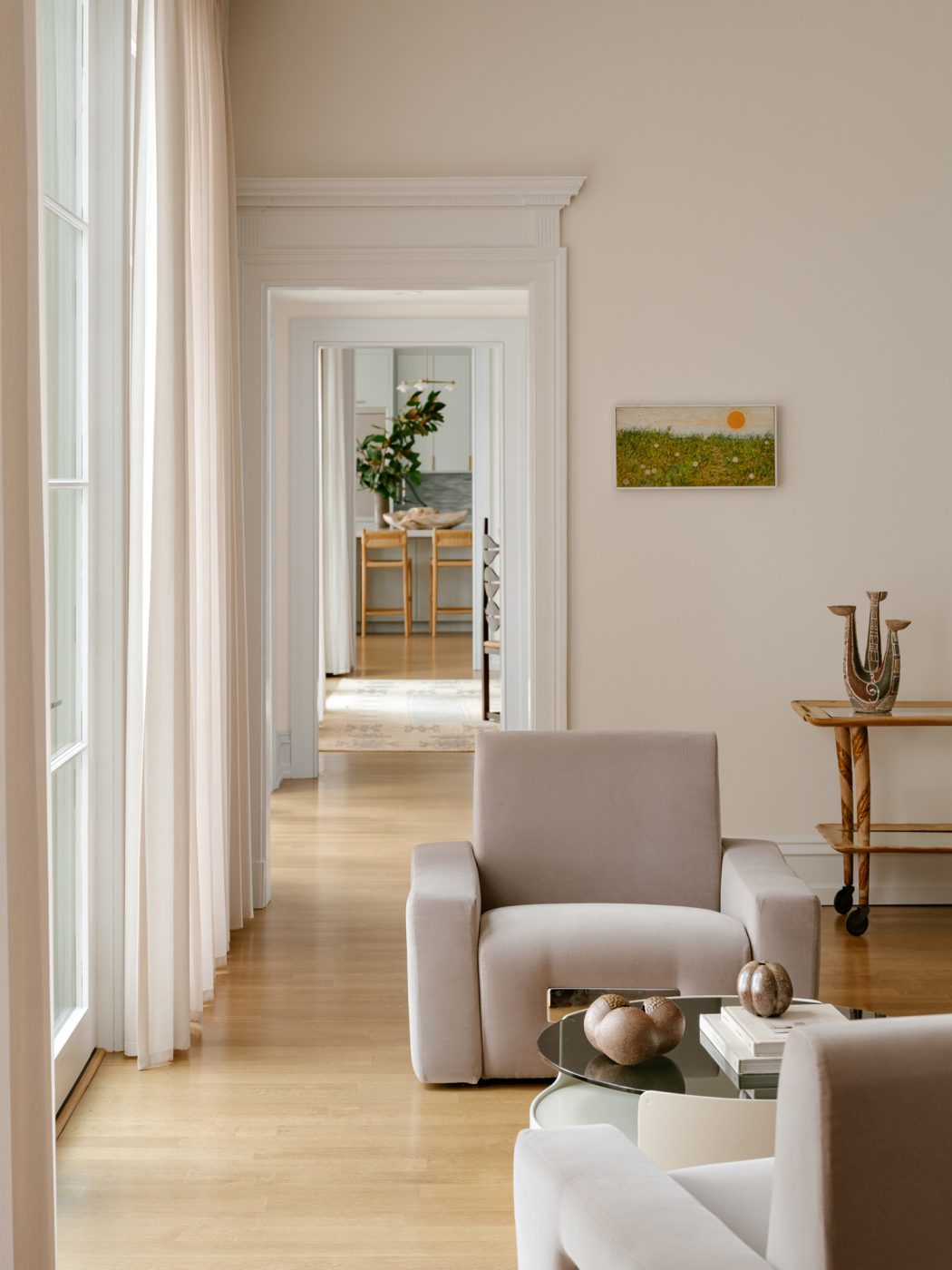
The commodious space contains multiple inviting seating areas, to provide comfort and flexibility. Goldfarb and Moirano devised a bespoke double-sided sofa that faces the central grouping around the fireplace as well as, along the wall of windows at the back, a pair of 1970s velvet-and-chrome lounge chairs by Mario Sabot and a groovy Erik van Buijtenen table designed in the ’70s for Nebu.
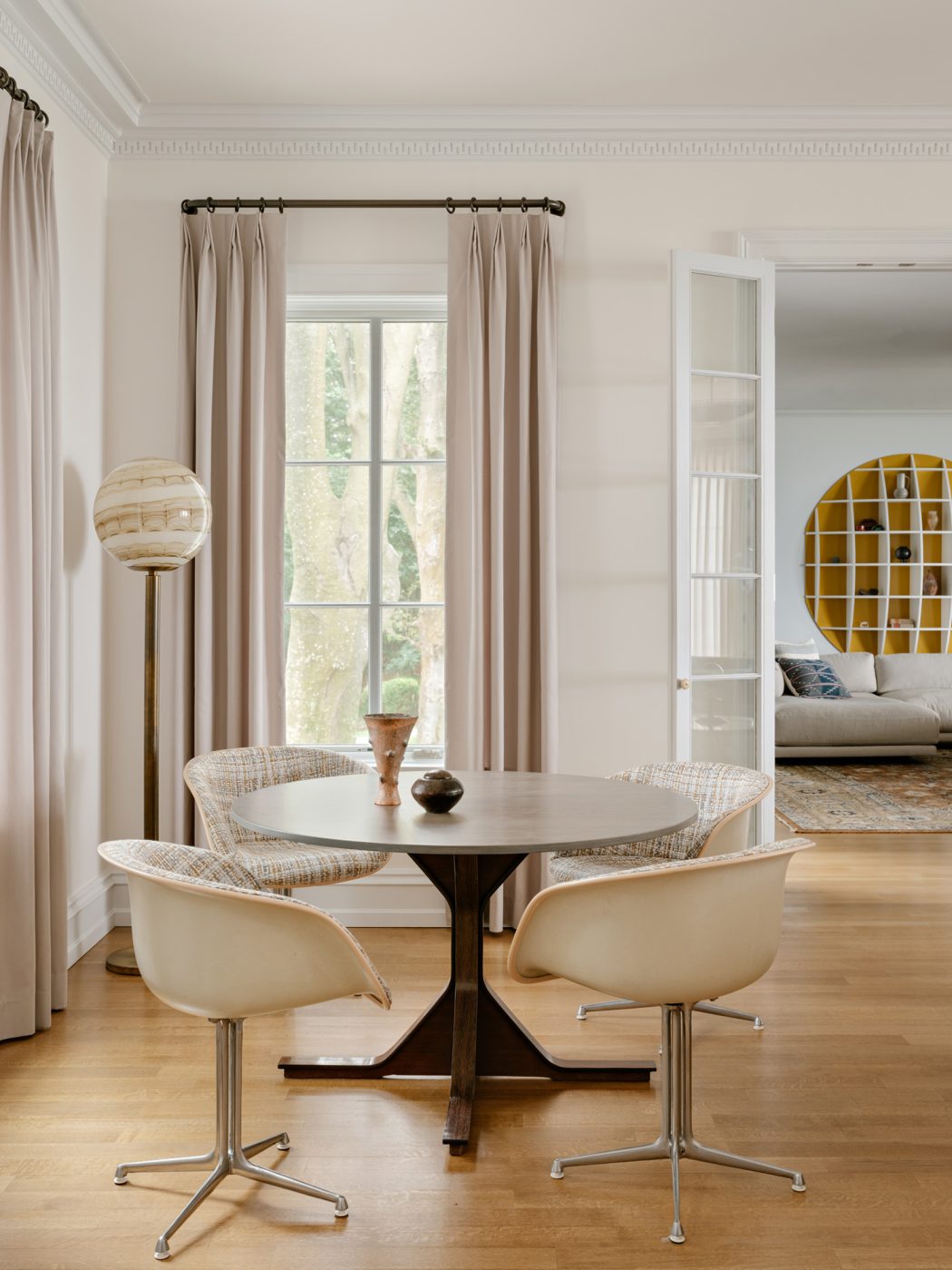
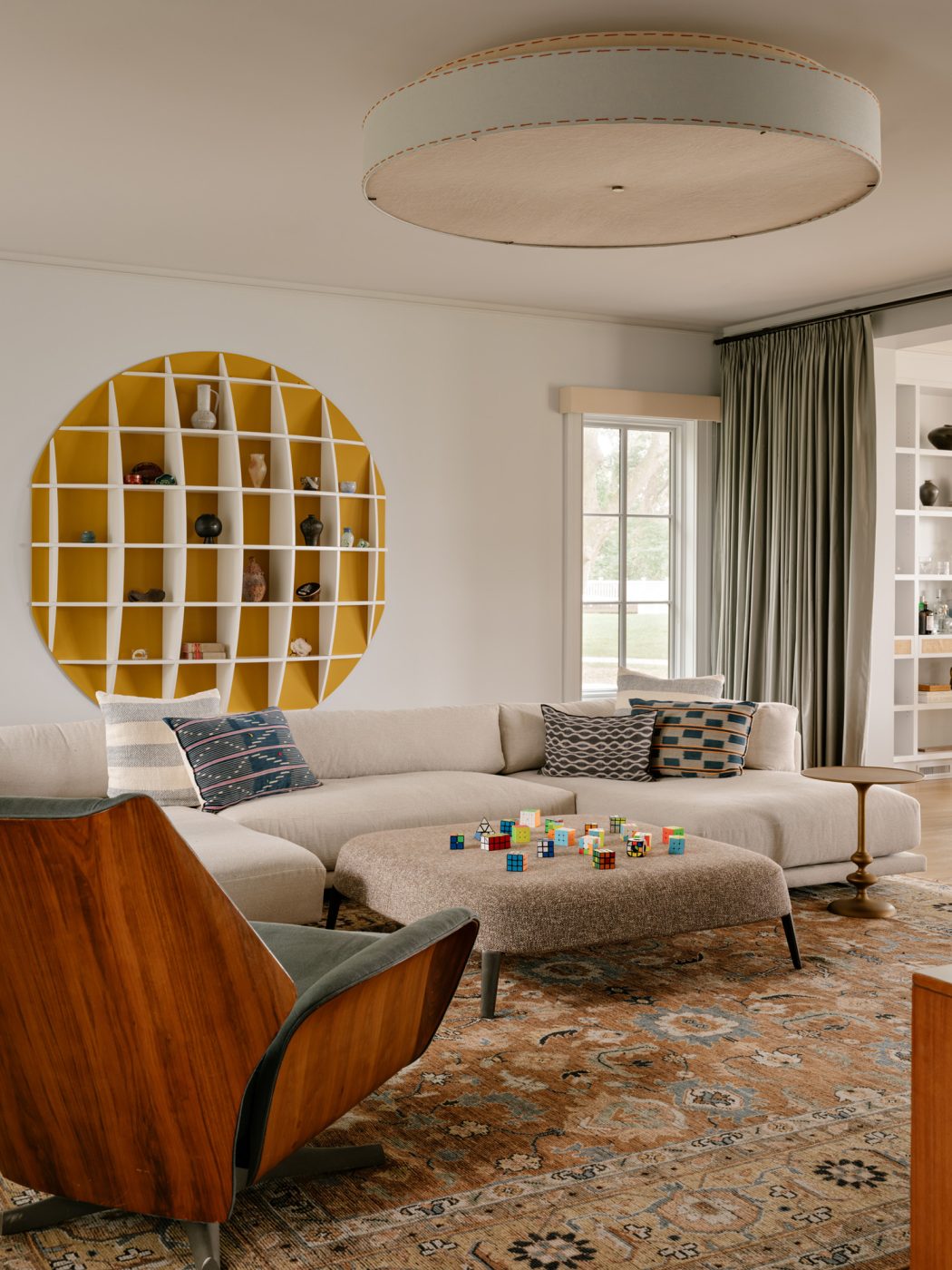
Other statement-making vintage pieces are found in the TV room, including a circular wall-mounted bookshelf by Manfredo Massironi — its back panel refinished in a sunny yellow — and, nearby, a Raymond Loewy lounge chair from the 1960s. “That recliner is a beast, just huge and so heavy,” says Goldfarb. “It works beautifully in that space.”
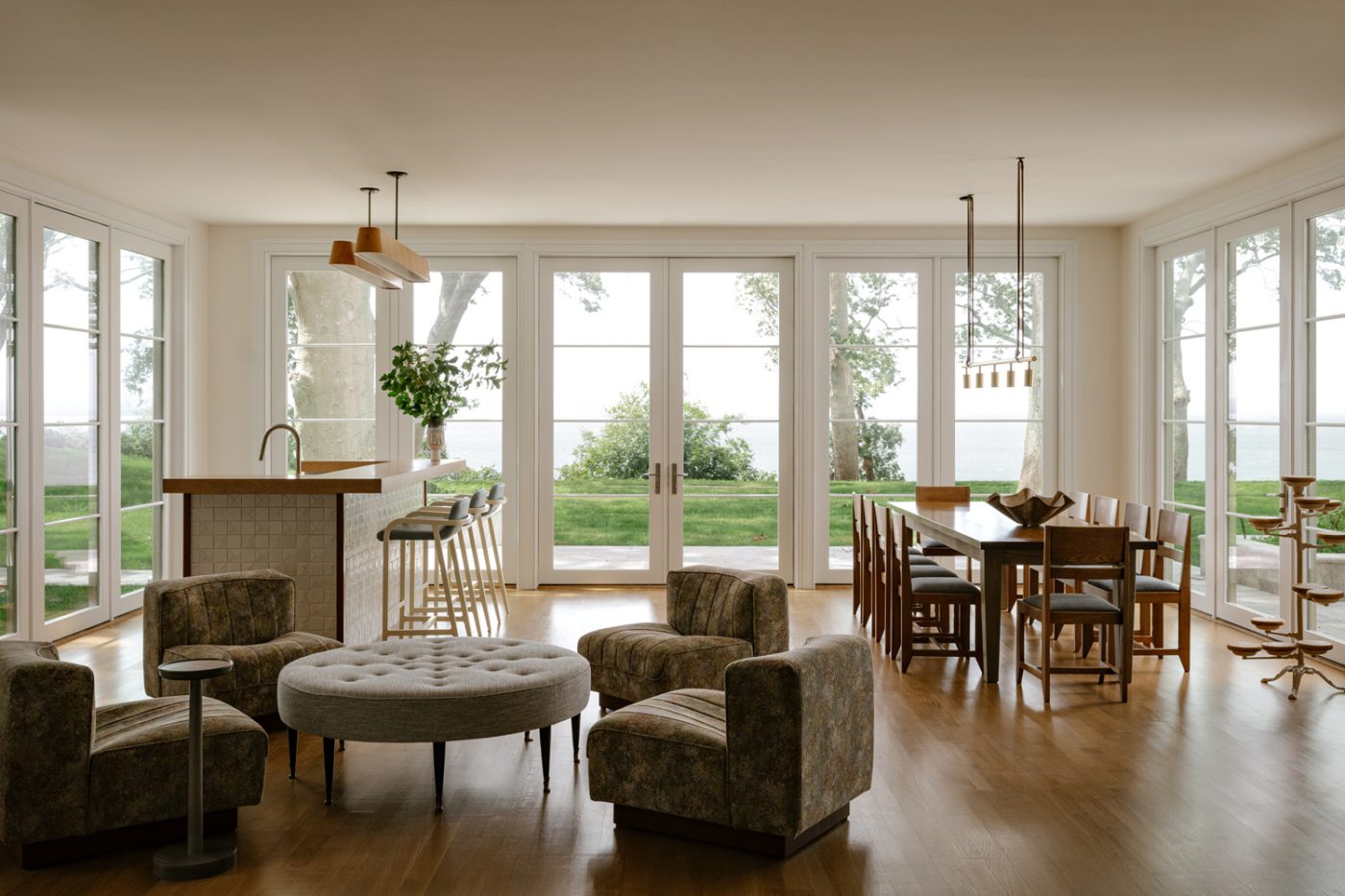
Adjacent to the TV room, the designers created a sunroom-like bar, outfitted with cozy 1970s Tito Agnoli lounge chairs and a variety of tables. Together, the two spaces compose “a play zone,” says Moirano, adding that the bar also functions as a secondary dining space. “When they’re entertaining,” he explains, “they can open up all the doors to the terrace and it becomes indoor-outdoor. There is seating for up to forty people for dinner at the various tables.”
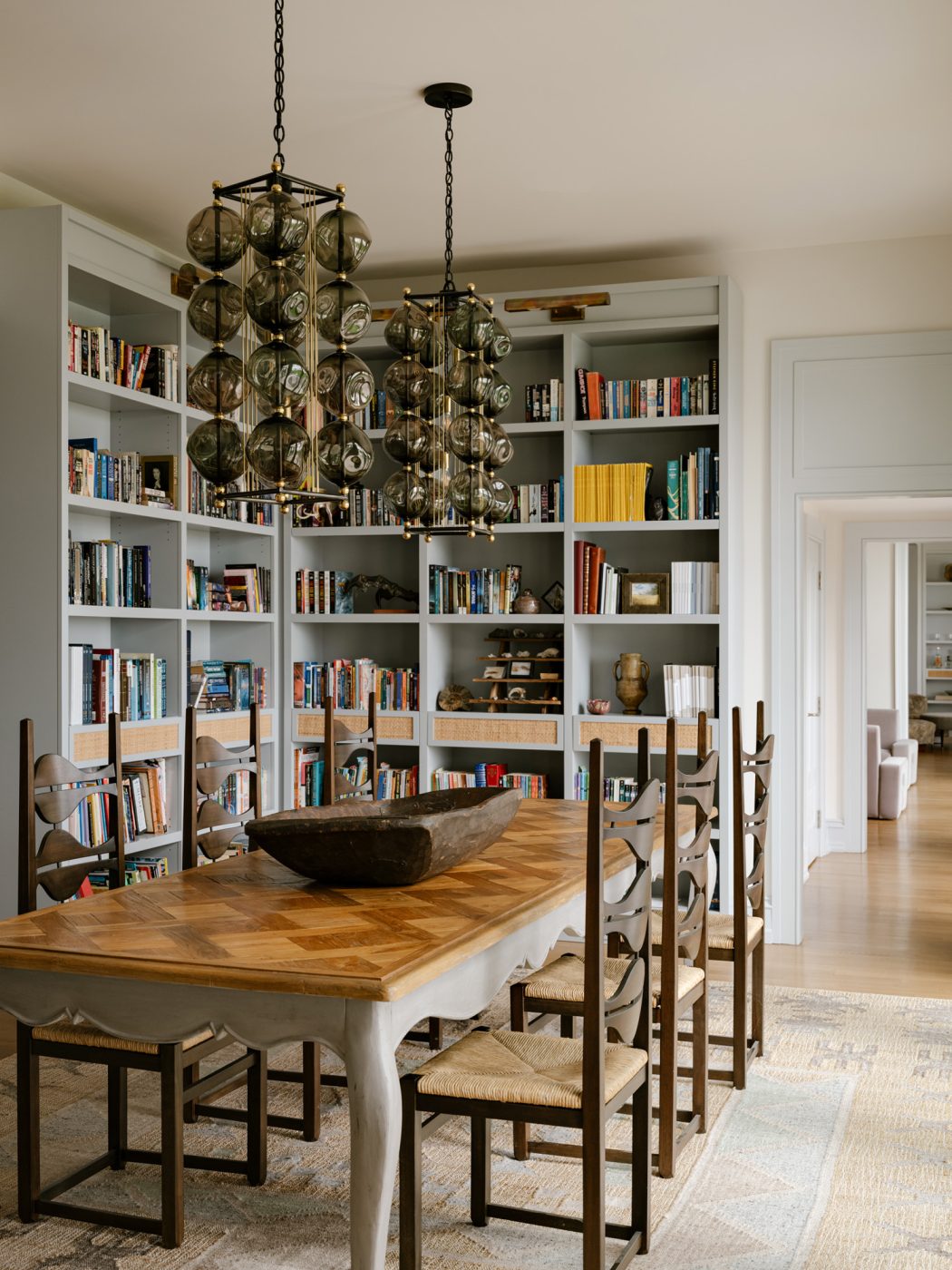
The main dining room, meanwhile, has an intimate vibe, thanks in part to the floor-to-ceiling custom shelves filled with books and objects made or collected by the family. A French Provincial–style table is surrounded by 1960s high-back, rush-seated chairs by Jordi Vilanova i Bosch; suspended above is a striking pair of pendant lights by Bourgeois Boheme Atelier. “The idea of a dining room that doubles as a library was really appealing to the clients,” says Goldfarb. “With the setting and the views, it’s just a very special space.”
The array of vintage gems continues on the home’s second floor. In the stairwell, Goldfarb and Moirano redesigned the big picture window with artful asymmetrical mullions inspired by the paintings of Piet Mondrian and installed one of Kazuhide Takahama’s 1973 undulating minimalist Saori ceiling lights, acquired on 1stDibs.
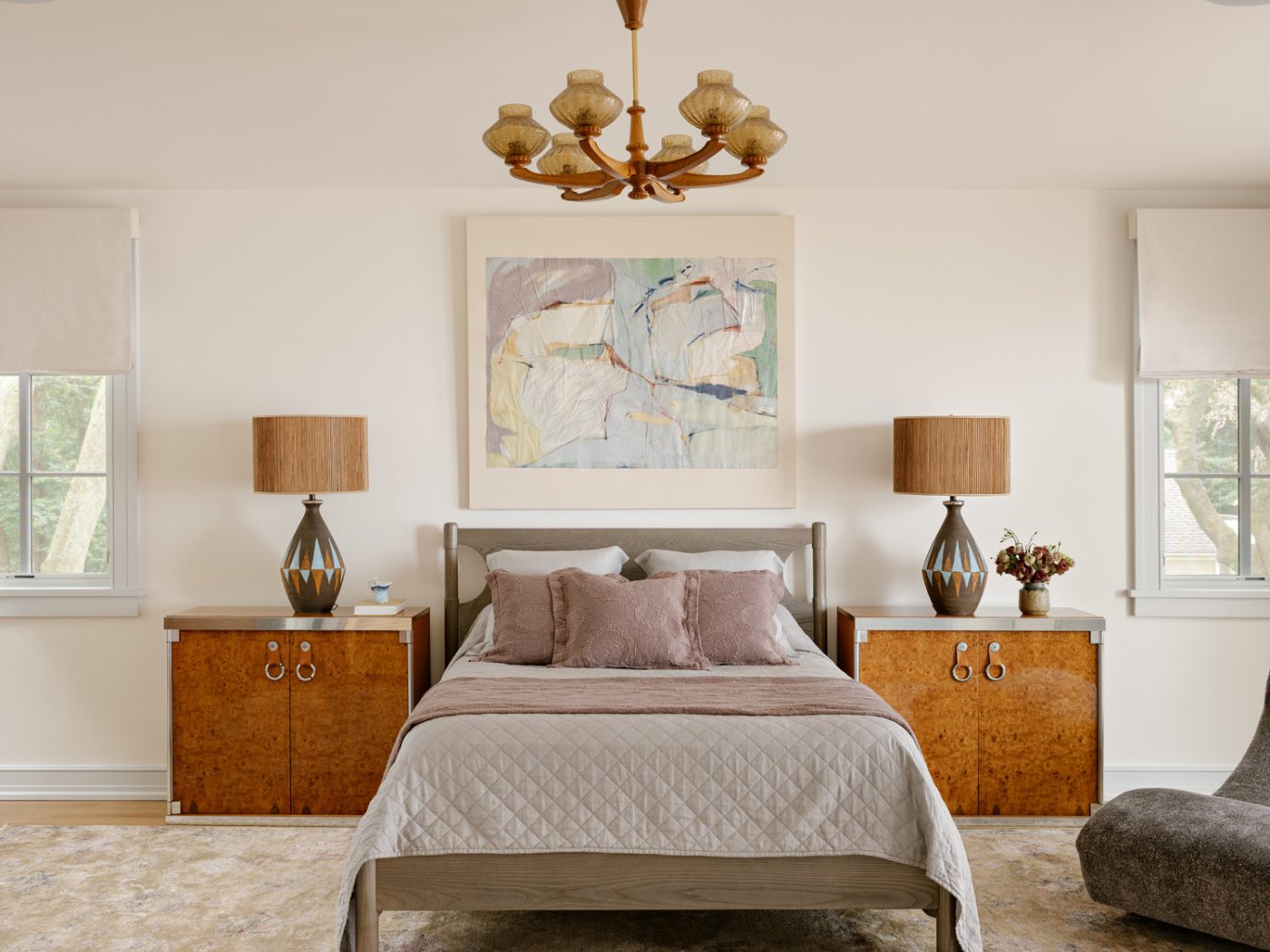
Down the hall, the couple’s bedroom showcases 1970s Guido Faleschini burl-wood sideboards from 1stDibs, topped by circa 1960 Bitossi ceramic lamps. An abstract painting by Anne Wehrley Björk, mounted above the bed, is one of the few artworks in the home, where much of the visual interest is provided sculptural furnishings.
“That freaking mirror is so beautiful,” says Goldfarb. “It’s set into travertine and cantilevered off to one side. I would love to have it myself.”
The consistent use of vintage pieces throughout the house helps to reinforce “the connections, the threads that we pull through almost every single room,” says Moirano. The success of this approach comes from unexpected choices and combinations, explains Goldfarb: “It’s vintage done in a way that feels fresh. There’s a light touch, but it’s thoughtful and very impactful.”