April 5, 2026Victoria Sass Shifts Styles from a Minimalist Log Cabin to Her Own Exuberantly Patterned Home
The logs were already there. Thick, honey-colored tree trunks stacked into walls and and laid end to end as rafters, forming the kind of northern Minnesota cabin that smells of sap and smoke even when the fireplace is cold. But the furniture inside the home, known as the Raven, refuses to conform to cabin cliché.
Near the living room’s stone fireplace, for instance, a pair of cocoa-brown Gerrit Rietveld Utrecht armchairs sit low and angular beside an Eero Saarinen Tulip table. Their sharp silhouettes seem ready to slice through the timber that surrounds them.
“A friend of mine calls this project ‘Rick Owens in the woods.’ ” says Victoria Sass, who designed the interiors, “which I think is funny and accurate.”

Sass, founder of the Minneapolis firm Prospect Refuge Studio, often plays with the tension between older buildings and contemporary design. The Raven — a lakeside retreat in the woods intended as a place to host family get-togethers for generations to come — stretches that tension almost to the snapping point.
The logs remain unapologetically rustic. The decor leans strongly toward modernism.

Downstate, in Minneapolis, Sass explored the other end of the spectrum. Triangle Park, her own turn-of-the-20th-century craftsman-style house, is decked out in floral wallpapers, unusual antiques, family heirlooms, plaster finishes and striking textiles — a domicile that changes with the whims and rhythms of real life.
Together, the two projects represent the poles of Sass’s approach to interiors: one pared-down and sculptural, the other eclectic and personal.
“It’s interesting, because the Raven was commissioned work, while Triangle Park is my own home,” Sass says. “A commissioned environment is, in a way, encapsulated and then released to the client, where it begins to transform under new ownership and occupancy. My own home is ever evolving under my eye.”

At the Raven, the stylistic push and pull is most overt in the kitchen. Rift-sawn red-oak cabinetry stained black, minimalist aged-brass hardware and inky quartz countertops give the space a slick, urban edge cutting against the natural contours of the timber.
“The monolithic black kitchen set within the wrap of the hand-hewn logs is one of my favorite moments,” Sass says.
The juxtaposition continues in the living areas. “How do you hold your own against something with a perspective as strong as log or timber construction?” the designer asks. “You have to march decisively in the other direction.”

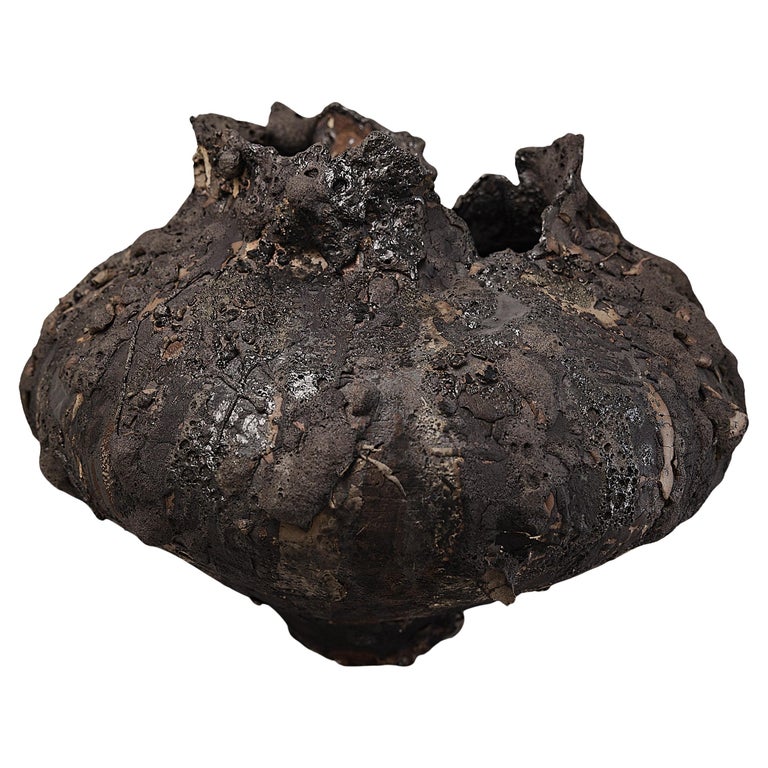
In the dining space, a brawny oak table with a charcoal finish is surrounded by Stellar Works walnut chairs with black-leather padding. A blobby ceramic vessel by Zoë Powell rests on top, while a Ravenhill Studio Hood chandelier illuminates the scene from above.
“The cabin artwork in the dining room was inherited with the home and has been passed down from owner to owner,” Sass explains. “It’s become a kind of iconographic piece tied to the property itself.”
Nothing blends. Everywhere, contrast is allowed to thrive. “We wanted it cleanly documented what was old and what was new,” Sass says. “That clear opposition, two perspectives meeting without trying to blur the line, lets each one feel more powerful.”

Sass’s own heritage house, on the other hand, explores a layered aesthetic that arises from trying new tricks and constantly rotating objects.
In the entry hall, a hand-painted wall treatment featuring birds, acorns and wildflowers composed of wavy black-and-white marks is part theatrical backdrop, part personal archive.
This is met by traditional oak wainscotting and millwork, all surrounding a cozy seating area comprising plush vintage armchairs reupholstered in House of Hackney’s Rainbow Rose Dusk Stripe, Visual Comfort brass lamps, an antique marble-topped chest of drawers and a 1960s Italian mother-of-pearl pendant light.

Sass commissioned the mural from artists Kate Worum and Jennifer Jorgensen, of She She. “I was really curious about the idea of embedding personal histories into architecture,” she says. “I love visiting historic estates full of symbolic emblems and totems — architectural moments that tell the story of the lives lived within the walls.”
The motif, she adds, “is the story of me meeting my husband. I’ll just leave that there.”
If the Raven represents a finished composition, Triangle Park functions more like a lab for material and stylistic experimentation. “It’s less resolved, more in transition,” Sass says.
In the spacious living room, a 1960s Milo Baughman burlwood coffee table sits between a 19th-century French campaign daybed and a pair of well-worn leather club chairs, with a woven Tuareg mat underfoot.

A vintage tapestry and richly patterned textiles — Clarence House’s Tibet epingle on the daybed and a Gregory Parkinson tablecloth repurposed for a seat cushion on the Pierre Frey–covered sofa, not to mention all the wonderfully mismatched pillows — add touches of fantasy.
For Sass, the interweaving of disparate pieces is less a strategy than the unfolding narrative of living in a particular place, where nice things can accumulate gradually.
“You should spend less time worrying about if the object is ‘right’ and more time getting to know yourself and your story,” the designer advises. “Then, you acquire what speaks to you and nestle it into your life wherever it fits best.”


That approach traces back to Sass’s childhood, part of which she spent in Santa Cruz, California, where her family worked in the mountaineering business. Outdoor-gear shops — dense with nylon backpacks, metal buckles, colorful climbing ropes and utilitarian displays — form some of her earliest memories of interiors.
“I can remember interior environments like some people remember old friends,” she says.
Later, after moving to rural Minnesota, Sass began tweaking her bedroom and furnishings. The artistic isolation of the countryside “made me look to the nontraditional mediums I had around me as modes for expression,” she recalls. “I was always refurbishing furniture . . . and I worked through ideas using my personal space as a kid, re-creating environments from movies, cliché teenage stereotypes or even pivotal moments in my family history.”

Those early tinkerings led her to study architecture in Copenhagen, in 2007, where she encountered Scandinavian design firsthand, and met her husband, who’s Danish, in the process. “The Scandinavian influence has had a big effect on me, but maybe not in the way you’d expect,” she says. “Being around the homogeneity of Nordic design clarified the diversity of American design for me.”
Today, Sass lives in Minneapolis’s leafy East Isles neighborhood with her husband, their three children and a Bernedoodle named Gus, running both Prospect Refuge Studio and Prospect Refuge Gallery, a contemporary-design and -art space that spotlights creators with Midwestern ties.


“I think there are cultural Midwestern values — humility, frugality, consistency, modesty, contentment, stability — that are being sought after in a volatile world,” Sass says. These values subtly inform many of the interiors she creates.
At Triangle Park, they manifest in patience and accumulation, rooms assembled (and changing) over time, rather than orchestrated in one dramatic swoop.
At the Raven, Midwestern norms emerge in the form of restraint. The Lincoln-esque structure remains visible, while the sturdy modern furniture is chic without announcing itself.
“Architectural framework first, always,” Sass says of her design process. “Everything else is a new invention. That’s our play space.”