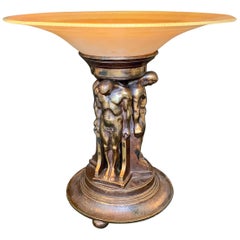
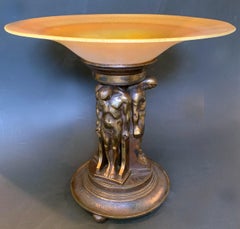
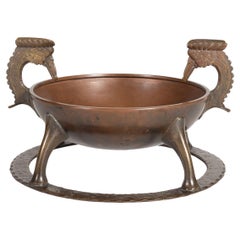
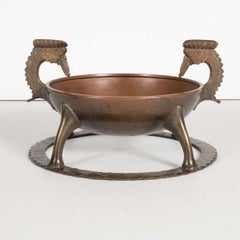
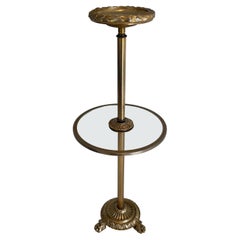
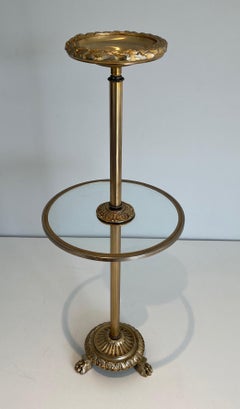
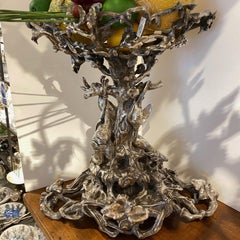
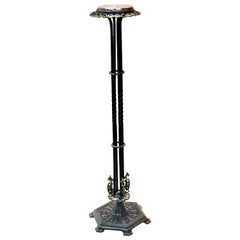
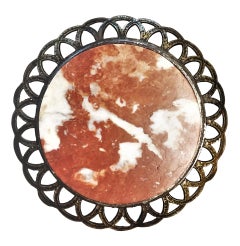
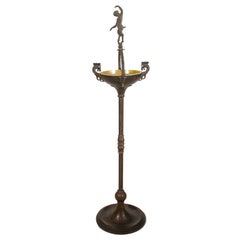
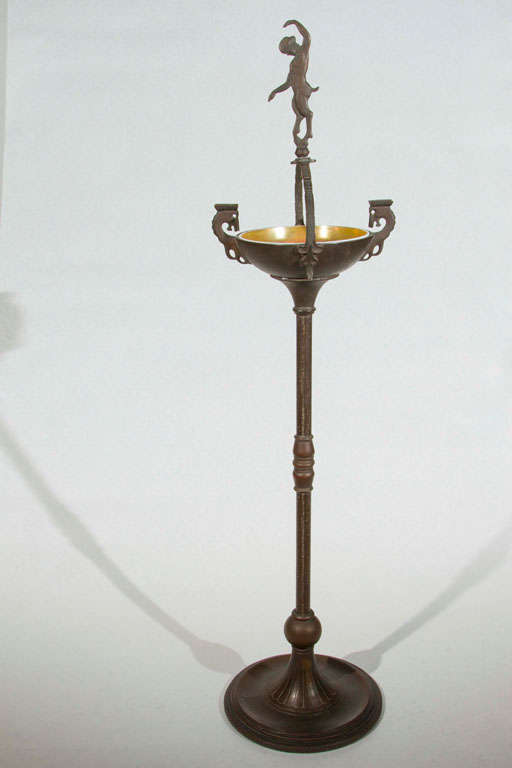
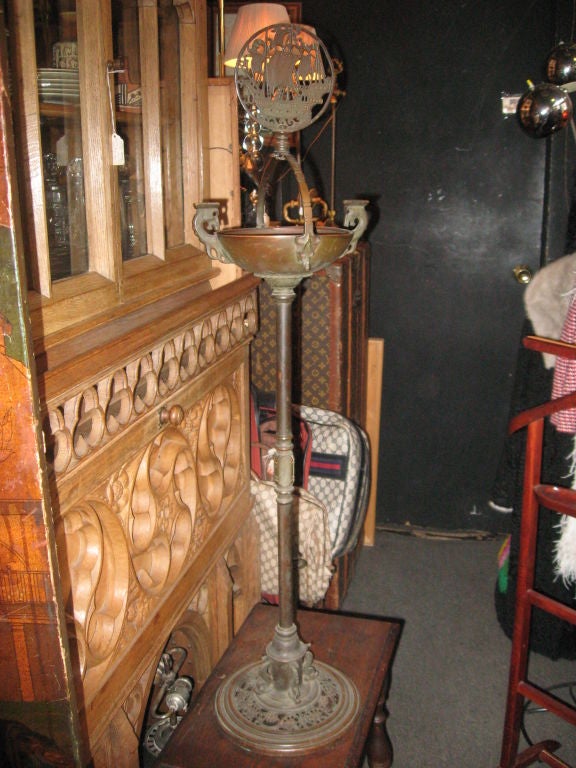
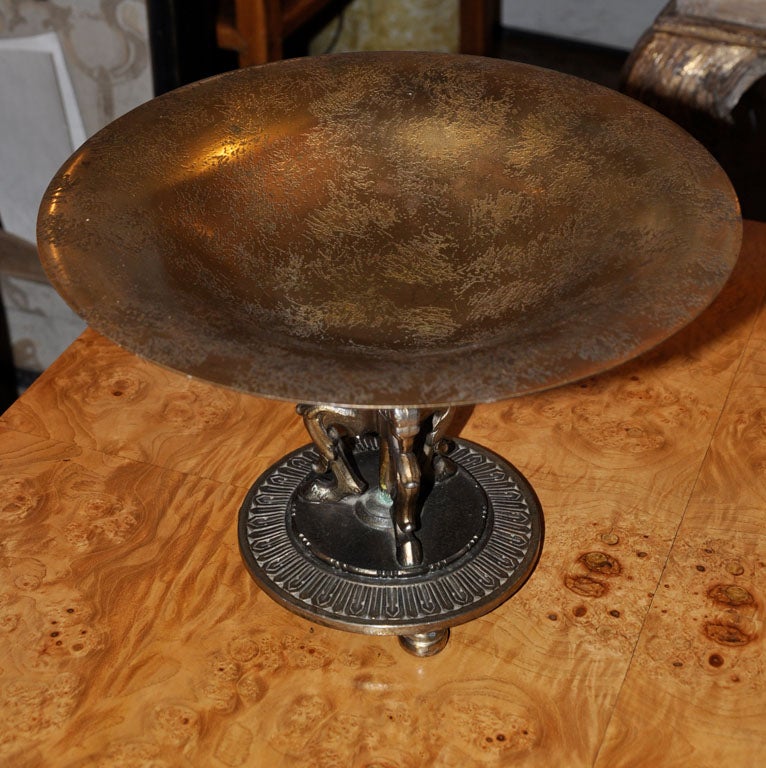
By Oscar Bruno Bach
Located in New York, NY
Dimensions:
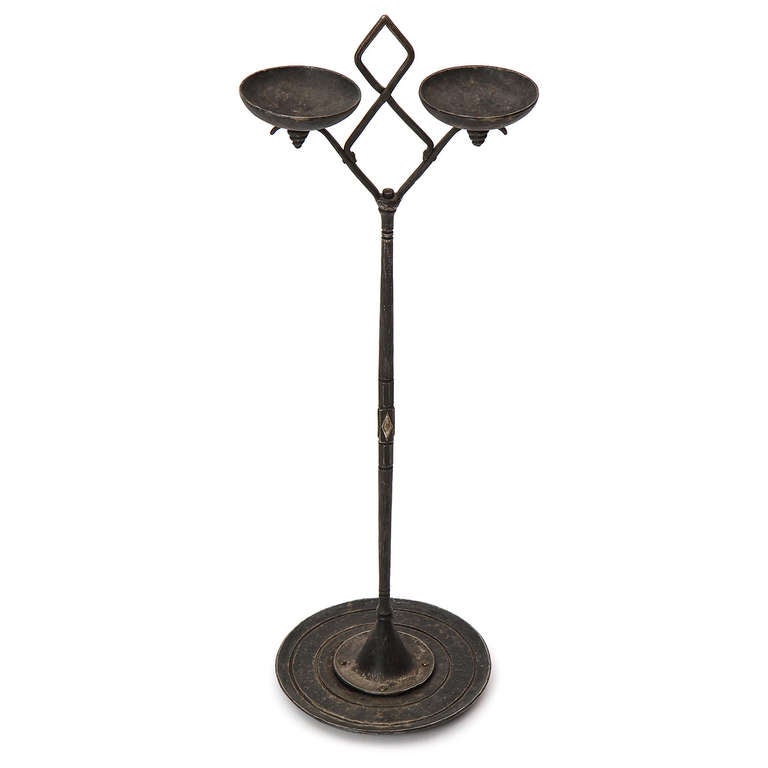
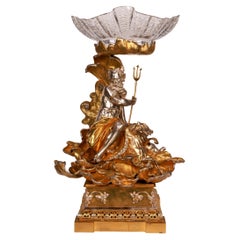
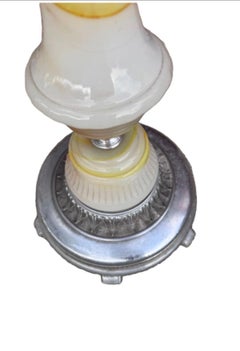
Height 41.5”
Marble top diameter 6” (with frame: 9.5”)
Base diameter 13”.
Oscar Bruno Bach (German/American 1884 - 1957), a German-born artisan, who was one of the most technically skilled and commercially successful figures in the field of decorative metalwork during the first half of the 20th century. His design and production ranged from small and domestic to grand-scale architectural. His style was as diverse as his use of metals and included Arts & Crafts, Gothic, Renaissance, Spanish Baroque, Tudor Revival, and, on occasion, modern Art Deco. Thematically he was particularly fond of the zodiac, of lush scrolling grapevines, classical masks, mythological symbols and elements of the Italianate and Germanic grotesque. Oscar Bach's work can be found in the permanent collections of The Metropolitan Museum of Art, The Minneapolis Museum of Art, The Wolfsonian, and Reynolda House. As a young man, he studied painting at the Royal Academy in Berlin and underwent a 4-year apprenticeship in metallic arts. From 1898-1902, he attended the Imperial Academy of Art in Berlin.
Following this formal education, Bach became the artistic director of metallic arts firm in Hamburg, where he made an ornate jewel encrusted Bible cover for the study of Pope Leo XIII - an early article of his craft which remains in the Vatican permanent collection. Two years later, Bach won several important commissions to design metalwork for civic buildings, including the new city hall in Berlin. Between 1904 and 1911, Bach worked as a successful metalsmith in Germany, keeping a studio in Venice and traveling extensively throughout Europe, the Middle East and North Africa, where he became keenly aware of various decorative styles, history, materials, and techniques.
In 1911, Bach won the Grand Prix at the World's Exposition in Turin, Italy for a bed he designed for Kaiser Wilhelm II. 1911 was also the year when he moved to the United States to join his brother Max, and establish a business in New York City. Soon after his arrival, Oscar Bach and his brother opened a metal design studio together - first in Greenwich Village, under the name of BACH BROTHERS; but soon moved to 257 West 17th Street and became Oscar B. Bach Studios, Inc.
In the period of 1913-1923, Oscar Bach's little metal shop kept busy creating beautiful household objects for moneyed New Yorkers, as well as custom architectural works for America's great country estates. He worked often with architect Harrie T. Lindeberg and designed exterior and interior fittings for many of Lindebergh's clients. In April of 1923, the Bach brothers moved to a new studio at 511 West 42nd Street upon an acrimonious split with their business partner, Bertram Segar. Segar remained in Bach's West 17th Street studio, renaming it The Segar Studios. There, Bertram Segar continued to reproduce many of Bach's original designs and variations on Bach's designs, either selling them in an unmarked state or stamping them with his Segar Studios mark. Segar would continue to run a successful custom metalwork studio throughout the 1920s despite Oscar Bach's continued denouncing of Segar's poor ethics and poor taste.
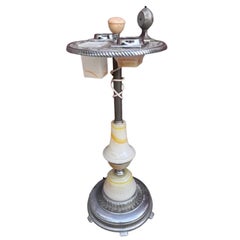
Despite such difficulties, Oscar Bach's Manhattan-based business continued to flourish throughout the mid-1920s and 1930s. Commercially, Bach's production pieces ranged from the modest, such as a small lead ashtray - to the pricey, such as a highly- ornamental bronze chandeliers. Almost every conceivable form was available - smoking stands, library lamps, footed bowls, card trays, planters, torchéres, andirons, slab tables, mirrors, sconces, picture frames, humidors, chairs, bookends, children...
Category
Early 1900s American Arts and Crafts Antique Oscar Bruno Bach Serveware, Ceramics, Silver and Glass