
August 23, 2026As a longtime Hollywood hair stylist, with clients including actress Vanessa Hudgens and design doyenne Kelly Wearstler, Chad Wood has long loved framing beautiful faces. Recently, he’s combined his eye for color, form and texture with his lifelong interest in crafting handsome spaces. He launched Chad Wood Interiors in 2017, and it has really hit its stride in the past few years.
“There’s such intimacy and trust required for both processes,” says Wood, who still does hair for his most loyal clients, many of whom have hired him to design their houses.
The designer’s sophisticated-yet-laid-back California style derives from a wealth of modernist and contemporary inspirations. In his home office, mood boards showcase the work of Frank Lloyd Wright, Scott Mitchell and the mid-century modernist Case Study architects; interiors by Vincent Van Duysen, Axel Vervoordt and Roman and Williams; and furniture designs by Jean Prouvé and Donald Judd.
“I have also loved Art Deco forever, and I get inspired every time I see work by Italian designers like Gio Ponti and Mario Bellini,” he says. Mixing such 20th-century classics with the custom designs required for large-scale California rooms is key to Wood’s approach.
“The blend is so important,” the designer explains. “I’m constantly on 1stDibs, and I will throw things from all eras together.”
Wood adds that a judicious balance achieves the best results: “Rooms with all vintage furniture can be the ‘chef’s kiss,’ but they can also feel museum-like. And too much custom furniture can feel soulless. What makes interiors work is how the old and the new bounce off each other.”
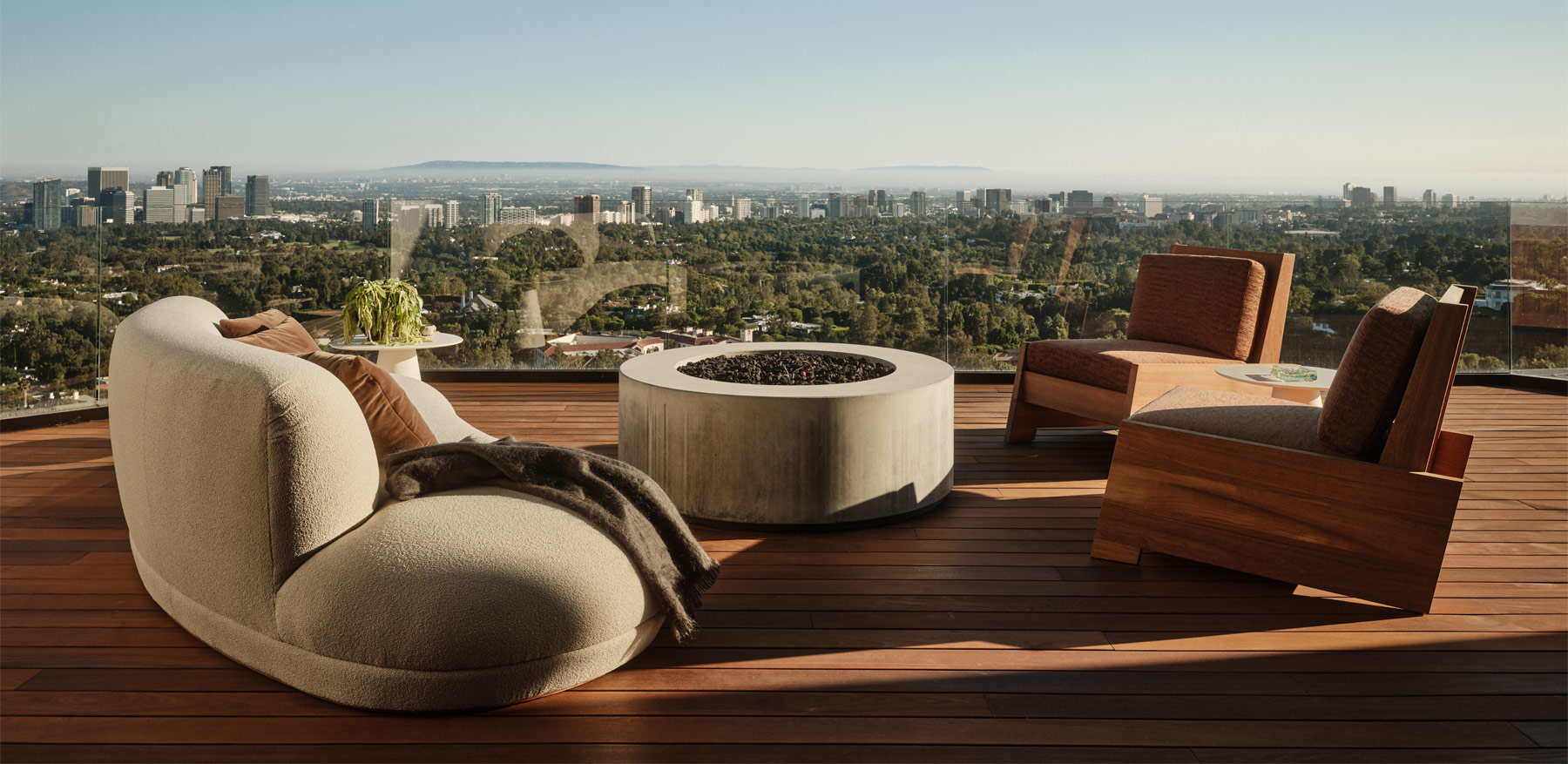
This synergy is exemplified in a recently completed project, a 7,000-square-foot, three-story house nestled in the west Hollywood Hills. “It’s almost a diamond shape, with intense views from downtown Los Angeles to Malibu,” Wood says of the angular, open-plan layout.
After refinishing millwork, honing stone surfaces and plastering and upholstering walls, Wood focused on finding furnishings that fit the brief given him by his clients, a New York City–based financier, his fiancée and their three-legged pit bull.
“They wanted comfort and durability, and they throw great parties,” Wood says, explaining that that meant his remit was to create both casual and cozy rooms just for them and large spaces that could still feel intimate for entertaining.
“Color became an important part of that conversation,” Wood continues, describing the aesthetic he and the clients landed on. “Rather than using anything overly bright or saturated, we gravitated toward more diffused, nuanced tones and layered them with rich fabrics and textures. The tactile quality of the materials was just as important as the palette.”
Take the white-oak-paneled library, which opens from the entry on the main floor. Here, a window wall offers wide views and plenty of natural light. Anchored by a floor-to-ceiling travertine fireplace, the room is bathed in rich woodsy greens and browns.
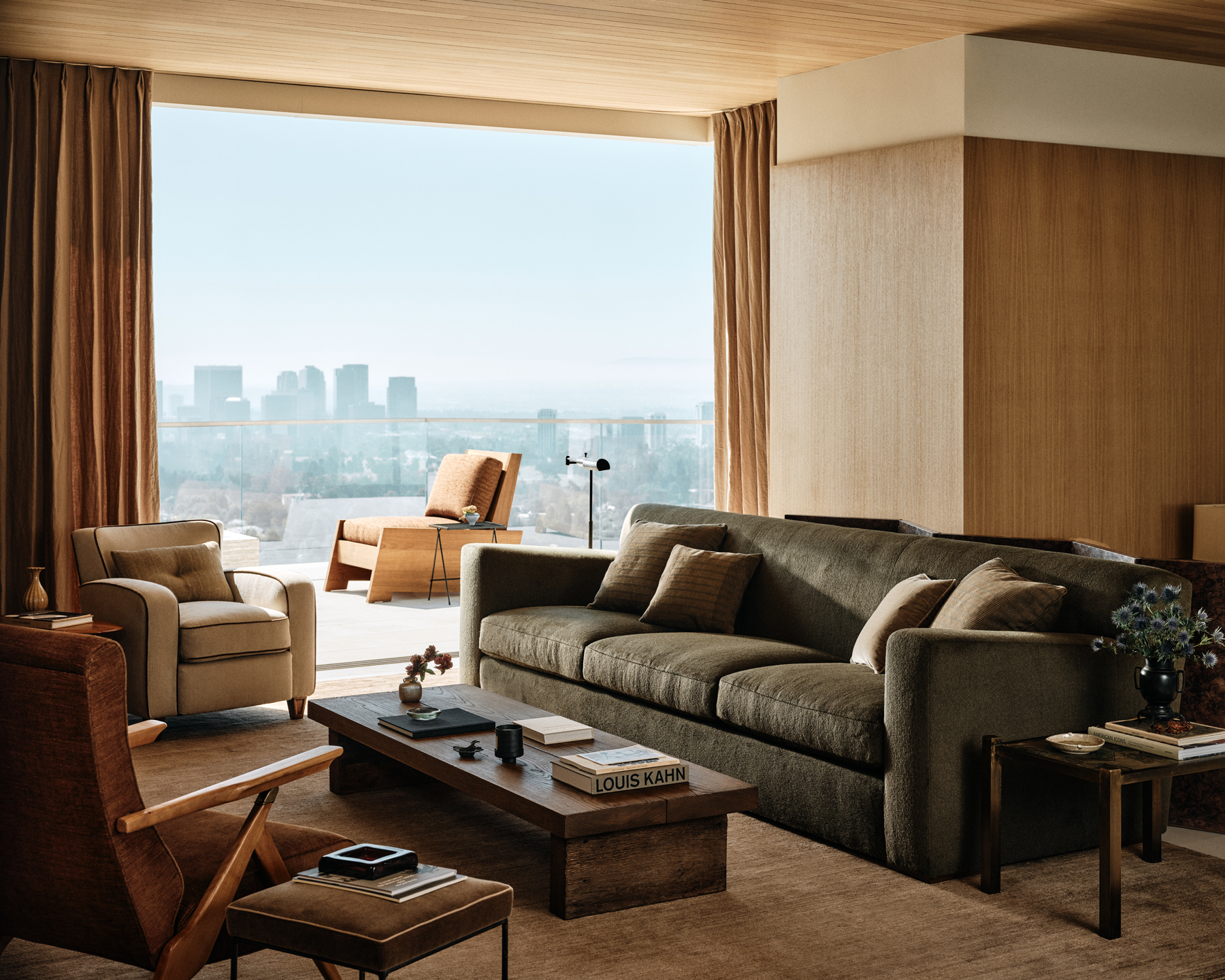
With their rectilinear forms, Wood’s custom coffee table and track arm sofa provide a counterpoint to a pair of plump 1940s Italian club chairs and a sleek, 1950s wood-framed reclining armchair by Carlo Mollino, next to which sits an early Paul McCobb Model 1305 stool.
To this arrangement, Wood added an etched-bronze side table by Philip and Kelvin Laverne, a modernist nod to antiquity. “It seems historic, and they rarely worked in rectangular shapes,” he says of the piece’s distinctive appeal, noting with a laugh, “I really wanted to keep it for myself.”
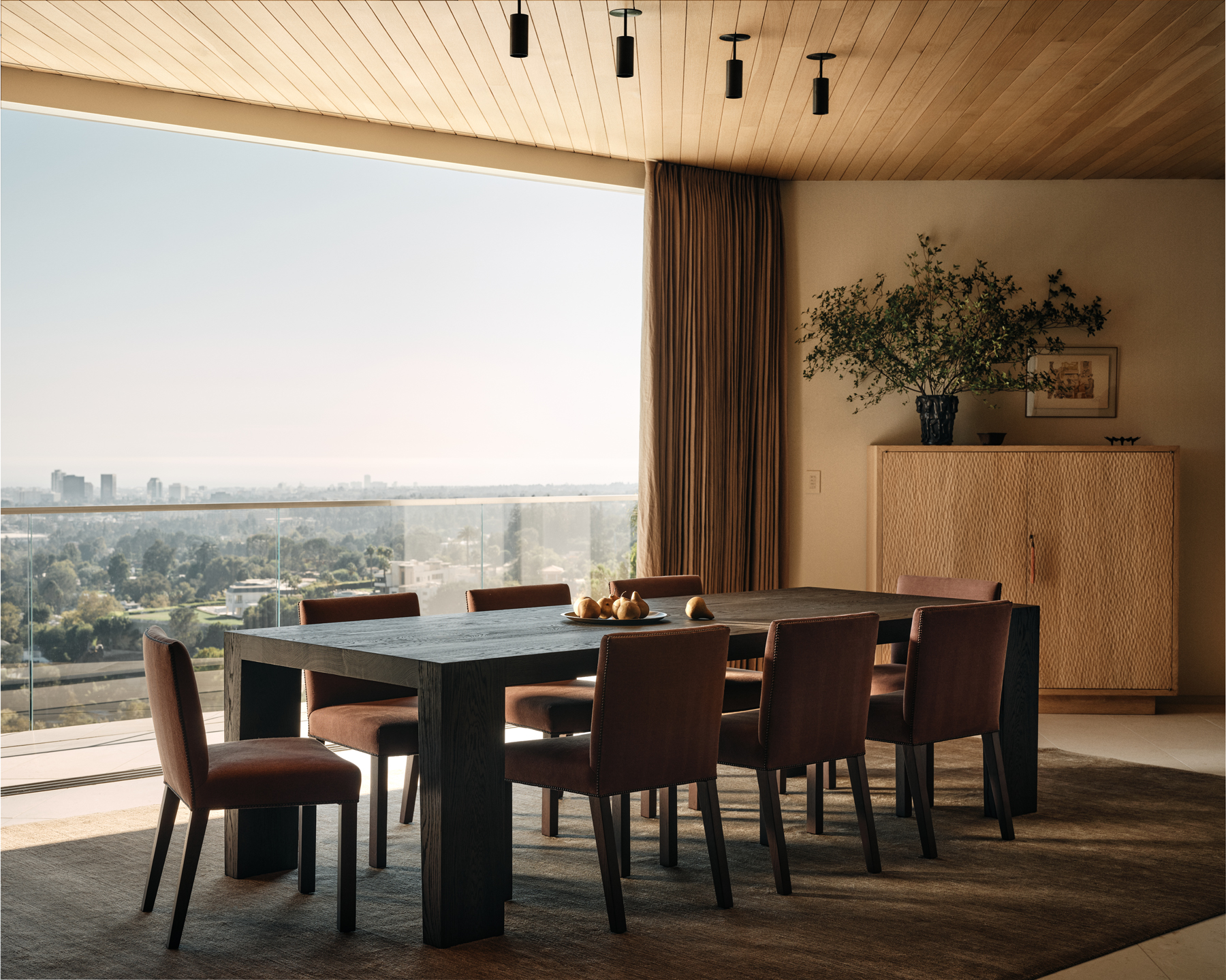
The wood-ceilinged dining room is a “more informal, intentionally masculine space,” says Wood, who kept the lighting minimal with monopoint ceiling fixtures and 1930s copper and opaline-glass sconces by Poul Henningsen, mounted above a walnut and bluestone console. The Parsons-style table is his own design.
On the lower level, a guest lounge off the two guest suites features a pair of 1940s Danish chairs Wood sourced from 1stDibs and covered in a gray wool velvet. Because the chairs weren’t exactly the same size, he had one rebuilt to create a perfectly matched duo. “I’m particularly obsessed with club chairs,” he says. “And when I saw the shape of these, I knew I’d love the way that light would bounce off this new fabric.”
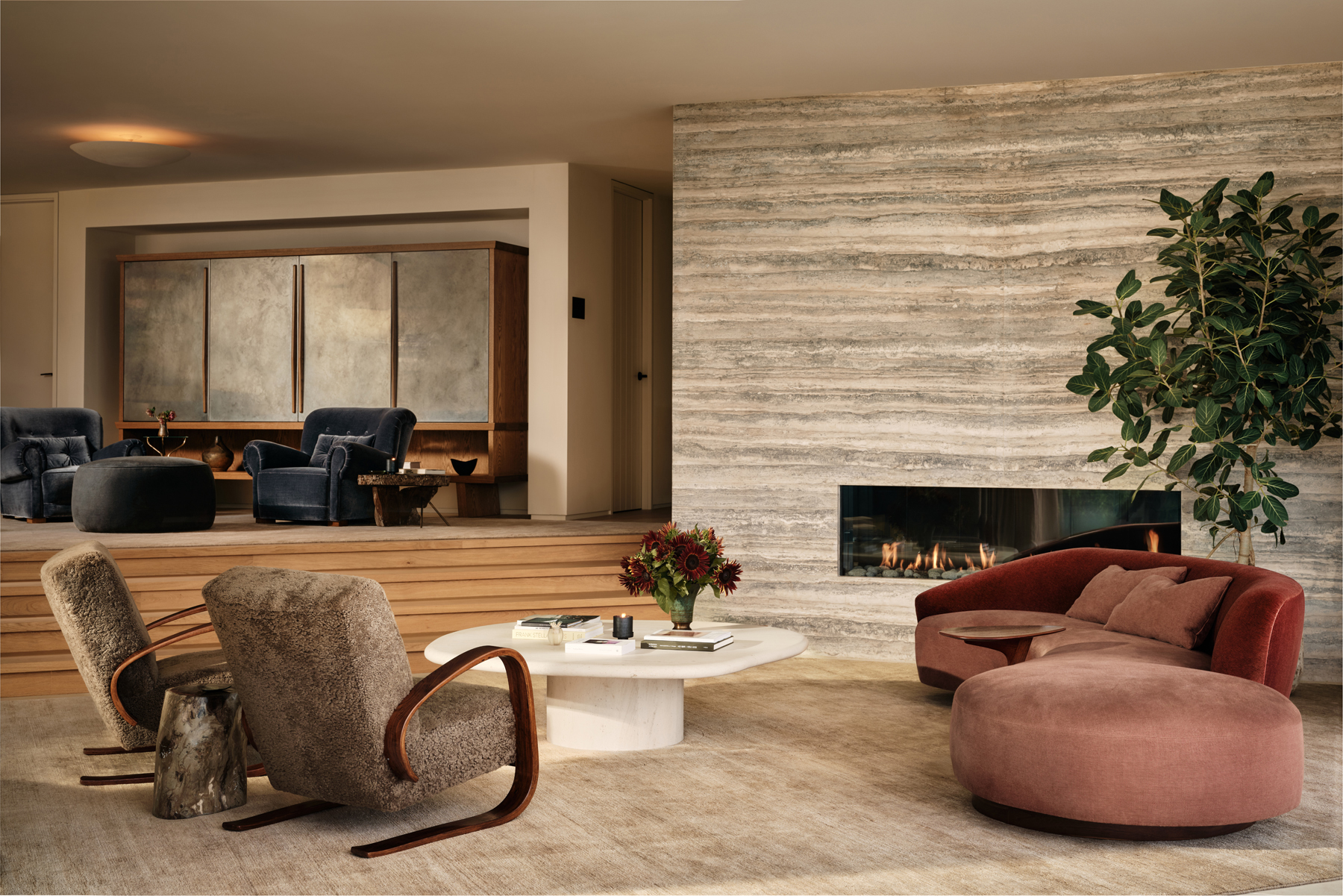
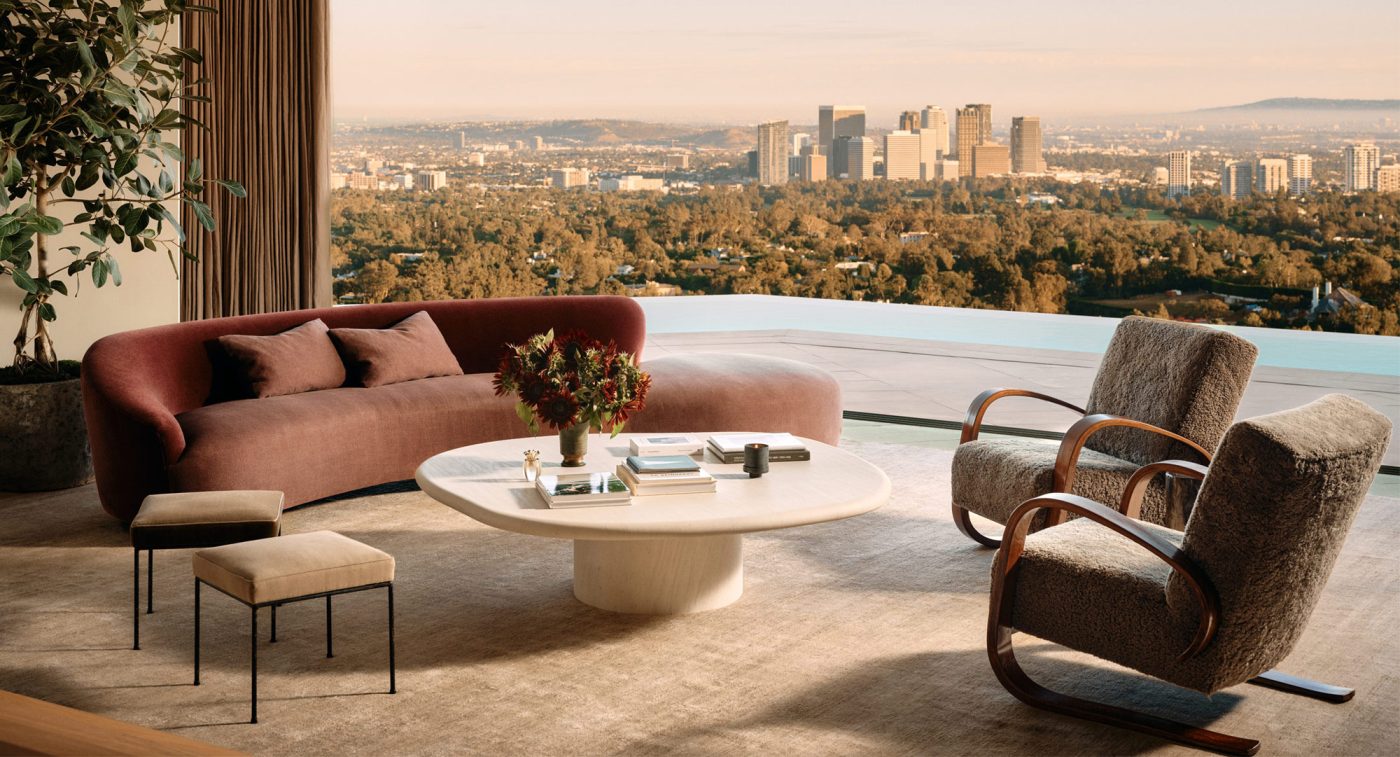
Beyond the guest lounge, the living room possesses a jet-set vibe, thanks to Art Deco armchairs cantilevered on sled legs, which appear to almost float, and a Vladimir Kagan Serpentine sofa that Wood covered in linen and mohair to emphasize its form. “It’s a piece of art that you can sit on,” he says.
Wood designed the round coffee table to suit the space. “The room required a center anchor, something with stone that wasn’t a strong color,” he says. “And the architecture is so angular that I needed something softer that you can move past and low enough to sit on the floor and use it. It works perfectly with that Kagan sofa.”
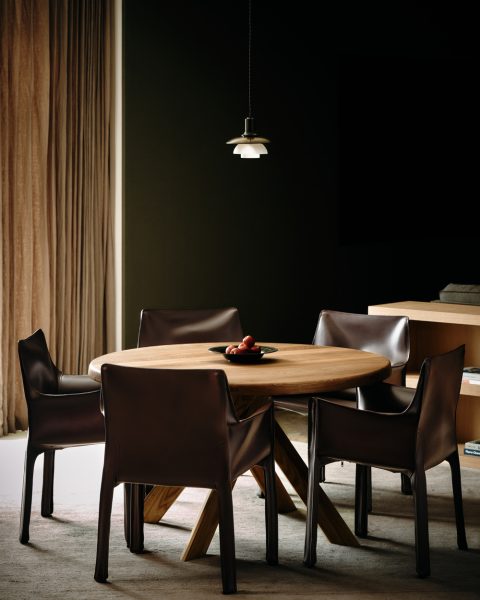
For the nearby games room, Wood selected a Pierre Chapo dining table and Mario Bellini leather Cab chairs. “It’s important to have a chair that will wear nicely, and these are perfect — architectural, without being too sharp. Light, durable and sexy at the same time,” he says.
Wood has long understood the allure of fine furnishings. The youngest of seven children, he was born in Arizona and lived in a series of homes in Washington and Utah, spending time antiquing with his mother and in the workshop with his building contractor father.
“Spaces affected the way I felt,” he recalls. “When I was a teenager, I made an entire furniture set in wood shop and painted my room chocolate brown. I had a cowhide rug and thrifted an Eames lounge chair, and I didn’t even know what it was. And I was obsessed with low lighting before I even knew I was gay.”
Before long, he was helping his friends’ parents decorate their homes. “I’m very dyslexic and wasn’t incredible in school,” he says, “but I could understand the language of a room.” Pursuing a college degree in interior design didn’t feel like a viable option, though, so he applied to a Paul Mitchell beauty school in Utah and, after graduating, in 2010, launched a career in hair styling.
The following year, Wood moved to Los Angeles, where he quickly gained a celebrity following. During the COVID shutdown, he began designing the homes of clients like Hudgens and Shay Mitchell. “I discovered that I thought in spatial terms,” he says, “and I could size up a room and start to source what it needed in my head.”
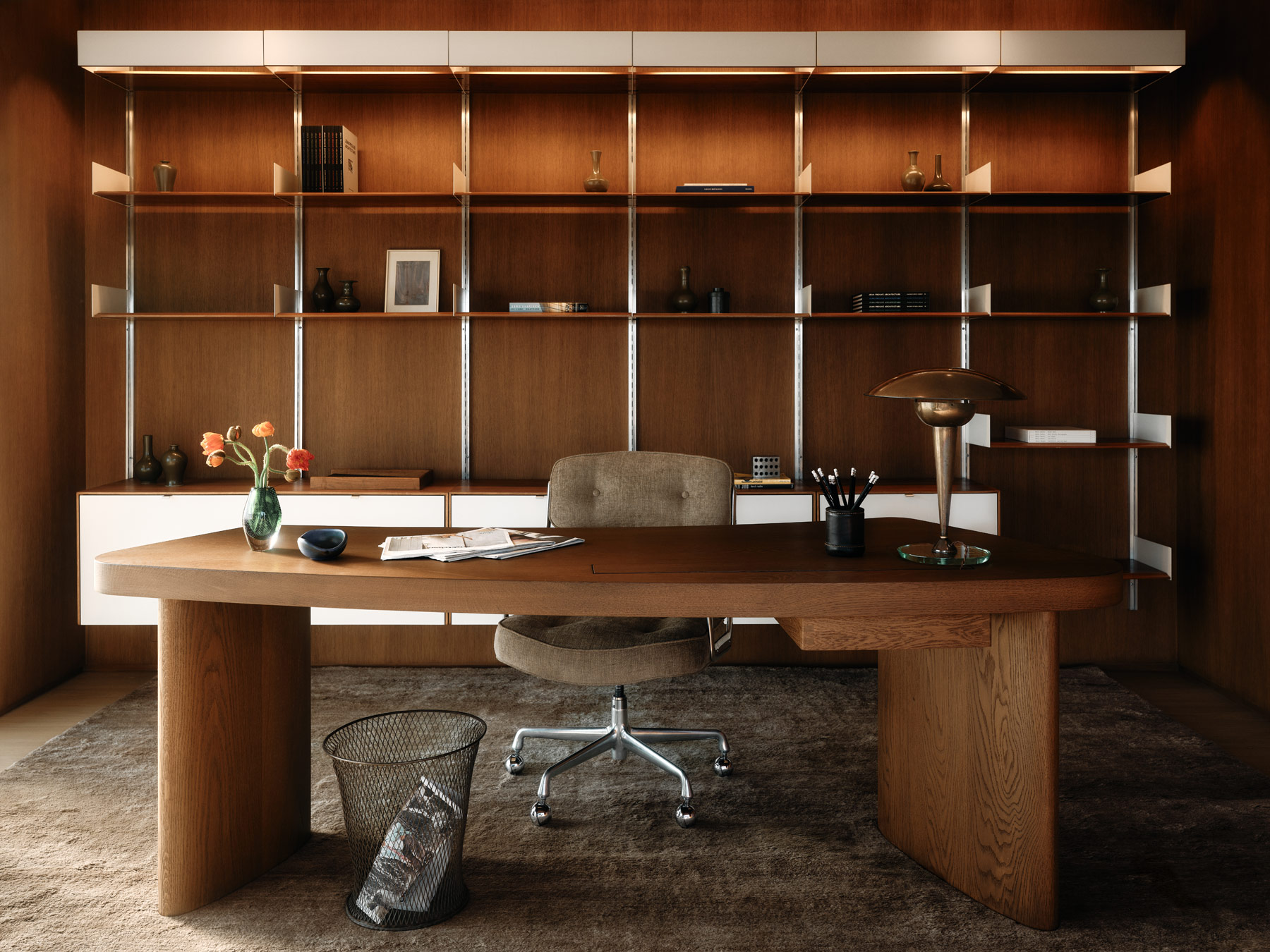
Wood relied on these instincts to transform the top floor of the Hollywood Hills house into a dramatic home office and plush primary suite. He paneled the walls of the former in white oak to set off a rare 1950s wall unit. Designed by Fred Ruf for Knoll, it sports white cabinet fronts, shelf dividers and integrated light fixtures.
When the clients requested an adjustable-height desk, Wood discovered that off-the-shelf models were “the most terrifying things I’ve ever seen.” He devised an elegant alternative, with Charlotte Perriand–inspired legs, designed to house the hydraulics and conceal the power cords for electronics.
To light the work surface, he purchased in Milan a brass-and-glass desk lamp reminiscent of Fontana Arte fixtures, which he had to disassemble to bring back in his suitcase. For seating, he chose a vintage black-leather Eames Aluminum Group desk chair, recovering it in a cozy Rosemary Hallgarten fabric — “to feel cozier,” he says, “and a little more seventies, like a real piece of furniture rather than a desk chair.” He partnered this with a pair of 1970s swivel chairs clad in mohair.
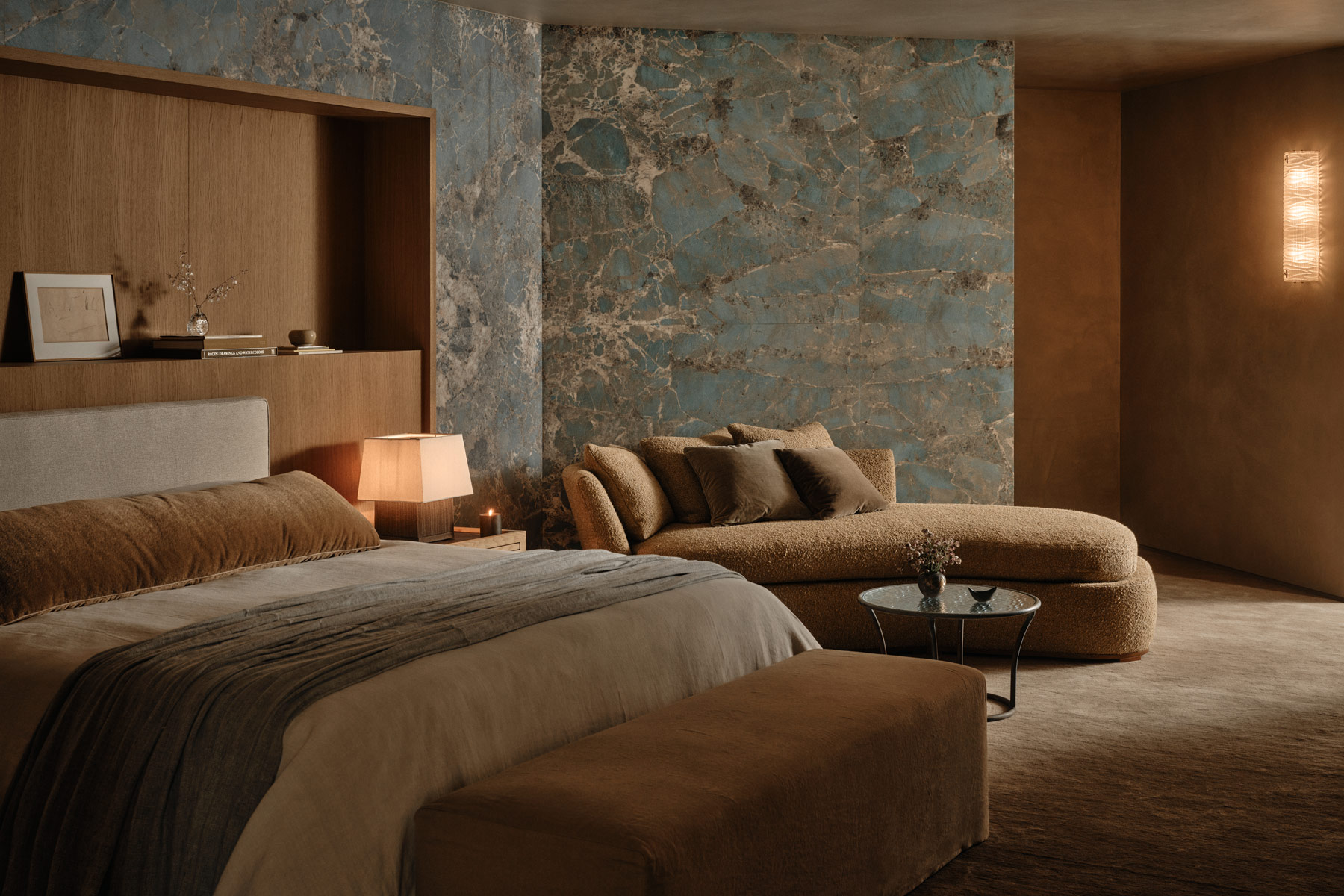
The primary bedroom has stone-clad walls, “a built-in funky feature that we worked around,” Wood says. “Although it’s not something I would’ve selected, it reminded me of Peter Marino’s 2023 design for the flagship Tiffany & Co. in New York, and once we honed it down, it became beautifully subdued and moody.”
The stone set the tone for a sylvan palette and luxurious appointments, including leather-topped bedside cabinets, contemporary Murano-glass sconces, a Studio Balestra mohair rug and a vintage Kipp Stewart bronze and glass side table that sits beside a curvaceous chaise.
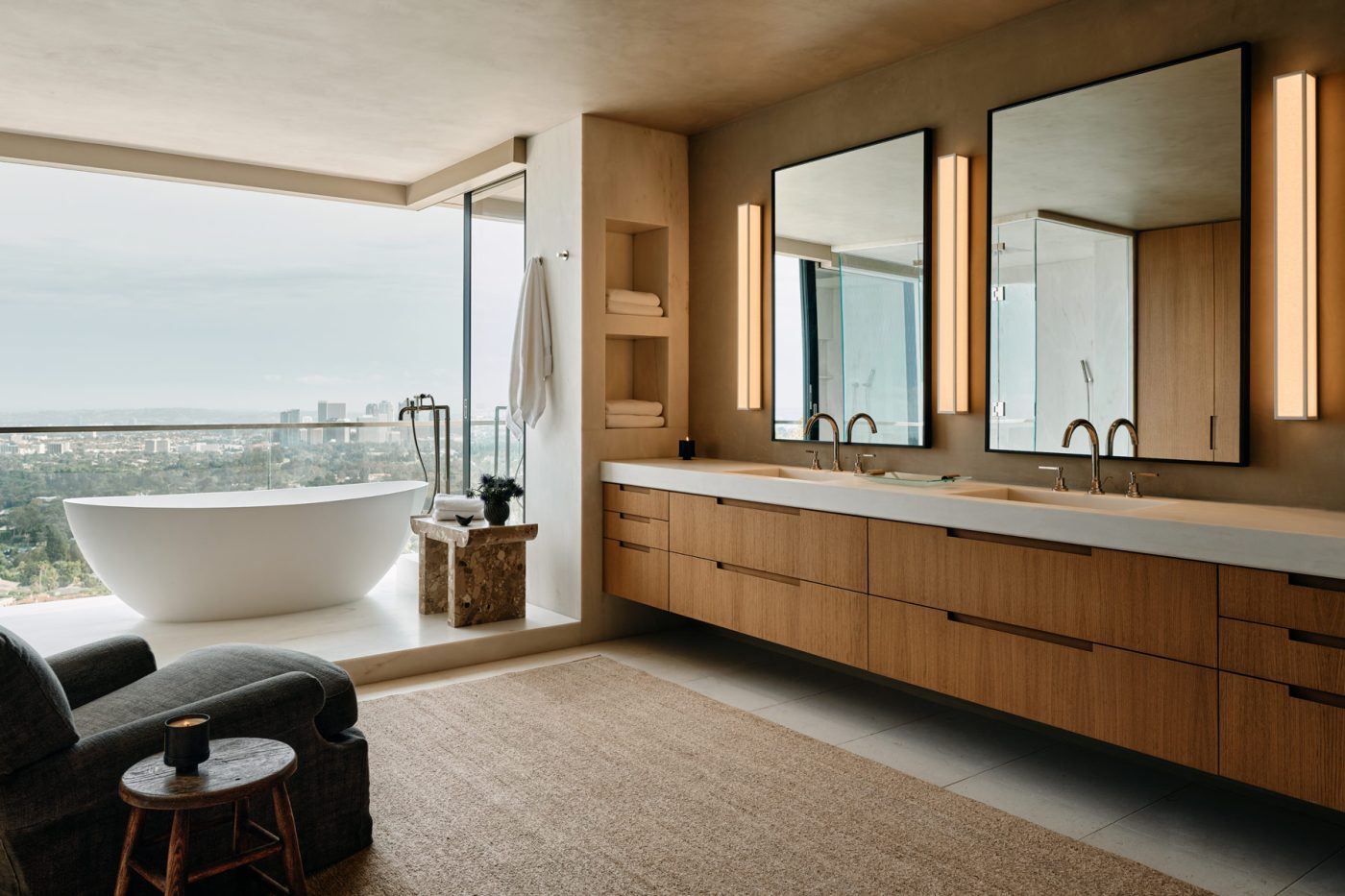
Wood reimagined the primary bathroom as a spa-like retreat, with an elevated modern tub perched near a wall of windows offering sweeping city views. In the walk-in closet, he incorporated an amenity he became used to over the years as a celebrity hairstylist: a vanity table with a free-standing bronze mirror and adjustable lighting.
“I like to do glam in the closet,” he says with a grin. “There’s too much steam in the bathroom.”