By Adolf Dehn
Located in Surfside, FL
ADOLF ARTHUR DEHN (American, 1895-1969)
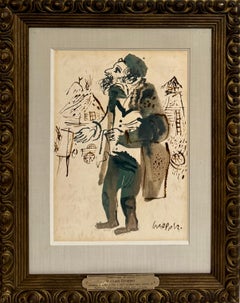
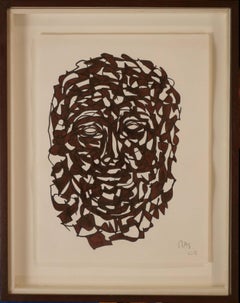
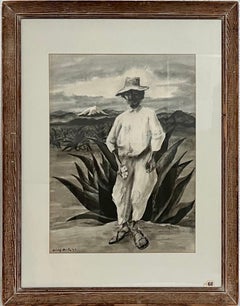
Portrait of Mexican Man with Agave Cactus plant, 1939, Gouache Painting
Hand signed and dated '39 lower left.
Whitney Museum of American Art, N.Y. Label verso
sight: 20.5 in. X 15 in. Frame is 32 X 24 inches
This was subsequently made into a lithograph in 1941 titled Man From Orizaba
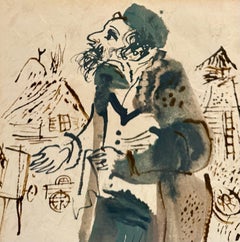
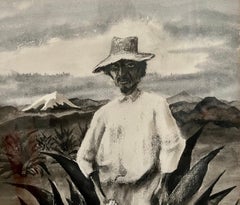
Standing in the foreground of an agave field is man wearing a straw hat, a white button up collared shirt, white pants and sandals. The man has shaggy black hair, a beard and moustache and large eyes. His right hand is clenched as if holding something and his left hand is open holding some flower-like objects. He stands in the middle of a large agave plant that expands the width of the composition. In the middle ground are large agave plants in subsequent rows. Behind the agave plantation is a mountain range with snow covered peak on the right hand side. Above the mountain range is a partially cloudy sky.
Adolf Dehn (November 22, 1895 – May 19, 1968) was an American artist known mainly as a lithographer. Throughout his artistic career, he participated in and helped define some important movements in American art, including regionalism, social realism, and caricature. A two-time recipient of the Guggenheim Fellowship, he was known for both his technical skills and his high-spirited, droll depictions of human foibles.
Dehn was born in 1895 in Waterville, Minnesota. He began creating artwork at the age of six, and by the time of his death had created nearly 650 images.
Dehn went to the Minneapolis School of Art (known today as the Minneapolis College of Art and Design), where he met and became a close friend of Wanda Gag. In 1917 he and Gág were two of only a dozen students in the country to earn a scholarship to the Art Students League of New York. He was drafted to serve in World War I in 1918, but declared himself a conscientious objector and spent four months in a guardhouse detention camp in Spartanburg, SC and then worked for eight months as a painting teacher at an arm rehabilitation hospital in Asheville, NC. Later, Dehn returned to the Art Students League for another year of study and created his first lithograph, The Harvest.
In 1921 Dehn's lithographs were featured in his first exhibition at Weyhe Gallery in New York City. From 1920 to 1921 in Manhattan, he was connected to New York's politically left-leaning activists. In 1921, he went to Europe. In Paris and Vienna he belonged to a group of expatriate intellectuals and artists, including Andrée Ruellan, Gertrude Stein, and ee cummings...
Category
1930s American Modern Adolf Dehn Paintings