By Roy Andersen
Located in San Antonio, TX
Roy Andersen
(1930-2019)
Arizona / Texas Artist
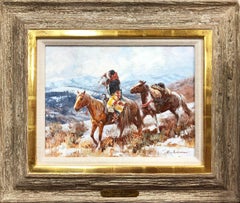
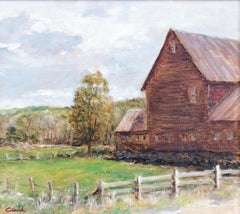
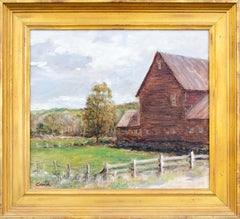
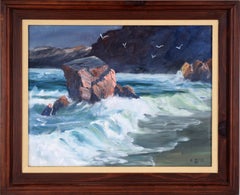
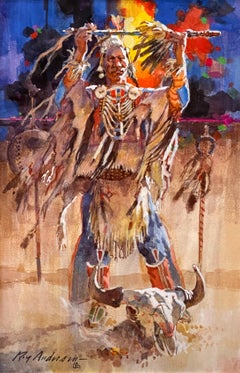
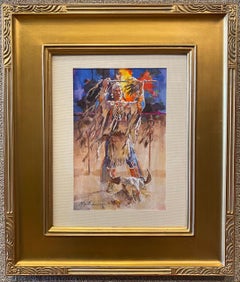
Image Size: 11 x 7.5
Frame: 21 x 17.5
Medium: Watercolor
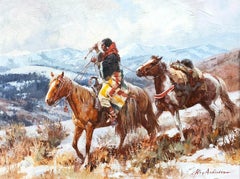
"Warrior"
Biography
Roy Andersen (1930-2019) Arizona / Texas Artist
In Roy Andersen’s The Medicine Pony, a Crow warrior stands in front of his white pony, holding a horse dance stick after a late afternoon rain. The man gazes toward the horizon while two other Indians wait behind him on their mounts. Painted on the white pony’s neck are symbols of dragonflies, which to the Crow people were messengers from the spirit world that carried dreams to individual warriors. “I was pretty proud of the piece,” Andersen, 82, says from his studio in Kerrville, Texas. “Some of them you struggle through, and sometimes they just paint themselves. Those are the ones that are really fun. This one went along the way I wanted.”
Authenticity is a hallmark of Andersen’s work. “I always like to try to get a little weather in my paintings,” he says of the sinking sun and afternoon rain in The Medicine Pony. The model for the white horse was a saddle horse Andersen used to own. He still uses the paint horses he raises as models. “I don’t know how many I have,” he admits. “I guess 25 or so.” Andersen also bought two longhorn steers to serve as models. “They’re pretty much pets,” he says. “I call them Gus and Woodrow, after [the characters in] Lonesome Dove.”
Growing up on a New Hampshire apple farm, Andersen had dreams of his own: “I wanted to grow up to be an Indian,” he says, “but found out that was a job I couldn’t get.” Another dream was to be an artist. “Nobody in my family had ever been that, and my parents said, ‘If that’s what he wants to be, well, we’ll try to help him.’ My father thought that I wasn’t strong enough to be a farmer and certainly not smart enough to be a carpenter, so if I wanted to be a painter, that was all right.”
Andersen studied at the Chicago Academy of Fine Arts and the Art Center School of Los Angeles, then became a professional illustrator, his work gracing National Geographic, Time and Sports Illustrated, as well as movie posters. His favorite poster was for Clint Eastwood’s The Outlaw Josey Wales (1976). “My wife was my agent then—she still is,” Andersen says. “I always told her that was my favorite job she ever got me.”
Living on the East Coast might have been good for a magazine illustrator, but Andersen’s heart belonged out West. “I was about 15 when I discovered The Field Museum in Chicago had all these cases of Indian artifacts,” he says. “I’d go down there drawing and sketching. I don’t know why, but I was always fascinated. My family’s all from Denmark, and my mother’s brother was the first to come over. His first job in the United States was a cowboy in Nebraska.”
Eventually, Andersen moved to Arizona, first Sedona—“The sunlight bouncing off those red rocks will screw a painting up faster than anything,” the painter recalls —and then Cave Creek. But the climate was hard on the horses he raises, so he moved to Kerrville. That was about 12 years ago.
Typically, Andersen will work on two or three paintings at the same time. “One on the easel, and two half-started,” he says. His inspiration comes from various sources. “Sometimes [a painting will] cook for a while,” he says. “I have sketchbooks, and I’ll scribble in there. Sometimes it’s a landscape I’ve seen and think that would be neat. I have a ton of books here, and I try to go to every museum that has Indian artifacts. I’ve collected some of my own and have had replicas made; they don’t cost as much as the real thing.”
Andersen stresses the importance of good research. “I love to do research. I guess that’s one of the reasons I hit it off with Geographic. I did a few Indian things—the first men in America, the Anasazi, and a thing on the Mayans. Course, I did space things and dinosaurs and everything else. But the Indian stuff is my main stuff.”
Source: History Online and Daily Times Obituaries
Submitted by: Ande Rasmussen
Photo of Roy Andersen
Known as a western painter, Roy Andersen did paintings of Crow, Cheyenne, and Apache Indians. He began his career living in Chicago and New York and working as an illustrator. He did numerous covers for Time Magazine including portraits of Albert Einstein and Prince Fahd. He also did illustrations for National Geographic magazine, and did a stamp series on Dogs and American Horses, and in 1984 and 1985, won Stamp of the Year Award. As a muralist, he has filled commissions for the National Park Service, the Royal Saudi Naval Headquarters, and the E.E. Fogelson Vistor Center at Pecos National Monument in New Mexico.
To pursue his talent for painting, Roy Anderson went West, living in Arizona and settling in Cave Creek. In 1990, he was voted official artist for Scottsdale's Parada del Sol, the "world's largest" horse-drawn parade commemorating the Old West.
Andersen grew up on an apple farm in New Hampshire and learned about Indian customs from his many hours spent at the Chicago Museum of Natural History. He is meticulous about being historically accurate in his paintings. Of him it was written: "There are no 'happy accidents' in an Andersen painting. He has a knowledge of his subject that is attained only through extensive research. You will not find an Apache medicine bag...
Category
21st Century and Contemporary Impressionist Roy Andersen Paintings