Items Similar to Art Deco Sculpture Signed Carlier
Video Loading
Want more images or videos?
Request additional images or videos from the seller
1 of 14
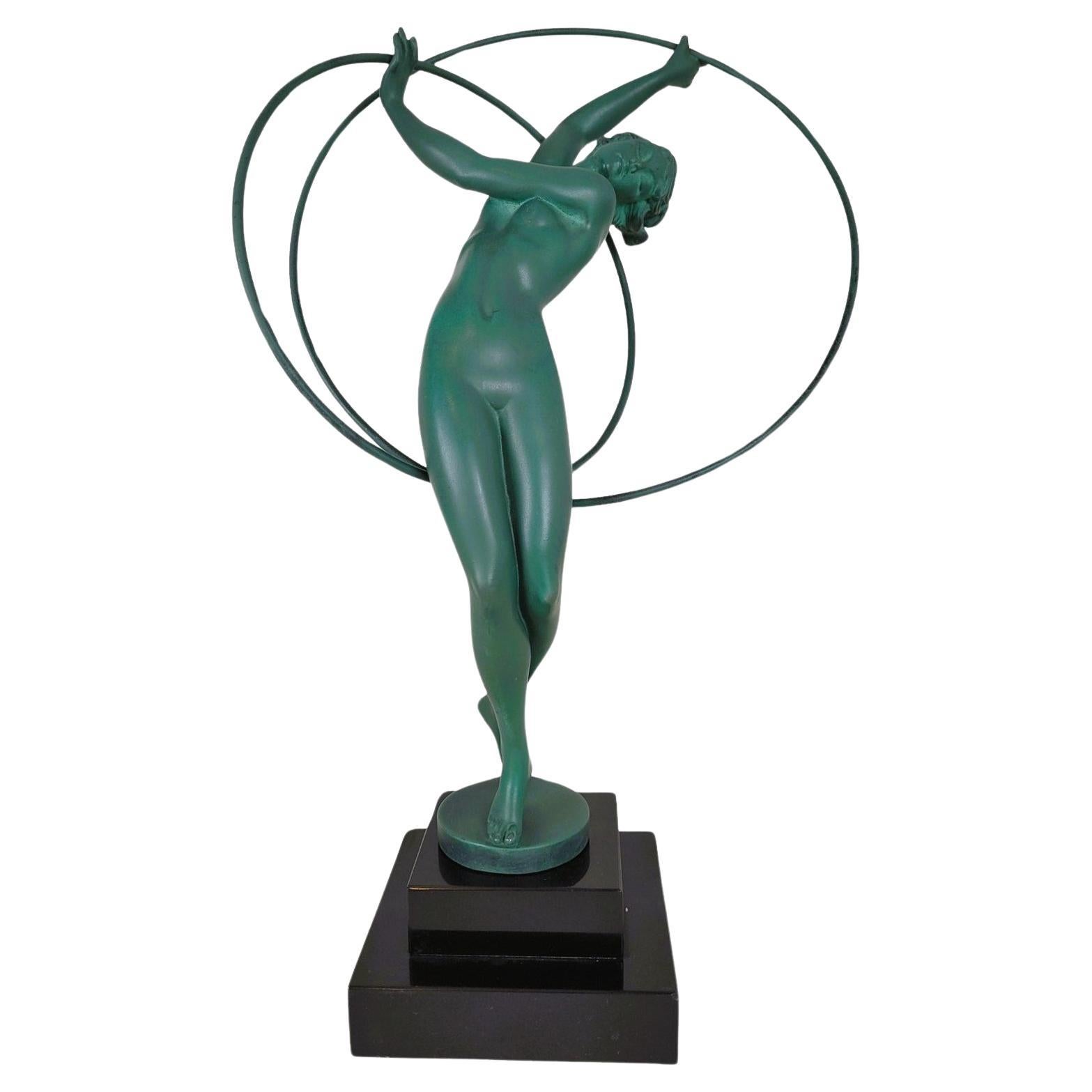
Art Deco Sculpture Signed Carlier
$4,742.55
£3,531.46
€4,000
CA$6,516.53
A$7,293.22
CHF 3,806.50
MX$88,939.72
NOK 48,718.04
SEK 46,117.86
DKK 30,448.50
Shipping
Retrieving quote...The 1stDibs Promise:
Authenticity Guarantee,
Money-Back Guarantee,
24-Hour Cancellation
About the Item
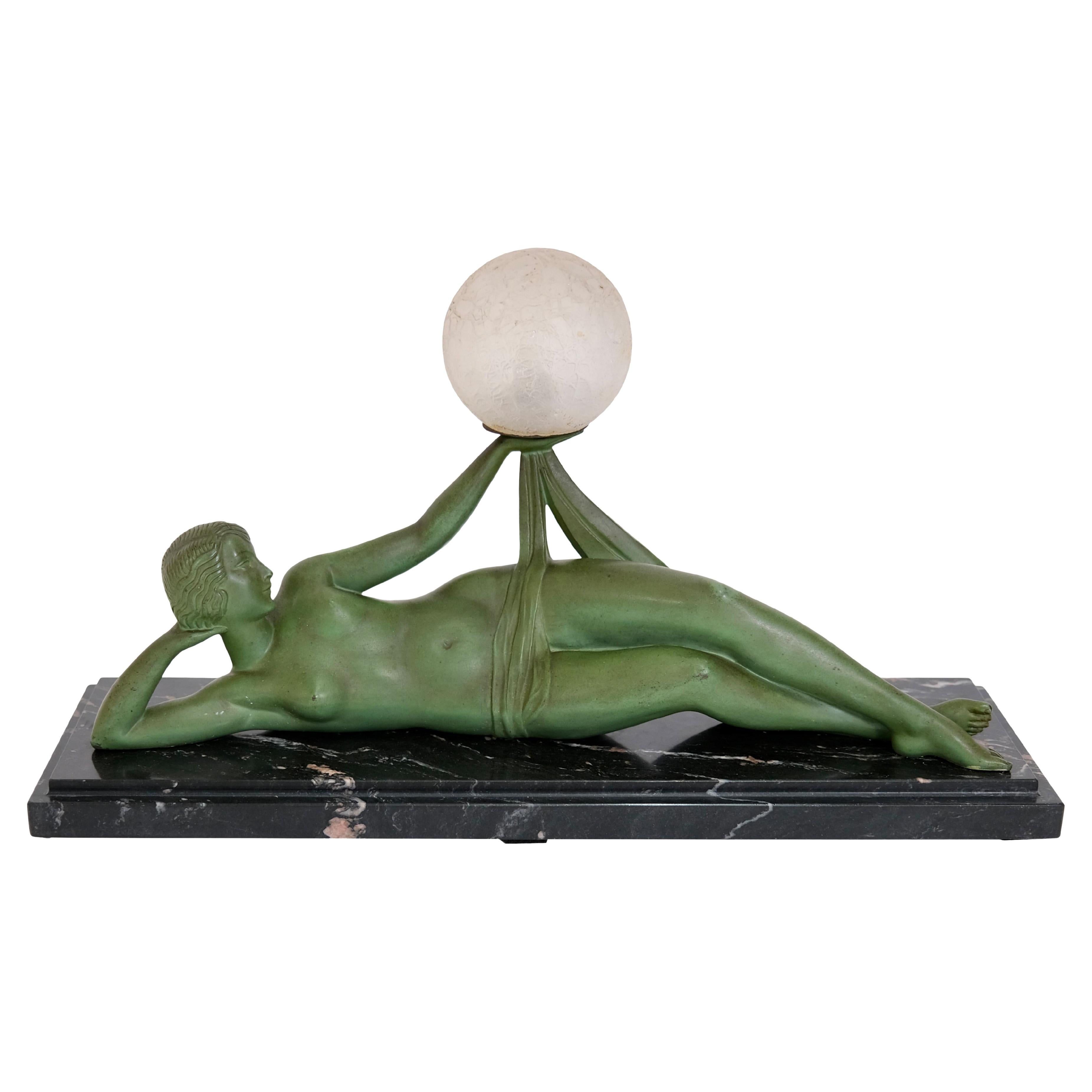
Large art deco illuminating sculpture, circa 1930.
Spelter sculpture on marble base.
Opalescent glass ball soap bubble.
In perfect condition and electrified
Length: 17,5 cm
Diameter: 15 cm
Height: 71 cm
Depth: 10,5 cm
Weight: 7kg
Sculptor - lives in Paris
born in Cambrai on January 3, 1849 and died in Paris on April 11, 1927
Joseph Carlier was born in a house on rue de la Prison, where Cambrai town hall now stands. His father is a cutler and a musician in his spare time. He wants to see his son become an architect or engineer of arts and crafts.
Pupil at the school of the Brothers, he will follow the courses of the municipal school of drawing under the watchful eye of his professors Berger, father and son. His father, fearing the ups and downs of an artist's life, was unenthusiastic about his son's professional choice. It was with the support of his mother that in 1864 he joined the workshop of the ornamental sculptor from Cambrai Lecaron, where he learned the trade by sculpting the stones of the cathedral of Cambrai. On this occasion, the young apprentice falls from a scaffolding and owes his salvation only to the strap of his bag which keeps him suspended from the mast.
He went to Paris to visit the Universal Exhibition of 1867 which reinforced his vocation as an artist. Not receiving any financial support from his parents, he had to do odd jobs and was hired by a furniture manufacturer in the Faubourg Saint-Antoine. Then he returned to Cambrai to follow the courses of the academic school in the studio of René Fache. A studious and diligent student, his teacher convinced Carlier's parents to let him settle in Paris to enter the École des Beaux-Arts. He obtained a scholarship from the city of Cambrai in 1869 and was admitted to Jules Cavelier's studio.
The professor provides a rigorously academic teaching. The war of 1870 interrupted his studies. Exempted from military service, he made a trip to his parents, then joined the Montrouge volunteers. He experienced his baptism of fire at the outposts of Bagneux and Buzenval, saw the orientalist painter Henri Regnault fall, himself received three shots and narrowly avoided the loss of his right arm. Proposed by his colonel for the cross he will say to him: "Give me the medal, that's enough". He received the military medal by decree of December 31, 1871, on the report of the Minister of War.
He attends the events of the Commune and goes in search of other horizons. Armed with a pistol and fifteen francs, he left for Spain, which he traveled on foot for six months. Hiring his services en route to stonemasons. Back in Paris he joined the studio of François Jouffroy, then entered the Académie Julian in the studio of Henri Chapu where he found his friend from Valenciennes, Léon Fagel.
Having never ceased to take an interest in his hometown and a member of several associations, he sat on the Cambrai reconstruction committee and took part in all the Parisian meetings where Cambrésiens were present.
On his death, the eulogy is pronounced by the poet Dévigne, A. Dorchain and the mayor of Cambrai G. Desjardins. Fernand Créteur reads his biography.
He is buried in Paris in the Montparnasse cemetery, near his parents-in-law.
works
In 1874, he made his debut at the Salon and subsequently exhibited every year. As a token of gratitude, he donated his first important work to the city of Cambrai. This is the stone statue of the Cambresian chronicler Enguerrand de Monstrelet, which he made in 1876 and which was erected in a public garden. It was destroyed by bombing in 1944.
In 1877, he designed his statue of The Resurrection which adorns the tomb of his sister-in-law in the Père-Lachaise cemetery in Paris. This work was commissioned from him for a funerary monument in the Recoleta cemetery in Buenos Aires, and he agreed to make a copy.
He exhibited Gilliat struggling with octopuses, which earned him a second medal at the Salon of 1879, then Before the Stone Age, which enabled him to obtain a travel grant and to visit Italy in 1881. In Florence, he modeled the sketch of The Blind and the Paralytic for which he was awarded the first medal at the Salon of 1883.
In 1885, he requested, without obtaining it, a workshop at the Mobilier national or at the quai de l'Alma for his sculpture work. In 1886, he applied for a block of marble, which was refused.
In 1888, he was commissioned to work on sculpture for the decoration of the Roubaix industrial school or the Universal Exhibition of 1889, which was unsuccessful.
In 1889, after his gold medal at the Universal Exhibition in Paris, he decided to transform his Gilliat which he exhibited at the Salon of 1890. His work was purchased by the State for the Luxembourg Museum. Having become a member of the jury of the Salon des artistes français, he had the rules revised. This same year, his request for a work of sculpture will be closed for the reason that in 1889 he was bought a statue at the Salon for the sum of 10,000 francs5. A new request in 1894 obtained the same answer.
At the end of the century, the city of Condé-sur-l'Escaut pre-selected him, as well as Léonie Duquesnoy and Jules Louis Mabille, to carry out the Monument de la Clairon, the native actress of this commune. It is finally Henri Gauquié who realizes the work.
He sculpts feminine grace with his masterpiece Le Miroir6, exhibited at the Universal Exhibition of 1900. This statue represents the character of Chrysis from the novel Aphrodite by Pierre Louÿs.
The follow-up given to his request to work on a sculpture for the Universal Exhibition of 1900, made in 1898, remains unknown.
For Condé-sur-Escaut, in 1907 he created the Monument to General Léon de Poilloüe de Saint-Mars, French general of division.
In 1904, he won a worldwide subscription launched for the creation of a Monument to the Vilmorins, erected in 1908 in a Parisian square.
He was called to Algiers in 1912 to reproduce the features of the Duke of Cars, the general of the conquest of 1830, and also to make the medallion of General Maurice Bailloud, the successor of the previous conqueror, for the realization of a bronze plaque. affixed to the obelisk of the War Memorial of the African Army, erected on the heights of Fort l'Empereur, inaugurated by the Governor General of Algeria Charles Lutaud, on October 21, 1912 and destroyed with explosives for the safety of the inhabitants of Algiers in 1943.
When the First World War broke out, he devoted himself to the work of refugees from the North and, as president of the Amicale de Cambrai, he devoted himself during the four years of the conflict with his friend Devignes to helping the people of Cambrésis. , driven out by war.
In 1916, Senator Paul Bersez thanked the Minister of Fine Arts for the purchase of a work [Which?] by the artist. In 1918, Carlier asked the Minister of Fine Arts for a post of Inspector of Fine Arts and informed him that some of the bronze statues placed in the gardens of Cambrai had been damaged by the bombardments of May 1944. He collaborated with the architect Castex has a monumental fountain project for the city of Reims.
After the war, he made bronzes of hairy people, copies of some of which adorn war memorials, in particular the statue of a soldier from the Great War bearing on its base "We don't pass!" which glorifies the fighters of Verdun.
- Creator:Émile Nestor Joseph Carlier 1 (Artist)
- Dimensions:Height: 27.96 in (71 cm)Width: 6.11 in (15.5 cm)Depth: 4.14 in (10.5 cm)
- Style:Art Deco (Of the Period)
- Materials and Techniques:
- Place of Origin:
- Period:
- Date of Manufacture:1930
- Condition:
- Seller Location:NANTES, FR
- Reference Number:1stDibs: LU7403234570732
About the Seller
No Reviews Yet
Vetted Professional Seller
Every seller passes strict standards for authenticity and reliability
1stDibs seller since 2022
45 sales on 1stDibs
Typical response time: 9 hours
- ShippingRetrieving quote...Shipping from: NANTES, France
- Return Policy
Authenticity Guarantee
In the unlikely event there’s an issue with an item’s authenticity, contact us within 1 year for a full refund. DetailsMoney-Back Guarantee
If your item is not as described, is damaged in transit, or does not arrive, contact us within 7 days for a full refund. Details24-Hour Cancellation
You have a 24-hour grace period in which to reconsider your purchase, with no questions asked.Vetted Professional Sellers
Our world-class sellers must adhere to strict standards for service and quality, maintaining the integrity of our listings.Price-Match Guarantee
If you find that a seller listed the same item for a lower price elsewhere, we’ll match it.Trusted Global Delivery
Our best-in-class carrier network provides specialized shipping options worldwide, including custom delivery.More From This Seller
View AllMax Le Verrier Art Deco Sculpture by Le Faguays
By Pierre Le Faguays
Located in NANTES, FR
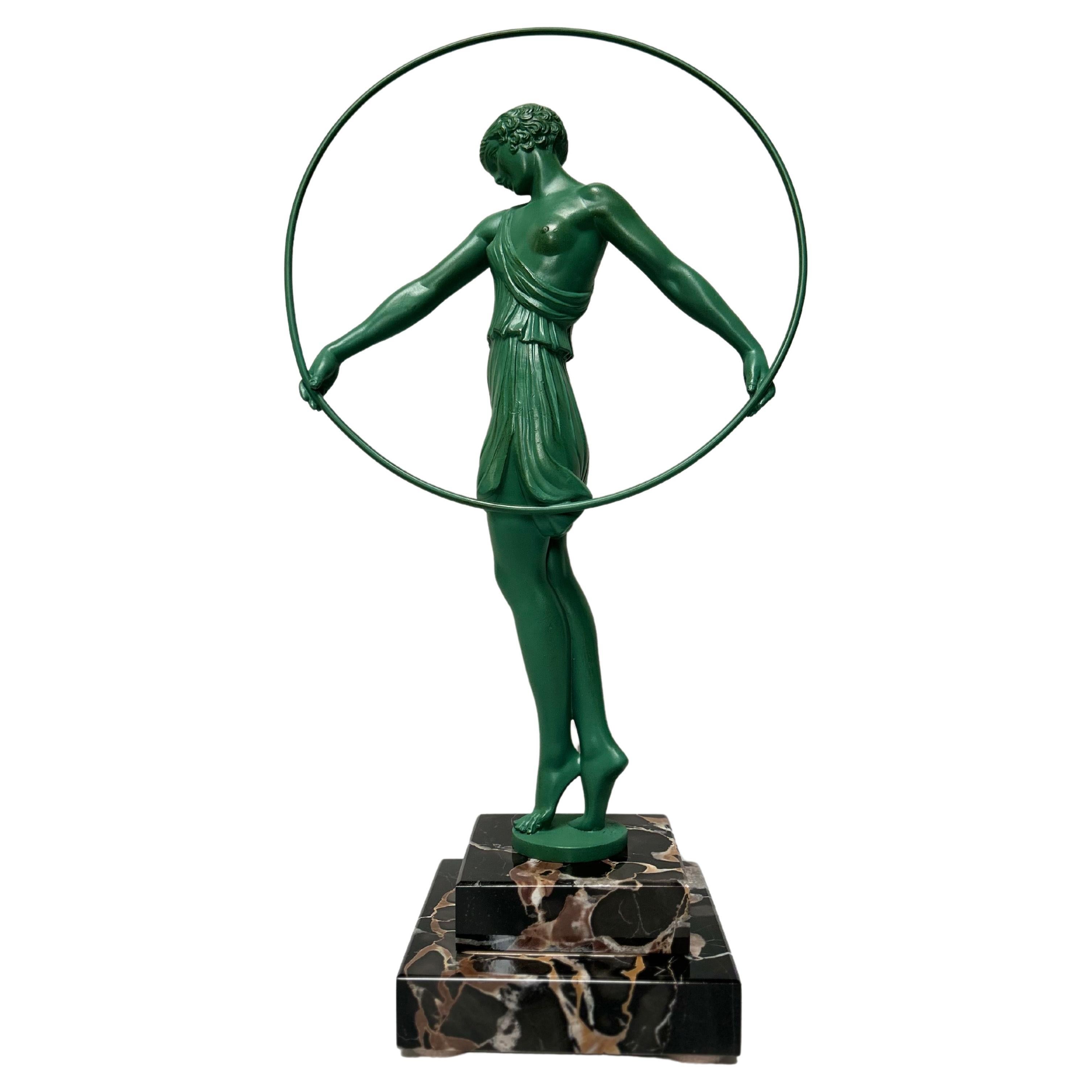
Large model of art deco sculpture "Danseuse aux cerceaux" pati. Subject in spelter with green patina on black marble base, signed on the base.
Model by Le Faguays published by Max Le...
Category
Mid-20th Century French Art Deco Figurative Sculptures
Materials
Marble, Spelter
Max le Verrier Atalante Art déco sculpture
By Max Le Verrier
Located in NANTES, FR
Art deco sculpture circa 1930 in spelter with green patina.
Large model, Portor marble base.
In perfect condition.
Signed on the marble M. le verrier
Total height: 80 cm
Width: 41 c...
Category
Mid-20th Century French Art Deco Figurative Sculptures
Materials
Marble, Spelter
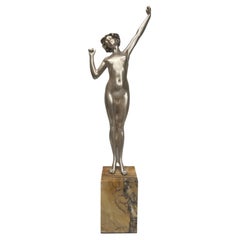
Awakening Art Deco Sculpture by Paul Philippe
By Paul Philippe
Located in NANTES, FR
Silvered bronze around 1925 on a marble base. s
Signed on the marble P Philippe.
In a perfect state
Total height: 64.5 cm 25.39 in
Depth: 15cm 5.9in
Width: 20cm. 7.87in
Bas...
Category
Vintage 1920s French Art Deco Figurative Sculptures
Materials
Marble, Bronze
Maurice Bouval Bronze Art Nouveau
By Maurice Bouval
Located in NANTES, FR
Maurice Bouval bronze with gilded patina signed M.Bouval and stamp of founder on a marble base portor.
Length: base 11 cm
Depth: 9,6 cm
Height: 30,...
Category
Early 20th Century French Art Nouveau Figurative Sculptures
Materials
Marble, Bronze

Art Deco Sculpture the Wounded Bird by H Moreau
By Hippolyte François Moreau
Located in NANTES, FR
Sculpture circa 1920 in spelter entitled "The Wounded Bird".
Executed by Hippolyte François Moreau.
Signed H Moreau.
Small chip on the marble, see on the l...
Category
Vintage 1920s French Art Deco Figurative Sculptures
Materials
Marble, Spelter

Alexandre Kelety Bronze Art Deco
By Alexandre Kéléty
Located in NANTES, FR
Art Deco bronze sculpture circa 1930.
A bronze girl with a double patina on a cream-colored marble base.
Note some wear on the patina.
Total height: 23 cm
Base width: 8 cm
Base dept...
Category
Mid-20th Century Art Deco Figurative Sculptures
Materials
Marble, Bronze
You May Also Like
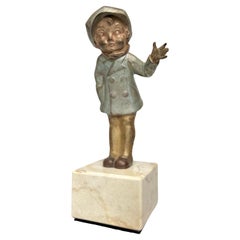
Sculpture, 1920, Art Deco, Sign: Akl. Ges.H.Gladenbeck & Sohn
Located in Ciudad Autónoma Buenos Aires, C
Sign:
Aktien-Gesellschaft Gladenbeck was a foundry located in Berlin, Germany, that operated from 1851 until 1926. During the 75-year period when the foundry was in operation it was...
Category
Vintage 1920s German Art Deco Figurative Sculptures
Materials
Marble, Bronze
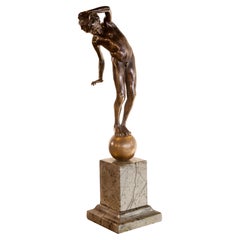
Art Deco Sculpture Author G. Arisse
By G. Arisse
Located in Buenos Aires, Argentina
Art Deco sculpture author G. Arisse
Origin France Circa 1930
Materials: white metal (patinated)
Very good conditions
Natural wear.
Category
Vintage 1930s French Art Deco Figurative Sculptures
Materials
Pewter
$2,240 Sale Price
20% Off
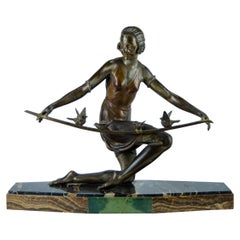
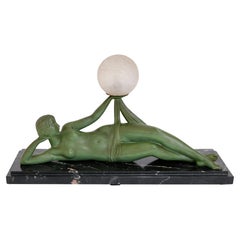
Max Le Verrier lighted Sculpture Aube French Art Deco vintage Table Lamp
By Pierre Le Faguays, Max Le Verrier
Located in Ulm, DE
“Aube” (French. break of dawn)
Designed in France during the roaring 1920s by “Fayral”, which is one of the pseudonymes from “Pierre Le Faguays” (1892-1962). His good friend and col...
Category
Early 20th Century French Art Deco Figurative Sculptures
Materials
Marble, Spelter
$3,734 Sale Price
25% Off
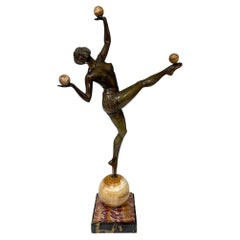
An Art Deco French bronze statue by Charles Henri Molins
Located in Delft, NL
An Art Deco French bronze statue by Charles Henri Molins
A bronze statue with a dancer juggling marble balls in Art Deco Style, raised on a square marble foot by Charles Henri Molin...
Category
Early 20th Century French Figurative Sculptures
Materials
Bronze
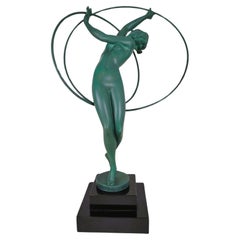
Illusion, Fayral And Max Le Verrier, Signed Sculpture, Art Deco, 20th Century
By Max Le Verrier
Located in MARSEILLE, FR
Illusion: Sculpture representing a naked dancer, playing with 2 hoops, standing on a stepped base in black marble
Green patina spelter, the base is signed by Fayral (pseudonym used ...
Category
20th Century French Art Deco Figurative Sculptures
Materials
Marble, Spelter
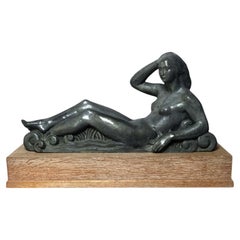
Art Deco Masterpiece Sculpture by René Buthaud
By René Buthaud
Located in Zurich, CH
This article features a striking statue by René Buthaud, a prominent French sculptor known for his mastery of form and material. Signed and measuring 70 cm in length, this piece exem...
Category
Vintage 1930s French Art Deco Figurative Sculptures
Materials
Metal
More Ways To Browse
Signed Architect
Art Deco Medallion
Vintage Safety Sign
Art Deco Cross
Gold Joseph Mayer
Art Deco Car Models
Car Bronze Sculpture
Aphrodite Sculpture
Vintage Tokens
Midcentury Shot Glasses
Vintage Dior Bag
Bronze French Soldier
Vintage Soap Art
Vintage G Straps
Art Deco Decorative Plaque
Mid Century Shot Glasses
Bronze Military Sculpture
Art Deco Marble Statues