Items Similar to Pair 19th Century Regency Style Carved Mahogany Cellarette Urns or Wine Coolers
Video Loading
Want more images or videos?
Request additional images or videos from the seller
1 of 9
Pair 19th Century Regency Style Carved Mahogany Cellarette Urns or Wine Coolers
$18,450per set
$34,500per set46% Off
£14,013.23per set
£26,203.60per set46% Off
€16,189.91per set
€30,273.82per set46% Off
CA$25,858.34per set
CA$48,353per set46% Off
A$28,940.35per set
A$54,116.10per set46% Off
CHF 15,104.64per set
CHF 28,244.44per set46% Off
MX$352,923.06per set
MX$659,937.42per set46% Off
NOK 193,318.80per set
NOK 361,490.44per set46% Off
SEK 183,001per set
SEK 342,196.99per set46% Off
DKK 120,823.16per set
DKK 225,929.48per set46% Off
Shipping
Retrieving quote...The 1stDibs Promise:
Authenticity Guarantee,
Money-Back Guarantee,
24-Hour Cancellation
About the Item
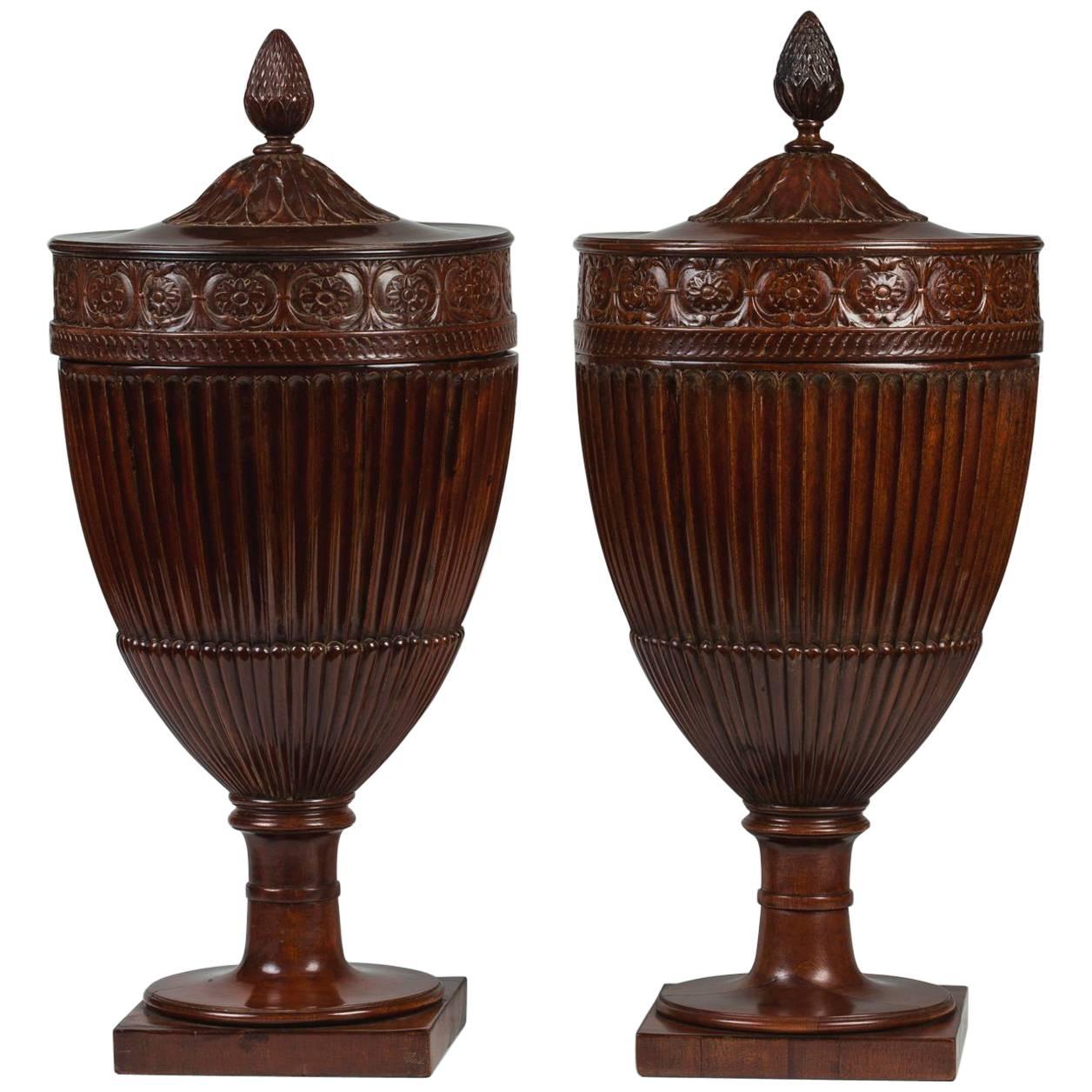
A very fine and rare pair of 19th century Regency style carved mahogany Cellarette urns or wine-drink coolers. The intricately carved ovoid shaped urn, decorated with acanthus leaves, wreaths and lilies, the removable lid top with a carved acorn finial and all raised on an heptagon base. The interior with their original copper metal-liners. Circa: Probably Irish, 1870-1880.
Cellarette or cellaret is a small furniture cabinet, available in various sizes, shapes, and designs which is used to store bottles of alcoholic beverages such as wine or whiskey. They usually come with some type of security such as a lock to protect the contents. Such wooden containers for alcoholic beverages appeared in Europe as early as the fifteenth century. They first appeared in America in the early eighteenth century and were popular through the nineteenth century. They were usually made of a decorative wood and sometimes had special designs so as to conceal them from the casual observer. They were found in pubs, taverns, and homes of the wealthy.
History
Wood box containers as freestanding alcoholic beverage cabinets first appeared in Europe in the fifteenth century to hold and secure alcoholic beverages in public houses. Cellarettes first appeared in colonial America in the eighteenth century as a form of the European liquor cabinet. The main purpose of a liquor cabinet or cellarette was to secure wine and whiskey from theft as the bottles were hidden and the cabinet could have a lock.
During the American Revolutionary War and the Civil War army officers' cellarettes often came with crystal decanters, shot glasses, pitchers, funnels, and drinking goblets. Eighteenth century cellarette designs were used into the twentieth century. Cellarettes of the eighteenth, nineteenth, and twentieth centuries were found in taverns and pubs and, in some cases, in the private homes of the elite.
Prohibition in the United States brought about variations of trompe-l'œil cellarettes designed to conceal illegal alcoholic beverages. To the casual observer, the three dimensional trompe-l'œil artwork on these cellarettes made them appear to be an ordinary table, bookcase, or other piece of furniture.
Cellarettes in England and America were custom designed wooden chests to carry, transport and store small numbers of bottled alcoholic beverages. They were often made of fine decorative wood like mahogany, rosewood, or walnut and could be of various shapes and sizes. Cellarettes were generally associated with dining room furniture. Sometimes cellarettes were small portable pieces of furniture with handles that could be moved from room to room in a house. Another type was a permanent piece of furniture built on a stand with a sliding shelf to hold glasses and a drawer for serving paraphernalia.
They could be free standing or built into a "pedestal-end" dining room buffet serving sideboard. Normally a cellarette had a hinged door or hinged top cover. Frequently a lock was provided, to secure the contents from thieves. Some cellarettes were lined internally with metal. This allowed wine or food to be iced keeping them longer than if they were at room temperature. The metal also prevented melted ice water from soaking into the wood. Men of wealth had as many as three cellarettes at a time as a status symbol, not necessarily indicating one was a heavy drinker.
In the late-18th and early-19th centuries, cellarettes were typically simple in design, following a Neoclassical aesthetic. Eventually, as Neoclassicism gave way to the more ostentatious Empire style, cellarettes became heavier and more ornate, emphasizing Roman and Grecian motifs. Some examples were made in the shape of sarcophagi mounted with lions' heads and animal-paw feet. Cellarette use declined in the 20th century due to the use of the refrigerator.
Measures: Height: 31 Inches (78.8 cm)
Width: 16 inches (40.1 cm)
Depth: 16 inches (40.1 cm)
Hexagonal Base: 12 1/2 by 12 1/2 (31.8 cm by 31.8 cm).
- Dimensions:Height: 31 in (78.74 cm)Width: 16 in (40.64 cm)Depth: 16 in (40.64 cm)
- Sold As:Set of 2
- Style:Regency (In the Style Of)
- Materials and Techniques:
- Place of Origin:
- Period:
- Date of Manufacture:circa 1870-1880
- Condition:Wear consistent with age and use. Minor losses. Minor fading. A truly beautiful and finely carved pair of wine or drink coolers. Overall condition is very good, with all original patina and interior liners. Very minor age wear and nick losses. Some have use these as a tea caddy storage. Please view all images.
- Seller Location:Los Angeles, CA
- Reference Number:Seller: Ref.: A2665 – Lot 114481stDibs: LU1796232940302
About the Seller
5.0
Vetted Professional Seller
Every seller passes strict standards for authenticity and reliability
Established in 1982
1stDibs seller since 2016
133 sales on 1stDibs
Typical response time: 1 hour
- ShippingRetrieving quote...Shipping from: Los Angeles, CA
- Return Policy
Authenticity Guarantee
In the unlikely event there’s an issue with an item’s authenticity, contact us within 1 year for a full refund. DetailsMoney-Back Guarantee
If your item is not as described, is damaged in transit, or does not arrive, contact us within 7 days for a full refund. Details24-Hour Cancellation
You have a 24-hour grace period in which to reconsider your purchase, with no questions asked.Vetted Professional Sellers
Our world-class sellers must adhere to strict standards for service and quality, maintaining the integrity of our listings.Price-Match Guarantee
If you find that a seller listed the same item for a lower price elsewhere, we’ll match it.Trusted Global Delivery
Our best-in-class carrier network provides specialized shipping options worldwide, including custom delivery.More From This Seller
View AllPair French 19th Century Napoleon III Empire Style Gilt-Bronze Urn Table Lamps
By Pierre-Philippe Thomire
Located in Los Angeles, CA
A fine pair of French 19th century Napoleon III Empire style patinated-bronze and gilt-bronze mounted allegorical covered urn vases lamps in the manner of Pierre-Philippe Thomire (Fr...
Category
Antique Late 19th Century French Empire Table Lamps
Materials
Bronze
$14,850 Sale Price / set
40% Off
Pair of French 19th-20th Century Giltwood Carved Standing Pedestal Planters
Located in Los Angeles, CA
A pair of French 19th-20th century Louis XV style giltwood carved figural three-legged standing pedestal planters Jardinières, each with carved figur...
Category
Antique Early 1900s French Louis XV Planters and Jardinieres
Materials
Giltwood
$5,685 Sale Price / set
24% Off
Pair of Tall French 19th Century Gothic Revival Style Carved Oak Church Pedestal
Located in Los Angeles, CA
A large pair of tall French 19th century Gothic Revival style carved oak and parcel-gilt Church pedestal stands. The slender body stands, each centred ...
Category
Antique 19th Century French Gothic Revival Pedestals and Columns
Materials
Gold Leaf
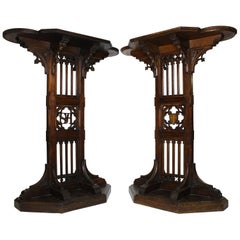
$9,895 Sale Price / set
46% Off
Fine Pair of French 19th Century Marble and Gilt Bronze-Mounted Flambeaux Urns
Located in Los Angeles, CA
A fine pair of French 19th century Rouge-Royal marble and figural gilt bronze-mounted flambeaux urns surmounted with four ormolu figures of dolphins supporting the center urn with th...
Category
Antique 19th Century French Louis XV Urns
Materials
Marble, Bronze
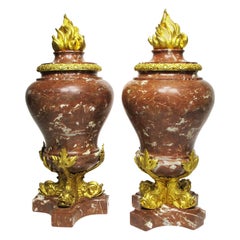
$19,850 Sale Price / set
43% Off
Pair French 19th Century Napoleon III Empire Style Gilt-Bronze Urn Table Lamps
By Pierre-Philippe Thomire
Located in Los Angeles, CA
A very fine pair of French 19th century Napoleon III Empire style patinated-bronze and gilt-bronze Mounted Allegorical covered Urn vases lamps in the manner of Pierre-Philippe Thomir...
Category
Antique Late 19th Century French Empire Revival Table Lamps
Materials
Marble, Brass, Bronze, Ormolu
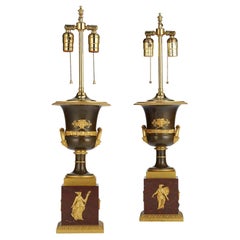
$12,950 Sale Price / set
31% Off
Pair of French, 19th Century Neoclassical Style Gilt Bronze and Marble Urn Lamps
Located in Los Angeles, CA
A very fine pair of French, 19th century neoclassical style gilt bronze-mounted marble urns. The ovoid form marble urns flanked by foliate scroll handles with satyr mask terminals, o...
Category
Antique Late 19th Century French Neoclassical Table Lamps
Materials
Marble, Brass, Bronze
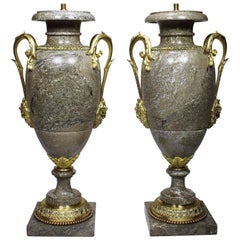
$12,950 Sale Price / set
21% Off
You May Also Like
Large Magnificent Antique Pair of Carved Mahogany Urns
Located in Suffolk, GB
Large magnificent antique pair of carved mahogany urns having profusely carved lift off lids with a pineapple shaped finial to the top, carved handles to the bases which boasts fabul...
Category
Antique 19th Century English Urns
Materials
Other

$9,079 Sale Price / set
20% Off
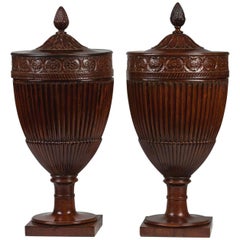
Pair of George III Carved Mahogany Dining Urns
Located in Kittery Point, ME
Each urn with a cone finial, the collar carved with interlaces and a tapered fluted body on a spreading socle. Formerly with spigots.
Provenance: Ginsburg & Levy, Inc., New York Bos...
Category
Antique Late 18th Century English George III Urns
Materials
Mahogany
$10,000 Sale Price / set
20% Off
Pair Monumental Carved Italian Urns Campana Grand Tour Planters
Located in Potters Bar, GB
You are viewing a gorgeous pair of large carved Italian urns of Campana form
Good size at over three feet tall - 91 CM
The quality to the carving is superb, really detailed carved ch...
Category
Vintage 1980s Urns
Materials
Wood
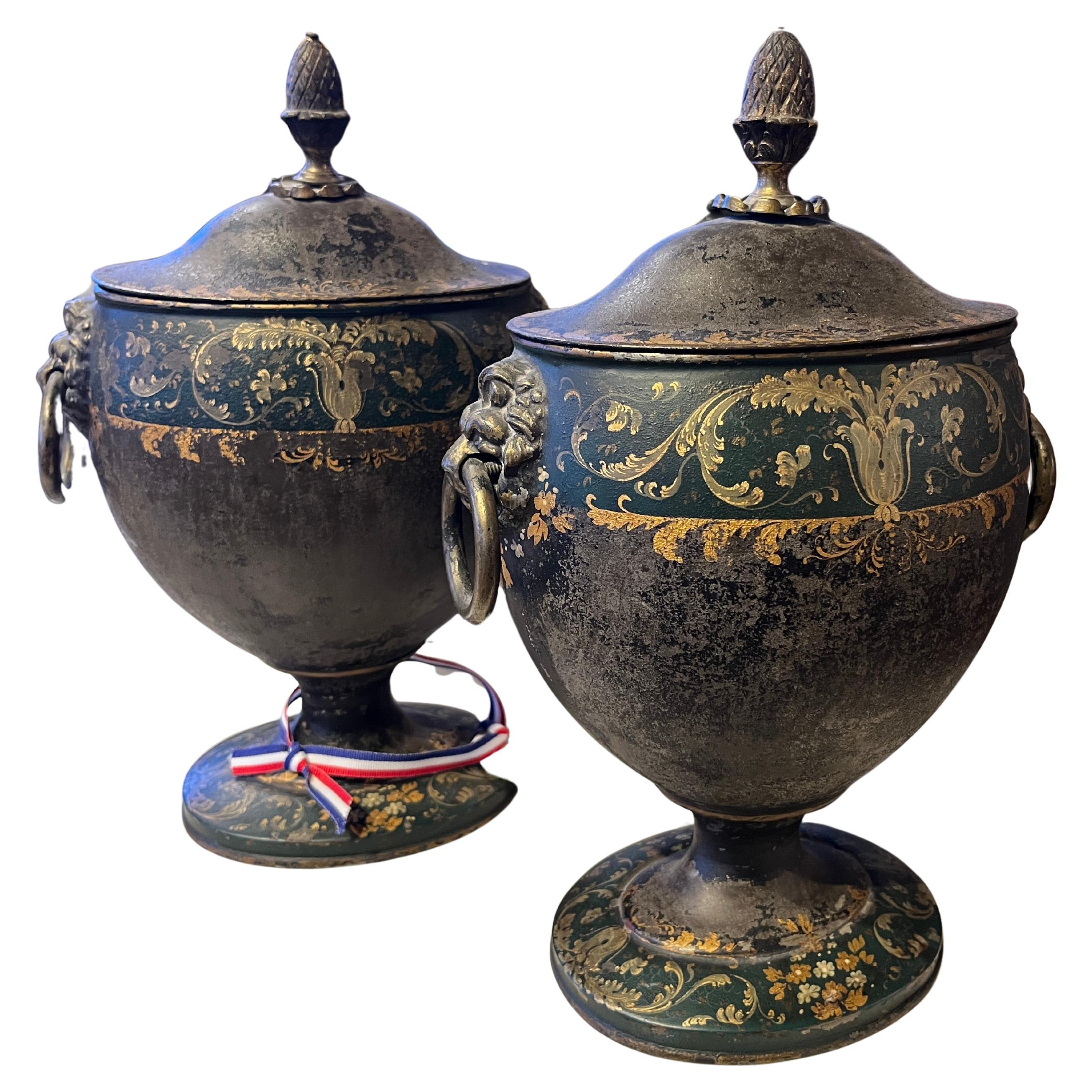
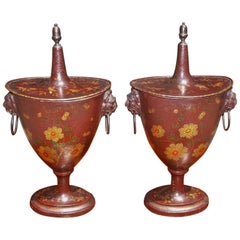
Pair of English Regency Tole Chestnut Urns, Circa 1810
Located in Charleston, SC
Pair of English Regency tole chestnut urns with hand-painted floral decorative motif, removable lids with acorn finials, original lions head side ha...
Category
Antique 1810s English Regency Urns
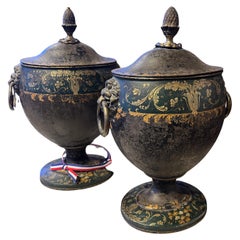
18th Century Pair English Regency Tole Chesnut Urns
Located in Scottsdale, AZ
18th Century Pair English Regency Tole Chestnut Urns
Unique Urns purchased in France.
See detailed photos.
Category
Antique 18th Century French Regency Urns
Materials
Chestnut
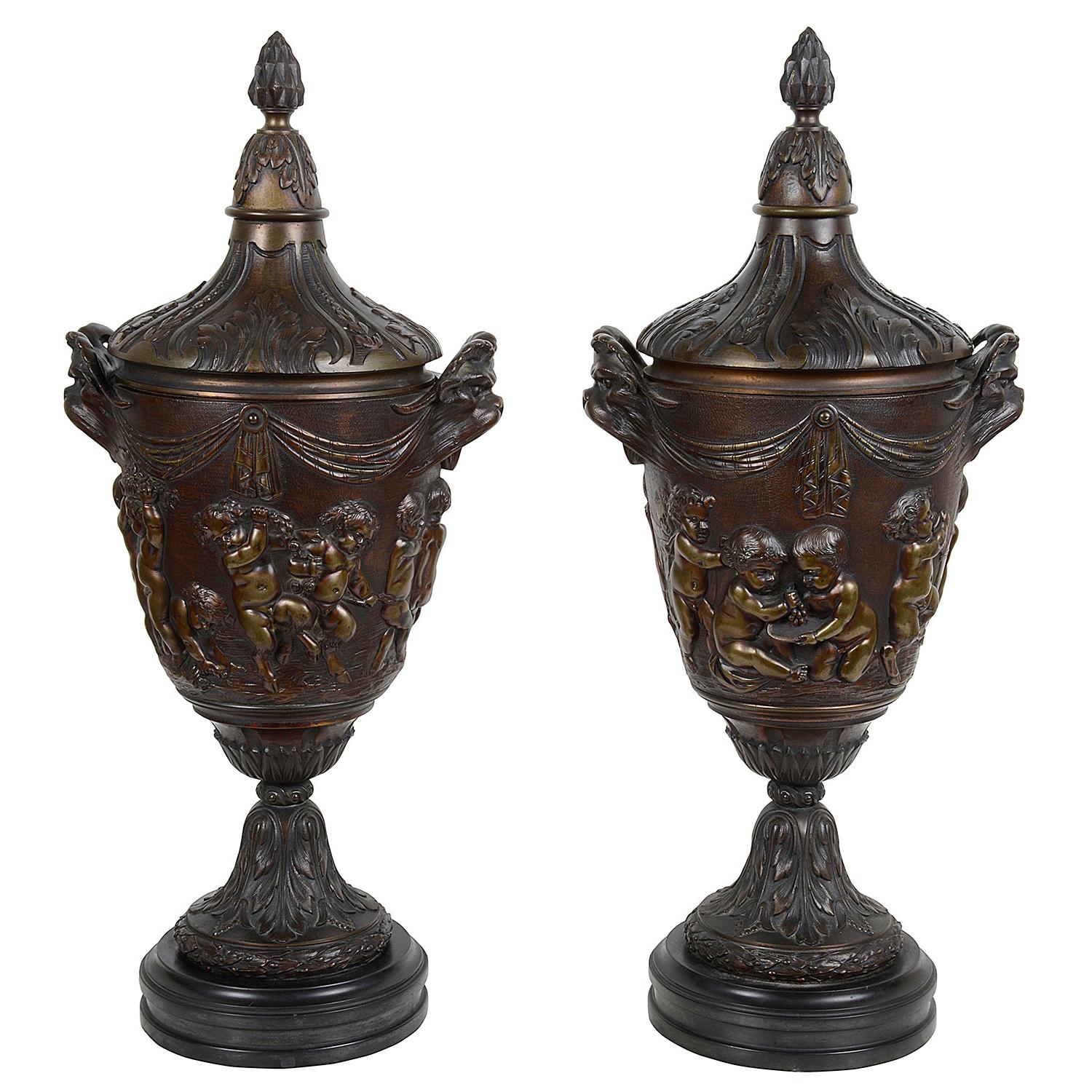
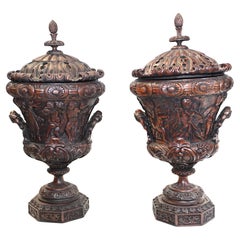
Pair of 19th Century Clodian Style Bronze Lidded Urns
By Clodion France
Located in Brighton, Sussex
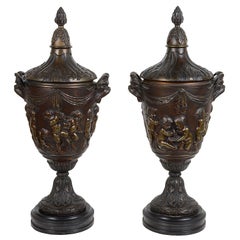
A good quality pair of 19th century French patinated bronze lidded urns after Clodian. Each with classical foliate decoration, mythical mask handles and scenes of Bacchus influenced ...
Category
Antique 19th Century French Urns
Materials
Bronze
More Ways To Browse
Urn Base Table
Antique Glass Urns
Antique Wood Urns
19th Century American Vases
Wood Carved Urn
Carved Wreath
Hand Carved Wood Vases
Roman Urn
Glass Urn Vases
Hand Carved Wood Vessel
Acorn Carved
Pair Of Metal Urns
Small Decorative Urns
Water Urn
Urn Pedestal Table
Regency Style With Lions
Revolutionary War Antique
Wooden Vase Stand