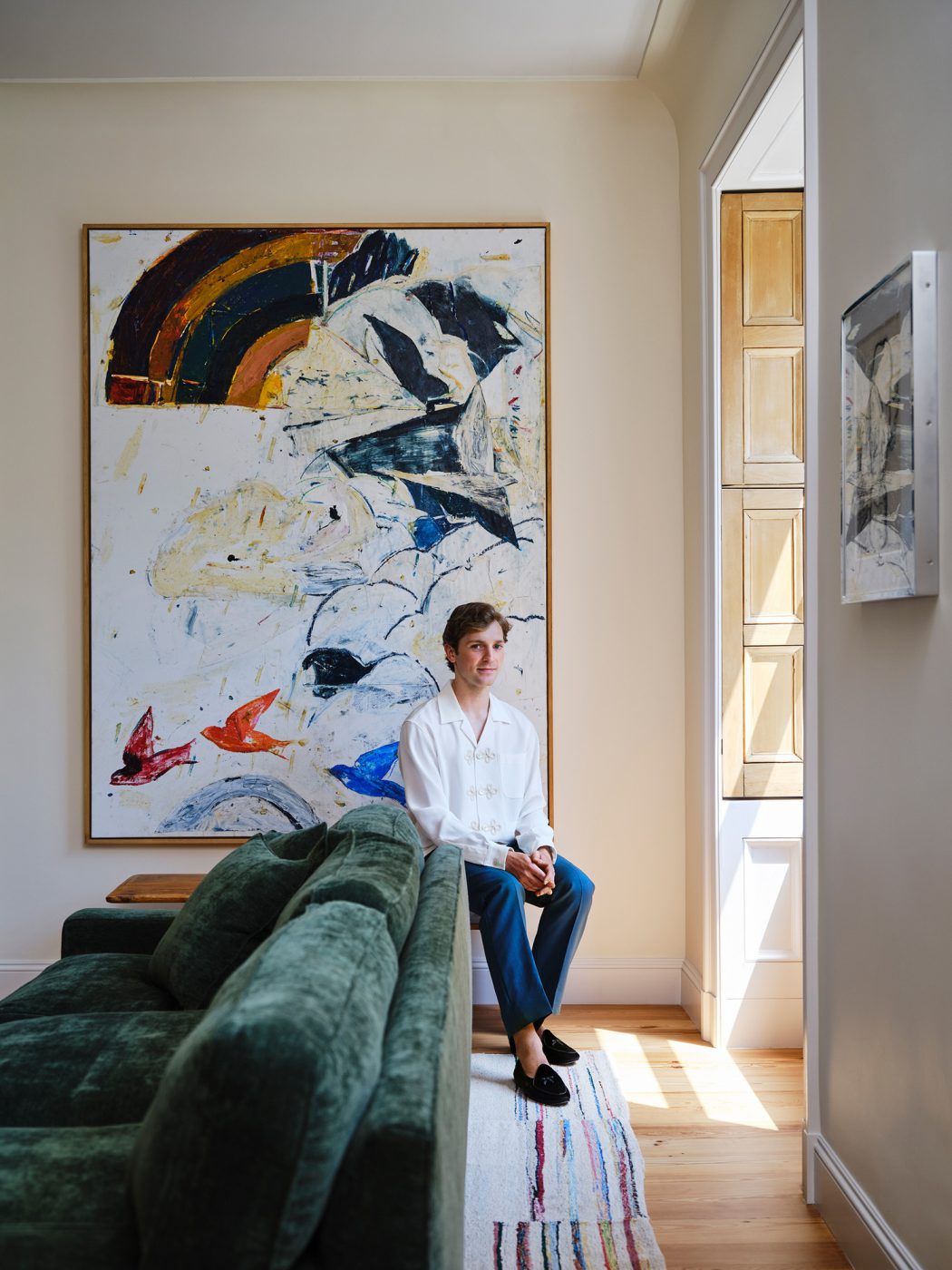
April 26, 2026Gunton Mark never studied interior design, and he spent less than two years working in the field before he went off on his own, in 2025. But Mark is a quick study, and more than that, he has, he says, the ability to think about interior design elements metaphorically, picturing rooms as ponds or mountaintops or forest clearings.
A raw-edged George Nakashima table symbolizes driftwood floating down a stream, a green chenille sofa could be a hedge, and a chandelier a flock of birds. “When I look at things,” he says, “I often see what they might be in other contexts.”
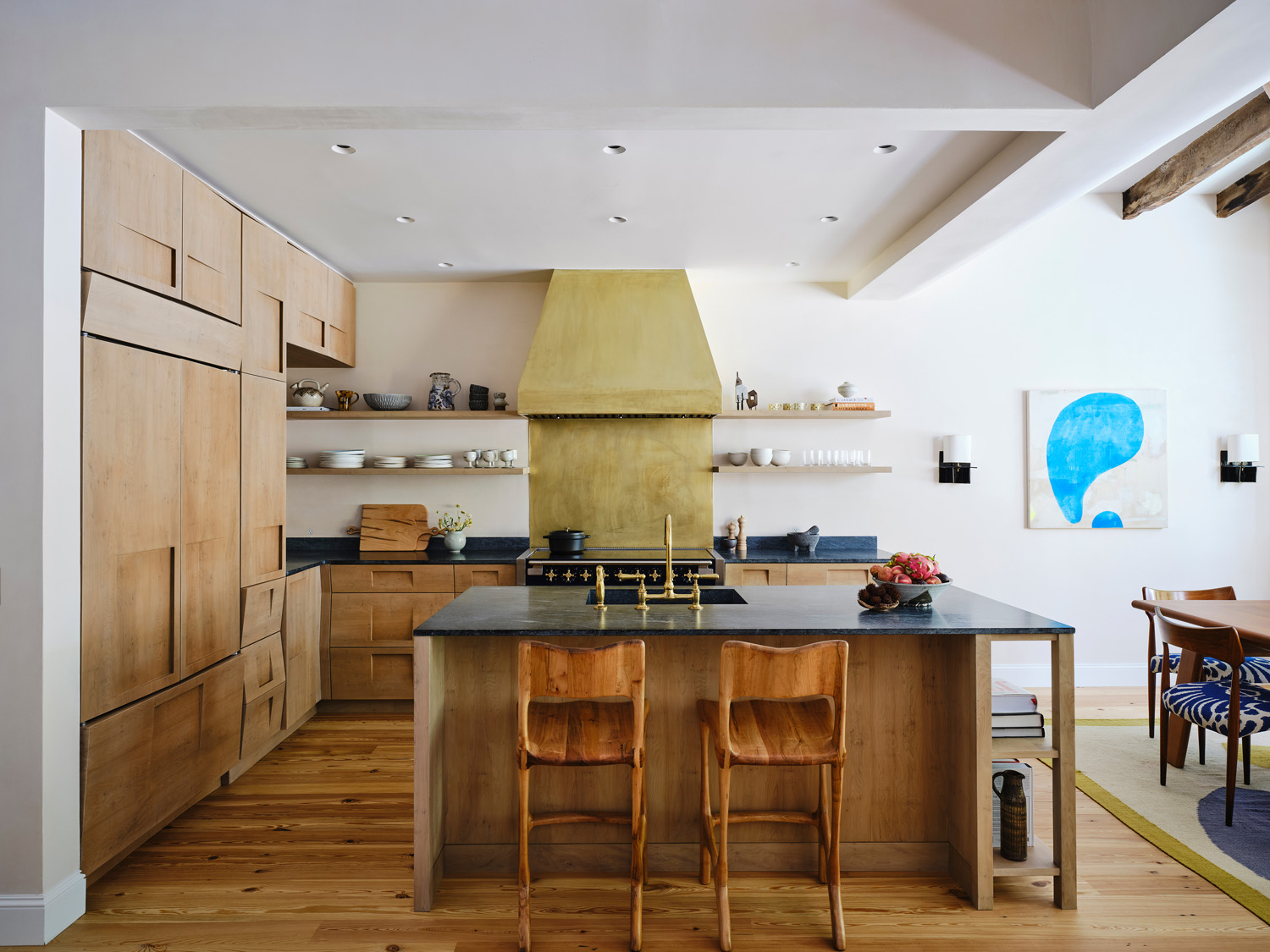
His first solo project, revamping the top two floors of an 1840s Greek Revival townhouse in Manhattan, exemplifies his approach. A novice at construction, he worked closely with Kim Letven, of NV/ design.architecture, on the permanent aspects of the renovation. Gutting the apartment, they shifted some walls to improve sight lines and bring light deep into the space.
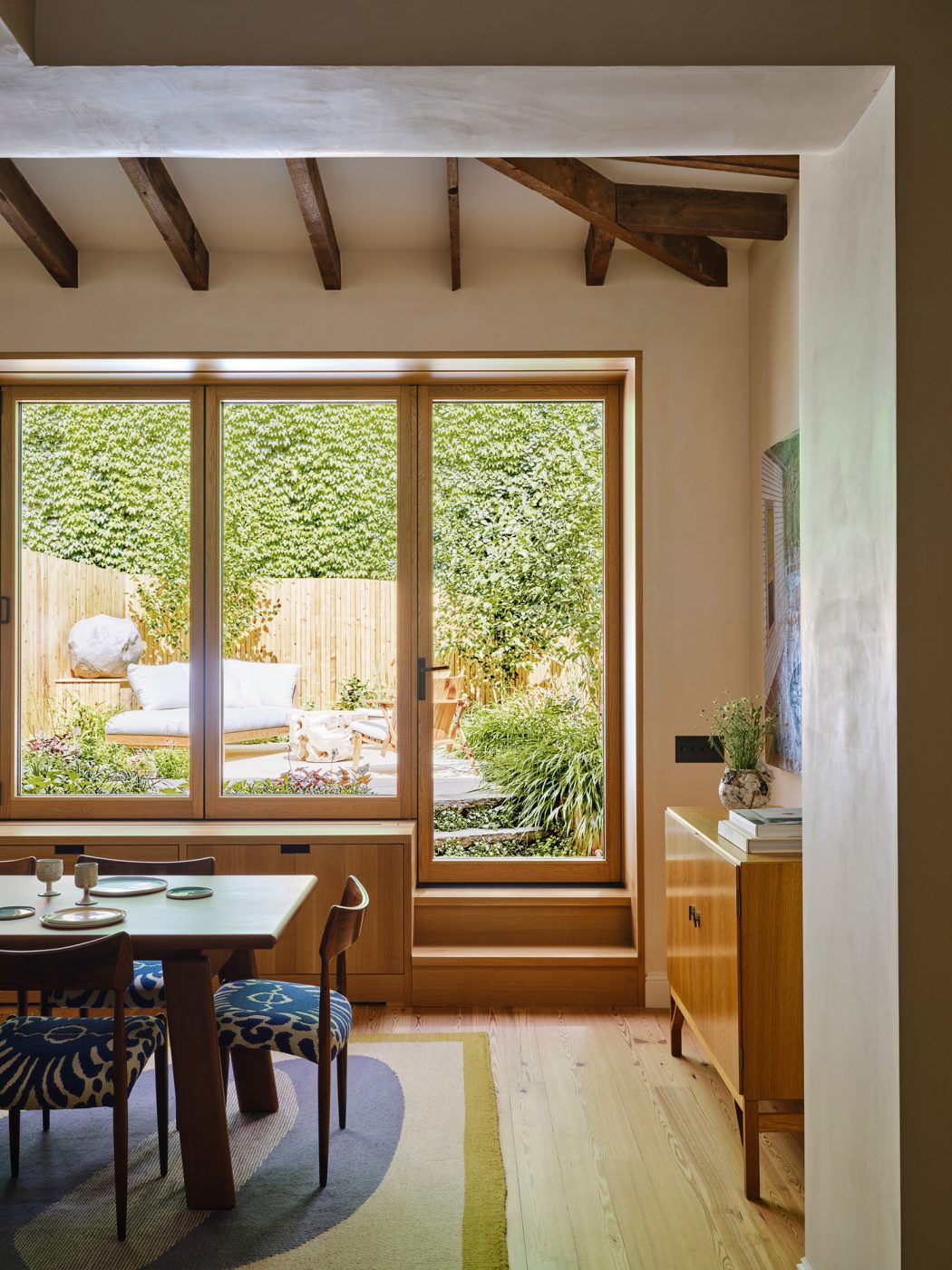
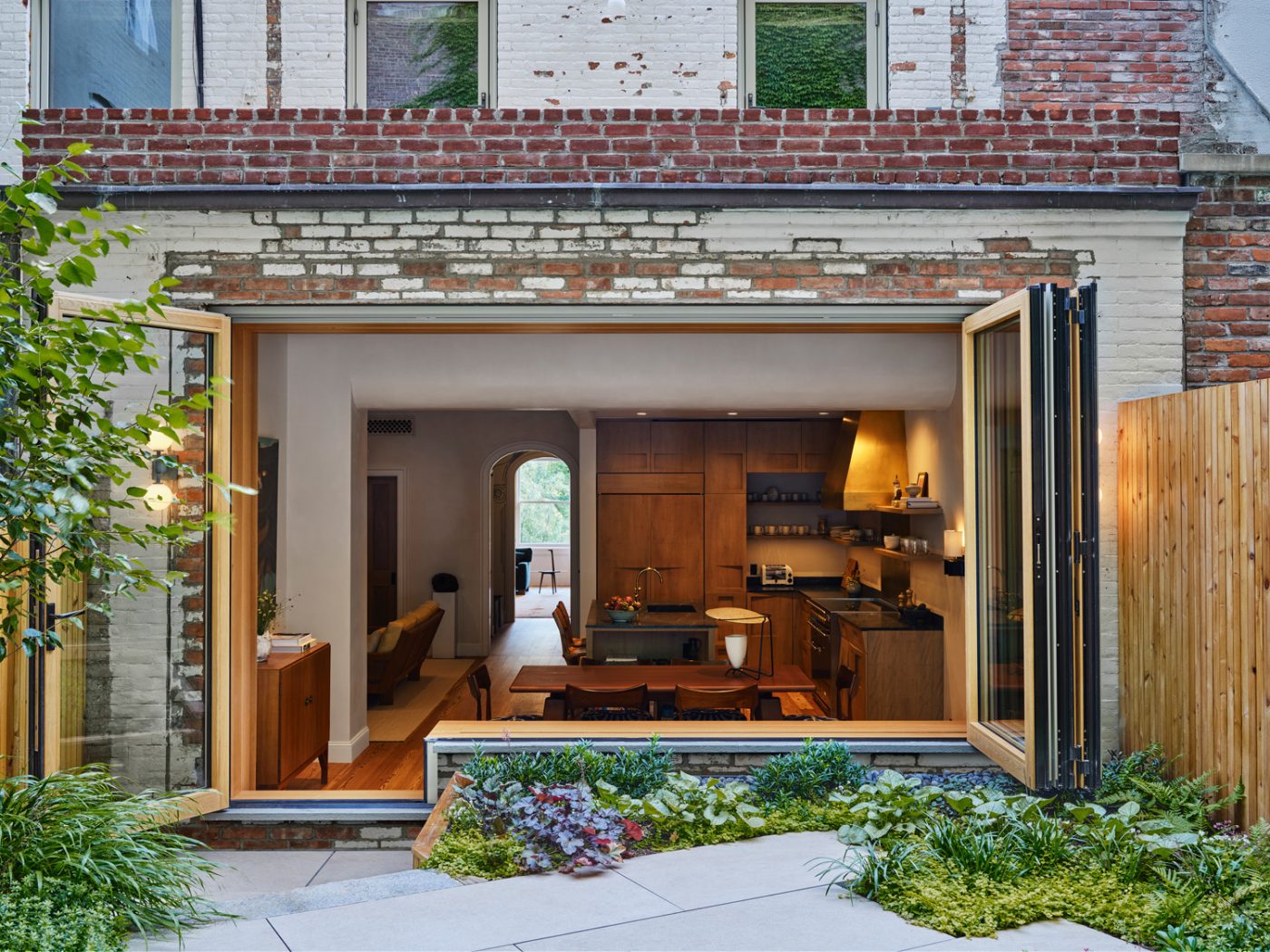
For Mark, the goal was to make the most of the unusual third-floor “backyard” — really the roof of the unit below — as well as the untended ivy-covered wall of the building behind it. Thanks to large new windows in the rear of the home, the apartment now seems to be immersed in nature, which was just what its young owner wanted. An investor focused on businesses with a sustainability bent, he is also an avid outdoorsman, likely to be found standing in a river fly-fishing or helping to run his family’s cattle ranch out west.
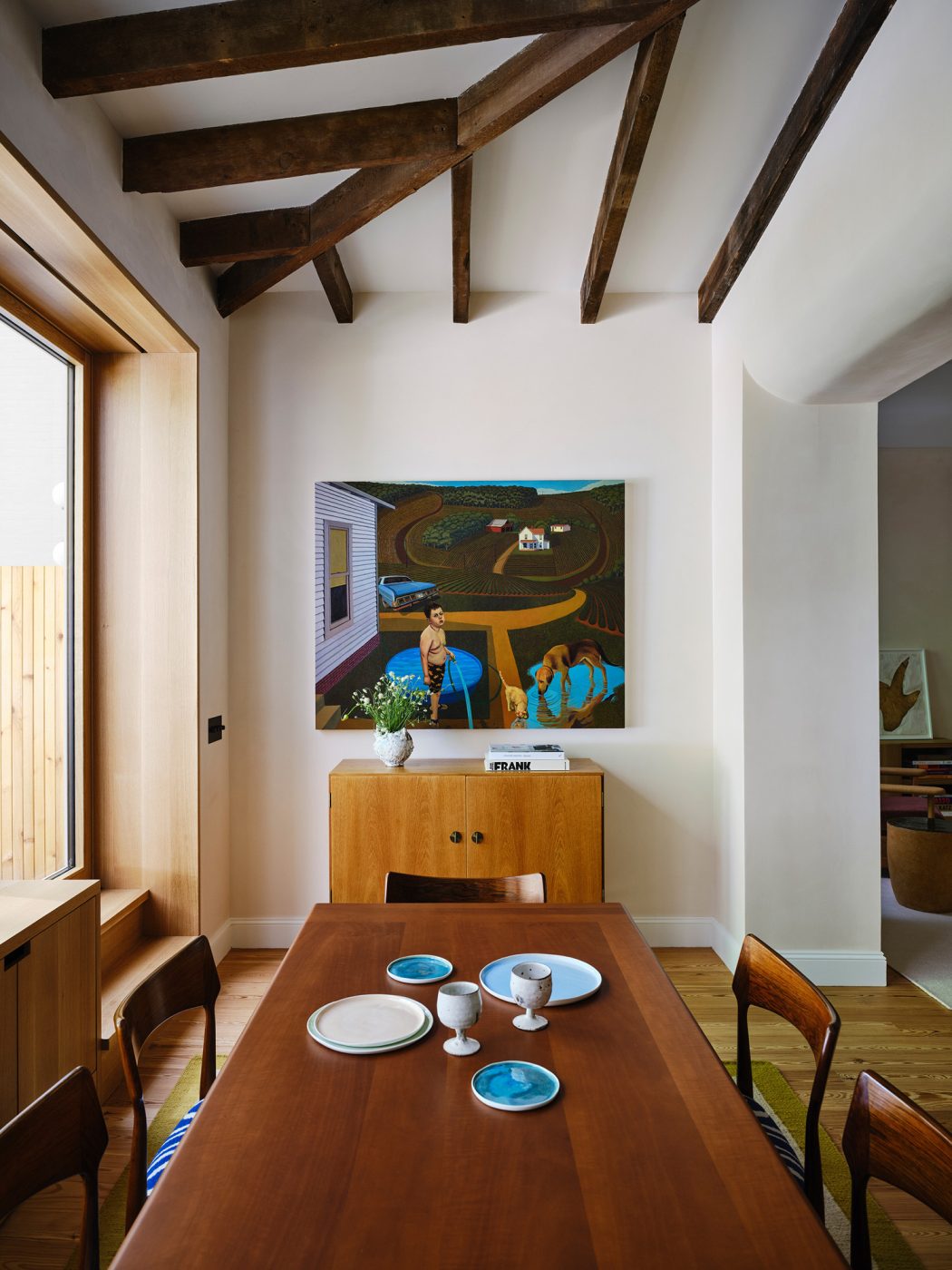
Mark didn’t just improve the home’s views of nature, he also brought nature inside, maximizing the use of wood, including reclaimed heart pine for the floors. It didn’t hurt that the interior demolition revealed wood beams over the dining room or that stripping layers of paint off the house’s 100-year-old shutters exposed their gentle grain.
In addition, the designers’ collaboration with Brooklyn’s Elephant Custom Furniture, which did many of the built-ins, was “a master class in varieties of wood,” says Letven, who lists walnut, teak, yew, European oak, mahogony and several other species along with the heart pine. This is reflected in how Mark addressed the door to the powder room, which bisected a prominent wall in the apartment’s most public space. He made sure it was not a utilitarian interruption but a beautiful wood inset.
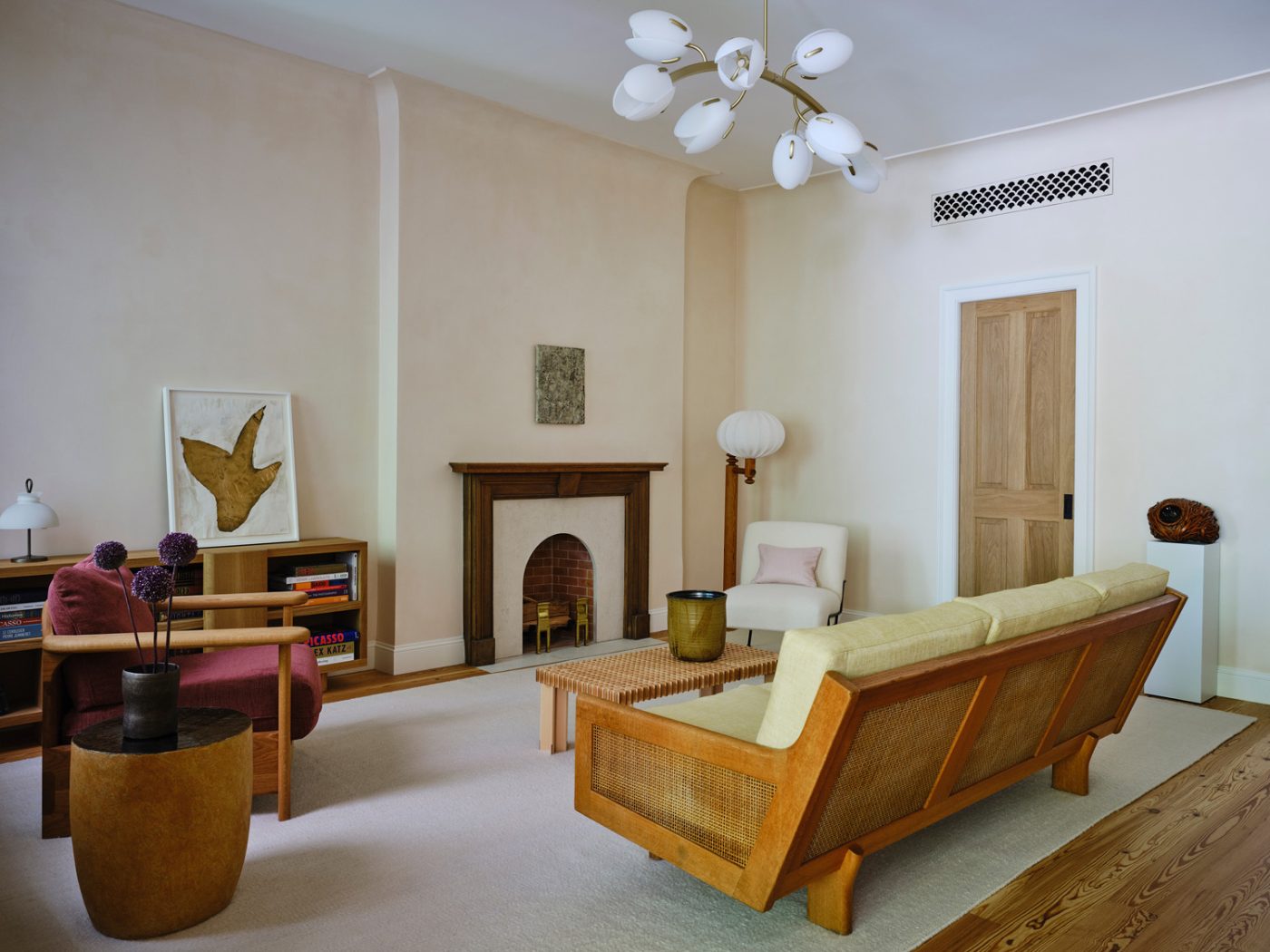
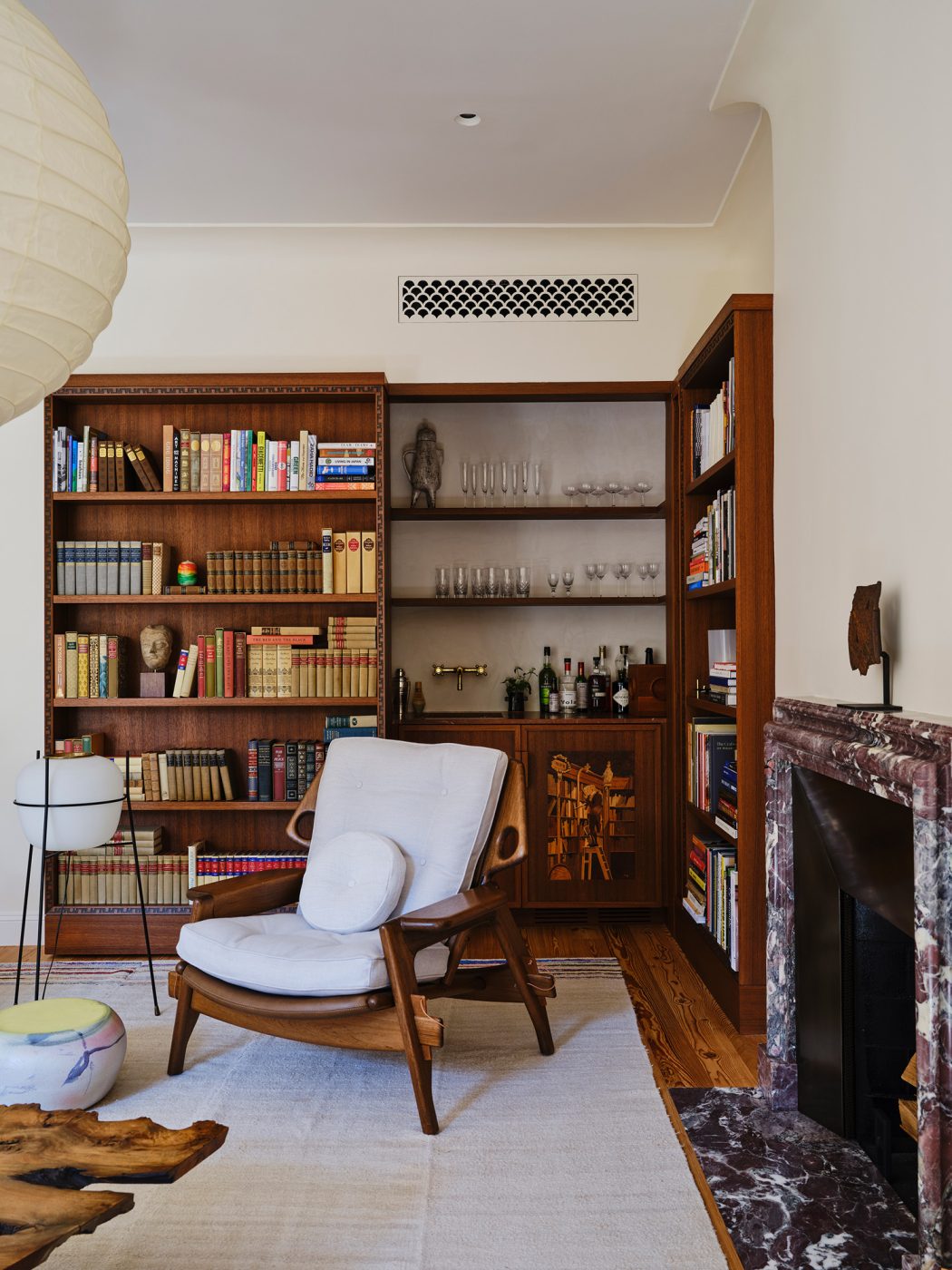
That large space — appropriately called “the great room” — features a particularly intriguing 1stDibs find: a wooden fireplace surround salvaged from an Edwardian-era country house in England. “I knew I wanted a salvaged piece, because the depth and character of wood cannot be replicated,” Mark says. He also valued its simplicity — a showier one would have drawn too much attention to the room’s asymmetry.
Facing the fireplace is a mid-century Danish sofa. Mark selected it for its low lines and rounded edges, which make it welcoming and unobtrusive, but he also loves its rattan back, an important detail since it’s the sofa’s rear that’s visible from the kitchen and dining room. He hung a very small painting over the mantel, reasoning that the sofa is so close to the fireplace that a big work would be hard to take in.
In front of the sofa, he placed a gridded Kyoto coffee table by Gianfranco Frattini, which is from 1stDibs, as are the vintage table lamp by Luigi Dominioni, on a console next to the fireplace, and the floor lamp by Uno and Östen Kristiansson, in a corner. That combination seamlessly brings together in one setting two great strands of mid-century modern design: Italian and Scandinavian.
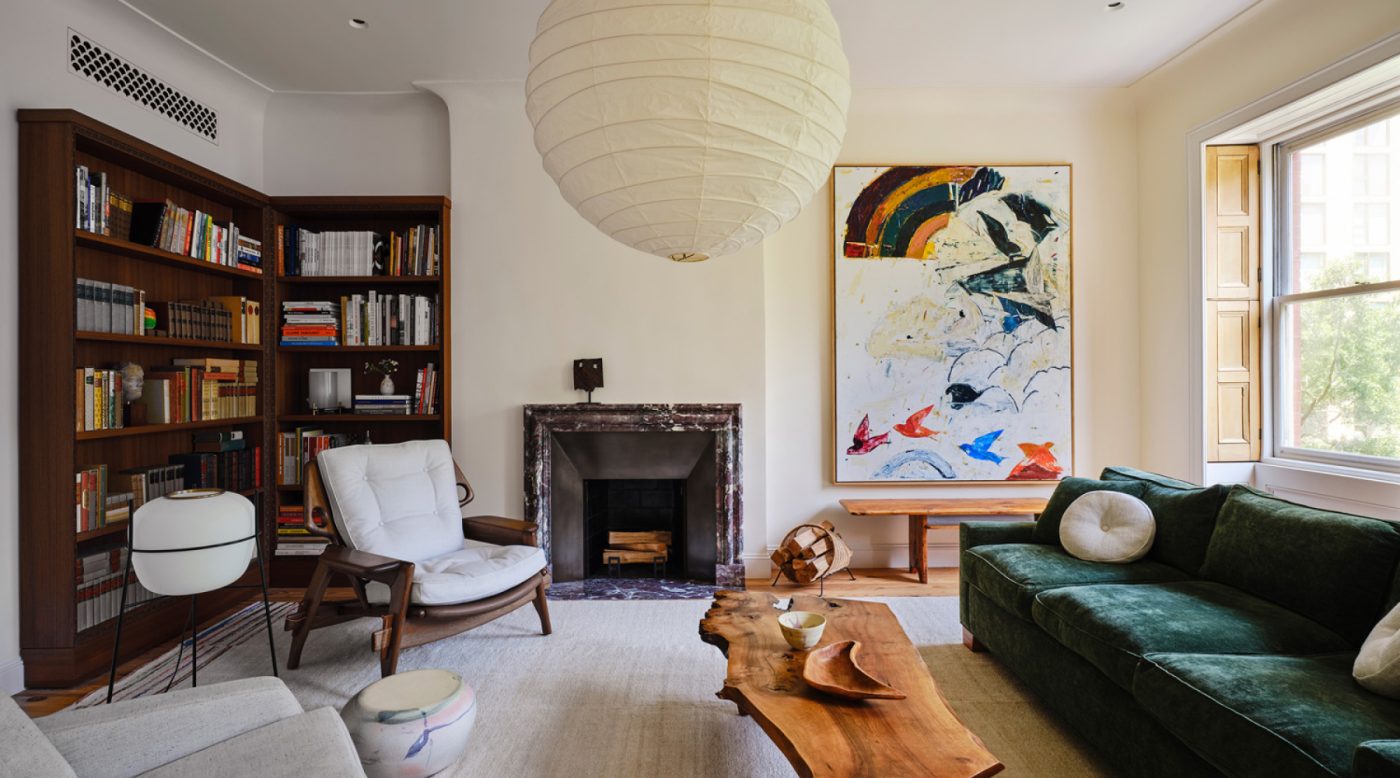
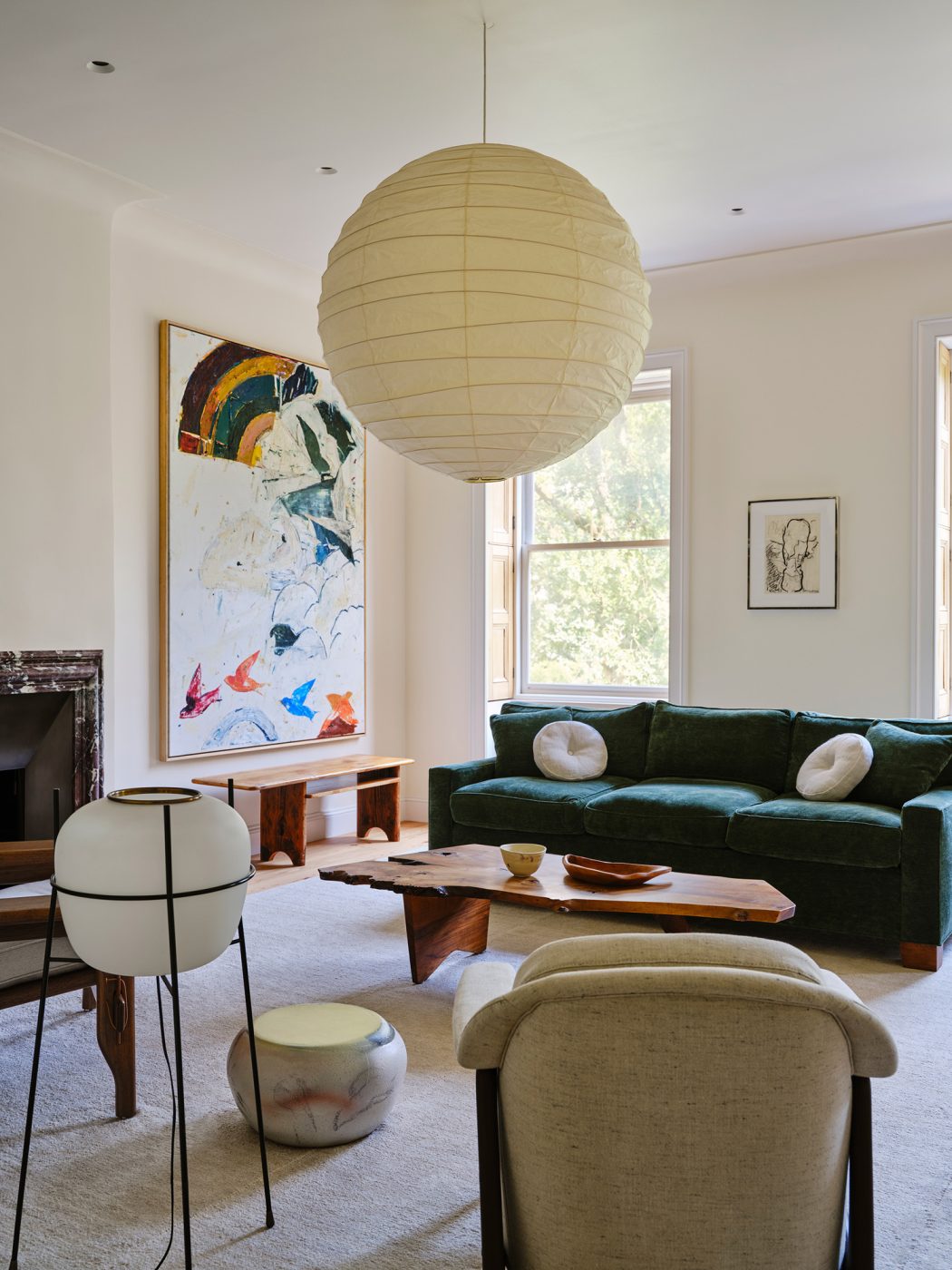
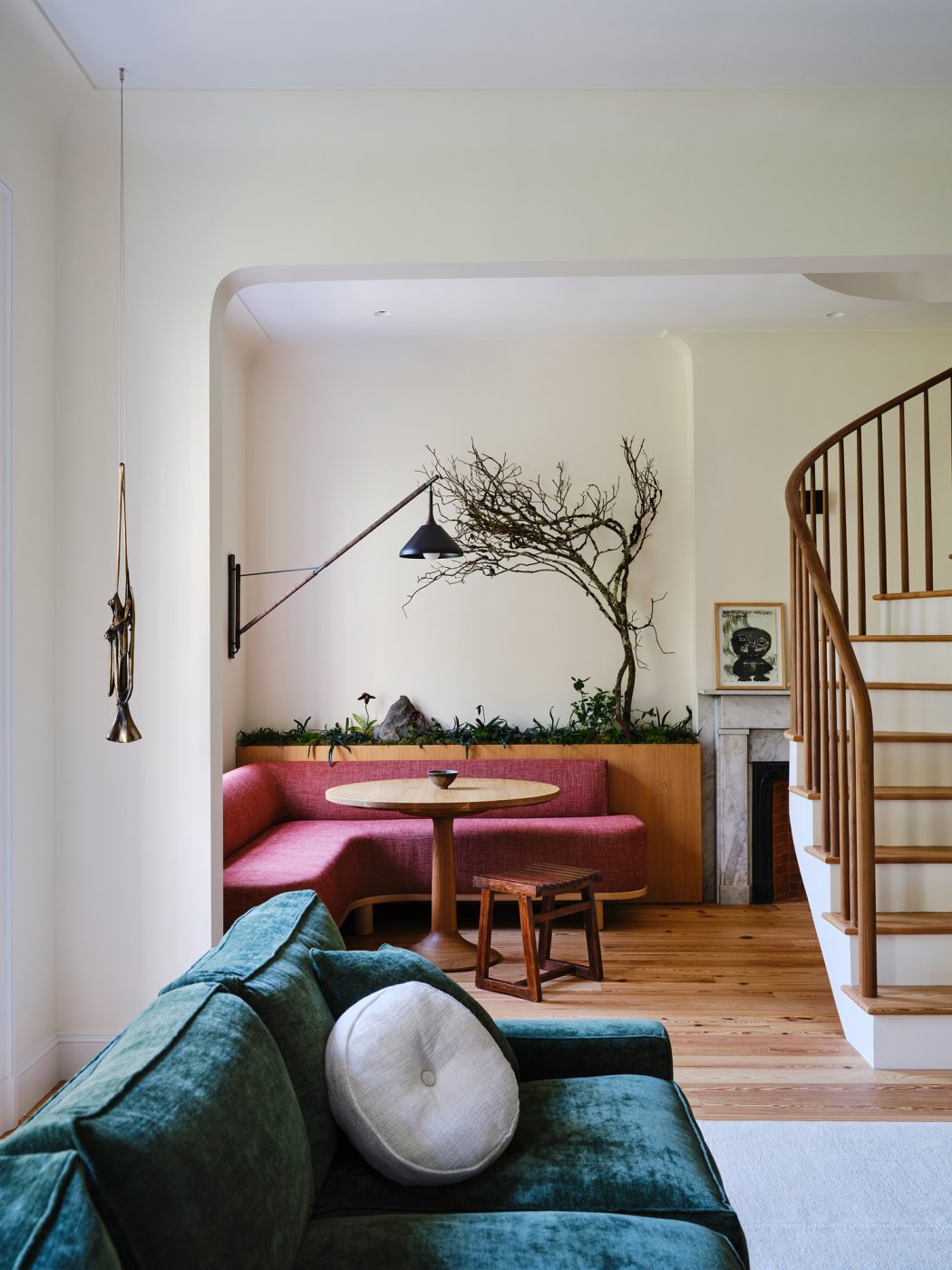
The living room could be a meadow near a pond. Hugging a mossy-hued chenille sofa is a vintage side table by Franco Albini that reminds Mark of a bird — rightfully so, since Albini called it Cicognino, “little stork” in Italian. A ceramic table, meanwhile, calls to mind a pebble. Add a Nakashima driftwood table to the tableau, and the space is practically the great outdoors.
It’s also a reflection of Mark’s sensibility: Under the painting on the wall next to the room’s fireplace is a bench that he found on the street on trash day. He says it goes well with the Nakashima, despite their very different price tags (zero versus lots of zeros).
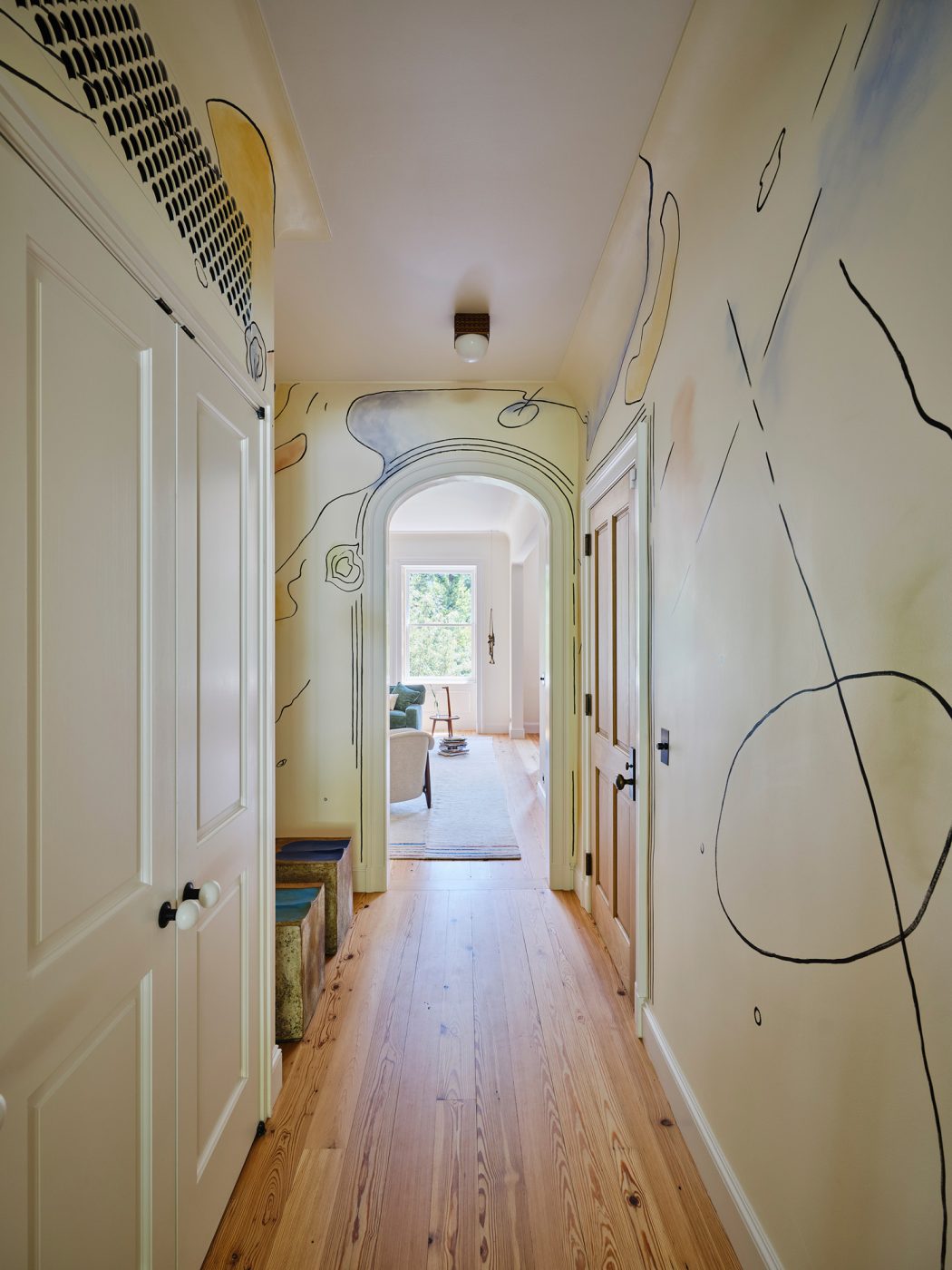
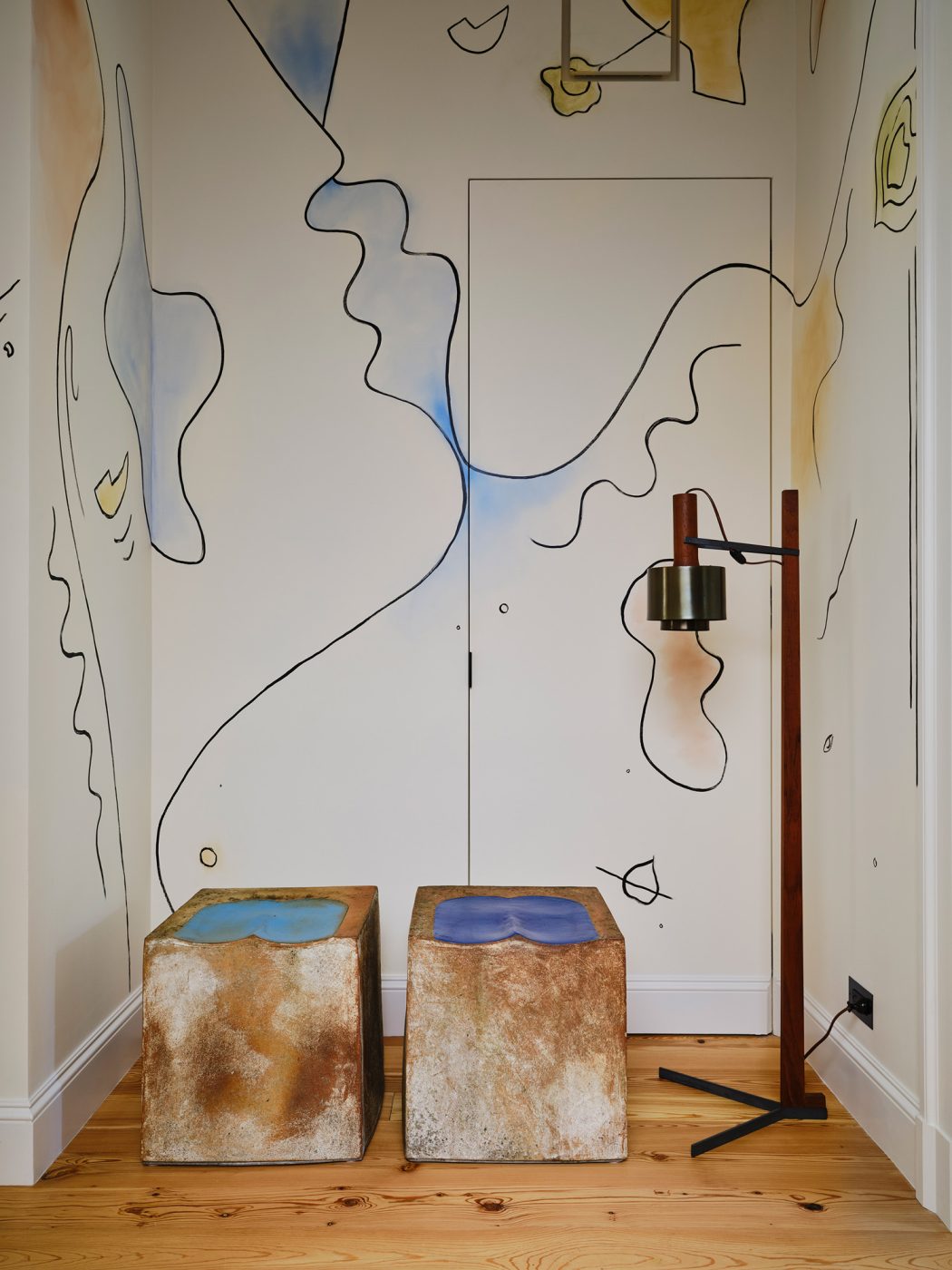
The first walls visitors see as they enter the apartment through the square-ish foyer bear a Surrealist, Jean Cocteau–inspired mural by Matt Austin Studio. Its colors correspond to the hues of the artworks in the living and dining rooms. Those rooms, too, have an almost surreal quality, as if a group of oddballs had gathered on a stage, nodding to one another but not conversing. Mark says he likes pieces that can stand alone and so can be used in other settings someday.
Mark, who is 25, grew up in San Diego, where he was, he says, “always rearranging the furniture” in his bedroom. After high school, he took a job as a barista. A regular customer who knew about his interest in design arranged an interview with Philip Stein Design Collective, which represents Maya Romanoff, Indoteak, Designers Guild and other makers. Soon, he was working as a sales rep. But he wanted to get closer to the furniture-arranging of his childhood.
Then, at a party, he met Penelope August, who has an eponymous design firm in Manhattan. She hired him as an intern, then made him a designer. Around the 18-month mark, he was ready to open his own office. “It all happened very quickly,” he says.
Along the way, he has learned from his collaborators. In the Manhattan townhouse, Mark and Letven together replaced the apartment’s narrow spiral staircase with a more gracious flight. “It was a real game of millimeters, because we wanted to leave enough room behind it for a functional den-slash-dining nook,” Mark says. The client requested a “living wall” in back of that nook’s banquette. Mark foresaw problems (bugs, leaks) and suggested a slightly less complicated planter box. Except for the tall branches, arranged by Brookyn’s Blue Plant, everything in it is alive.
A wall-mounted lamp over the banquette resembles a fishing pole, one of many subtle references to the client’s favorite pastime. A large acorn nestled in the plantings is a nod to the squirrels in the park across the street. “I’m really proud of the hidden little moments,” Mark says.
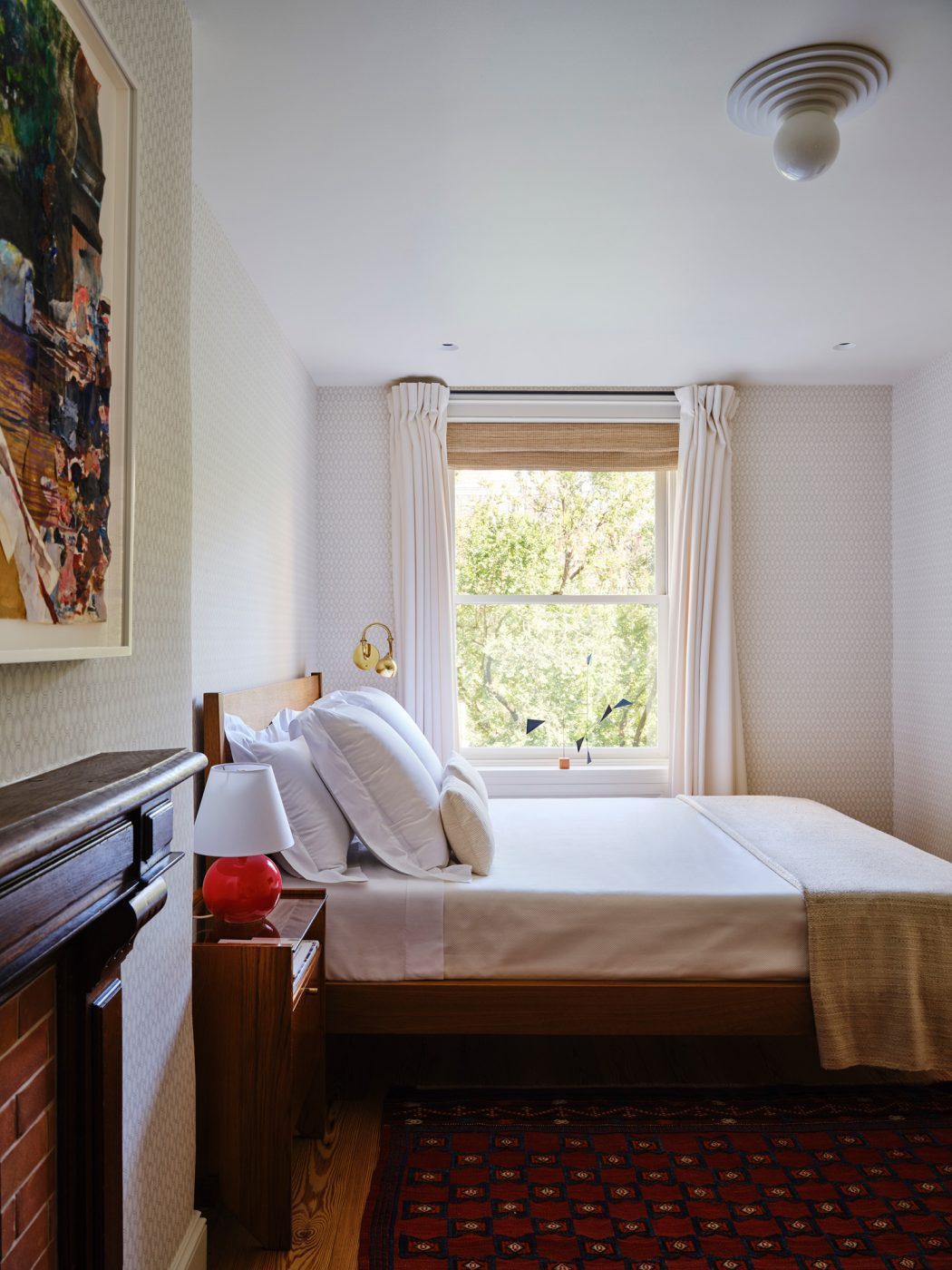
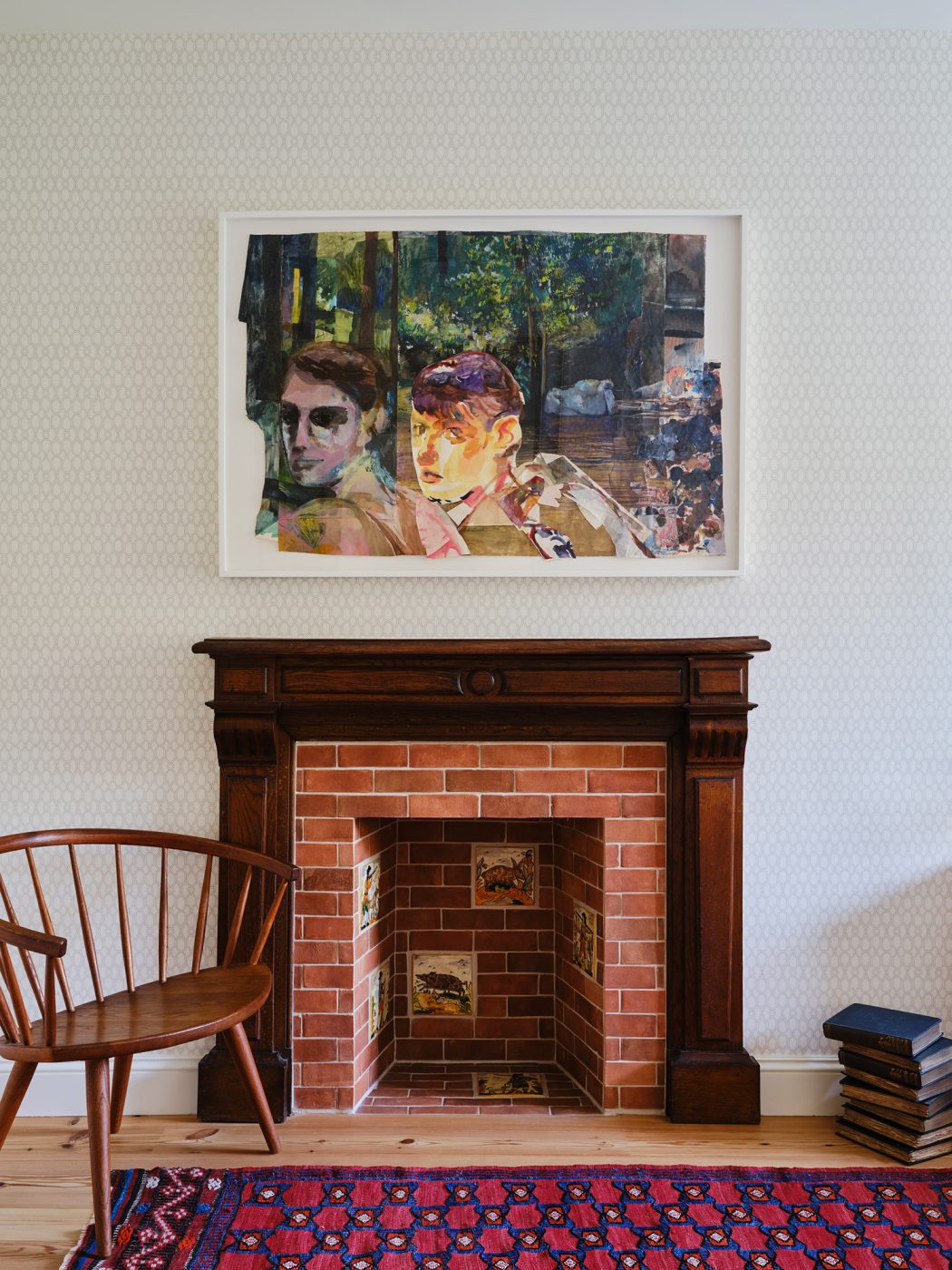
One of these is in the guest bedroom, where the fireplace brickwork incorporates a group of Portuguese tiles depicting hunting scenes. Beyond these elements, as well as a multicolored flatweave rug, a painting by Joana Galego and a petite Stig Lindberg table lamp, the space is entirely white. “With the surrealist combinations of things downstairs, you’ve got to give your guests a rest,” he says.
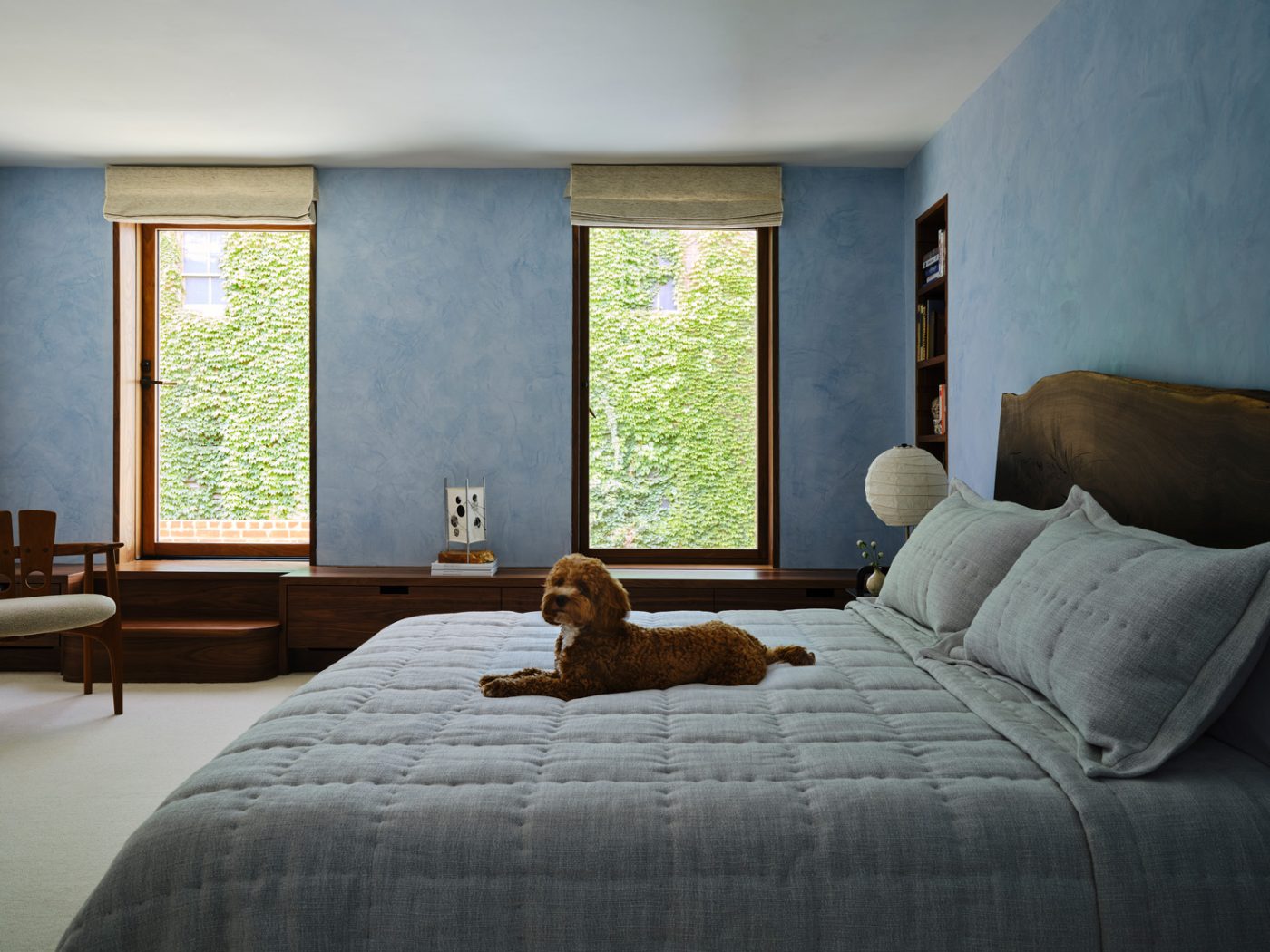
The master bedroom isn’t white but a pale blue that references sea and sky. The walls “become art with the movement and dreamy effect of their plaster finishes,” Mark says. “And the bed almost looks like a boat about to sail off. The curves on the bedside tables are reminiscent of fishing hooks and the table lamps of bobbers.” Separated by the blue walls, the white wall-to-wall carpet and white limewash ceiling create the sensation of floating in the clouds. Like Mark’s career trajectory, it all feels like a dream.