
February 8, 2026Transforming an antique house into a 21st-century home is often a high-wire act: Leaning into the past with traditional furnishings can plunge the interiors into time-capsule stuffiness, while leaping forward with contemporary minimalist moves might land in a discordant cold rigidity.
For a recently completed project, San Francisco–based Matthew Leverone — who for the past 20 years has brought sophistication and comfort to contemporary architecture by firms like Olson Kundig — struck a deft balance in reviving an early-20th-century mansion built in the manner of the late-17th-century Highclere Castle, famed as the location where much of Downton Abbey was filmed.
The clients, a married couple with a school-age daughter and son, “wanted to keep the integrity of the interior architecture but make it more modern and livable,” Leverone says. “The goal was to meld the husband’s love of traditional architecture and the wife’s more minimal, contemporary taste in decor.”
Set within a gated estate in the Bay Area community of Piedmont, California, the three-story, six-bedroom mansion was designed in 1918 by Albert L. Farr in Jacobean style, with a steeply peaked roof, Dutch gables, two-story leaded-glass windows, a grand staircase, paneled walls and doors and decorative plasterwork fit for a wedding cake.
In the mid-2000s, long before its 2022 purchase by Leverone’s clients, the property had undergone a painstaking restoration that included period-correct baths and kitchen. Beyond that, however, it had been decorated like a 19th-century dowager countess overly dependent on cosmetics and costume: all dark wall colors, gilded chandeliers and dress-fabric drapes hung on heavy carved rods.
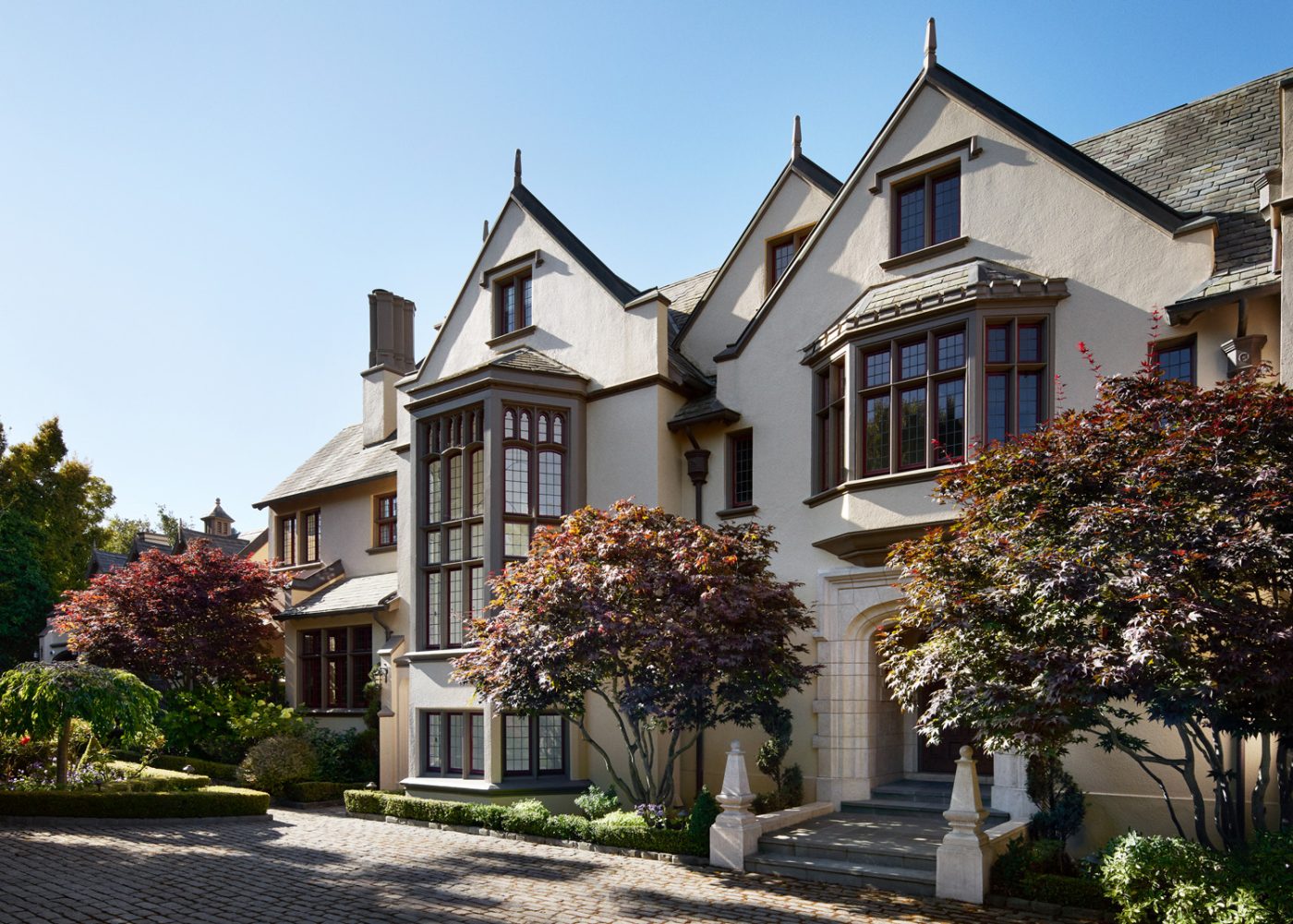
“The beautiful architectural detailing was the main attraction,” Leverone recalls, “but we had to pare it down and play against the rectilinear lines with sculptural furniture to make the interiors warm and inviting.”
While taking inspiration from contemporary French designers Charles Zana, Thierry Lemaire, Joseph Dirand and Pierre Yovanovich — known for breathing new life into old Parisian apartments — Leverone stayed true to the California organic modern aesthetic. “I don’t gravitate to anything too shiny or fancy, and you don’t see a lot of color or pattern in our work,” he says. “I love natural materials, textiles and textures.”
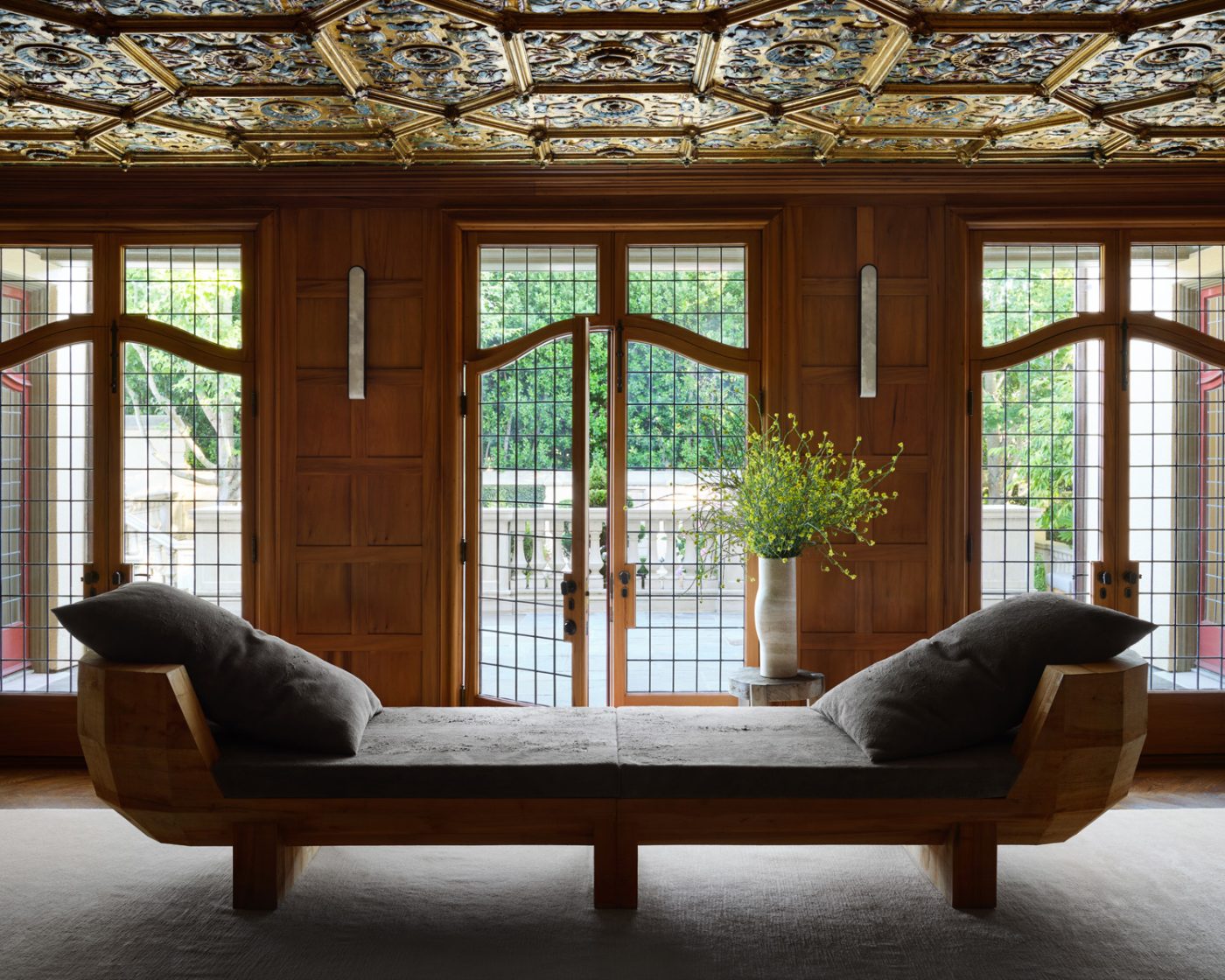
A case in point is the 400-square-foot entry hall, which features completely restored gumwood paneling, herringbone oak floors and a hand-painted and gold-leafed coffered ceiling and is all but dominated by Rick Owens’s Double Bubble bench, from Carpenters Workshop Gallery. Carved from elm, with a distressed leather cushion, the piece echoes the lines of a set of nearby French doors and serves as a minimalist counterpoint to the grandeur of the room. “It was a perfect fit,” say Leverone, “and the wife already had a Rick Owens leather jacket.”
The bench sits on a custom rug made of alpaca and hemp woven with bronze ingot inlays; the room is lit by bronze and alabaster sconces. By juxtaposing antique decorative flourishes with these contemporary designs, Leverone created a dramatic entrance for the home.
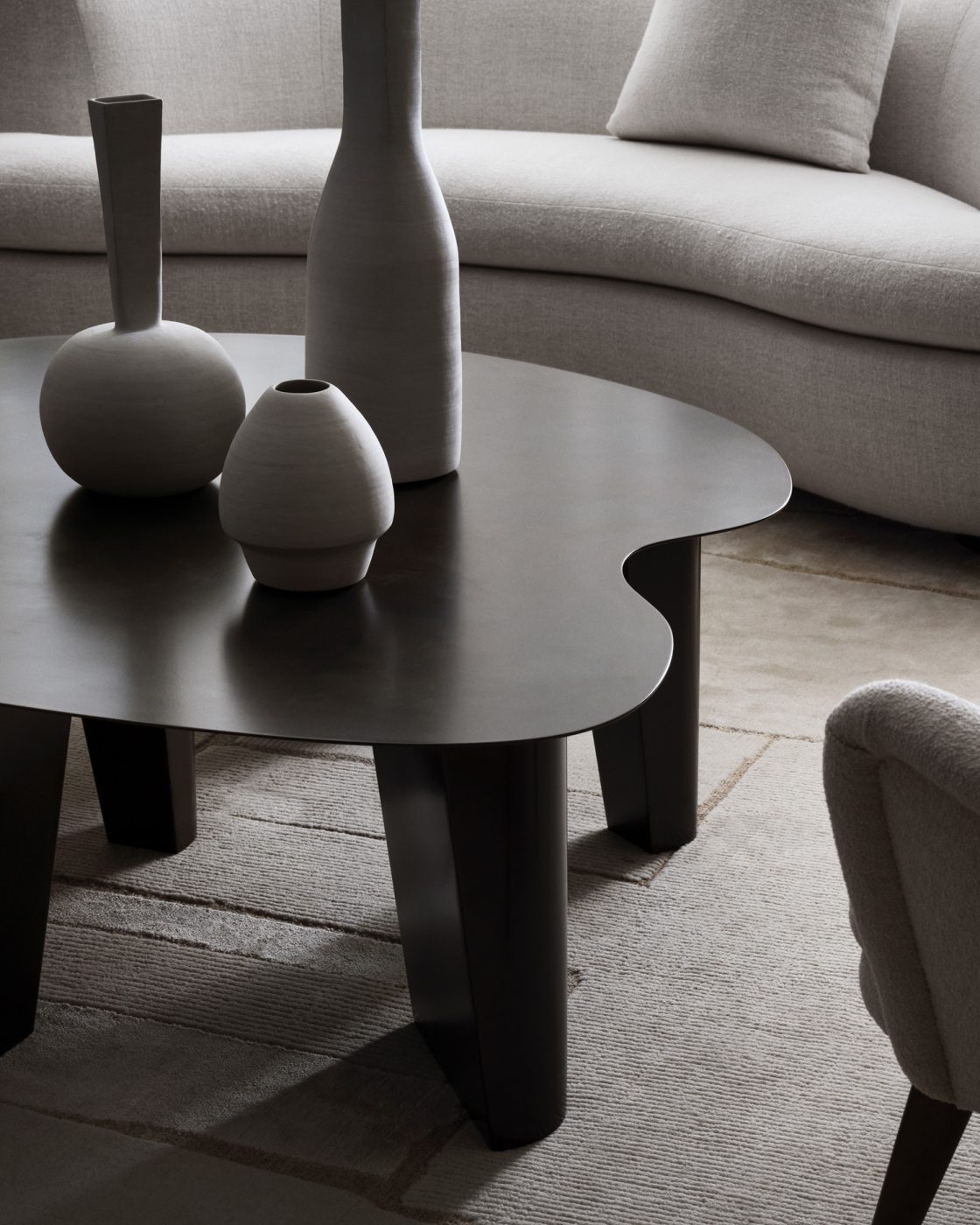
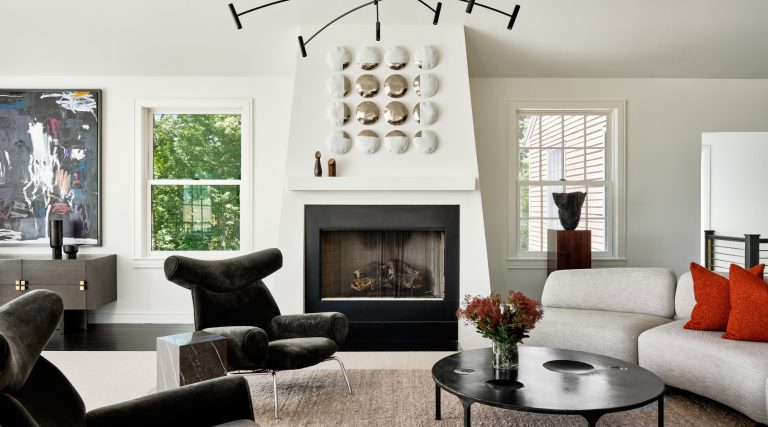
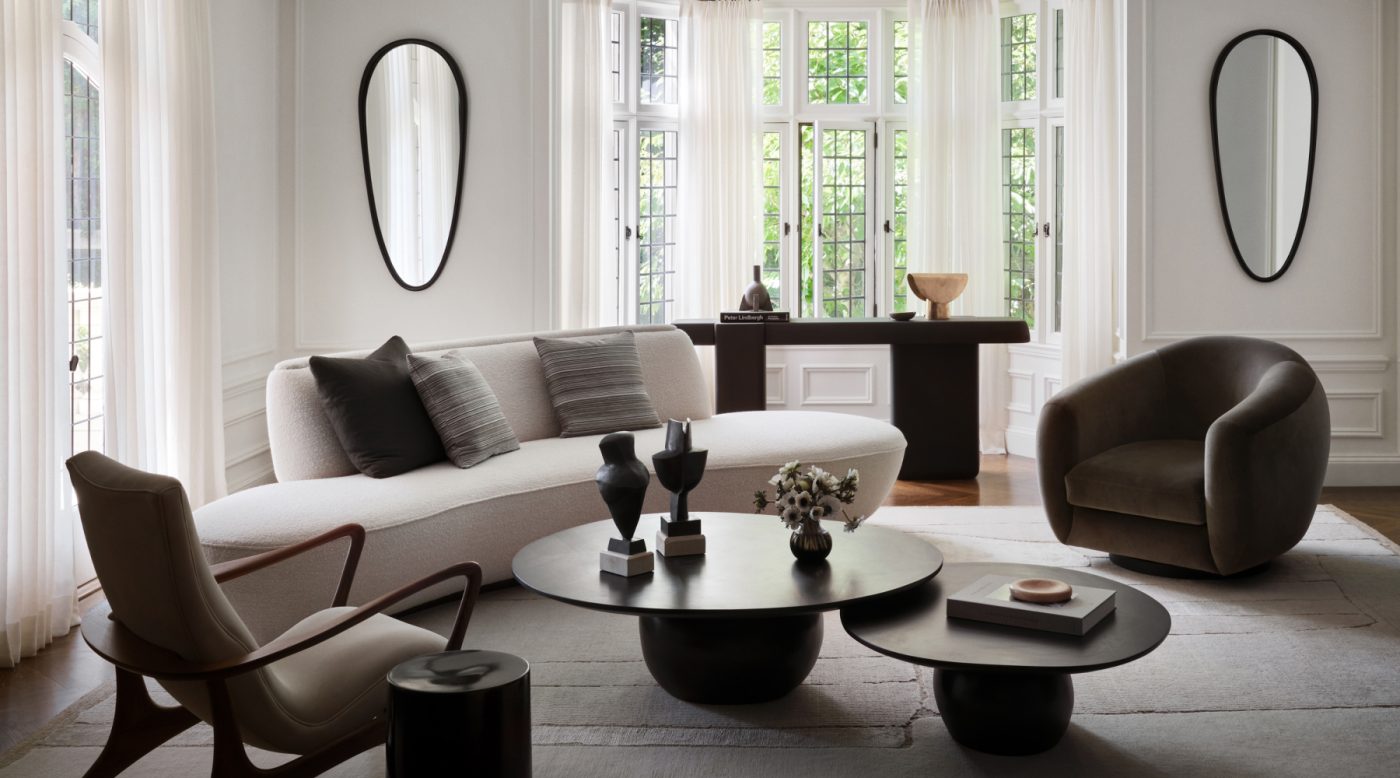
The French doors open from the stylish foyer into the neutral-toned living room, whose architecture is defined by bay windows and paneled moldings. For this space, Leverone selected a Damien Langlois-Meurinne sofa with a floating back, pairing it with hand-crafted Japanese burl-wood coffee tables. Pedestal-base Thierry Lemaire armchairs flank a biomorphic coffee table with multiple rudder-like legs; an Hervé Langlais marble side table from 1stDibs sits nearby. Adding visual impact are two vintage armchairs with angled back legs: a 1950s Pedro model by Carl Gustav Hiort af Ornäs and a Contour low-back lounge chair in walnut and suede by Vladimir Kagan.
“This room has so many right angles that it needed a softer take on furniture,” says Leverone, explaining his harmonious assemblage of curvaceous contemporary pieces.
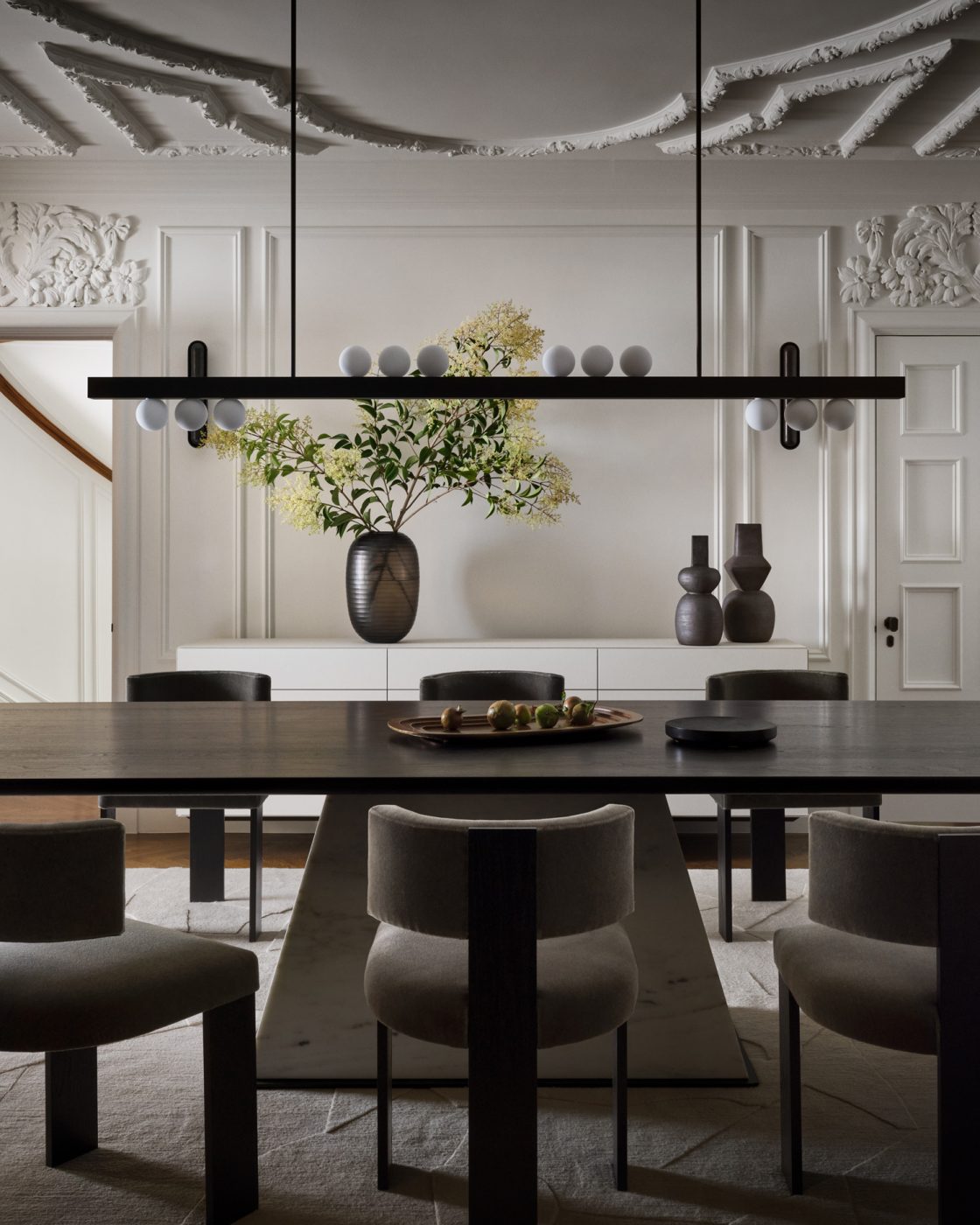
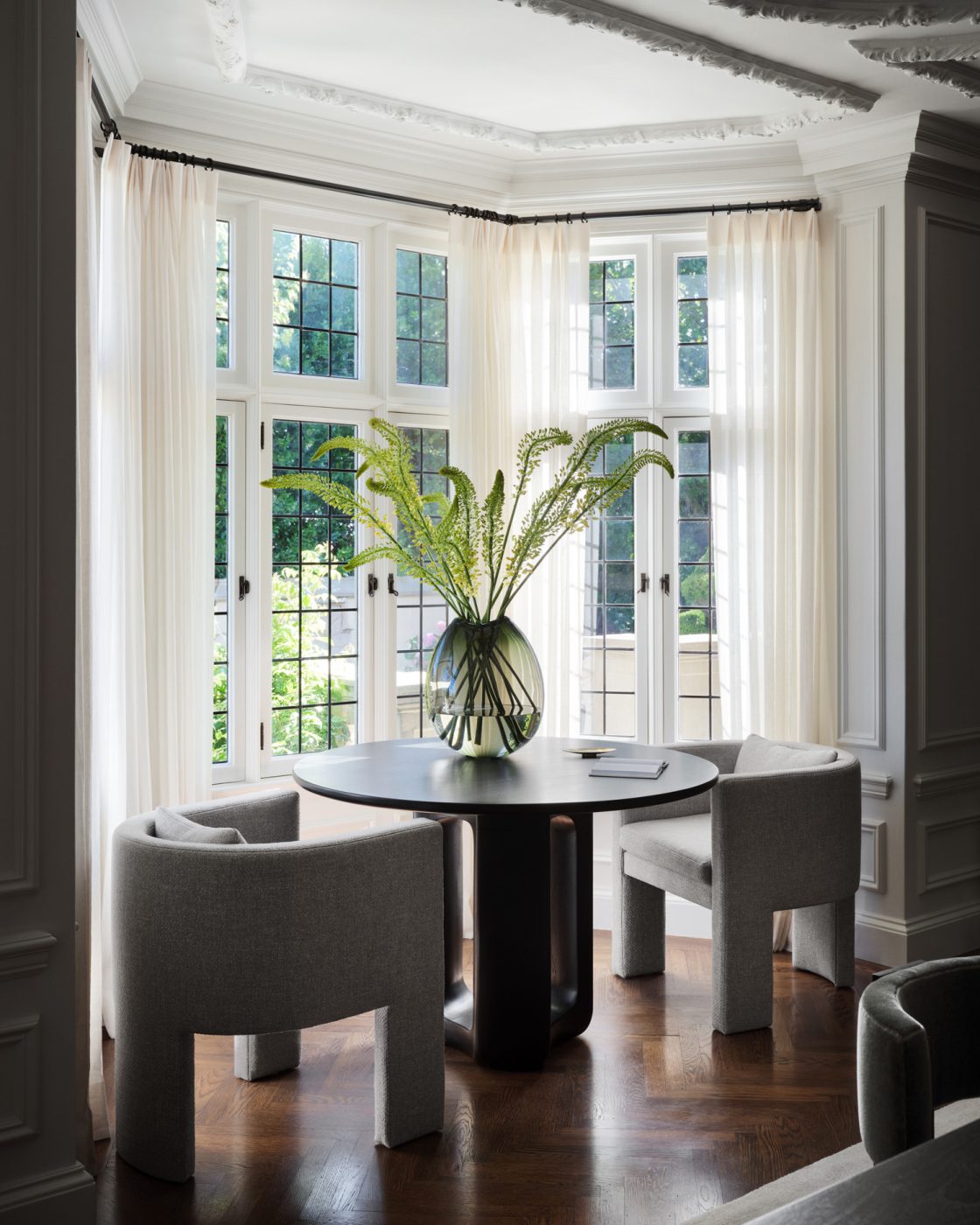
By contrast, the dining room — once painted red, now a calm white — uses right angles and straight lines to dial down the figurative flourishes of the plaster molding on the walls and ceiling. A linear minimalist bronze chandelier by Stephane Parmentier hangs above an almost gravity-defying dining table, whose solid wood top cantilevers out from a monolithic marble base. In a nearby window bay, a smaller round table and custom upholstered chairs ensure that the room functions well for both casual and formal dining.
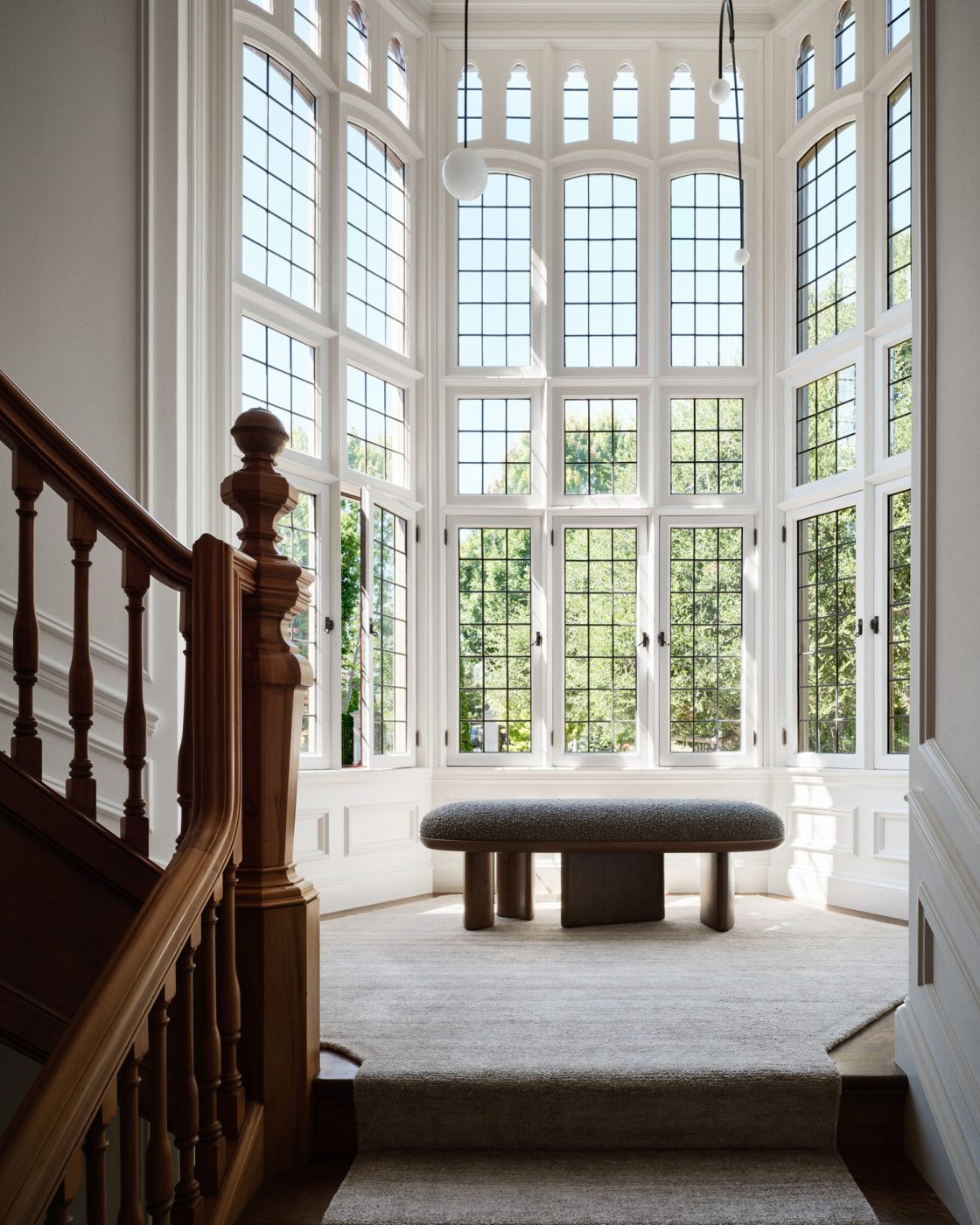
Leverone makes the most of pass-through and circulation areas that a lesser designer might have barely furnished at all. Over the soaring staircase, he mounted a vintage Austrian pendant from 1stDibs; on the landing, he hung a Mobile chandelier by Michael Anastassiades above a Demuro Das walnut bench. The latter offers a perch from which to gaze through the two-story leaded-glass windows at the garden.
The designer created another seating area to capture a perfect view on the second floor. There, Disc Interiors swivel chairs — placed under a 1stDibs-sourced folded-brass Montera pendant from Blueprint Lighting — face the front gates.
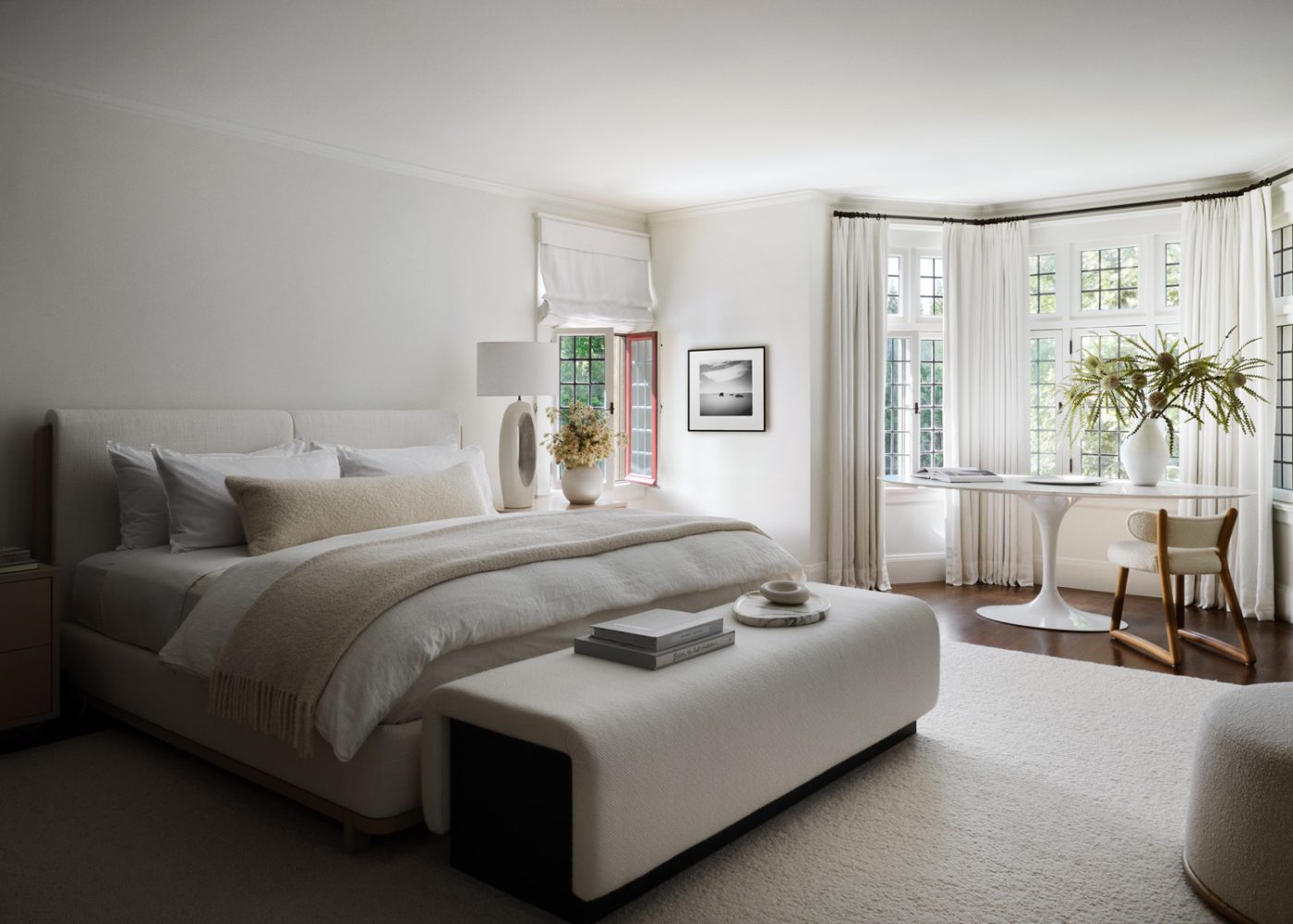
Creamy tones lend an enveloping sense of serenity to the primary suite, where plush, softly rounded upholstered pieces keep company with clean-lined custom case goods in white oak.
In the bedroom’s windowed nook, Leverone stationed Eero Saarinen’s mid-century classic Tulip dining table, accompanying it with a contemporary low-back sled-leg chair by Pierre Augustin Rose. “We thought of it as a writing table,” the designer says. “And the shape of the six-foot-long oval top plays so nicely with the other furniture, particularly a pair of bedside lamps with oval cutouts.”
While the guest bedroom, frequently used by visiting grandparents, has a mature aesthetic, with a fireplace-facing loveseat, dark-walnut nightstands and a Holly Hunt bed, the teenaged daughter’s room is youthfully sophisticated.
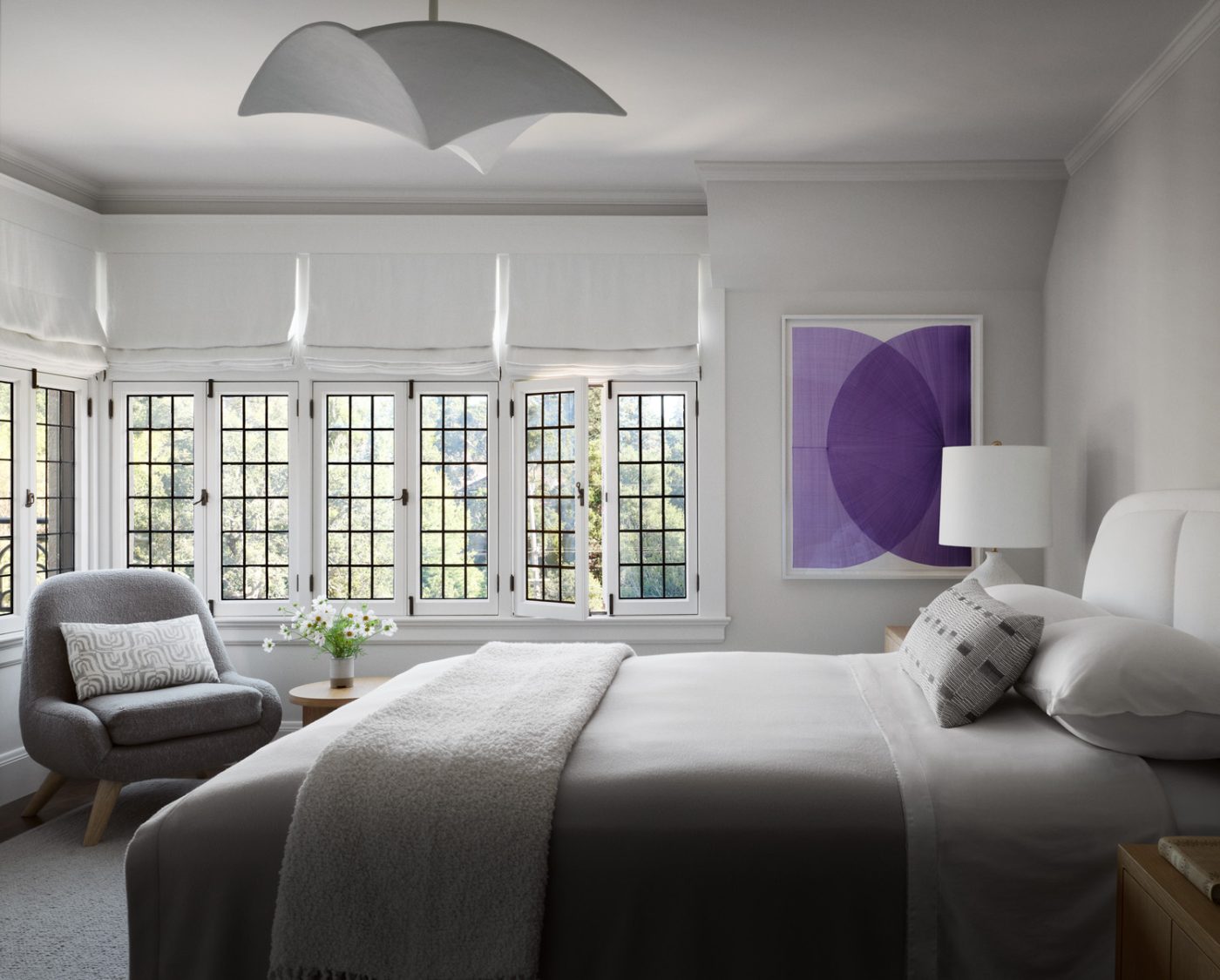
Punctuated by the bold purples of a 2020 Thomas Trum artwork, the otherwise muted bedroom features an arching, sail-like chandelier. Taking advantage of yet another windowed nook with views to the outdoors, the designer paired a playfully bulbous chair and an Art Deco–style desk of his own design. The latter’s waterfall edge recalls the work of Gilbert Rohde and Karl Springer.
Leverone, who grew up in a 1970s Monmouth County, New Jersey, modernist ranch created by his graphic designer father, came to understand furniture while working for commercial architects and retailers. After earning a BFA in interior design from Pennsylvania’s Arcadia University, in 1983, he joined a Princeton, New Jersey, architecture firm, then moved to New York City three years later. He worked in commercial spaces and store design and, in 1990, took on all the interior architecture for Macy’s, a role that gave him, he says, “a great sense of scale and proportion.”
He continued to work for Macy’s after relocating to the San Francisco area, in 1997. Three years later, he began working in residential design, launching Leverone Design in 2006.
At 9,000 square feet, the Piedmont home is one of his namesake firm’s larger projects — and it came with the additional challenge of needing to be completed within a year to accommodate the clients’ plans to have their children start attending school nearby. Even at that pace, Leverone was able to customize pieces from international galleries and manufacturers and work with artisans and craftsmen to produce unique designs for the home.
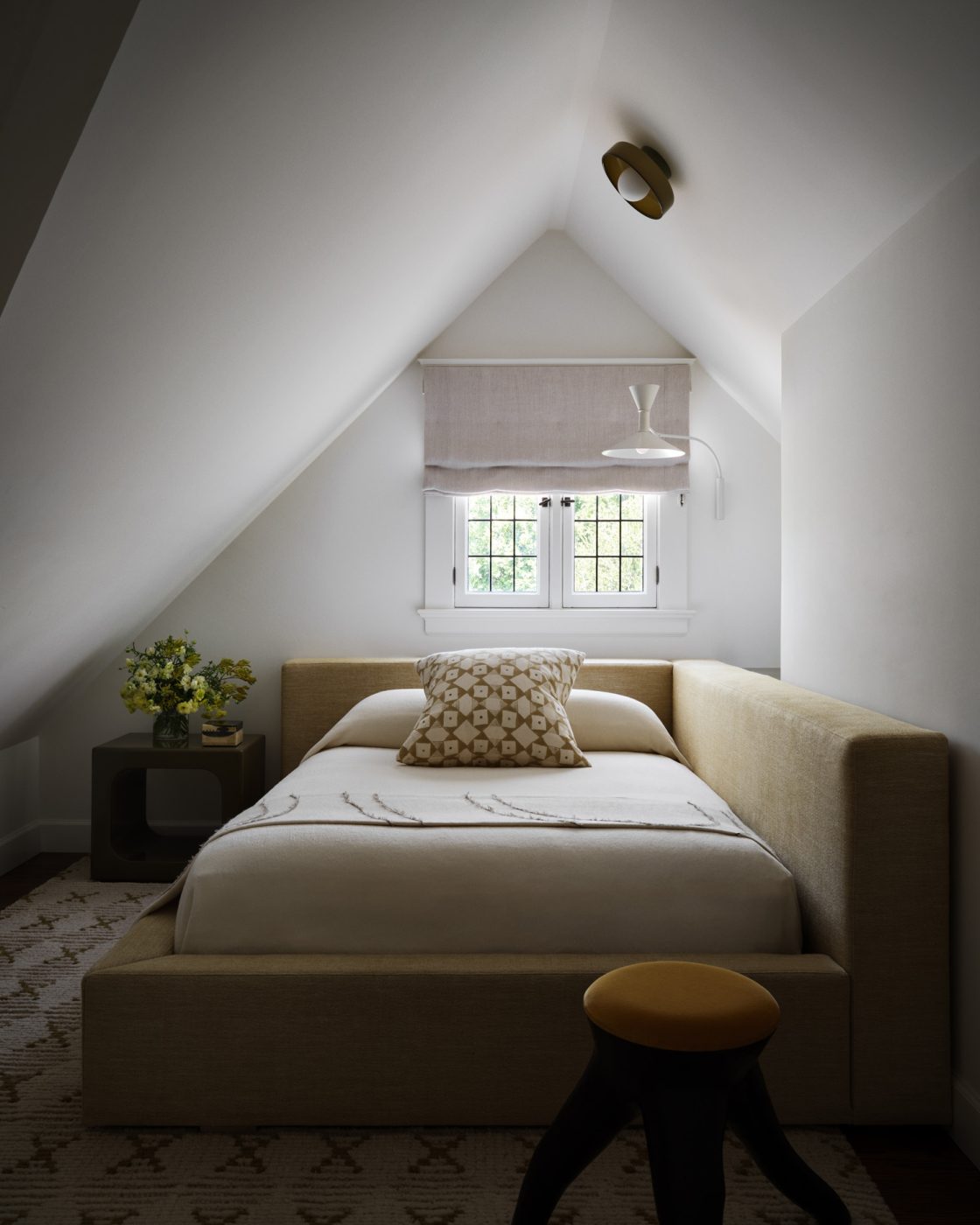
One of these takes center stage on the third floor, where he designed a kids’ guest bedroom under a ceiling vault “you can barely stand up in” around a custom upholstered bed that can do double duty as a sofa. Leverone devoted the rest of the space, which once housed servants’ quarters, to a handsome home office.
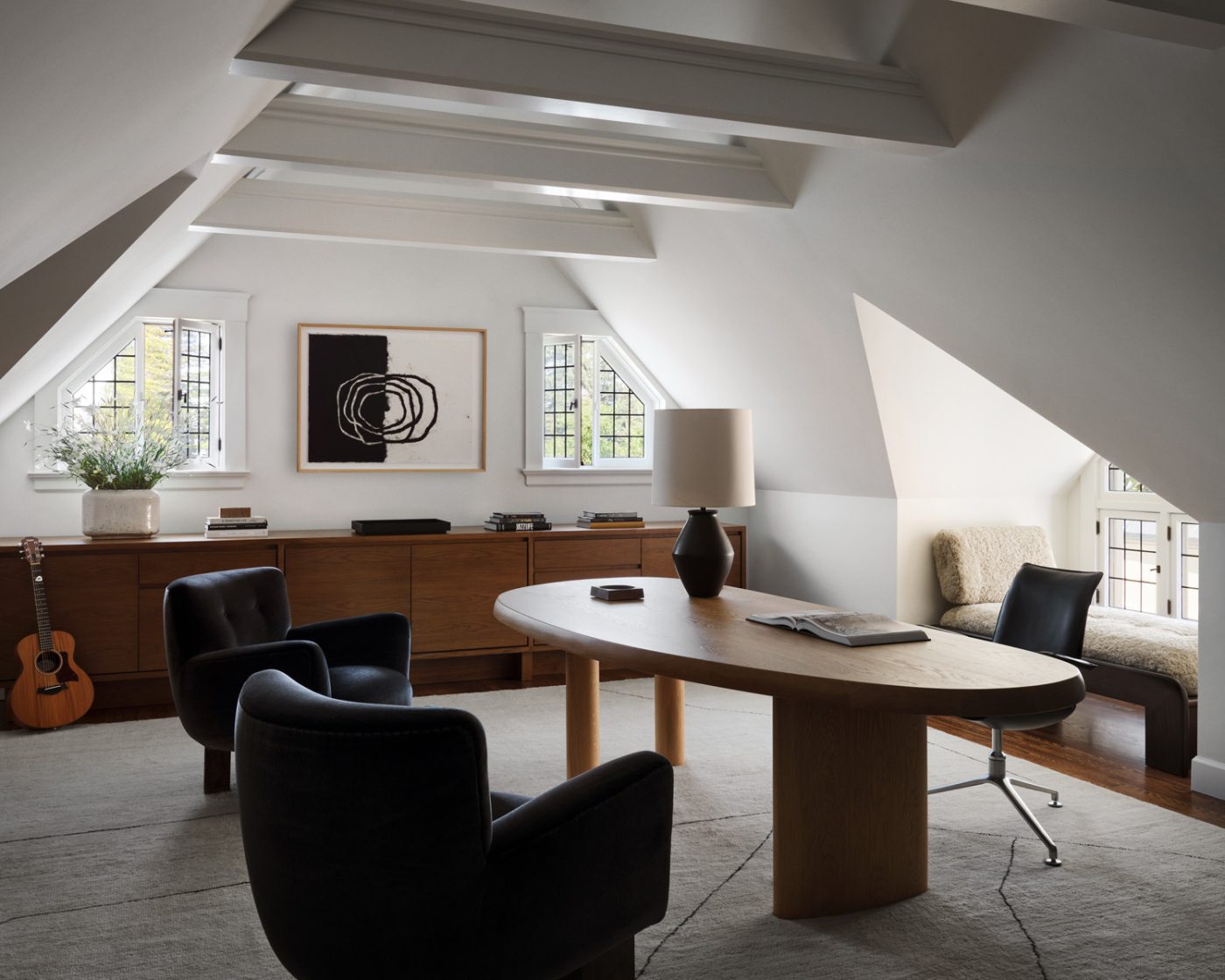
To outfit the office, he chose a chrome and black leather FK desk chair by Walter Knoll, complementing it with a Charlotte Perriand–inspired desk he designed with one oversize leg that conceals cords and cables. The Perriand vibe is reinforced by a pair of armchairs with chocolate-brown mohair upholstery and chunky reclaimed-pine legs, as well as a sheepskin-covered daybed from Lawson-Fenning that recalls furnishings from the Perriand-designed Les Arcs ski resort, in France.
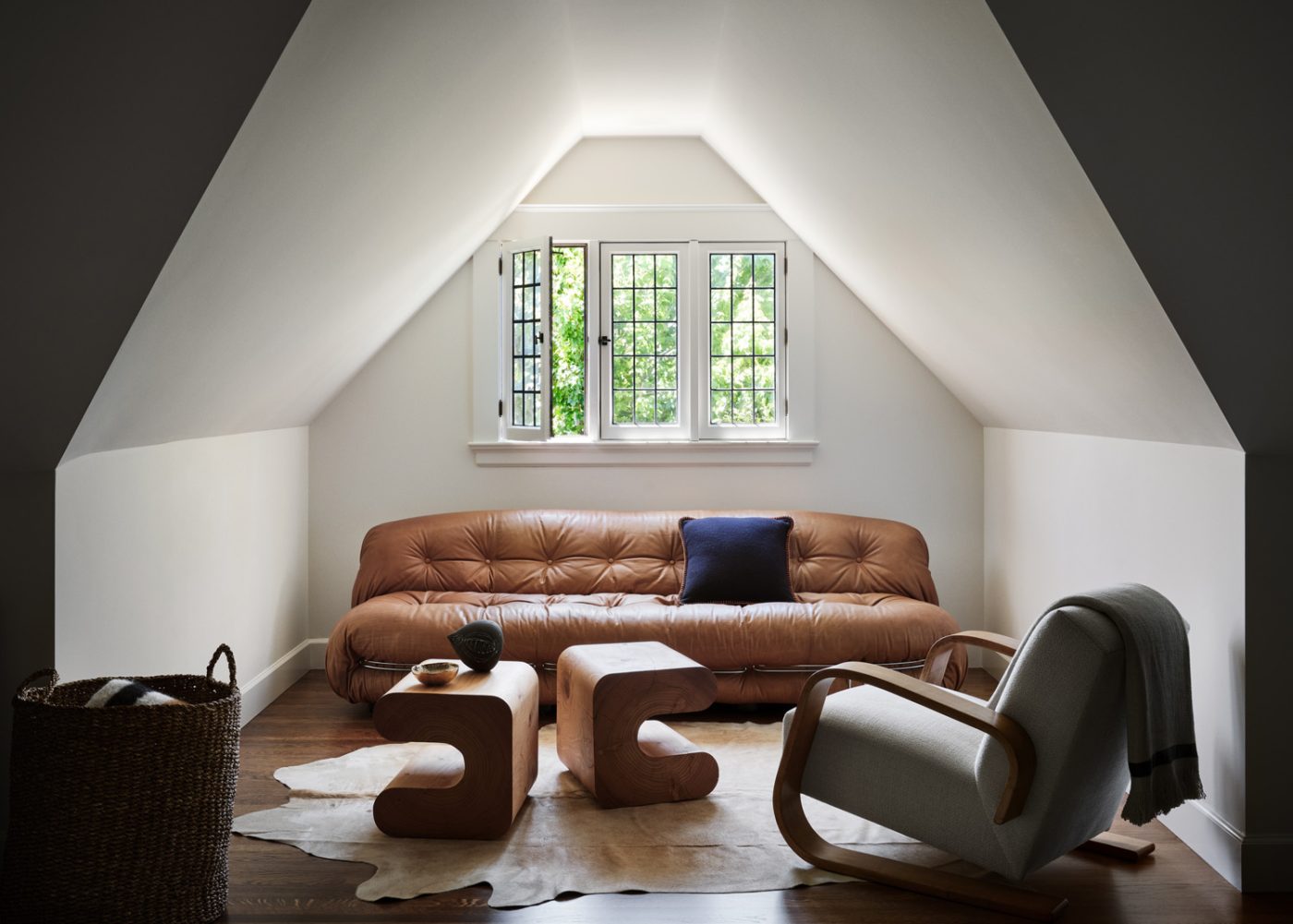
Across from the desk, under a steeply pitched ceiling vault, Leverone added equally hefty pieces to create a lounging spot where the husband likes to play guitar. There, a pair of C-shaped tables by the Los Angeles artist Christopher Norman and a vintage bent-birchwood Alvar Aalto 400 Tank chair face Afra and Tobia Scarpa’s Soriana sofa in a rich cognac leather.
“We need to understand what clients want their home to feel like and push the envelope a little bit for them,” Leverone says of his firm’s overall design approach. “Vintage, custom and artisan pieces give a project sensuality, soul and substance. We’re always trying to find something we haven’t seen before.”