Items Similar to French Art Deco Modernist Gilt Wrought Iron Gilbert Poillerat Coffee Table
Want more images or videos?
Request additional images or videos from the seller
1 of 21
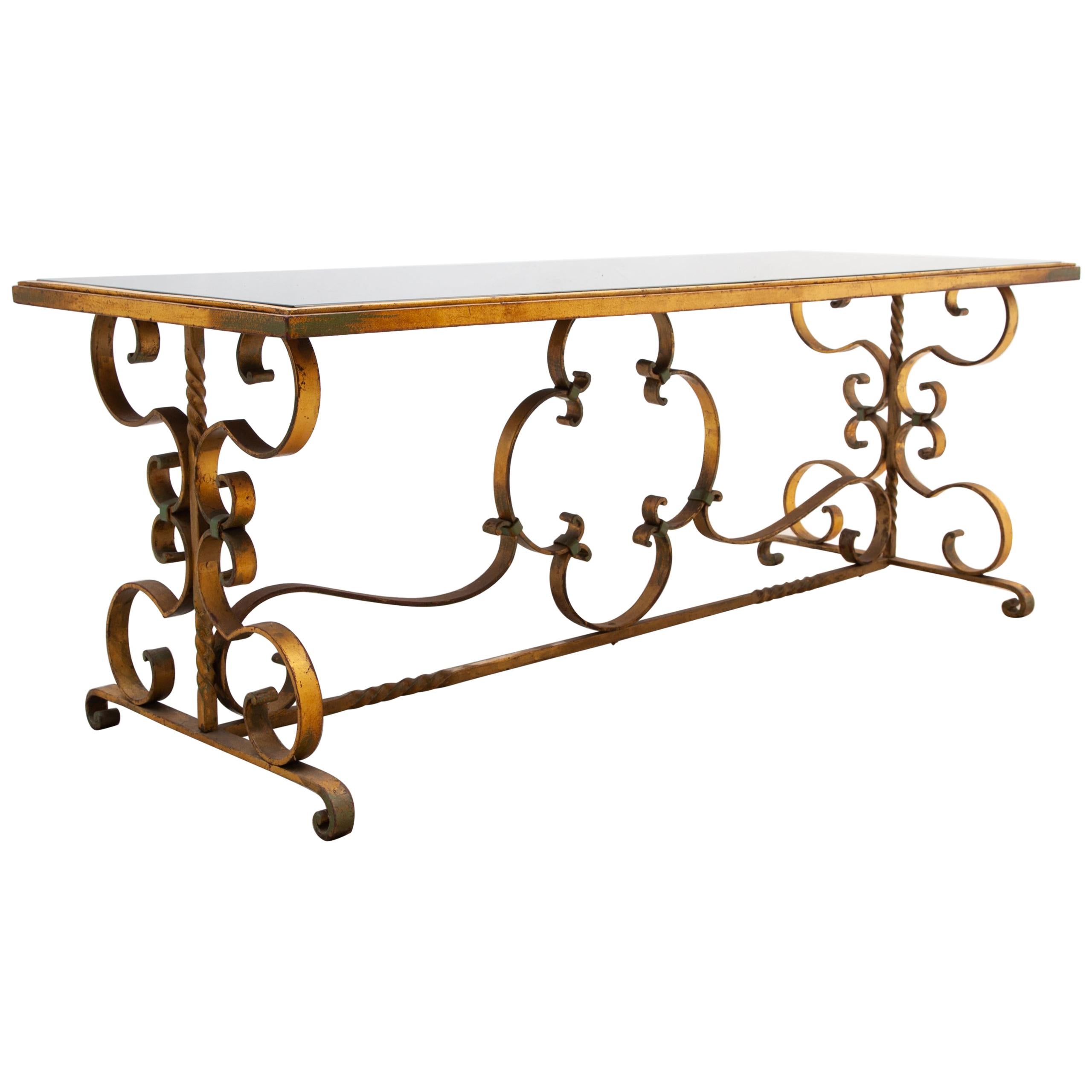
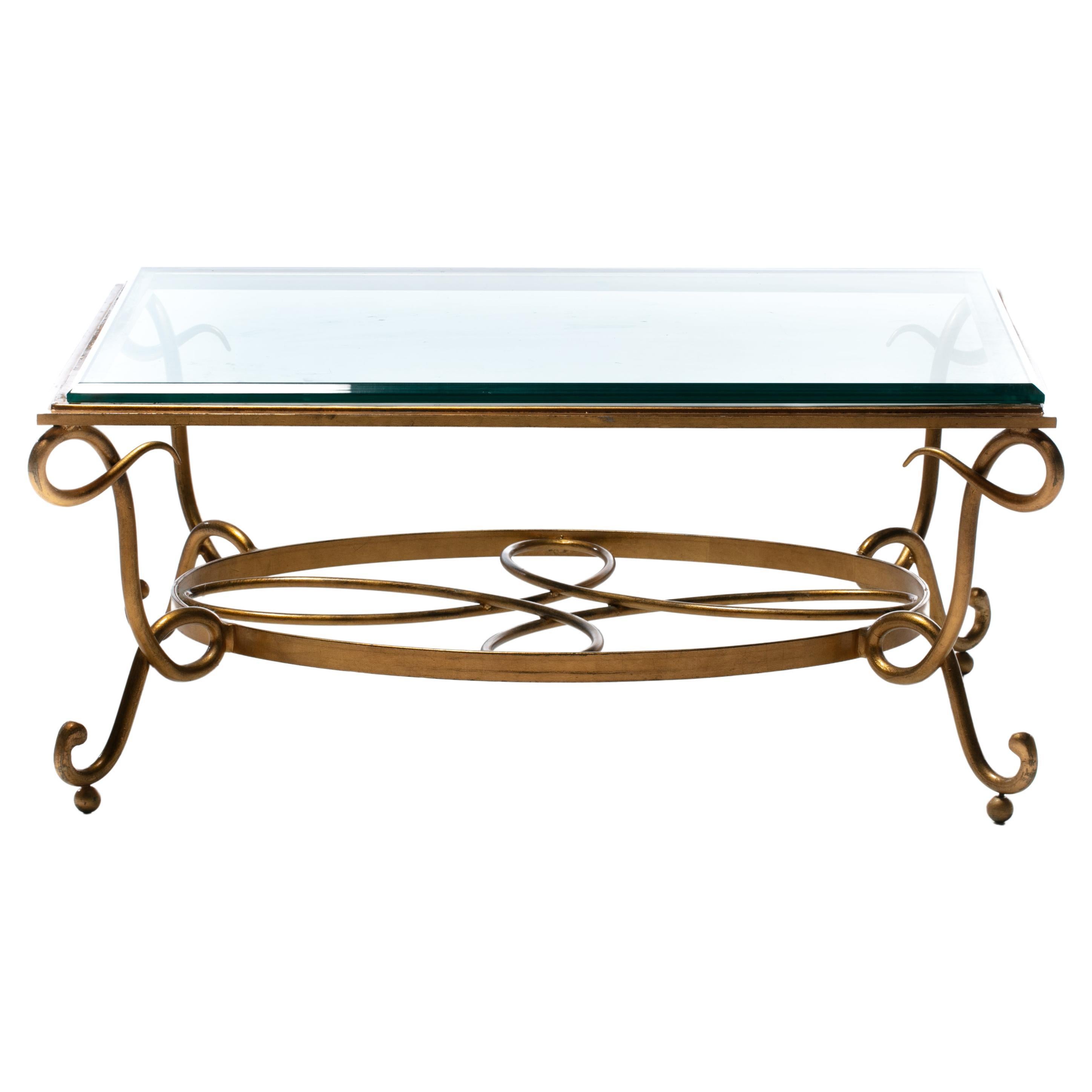
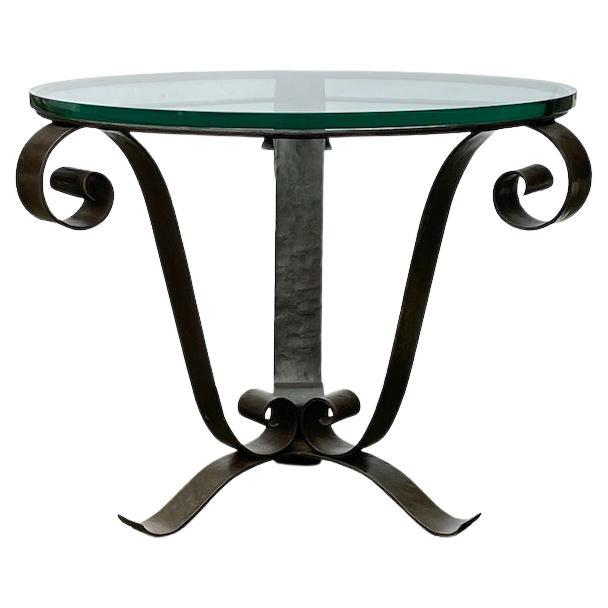
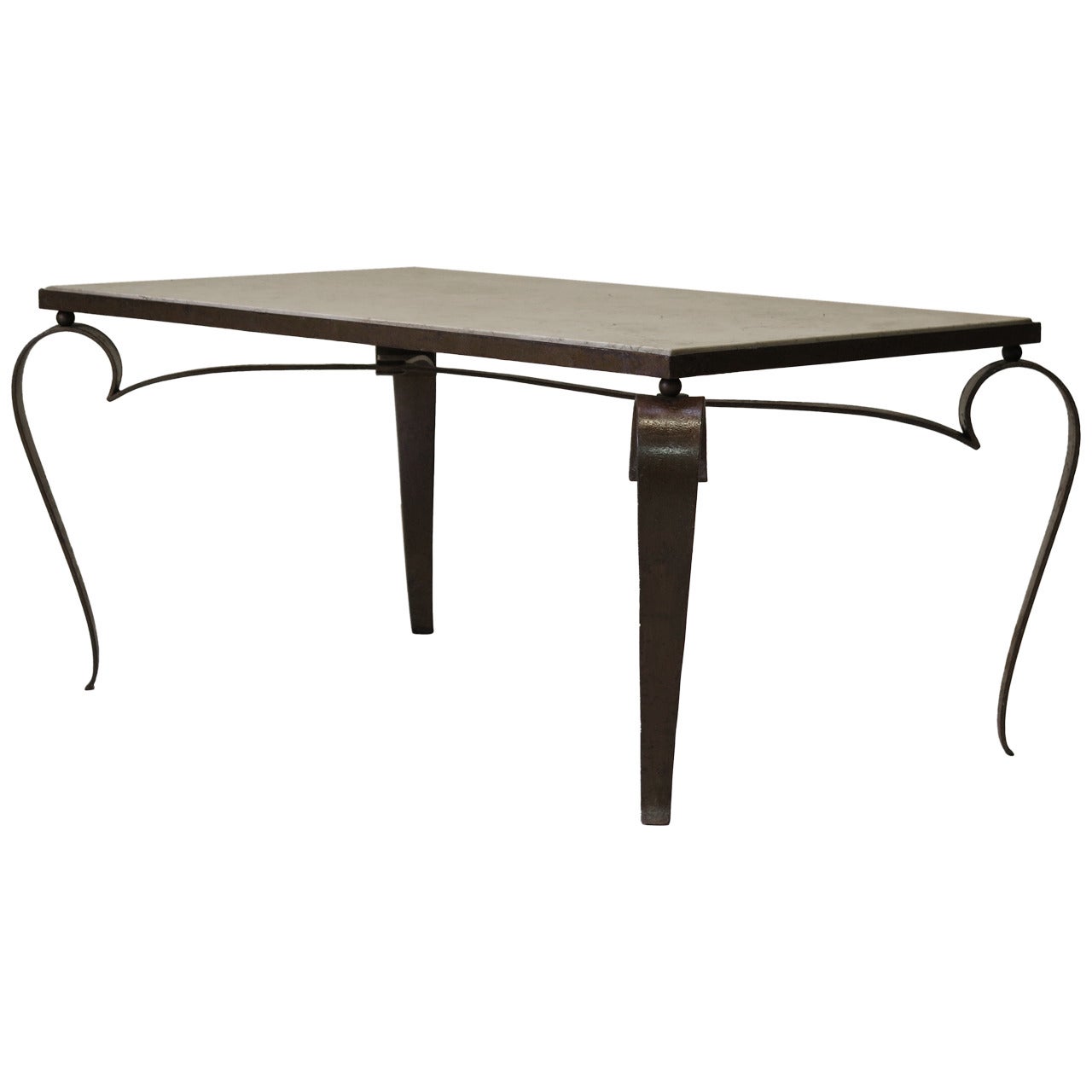
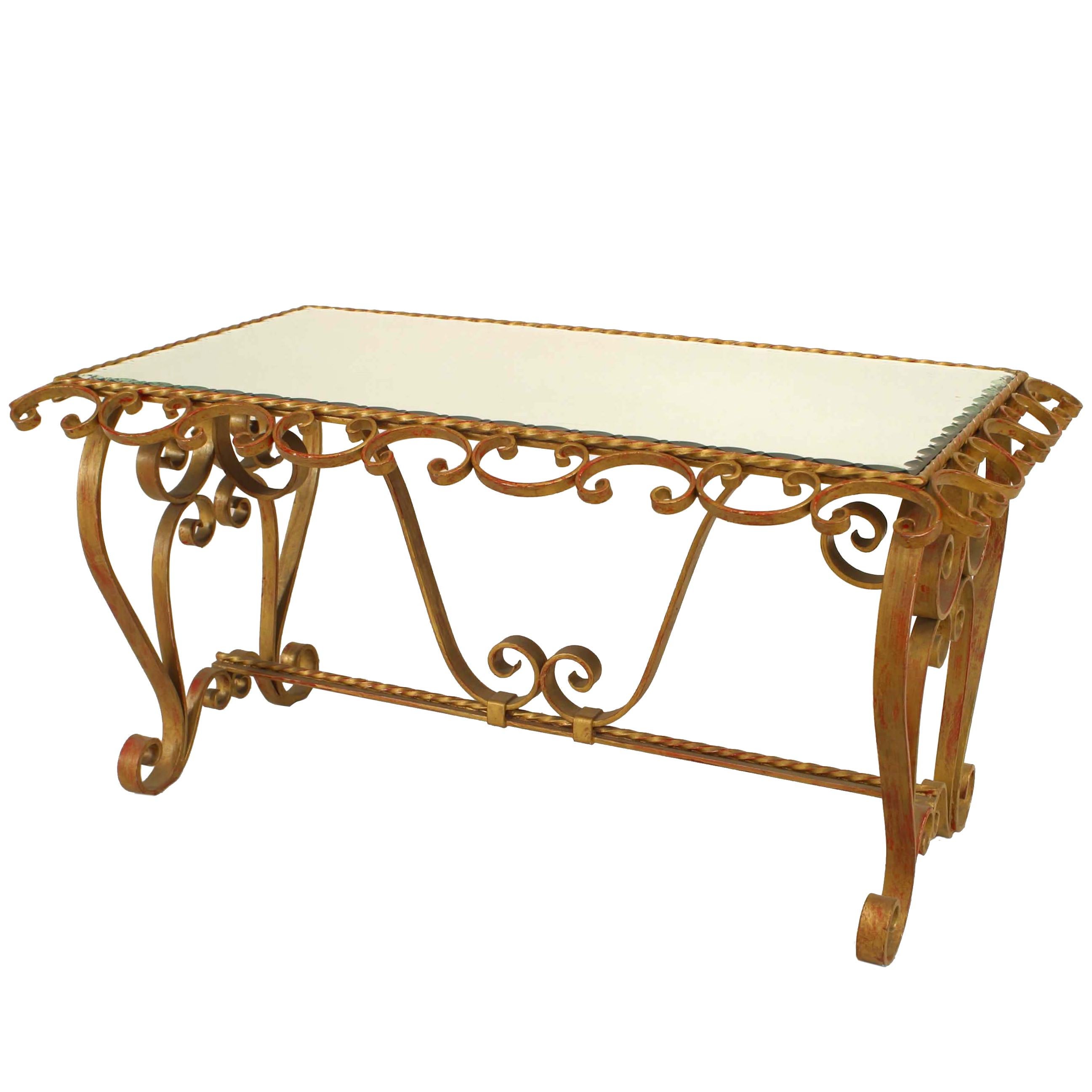
French Art Deco Modernist Gilt Wrought Iron Gilbert Poillerat Coffee Table
$4,500
£3,417.86
€3,931.17
CA$6,287.38
A$7,011.14
CHF 3,658.12
MX$86,029.36
NOK 46,561.98
SEK 44,116.46
DKK 29,339.74
Shipping
Retrieving quote...The 1stDibs Promise:
Authenticity Guarantee,
Money-Back Guarantee,
24-Hour Cancellation
About the Item
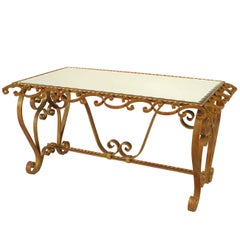
A visually striking midcentury French parcel gilt ironwork base coffee table attributed to / in the manner of celebrated Parisian designer and ironworker Gilbert Poillerat (France; 1902-1988)
Made in Paris, France, circa 1940s, exceptionally executed in Poillerat's distinctive Neoclassical influenced Art Deco Modernist design, high-quality craftsmanship, featuring an ornate open and airy sculptural scrolling black wrought iron frame with trestle supports, joined by lacquered gilded bronze-toned iron classical draped swag accents, surmounted by a rectangular giltwood enclosed inset mirrored glass tabletop framed with thick molded rim.
*Please note, after a cursory inspection, without attempting to remove or inspect beneath the glass, top rails or frame brackets, we found no apparent signatures, typical of Poillerat's's works, as the vast majority are not signed, so it's difficult to say with certainly if he actually crafted this piece, if he designed it and his workshop produced it, or if a different skilled artisan did. We believe it's most likely an authentic original, however we have not found enough documentation to support this without question, so we are saying it is possibly in the manner of / attributed to Poillerat. If verified, the value increases significantly.
Reminiscent of the now iconic 1948 mirror Poillerat made for French interior designer Jean Maurice Rothschild (1902–1998) during the same period.
- Gilbert Poillerat Biography:
There have been many important French designers associated with Art Deco and through the 1930’s, 1940’s and beyond who worked in wrought iron. One usually thinks of Edgar Brandt, Raymond Subes, and Paul Kiss, but this would change as the natural progression of design exploration began to move into the 1930’s and beyond, and Gilbert Poillerat soon emerged as one of the most original, influential, and important designers of his time, as well as fundamentally pushing decorative ironwork forward.
A pioneering French designer and metalworker, he's best known for his ornamental wrought iron designs that seamlessly blended classical elegance with Art Deco sophistication. His handcrafted andirons, tables, consoles, and decorative ironwork remain highly collectible today. Admired for their intricate scrollwork, gilded accents, and sculptural presence, his works continue to inspire both collectors and interior designers.
Born in France in the small town Mer, Loir et Cher in 1902. Poillerat graduated from the Ecole Bulle in 1921 and soon after went to to work as a designer and model maker for Edgar Brandt. Here he learnt much of his craft as Edgar Brandt was himself renowned for his work in metal and even weaponry making (developed during the First World War).
In 1927, Poillerat left Brandt, and began working for Baudet, Donon and Roussel, a firm specializing in construction frameworks. He was placed in charge of their decorative iron-work division, which produced tables, screens, grilles, andirons and lighting. This was the perfect opportunity to hone his skills, and also to evolve his own styles.
In 1928, he first exhibited at the salon d’Automne. His earlier works were studies in fluidity, with complex intertwining of wrought iron in his “calligraphic” style, and often, the wrought iron was gilded.
In 1934, he decided to try his hand at jewelry (the famed American wrought iron artist Albert Paley has similarly made some very jewelry). Poillerat was designing jewelry for the famed French couturier Jacques Heim. In 1935, he was commissioned to design the First Class pool and patinated doors for the ocean liner Normandie.
During this time, though, Poilleral was busily at work designing all manner of furniture and other architectural elements. Tables and consoles were particular specialties, but he also designed table and floor lamps, hanging fixtures, and grilles intended for various purposes. *We believe it's during this time in the 1940s, most likely post-war, he produced the table we're offering*
In 1946, Poillerat left Baudet, Donon et Roussel, and he was named professor at the esteemed École National des Arts Decoratifs, where he taught for 26 years, while continuing his prodigious output.
Moving into the 1950’s, Poillerat’s designs, in keeping with changing tastes, became much simpler and more severely rectilinear, relying on perfect proportions for dramatic effect, and he continued to remain an important figure in French design.
During his career he collaborated with recognised designers such as Andre Arbus, Jaques Adnet, Jean Royere, Raymond Subes, Rene Prou, Jansen, and Maison Bagues to name just a few. His designs show his love of hard metal and design. His work reflected the constant changing of tastes over time. Considered Maitre Ferronnier or master ironworker, he was also prolific at design. From the 1930 his designs became much simpler and suggestive of 18th century Neoclassical forms.
The style he developed evokes the Ecole de Fontainebleau and the almost surreal preciosity made fashionable by certain designers at that time. Active during the Art Deco Moderne period, compared to many other designers, he was inspired more by antique historical forms - making his objects airy and delicate in appearance. A unique contrast to the heavy dark ironwork, this subtle elegant gracefulness can be seen by the use of details such as entwined chord. His motto to reflect his work was, "iron is not an accessory, it is an ornament".
Recognised as being one of the most skilled ironworkers and designers of the 20th century, Poillerat's works are known for being highly unique and often produced in limited quantities and frequently one-offs. His work can be characterised as being bold, striking and dynamic, and nearly a century later his architectural work can be found adorning numerous important buildings and his decorative arts found inside prestigious homes, museums and fine private collections around the world.
Dimensions: (approx)
21.5" High, 47.25" Wide, 23.75" Deep
- Condition Report:
Overall a remarkable example that presents well, in highly desirable very good original unrestored vintage condition. Strong, sturdy, stable, structurally sound. Attractive appearance, with nicely aged warm patina, typical patinated metalwork, nicks, abrasions, moderate rubbing and loss to giltwood, typical patinated metalwork with scattered oxidation, minor surface scratches to glass, all expected wear consistent with age and use.
- 1stdibs arranged professional shipping / in-home white-glove delivery services available:
Depending on your location, our trusted third-party shipping partners availability, schedule, route, weather, etc... we typically qoute to please allow up to eight weeks for delivery. It's typically sooner than that, but please be sure to read your qoute for details.
Local Pick-up / Delivery available around Dallas and the DFW / North Texas area
- Attributed to:Gilbert Poillerat (Metalworker)
- Similar to:Raymond Subes (Metalworker)
- Dimensions:Height: 21.5 in (54.61 cm)Width: 23.75 in (60.33 cm)Depth: 47.25 in (120.02 cm)
- Style:Mid-Century Modern (Of the Period)
- Materials and Techniques:
- Place of Origin:
- Period:
- Date of Manufacture:circa 1940s
- Condition:Wear consistent with age and use. Minor losses. Minor fading. Overall in great highly desirable original unrestored antique condition. Attractive appearance, nicely aged patina/patinated metalwork, expected wear commensurate with age & use, nicks, abrasions, rubbing loss to gilt, character marks & charm.
- Seller Location:Forney, TX
- Reference Number:1stDibs: LU5977244063932
About the Seller
4.8
Platinum Seller
Premium sellers with a 4.7+ rating and 24-hour response times
Established in 2013
1stDibs seller since 2021
290 sales on 1stDibs
Typical response time: <1 hour
- ShippingRetrieving quote...Shipping from: Forney, TX
- Return Policy
Authenticity Guarantee
In the unlikely event there’s an issue with an item’s authenticity, contact us within 1 year for a full refund. DetailsMoney-Back Guarantee
If your item is not as described, is damaged in transit, or does not arrive, contact us within 7 days for a full refund. Details24-Hour Cancellation
You have a 24-hour grace period in which to reconsider your purchase, with no questions asked.Vetted Professional Sellers
Our world-class sellers must adhere to strict standards for service and quality, maintaining the integrity of our listings.Price-Match Guarantee
If you find that a seller listed the same item for a lower price elsewhere, we’ll match it.Trusted Global Delivery
Our best-in-class carrier network provides specialized shipping options worldwide, including custom delivery.More From This Seller
View AllVintage Signed Italian Art Deco Modern Iron Curule Cocktail Trolley Table
Located in Forney, TX
A stylish vintage, circa 1930s, hammered and patinated bronze-tone iron Italian Modernist table on casters. Signed, V.E.T. Meris.
Hand-crafted in Italy in the early/mid-20th centur...
Category
Early 20th Century Italian Art Deco Coffee and Cocktail Tables
Materials
Wrought Iron
Mid-Century French Gilt Brass Marble Top Coffee Table
Located in Forney, TX
A beautiful and scarce vintage coffee table from the mid 20th century, having the original rectangular marble top with molded edge, above a brilliant polished brass frame, scalloped ...
Category
Mid-20th Century Coffee and Cocktail Tables
Materials
Marble, Brass
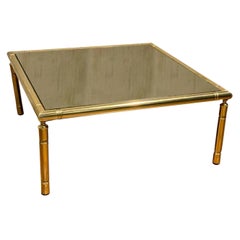
Mid-Century French Brass Smoked Glass Coffee Table
By Jacques Adnet, Maison Jansen
Located in Forney, TX
A large, square, French tubular polished brass table, circa 1960s/1970s. The vintage mid-century table has a base frame with a modern faux bamboo-like design, and inset smoked mirror glass top. Substantial proportions, well made, good quality and craftsmanship, Hollywood Regency style, Modernist influence, in the manner of Jacques Adnet and Maison Jansen.
Provenance:
Acquired from the estate of the late T. Boone Pickens (1928-2019). An American business magnate, billionaire, financier, and philanthropist.
Dimensions: (approx)
14.5"H, 33.5"W, 33.5"D
Acquisition:
J. Garrett Auctioneers had the pleasure of presenting Pickens' collection of 18th and 19th Century furnishings and accessories. This piece comes from the iconic Texas and Oklahoma oil...
Category
Mid-20th Century Coffee and Cocktail Tables
Materials
Brass
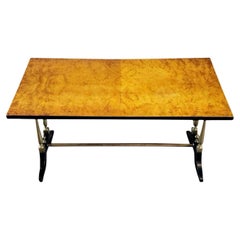
Maison Jansen Style Mid-Century French Modern Coffee Table
By Maison Jansen
Located in Forney, TX
A superb French midcentury cocktail table in the style of Maison Jansen. Fine craftsmanship and quality, exceptionally executed, rectangular shape, having gorgeous olive burl wood to...
Category
Mid-20th Century French Mid-Century Modern Coffee and Cocktail Tables
Materials
Brass, Bronze
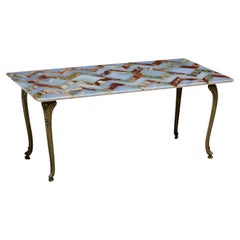
French Mid-Century Louis XV Hollywood Glam Inlaid Onyx Gilt Brass Coffee Table
By Maison Jansen
Located in Forney, TX
Stunning vintage French mid-century cocktail table. circa 1960s/1970s
A transitional masterpiece, mixing design elements of luxurious 18th century Louis XV style with Hollywood Rege...
Category
Mid-20th Century French Hollywood Regency Coffee and Cocktail Tables
Materials
Onyx, Marble, Breccia Marble, Brass, Bronze
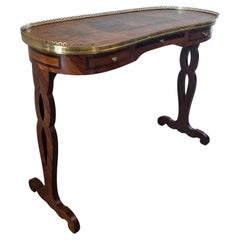
Antique French Louis XVI Style Kidney Trestle Gilt Brass Gallery Writing Table
Located in Forney, TX
Add luxurious elegance and sophistication with this exquisite French Louis XVI style kingwood marquetry table a ecrire (writing table).
Dating to the late 19th / early 20th century,...
Category
Early 20th Century European Louis XVI Desks and Writing Tables
Materials
Brass, Bronze, Ormolu
You May Also Like
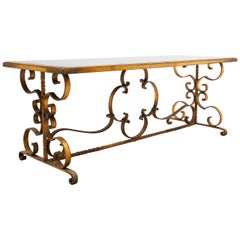
1930s Wrought Iron Art Deco Coffee Table, France
Located in Antwerp, BE
Beautifully Art Deco coffee or centre table with a wrought iron base and the warm original gilded and black smoked detailing of the glass top, detailed design of pleasant curves, ver...
Category
Mid-20th Century French Art Deco Coffee and Cocktail Tables
Materials
Wrought Iron
$3,215 Sale Price
40% Off
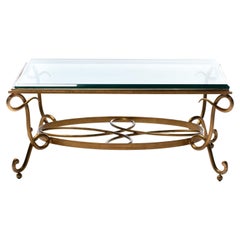
French 1940s René Prou Style Gilt Iron Coffee Table
By René Prou
Located in Saint Louis, MO
Classic Parisian charm oozes from this 1940s French René Prou style Coffee Table with its whimsical gilded curves and upper crust profile. Fanciful. Ornate. The perfect choice to anchor that Upper East Side living room. Simply add some interesting table books and a wonderfully scented floral arrangement and voilà - c'est si tres bon! Gilded beautifully with rich golden tones. Center emblem is reminiscent of a four leaf clover and is framed with an oval border. Legs curve like a chic signature and rest atop ball feet. This table gives a feeling of constant movement and flow, precisely what made René Prou's pieces so unique and sought after. Beveled glass top allows the table's sexy details to be well regarded from all perspectives. Want to see more beautiful things? Scroll down below and click "View All From Seller" or favorite our shop to get your 1stDibs on our new inventory.
Photographed and also currently available in our shop:
Vladimir Kagan Post Modern Scallop Chaise Lounge...
Category
Vintage 1940s French Art Deco Coffee and Cocktail Tables
Materials
Gold Leaf, Iron
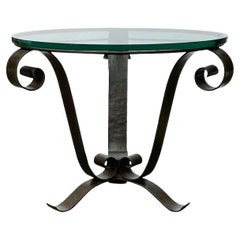
French Art Deco 1940s Wrought Iron Table
Located in CA, CA
An elegant French Art Deco 1940s wrought iron coffee table.
Understated in it simplicity the forging of this piece has been executed with great precision the interior of each of the...
Category
Vintage 1940s French Art Deco Coffee and Cocktail Tables
Materials
Wrought Iron
Gilt Iron and Marble Top Art Deco Coffee Table, France circa 1950s
Located in Isle Sur La Sorgue, Vaucluse
Charming rectangular coffee table with a gilt iron base and a beige stone top.
Category
Mid-20th Century French Art Deco Coffee and Cocktail Tables
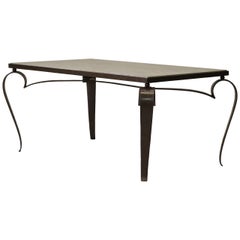
French Art Moderne Gilt Iron and Mirror Coffee Table
Located in Queens, NY
French Art Moderne (1940s) gold painted wrought iron coffee table with scroll / twisted iron details and beveled trimmed edge mirror top.
Category
Vintage 1940s French Modern Coffee and Cocktail Tables
Materials
Wrought Iron
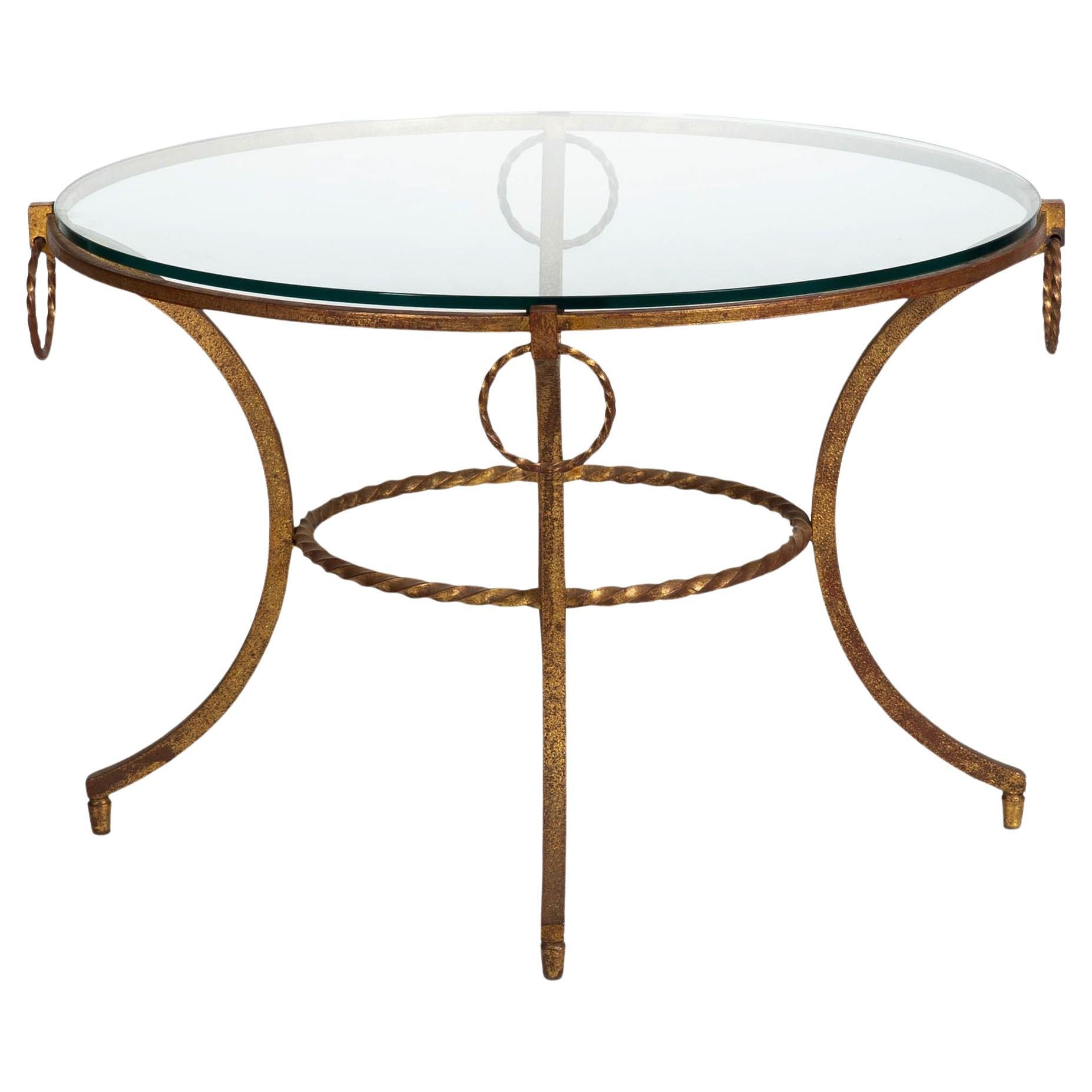
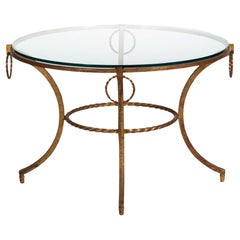
French Modernist Gilded Wrought-Iron & Glass Coffee Accent Table ca. 1950s
Located in Shippensburg, PA
MODERNIST GILDED WROUGHT-IRON AND GLASS COFFEE TABLE
French, circa 1950s unmarked
Item # 401RGG02P-1
An endlessly interesting modernist accent table from the 1950s, it works perfectly both as a side table beside a low sofa or chair or as a coffee or cocktail table. The diminutive stature of the table allows it to be a part of the room without dominating at all, adding texture and visual interest with the brilliantly textured gilt patina while having a great deal of negative space that makes the table feel light, airy and relaxed. The 3/8" thick (and brand new) glass top is set into tiny grooves in the legs, each with a single twisted iron ring hanging from the top with a gentle curved profile that terminates in a stubbed sabot. Ready to place.
We acquired this together with a matched pair to this that is almost identical in size but is a simple black patination instead of having the gilt surface on the wrought iron; contact us if you would like to know about the other table.
Measurements: 19 1/8" H x 29 5/8" diameter
Condition Report:
Glass is brand new 3/8" thick tempered clear glass; table in very good condition, light wear to gilding and overall patina in a few spots, incredibly sturdy and solid. A fine ready-to-place presentation.
About silla antiques...
Category
20th Century French Coffee and Cocktail Tables
Materials
Wrought Iron
More Ways To Browse
Iron Bronze Table French
Used Pool Table
Cocktail Picks
Small Maison Jansen Table
French Metal Scrolled Table
1950s Art Deco Mirrors
Screen Doors Vintage
Gloves Made In France
Art Moderne Jewellery
Art Deco Metal Screen
Used Jewelry Dallas
1950s Pool Furniture
Glass Pool Table
Vintage Cocktail Picks
Mid Century Pool Table
Hand Glove Mold
Maurice Fine Jewelry
Retro 1950s Cocktail Party