August 2, 2026It’s a house that might have served as a subject for the legendary architectural photographer Julius Shulman. The sleek, white, mid-century modern residence, located in Los Angeles’s Studio City, sits at the end of a winding hillside road. In the evening, the last rays of the sun filter through curtained walls of glass while the lights of the San Fernando Valley twinkle below. From the primary bedroom, sliding doors open to the living room, which leads to a terrace overlooking a pool, blurring the boundaries between inside and out.

Its current owners lived in the 3,300-square-foot house for a year before realizing they needed help turning it into a home. The young couple — he works in technology, she imports wine — share a love of great food and entertaining but knew little about decorating.
So, an artist whose work they collect, Anne Libby, introduced them to a friend she has known since they were fellow students at Providence’s Rhode Island School of Design: Adam Charlap Hyman, cofounder, with architect Andre Herrero, of the 1stDibs 50 firm Charlap Hyman & Herrero.


“It was a fun connection,” Charlap Hyman says. “They are lovely people, and since they hadn’t made any big purchases, we basically started from scratch.”
The designers — known for their deeply historical, conceptual approach to both interiors and set design — begin every project by assembling several hundred images to show their clients, representing everything from architectural details to furnishings to color palettes to decor from different periods and around the globe. The pictures are a diagnostic tool: How the clients respond helps the studio ascertain what they want.

Charlap Hyman then collaborates with his mother, artist Pilar Armon, to create two watercolor renderings for each room depicting different options. He presents these to the clients together with fabric samples and tear sheets that flesh them out.
In this case, the couple gravitated toward earth-toned 1950s Los Angeles interiors and Parisian rooms from the tail end of the past century. One interior in particular became a touchstone: fashion designer Miuccia Prada’s 1990s Milan apartment. “They really liked the palette there — eggplant and olive green — as well as the dark floors,” says Charlap Hyman, who combined those hues in the Studio City home with camel, beige, celadon and pool-table green.

Architecturally, the house, which had undergone several renovations, called for a light restoration rather than a complete overhaul. Herrero took the lead on refinements, deploying subtle gestures, like staining the floors a dark hue and replacing the recessed ceiling lights with simple, funnel-shaped 1970s-style plastic fixtures with exposed bulbs. To bring the structure more in line with its original period, the designers relied on clues provided by the house itself, since earlier records — and even the name of the architect — were impossible to find.


To soften the building’s austere lines, the designers looked to one of their favorite inspirations: the architect Lina Bo Bardi’s 1951 modernist Casa de Vidro, in São Paulo, Brazil. Bo Bardi’s ceiling-hung drapes are echoed in the pleated sheer natural-linen curtains the duo hung from the Studio City house’s skylight-like openings. “They encourage the eye to travel up and out,” Charlap Hyman says.


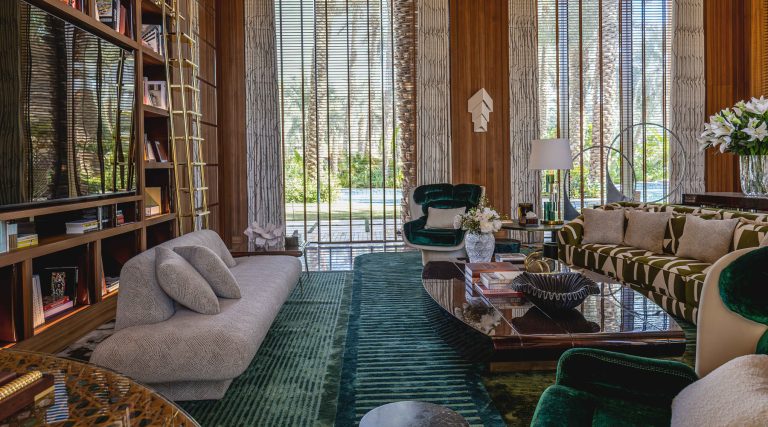
The living room is lounge-like, with multiple seating areas taking advantage of panoramic views. One side is anchored by a built-in L-shaped sofa in Holland & Sherry velvet, topped with pillows made from antique kimono fabrics. Around this are arranged several vintage finds sourced on 1stDibs, including a pair of high-backed circa 1960 bent-bamboo chairs by Dirk van Sliedrecht, a swivel-armed Serge Mouille sconce and two massive ceramic pots holding ficus trees.
A work by Libby — a quilted wall piece referencing modernist windowpanes — hangs nearby, its palette deftly picking up the sofa’s purple upholstery and the pale-turquoise planters.
In Charlap Hyman’s hands, the combination of furniture and art feels inevitable, with sculptural shapes adding visual excitement to the room’s rectangular geometry. “The goal was to make the architecture sing,” he says, “and to bring the view inside and create a comfortable space full of special things.”


Because the couple loves to entertain in groups big and small, in ways both casual and formal, the dining area was designed for flexibility. The custom table was made in two sections topped with two different pink marbles — one light, one dark — and mounted on casters. It becomes one long table, surrounded by Vico Magistretti black-framed chairs with rush seats, when the homeowners invite friends to their frequent dinner parties. Separated, its square component parts are ideal for more intimate gatherings.
Nearby, a collection of hand-blown blue Venetian glass vessels by the artist Nicholas Kekic tops one of Charles Dudouyt’s 1940s faceted oak credenzas, whose style Charlap Hyman calls “rustic Deco.”

Another hue inspired by the Prada apartment — Charlap Hyman calls it “mole,” a warm brown with hints of red or purple — envelops the cozy den, which overlooks a back garden. The couple uses the room for watching TV and late-night entertaining, projecting movies onto an oversize screen while guests sink into a cloudlike Mario Bellini sectional or recline on a vintage Italian rattan daybed topped with pillows made from antique rugs.
For the primary bedroom, the initial concept watercolors offered two distinct options: a mid-century-inflected space with spice-hued accents and a more ethereal cocoon with a refreshing palette of seaside pastels.

When the couple chose the latter, the designers created a custom aqua-hued Formica bed with integrated bedside tables inspired by a Gio Ponti design, laying a seafoam-green rug with pom-pom details underneath. They commissioned a silk bedspread and shams from Leontine Linens embroidered with waves and a fish-in-a-net motif on each pillow. “We were thinking about Old Hollywood touches of glamour,” Charlap Hyman says.
“It’s a cool, calm, chill California low-key interior,” he concludes. “And I think we found a way to do it that still feels personal, sophisticated and not predictable.”