
May 17, 2026Portugal–based studio Oitoemponto designed its first Middle East project in a somewhat unexpected location. Rather than occupying a urban high rise or set among desert dunes, the property is nestled predominantly in the heart of a luxuriant palm grove in a wadi, or seasonal river valley, in Saudi Arabia.
When the firm’s principals — French-born Jacques Bec and his Portuguese husband, Artur Miranda — first visited the site, they discovered a blanket of parsley covering the ground.
“It’s quite astonishing, because the surroundings are dusty and sandy, and suddenly you turn a bend and you’re in a mini paradise,” says Bec. “The temperature drops about ten degrees.” The remains of a 12th-century city wall are located nearby.
Bec and Miranda’s clients are a Saudi industrialist and his family. It was the 20-something son who discovered Oitoemponto’s work, during a stay at Lisbon’s most iconic hotel, the Four Seasons Ritz, a 1950s property that the pair has been gradually refurbishing since 2019. He bought one of their books in the hotel’s boutique, returned home to Saudi Arabia and told his parents they should hire Oitoemponto — a member of the newly announced 2026 1stDibs 50 — for what turned out to be a mammoth project.
Working with a plot of land covering nearly 50 acres, the designers were initially tasked with creating five different structures: a main house, a guest house, a gym, a cliff-top tent overlooking the valley and an entertaining pavilion. The clients later expanded the scope to include additional buildings, and also requested that as few palm trees be cut down as possible.
When it came to the pavilion, top of mind for the owners was its ability to impress their guests. “They are very well informed and cosmopolitan,” says Miranda. “They wanted to bring back to their country the kind of aesthetic they experience when they travel.”
The pavilion’s exterior exemplifies Oitoemponto’s architectural approach. The designers like to cite mid-20th-century Italian master Piero Portaluppi as an influence, and their own buildings are often simple and spare, with strong straight lines and little ornamentation, in the manner of Portaluppi’s most famous commission, Villa Necchi Campiglio, in Milan.
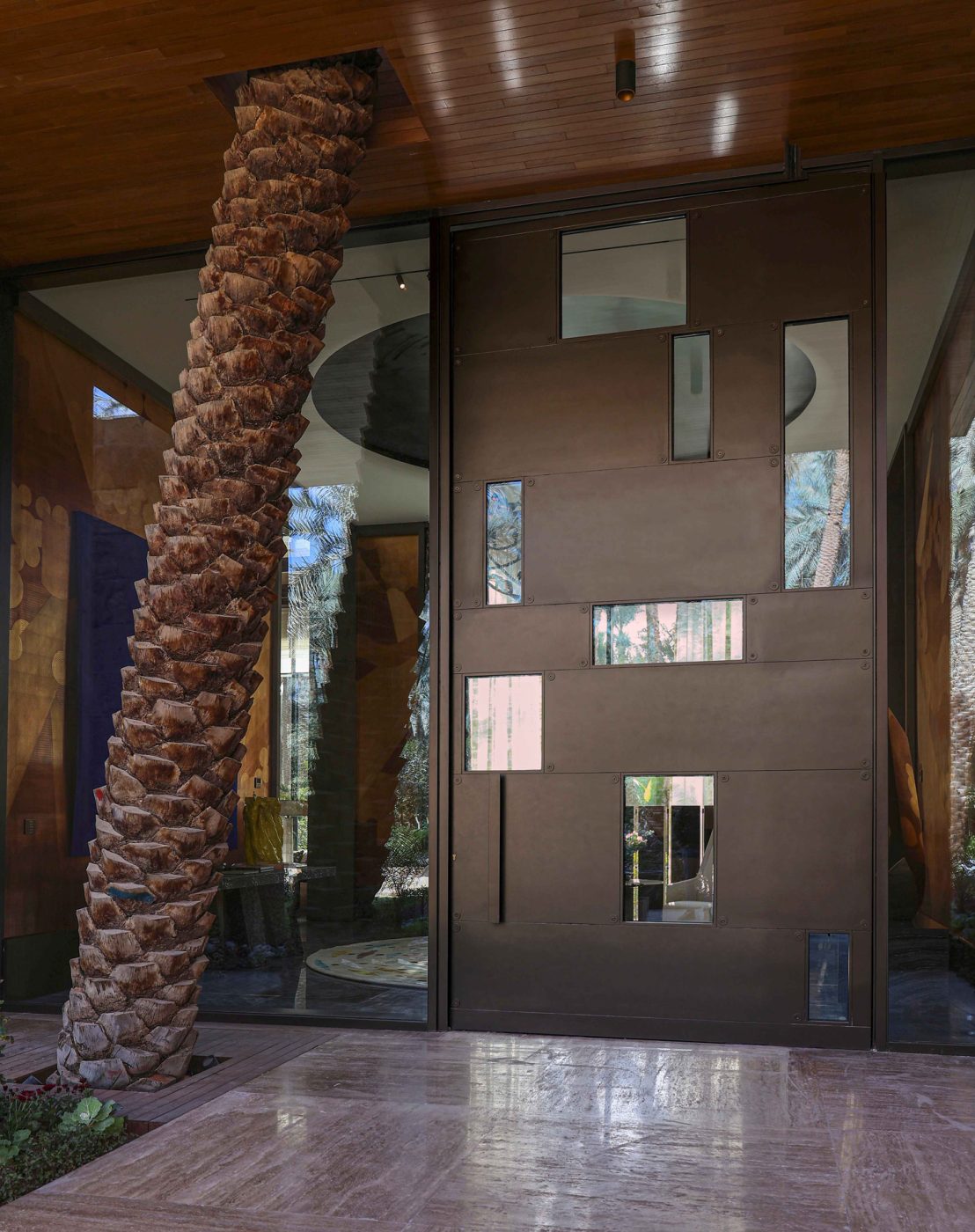
Here, they chose to work with local materials — rammed earth, stone and teak — and installed a majestic front door with glazed rectangular openings arranged in a syncopated fashion. “When you arrive, you get a glimpse of what’s coming, but not too much, so as to maintain an element of surprise,” says Miranda.
The project presented two main challenges. The first was understanding how people live and entertain in the Middle East. The designers found themselves “working with a completely different philosophy,” says Miranda. “All the codes you’re used to no longer apply there.”
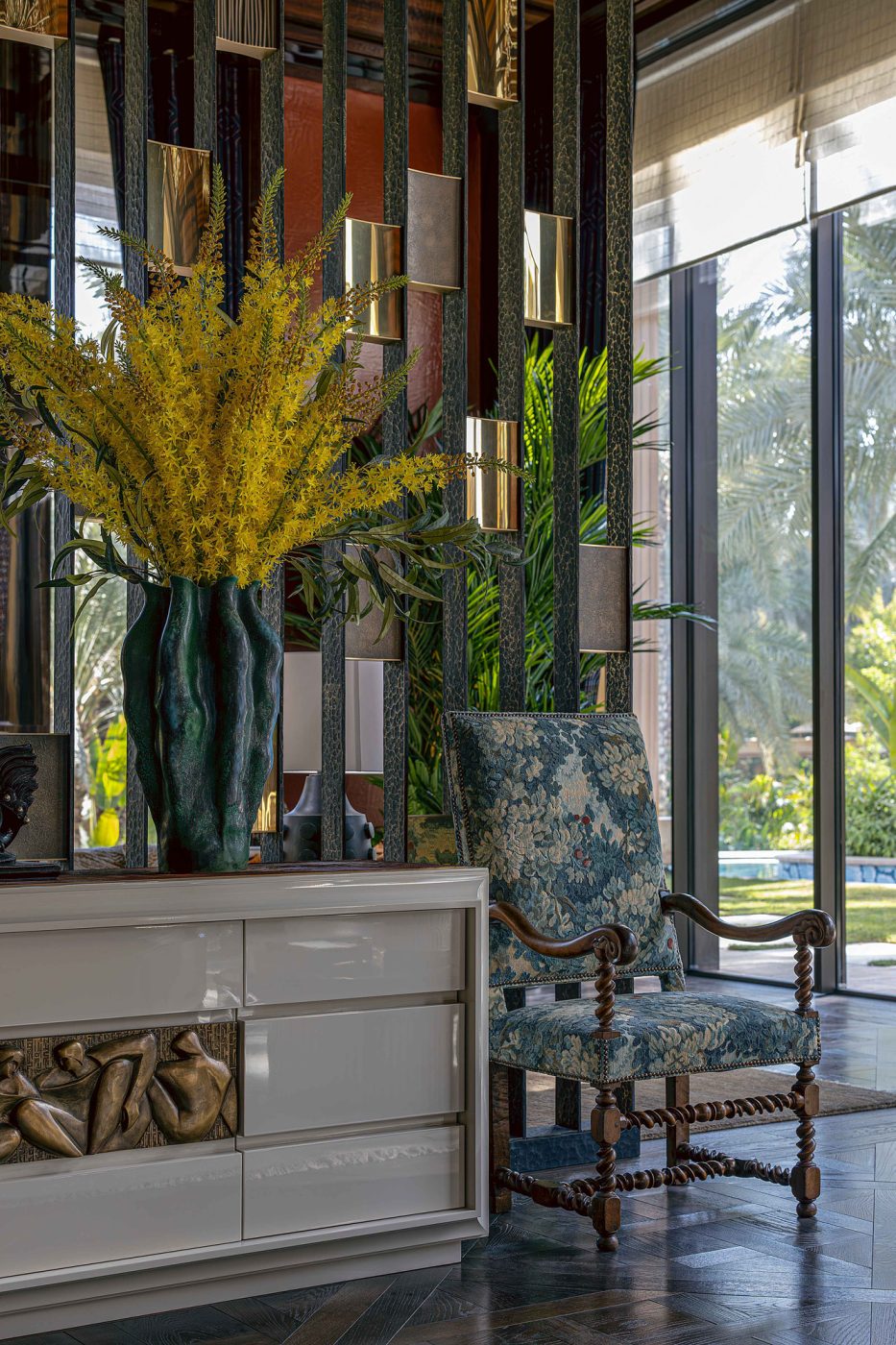
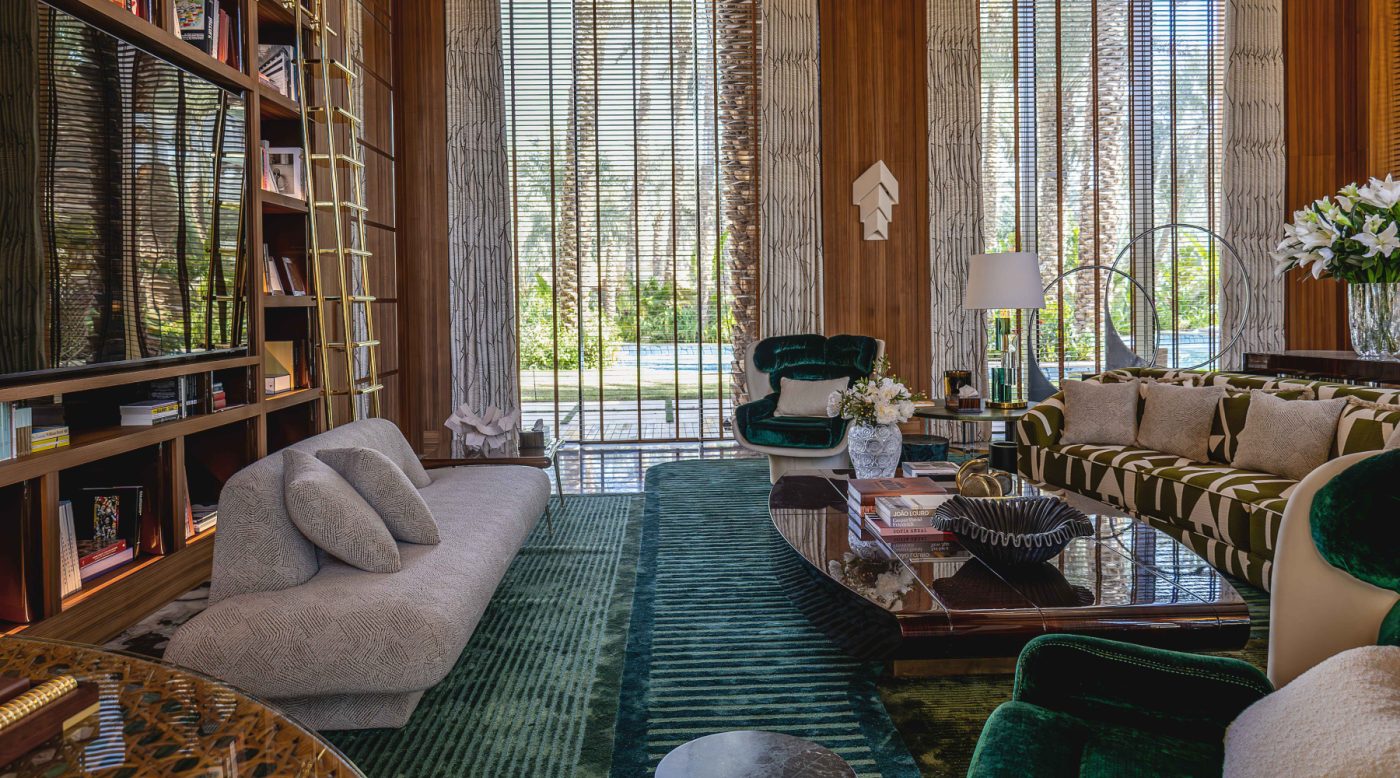
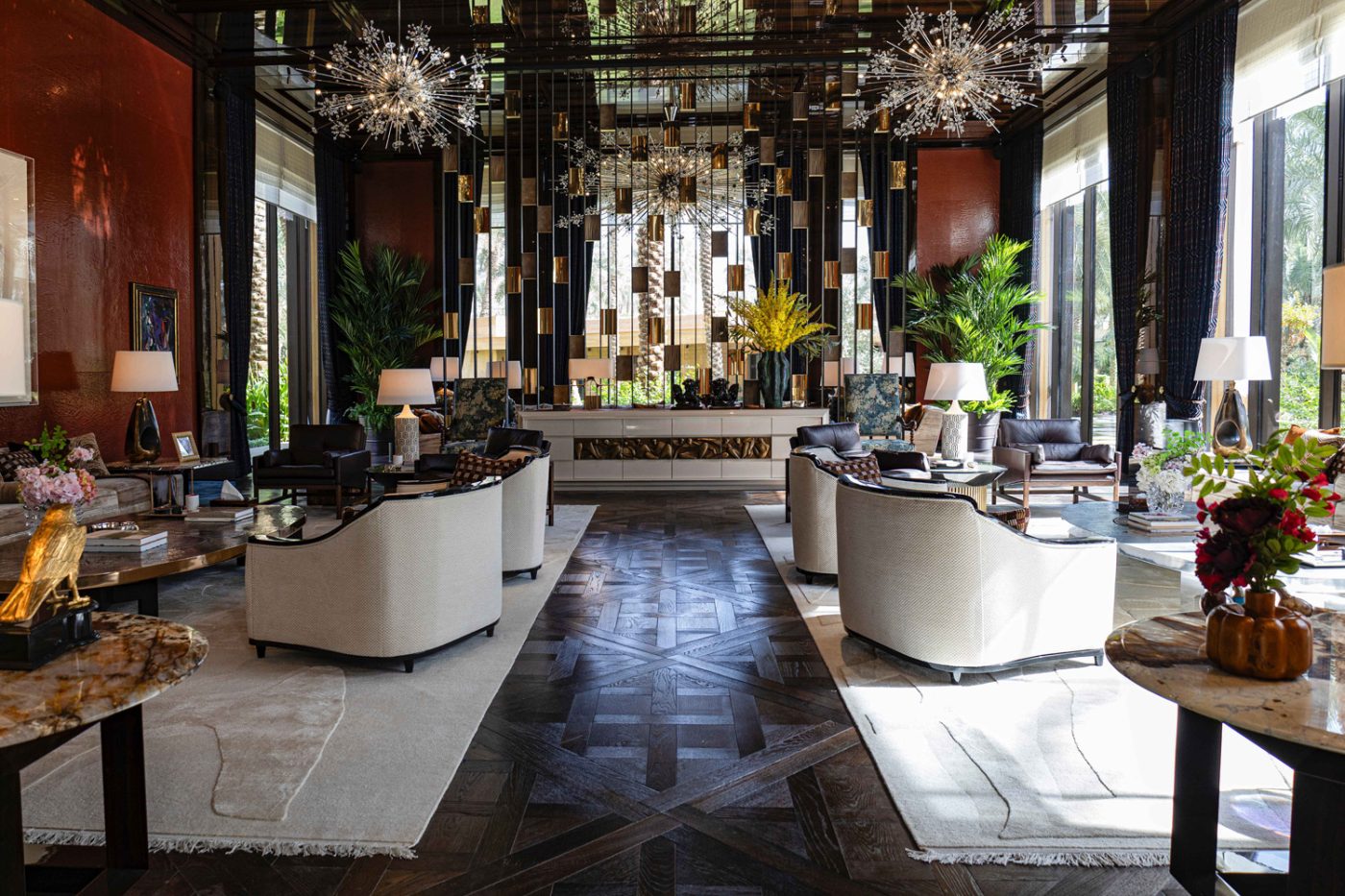
The clients, for example, asked for separate zones for men and women in the pavilion’s grand salon, a request Bec and Miranda met by designing a custom openwork, hammered-bronze screen to separate the two areas. They also had to develop creative design solutions for the storage of abayas, as well as for an indoor pool for women.
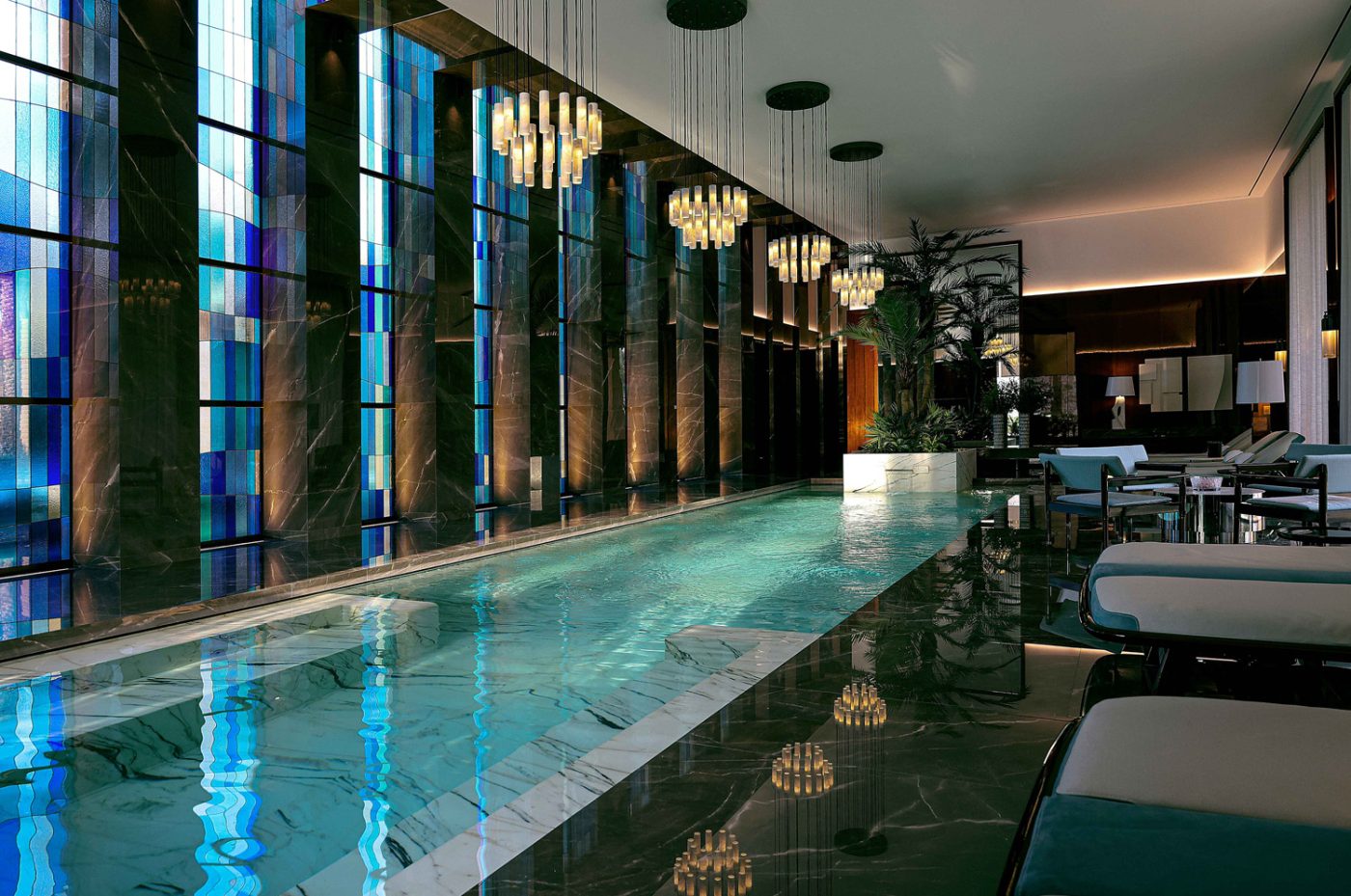
“They can’t swim outside,” explains Bec. “There are always gardeners present.” The designers ultimately crafted a pool shielded by floor-to-ceiling stained-glass windows with a wave-like motif in gradations of blue, conceived to let in light while ensuring privacy.
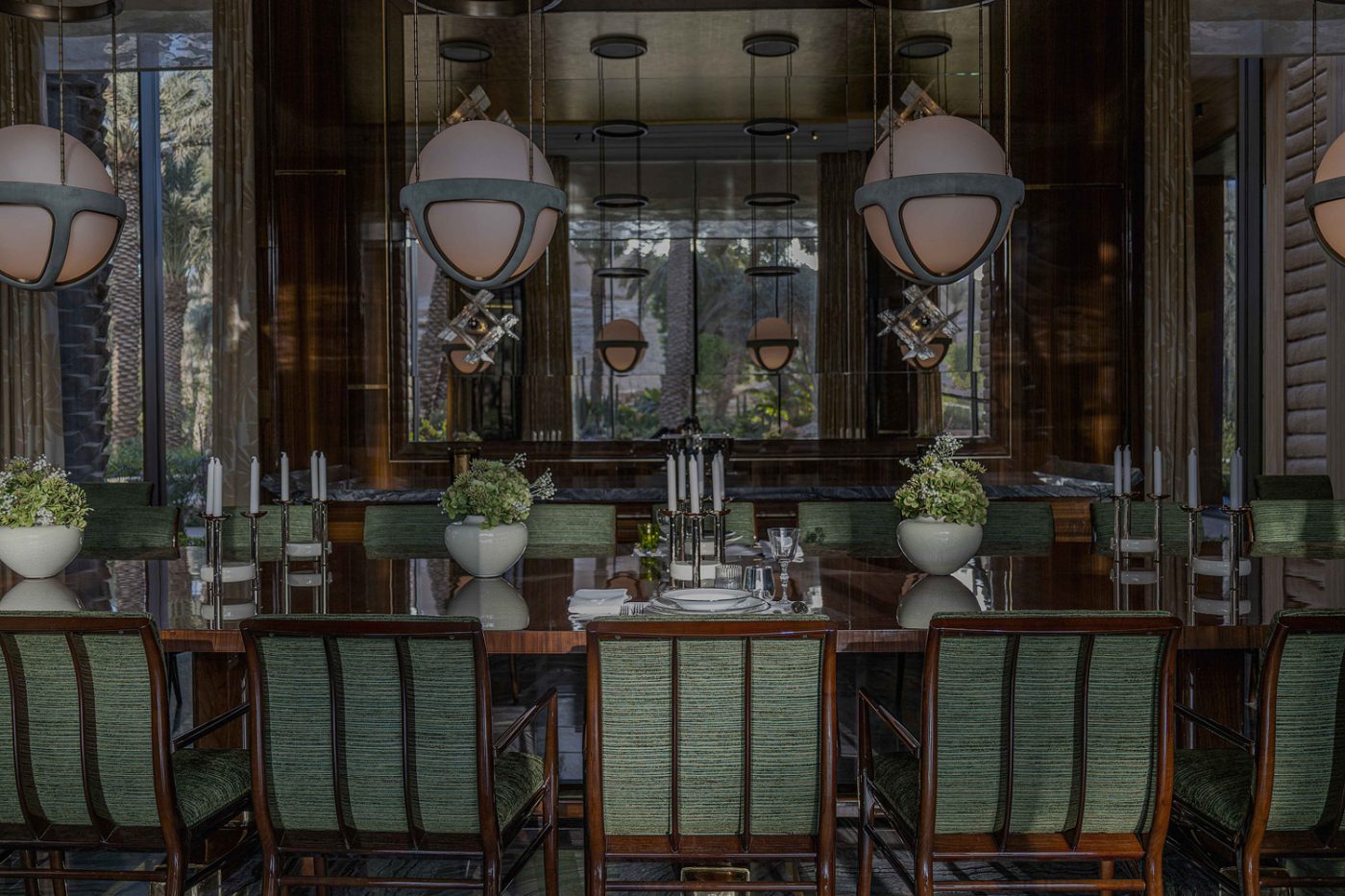
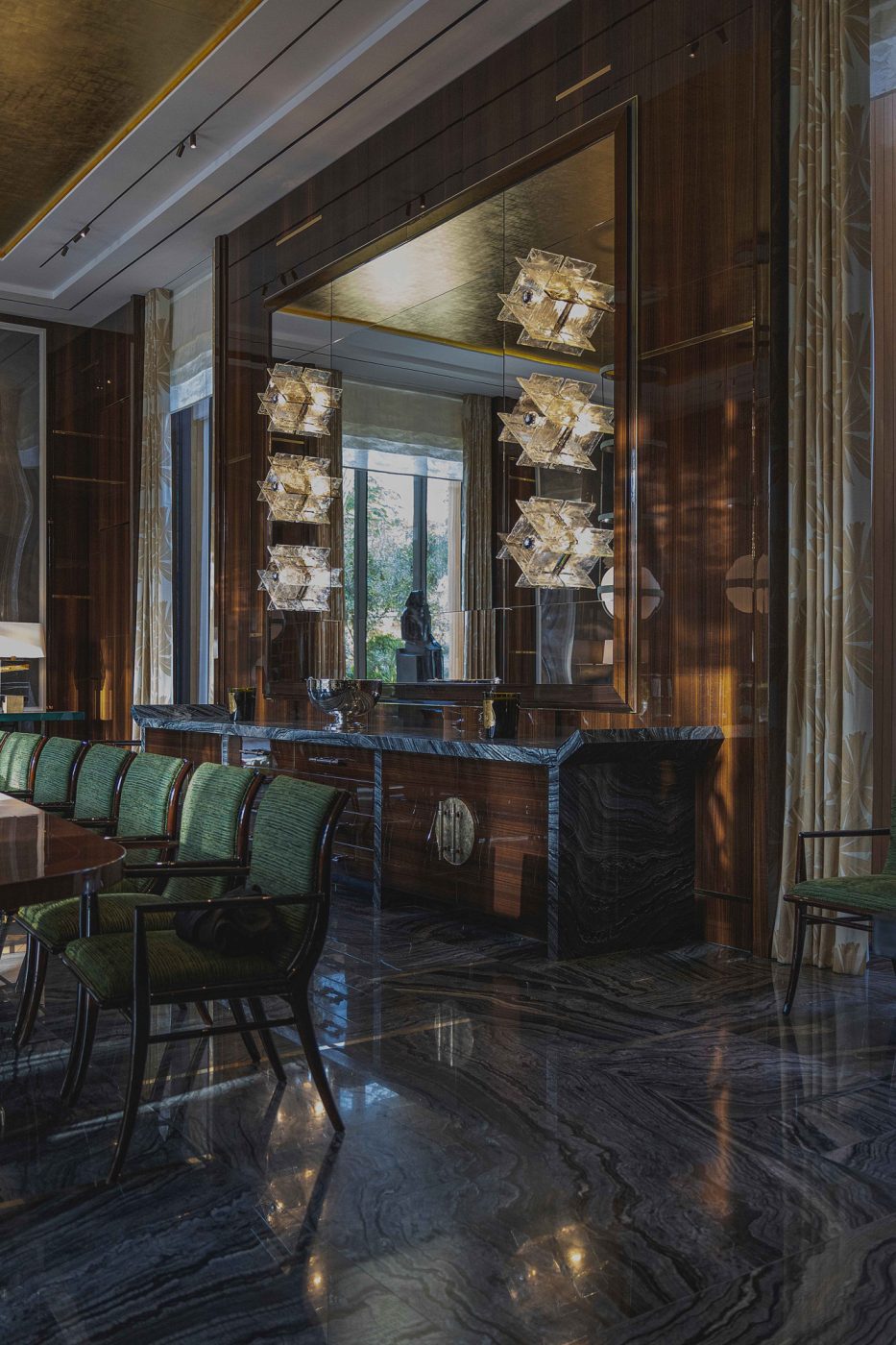
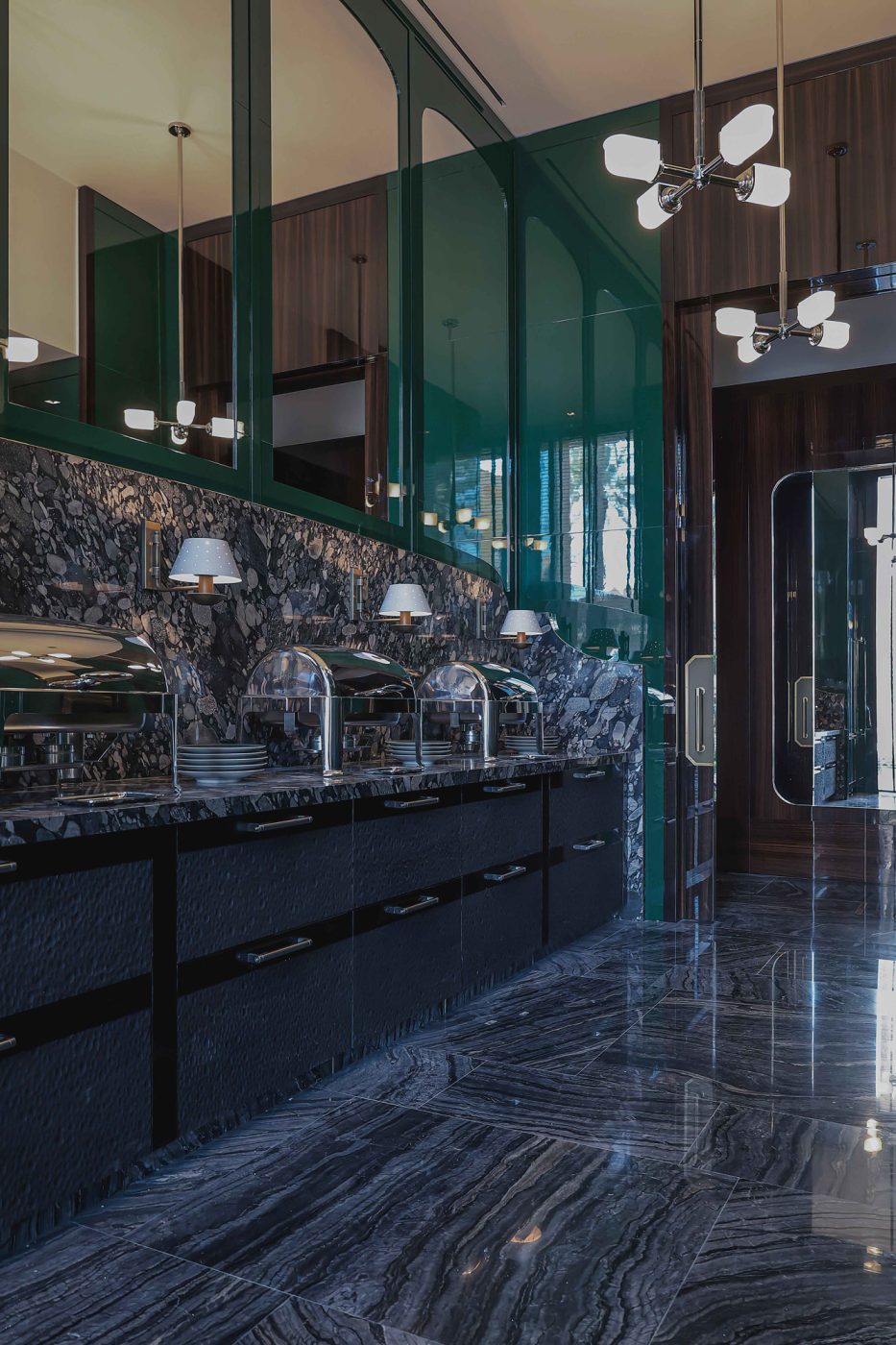
In addition, when Saudis entertain they favor buffets rather than sit-down meals. Hence, for the dining room, Bec and Miranda designed five large serving tables, made from Sahara Noir marble, with upturned winged ends inspired by traditional Chinese furniture. “That way,” quips Bec, “if someone spills some soup, it doesn’t fall on the floor.”
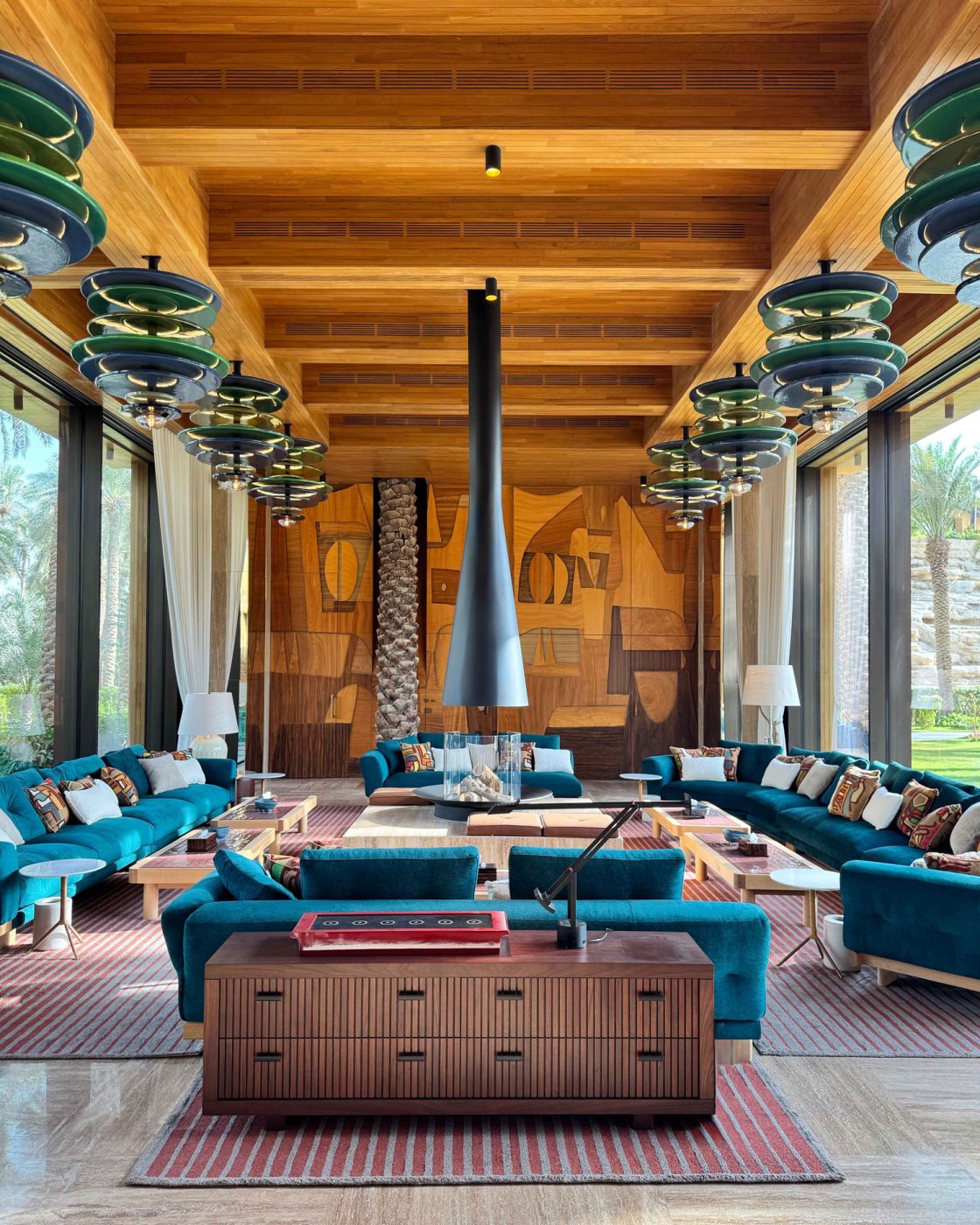
The other challenge the designers had to deal with was the monumentality of the different volumes. The grand salon is proportioned to hold up to 100 guests, and the pavilion’s entry hall is so vast that a specially adapted eight-foot-long Hervé Van der Straeten Magma 426 dining table serves as a console there.
Ceilings soar to more than 16 feet, which required Bec and Miranda to modify the scale of the gilded Namban wallpaper they designed for de Gournay and used in both the entry and corridors. “When we conceived it, we never imagined it having to be so high,” says Miranda.
Everywhere, they stretched the limits in terms of refinement. The walls of the grand salon, for instance, are clad in vernis Martin, a special varnish developed by a quartet of brothers named Martin in 18th-century France to imitate Asian lacquerwork.
For the dining room, Bec and Miranda designed a custom table with a top carved from a single piece of rosewood. And in the indoor-outdoor sitting room, or diwaniyah, they concealed a coffee station behind a wooden wall decorated with an abstract pattern. At the touch of a button, the panel in front of the station recedes a few inches and then moves up and disappears behind the wall. “It was really complicated to develop the mechanism,” says Bec, “especially as it was essential that it make no noise.”
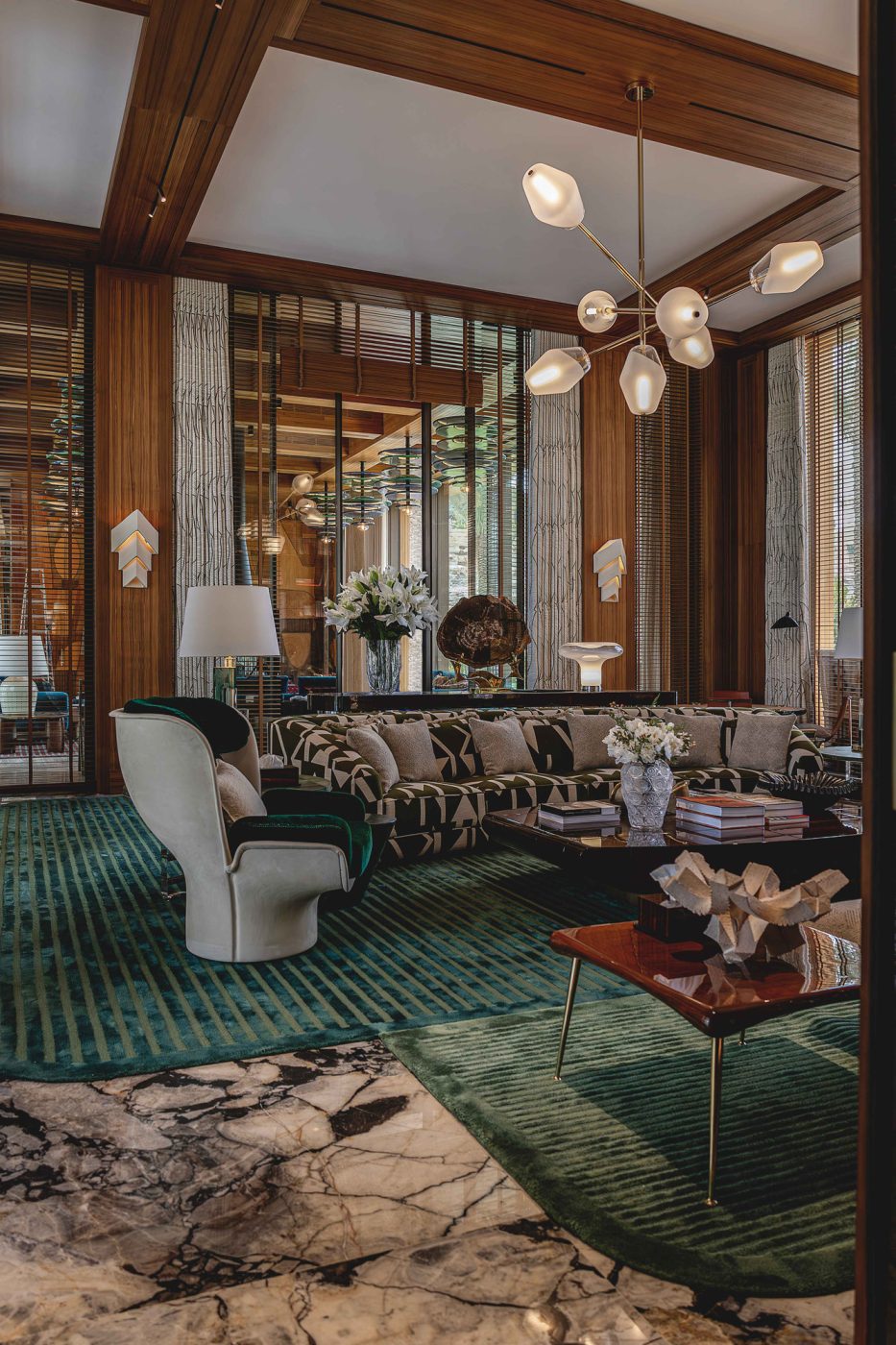
One thing they wanted to avoid was using ornate, traditional chandeliers. For the grand salon, they sourced a set of astral crystal and brass Metropolitan chandeliers, designed by Hans Harald Rath for J. & L. Lobmeyr in 1963. “They’re the ones at New York’s Metropolitan Opera House that rise up at the beginning of each performance,” says Bec. In the dining room, they introduced a more modern feel with Apparatus’s sculptural Reprise pendant lights in aged brass and suede.
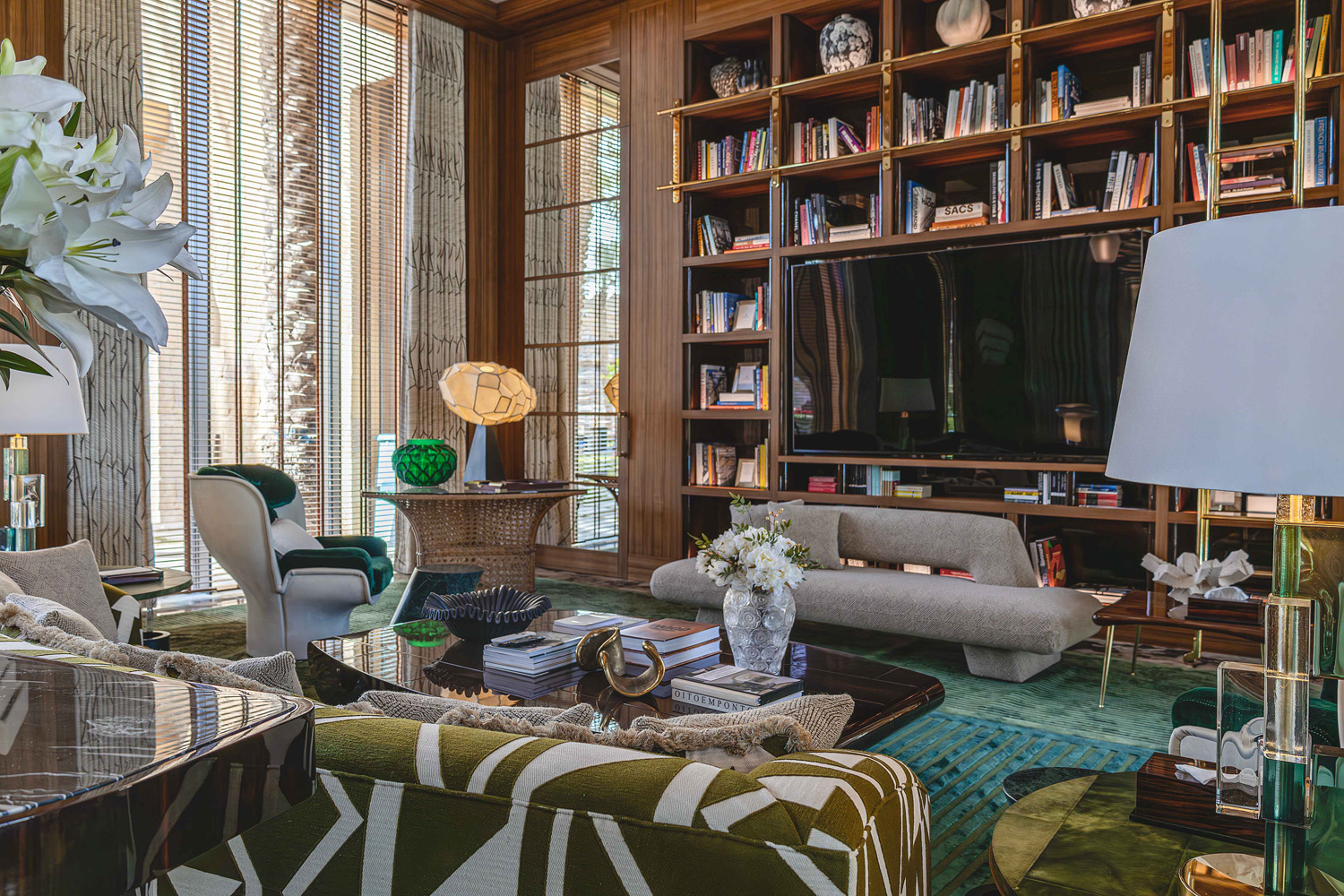
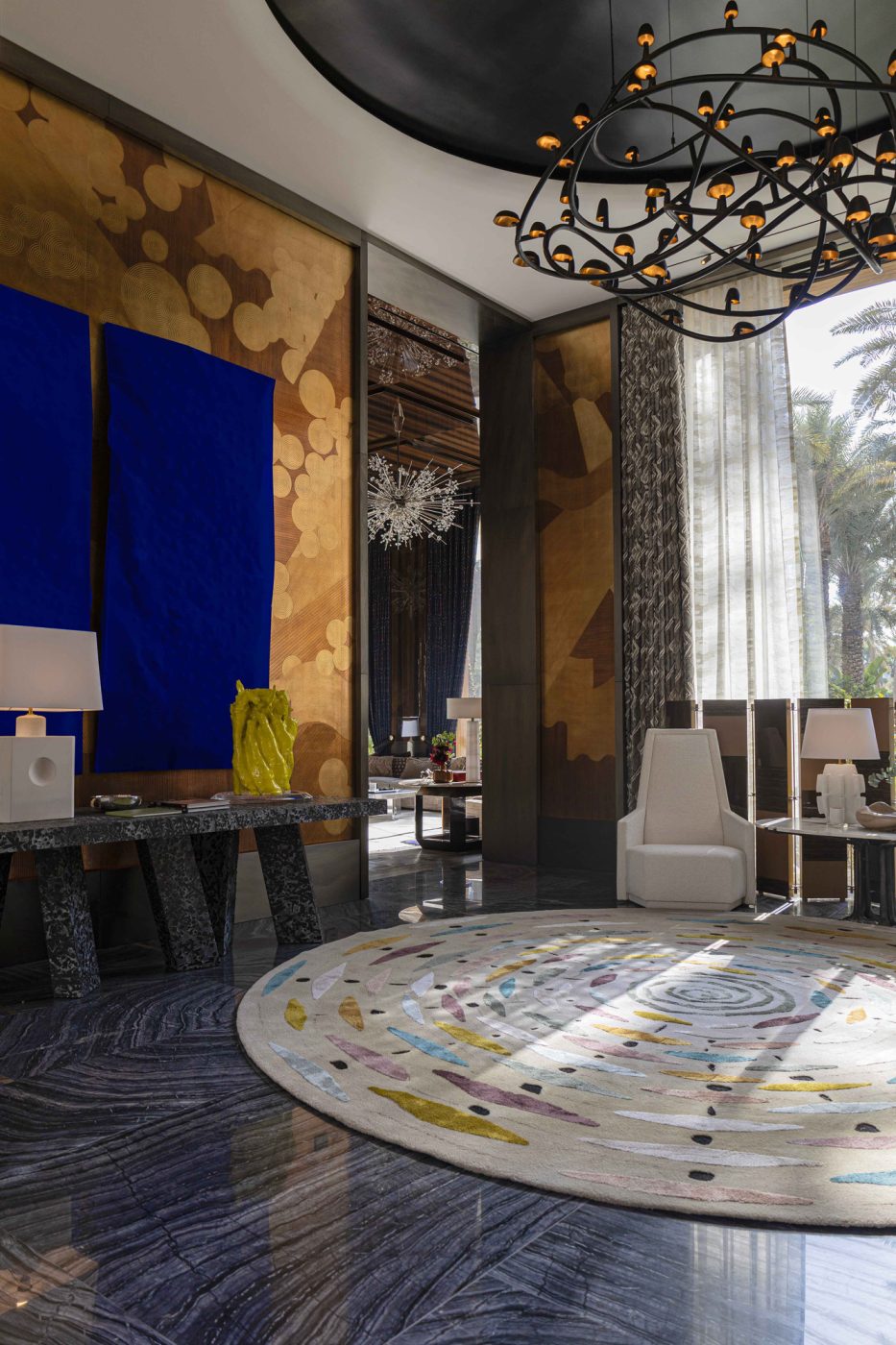
The decor throughout is an artful mix of vintage finds, contemporary creations and Oitoemponto designs. In the entry hall, a swirling chandelier by Frederik Molenschot converses with an Émile Gilioli sculpture that formerly stood on a terrace at the Pompidou Center, in Paris, as well as an Oitoemponto Guarujá folding screen, whose usual five panels were doubled for this space. “We wanted part of the garden to still be visible above it,” says Bec. “We love lantern-like entry halls that allow you to see right through the house.”
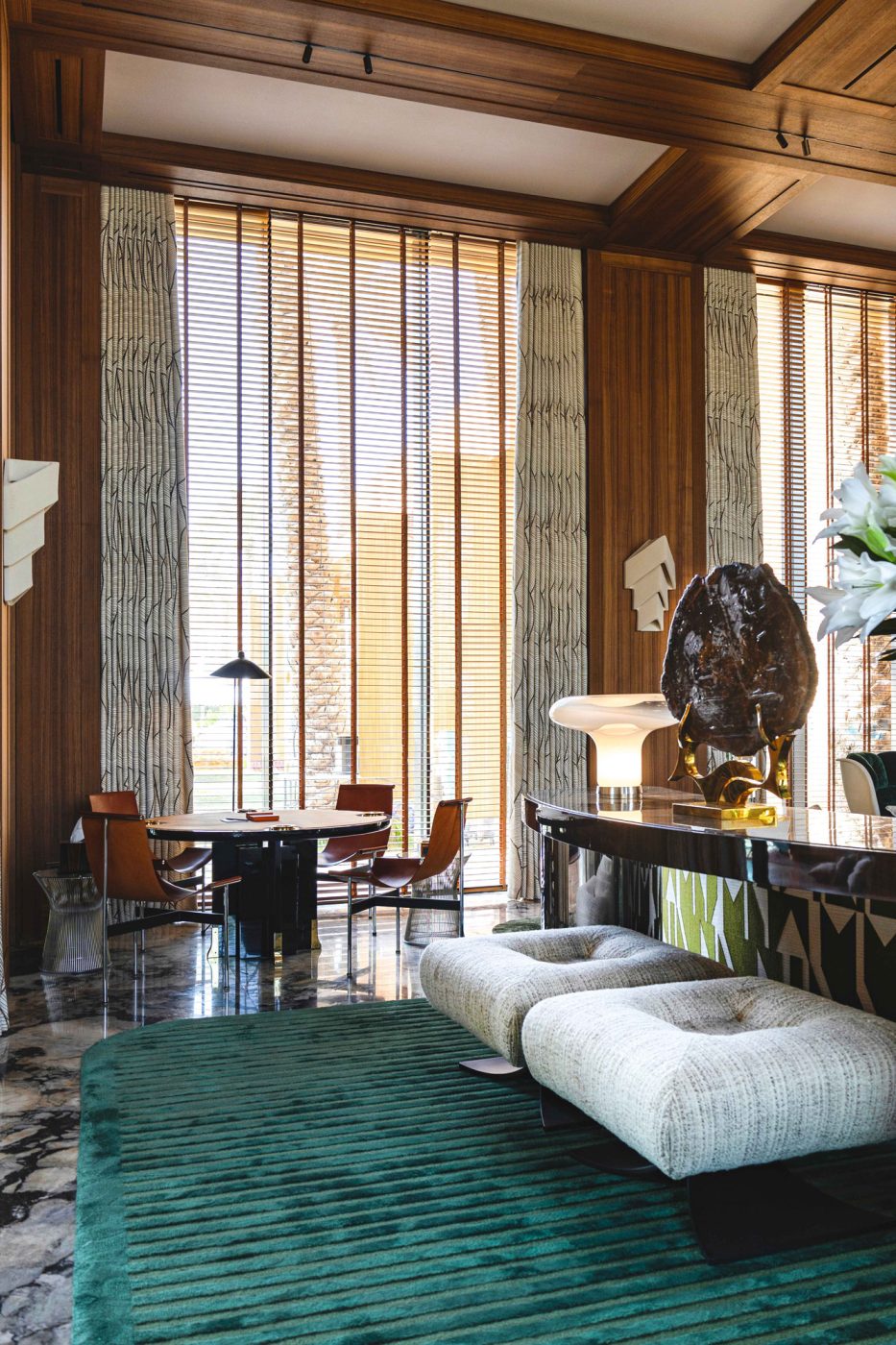
The game room brings together a Mayan sofa by Harvey Probber, a special edition of Joe Colombo’s emblematic Elda chair clad in suede, a Marzio Cecchi wicker-and-glass table, Guy Bareff sconces and a quartet of vintage T-chairs by Katavolos, Kelley & Littell, sourced from Andreas Schneider via 1stdibs, which sit at a games table. “They’re really keen on card games in Saudi Arabia,” says Miranda. “So, it gets used a lot.”
Requiring a large quantity of vintage seating for the dining room, the designers acquired several sets of T.H. Robsjohn-Gibbings chairs from 1stdibs dealer Modern Epic Antiques, all the same model but in different woods, and then had them refinished and stained to match one another.
Guests in the grand salon can relax in Oitoemponto’s Artur armchairs while admiring Ado Chale coffee tables, René Lalique vases and even a pair of Louis XIII tapestry-upholstered high-back chairs.
At the end of each commission, Miranda and Bec have a ritual. They present their clients with a leather-bound book cataloguing the items in each room, together with a custom key ring bearing a design inspired by the project. For the reception pavilion, the key ring references the pattern of the glazed openings of the front door.
“As we put so much emotion into the houses we design, they are our babies until the moment we hand them over,” explains Bec. “We give our clients the keys and insist they open the house. It’s essential for us to have that physical gesture to sever that bond.”