June 21, 2026One of the most anticipated events on the international design calendar, WOW!house is now in full swing for its fifth year. Built from the ground up along the length of a light-filled enclosed courtyard at London’s Design Centre Chelsea Harbour, the showcase, which runs until July 2, draws a global audience keen to experience the very best of what’s next in interior design.
The 2026 edition takes visitors on a journey through a series of 22 full-size rooms and outdoor areas, realized by a roster of design A-listers and rising stars from the UK and beyond. Produced in collaboration with world-renowned brands, they push creative boundaries, sparking conversations about the current spirit of design.
The Wow!talks series, meanwhile, presents sparkling conversations throughout the run of the show, including “Bespoke Interiors,” on June 30 at 3:30, moderated by Introspective’s editorial director, Anthony Barzilay Freund, and featuring this year’s WOW!house participant Charu Gandhi, founder of Elicyon, and alums Stephanie Barba Mendoza and Alex Dauley.
Below, Introspective explores some of the standout spaces captivating the crowds this summer.
Francis Sultana
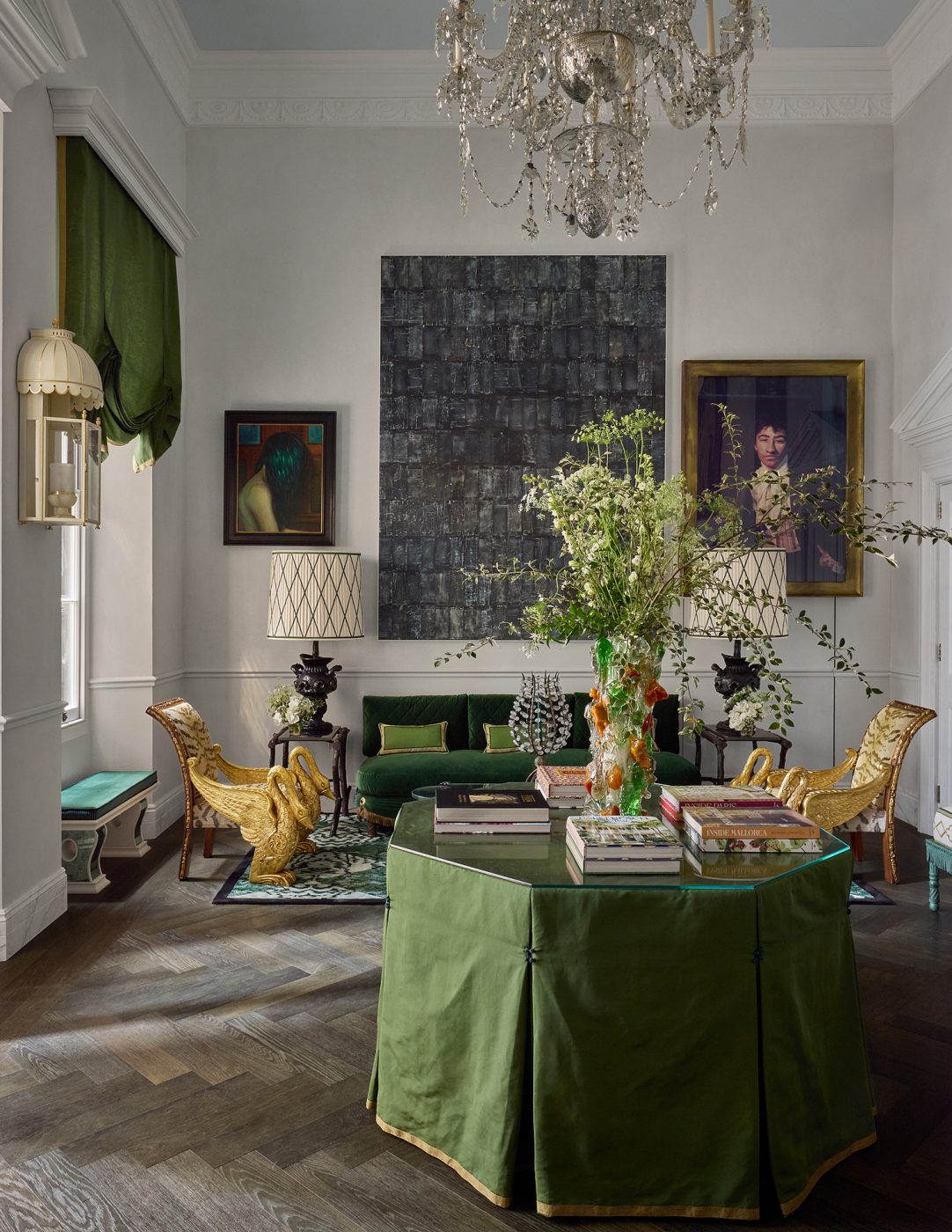
Serving as the point of entry to the exhibition, Francis Sultana’s sophisticated foyer takes its cues from the stately homes of the British countryside and historic London mansions. “I curated the furniture to be a combination of historical pieces and contemporary design,” Sultana says. “For me, that’s the essence of a UK residence — referencing the past while remaining alive in the present.”
Celebrated for his ability to combine distinctive British style with continental flair, the London–based, Maltese-born Sultana has mixed significant antiques with collectible 20th- and 21st-century items. A large-scale 18th-century crystal chandelier provides drama, hanging above twin glamorous 19th-century Russian giltwood-and-mahogany armchairs paired with contemporary Petit Trianon side tables by Garouste and Bonetti, which are topped with Vase table lamps by Mattia Bonetti, all flanking a custom sofa by Poliform.
“I wanted to include work by John Fowler,” says Sultana, referring to the pioneering early-20th-century cofounder of Colefax & Fowler. “So, I’ve used the Jockey lamps, which are very grand and overscale, as well as one of his fabrics, as a border on a pair of Mattia Bonetti bronze stools.”
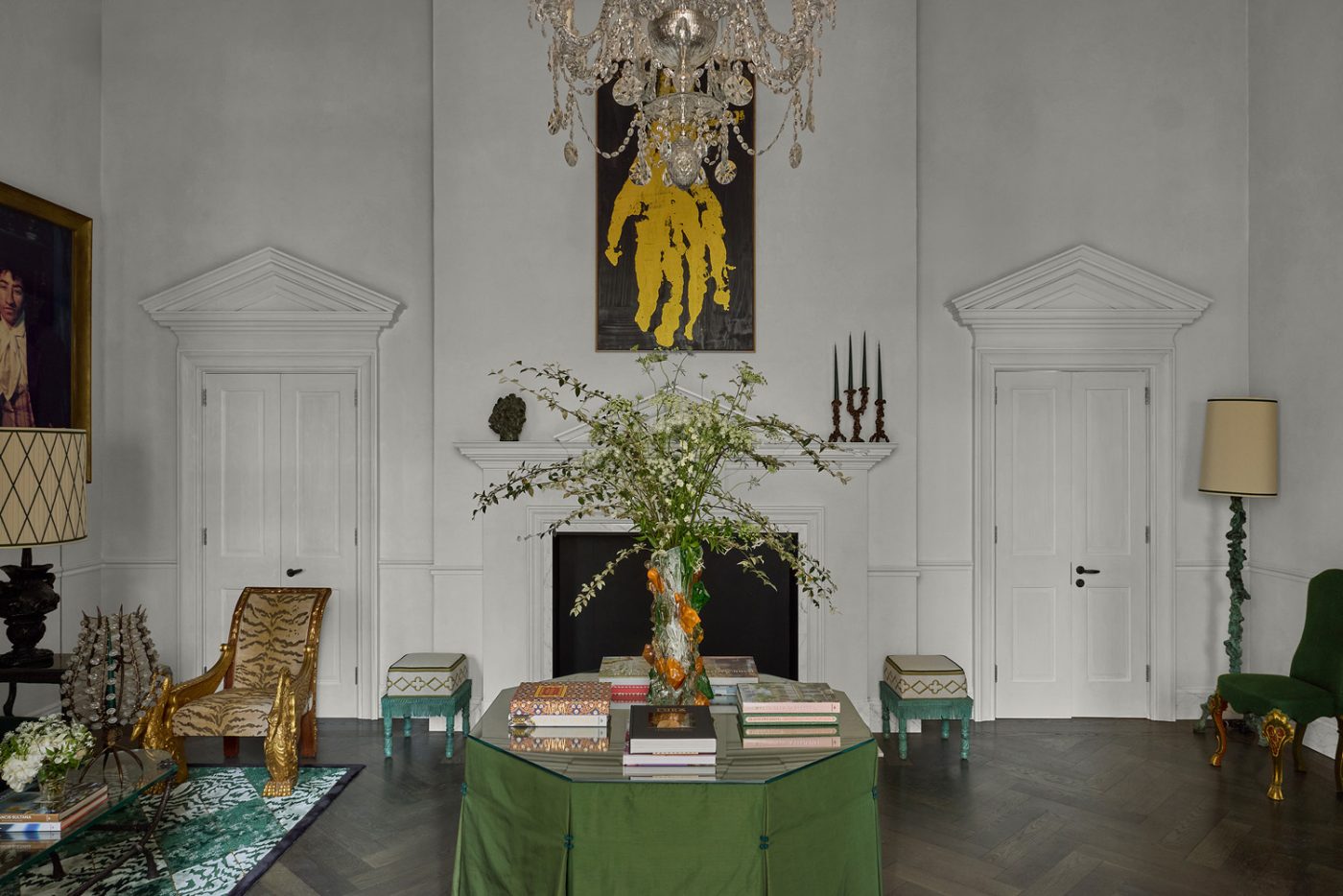
Key to the scheme is an art curation featuring museum-grade works by Yayoi Kusama, Cindy Sherman, Georg Baselitz and George Condo. “It is a varied selection, but as a group they create a wonderful energy,” Sultana says. “It shows that even against a classical architectural background, contemporary pieces can inject immediate relevance and completely transform the narrative for today.”
Albion Nord
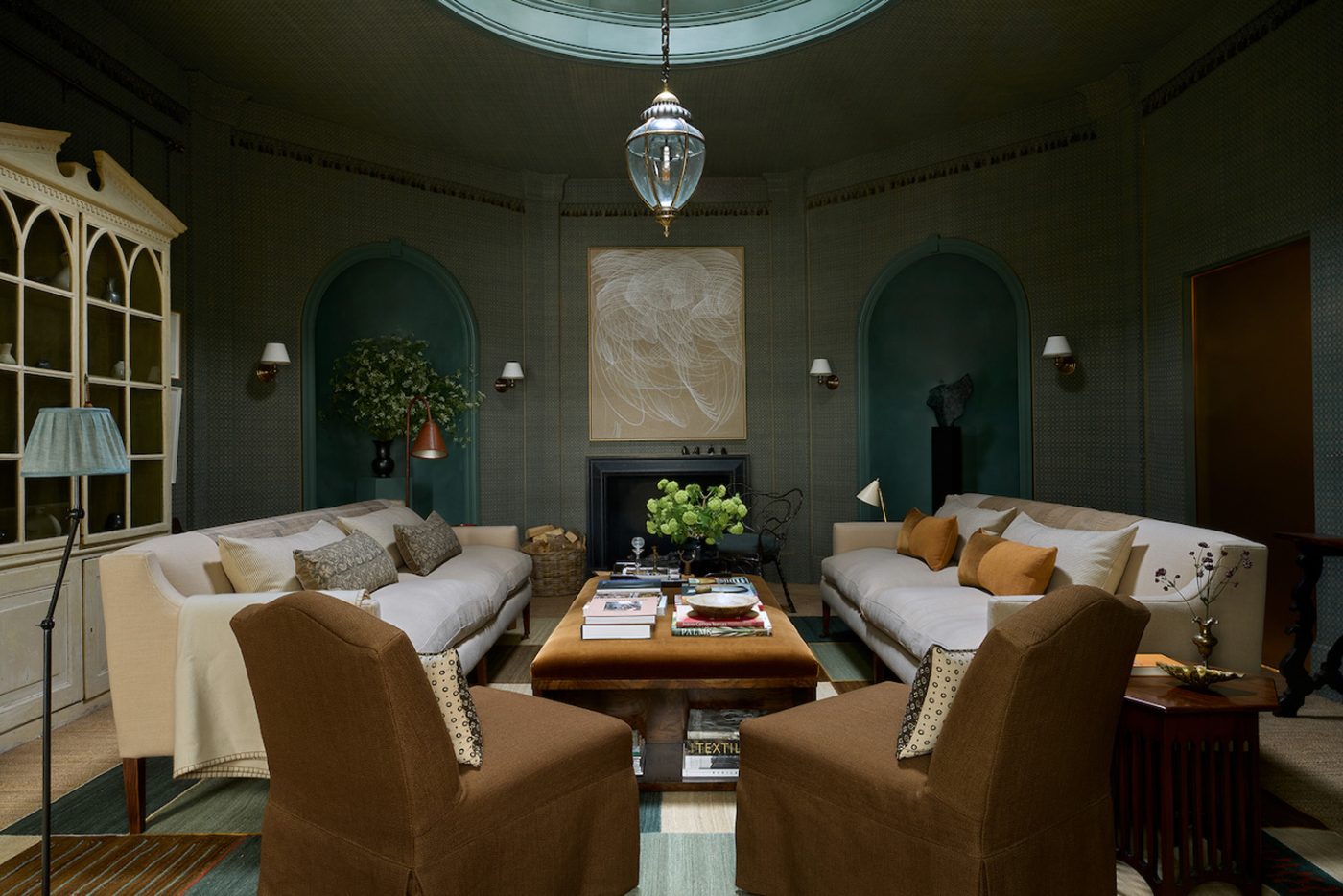
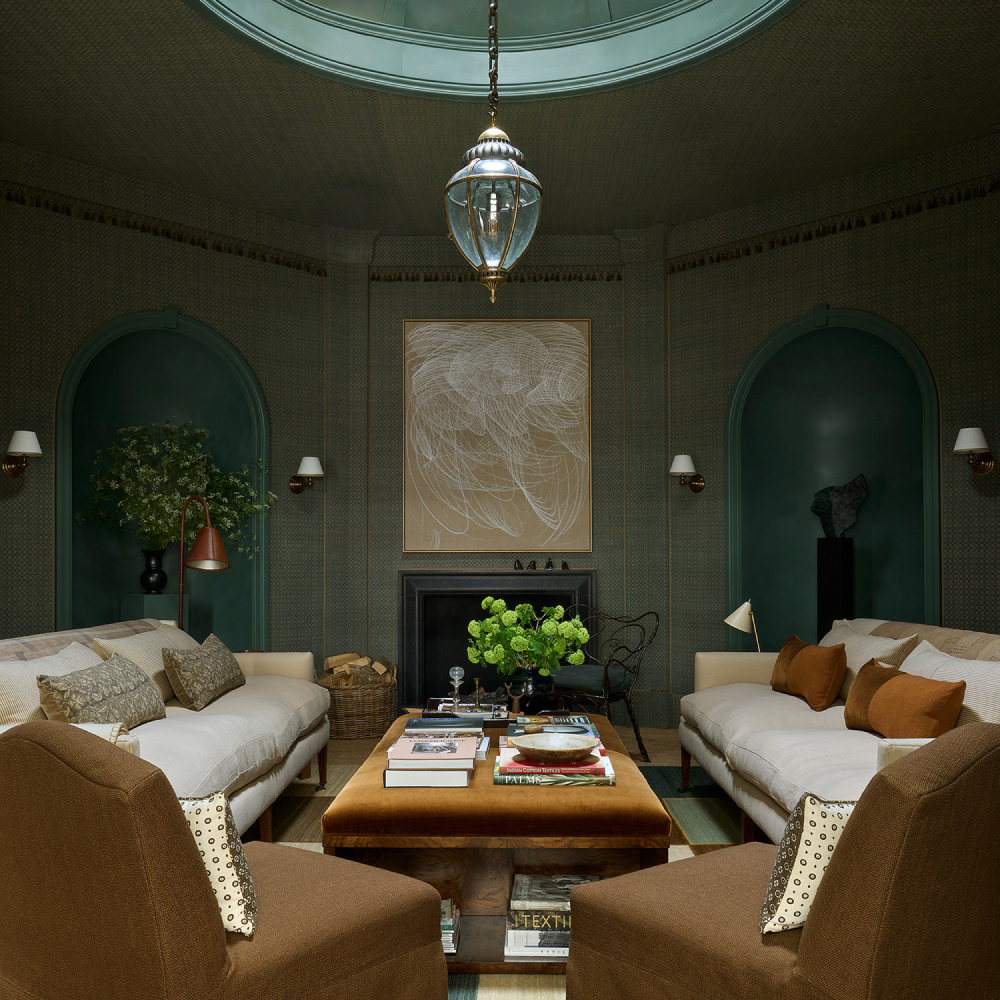
Inspired by the octagonal spaces that were popular during the Georgian and Regency periods, Albion Nord’s elegant drawing room was designed in partnership with luxury fabric, wallpaper and trimming manufacturer Turnell & Gigon.
“Traditionally, these rooms were quite smart and only used at very specific times,” says Ottalie Stride, founder and director of the London-based studio. “We wanted to reinvent it, and for it to feel cozier and more intergenerational.”
To that end, the team wrapped the walls in a hand-blocked fabric and used a bespoke trim — created in collaboration with Turnell & Gigon’s historic mill, Les Passementeries de l’Île de France — to edge the room’s hand-painted architectural reveals, which also house smart bar units. A custom domed roof light pulls light down into the space.
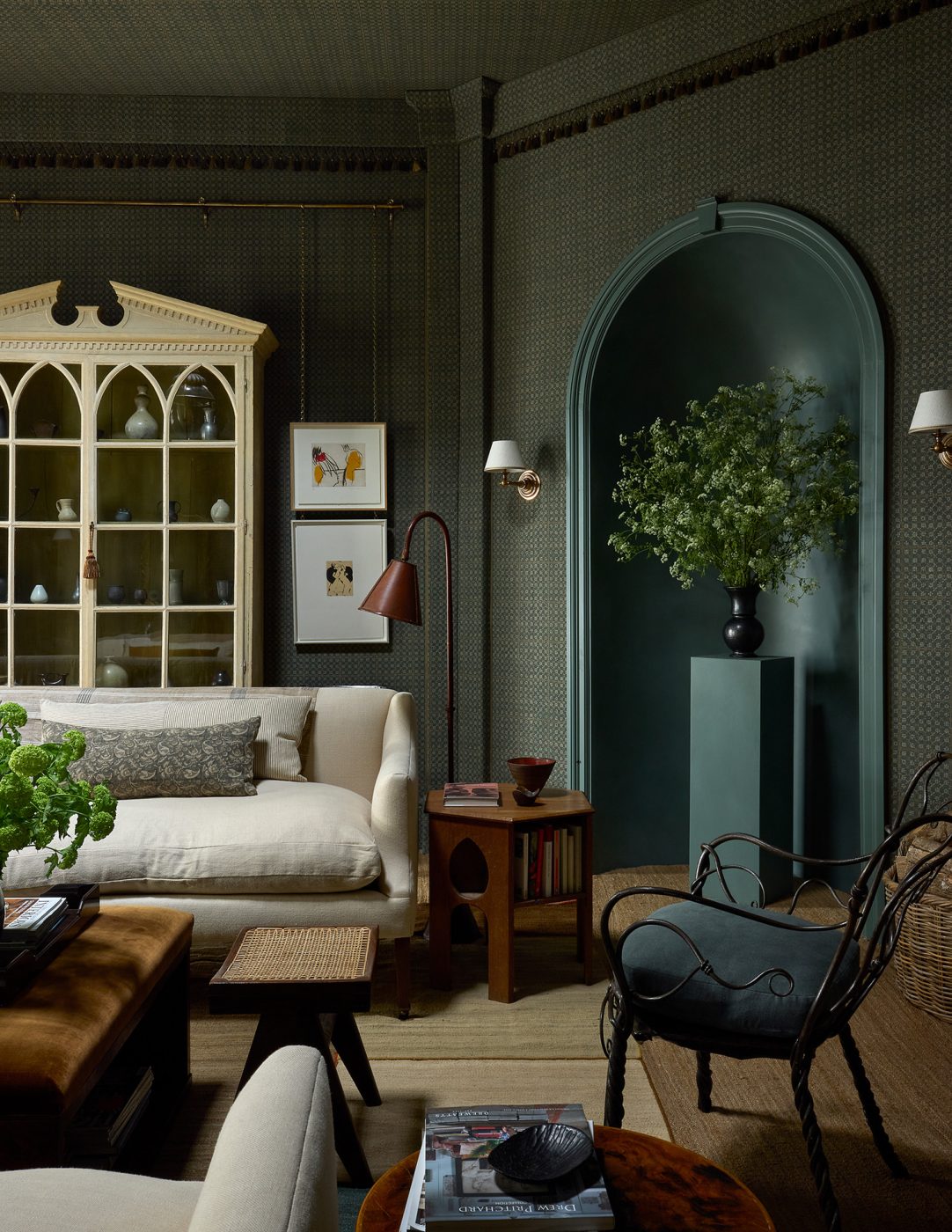
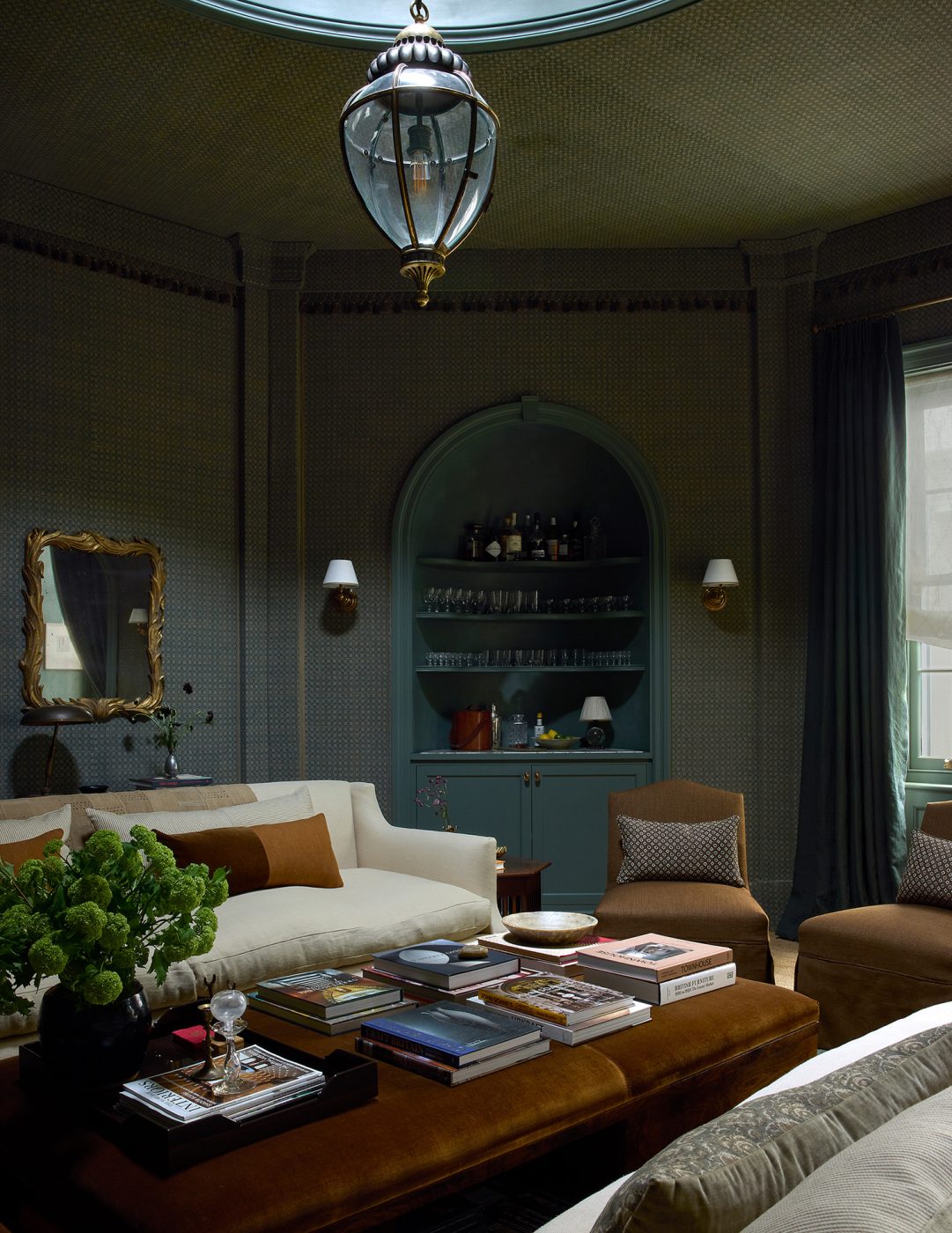
An upholstered ottoman by Albion Nord rests on a custom woven Afghan rug at the center of the room, surrounded by a mix of vintage and contemporary furniture, including a quintessentially English sofa, designed by the studio to feel both architectural and light; an 18th-century Spanish pedimented bookcase; a 1940s mahogany occasional table; a mid-century Parisian ironwork chair; and a petite teak-and-cane stool by Pierre Jeanneret. A pair of custom slipper chairs by George Smith sit alongside a bronze floor lamp by Vaughan, while an elegant lantern illuminates the space from above. The result is a scheme that’s balanced and refined yet liveable and inviting.
Róisín Lafferty
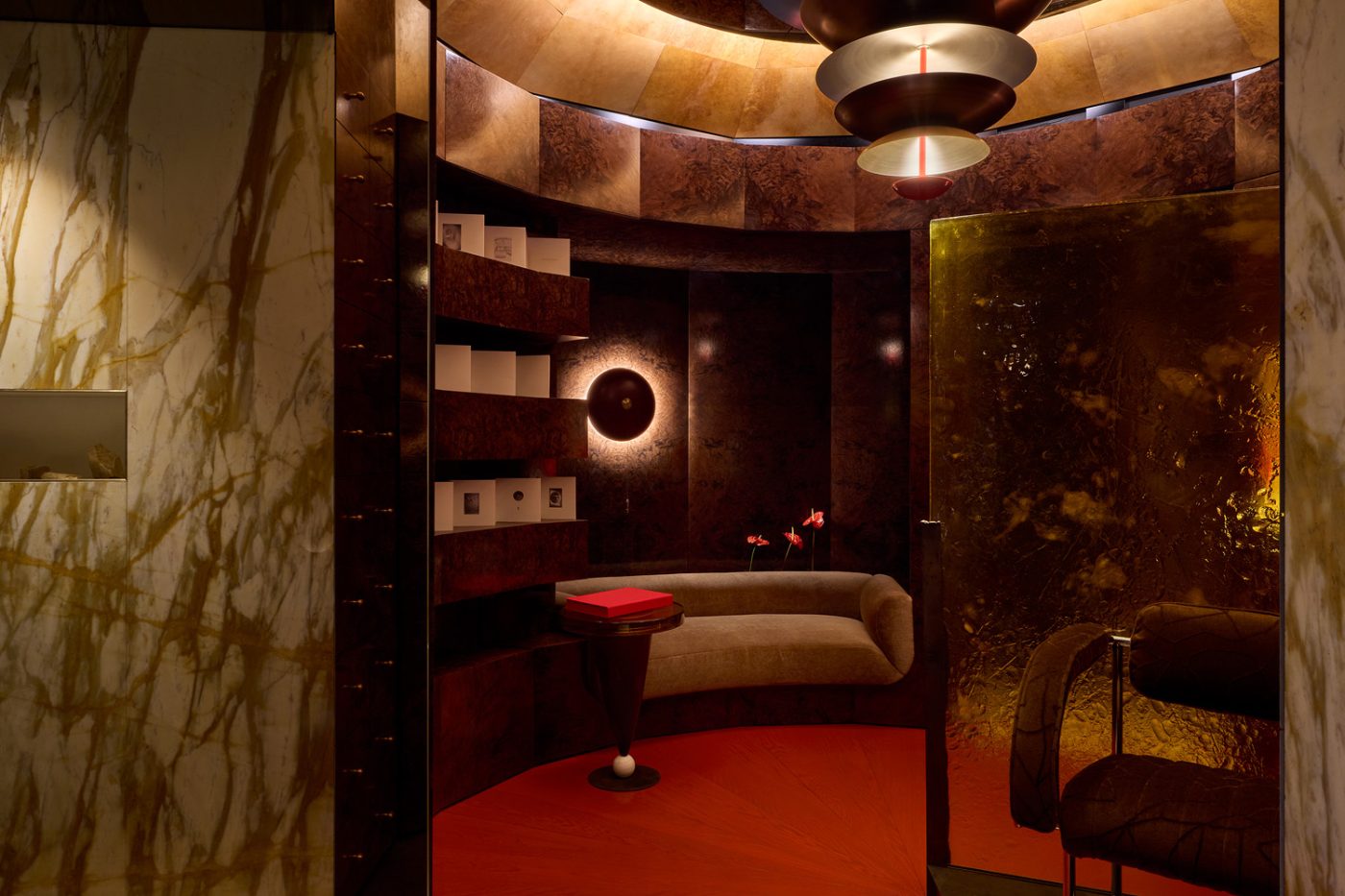
“For me, it’s less of a library in the traditional sense and more a space for ideas, creativity and contemplation,” Dublin-based designer Róisín Lafferty says of her considered, compact space. “Because it’s a small room, we wanted to create a portal that draws people in, making the experience feel calm and immersive.”
A major inspiration, according to Lafferty, was last year’s centenary Art Deco exhibition in Paris, where the joinery on display resembled theatrical set design rather than serving as mere wall cladding. “Working with custom furniture manufacturers Shepel’, who are fantastic craftspeople, allowed us to treat the whole room as a single cabinet,” she says. “It became less about individual objects and more about the architecture of the space itself.”
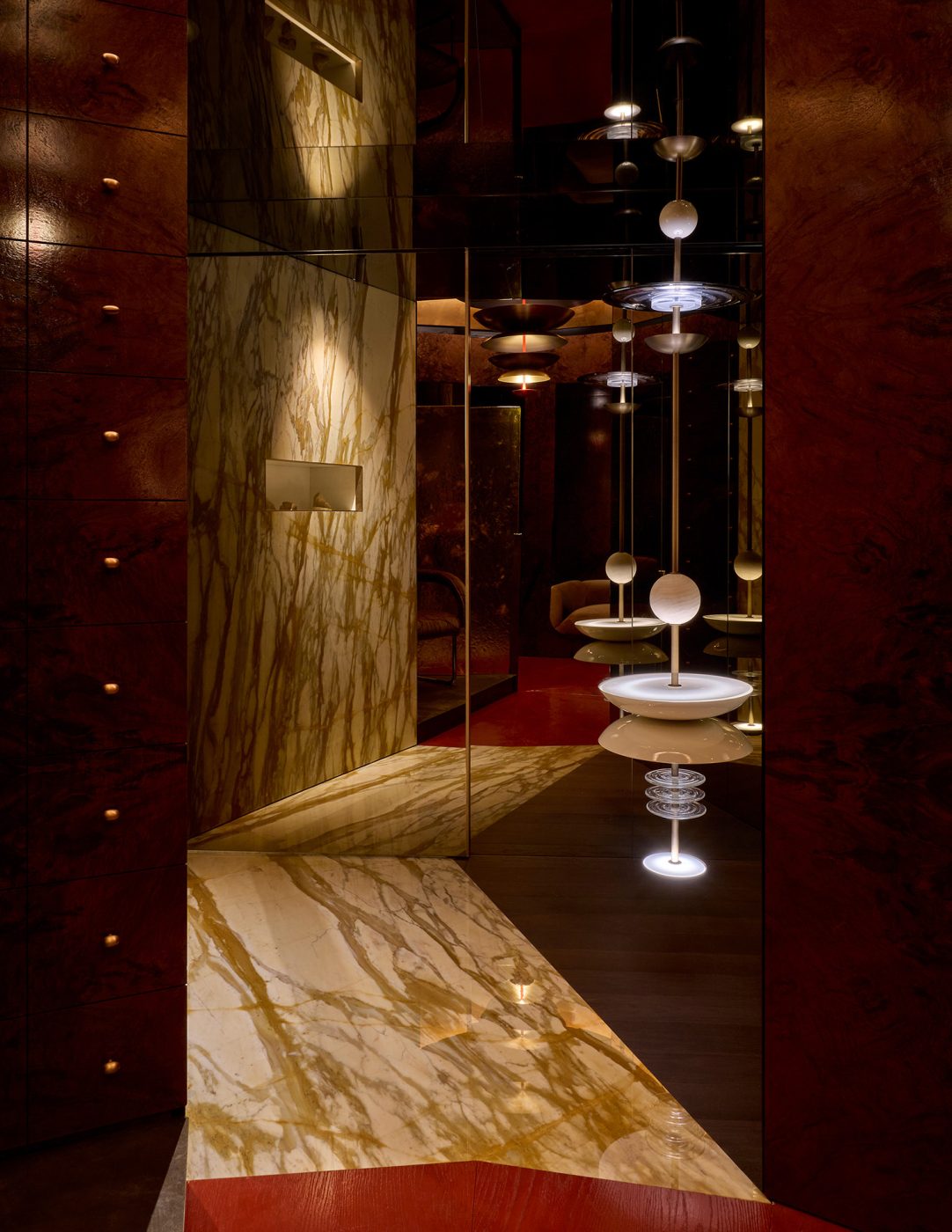
The installation features richly textured burl wood that wraps seamlessly from the high-gloss floors to the ceiling. “I wanted there to be a sense of nostalgic calm, which is why I chose burl,” says Lafferty. “I love its imperfection, the depth of tone and the richness it brings to the walls.”
Layered accents of parchment and ebony define pockets within the framework, while the shelving transitions smoothly into an integrated seating area upholstered in plush mohair velvet. Illumination in the atmospheric and highly tailored scheme comes from a bespoke suite of lighting, including a pendant totem lamp and a wall light, all custom crafted for the space by Atelier 001.
Elicyon
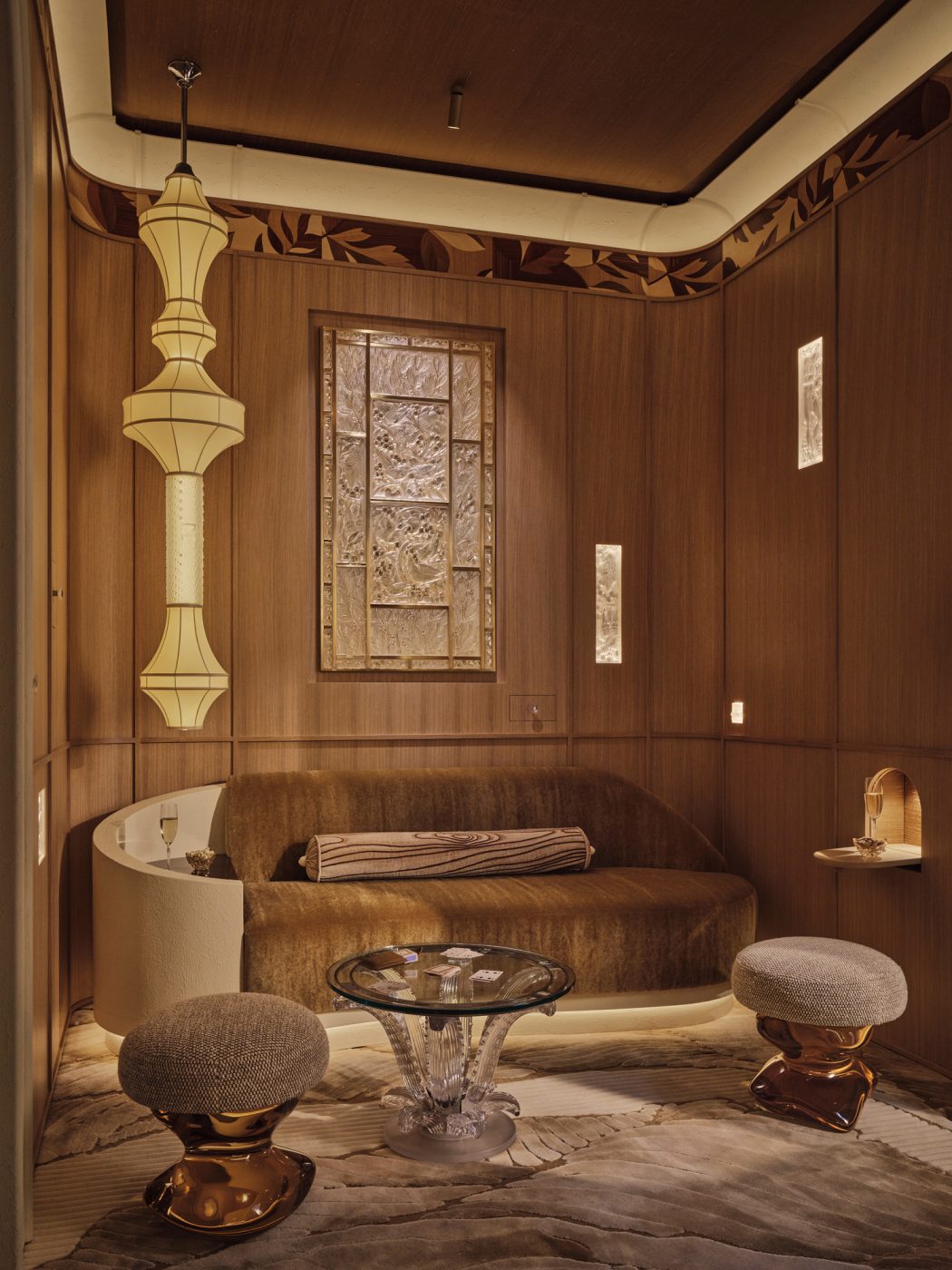
Imagined as a “box of delights,” this sophisticated home bar was crafted by Elicyon together with celebrated French brand Lalique. “I’ve been interested in Lalique as an architectural element for many years, above and beyond its decorative influence,” says the studio’s founder, Charu Gandhi. “We had a very clear vision to show it through a contemporary lens.”
Wrapped in pale oak open-grain paneling, with a silk-fabric ceiling above, the space cleverly showcases Lalique’s remarkable history and artistry via pieces like a 1921 Hirondelles chandelier, depicting swallows in flight; a 1951 Cactus coffee table; art panels, including a rare Merles et Raisins 1928 design by René Lalique himself; and a bespoke Totem light — a recent collaboration between Elicyon and the luxury glassmaker. Lalique jewelry, perfumes and objects are housed in eight backlit recesses with tiny doors, inviting visitors to engage with the space.
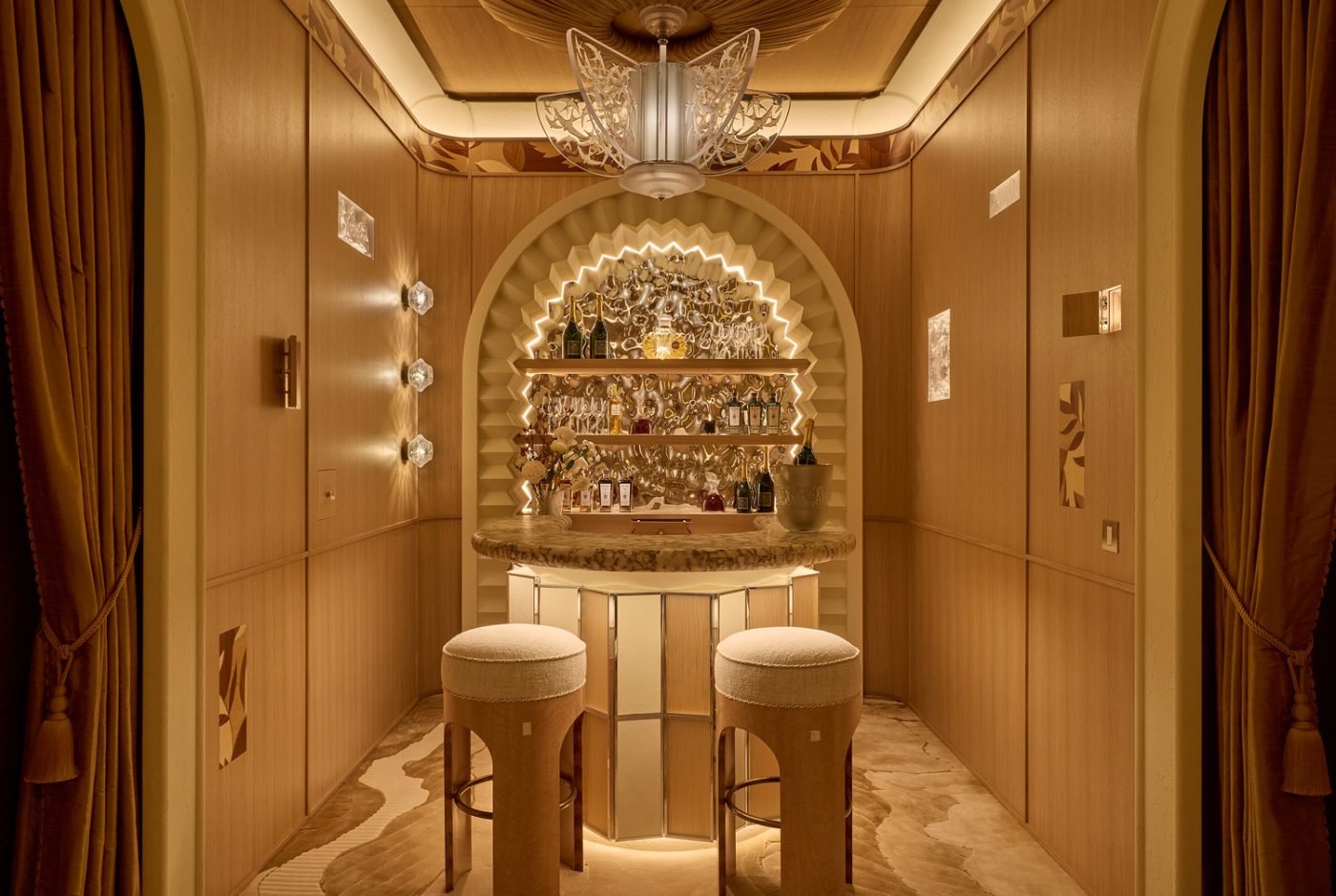
To balance the room’s rectilinear architectural lines, Gandhi introduced pieces with gentle curves, layered lighting and tactile materials — leathered alabaster, hammered metal, mohair and bouclé. An intricate marquetry border pays homage to Lalique’s signature flora and fauna motifs, and in doing so, ties the historic narrative together.
Young Huh
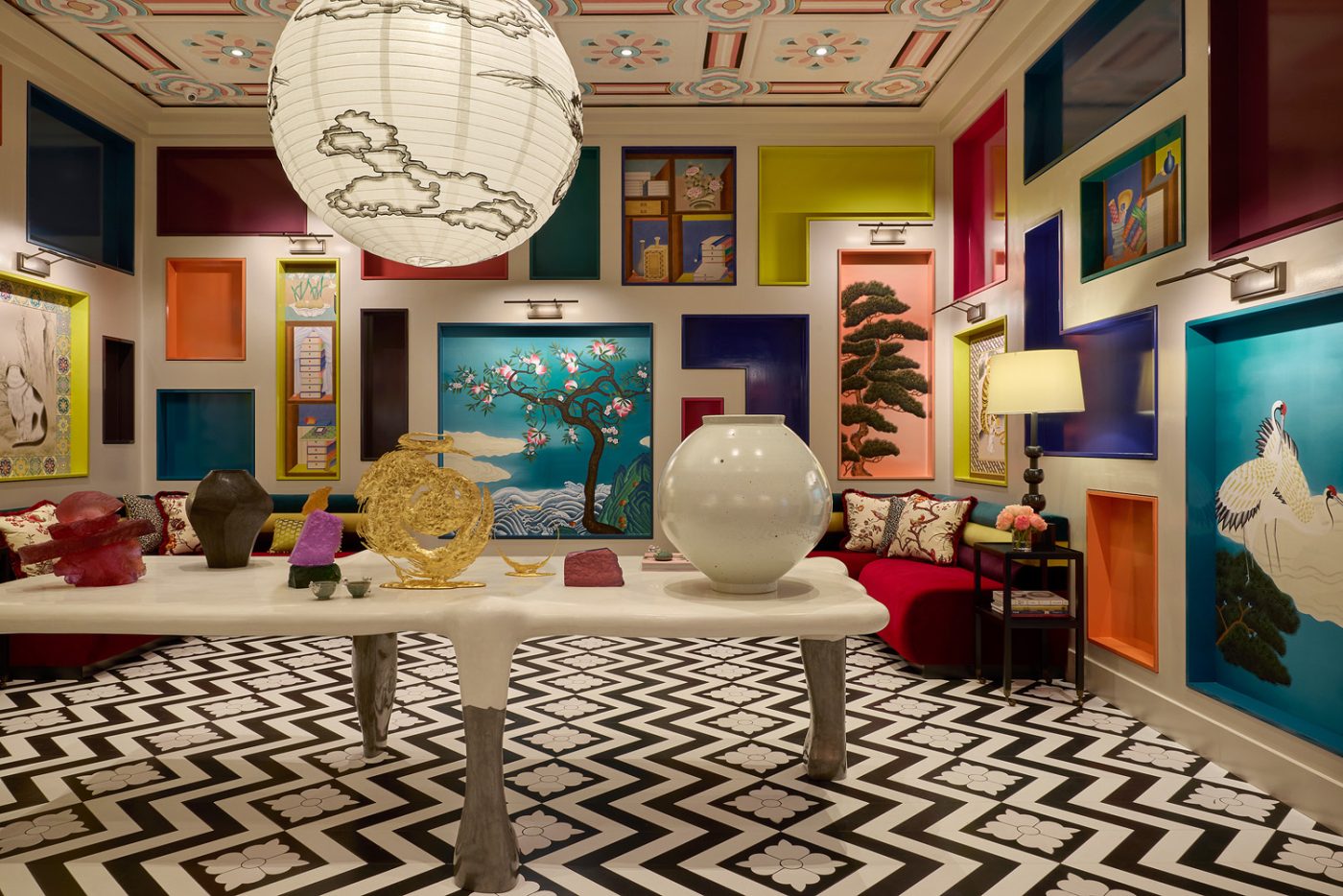
Young Huh took a deep dive into her Korean cultural heritage in designing the salon, a collaboration with Benjamin Moore. Envisaged as a reception and display space within a Korean palace, the room combines traditional references with the visual language of modernism.
“My inspiration was to feature minhwa, which is Korean folk-art painting, and looking at the colors, I realized that it’s very aligned with modernist art,” says the New York–based designer. “So, we created panels recalling the works of Donald Judd, Piet Mondrian and Dan Flavin that showcase the minhwa in a fresh way.”
Young had the room’s walls lacquered then inset with 55 individual panels, some painted vibrant Benjamin Moore hues, others framing hand-painted custom adaptations of her Soru collection — a line of silk wallcoverings created in collaboration with Fromental. The black-and-white tiled floor takes its cue from Korean palaces and temples.
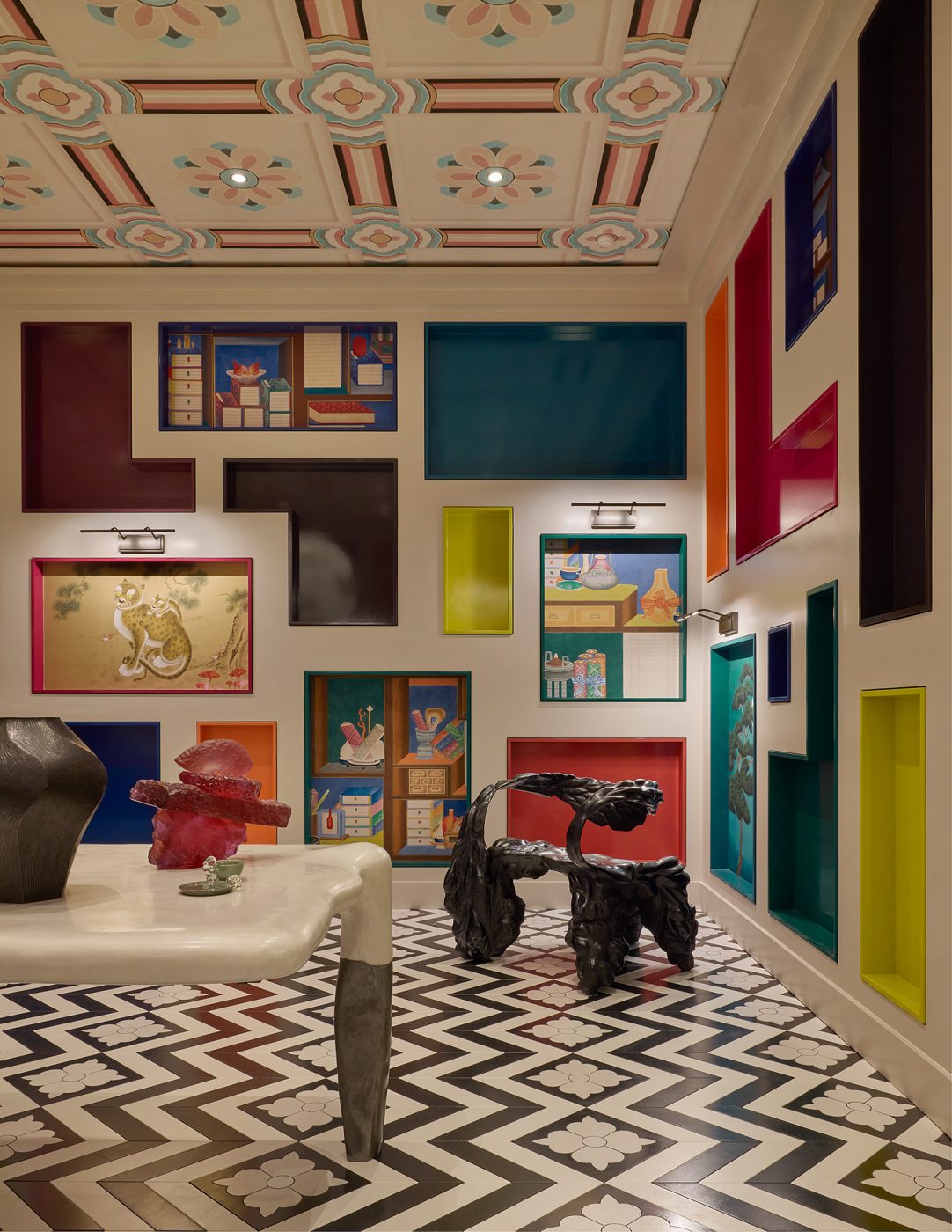
A smart curation of collectible design provokes a sense of joy while also inviting an appreciation of craftsmanship. Among the highlights are a sculptural dining table and Jan Waterston’s Self Mining chair, which are illuminated by Vaughan’s bronze Coldstream picture lights. Fromental’s artistry extends to the trompe-l’œil ceiling, which produces the impression of a coffered canopy overhead. A custom corner banquette, upholstered in colorful cottons by Manuel Canovas, introduces a softer counterpoint to the room’s high-gloss surfaces.
Sara Cosgrove
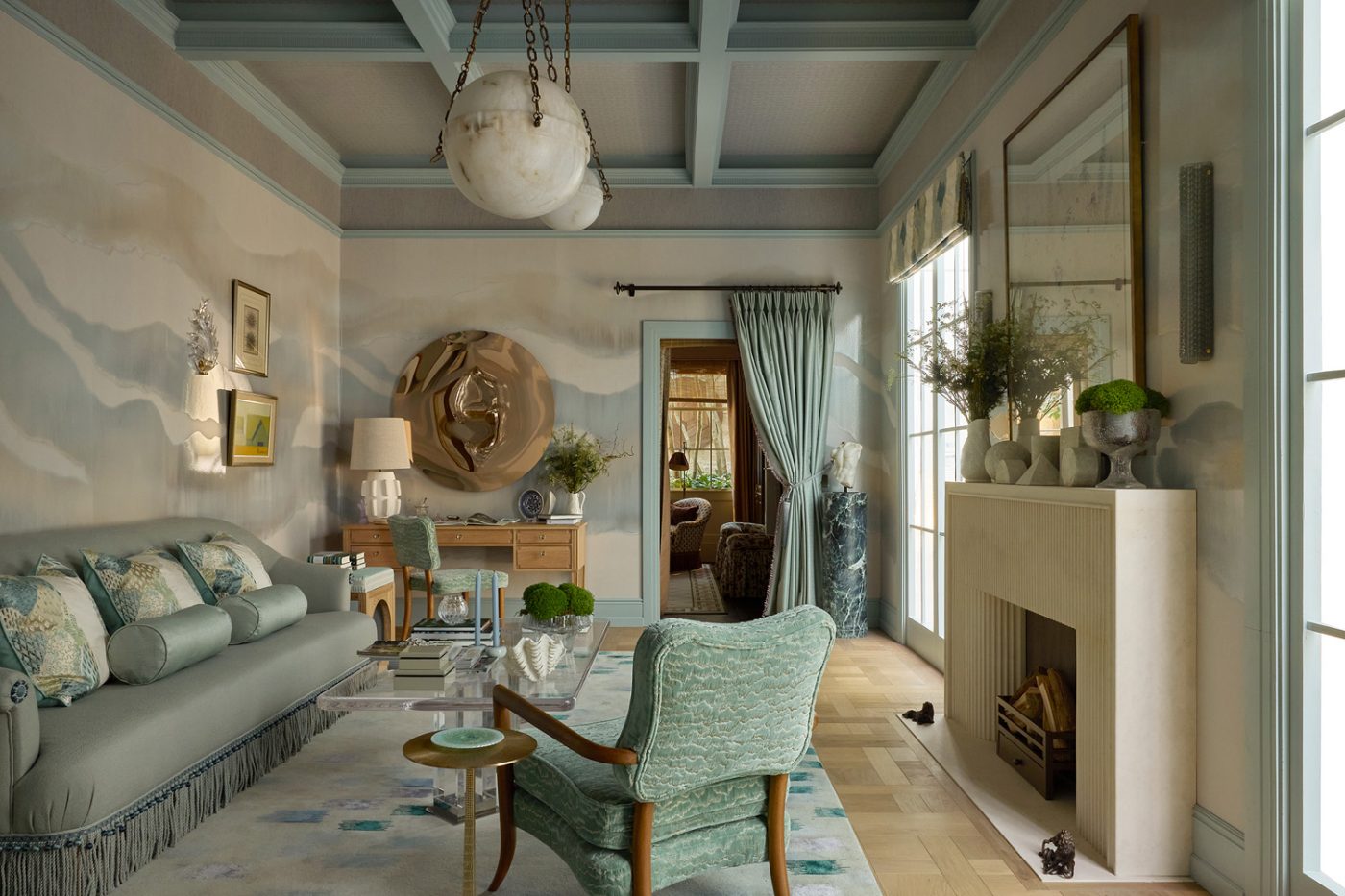
“The clue is in the name — the morning room. From day one, I wanted something uplifting, regenerative and invigorating,” Irish designer Sara Cosgrove says of her space, created in collaboration with wallcovering specialist Phillip Jeffries. “There is something inherently heritage about a morning room. It doesn’t exist in most houses today. We live in this high-velocity world where everything is intense sensory overload, so I created an analogue space that feels like a step back in time.”
Resonating with the forms and colors of the Phillip Jeffries wallcovering, which resembles shimmering Japanese lacquer, the room’s decor is underpinned by craftsmanship, a nod to Cosgrove’s roots working in fashion with Chinese-Irish designer John Rocha. Anchoring the space is a sculptural limestone fireplace above which hangs a custom artwork depicting wildflowers from the West of Ireland, stitched by Irish embroidery artist Laura Weber, who also makes ensembles for the Met Gala.
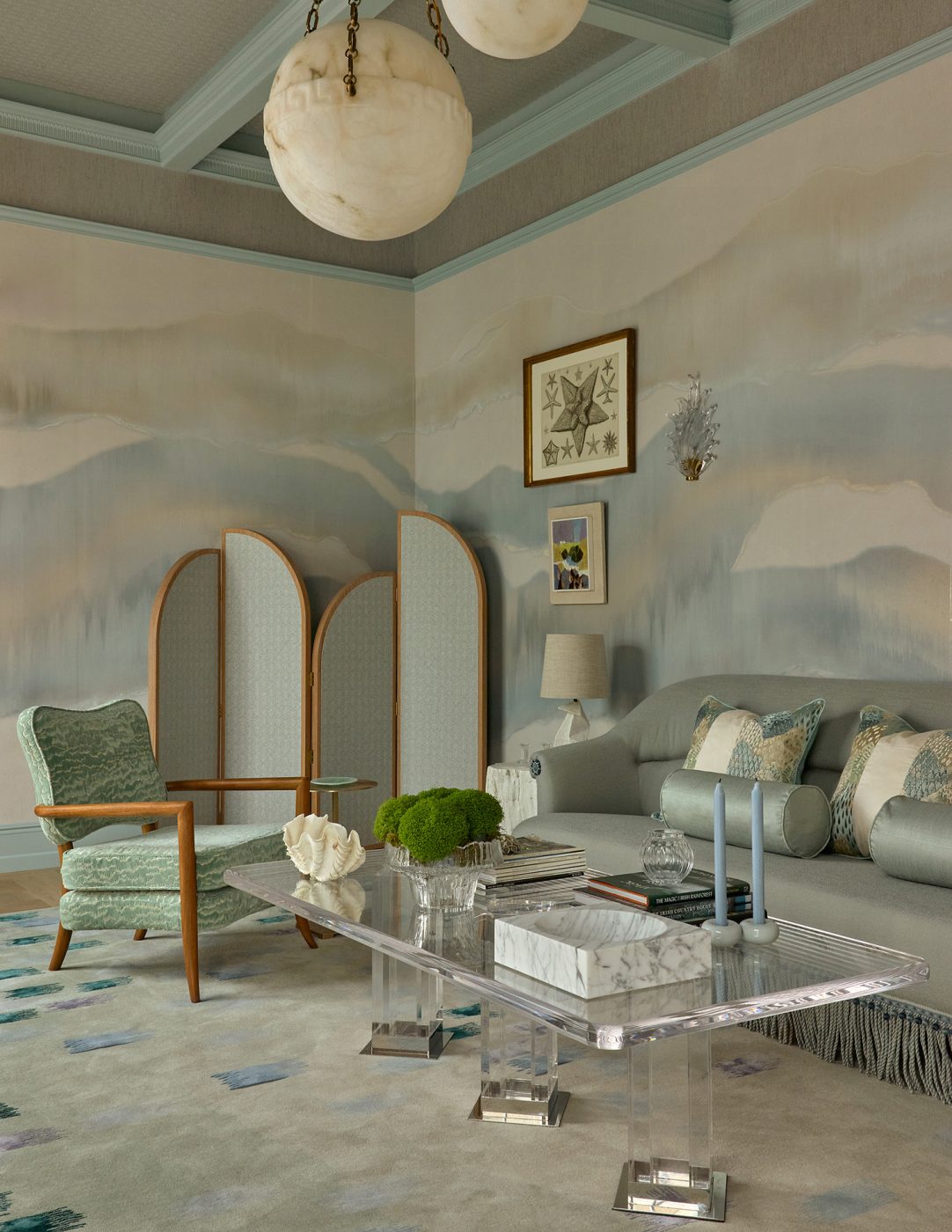
Cosgrove partnered a curvaceous bespoke fringed sofa with upholstered Julian Chichester chairs, a custom clear-acrylic table and lamps by Porta Romana whose forms are inspired by origami and the work of British modernist sculptor Barbara Hepworth. Peppered throughout are the designer’s own sentimental treasures, including her granny’s tape measure and watercolors, harking back to a slower-paced life.
“This is a space where you don’t want to plug in, lock in or charge but instead return to rituals like reading magazines and having long conversations,” Cosgrove says. “There is something incredibly romantic about disconnecting.”
Salvesen Graham
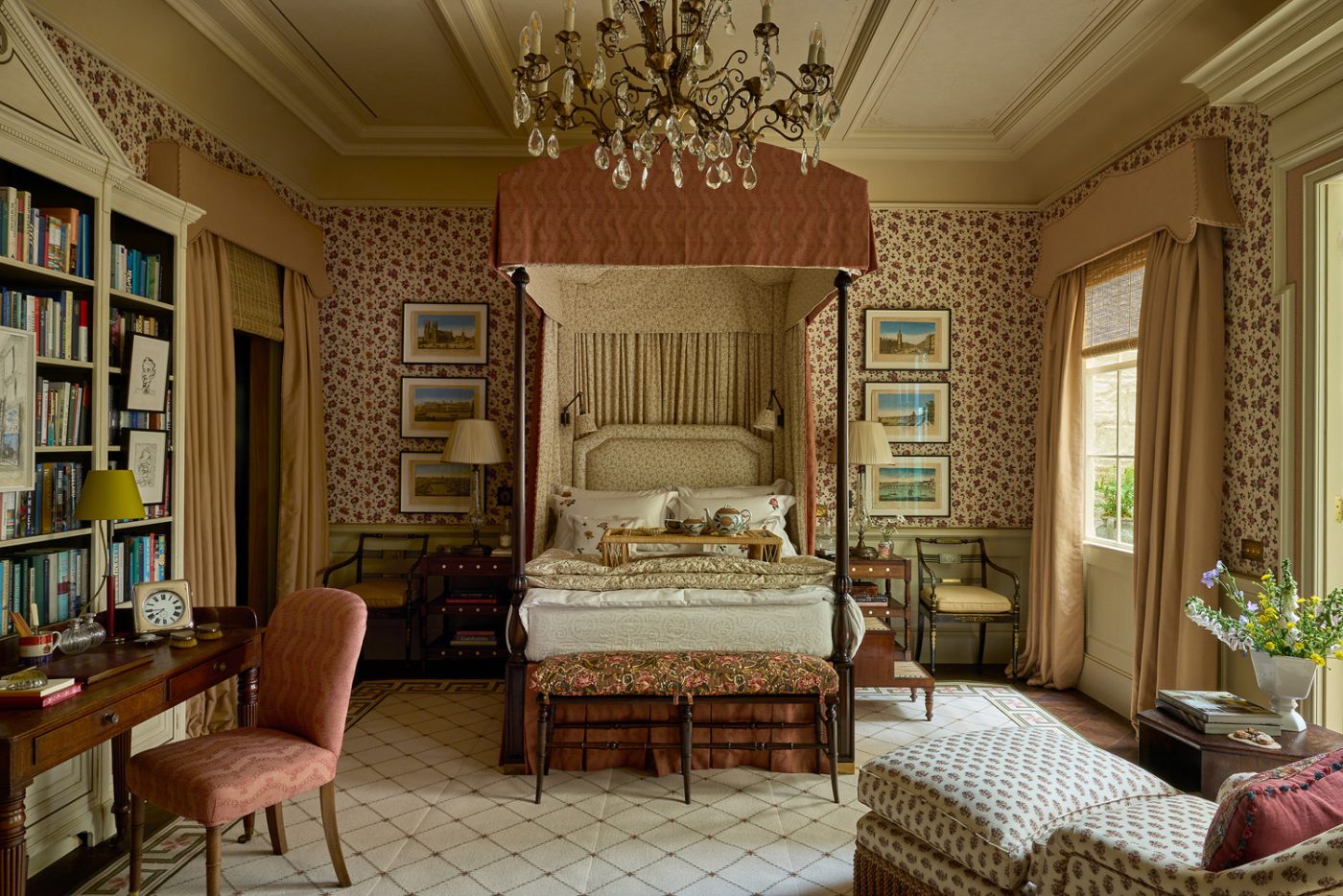
A masterclass in Anglo-American elegance, the primary bedroom by London-based design firm Salvesen Graham strikes a perfect balance between soft, layered decorating and a structured architectural framework. Cofounders Nicole Salvesen and Mary Graham conceived the space through an enchanting fictional character. “We imagined the room belonging to a British lady who had followed her heart to the U.S.,” Graham says. “She wanted the comfort of an English country bedroom, with the architectural details you find in classical American buildings.”
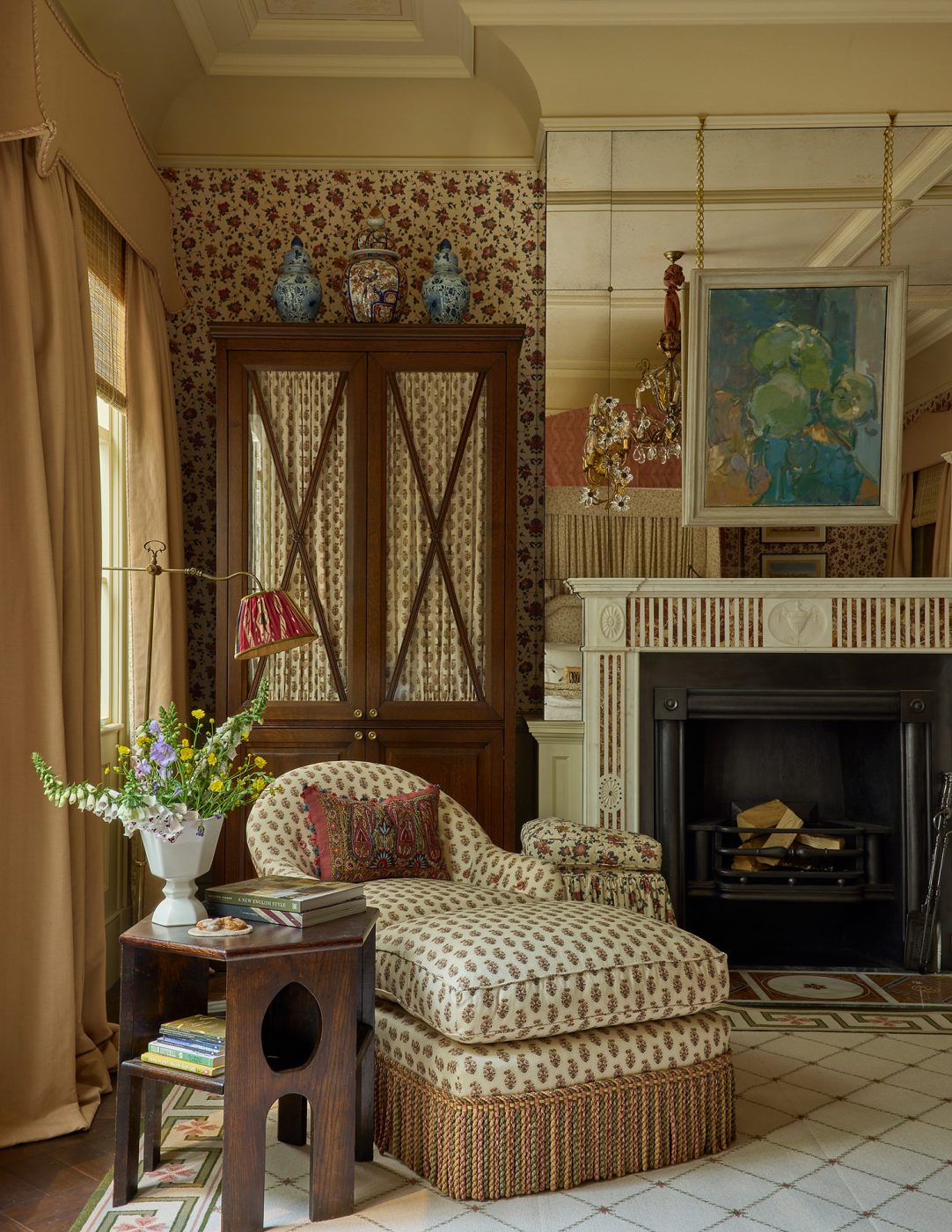
Showcasing the studio’s new fabric and wallpaper collection, the room features a pretty floral print wrapping all four walls and a tonal stripe, used for the pelmet and the outer layers of the canopy enclosing a fabulous four-poster bed. Dotted around are the belongings of its imaginary inhabitant: framed pictures of London and colorful tomes packed into a custom broken-pediment bookcase, as well as an English newspaper sitting on a breakfast tray.
Opposite the bed, a striking mirror-clad chimney breast pairs with an 18th-century chimneypiece. Additional antiques, including a handsome mahogany Georgian desk, a collection of silver trinkets and an octagonal library table, add a touch of British craftsmanship.
Studio Duggan
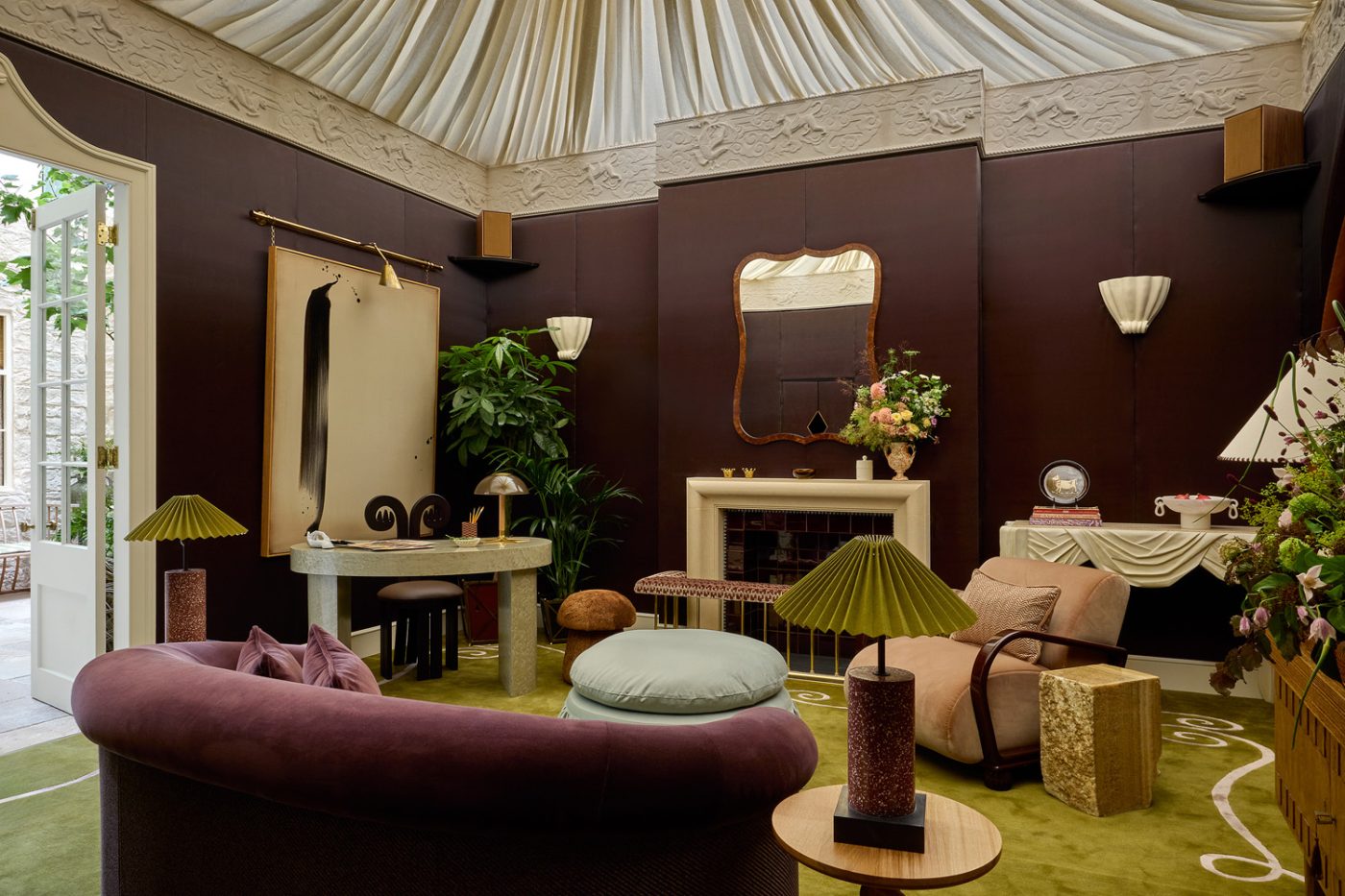
Decadent, moody and delightfully unexpected, the speakeasy salon by Studio Duggan is a study in multifunctional luxury. Envisioned as a private sanctuary for a discerning Italian woman, the room was intentionally sectioned off to create an element of surprise.
“It’s a big space, and we wanted something fun where she could do everything from working to entertaining and relaxing,” says Tiffany Duggan, founder of the London-based practice. “The furniture has been designed to pull double duty, transitioning seamlessly from day to night.”
Luxurious fabrics by the room’s sponsor, Black Edition for Romo, guided the scheme. To wrap the walls, Duggan selected a dark-brown linen blend that mimics the sheen of lacquer. She upped the drama with a tented ceiling in an ivory satin, and a bespoke plaster frieze, crafted in Paris, that reimagines the mythical beasts from another Romo textile. “I loved the fabric, but it felt like too much for this space, so we had it made into plaster instead,” she says.
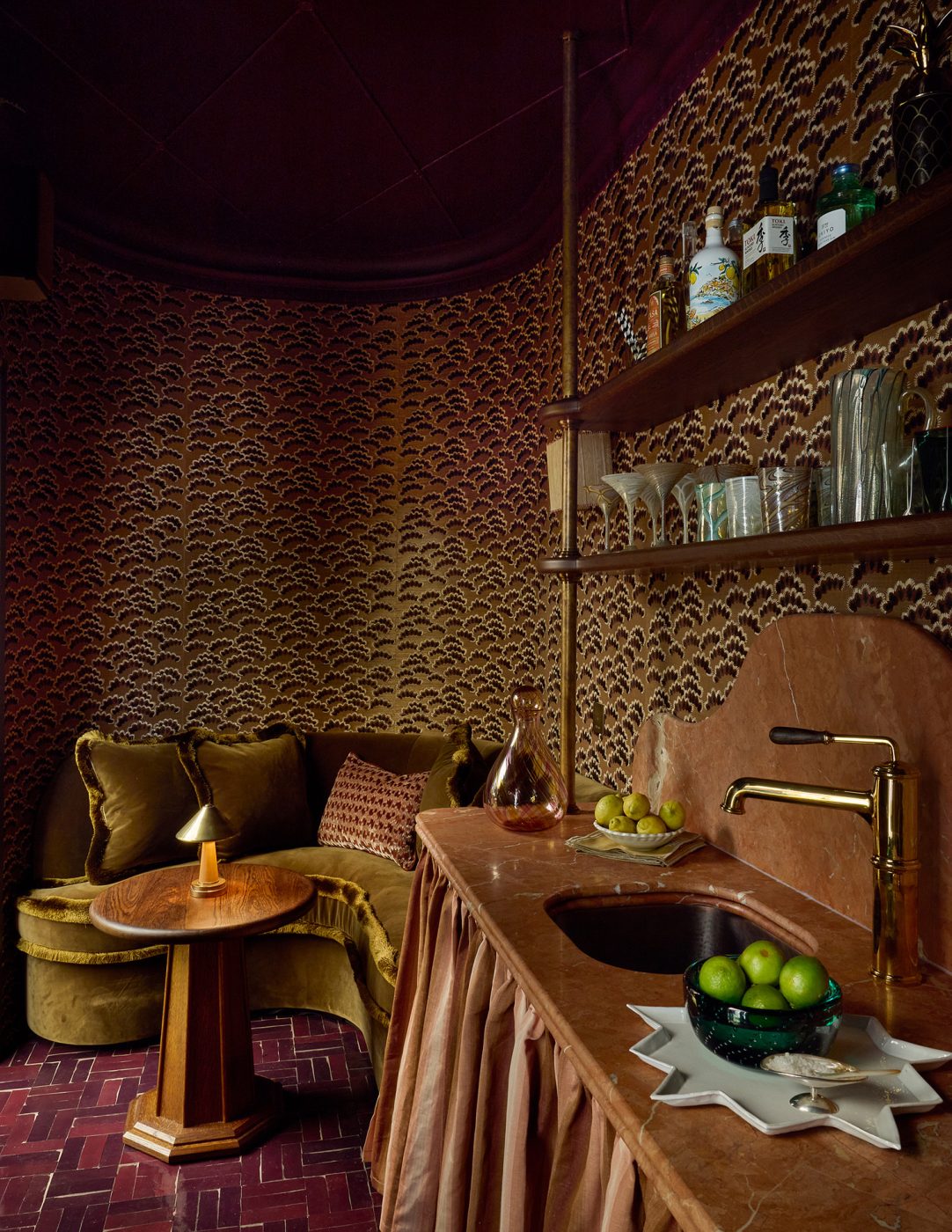
Duggan mined her own line of furniture for the kidney-shaped table, which serves as both a desk and a spot for cocktails, and the relaxed-looking Speakeasy armchair, an obvious choice, given the theme. A Paolo Moschino bronze-verdigris Astral pendant provides light from above, while a 1960s Italian painted-oak sideboard contributes a layer of vintage patina.
Martin Kemp Design
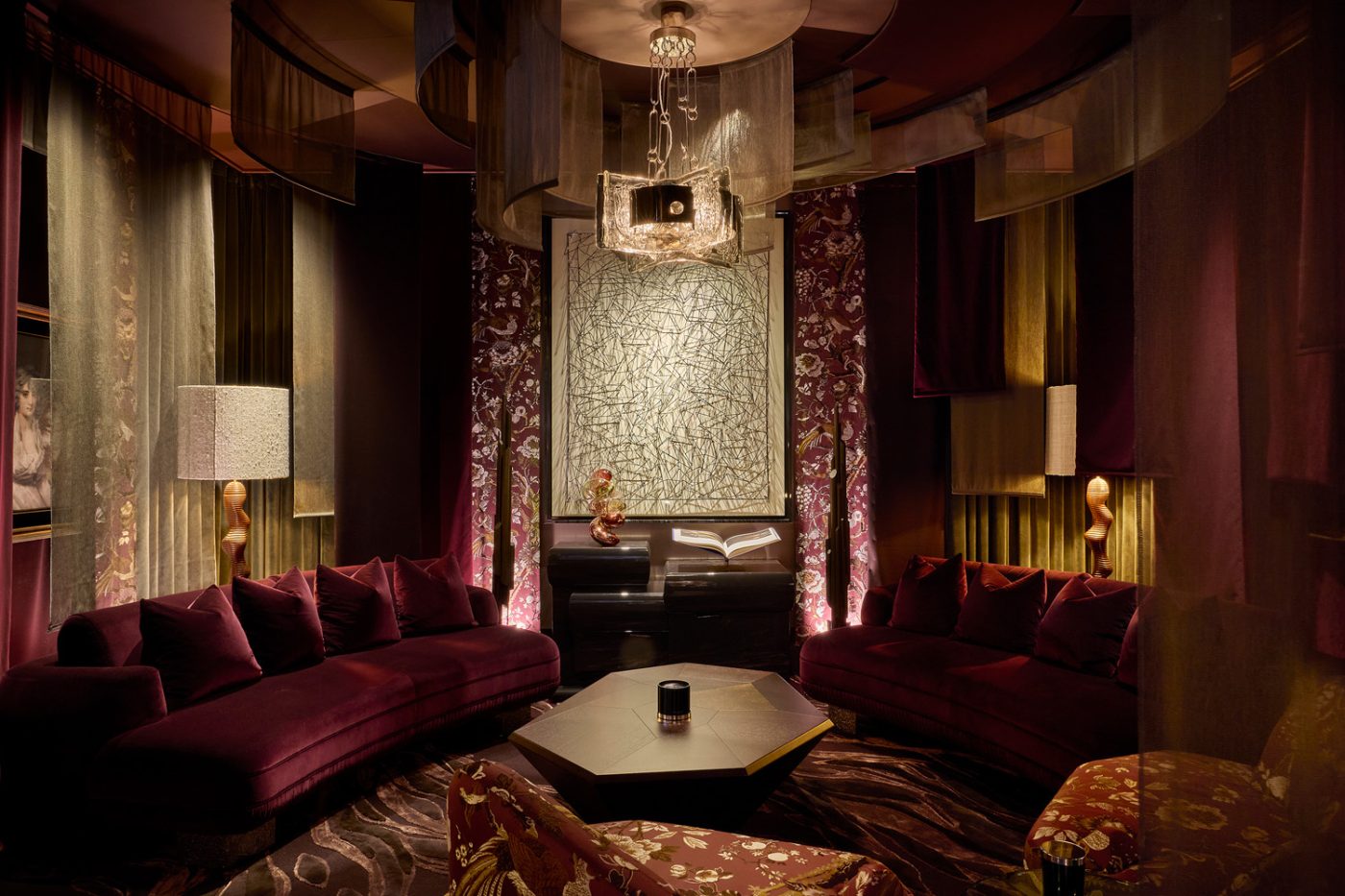
Stepping into the parlor designed by Martin Kemp feels like entering a theater set, which is exactly what the London-based designer intended. “We wanted it to be a room for conversation, for drinking — whether a cocktail or tea — and relaxing,” he says. “The circular layout embraces people and aids conversation. In turn, we were inspired to create the circular ceiling with the layered rouge noir fabric panels, which add a sense of depth and movement.”
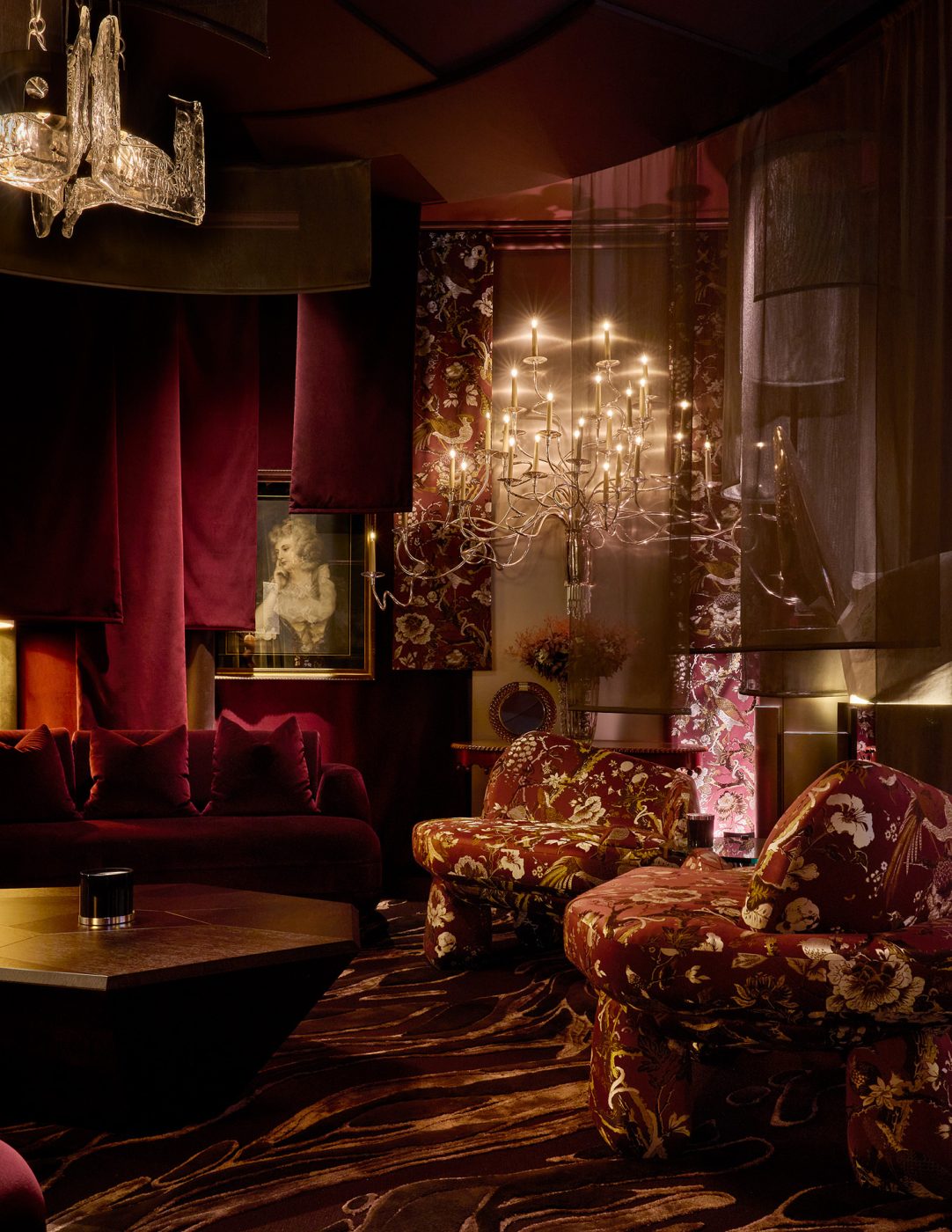
The cocooning space serves up an exclusive preview of Kemp’s forthcoming furniture line. These pieces are juxtaposed with unique decorative finds, like a handblown-glass sculpture by Swedish artist Markus Emilsson and characterful antiques, including a 19th-century mahogany side table, a vintage Fontana Arte ceiling light, brutalist wooden floor lamps and a silver-plated Italian Medusa wall candelabra.
A standout element is an antique display case, home to 1970s stone bookends, Art Deco dessert dishes, vintage cigarette lighters and other such curiosities. “This is a memory of my grandparents,” says Kemp. “My grandmother had a cabinet next to her favorite armchair that was filled with weird and wonderful things.”
Henri Fitzwilliam-Lay
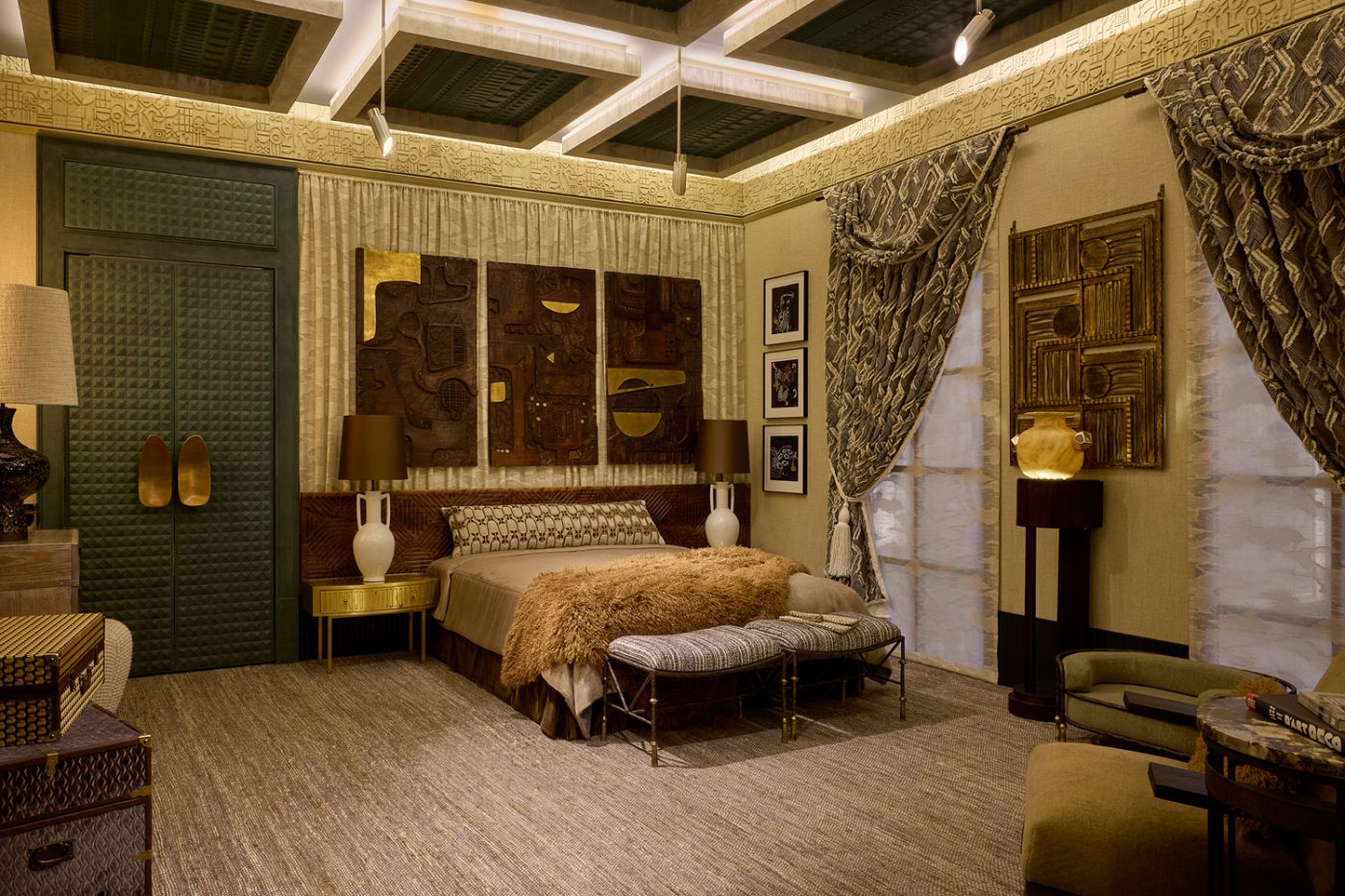
Art Deco meets brutalism in this heavily textured bedroom suite designed by London’s Henri Fitzwilliam-Lay. Avoiding the high-shine chrome surfaces typically associated with the former movement, the space pairs geometric lines with global handcraft.
“It’s a great time to be celebrating Art Deco post its hundred-year anniversary, and we wanted to give it a warmer, more modern twist,” Fitzwilliam-Lay says. “We used a highly textured fabric that reminded us of African Kuba cloth, then we threw in a bit of brutalism for good measure because those strong geometric lines complement Art Deco perfectly.”
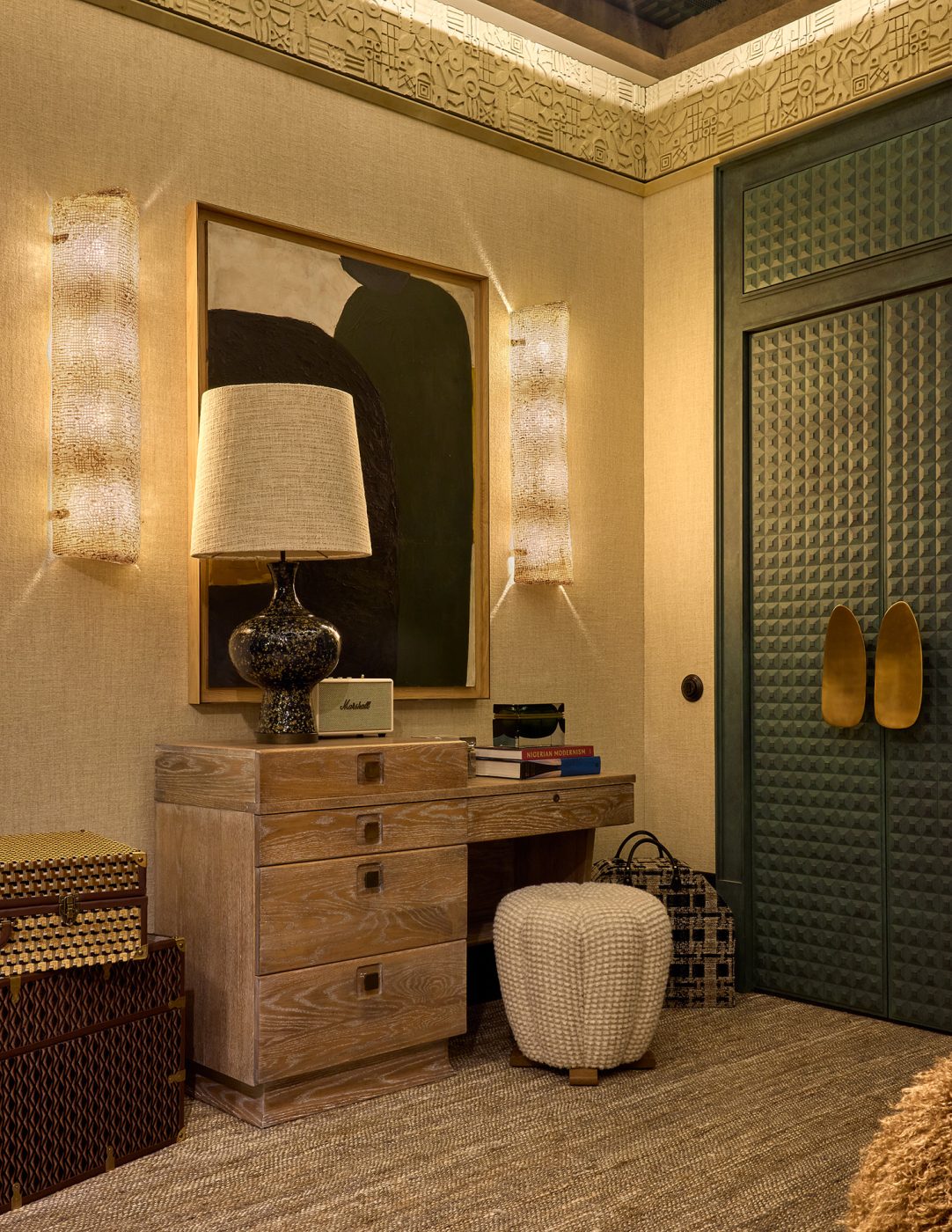
A floating hand-carved headboard frames the bed, joining such vintage pieces as a 1930s French nickel-and-wrought-iron Art Deco side table, a 1930s gilt-iron wall panel, a 1950s French limed-oak desk and a French wrought-iron Art Deco hall stand. These sit alongside a reedition of Jean-Michel Frank’s 1939 Elephant armchair. Bringing warmth to the scheme are a table lamp by Bella Figura, a curved stool and cast-ceramic lamps by Porta Romana and a pair of vintage Venetian wall lights.
De Rosee Sa
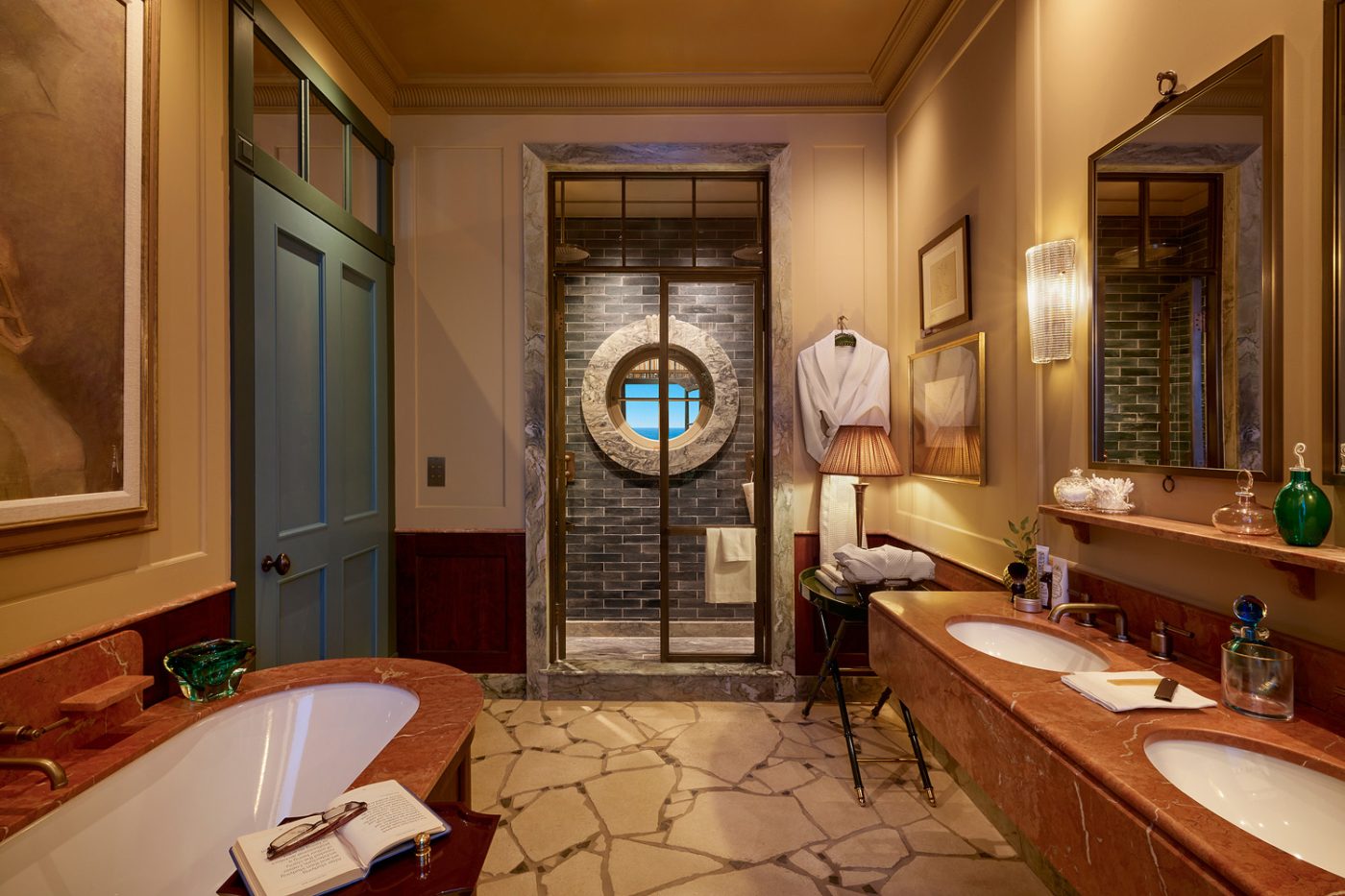
Devised by London- and Lisbon-based architecture and interior design studio De Rosee Sa in collaboration with stone and tile specialist Ca’ Pietra, this bathroom channels the nostalgic charm of a 1970s Mediterranean hotel. “A bathroom is a very functional space — it’s all about routine — but we wanted to whisk you away to a wonderful summer-holiday destination,” says Max de Rosée, cofounder of the firm with his wife, Claire Sá.
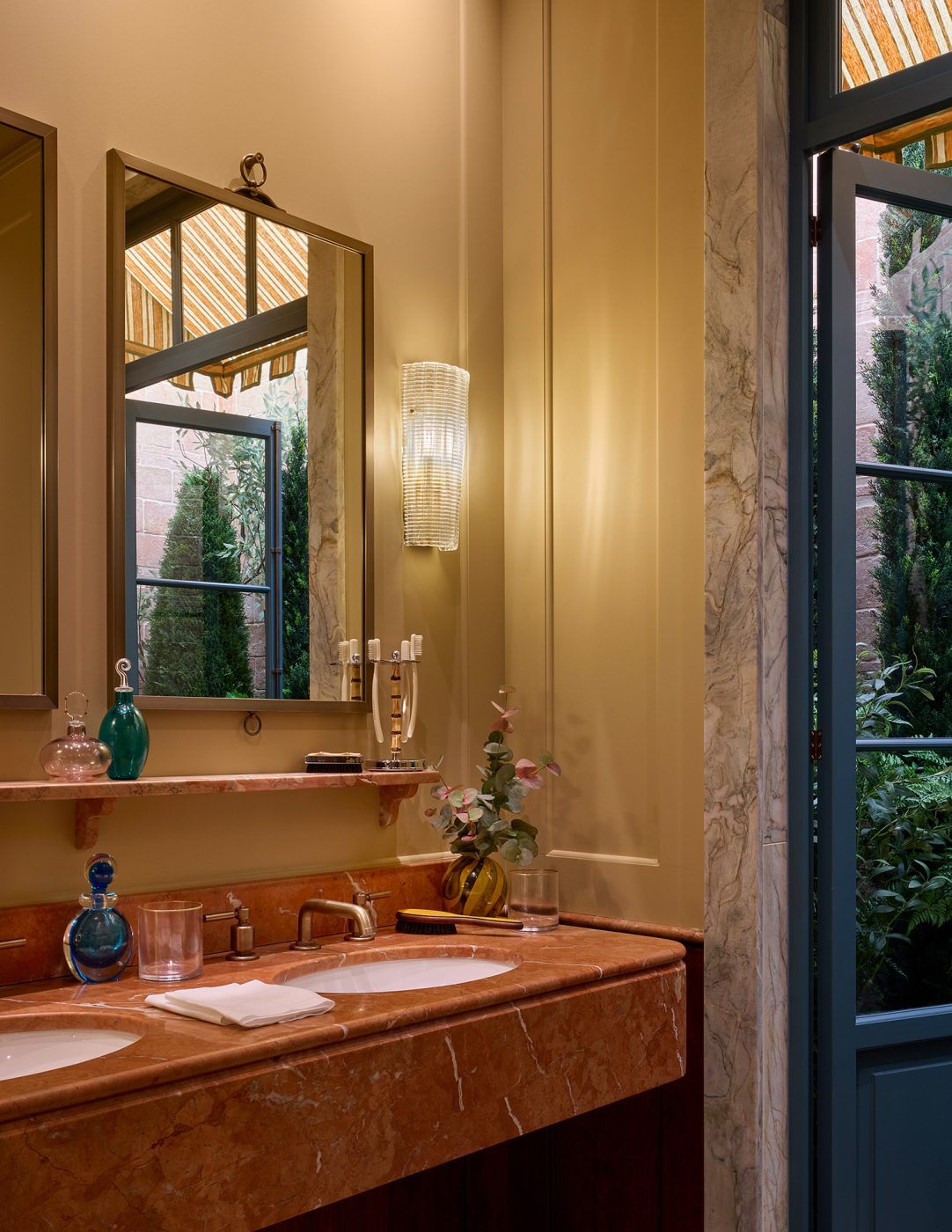
Ca’ Pietra’s artisans pushed structural boundaries in crafting the architectural elements, including a profiled stone cornice and a round window surround. Underfoot, irregular, tumbled limestone is laid in a Pietra Pazza format, transitioning into reclaimed granite cobblestones. Honed rose-tinted Versailles Rouge marble envelops the double basin and Waterworks bath.
“The marble brought a richness that felt central to the scheme, especially against the limestone floor and darker tile work,” says Sá. “We wanted the bathroom to feel transportive but still rooted in craft.” A pair of Italian ribbed Murano glass wall lights from Valerie Wade complete the immersive space.
Russell Sage
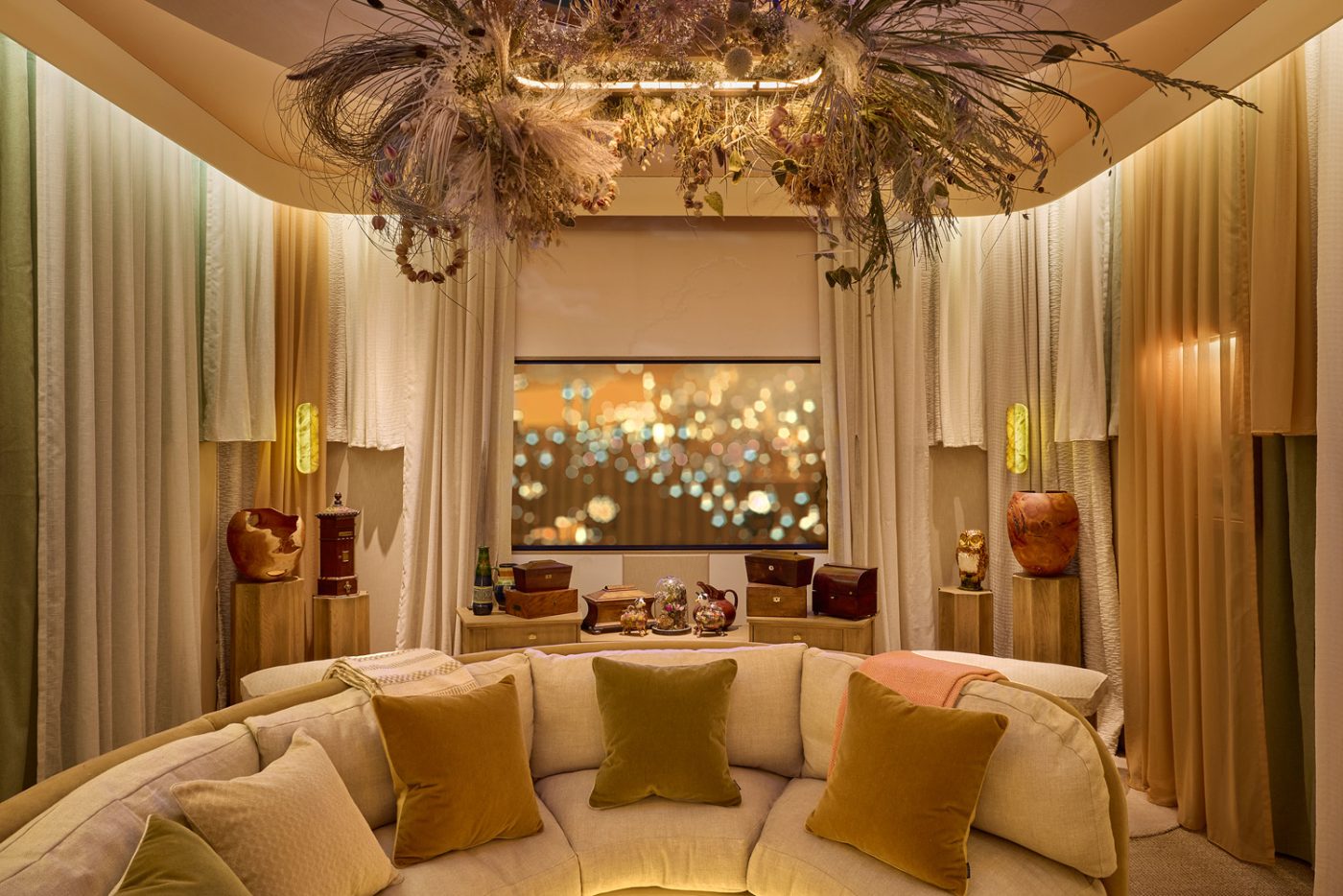
Russell Sage calls his room “the Momentarium” — a multisensory environment that captures a fleeting moment in time. Partnering with sponsor Nucleus, which specializes in high-performance AV systems, smart home automation and bespoke cinema experiences, Sage integrated state-of-the-art technology discreetly into the architecture. But the experience he sought to craft was less cinematic than therapeutic.
“I was keen to use the tech to create something more like being in a flotation tank rather than going to the movies,” Sage says. “I liked the idea that we could have a room that’s really calm.”
This slice of escapism was inspired by his own happy time: walking his black Labrador, Hugo, a video of which, accompanied by a bespoke musical score written by a friend, plays across screens fitted into the ceiling and walls.
Tactile curtains swathe the space, at whose center is a huge circular George Smith daybed.
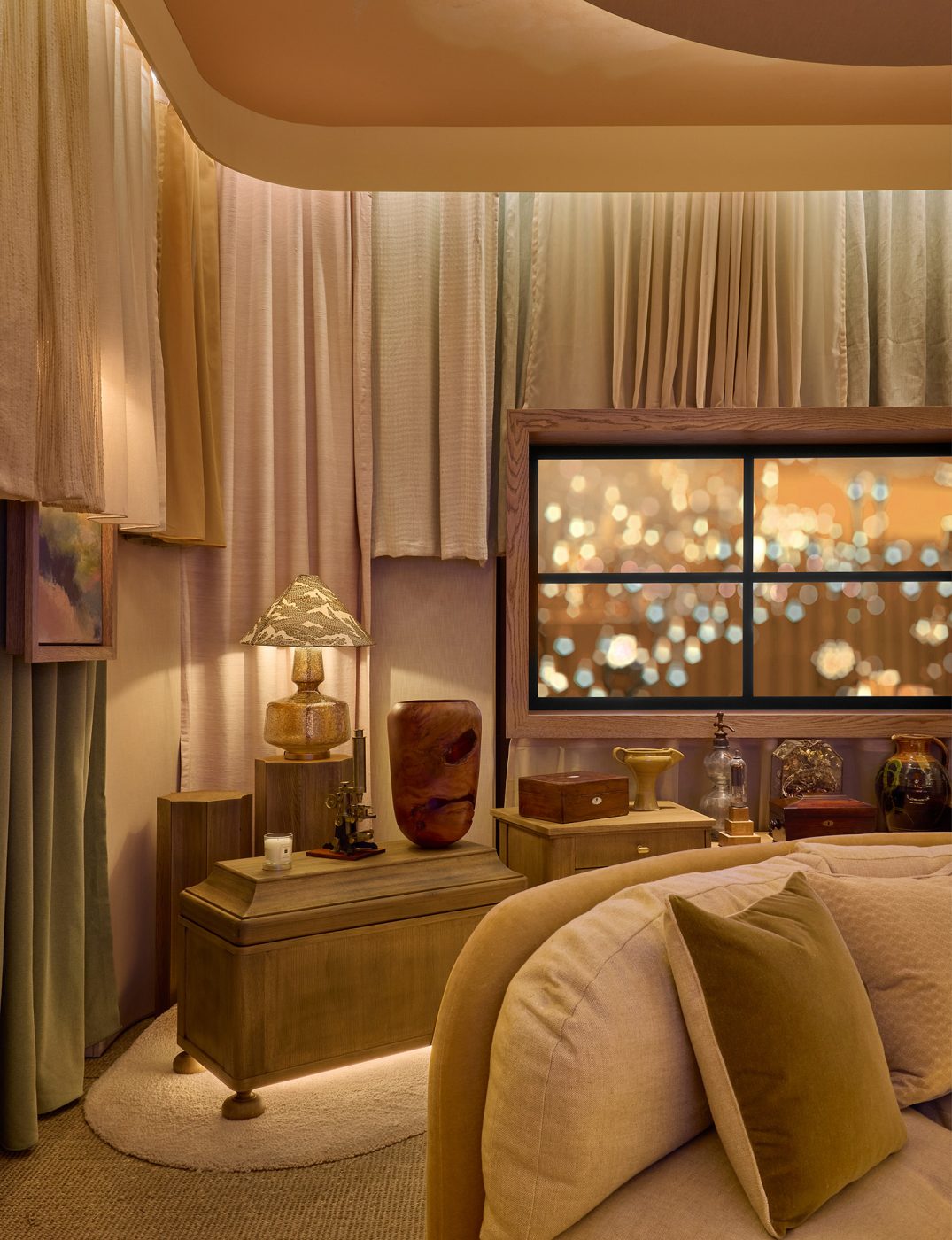
“I’ve always loved the concept of having a sofa that’s like a dog bed,” says Sage, “so a whole bunch of friends could just climb in.”
This oversize seating is flanked by custom curved wood cabinets lit from underneath. Decorative pieces include sculptural yew vessels by Anthony Bryant, which sit alongside such personal treasures as vintage wooden boxes and cards dispensed from a 1950s fortune-telling machine.
“These items are purposely nostalgic for me but not hugely valuable,” says Sage. “I like that the space is minimalist with a little bit of clutter.”
Max Rollitt
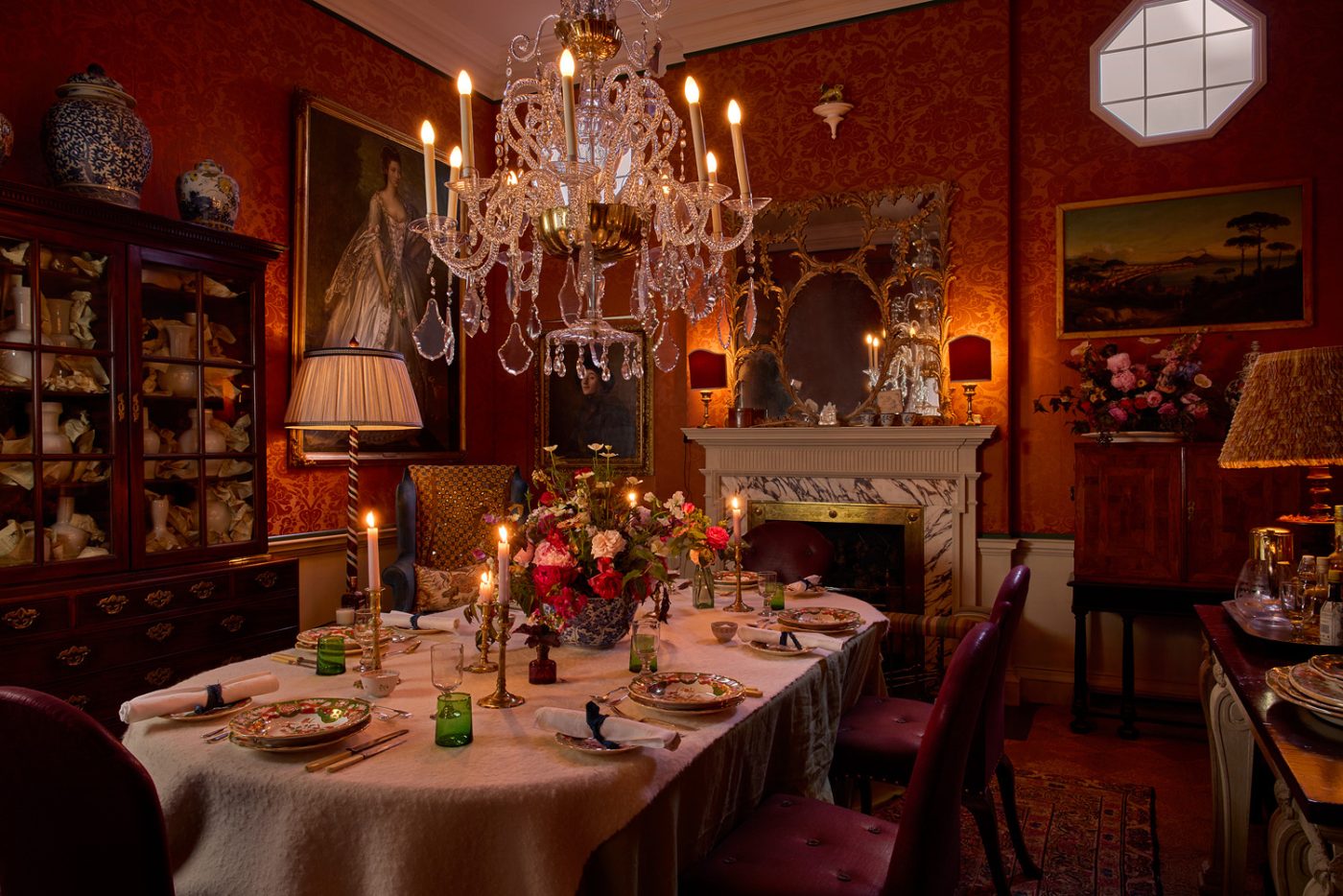
Richly layered and full of historical drama, the dining room by Max Rollitt produces an immediate impact. “Because people use the kitchen so much these days [for hosting], a formal entertaining space needs to be really exciting — it needs to be a treat to go into,” says the Hampshire-based interior designer, furniture maker and antiques dealer. “Architecturally, we built a room dating from the 1700s, and within it, we wanted to create an atmosphere that’s exuberant and inviting.”
He achieved this through exaggerated scale and luxurious textures, beginning with the doorway, which is flanked by generous deep green drapes made using a heavy wool fabric from the room’s sponsor, Schumacher. The windows are dressed with a sumptuous velvet from the design house, while the walls are wrapped in a deep terracotta damask.
“The damask is framed by a big box cornice, deep dado rails and enormous skirting boards,” says Rollitt. “At the center of everything is a huge nineteenth-century Spanish crystal chandelier. The magic comes directly from the size.”
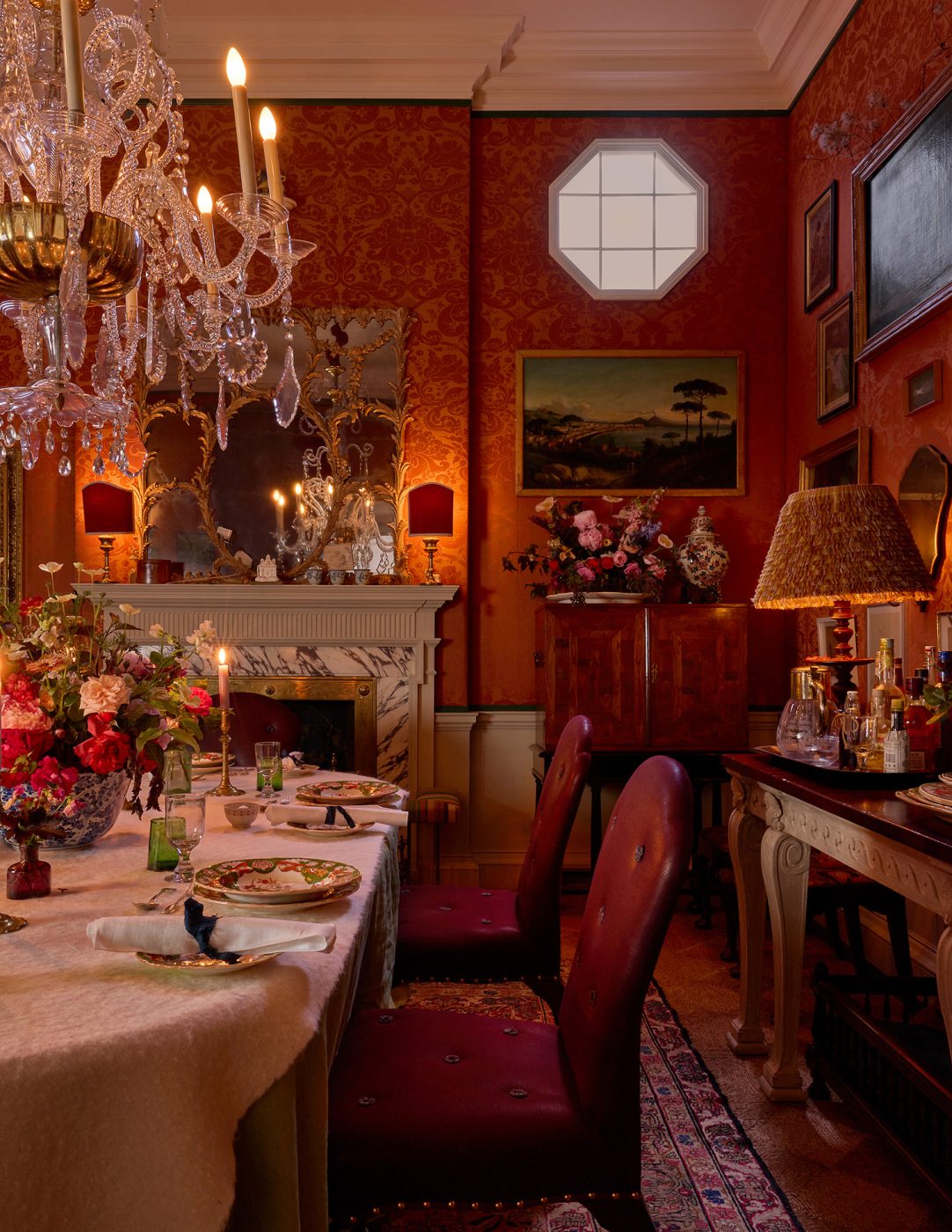
Rollitt’s bespoke furniture pieces sit companionably alongside museum-quality antiques — among them, a George II mahogany library bookcase, a 17th-century kingwood cabinet, a late-Rococo carved overmantel mirror and a host of artworks, including a pair of full-length 18th-century portraits. Together, these curated treasures create a space that is deeply storied and wonderfully alive.