Continental Europe - More Prints
to
288
748
369
549
103
85
Overall Width
to
Overall Height
to
508
291
211
209
46
31
5
3
3
2
2
2
139
131
54
54
47
12
34
1,548
260
9
4
24
33
40
202
405
408
193
87
2
1,418
341
92
9
6
5
4
3
2
2
2
1
1
1
1
1
1
1
1
1
1
1
844
379
307
167
117
40
839
1,854
3,864
3,641
Item Ships From: Continental Europe
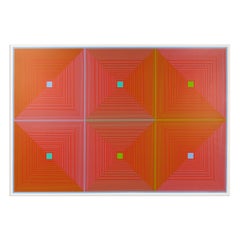
Richard Anuszkiewicz, Six Squares - Signed Screen Print from 1969, Op Art
By Richard Anuszkiewicz
Located in Hamburg, DE
Richard Anuszkiewicz (American, 1930–2020)
Six Squares, 1969
Medium: Screenprint on card
Dimensions: 64 x 94 cm (25 x 37 in)
Edition of 200: Hand-signed and numbered in pencil
Category
20th Century Abstract Geometric Continental Europe - More Prints
Materials
Screen
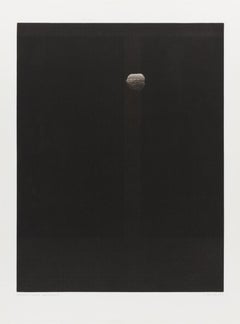
Walnut - Original Mezzotint by Yozo Hamaguchi - 1979
By Yozo Hamaguchi
Located in Roma, IT
Walnut is an original mezantint on paper realized in 1979 by the Japanese artist Yozo Hamaguchi. The artwork is hand- signed by the artist in pencil on lower right. Dedicated with a...
Category
1970s Continental Europe - More Prints
Materials
Mezzotint
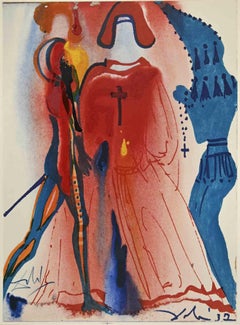
Act III, Scene I - From “Romeo and Juliet” - Lithograph - 1975
By Salvador Dalí
Located in Roma, IT
Act III, Scene I - From “Romeo and Juliet” is an artwork realized in 1975.
Mixed colored lithograph.
Signed and dated in plate on the lower right margin.
Perfect conditions.
P...
Category
1970s Surrealist Continental Europe - More Prints
Materials
Lithograph
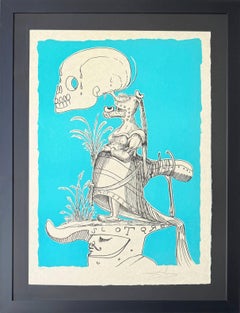
Les Songes Drôlatiques de Pantagruel, Planche III
By Salvador Dalí
Located in OPOLE, PL
Salvador Dali (1904-1989) - Les Songes Drôlatiques de Pantagruel, Planche III
Lithograph from 1973.
Edition 6/250 on Japon paper.
Dimensions of work: 76 x 56 cm
Publisher: Carpen...
Category
1970s Surrealist Continental Europe - More Prints
Materials
Lithograph
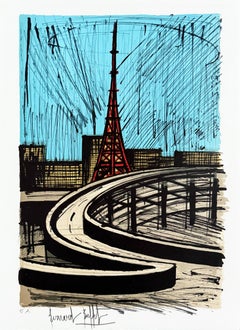
The Eiffel Tower and the highway, Tokyo
By Bernard Buffet
Located in OPOLE, PL
Bernard Buffet (1928-1999) - The Eiffel Tower and the highway, Tokyo
Lithograph from 1981.
Artsit's edition.
On Arches paper.
Dimensions of work: 53.5 x 39 cm.
Hand signed.
The...
Category
1980s Expressionist Continental Europe - More Prints
Materials
Lithograph
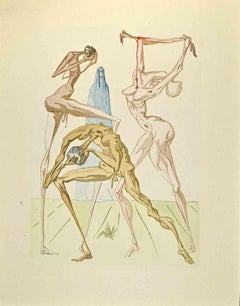
The Sodomites - Woodcut print - 1963
By Salvador Dalí
Located in Roma, IT
The Sodomites - Hell Plate 19 is a woodcut print realized in 1963 for a series illustrating the Medieval poem of the "Divine Comedy" by Dante Alighieri.
Good conditions.
Limited e...
Category
1960s Surrealist Continental Europe - More Prints
Materials
Woodcut
Sill Life - Original Lithograph by Ivo Pannaggi - 1975 ca.
By Ivo Pannaggi
Located in Roma, IT
Image dimensions: 54 x 40 cm.
Still Life is a beautiful and rare lithograph realized by the artist Ivo Pannaggi in a circulation of 100 copies around 197...
Category
1970s Futurist Continental Europe - More Prints
Materials
Lithograph

Untitled / - The archaism of nature -
Located in Berlin, DE
Jorge Machold (1940 Chemnitz - 2015 Berlin), Untitled, 1973. Color etching, 41.5 x 29.2 cm (plate size), 49.5 cm x 39.5 cm (sheet size), signed lower right in lead “J.[orge] Machold”...
Category
1970s Abstract Continental Europe - More Prints
Materials
Paper

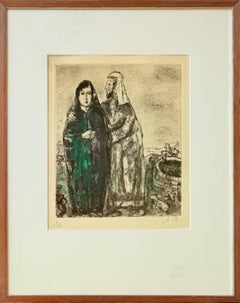
Meeting of Jacob and Rachel at the well
By Marc Chagall
Located in OPOLE, PL
Marc Chagall (1887-1985) - Meeting of Jacob and Rachel at the well
Etching from 1958.
Edition of 100
Enhanced with watercolour by the artist.
Dimensions of work: 52 x 37 cm.
Han...
Category
1950s Modern Continental Europe - More Prints
Materials
Etching

$3,944 Sale Price
40% Off
Marc Chagall - Original Lithograph
By Marc Chagall
Located in Collonge Bellerive, Geneve, CH
Marc Chagall
Original Lithograph
1963
Dimensions: 32 x 24 cm
Reference: Chagall Lithographe 1957-1962. VOLUME II.
Condition : Excellent
Marc Chagall (born in 1887)
Marc Chagall was born in Belarus in 1887 and developed an early interest in art. After studying painting, in 1907 he left Russia for Paris, where he lived in an artist colony on the city’s outskirts. Fusing his own personal, dreamlike imagery with hints of the fauvism and cubism popular in France at the time, Chagall created his most lasting work—including I and the Village (1911)—some of which would be featured in the Salon des Indépendants exhibitions. After returning to Vitebsk for a visit in 1914, the outbreak of WWI trapped Chagall in Russia. He returned to France in 1923 but was forced to flee the country and Nazi persecution during WWII. Finding asylum in the U.S., Chagall became involved in set and costume design before returning to France in 1948. In his later years, he experimented with new art forms and was commissioned to produce numerous large-scale works. Chagall died in St.-Paul-de-Vence in 1985.
The Village
Marc Chagall was born in a small Hassidic community on the outskirts of Vitebsk, Belarus, on July 7, 1887. His father was a fishmonger, and his mother ran a small sundries shop in the village. As a child, Chagall attended the Jewish elementary school, where he studied Hebrew and the Bible, before later attending the Russian public school. He began to learn the fundamentals of drawing during this time, but perhaps more importantly, he absorbed the world around him, storing away the imagery and themes that would feature largely in most of his later work.
At age 19 Chagall enrolled at a private, all-Jewish art school and began his formal education in painting, studying briefly with portrait artist Yehuda Pen. However, he left the school after several months, moving to St. Petersburg in 1907 to study at the Imperial Society for the Protection of Fine Arts. The following year, he enrolled at the Svanseva School, studying with set designer Léon Bakst, whose work had been featured in Sergei Diaghilev's Ballets Russes. This early experience would prove important to Chagall’s later career as well.
Despite this formal instruction, and the widespread popularity of realism in Russia at the time, Chagall was already establishing his own personal style, which featured a more dreamlike unreality and the people, places and imagery that were close to his heart. Some examples from this period are his Window Vitebsk (1908) and My Fianceé with Black Gloves (1909), which pictured Bella Rosenfeld, to whom he had recently become engaged.
The Beehive
Despite his romance with Bella, in 1911 an allowance from Russian parliament member and art patron Maxim Binaver enabled Chagall to move to Paris, France. After settling briefly in the Montparnasse neighborhood, Chagall moved further afield to an artist colony known as La Ruche (“The Beehive”), where he began to work side by side with abstract painters such as Amedeo Modigliani and Fernand Léger as well as the avant-garde poet Guillaume Apollinaire. At their urging, and under the influence of the wildly popular fauvism and cubism, Chagall lightened his palette and pushed his style ever further from reality. I and the Village (1911) and Homage to Apollinaire (1912) are among his early Parisian works, widely considered to be his most successful and representative period.
Though his work stood stylistically apart from his cubist contemporaries, from 1912 to 1914 Chagall exhibited several paintings at the annual Salon des Indépendants exhibition, where works by the likes of Juan Gris, Marcel Duchamp and Robert Delaunay were causing a stir in the Paris art world. Chagall’s popularity began to spread beyond La Ruche, and in May 1914 he traveled to Berlin to help organize his first solo exhibition, at Der Sturm Gallery. Chagall remained in the city until the highly acclaimed show opened that June. He then returned to Vitebsk, unaware of the fateful events to come.
War, Peace and Revolution
In August 1914 the outbreak of World War I precluded Chagall’s plans to return to Paris. The conflict did little to stem the flow of his creative output, however, instead merely giving him direct access to the childhood scenes so essential to his work, as seen in paintings such as Jew in Green (1914) and Over Vitebsk (1914). His paintings from this period also occasionally featured images of the war’s impact on the region, as with Wounded Soldier (1914) and Marching (1915). But despite the hardships of life during wartime, this would also prove to be a joyful period for Chagall. In July 1915 he married Bella, and she gave birth to a daughter, Ida, the following year. Their appearance in works such as Birthday (1915), Bella and Ida by the Window (1917) and several of his “Lovers” paintings give a glimpse of the island of domestic bliss that was Chagall’s amidst the chaos.
To avoid military service and stay with his new family, Chagall took a position as a clerk in the Ministry of War Economy in St. Petersburg. While there he began work on his autobiography and also immersed himself in the local art scene, befriending novelist Boris Pasternak, among others. He also exhibited his work in the city and soon gained considerable recognition. That notoriety would prove important in the aftermath of the 1917 Russian Revolution when he was appointed as the Commissar of Fine Arts in Vitebsk. In his new post, Chagall undertook various projects in the region, including the 1919 founding of the Academy of the Arts. Despite these endeavors, differences among his colleagues eventually disillusioned Chagall. In 1920 he relinquished his position and moved his family to Moscow, the post-revolution capital of Russia.
In Moscow, Chagall was soon commissioned to create sets and costumes for various productions at the Moscow State Yiddish Theater...
Category
1960s Surrealist Continental Europe - More Prints
Materials
Lithograph
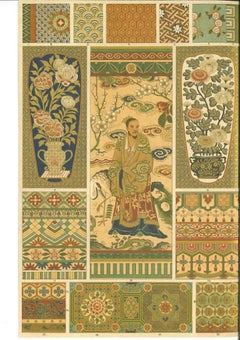
Japanese Decorative Motifs - Vintage Chromolithograph - Early 20th Century
Located in Roma, IT
Japanese Decorative Motifs is a vintage chromolithograph realized by an anonymous artist in the early 20th Century.
Good conditions.
The artwork rep...
Category
Early 20th Century Continental Europe - More Prints
Materials
Paper, Lithograph
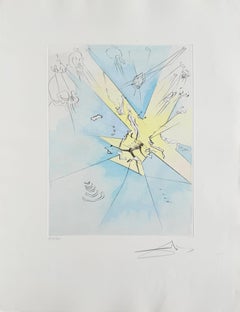
A Shattering Entrance upon the American Stage
By Salvador Dalí
Located in OPOLE, PL
Salvador Dali (1904-1989) - A Shattering Entrance upon the American Stage
Drypoint etching with stencil from 1973.
Editon A 55/195 on Arches paper.
Dimensions of work: 65.4 x 50.4...
Category
1970s Modern Continental Europe - More Prints
Materials
Drypoint, Etching
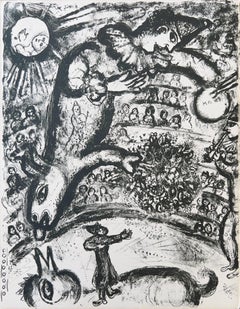
Cirque
By Marc Chagall
Located in OPOLE, PL
Marc Chagall (1887-1985) - Cirque
Lithograph from 1967.
The edition of 250 on Arches paper.
Dimensions of work: 42 x 32.5 cm.
Publisher: Tériade, Paris.
Reference: Mourlot 487, ...
Category
1930s Symbolist Continental Europe - More Prints
Materials
Lithograph
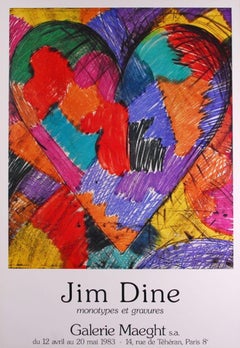
$1,864
Jim Dine - Galerie Maeght 1983
By Jim Dine
Located in Winterswijk, NL
"Heart" by Jim Dine is a color offset lithograph, created for an exhibition at the Galerie Maeght in Paris from April 12 to May 20, 1983. This artwork is a prime example of Dine's di...
Category
20th Century Continental Europe - More Prints
Materials
Paper
Printemps
By Marc Chagall
Located in OPOLE, PL
This work will be exhibited at Art on Paper NYC, September 4–7, 2025.
–
Marc Chagall (1887-1985) - Printemps
Lithograph from 1938.
Dimensions of work: 35 x 26 cm
Publisher: Téri...
Category
1930s Symbolist Continental Europe - More Prints
Materials
Lithograph
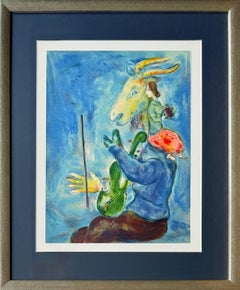
Juste Présent
By Sonia Delaunay
Located in OPOLE, PL
Sonia Delaunay (1885-1979) - Juste Présent
Lithograph from 1961.
Dimensions of work: 38 x 28 cm
Publisher: Lacourière et Frélaut, Paris.
The work is in Excellent condition.
Fast...
Category
1960s Expressionist Continental Europe - More Prints
Materials
Lithograph
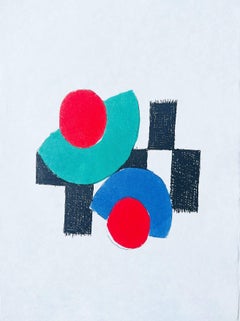
$1,147 Sale Price
20% Off
Orange labyrinth - XXI Century, Contemporary Linocut & Woodcut Print, Abstract
By Maria Stelmaszczyk
Located in Warsaw, PL
MARIA STELMASZCZYK (born in 1983) Studies at the Faculty of Graphic Arts and Painting
Laboratory of Woodcut Techniques and Artistic Book at the Academy of Fine Arts Władysław Strzemi...
Category
Early 2000s Contemporary Continental Europe - More Prints
Materials
Paper, Linocut, Woodcut
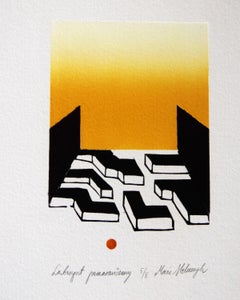
Elisabeth - Contemporary figurative Print, Pop art, Polish artist
Located in Warsaw, PL
*** Please note: Pictures of print in frame are only a visualization. Artwork is sold unframed
DANUTA DĄBROWSKA-SIEMASZKIEWICZ Painter and graphic artist. Her works have been publis...
Category
20th Century Other Art Style Continental Europe - More Prints
Materials
Paper, Screen
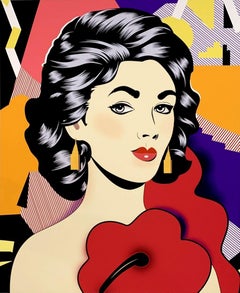
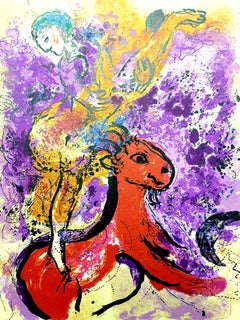
Marc Chagall - The Red Rider - Original Lithograph
By Marc Chagall
Located in Collonge Bellerive, Geneve, CH
Marc Chagall - Original Lithograph
The Red Rider
From the unsigned, unnumbered lithograph printed in the literary review XXe Siecle
1957
See Mourlot 191
Dimensions: 32 x 24 cm
Publisher: G. di San Lazzaro.
Marc Chagall (born in 1887)
Marc Chagall was born in Belarus in 1887 and developed an early interest in art. After studying painting, in 1907 he left Russia for Paris, where he lived in an artist colony on the city’s outskirts. Fusing his own personal, dreamlike imagery with hints of the fauvism and cubism popular in France at the time, Chagall created his most lasting work—including I and the Village (1911)—some of which would be featured in the Salon des Indépendants exhibitions. After returning to Vitebsk for a visit in 1914, the outbreak of WWI trapped Chagall in Russia. He returned to France in 1923 but was forced to flee the country and Nazi persecution during WWII. Finding asylum in the U.S., Chagall became involved in set and costume design before returning to France in 1948. In his later years, he experimented with new art forms and was commissioned to produce numerous large-scale works. Chagall died in St.-Paul-de-Vence in 1985.
The Village
Marc Chagall was born in a small Hassidic community on the outskirts of Vitebsk, Belarus, on July 7, 1887. His father was a fishmonger, and his mother ran a small sundries shop in the village. As a child, Chagall attended the Jewish elementary school, where he studied Hebrew and the Bible, before later attending the Russian public school. He began to learn the fundamentals of drawing during this time, but perhaps more importantly, he absorbed the world around him, storing away the imagery and themes that would feature largely in most of his later work.
At age 19 Chagall enrolled at a private, all-Jewish art school and began his formal education in painting, studying briefly with portrait artist Yehuda Pen. However, he left the school after several months, moving to St. Petersburg in 1907 to study at the Imperial Society for the Protection of Fine Arts. The following year, he enrolled at the Svanseva School, studying with set designer Léon Bakst, whose work had been featured in Sergei Diaghilev's Ballets Russes. This early experience would prove important to Chagall’s later career as well.
Despite this formal instruction, and the widespread popularity of realism in Russia at the time, Chagall was already establishing his own personal style, which featured a more dreamlike unreality and the people, places and imagery that were close to his heart. Some examples from this period are his Window Vitebsk (1908) and My Fianceé with Black Gloves (1909), which pictured Bella Rosenfeld, to whom he had recently become engaged.
The Beehive
Despite his romance with Bella, in 1911 an allowance from Russian parliament member and art patron Maxim Binaver enabled Chagall to move to Paris, France. After settling briefly in the Montparnasse neighborhood, Chagall moved further afield to an artist colony known as La Ruche (“The Beehive”), where he began to work side by side with abstract painters such as Amedeo Modigliani and Fernand Léger as well as the avant-garde poet Guillaume Apollinaire. At their urging, and under the influence of the wildly popular fauvism and cubism, Chagall lightened his palette and pushed his style ever further from reality. I and the Village (1911) and Homage to Apollinaire (1912) are among his early Parisian works, widely considered to be his most successful and representative period.
Though his work stood stylistically apart from his cubist contemporaries, from 1912 to 1914 Chagall exhibited several paintings at the annual Salon des Indépendants exhibition, where works by the likes of Juan Gris, Marcel Duchamp and Robert Delaunay were causing a stir in the Paris art world. Chagall’s popularity began to spread beyond La Ruche, and in May 1914 he traveled to Berlin to help organize his first solo exhibition, at Der Sturm Gallery. Chagall remained in the city until the highly acclaimed show opened that June. He then returned to Vitebsk, unaware of the fateful events to come.
War, Peace and Revolution
In August 1914 the outbreak of World War I precluded Chagall’s plans to return to Paris. The conflict did little to stem the flow of his creative output, however, instead merely giving him direct access to the childhood scenes so essential to his work, as seen in paintings such as Jew in Green (1914) and Over Vitebsk (1914). His paintings from this period also occasionally featured images of the war’s impact on the region, as with Wounded Soldier (1914) and Marching (1915). But despite the hardships of life during wartime, this would also prove to be a joyful period for Chagall. In July 1915 he married Bella, and she gave birth to a daughter, Ida, the following year. Their appearance in works such as Birthday (1915), Bella and Ida by the Window (1917) and several of his “Lovers” paintings give a glimpse of the island of domestic bliss that was Chagall’s amidst the chaos.
To avoid military service and stay with his new family, Chagall took a position as a clerk in the Ministry of War Economy in St. Petersburg. While there he began work on his autobiography and also immersed himself in the local art scene, befriending novelist Boris Pasternak, among others. He also exhibited his work in the city and soon gained considerable recognition. That notoriety would prove important in the aftermath of the 1917 Russian Revolution when he was appointed as the Commissar of Fine Arts in Vitebsk. In his new post, Chagall undertook various projects in the region, including the 1919 founding of the Academy of the Arts. Despite these endeavors, differences among his colleagues eventually disillusioned Chagall. In 1920 he relinquished his position and moved his family to Moscow, the post-revolution capital of Russia.
In Moscow, Chagall was soon commissioned to create sets and costumes for various productions at the Moscow State Yiddish Theater, where he would paint a series of murals titled Introduction to the Jewish Theater as well. In 1921, Chagall also found work as a teacher at a school for war orphans. By 1922, however, Chagall found that his art had fallen out of favor, and seeking new horizons he left Russia for good.
Flight
After a brief stay in Berlin, where he unsuccessfully sought to recover the work exhibited at Der Sturm before the war, Chagall moved his family to Paris in September 1923. Shortly after their arrival, he was commissioned by art dealer and publisher Ambroise Vollard to produce a series of etchings for a new edition of Nikolai Gogol's 1842 novel Dead Souls. Two years later Chagall began work on an illustrated edition of Jean de la Fontaine’s Fables, and in 1930 he created etchings for an illustrated edition of the Old Testament, for which he traveled to Palestine to conduct research.
Chagall’s work during this period brought him new success as an artist and enabled him to travel throughout Europe in the 1930s. He also published his autobiography, My Life (1931), and in 1933 received a retrospective at the Kunsthalle in Basel, Switzerland. But at the same time that Chagall’s popularity was spreading, so, too, was the threat of Fascism and Nazism. Singled out during the cultural "cleansing" undertaken by the Nazis in Germany, Chagall’s work was ordered removed from museums throughout the country. Several pieces were subsequently burned, and others were featured in a 1937 exhibition of “degenerate art” held in Munich. Chagall’s angst regarding these troubling events and the persecution of Jews in general can be seen in his 1938 painting White Crucifixion.
With the eruption of World War II, Chagall and his family moved to the Loire region before moving farther south to Marseilles following the invasion of France. They found a more certain refuge when, in 1941, Chagall’s name was added by the director of the Museum of Modern Art (MOMA) in New York City to a list of artists and intellectuals deemed most at risk from the Nazis’ anti-Jewish campaign. Chagall and his family would be among the more than 2,000 who received visas and escaped this way.
Haunted Harbors
Arriving in New York City in June 1941, Chagall discovered that he was already a well-known artist there and, despite a language barrier, soon became a part of the exiled European artist community. The following year he was commissioned by choreographer Léonide Massine to design sets and costumes for the ballet Aleko, based on Alexander Pushkin’s “The Gypsies” and set to the music of Pyotr Ilyich Tchaikovsky.
But even as he settled into the safety of his temporary home, Chagall’s thoughts were frequently consumed by the fate befalling the Jews of Europe and the destruction of Russia, as paintings such as The Yellow Crucifixion...
Category
1950s Surrealist Continental Europe - More Prints
Materials
Lithograph
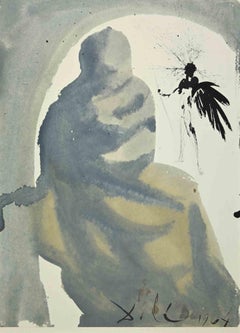
Seduxisti Me, Domine - Lithograph - 1964
By Salvador Dalí
Located in Roma, IT
Seduxisti Me, Domine is a Color lithograph on heavy rag paper realized in 1964. It is part of Biblia Sacra vulgatæ edition is published by Rizzoli-Mediolani between 1967 and 1969.
S...
Category
1960s Surrealist Continental Europe - More Prints
Materials
Lithograph
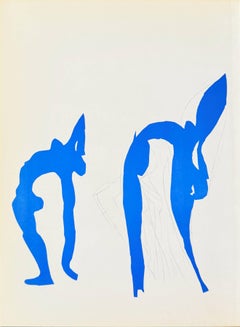
Acrobates
By Henri Matisse
Located in OPOLE, PL
Henri Matisse (1869-1954) - Acrobates
Lithograph from 1958.
Dimensions of work: 35.5 x 26.4 cm
Publisher: Tériade, Paris.
First, original edition.
The work is in Excellent condi...
Category
1950s Surrealist Continental Europe - More Prints
Materials
Lithograph
$669 Sale Price
20% Off
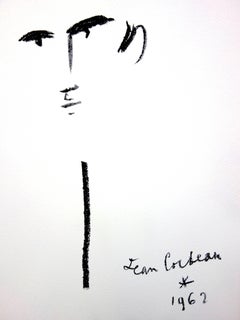
Jean Cocteau - Portrait - Original Lithograph
By Jean Cocteau
Located in Collonge Bellerive, Geneve, CH
Original Lithograph by Jean Cocteau
Title: Taureaux
Signed in the plate
Dimensions: 40 x 30 cm
Edition: 200
Luxury print edition from the portfolio of Trinckvel
1965
Jean Cocteau
W...
Category
1960s Modern Continental Europe - More Prints
Materials
Lithograph
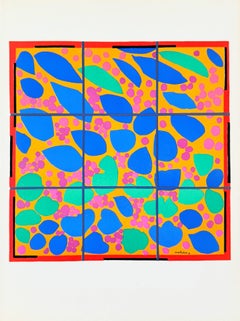
Lierre en Fleur
By Henri Matisse
Located in OPOLE, PL
Henri Matisse (1869-1954) - Lierre en Fleur
Lithograph from 1958.
Dimensions of work: 35.5 x 26.4 cm.
Plate signed.
Publisher: Tériade, Paris.
First, original edition.
The work...
Category
1950s Surrealist Continental Europe - More Prints
Materials
Lithograph
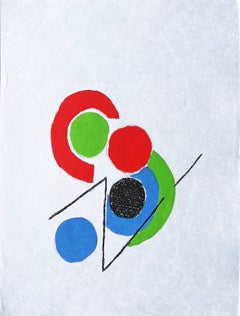
Juste Présent
By Sonia Delaunay
Located in OPOLE, PL
Sonia Delaunay (1885-1979) - Juste Présent
Lithograph from 1961.
Dimensions of work: 38 x 28 cm
Publisher: Lacourière et Frélaut, Paris.
The work is in Excellent condition.
Fast...
Category
1960s Expressionist Continental Europe - More Prints
Materials
Lithograph
$1,147 Sale Price
20% Off
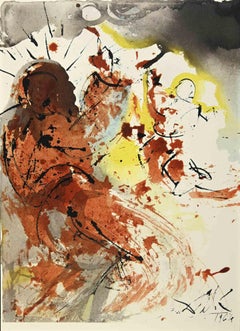
Sanctus Hieronymus - Lithograph - 1964
By Salvador Dalí
Located in Roma, IT
Sanctus Hieronymus is a Color lithograph on heavy rag paper realized in 1964. It is part of Biblia Sacra vulgatæ edition is published by Rizzoli-Mediolani between 1967 and 1969.
Sig...
Category
1960s Surrealist Continental Europe - More Prints
Materials
Lithograph
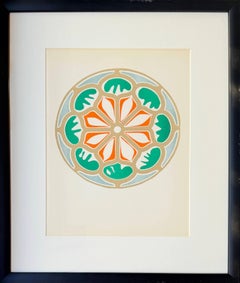
Rosace
By Henri Matisse
Located in OPOLE, PL
Henri Matisse (1869-1954) - Rosace
Lithograph from 1958.
Dimensions of work: 35.5 x 26.4 cm
Plate signed.
Publisher: Tériade, Paris.
First, original edition.
The work is in Exc...
Category
1950s Surrealist Continental Europe - More Prints
Materials
Lithograph
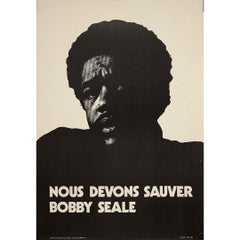
Circa 1970 striking poster Black Power - We must save Bobby Seale
Located in PARIS, FR
This striking poster is a powerful artifact of international solidarity with the Black Panther Party during one of its most turbulent periods. Featuring a stark, high-contrast halfto...
Category
1970s Continental Europe - More Prints
Materials
Paper
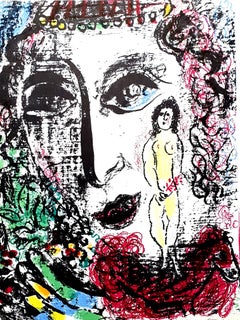
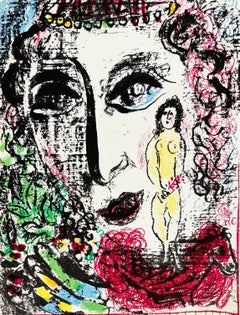
L'apparition au Cirque
By Marc Chagall
Located in OPOLE, PL
"Marc Chagall (1887-1985) - L'apparition au Cirque
Original Lithograph from 1960.
Dimensions of work: 32 x 24 cm.
Publisher: Maeght Éditeur, Paris.
The work is in Excellent condi...
Category
1960s Modern Continental Europe - More Prints
Materials
Lithograph
$701 Sale Price
34% Off
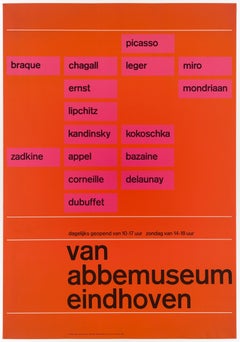
Modern Art at the Van Abbemuseum in Eindhoven – Original Vintage Dutch Poster
Located in Zurich, CH
Original Vintage Poster in bright and crisp colors by the Dutch graphic design legend Wim Crouwel, advertising rather the museum's collection of works by...
Category
Mid-20th Century Abstract Continental Europe - More Prints
Materials
Paper
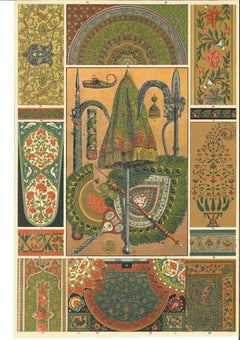
Decorative Motifs - Original Chromolithograph - Early 20th Century
Located in Roma, IT
Decorative Motifs of the Indian Renaissance is a vintage chromolithograph realized by an anonymous artist in th early 20th Century.
Good conditions.
Category
Early 20th Century Continental Europe - More Prints
Materials
Paper, Lithograph
Don't be afraid - XX Century figurative etching print, Black & white, Surrealism
By Jacek Sroka
Located in Warsaw, PL
ZBIGNIEW LUTOMSKI
He was born in 1934 in Grodno. Polish graphic designer, painter and teacher.
He studied at the Academy of Fine Arts in Krakow, where in 1960 he obtained a diploma. ...
Category
21st Century and Contemporary Contemporary Continental Europe - More Prints
Materials
Paper, Etching
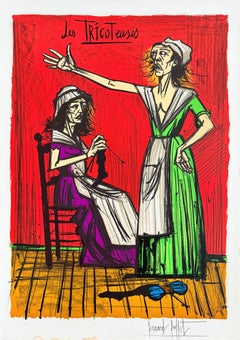
Les Tricoteuses
By Bernard Buffet
Located in OPOLE, PL
Bernard Buffet (1928-1999) - Les Tricoteuses
Lithograph from 1977.
The edition of 103/150.
On Arches paper with watermark.
Dimensions of work: 76 x 56 cm.
Hand signed.
The work ...
Category
1970s Expressionist Continental Europe - More Prints
Materials
Lithograph
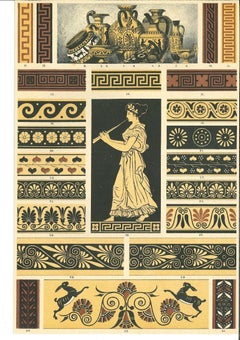
Greek Decorative Motifs - Chromolithograph - Early 20th Century
Located in Roma, IT
Greek Decorative Motifs is a vintage chromolithograph realized by an anonymous artist of the early 20th Century.
Good conditions.
The artwork represents Greek Decorative motifs in ...
Category
Early 20th Century Continental Europe - More Prints
Materials
Paper
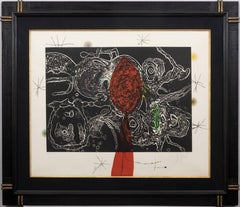
Espriu - Miró II
By Joan Miró
Located in OPOLE, PL
Joan Miro (1893-1983) - Espriu - Miró II
Etching and aquatint with carborundum from 1975.
The edition of 15/50 on on Guarro paper with Sala Gaspar watermark.
Dimensions of work: 70.3 x 85.7 cm.
Hand signed.
Publisher: Sala Gaspar, Barcelona.
Reference: Dupin 870; Cramer 197.
The work is in Good condition.
--
Joan Miró’s Espriu...
Category
1970s Surrealist Continental Europe - More Prints
Materials
Aquatint
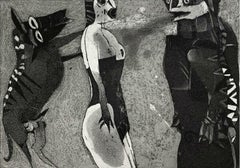
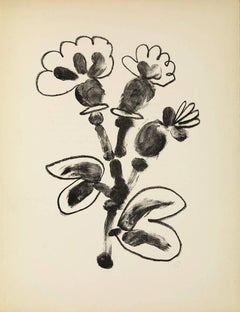
De mémoir d'homme, Planche V
By Pablo Picasso
Located in OPOLE, PL
Pablo Picasso (1881-1973) - De mémoir d'homme, Planche V
Lithograph from 1950.
An unnumbered copy from a limited edition of 350.
Dimensions of work: 32 x 25 cm
Publisher: Édition...
Category
1950s Modern Continental Europe - More Prints
Materials
Lithograph
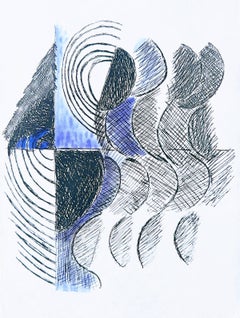
Juste Présent
By Sonia Delaunay
Located in OPOLE, PL
Sonia Delaunay (1885-1979) - Juste Présent
Lithograph from 1961.
Dimensions of work: 38 x 28 cm
Publisher: Lacourière et Frélaut, Paris.
The work is in Excellent condition.
Fast...
Category
1960s Expressionist Continental Europe - More Prints
Materials
Lithograph
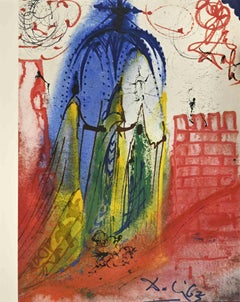
Act I, Scene IV - From “Romeo and Juliet” - Lithograph - 1975
By Salvador Dalí
Located in Roma, IT
Act I, Scene IV - From “Romeo and Juliet” is an artwork realized by Salvador Dalí in 1975.
Mixed colored lithograph.
Signed and dated in plate on the lower right margin. Perfect...
Category
1970s Surrealist Continental Europe - More Prints
Materials
Lithograph
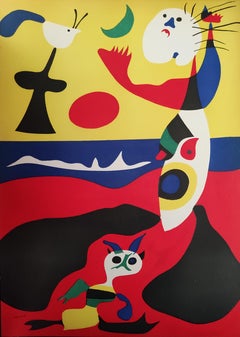
Summer
By Joan Miró
Located in OPOLE, PL
Joan Miro (1893-1983) - Summer
Lithograph from 1938.
Dimensions of work: 35 x 26 cm
Publisher: Tériade, Paris.
The work is in Excellent condition.
Fast and secure shipment.
Category
1930s Surrealist Continental Europe - More Prints
Materials
Lithograph
$1,195
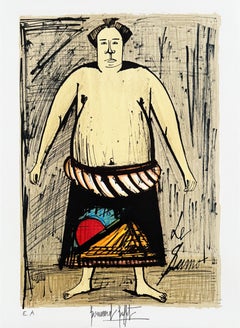
Sumo
By Bernard Buffet
Located in OPOLE, PL
Bernard Buffet (1928-1999) - Sumo
Lithograph from 1981.
Artsit's edition.
On Arches paper.
Dimensions of work: 53.5 x 39 cm.
Hand signed.
The work is in Excellent condition.
Category
1980s Expressionist Continental Europe - More Prints
Materials
Lithograph
$1,434
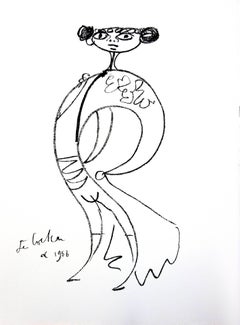
Jean Cocteau - Surrealist Torrero - Original Lithograph
By Jean Cocteau
Located in Collonge Bellerive, Geneve, CH
Original Lithograph by Jean Cocteau
Title: Taureaux
Signed in the plate
Dimensions: 40 x 30 cm
Edition: 200
Luxury print edition from the portfolio of Trinckvel
1965
From the last po...
Category
1960s Modern Continental Europe - More Prints
Materials
Lithograph
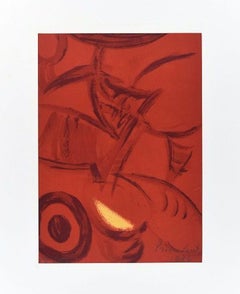
Untitled - Original Lithograph by Primo Conti - 1973
By Primo Conti 1
Located in Roma, IT
Untitled is a beautiful original colored lithograph on cream-colored paper realized by the Italian artist Primo Conti (1900-1988).
An original print, repr...
Category
1970s Contemporary Continental Europe - More Prints
Materials
Lithograph
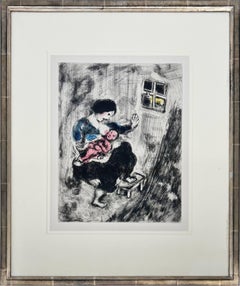
The Wolf, the Mother, and the Child
By Marc Chagall
Located in OPOLE, PL
Marc Chagall (1887-1985) - The Wolf, the Mother, and the Child
Etching from 1954.
Edition of 85.
Enhanced with watercolour by the artist.
Dimensions of work: 39 x 30 cm.
Referen...
Category
1950s Modern Continental Europe - More Prints
Materials
Etching
$2,151 Sale Price
40% Off
Les Songes Drôlatiques de Pantagruel, Planche XXV
By Salvador Dalí
Located in OPOLE, PL
Salvador Dali (1904-1989) - Les Songes Drôlatiques de Pantagruel, Planche XXV
Lithograph from 1973.
Edition 6/250 on Japon paper.
Dimensions of work: 76 x 56 cm
Publisher: Carpen...
Category
1970s Surrealist Continental Europe - More Prints
Materials
Lithograph
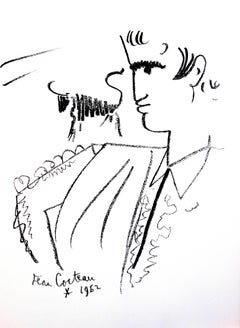
Jean Cocteau - Portrait - Original Lithograph
By Jean Cocteau
Located in Collonge Bellerive, Geneve, CH
Original Lithograph by Jean Cocteau
Title: Taureaux
Signed in the plate
Dimensions: 40 x 30 cm
Edition: 200
Luxury print edition from the portfolio of Trinckvel
1965
Jean Cocteau
W...
Category
1960s Modern Continental Europe - More Prints
Materials
Lithograph
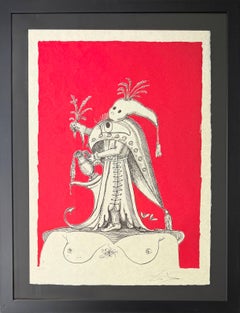
Les Songes Drôlatiques de Pantagruel, Planche VII
By Salvador Dalí
Located in OPOLE, PL
Salvador Dali (1904-1989) - Les Songes Drôlatiques de Pantagruel, Planche VII
Lithograph from 1973.
Edition 6/250 on Japon paper.
Dimensions of work: 76 x 56 cm
Publisher: Carpen...
Category
1970s Surrealist Continental Europe - More Prints
Materials
Lithograph
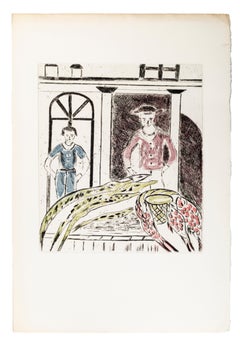
Unexpected Guests - Lithograph by A. Ruellan - 1970s
By Andrée Ruellan
Located in Roma, IT
Image dimensions: 29.9 x 24.7 cm.
Unexpected Guests is an original colored lithograph realized during the 1970s by the French artist Andrée Ruelland.
The artwork represents a coupl...
Category
1970s Contemporary Continental Europe - More Prints
Materials
Lithograph
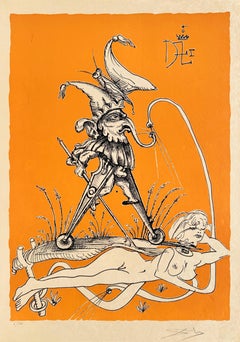
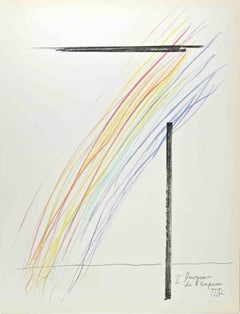
Invasion de l'Espace - Lithograph by Man Ray - 1975
By Man Ray
Located in Roma, IT
Invasion de l'espace is a color lithograph by the American artist and exponent of Dadaism and Surrealism Man Ray (Philadelphia, 1890 - Paris, 1976).
The workr was edited by the Fr...
Category
1970s Surrealist Continental Europe - More Prints
Materials
Lithograph
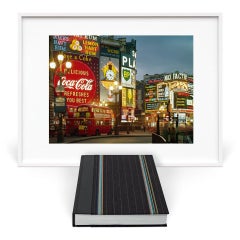
London. Portrait of a City 'Piccadilly Circus’ Color Print & Limited Ed Book
Located in Los Angeles, CA
London Calling
Tailor-made for TASCHEN by Paul Smith
For die-hard lovers of Paris, Berlin, London, Los Angeles, and New York, TASCHEN introduces the Portrait of a City Art Edition series. For each edition, limited to only 500 copies, a legendary local fashion designer is invited to design a bespoke fabric to line the cover, and a large signed and numbered print of one of the images from the book is included.
Limited to 500 numbered copies
Comes with a fine art print on archival paper, signed by Elmar Ludwig
Packaged in a special cover and clamshell case designed by legendary British fashion designer Paul Smith
Samuel Johnson famously said that: “When a man is tired of London, he is tired of life.” London’s remarkable history, architecture, landmarks, streets, style, cool, swagger, and stalwart residents are pictured in hundreds of compelling photographs sourced from a wide array of archives around the world. London is a vast sprawling metropolis, constantly evolving and growing, yet throughout its complex past and shifting present, the humor, unique character, and bulldog spirit of the people have stayed constant. This book salutes all those Londoners, their city, and its history. In addition to the wealth of images included in this book, many previously unpublished, London’s history is told through hundreds of quotations, lively essays, and references from key movies, books, and records.
From Victorian London to the Swinging ’60s; from the Battle of Britain to punk; from the Festival of Britain to the 2012 Olympics; from the foggy cobbled streets to the architectural masterpieces of the millennium; from rough pubs to private drinking clubs; from Royal Weddings to raves, from the charm of the East End to the wonders of Westminster; from Chelsea girls to Hoxton hipsters; from the power to the glory: in page after page of stunning photographs, reproduced big and bold like the city itself, London at last gets the photographic tribute it deserves.
Photographs by: Slim Aarons, Eve Arnold, David Bailey, Cecil Beaton, Bill Brandt, Alvin Langdon Coburn, Anton Corbijn, Terence Donovan, Roger Fenton, Bert Hardy, Evelyn Hofer, Frank Horvat, Tony Ray-Jones, Nadav Kander...
Category
20th Century Continental Europe - More Prints
Materials
Archival Pigment
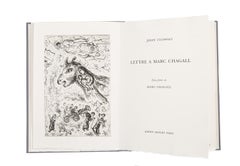
Lettre à Marc Chagall, with five etchings by the artist
By Marc Chagall
Located in OPOLE, PL
Marc Chagall (1887 Liozna near Vitebsk – 1985 Saint-Paul-de-Vence), Jerzy Ficowski: Lettre à Marc Chagall with five etchings by the artist, 1969
Technique: etching on paper
Dimensio...
Category
1960s Symbolist Continental Europe - More Prints
Materials
Etching
$5,856 Sale Price
30% Off
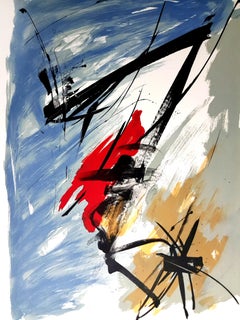
Jean Miotte - Abstract Composition - Original Aquatint Engraving
By Jean Miotte
Located in Collonge Bellerive, Geneve, CH
Jean Miotte - Rare Original Aquatint Engraving
Title: Abstract Composition
Dimensions: 76 x 56 cm
Jean Miotte, 1926 - 2016
Miotte came of artistic age in the decade after World War...
Category
1970s Abstract Expressionist Continental Europe - More Prints
Materials
Aquatint
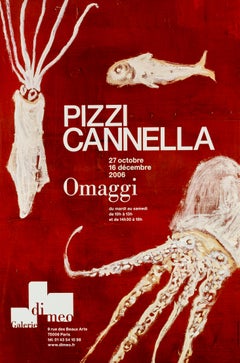
Pizzi Cannella Exhibition Poster - 2006
By Piero Pizzi Cannella
Located in Roma, IT
Pizzi Cannella Exhibition is a vintage exhibition poster realized in 2006.
Mixed colored offset poster realized in the occasion of the exhibition of Pizzi Cannella in 2006.
Good co...
Category
Early 2000s Contemporary Continental Europe - More Prints
Materials
Offset
$172 Sale Price
20% Off
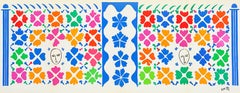
Décoration - Masques
By Henri Matisse
Located in OPOLE, PL
Henri Matisse (1869-1954) - Décoration - Masques
Lithograph from 1958.
Dimensions of work: 96.5 x 35.5 cm.
Plate signed.
Publisher: Tériade, Paris.
Each copy of this Lithograph ...
Category
1950s Surrealist Continental Europe - More Prints
Materials
Lithograph
$956 Sale Price
20% Off
Red Knight on Brown Background - Original Lithograph by Marino Marini - 1961
By Marino Marini
Located in Roma, IT
Image dimensions: 70x50 cm.
Hand signed and numbered. Edition of 50 prints, numbered and hand signed.
Dedicated to Nesto Jacometti.
Ref. Abrams n.80.
Rare and in excellent conditions.
Category
1960s Continental Europe - More Prints
Materials
Lithograph

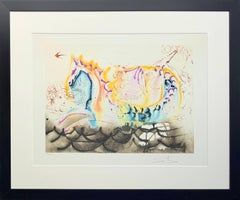
Le cheval marin
By Salvador Dalí
Located in OPOLE, PL
Salvador Dali (1904-1989) - Le cheval marin
Lithograph from 1972.
The edition of 187/250.
Dimensions of work: 68 x 50 cm
On B.F.K Rives paper as stated in the Field catalogue.
R...
Category
1970s Surrealist Continental Europe - More Prints
Materials
Lithograph
$5,772 Sale Price
30% Off
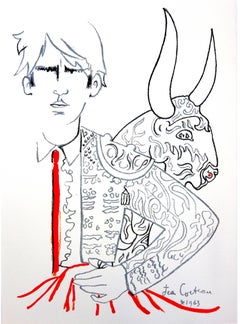
Jean Cocteau - Bulls - Original Lithograph
By Jean Cocteau
Located in Collonge Bellerive, Geneve, CH
Original Lithograph by Jean Cocteau
Title: Taureaux
Signed in the plate
Dimensions: 40 x 30 cm
Edition: 200
Luxury print edition from the portfolio of Trinckvel
1965
Jean Cocteau
W...
Category
1960s Modern Continental Europe - More Prints
Materials
Lithograph
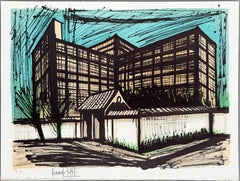
Fujita Hotel in Kyoto
By Bernard Buffet
Located in OPOLE, PL
Bernard Buffet (1928-1999) - Fujita Hotel in Kyoto
Lithograph from 1981.
Artsit's edition.
On Arches paper.
Dimensions of work: 71 x 53.5 cm.
Hand signed.
The work is in Excell...
Category
1980s Expressionist Continental Europe - More Prints
Materials
Lithograph
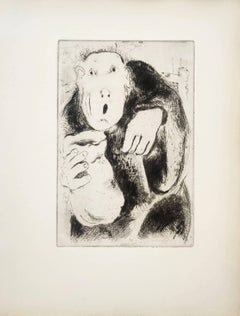
Le Sept Péchés Capitaux
By Marc Chagall
Located in OPOLE, PL
Marc Chagall (1887-1985) - Le Sept Péchés Capitaux
Etching from 1925.
Edition of 300 proofs.
Dimensions of work: 25 x 19.5 cm.
Publisher: Tériade, Paris.
Reference: Kornfeld 47....
Category
1920s Symbolist Continental Europe - More Prints
Materials
Etching
$744 Sale Price
30% Off
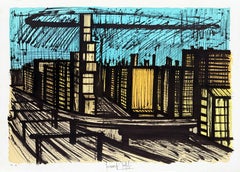
Ginza District-Tokyo
By Bernard Buffet
Located in OPOLE, PL
Bernard Buffet (1928-1999) - Ginza District-Tokyo
Lithograph from 1981.
Artsit's edition.
On Arches paper.
Dimensions of work: 71 x 53.5 cm.
Hand signed.
The work is in Excelle...
Category
1980s Expressionist Continental Europe - More Prints
Materials
Lithograph
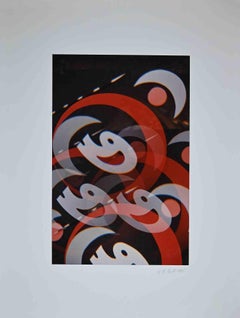
Exibition Print dated 1995 by Miller Null - Vintage Photograph - 1995
Located in Roma, IT
Exibition print dated 1995 by Miller Null is a vintage photographic print on color paper applied on cardboard.
Signature in pencil on front of cardboard, dated 1995, a late print before photographer's death...
Category
1990s Abstract Continental Europe - More Prints
Materials
Photographic Paper
Jean Cocteau - Olé - Original Lithograph
By Jean Cocteau
Located in Collonge Bellerive, Geneve, CH
Jean Cocteau - Olé - Original Lithograph
1934
Signed and dated in the plate
Numbered in pencil
Edition : /200
Dimensions: 50 x 33 cm
Provenance : Succession Dermit, Cocteau's heir
Category
1930s Modern Continental Europe - More Prints
Materials
Lithograph

Still Thinking About These?
All Recently ViewedMore Ways To Browse
Mordechai Rosenstein
Murakami Flowers Blooming In This World
Oranges By Donald Sultan
Picasso Bullring
Porsche 904
R And B Vintage Radio
R W Smith
Richard Sedlon
Roy Lichtenstein Sweet Dreams
Salvador Dali Signed 1975
Sandra Gamarra
Schnabel Poster
Seattle Worlds Fair Poster
Shelby And Sandy
Shepard Fairey Love Lotus
Shinduk Kang
Snoopy Tennis
Sorrento Vintage Poster