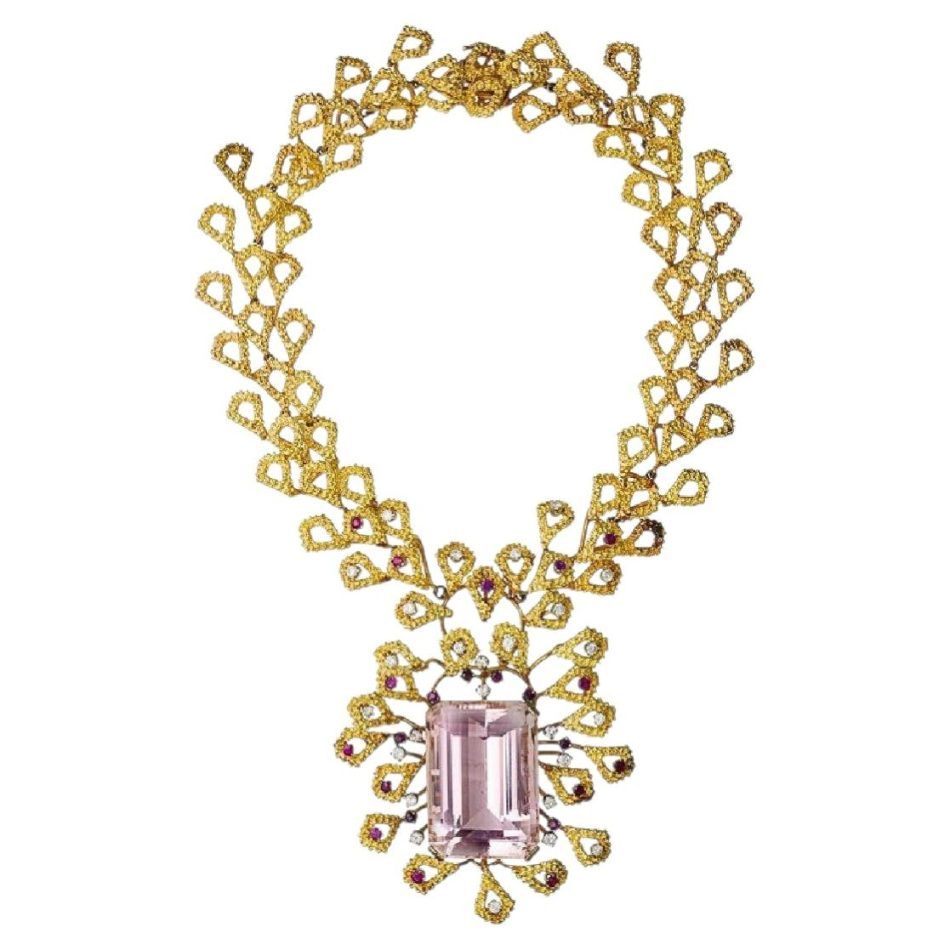
Ranging in color from ballet-slipper pink to rich violet, kunzite might be the prettiest gemstone you’ve never heard of. It was named after Tiffany & Co. gemologist George F. Kunz, who determined that specimens discovered in San Diego County in 1902 were a variety of the mineral spodumene. Given its origins, the stone makes an appropriate centerpiece for this astounding jewel designed by another American original, Barbara B. Anton.
Anton was a quintessential creator. She studied engineering, fine art and acting. She was a playwright and an editor. She was a visionary jewelry designer and in 1965 became a GIA-certified gem specialist — unusual at the time for a woman. The attributes honed in these pursuits, from her artist’s eye to her mathematical prowess to her flair for the dramatic, doubtless helped make her jewels so singular. This monumental necklace, offered on 1stDibs by Raritet Antique Gallery, is an outstanding example. Its 188-carat emerald-cut, pastel-pink kunzite drop is encircled by textured-gold petals and round-cut diamonds and rubies.
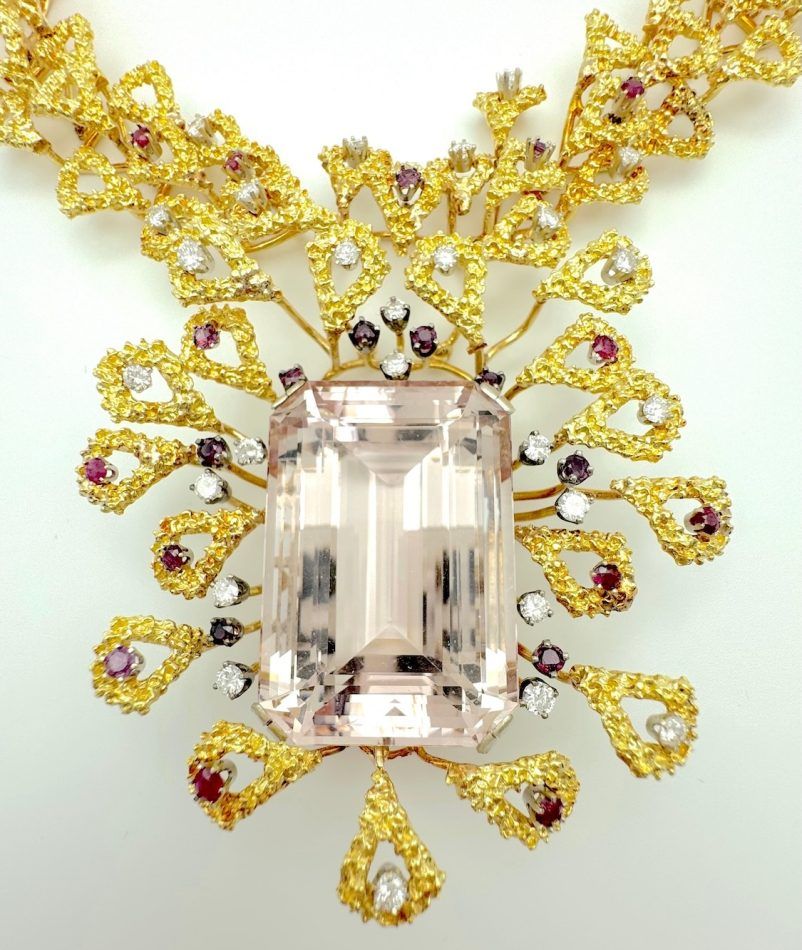
Textured gold figured prominently in many of Anton’s pieces, giving them an organic quality, like coral budding on the ocean floor. Some feature tentacle-like forms holding the stones in places — structural elements cleverly transformed into part of the design.
Although this particular jewel is, to put it mildly, bold, it is also supremely wearable. Looking at its underside, it’s clear that the articulated necklace was thoughtfully constructed, with a smooth gold structure serving as its foundation.
Equally clearly, Anton didn’t need diamonds and rubies to instill her work with drama. She often used non-precious stones like peridot, amethyst, citrine and, as in this necklace, kunzite, elevating them through her extraordinary creations. For this particular piece, which seems best suited to a big night out, kunzite was a fitting choice. Known as an evening stone, it fades in color if exposed to too much sunlight. After all, stars shine brightest at night.