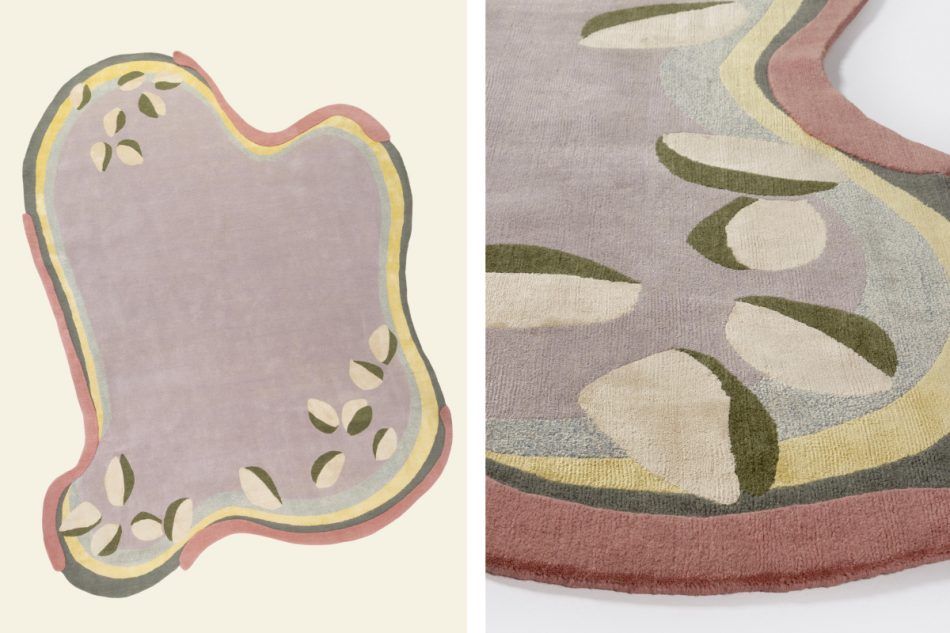
While most carpets serve as the backdrop to a room, the best transcend that role to take center stage. Such is the case with a new line of handmade rugs conceived by the American-born, U.K.-based artist Dawn Bendick and woven by artisans in Nepal. The six-piece collection is a collaboration with the New York gallery FJ Hakimian, exemplified in the design shown here, titled the Pond. Its name becomes clear when viewed from above: an irregular outline that recalls a pastel-hued body of water, which is a perspective that carries through the six-piece collection. “One of the rugs was inspired by pavers beneath my feet at Waterloo train station,” Bendick says.
Known primarily for large-scale kiln-formed glass works, the artist approached the series with a like sensibility, despite the shift in material. “The way light moves across my pieces is similar to how wool and silk reflect it in a rug,” she says. This is beautifully illustrated in the Pond, in which leaves rendered in silk catch the light with a soft sheen, contrasting with the denser, more matte wool surrounding them. The effect is subtle, but it lends the surface a sense of movement.
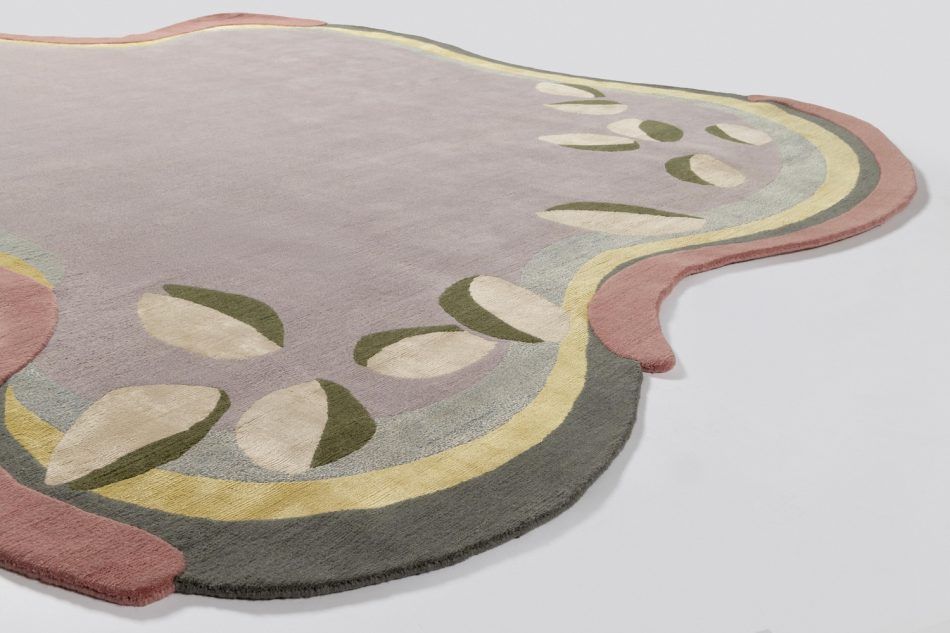
The piece’s shape, meanwhile, embodies ideas being developed in Bendick’s larger practice. “I’m working on a new body of large glass textures with an organic outline, so the dialogue between the glass and the rug forms was a natural progression,” she says. Other influences came from FJ Hakimian’s archive, which includes a historic collection of Aubusson carpets, Scandinavian flat-weaves and Austrian Wiener Werkstätte floor coverings. The graphic character of the Pond’s fluid border, the artist explains, “comes from the hand-drawn quality we wanted to retain once it came off the sketch and entered into production.”
According to Roxanne Hakimian, the creative director of FJ Hakimian, which is offering the piece on 1stDibs), translating the artist’s vision into a hand-knotted rug was itself a creative act. “Irregular shapes, like those seen in the Pond, present real challenges,” she says. “Every piece starts as a rectangle, so the weavers in Nepal have to map the entire design with the final silhouette in mind from the very beginning, making sure the border bands and leaf motifs land exactly where they need to be before any cutting begins.” The hand-cutting that follows, she adds, is painstaking work. “Tracing and cutting such a fluid, unpredictable outline leaves very little margin for error. It significantly increases both the skill and time required, but that’s precisely what makes the result so special.”