When Roger Capron arrived in Vallauris, France, in 1946, the small Côte d’Azur village was already synonymous with ceramics. Capron, trained at Paris’s School of Applied Arts and restless after a stint teaching art there, threw himself into the craft alongside fellow makers Robert Picault and Jean Derval at a shared workshop called l’Atelier Callis. Vallauris’s reputation was already attracting artists from across Europe, and Capron found himself at the center of a remarkably fertile creative moment.
Pablo Picasso was also drawn to the region and soon set up his own studio nearby, adding to what was becoming an unlikely concentration of artistic energy in the village. Capron stayed put, however, as the others moved away, eventually building his own atelier into one of the region’s most celebrated creative studios, earning the Gold Medal at the Milan Triennial in 1954 and, by 1980, employing nearly 120 people.
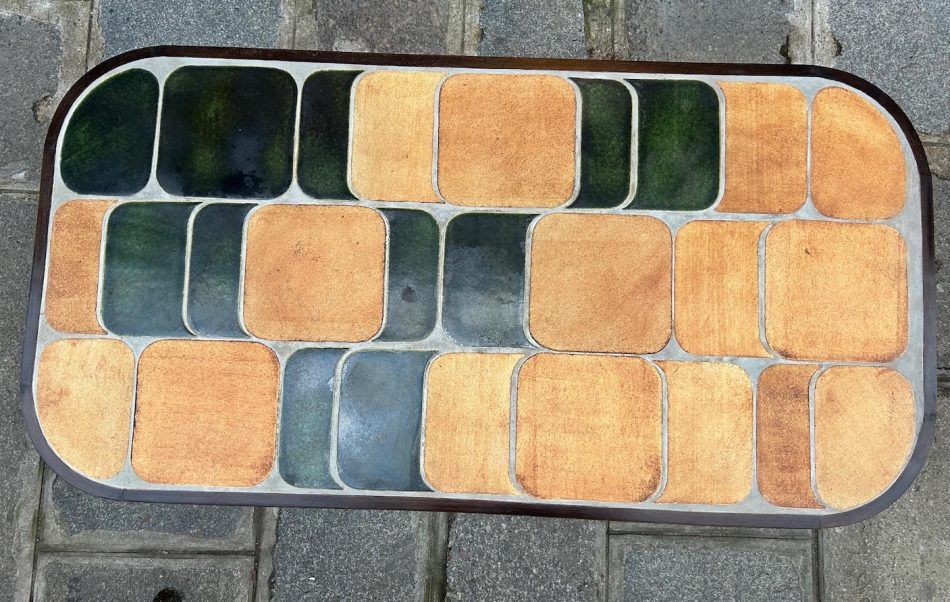
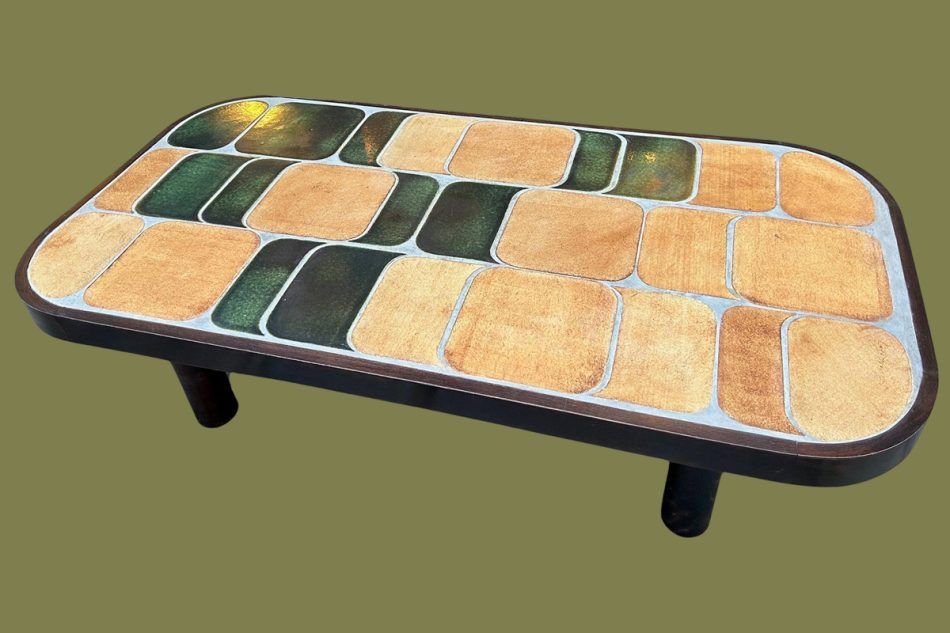
The Shogun table, an example of which is pictured here, arrived late in his career, during the 1970s, when he had shifted from the botanical tile imprints that defined his 1960s output to a more spare aesthetic. The low table, with a stoneware top set on a softly rounded wood base, produces an almost meditative effect, its grid of hand-glazed ceramic tiles arranged with a rigor that spoke directly to clients who prized this kind of minimalism.
What makes this particular example stand out, according to Paris-based dealer Edouard de la Marque, of 1stDibs seller Galeries Edouard de la Marque, is the tile pattern and hue. “Some pieces interlock with one another,” he says, “and the color of the enamels —sometimes metallic, in varying shades of green — gives this table its uniqueness.” The iridescence wasn’t accidental, exactly, but it wasn’t entirely intentional, either. “The firings had their own variations,” de la Marque explains, “and all the ceramics came out with different tones, depending on the chemical reactions of the glazes.” No two Shogun tables ever emerged from the kiln quite the same.
That handmade unpredictability is part of what entices collectors. But de la Marque also points to a more elemental factor in the table’s enduring appeal: its ability to disappear into an interior and subtly improve it. “The slightly rounded corners, the use of wood, the three main tones of the glazes and the tiles with green or black reflections all blend perfectly with soft, warm atmospheres,” he says. Country houses, seaside cottages, mountain retreats — the Shogun is equally at home in them all.