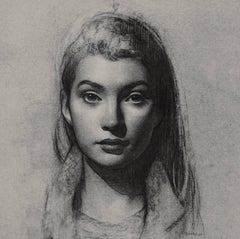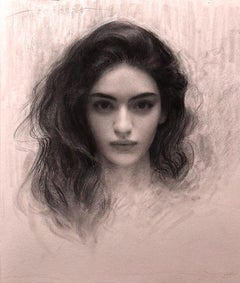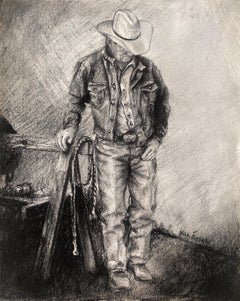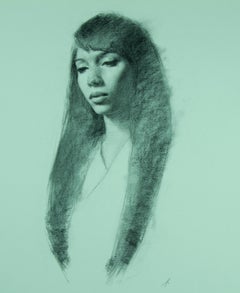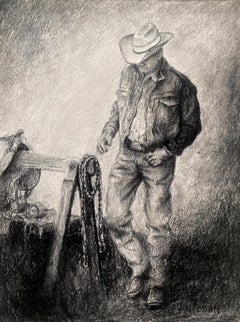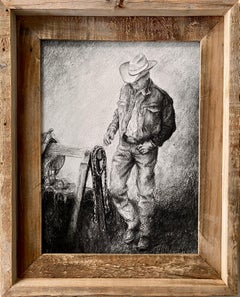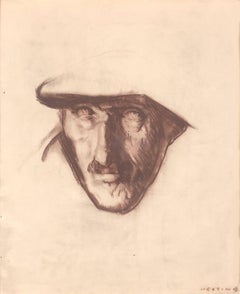
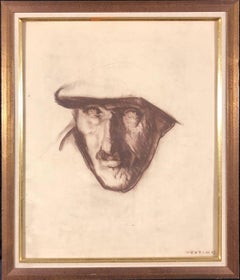
Sean KeatingSelf-Portrait, c. 1950
Price Upon Request
Self-Portrait
By Sean Keating
Located in Missouri, MO
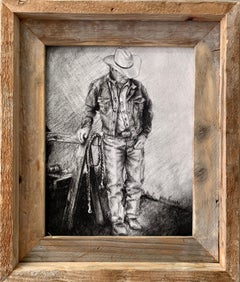
Sean Keating (Irish 1889-1977) "Self Portrait" c. 1950s Charcoal on Paper Signed Lower Right Framed Size: approx 20 x 16 inches A noted portrait and figure painter, influenced by both Romanticism and Realism, Sean Keating was an Irish nationalist painter who executed several iconic images of the Irish Civil war era, and of the ensuing period of industrialization. One of the great exemplars of representational painting in Ireland, Keating was an intellectual artist in that he set out to depict the birth and development of the Republic of Ireland, and his pictures are deliberately idealized even heroic. However, he held very conservative views about art - verging on the academic style - and was a committed defender of traditional Irish painting, considering much modern art to be bogus. Born in Limerick, Sean Keating studied drawing at the Limerick Technical School before winning a scholarship, arranged for him by William Orpen, to study fine art painting at the Metropolitan School of Art in Dublin. In 1914 he won the Taylor Scholarship and the following year exhibited three paintings at the Royal Hibernian Academy. Over the next period of years he spent time on the Aran Islands off County Galway, and then in London. He returned to Ireland in 1916 and painted the war of independence and the subsequent civil war. Works he completed at this time include the painting: Men of the South (1921) depicting a group of IRA men about to stage a military ambush, and An Allegory (c. 1922) which features a cluster of figures representing the fractures in the young Irish state. Meantime, in 1919, Keating was appointed an assistant teacher at the Dublin Metropolitan School of Art. Then in 1921, he staged his first one-man show at The Hall, Leinster Street. In 1923, he was elected to the Royal Hibernian Academy. In a Dublin exhibition of Irish art held in 1924, Keating was awarded the gold medal for his picture Homage to Hugh Lane - now hanging in the Hugh Lane Gallery. In the late 1920s, Keating was commissioned to record the building of the hydro-electric power generator at Ardnacrusha, near Limerick. He painted a number of paintings of this scheme. Not unlike the Soviet Realism School of painting, these paintings sought to promote the construction work as an achievement of heroic proportions. Keating's works began to attract interest abroad. He exhibited at the Royal Academy in London and, in 1930, he held a one-man show at the Hackett Gallery, New York. In 1931 Keating's one-person exhibition was staged at the Victor Waddington Galleries, Dublin. In 1934 he was made professor of the National College of Art in Dublin, and Professor of Painting, three years later. His 1937 exhibition at the Victor Waddington Galleries attracted considerable interest. In 1939, he was asked to paint a wall-painting for the Irish pavilion at the New York World Fair and duly created a huge mural of fifty-four panels. He was President of the Royal Hibernian Academy from 1949 to 1962, exhibiting nearly 300 works during the period. In 1963, a retrospective exhibition was staged at the Municipal Gallery of Modern Art, which was opened by Irish President de Valera...
1950s Realist Sean Keating Art
Charcoal, Archival Paper