Earthenware Ceramics

846 Results
to
76
702
142
3
101
284
317
145
87
152
39
31
5
24
22
10
33
27
18
11
4
75
71
44
33
29
21
19
13
13
11
9
8
3
2
1
9,164
1,204
879
543
473
354
727
208
100
85
73
847
793
834
28
24
24
21
19
Material: Earthenware
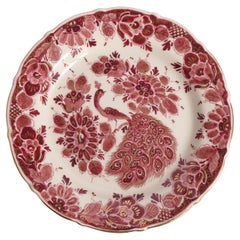
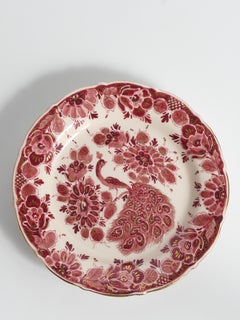
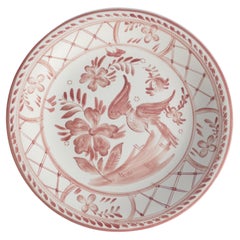
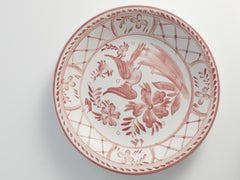
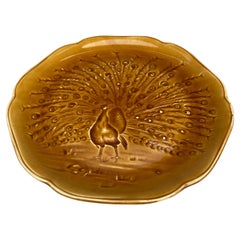
Regina Gouda Delft Hand-Painted Plate Red Peacock & Floral Motif Holland, 1950s

Regina Gouda Delft Hand-Painted Plate Red Peacock & Floral Motif Holland, 1950s

By Regina Company, Delft

Located in Grythyttan, SE

Regina Gouda Delft Hand-Painted Plate – Peacock & Floral Motif with Gold Trim, Made in Holland, A beautifully hand-painted Dutch Delft plate by Regina, Gouda, Holland, featuring an ...

Category

1950s Dutch Folk Art Vintage Earthenware Ceramics

Materials

Earthenware

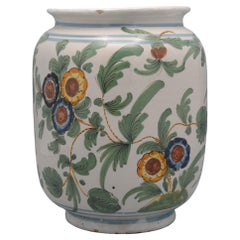
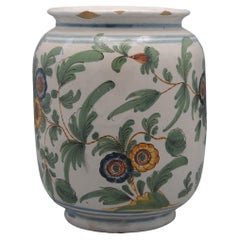
Pesaro - Large albarello - 'al tacchiolo' decor, 18th century

Pesaro - Large albarello - 'al tacchiolo' decor, 18th century

Located in DELFT, NL

Very large albarello with polychrome decoration called “al tacchiolo” of foliage with stylized flowers. Marked under the base: “N°20 Pesaro, 18th century. Fabbrica Casali Callegari ...

Category

Late 18th Century Antique Earthenware Ceramics

Materials

Maiolica

Vallauris Majolica Ceramic Large Wall Plate Trompe L'oeil Seafood Motif

Vallauris Majolica Ceramic Large Wall Plate Trompe L'oeil Seafood Motif

By Vallauris

Located in Barcelona, ES

Eye-catching Majolica glazed ceramic trompe l'oeil plate attributed to Vallauris. France, 1960s. This large plate has a black background and a colorful trompe l'oeil decoration comp...

Category

Mid-20th Century French Mid-Century Modern Earthenware Ceramics

Materials

Majolica, Pottery, Ceramic

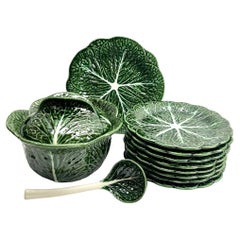
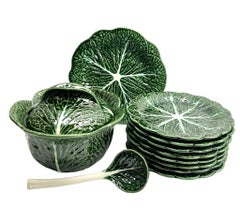
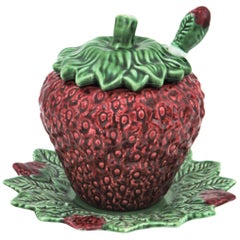
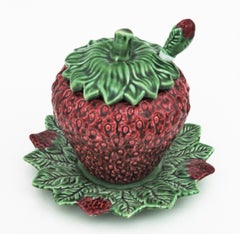
Strawberry Shaped Majolica Ceramic Tureen by Bordalo Pinheiro

Strawberry Shaped Majolica Ceramic Tureen by Bordalo Pinheiro

By Rafael Bordalo Pinheiro

Located in Barcelona, ES

Eye-catching Majolica ceramic white and green strawberry shaped tureen. Manufactured by Bordalo Pinheiro, Portugal, 1960s. This cute tureen has a very realistic design with leaves on the top. A leaf shaped serving plate and a small serving spoon complete the set. This highly decorative serving piece will be a nice addition to any kitchen or dining table. It will be a cool choice used as sauce tureen. Excellent condition. On sale as a set of three pieces, strawberry tureen...

Category

Mid-20th Century Portuguese Mid-Century Modern Earthenware Ceramics

Materials

Majolica, Pottery, Ceramic

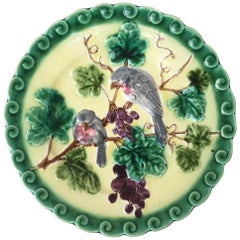
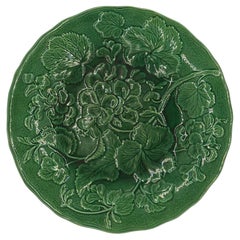
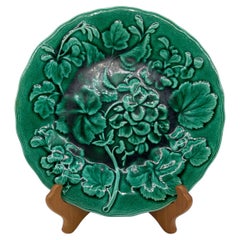
Majolica Green-Glazed Geranium Plate by Hope & Carter, English, ca. 1880

Majolica Green-Glazed Geranium Plate by Hope & Carter, English, ca. 1880

Located in Banner Elk, NC

English majolica green-glazed 9-inch plate, with relief molded geranium plants and blossoms and shaped rim, the reverse with impressed mark 'HOPE & CARTER, ENGLAND,' ca. 1880. For t...

Category

19th Century English Victorian Antique Earthenware Ceramics

Materials

Majolica

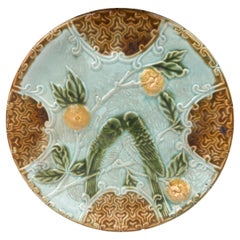
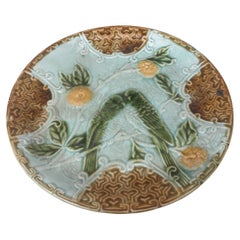
Majolica Parakeets Plate Salins, circa 1890

Majolica Parakeets Plate Salins, circa 1890

By Salins

Located in Austin, TX

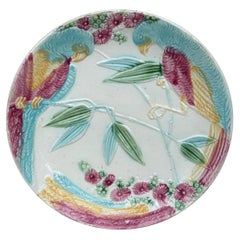
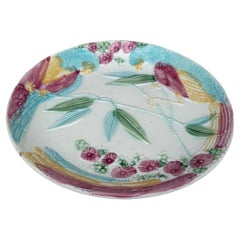
Majolica plate two parakeets on a blue background with oranges signed Salins, circa 1890.    

Category

1890s French Art Nouveau Antique Earthenware Ceramics

Materials

Ceramic, Majolica

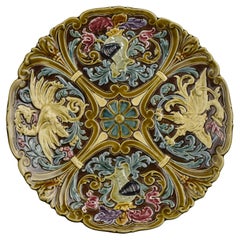
Italian Renaissance Plate, Patanazzi Workshop, Urbino, Circa 1580

Italian Renaissance Plate, Patanazzi Workshop, Urbino, Circa 1580

By Patanazzi Workshop

Located in Milano, IT

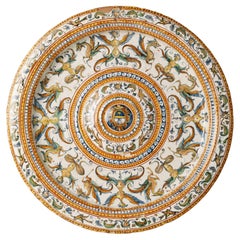
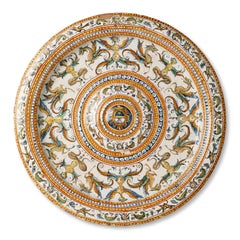
Acquareccia plate Patanazzi workshop Urbino, last quarter of the 16th century It measures diameter 17.12 in; foot diameter 11.53 in; height 1.88 in (43.5 cm; 29.3 cm; 4.8 cm). Weight State of conservation: wear and a few small minimal detachments of enamel, chipping on the raised areas, peeling of enamel at the brim on the back. This large, shallow basin is equipped with a wide and convex well. It is umbonate with a contoured center. The brim, short and flat, is enclosed in a double rounded and barely raised edge. The basin has a flat base without rims; it has a slightly concave center in correspondence to the well. The shape takes inspiration from the basins associated with the metal forged amphora pourers that traditionally adorned the credenza. These were used from the Middle Ages to wash hands during banquets. Two or three people washed their hands in the same basin and it was considered an honor to wash one’s hands with an illustrious person. The decoration is arranged in concentric bands with, in the center of the umbo, an unidentified shield on a blue background: an oval banded in gold with a blue head, a gold star and a field with a burning pitcher. Rings of faux pods separate the center from a series of grotesque motifs of small birds and masks. These go around the basin and are, in fact, faithfully repeated on the brim. The main decoration develops inside the flounce of the basin, which sees alternating symmetrical figures of winged harpies and chimeras. The ornamentation, outlined in orange, green and blue, stands out against the white enamel background. This decorative style, defined since the Renaissance as “grottesche” or “raffaellesche”, refers to the decorations introduced after the discovery of the paintings of the Domus Aurea towards the end of the fifteenth century. The discovery of Nero's palace, buried inside Colle Oppio by damnatio memoriae, occurred by chance when a young Roman, in 1480, fell into a large crack which had opened in the ground on the hill, thus finding himself in a cave with walls covered with painted figures. The great artists present in the papal city, including Pinturicchio, Ghirlandaio, Raffaello, immediately visited these caves. The decorations found there soon became a decorative subject of immense success: the term grotesque , with the meaning of “unusual,” “caricatured,” or “monstrous,” was later commented by Vasari in 1550 as “una spezie di pittura licenziose e ridicole molto”( “a very licentious and ridiculous kind of painting”). The decorations “a grottesche” also widely circulated in ceramic factories, through the use of engravings, variously interpreted according to the creativity of the artists or the requests of the client. Our basin is reflected in similar artifacts produced at the end of the sixteenth century by the factories of the Urbino district. See the series of basins preserved in the main French museums, among which the closest in morphology is that of the Campana collection of the Louvre (Inv. OA1496); this however has a more complex figure decoration, while the decoration of our specimen is sober and with a watercolor style. The style, sure in its execution, approaches decorative results still close to the works produced around the middle of the sixteenth century by the Fontana workshop. The decoration is closely linked to their taste, which later finds its natural outlet, through the work of Antonio, also in the Patanazzi workshop. Studies show the contiguity between the two workshops due to the kinship and collaboration between the masters Orazio Fontana and Antonio Patanazzi, both trained in the workshop of Guido Fontana il Durantino. It is therefore almost natural that their works, often created according to similar typologies and under the aegis of the same commissions, are not always easily distinguishable, so much so that the presence of historiated or “grottesche” works by Orazio is documented and preserved in Antonio Patanazzi's workshop. Given that the studies have always emphasized the collaboration between several hands in the context of the shops, it is known that the most ancient “grottesche” works thus far known, can be dated from 1560, when the Fontana shop created the so-called Servizio Spagnolo (Spanish Service) and how, from that moment on, this ornamentation became one of the most requested by high-ranking clients. We remember the works created for the Granduchi di Toscana, when Flaminio Fontana along with his uncle Orazio supplied ceramics to Florence, and, later, other commissions of considerable importance: those for the service of the Duchi d’Este or for the Messina Farmacia of Roccavaldina, associated with the Patanazzi workshop when, now after 1580, Antonio Patanazzi began to sign his own work. Thus, in our basin, the presence of masks hanging from garlands, a theme of more ancient memory, is associated in the work with more advanced stylistic motifs, such as the hatching of the chimeras and harpies. These are found here on the front with the wings painted in two ornate ways. In addition, the theme of the birds on the edge completes the decoration along the thin brim and can be seen as representing an early style typical of the Urbino district during a period of activity and collaboration between the two workshops. Later, a more “doll-like” decorative choice, typical of the end of the century and the beginning of the seventeenth century, characterized the period of the Patanazzi workshop under the direction of Francesco. Bibliography: Philippe Morel, Il funzionamento simbolico e la critica delle grottesche nella seconda metà del Cinquecento, in: Marcello Fagiolo, (a cura di), Roma e...

Category

16th Century Italian Renaissance Antique Earthenware Ceramics
Materials

Maiolica

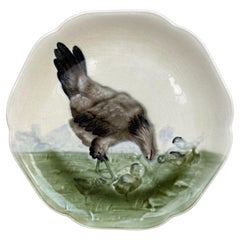
19th Century Majolica Hen & Chicks Plate Choisy Le Roi

19th Century Majolica Hen & Chicks Plate Choisy Le Roi

By Choisy-le-Roi

Located in Austin, TX

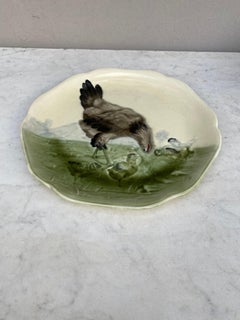
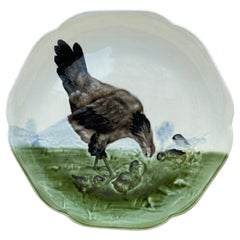
Majolica plate with hen & chicks signed Hippolyte Boulenger Choisy le Roi, circa 1890. The manufacture of Choisy le Roi was one of the most important manufacture at the end of 19th c...

Category

1890s French Country Antique Earthenware Ceramics

Materials

Majolica, Ceramic

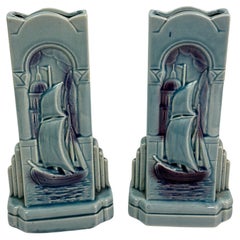
Sarreguemines French Majolica Pair of Vases with Ships, Vintage France

Sarreguemines French Majolica Pair of Vases with Ships, Vintage France

By Sarreguemines

Located in Nuernberg, DE

Beautiful pair of vases made by Sarreguemines France. Underglaze mark. Nice addition to your table or just to display. Please see detailed pictures for vintage as found condition. Ma...

Category

1930s French Folk Art Vintage Earthenware Ceramics

Materials

Ceramic, Majolica

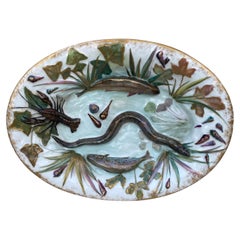
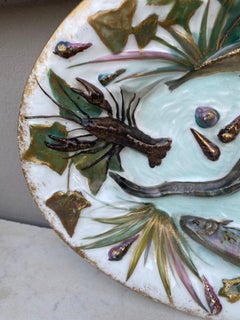
19th Century Majolica Porcelain Palissy Fish Wall Platter

19th Century Majolica Porcelain Palissy Fish Wall Platter

Located in Austin, TX

Rare 19th century porcelain Palissy platter with fishs, eel, shells , crawfish and ivy leaves.

Category

1880s French Victorian Antique Earthenware Ceramics

Materials

Ceramic, Majolica, Porcelain

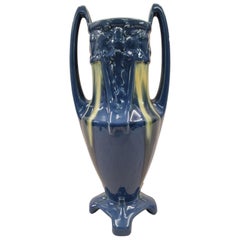
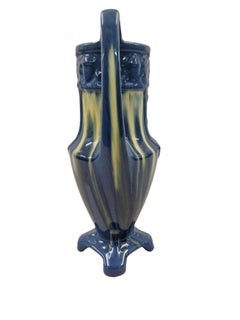
Flower Vase, Early Art Deco, Blue Yellow Run Glaze, Ceramic, ~ 1915, France

Flower Vase, Early Art Deco, Blue Yellow Run Glaze, Ceramic, ~ 1915, France

Located in Wien, AT

Very decorative vase from the early art deco period, made in France. This object has a shape that looks like the ancient Greek amphorae, but has a four-pass stand to ensure stabili...

Category

1910s French Art Deco Vintage Earthenware Ceramics

Materials

Ceramic, Majolica

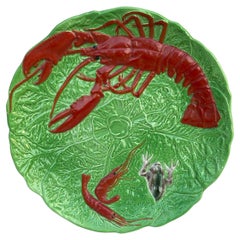
French Majolica Lobster Platter Choisy Le Roi Circa 1930

French Majolica Lobster Platter Choisy Le Roi Circa 1930

By Choisy-le-Roi

Located in Austin, TX

French Majolica Lobster ,Shrimp and frog Platter HB Choisy Le Roi Circa 1930. The manufacture of Choisy le Roi was one of the most important manufacture a...

Category

1930s French Country Vintage Earthenware Ceramics

Materials

Ceramic, Majolica

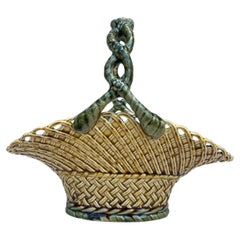
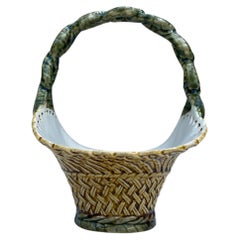
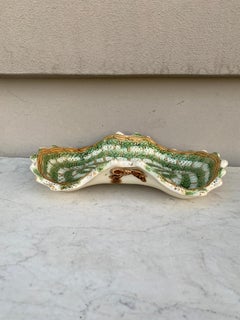
19th Century Majolica Basket Choisy Le Roi

19th Century Majolica Basket Choisy Le Roi

By Choisy-le-Roi

Located in Austin, TX

19th Century French Majolica basket signed Choisy le Roi. H / 9 inches , 10" on 6.5 inches.

Category

1880s French Victorian Antique Earthenware Ceramics

Materials

Ceramic, Faience, Majolica

Ancient Maiolica Tiles, Ambrogette, Rampini Manufactory, Pavia, 1693-1704

Ancient Maiolica Tiles, Ambrogette, Rampini Manufactory, Pavia, 1693-1704

By Siro Antonio Africa

Located in Milano, IT

Six maiolica “ambrogette” (tiles) Rampini manufactory, painter probably Siro Antonio Africa Pavia, 1693-1704 a) 6.88 x 5.51 in (17.5 x 14 cm); 0.55 lb (252 g) b) 7.08 x 5.70 in (18 x 14.5 cm); 0.51 lb (233 g) c) 6.88 x 5.70 in (17.5 x 14.5 cm); 0.54 lb (245 g) d) 6.81 x 5.51 in (17.3 x 14 cm); 0.50 lb (230 g) e) 6.88 x 5.51 in (17.5 x 14 cm); 0.50 lb (229 g) f) 7.08 x 5.70 in (18 x 14.5 cm); 0.51 lb (233 g) State of conservation: intact. These six ”maiolica fina” small “ambrogette” belong to a family of ceramic works considered among the finest produced between the 17th and 18th centuries. For a long time, this type of maiolica was attributed to the Venetian village of Angarano, but later it was definitively attributed to the pottery factories in Pavia. A fundamental study ascribed this production specifically to Pavia through an analysis of Lombard collections and a comparison with archaeological remains found near the two main manufacturing sites in the city. (E. Pelizzoni - M. Forni - S. Nepoti, La maiolica di Pavia tra Seicento e Settecento, Milano 1997). The six small oval tiles have rounded edges and are decorated with a historiated motif. They were created using high-fired polychrome technique, with a predominance of cool tones and a dominance of gray and blue, interspersed with manganese, citrine yellow, orange-yellow, and green. The six small “ambrogette” are characterized by the same stylistic features, with a similar decorative design. The first tile (a) depicts a female figure, holding a stiletto and sitting near a pedestal supporting a relief-decorated baluster vase. Behind her, a child is holding a chalice, while through the arches of a portico, a glimpse of a mountainous landscape can be seen in the background. The female figure could possibly be Lucretia, an example of virtue in ancient Roman culture. In the second “ambrogetta” b), the Biblical episode of Judith and Holofernes is depicted through canonical iconography: the decapitated body of Holofernes lies on the bed in the background, while the protagonist, Judith, is seen placing his head into a sack held by a maidservant. Through an archway a shining slice of the moon gives the perception of nighttime. Surprisingly, within the narrative, there is the presence of a basin in the shape of a large shell, closely resembling the products of Pavia's factories. The third small plaque (c) depicts a female figure standing on a plinth and framed by an architectural arch with a vast mountainous landscape in the background. The woman, with her breasts exposed, is accompanied by two children: one approaching her as if wanting to be picked up, and the other seated with an apple in his hand. The protagonist lends herself to different interpretations: perhaps she represents Rea Silvia with the two twin founders of Rome, or perhaps she is an allegory for the Pietà, a common theme depicted on maiolica. In the fourth tile (d), three characters are depicted near a column. The main figure is an old man with a sad expression, holding a cup, while a woman, wearing a turban on her head, also holds a cup in her right hand and a pitcher in her left. A second woman with her hair bound holds another pitcher behind the old man: at his feet a traveller's bag can be seen, along with some apples and a slice of cheese on a rectangular base. It is likely the sad Biblical episode of Lot and his daughters...

Category

Early 1700s Italian Baroque Antique Earthenware Ceramics

Materials

Maiolica

Early 20th Century Pink S. Hublet Art Pottery Tea Pot

Early 20th Century Pink S. Hublet Art Pottery Tea Pot

Located in Houston, TX

This is a beautiful stoneware vase by S. Hublet, made in Belgium. It has a granite like beige, pink and black surface accented by freeform chevrons on the top and the bottom. The center of this magnificent oversized art pottery tea pot...

Category

Early 1900s Belgian Antique Earthenware Ceramics

Materials

Ceramic, Clay, Earthenware

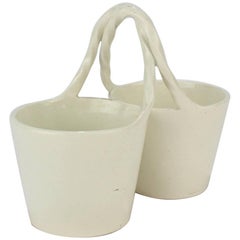
18th Century Polychrome Delft Oil and Vinegar Stand

18th Century Polychrome Delft Oil and Vinegar Stand

Located in Haddonfield, NJ

18th Century polychrome Delft oil and vinegar stand in Imari flower decorations.

Category

Mid-18th Century Dutch Baroque Antique Earthenware Ceramics

Materials

Delft

Talavera Decorative Lavabo Sink Folk Art Mexican Ceramic Spanish Colonial

Talavera Decorative Lavabo Sink Folk Art Mexican Ceramic Spanish Colonial

By Cesar

Located in Queretaro, Queretaro

Elegant surrealist sink lavabo made with the Talavera technique. Artist, Cesar Torres portraits the colonial art of Mexico. The Spanish colonial style sink is a perfect piece to bring personality and light to bathrooms and restrooms. Its warm colors bring light to the piece, creating a cozy effect in the atmosphere where it is placed. The Talavera is not just a simple painted ceramic: its exquisite decoration is the product of a delicate process of alchemy that translates into fine enamels. In Puebla, Mexico few people still produce using Talavera with the ancestral techniques.One of those few is Cesar Torres, Don Cesar...

Category

21st Century and Contemporary Mexican Spanish Colonial Earthenware Ceramics

Materials

Ceramic, Clay, Majolica

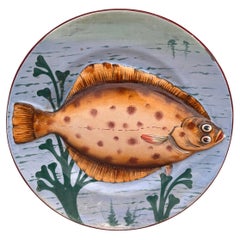
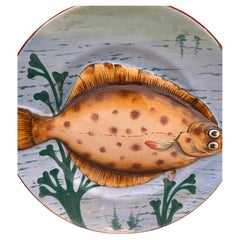
19th Century Majolica Palissy Porcelain Flounder Fish Wall Platter

19th Century Majolica Palissy Porcelain Flounder Fish Wall Platter

Located in Austin, TX

Rare 19th Century Majolica Porcelain Palissy Flounder Fish Wall Platter. 8.2 inches diameter.

Category

1880s French Victorian Antique Earthenware Ceramics

Materials

Ceramic, Majolica, Porcelain

Wall Art Composition of Mid-Century Modern Ceramic Fish Shaped Plates

Wall Art Composition of Mid-Century Modern Ceramic Fish Shaped Plates

Set of midcentury multi color ceramic fish Plates and Platters as Wall Decoration A cool collection of eleven european glazed ceramic, porcela...

Category

20th Century European Mid-Century Modern Earthenware Ceramics

Materials

Ceramic, Majolica, Porcelain, Terracotta

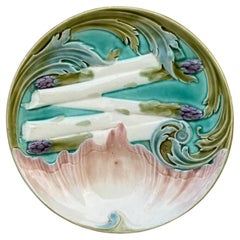
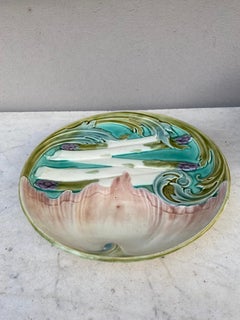
Majolica Asparagus Plate Keller Et Guerin Luneville, circa 1880

Majolica Asparagus Plate Keller Et Guerin Luneville, circa 1880

By Luneville

Located in Austin, TX

Large Majolica asparagus plate signed Keller et Guerin Luneville, circa 1880. This plate exist in different colors and sizes.

Category

1880s French Rustic Antique Earthenware Ceramics

Materials

Ceramic, Faience

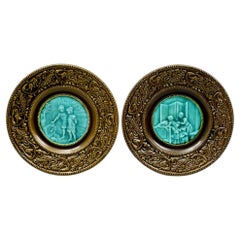
Two Beautiful 19th Century Majolica Plates by Villeroy & Boch, Germany

Two Beautiful 19th Century Majolica Plates by Villeroy & Boch, Germany

By Villeroy & Boch

Located in Nuernberg, DE

19th century majolica plates by Villeroy & Boch in unusual color combination of olive green and turquoise with relief design on front. Nice addition to your table or just to display....

Category

19th Century German Victorian Antique Earthenware Ceramics

Materials

Ceramic, Majolica

Italian Majolica Trompe l’Oeil Garden Stools

Italian Majolica Trompe l’Oeil Garden Stools

Located in Savannah, GA

A pair of Italian majolica trompe l’oeil garden stools, mid-20th century. 13 inches wide by 13 inches deep by 15 ½ inches tall

Category

Mid-20th Century Italian Earthenware Ceramics

Materials

Majolica

A George Jones Majolica Rooster Teapot, English, ca. 1872

A George Jones Majolica Rooster Teapot, English, ca. 1872

By George Jones

Located in Banner Elk, NC

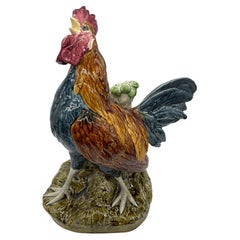
A George Jones Majolica Rooster (Cockerel) teapot, English, ca. 1872, naturalistically modeled as a running cockerel, the tail feathers forming the handle, the open beak forming the ...

Category

1870s English Victorian Antique Earthenware Ceramics

Materials

Majolica

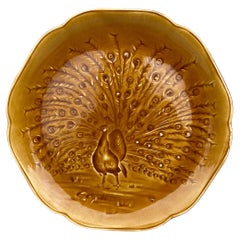
19th Century Yellow Majolica Peacock Plate Choisy Le Roi

19th Century Yellow Majolica Peacock Plate Choisy Le Roi

By Choisy-le-Roi

Located in Austin, TX

Goldenrold mustard Majolica plate with a peacock signed Hippolyte Boulenger Choisy le Roi, circa 1890. The manufacture of Choisy le Roi was one of the most important manufacture at t...

Category

1890s French Country Antique Earthenware Ceramics

Materials

Majolica, Ceramic

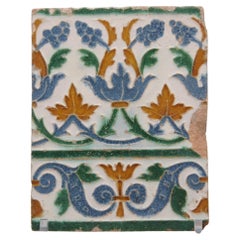
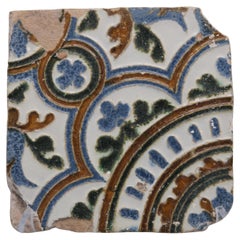
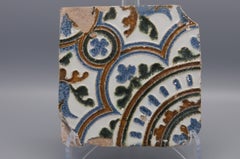
Spanish Azulejo Tile Arista y Cuenca - Toledo 16th century

Spanish Azulejo Tile Arista y Cuenca - Toledo 16th century

By Estadio of Spain

Located in DELFT, NL

Early Arista y cuenca tile made in Toledo. Tile decorated in renaissance with stylized flowers was probably made between 1550 and 1575.

Category

16th Century Spanish Renaissance Antique Earthenware Ceramics
Materials

Earthenware

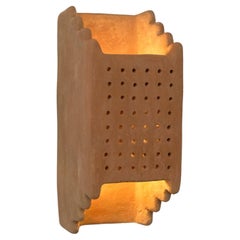
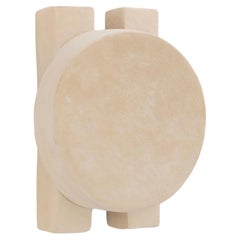
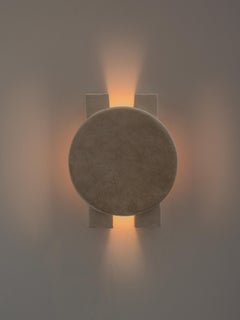
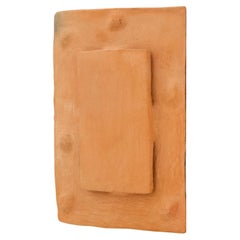
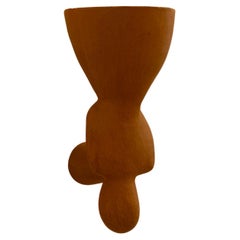
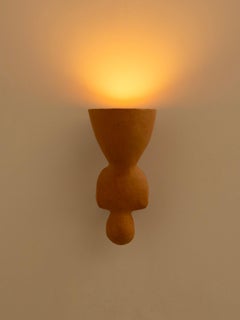
Contemporary Organic Modern Moroccan Handmade Terracotta Ceramic Wall Lamp

Contemporary Organic Modern Moroccan Handmade Terracotta Ceramic Wall Lamp

Located in Marseille, FR

- Handbuilt terracotta ceramic wall light - made of clay collected from the potter's surroundings. - made in the Moroccan Rif mountains by the potter Houda. - co-created by the potte...

Category

2010s Moroccan Organic Modern Earthenware Ceramics

Materials

Clay, Earthenware

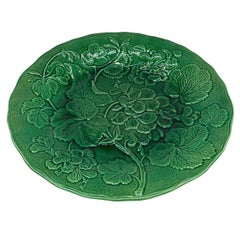
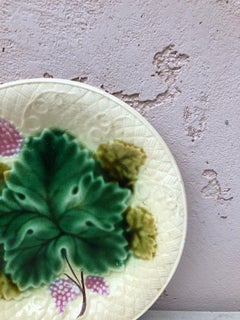
Majolica Green-Glazed Geranium Plate, Hope & Carter, English, ca. 1870s

Majolica Green-Glazed Geranium Plate, Hope & Carter, English, ca. 1870s

Located in Banner Elk, NC

English majolica green-glazed 9.13-inch plate, with relief molded geranium plants and blossoms and a shaped rim by the English firm Hope & Carter, Burslem, Stoke-on-Trent, ca. 1870s....

Category

Late 19th Century English Victorian Antique Earthenware Ceramics

Materials

Majolica

Small Majolica Pate White Rabbit Tureen

Small Majolica Pate White Rabbit Tureen

By Michel Caugant

Located in Austin, TX

Small Majolica white rabbit pate tureen or box circa 1950 signed Caugant.

Category

1950s French Country Vintage Earthenware Ceramics

Materials

Ceramic, Faience

Palissy Ware Majolica Ewer, Portuguese, Manuel Mafra, Caldas da Rainha

Palissy Ware Majolica Ewer, Portuguese, Manuel Mafra, Caldas da Rainha

By Manuel Mafra 1

Located in Banner Elk, NC

Palissy Ware Majolica Ewer, Portuguese, circa 1880 by Manuel Mafra, Caldas da Rainha. For over 28 years we have been among the Nation’s preeminent specialists in Fine antique Majolica. Book Reference: Marshall P. Katz, Portuguese Palissy Ware...

Category

1880s Portuguese Victorian Antique Earthenware Ceramics

Materials

Majolica

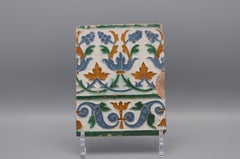
Spanish Azulejo Tile Arista y Cuenca - Toledo 16th century

Spanish Azulejo Tile Arista y Cuenca - Toledo 16th century

By Estadio of Spain

Located in DELFT, NL

Early Arista y cuenca tile made in Toledo. Tile decorated in renaissance with stylized flowers was probably made between 1550 and 1575.

Category

16th Century Spanish Renaissance Antique Earthenware Ceramics
Materials

Earthenware

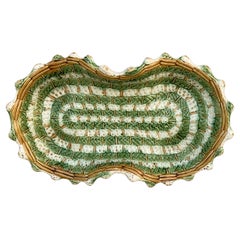
French Hand-Painted Majolica Vegetable Platter, 20th Century Design

French Hand-Painted Majolica Vegetable Platter, 20th Century Design

Located in LA CIOTAT, FR

An attractive and unusual vintage serving platter, embellished with a central divider of beautifully crafted and hand-painted garden vegetables. A raised, embossed and painted green ...

Category

20th Century French Earthenware Ceramics

Materials

Ceramic, Majolica

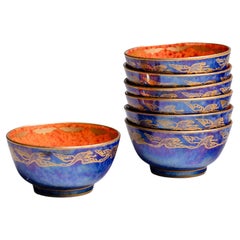
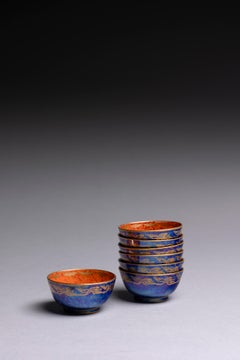
Set of 7 Miniature Wedgwood Lustre Bowls by Daisy Makeig-Jones

Set of 7 Miniature Wedgwood Lustre Bowls by Daisy Makeig-Jones

By Wedgwood, Daisy Makeig-Jones, Wedgwood Fairyland Lustre

Located in Fort Lauderdale, FL

A set of 7 miniature blue and orange lustre bowl designed by Daisy Makeig-Jones for Wedgwood ca. 1920 and decorated with the 'Hummingbirds' pattern. Daisy Makeig-Jones’s lustreware ...

Category

1920s English Art Nouveau Vintage Earthenware Ceramics

Materials

Ceramic, Luster, Porcelain

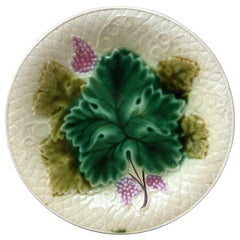
German Majolica Plate with Morning Glory, circa 1900

German Majolica Plate with Morning Glory, circa 1900

Located in Nuernberg, DE

Early 20th century German majolica plate with morning glory on a blue basket weave and a brown border, circa 1900. Small cracks in the glazing, glazing craquelure, chip at the backsi...

Category

Early 1900s German Art Nouveau Antique Earthenware Ceramics

Materials

Ceramic, Majolica

Danish Modern Group of Glazed Ceramics Bowls by Jeppe Hagedorn-Olsen, 1960s

Danish Modern Group of Glazed Ceramics Bowls by Jeppe Hagedorn-Olsen, 1960s

By Jeppe Hagedorn-Olsen

Located in Odense, DK

Wonderful set of 4 unique pictured earthenware bowls made by Danish artist Jeppe Hagedorn-Olsen in his own studio in the 1960s. These rare pieces have a rectangular shape and are dat...

Category

1960s Danish Scandinavian Modern Vintage Earthenware Ceramics

Materials

Earthenware

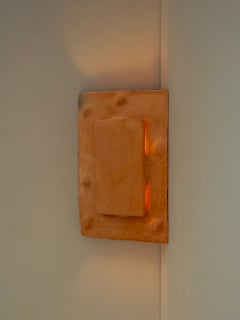
Contemporary Organic Modern Moroccan Handmade Terracotta Ceramic Corner Lamp

Contemporary Organic Modern Moroccan Handmade Terracotta Ceramic Corner Lamp

Located in Marseille, FR

- Handbuilt terracotta ceramic corner wall light - made of clay collected from the potter's surroundings. - made in the Moroccan Rif mountains by the potter Houda. - co-created by th...

Category

2010s Moroccan Organic Modern Earthenware Ceramics

Materials

Clay, Earthenware

18th Century Organic Terracotta Vessel from Calanda, Spain, 1760-80

18th Century Organic Terracotta Vessel from Calanda, Spain, 1760-80

Located in London, England

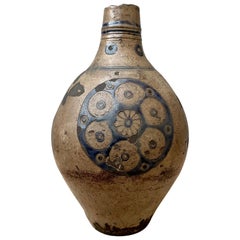
Beautifully organic shaped terracotta vessel from the historic town of Calanda in the Aargon region. Original dry weathered surface, with some remnants of the original reddish brow...

Category

18th Century Spanish Antique Earthenware Ceramics

Materials

Earthenware, Terracotta

Minton Majolica Centerpiece Tray 15-in, Lotus Flower on Green Ground, Dated 1863

Minton Majolica Centerpiece Tray 15-in, Lotus Flower on Green Ground, Dated 1863

By Minton

Located in Banner Elk, NC

Minton Majolica centerpiece, naturalistically modeled as a pond bed with simulated water glazed in cyan blue, with green glazed lily pads and flowering pond lilies (lotus), and reeds glazed in various shades of green, with brown and ochre-glazed cattails molded in high relief to form the border, with a central lotus flower glazed in white and blue, concealing a solid brass original fitting for a candle, doubling as a receptacle for an (optional) additional tier which would have screwed into the fitting; the fitting is removable. Impressed marks to reverse: 'MINTON' and Minton date cypher for 1863; an impressed 'A' possibly for the designer, Thomas Allen...

Category

Mid-19th Century English Victorian Antique Earthenware Ceramics

Materials

Majolica

Spanish Azulejo Tile Arista y Cuenca - Toledo 16th century

Spanish Azulejo Tile Arista y Cuenca - Toledo 16th century

By Estadio of Spain

Located in DELFT, NL

Early Arista y cuenca tile made in Toledo. Tile decorated in renaissance with stylized flowers was probably made between 1550 and 1575.

Category

16th Century Spanish Renaissance Antique Earthenware Ceramics
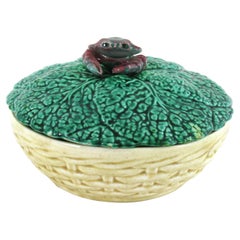
Materials

Earthenware

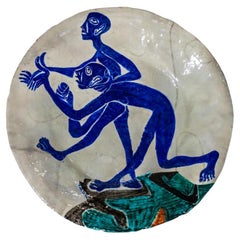
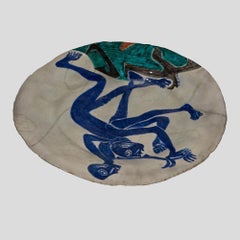
1953 hand painted signed Art Glazed Ceramic Plate by Salvatore Meli Rome Italy

1953 hand painted signed Art Glazed Ceramic Plate by Salvatore Meli Rome Italy

By Salvatore Meli

Located in London, GB

This is 1953 Art glazed Ceramic Charger Painted with two stylised blue figures suggesting dance movement on an off white background with earth brown and grass green soil with a touch...

Category

1950s Italian Mid-Century Modern Vintage Earthenware Ceramics

Materials

Ceramic, Earthenware

Georgian Spode Plate, Bow Pot Pattern, Pearl-Ware, Gilded, Circa 1820

Georgian Spode Plate, Bow Pot Pattern, Pearl-Ware, Gilded, Circa 1820

By Josiah Spode

Located in Lincoln, Lincolnshire

This is a beautiful plate in the Bow Pot pattern, produced by the Spode factory and made of a type of earthenware pottery called Pearl-ware, in the early 19th century, circa 1820. ...

Category

Early 19th Century English Chinoiserie Antique Earthenware Ceramics
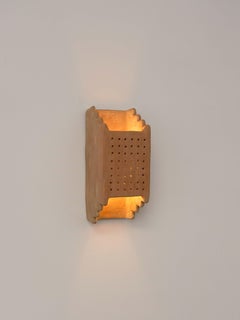
Materials

Pearlware

FOUR 17th Century Delft Blue and White Wall Tiles on Frame Set 1, Netherlands

FOUR 17th Century Delft Blue and White Wall Tiles on Frame Set 1, Netherlands

Located in Lincoln, Lincolnshire

These are Four Delft ceramic wall tiles mounted on a modern wood frame, all with a blue and white hand painted flower pattern, made in the Netherlands during the 17th century, circa ...

Category

Late 17th Century Dutch Dutch Colonial Antique Earthenware Ceramics
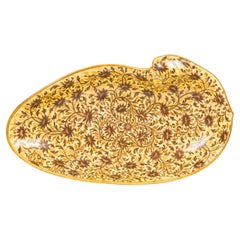
Materials

Wood, Earthenware

Majolica Oranges Plate by Keller & Guerin Saint Clement, France 1900s

Majolica Oranges Plate by Keller & Guerin Saint Clement, France 1900s

By Saint-Clément

Located in Valencia, VC

Majolica plate by Keller et Guerin Saint-Clément featuring the oranges decor. Hand produced in France circa the 1900s. In beautiful condition. Very pretty. We specialized in 20th...

Category

Early 1900s French French Provincial Antique Earthenware Ceramics
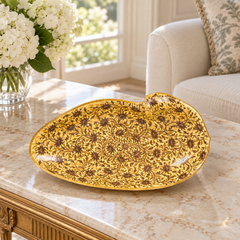
Materials

Ceramic, Earthenware, Majolica, Porcelain

Early 20th Century French Hand-Painted Faience Terrine from Rouen

Early 20th Century French Hand-Painted Faience Terrine from Rouen

By Rouen

Located in Verviers, BE

The designs on this French faience group is typical of pottery made in Rouen. Early 20th century French hand-painted Faience Terrine from Rouen. Marking on the bottom: "Rouen Fait...

Category

Early 20th Century French Earthenware Ceramics

Materials

Faience

German Majolica Asparagus Platter circa 1900

German Majolica Asparagus Platter circa 1900

Located in Austin, TX

German Majolica Asparagus Platter circa 1890. Craddle 8" by 4.5" , platter 12.3" by 9.7"

Category

Early 1900s German Country Antique Earthenware Ceramics
Materials

Ceramic, Faience

Arts & Crafts Minton Pottery Tile Designed by Christopher Dresser

Arts & Crafts Minton Pottery Tile Designed by Christopher Dresser

By Minton, Christopher Dresser

Located in Fort Lauderdale, FL

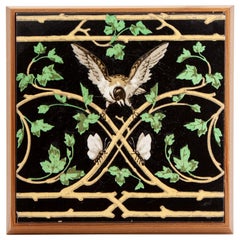
A Minton pottery tile designed by Christopher Dresser in 1873. This tile, designed by Christopher Dresser and made in 1873, exemplifies the Aesthetic Movement ethos of the home as...

Category

Late 19th Century British Aesthetic Movement Antique Earthenware Ceramics
Materials
Earthenware