In a darkened Paris nightclub, a young couple dances as if no one else exists. She twists away, skirt flaring, dark hair drifting behind her right shoulder; he follows the jazzy beat, every joint of his skeleton loose with movement as he gazes affectionately at his partner.
Around them, people turn to watch the dancers as well as the unseen photographer, Robert Doisneau. The picture, titled Be-bop en cave Vieux Colombier, from 1951, is at once spontaneous and intimate — a fleeting encounter preserved without losing its energy.
“It has a very prominent place in my house,” says actress Patricia Clarkson, whose former boyfriend gifted the print to her in the 1990s. “I look at it pretty much every day, and it thrills me every single time.”
Clarkson reflects on the image in the newest episode of the Objects of Desire podcast, noting what she describes as its romance and physical immediacy — the way the dancers’ bodies seem caught mid-gesture rather than arranged for the camera.

A genuine sense of presence suffuses Doisneau’s work. Rather than staging over-the-top compositions, he returned again and again to ordinary Parisians in motion — children playing, couples kissing, passersby passing by — finding what he later described as moments meant to be shared rather than possessed.
“Whether he was photographing Picasso or a worker, it was the same level of humanity for him,” says Isabelle Benoit, curator of the traveling retrospective “Robert Doisneau. Instants Donnés,” on view at La Boverie in Liège, Belgium, now through May 2.
Born in 1912 in the suburb of Gentilly, just south of Paris, Doisneau lost both parents early: his father, a plumber, was killed in World War I when he was four years old; his mother died of tuberculosis when he was seven. Raised by an aunt, he later enrolled at Paris’s École Estienne, studying engraving, lithography and the crafts of the book trade before turning to photography.

He came of age as cameras were becoming lighter and faster, part of the first generation liberated from tripods and long exposure times. His preferred brands were Rolleiflex and Leica.
Benoit notes that he started out photographing cobblestone streets, then children, “because he was a very shy person.” Only later did he develop the charm and nerve to get lens-to-face with adults.
By the 1930s, Doisneau was professionally employed at the Renault factory outside Paris, documenting assembly-line workers and engineers and producing ads featuring the cars they built. He even acquired a special license to shoot from airplanes. The job paid the bills but left him restless, and he was fired for chronic lateness.

“To him, the most important part of that job was daily contact with workers,” Benoit says. Although his upbringing was petit bourgeois, he had a lifelong identification with the working class, which was deepened by France’s mass labor strikes of 1936 and shaped both his subject matter and his sense of purpose.
This placed him firmly within the tradition of humanist photography. “I prefer the term ‘poetic realism,’ ” Benoit says. “He was able to restore poetry even in the most difficult social situations — people on the street, workers from the coal mines — and bring humanity to very dark contexts.”
At the same time, Doisneau resisted sentimentality. During his three years at Vogue, in the 1950s, he photographed concierges, housekeepers and daily life in cities like Le Havre and Marseille. “He felt a duty to show real French people,” Benoit says. “Vogue was more than just a fashion magazine back then.”

In mid-century Europe, specialization was rare. Agencies asked for everything, and Doisneau obliged, taking assignments related to industry and advertising, nightlife and leisure. “He considered himself a worker,” Benoit says, “a photographer responding to commissions.” The artist label came only after the pictures had outlived their origins.
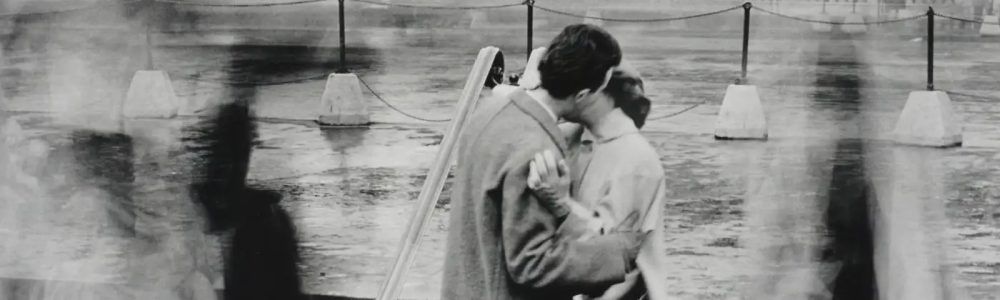
The Belgian exhibition underscores just how widely his practice ranged. It includes, of course, Doisneau’s most famous creation: Le Baiser de l’Hôtel de Ville, 1950, his photograph of a young couple pausing to smooch on a busy Paris promenade, which was shot for Life magazine and went on to become one of the most widely reproduced pictures of the 20th century and an enduring icon of postwar Parisian romance.
But alongside his well-known black-and-white street scenes are advertising commissions, editorial spreads, collages from the 1960s and ’70s and lesser-known color photos, including a surprising Palm Springs series depicting wealthy Americans playing golf. “You don’t expect it to be by Doisneau, but it is,” Benoit says.

“People misunderstand him as a romantic photographer nostalgic for Paris in the ’50s,” she adds. “But he was a modern observer. He never said things were better before.”
The immediacy of the pictures still resonates with collectors. “The human element of the artist’s photographs transcends time,” says Brian Paul Clamp, director of CLAMP, in New York. “Today’s viewers can still relate to the faces and personalities found in the images, as well as the humor and joie de vivre.”
Clamp is particularly drawn to Doisneau’s Parisian nightlife photographs from the early 1950s, which he sees “in conversation with Brassaï’s compositions from 20 years earlier.”

Staley-Wise Gallery cofounder Etheleen Staley describes Doisneau as a kind-hearted witness to a particular place and era. “It’s all about France and the French people and French culture,” she says. “A different generation, a different time.”
There’s “nothing dark, nothing harsh” in his gaze, Staley adds. “It goes from dogs to babies to strippers to weddings. He showed love for all his subjects. In his pictures, there’s a real warmth and affection.”
For Peter Fetterman, the photographs can be almost therapeutic. “A great Doisneau print,” he says, “is one that gives joy and hope and beauty for the viewer to escape to.”

Fetterman’s Santa Monica gallery recently acquired a cache of Doisneau photographs from an octogenarian French collector of humanist imagery who is downsizing after decades of careful stewardship.
“He wanted me to find new loving homes for them,” Fetterman says. “That really is the nature of collecting. We are all only temporary custodians.”
The idea of photographs as gifts rather than trophies echoes throughout the retrospective at La Boverie. Its title, “Instants Donnés,” refers to the notion of a “given moment,” Benoit says. “Doisneau was always thinking about to whom he would give the photograph. So, for him, taking a picture was to make a gift.”