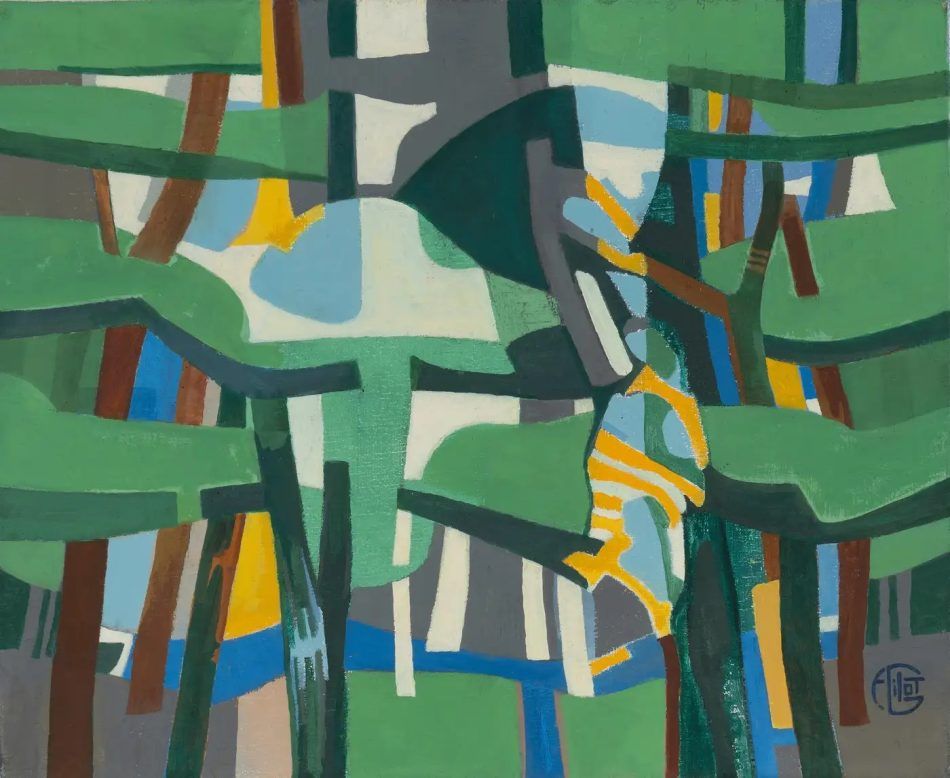
Brightness cuts through the center of Françoise Gilot’s Vers la Clairière, 2001. Deep greens, shadowy grays and earthy browns fill either side of the painting, suggesting a dense forest, while the middle part sings with vivacity, guiding the eye toward the light.
Yet the scene is no simulation of nature. Woods, dirt, stream and sky are roughly implied through hard-edged, jazzy forms dancing across the canvas.
“What I’m immediately drawn to in Vers la Clairière is the way Françoise Gilot turns a landscape into something highly structured,” says Hélène Bailly Marcilhac, whose Paris gallery is offering the work on 1stDibs. “You still recognize nature, the trees, the foliage, the sense of depth, but everything has been carefully reorganized.”
Gilot’s name is often mentioned alongside that of Pablo Picasso, with whom she shared a decade-long relationship, from 1943 to ’53. But her artistic ambitions both preceded and outlived that chapter.
Born in 1921 in Neuilly-sur-Seine, just outside Paris, Gilot grew up in a smart and creative household. Her father was an agronomist and businessman and her mother a watercolorist, who inspired her daughter to paint.
Gilot studied both law and art, attending the Sorbonne and the Académie Julian while developing a visual language that floated between figuration and abstraction.
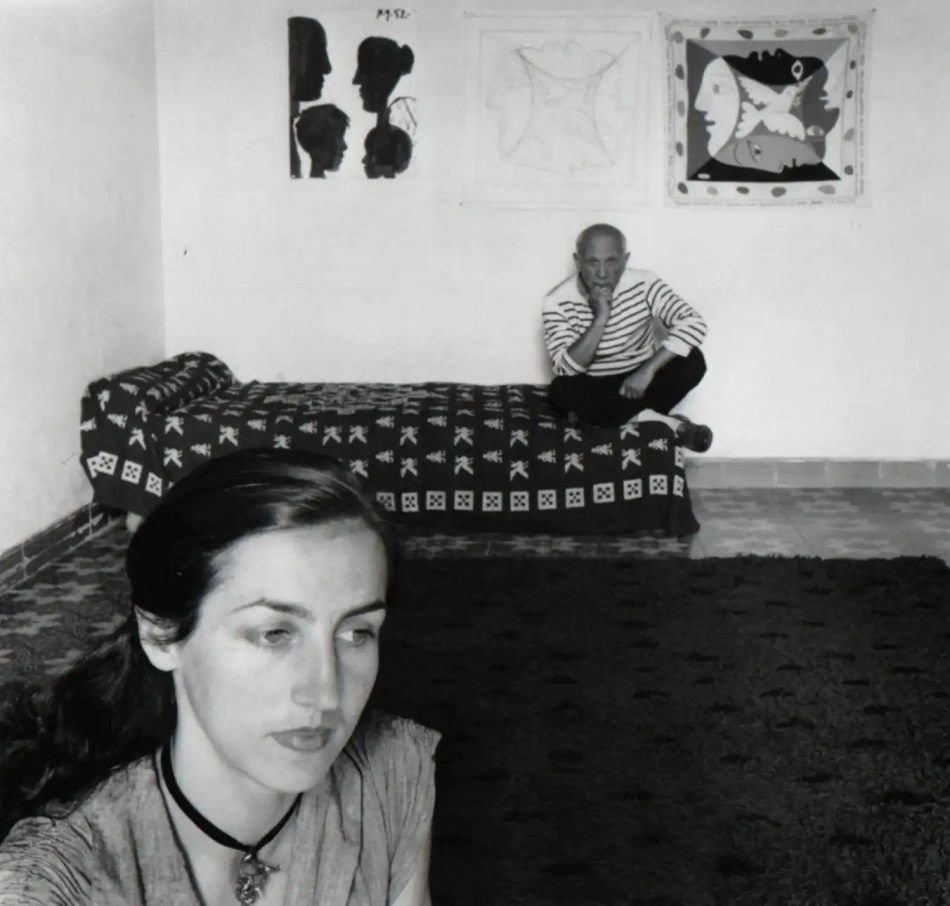
The pursuit of independence became a defining feature of her life. After leaving Picasso, Gilot continued to build her career as a painter, printmaker and writer while raising their two children, Claude and Paloma.
In 1970, she married Jonas Salk, the American virologist famous for developing the polio vaccine, and began dividing her time among Paris, New York and La Jolla, California.
Over the following decades, she exhibited widely in the United States and Europe, establishing herself as a formidable presence in the postwar art scene.
Gilot’s style pulled on several strands of 20th-century modernism — from the structural fracturing of Cubism to the dreamlike clarity of Surrealism — ultimately arriving at a poetic form of abstraction.
She continued her creative pursuits well into her later years, working from studios in New York and Paris until her death in 2023, at the age of 101.
“This 2001 painting belongs to a period when her artistic language was fully established,” Bailly Marcilhac says of Vers la Clairière. “After moving to the United States with her children, Françoise Gilot truly came into her own as an artist, and there she developed a very personal visual language.”
In Vers la Clairière, that language distills wilderness into interlocking planes of color, which may or may not hold biographical connotations. “I really like that balance between fluidity and structure,” Bailly Marcilhac says. “The forms move and curve, yet the composition remains very controlled.”