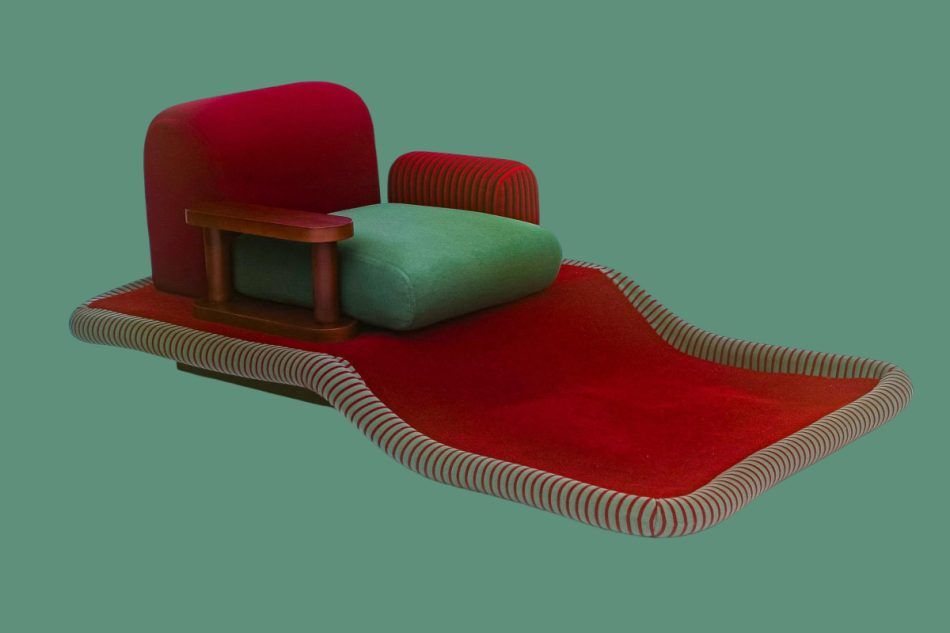
Some pieces of furniture are purely functional. Others are put on a pedestal and displayed with the same reverence as a work of art. And then there are those that exist somewhere between those poles. Ettore Sottsass’s Tappeto Volante (Flying Carpet) armchair, produced for the Italian furniture manufacturer Bedding Brevetti in the 1970s, is firmly occupies that middle ground.
The design is, by any rational measure, a lot: carpet underfoot, bold patterns stacked against bolder ones and upholstery in colors that seem at first glance not to agree with one another. Its scale is throne-like, and its silhouette is more surreal than ergonomic. “Try to position this piece in either the art or design worlds,” says Peter Blake, the Laguna Beach, California–based seller who is offering one of these chairs on 1stDibs, “and it doesn’t want to fit into either of them.”
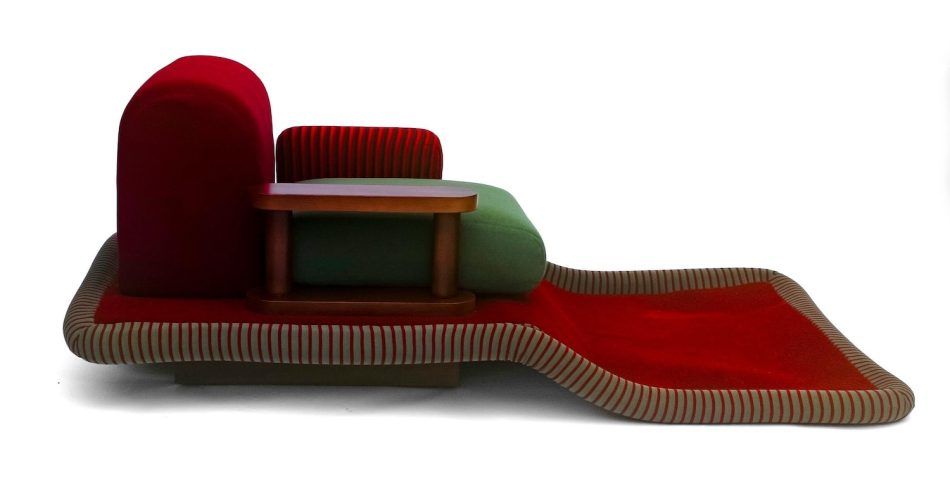
The Flying Carpet chair’s resistance to easy categorization is partially the point. It arrived before the rise of the Milan-based Memphis Group, which Sottsass founded and wouldn’t be formalized until 1981. But it was a clear foreshadowing of the collective’s design principles.
By 1970, Sottsass had spent years absorbing influences from far outside the European modernist tradition, including ones encountered during extensive travels through India. The result was a growing restlessness with minimalism’s austerity, and the Flying Carpet reads as a burst of creative expression. “Memphis was like that moment when designers said, ‘I’ve had enough of minimalism. How can we be more playful about things?'” Blake says. This chair, it could be argued, made that statement first.
What looks like a collision of textures is actually a fairly straightforward construction: a beechwood frame and armrests, a foam seat and an upholstery scheme that layers multicolored fabric, velvet and carpeting. Inspired by the magic carpets of ancient Arabic tales, Sottsass rendered this miraculous mode of transport for rulers and mythical figures as a piece of furniture that in some ways resembles a small stage more than a chair.
What distinguishes this particular example is its condition. Flying Carpet chairs typically show wear, partly because the design requires stepping onto the carpet base to sit down. The one being offered, with its vibrant colors and wood intact, appears to have been displayed rather than used. It “was probably either stored or shown in a home as art,” Blake says. For collectors who want a piece that changed the 20th-century design conversation, few fulfill that desire as audaciously as this one.