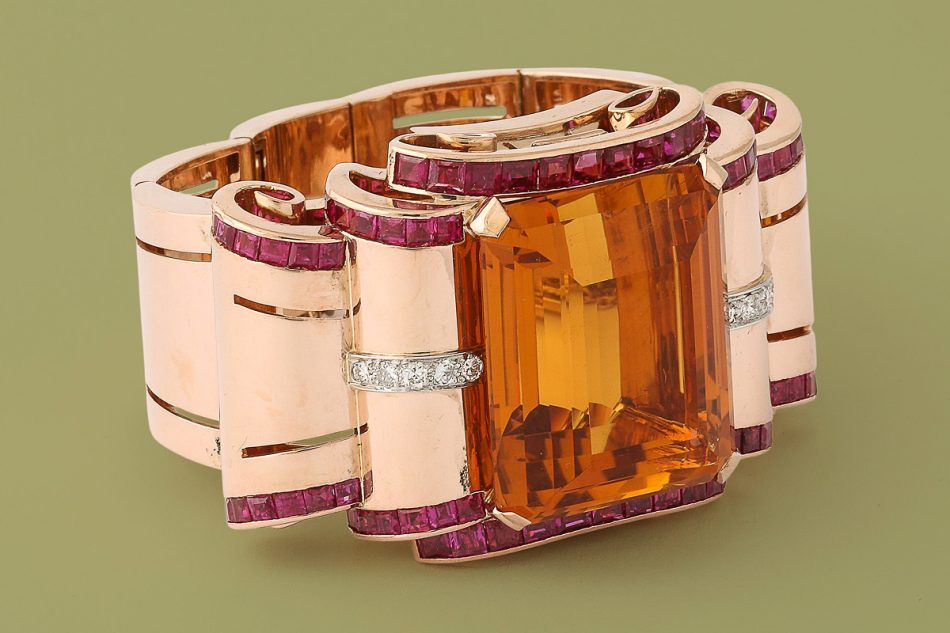
A jewel that immediately presents as an artifact of a certain era is compelling to many collectors, especially if they favor that period’s aesthetic — and its most famous practitioners — above all others. It’s particularly thrilling when the piece’s design elements — the metal, stones or techniques used in its fabrication, its scale or all these things at once — can be traced to a specific historical context. That’s true of this bracelet, making it an outstanding exemplar of the Retro period (extending from about 1935 through the early 1950s).
Although the bracelet is not signed, High Style Deco, which is offering it on 1stDibs, attributes its design to the venerable French jewelry house Mauboussin, founded in 1827. Since the piece was crafted in the United States in the 1940s, it was likely produced in Mauboussin’s affiliated atelier in New York.

Voluminous in scale, composed of high-relief scrolls and coils, the bracelet has a silhouette that falls somewhere between chiseled geometric sculpture and the puffed-out loops of a meticulously tied bow (a well-known Retro-period motif). The dimensional goldwork reflects a shift in 1940s jewelry, when gold became the metal of choice because of World War II platinum shortages. The same historical undercurrents informed other form-forward designs, like Cartier’s extra-wide Tank bracelets made entirely of gold.
Mega gems, like the 85-carat central stone here, were frequent components of the Retro era’s bold gold pieces. The use of citrine in the bracelet is significant. Wartime disruptions made traditional gems, like the rubies and sapphires from Asia and Africa, harder to obtain, prompting jewelers to pivot to such stones as citrine, amethyst and aquamarine. Sourced from South Africa (mainly Brazil), these were readily available in substantial sizes, making them particularly well-suited to the Retro period’s preference for cocktail-party jewels with dramatic presence.
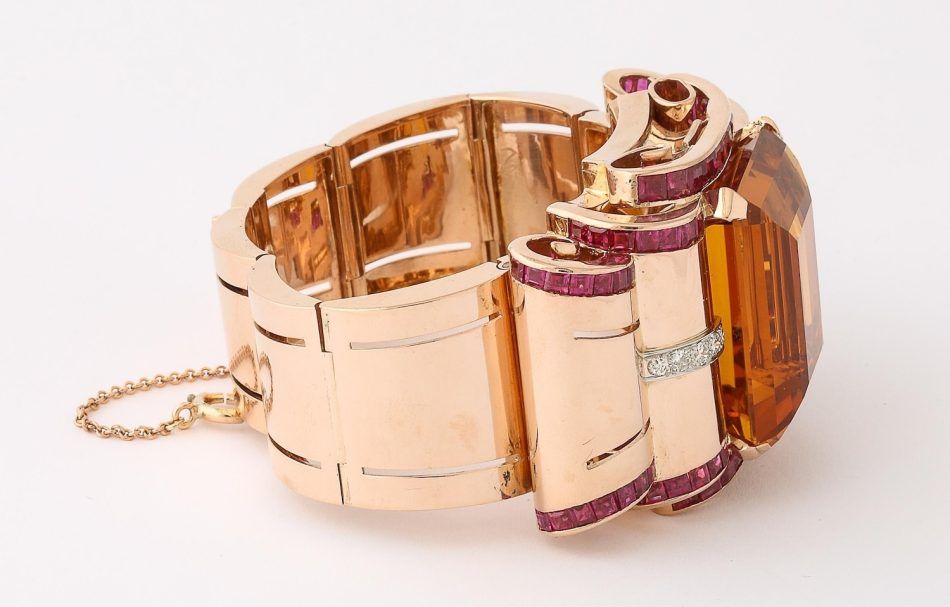
Beyond what the design elements reveal about the era’s geopolitics, the bracelet also offers evidence of Hollywood’s influence on 1940s jewelry trends. Glamorous film stars helped popularize generously proportioned bracelets (and gems) on and off camera. Joan Crawford, for example, appears in an iconic photograph from the film The Women (1939) wearing a cuff by Raymond C Yard set with two enormous half-moon-shaped citrines, part of a two-piece suite that sold for $250,000 at auction in 2022.
A bit of fashion history is on display as well. Bracelets were the Retro era’s must-have accessory, from Machine Age–inspired tubogas designs and bold geometric links to fluid, flexible belt styles finished with gem-set buckles. They were the perfect complement to the era’s three-quarter-length dress sleeves and Crawford-esque suit jackets, both tailored to allow a bracelet to catch the light.
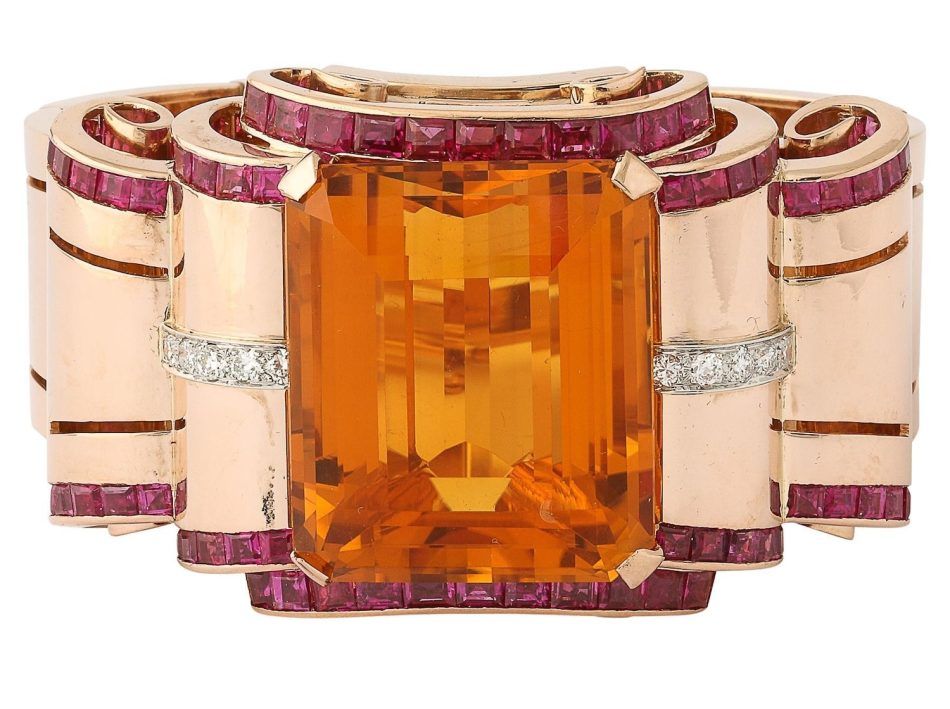
After World War II, triumph and optimism filled the air. The mood called for ever-bolder statement jewels designed to stand out at a party, perhaps alongside a cocktail ring crowned with a sizable stone. Volume was key, as was the confidence to accessorize at such an extravagant scale. High Style Deco’s bracelet is unmistakably Retro, yet its confident energy feels entirely at home in the present moment. Like sidecars served in coupe glasses, emerald-cut gemstones (the bigger the better!) paired with geometric forms have a timeless quality, especially when appearing in a magnificent design.