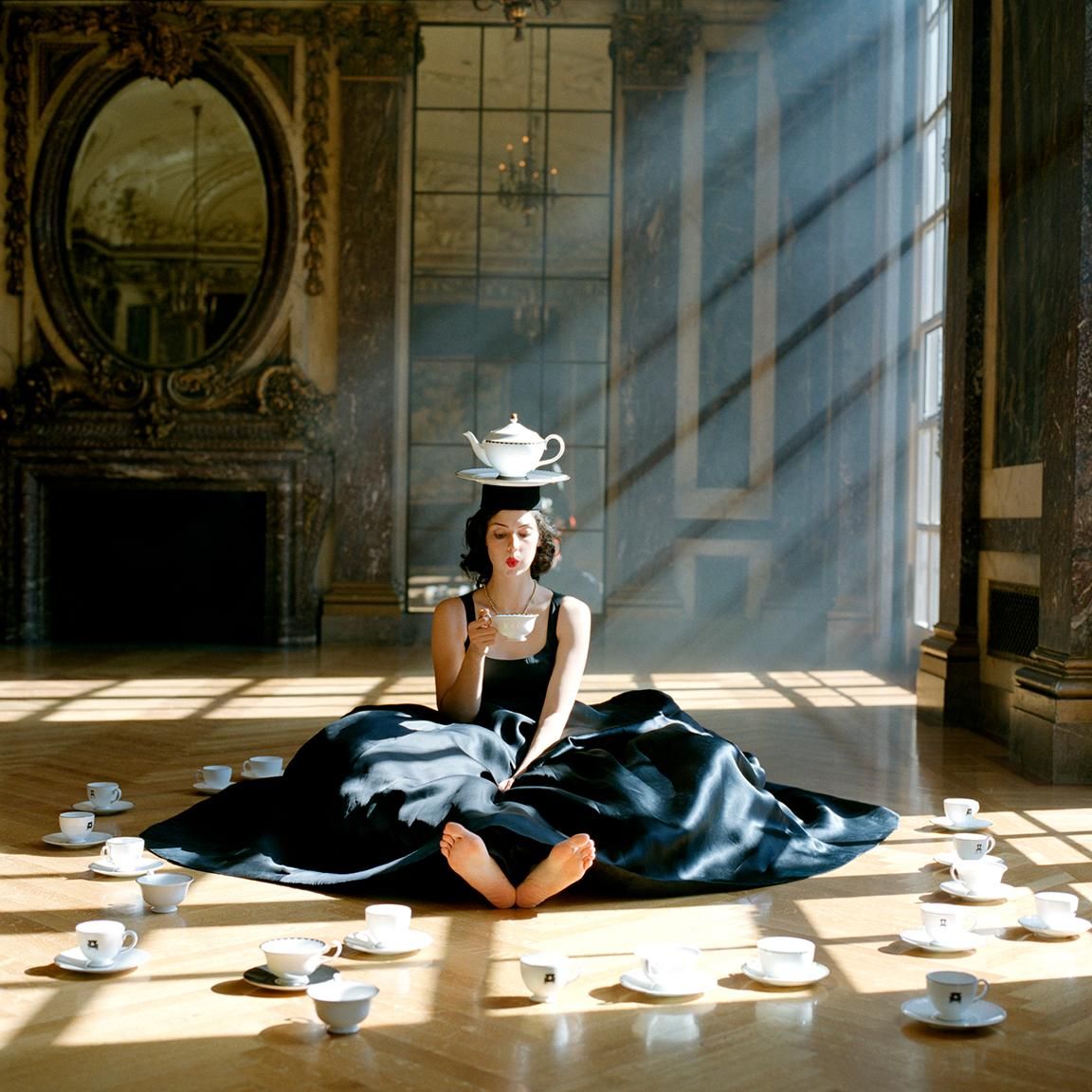
In Zoe Balancing Teapot on Head, Burden Mansion, New York, New York, Rodney Smith staged an act of contrarian composure. A young woman, barefoot and wearing a ballgown, sits on the parquet floor of a grand, sunlight-flooded room, a porcelain teapot resting on her head as if it were a natural extension of her body. She’s encircled by at least 19 cups and saucers while cooling her own tea through pursed red lips.
The scene is both highly elegant and somewhat silly, with perfect control and humor occupying the same breath. Like much of Smith’s output, it seems to hover at the intersection of fashion photography, cinematic stills and philosophical riddles — formal, exacting, wry and unplaceable in time.
“He worked with extraordinary deliberation,” says Etheleen Staley, director of Staley-Wise Gallery, which represents the artist. “This photograph was made on film, using natural light and carefully composed in camera, without digital manipulation. The balance is real, the moment sustained.”
Smith shot Zoe Balancing Teapot in 2006 as part of an ad campaign for designer Barbara Barry, whose collections have ranged from Wedgwood china and silverware to Henredon furniture and embroidered bedding. The campaign sought to elevate everyday rituals by situating them in dreamy settings.
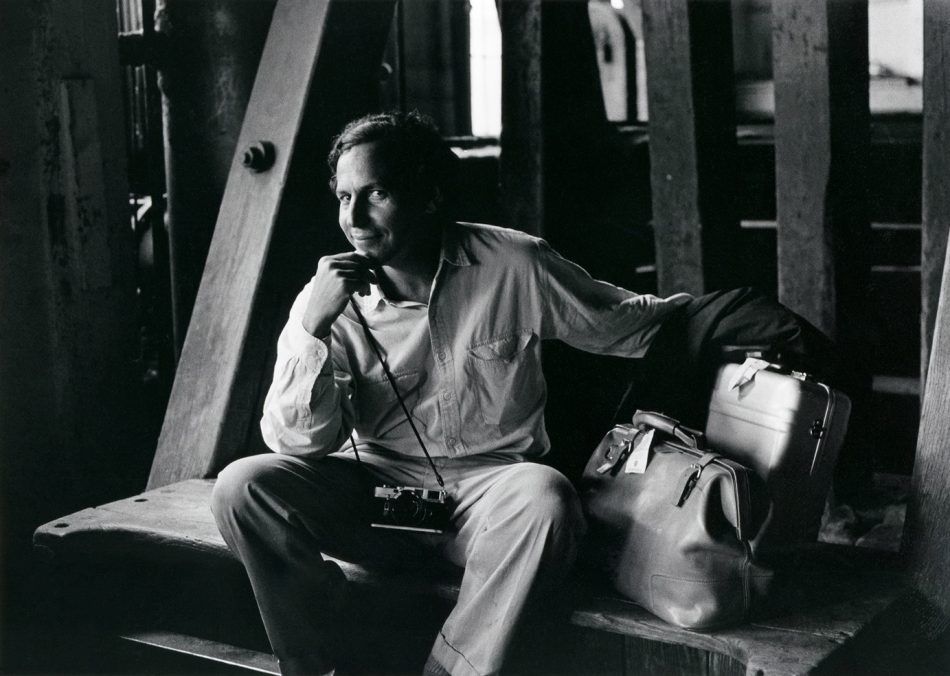
“Rodney and Barbara Barry were kindred spirits in their pursuit of beauty as an essential part of daily life — an antidote to the harshness of the world and a source of uplift and inspiration,” says Leslie Smolan, Smith’s widow and longtime creative partner.
Born in New York City, Smith (1947–2016) pursued a master’s degree in divinity in the 1970s at Yale University, where he also found time to study with Walker Evans.
He went on to travel the world as a fine-art and documentarian photographer, before becoming one of the most distinctive voices in fashion and commercial photography, known for crafting compositions that mingle classical order and perfectionism with deadpan humor and optimism.
Because of his art background, Smith knew how to make photographs that transcended their content to become rare objects in themselves. “Highly selective about what he released, Rodney printed his photographs sparingly, favoring quality over quantity,” Smolan explains. “As a result, works such as Zoe Balancing Teapot on Head are valued not only for their visual poetry but for their scarcity.”
His best-known compositions feature men and women dressed to the nines, captured with their faces partially obscured or shot from a distance in gorgeous locales, posing gleefully while sometimes performing gravity-defying feats.
Seen on magazine covers, on museum walls and in budget-bending ad campaigns, these now grace the pages of the new monograph Rodney Smith: Photography between Real and Surreal, published on the occasion of his first major exhibition in Italy, at Rovigo’s Palazzo Roverella through February 1. For those in the Western Hemisphere, there’s also a Smith solo show at the Franz Mayer Museum of Art and Design, in Mexico City, through March 15.
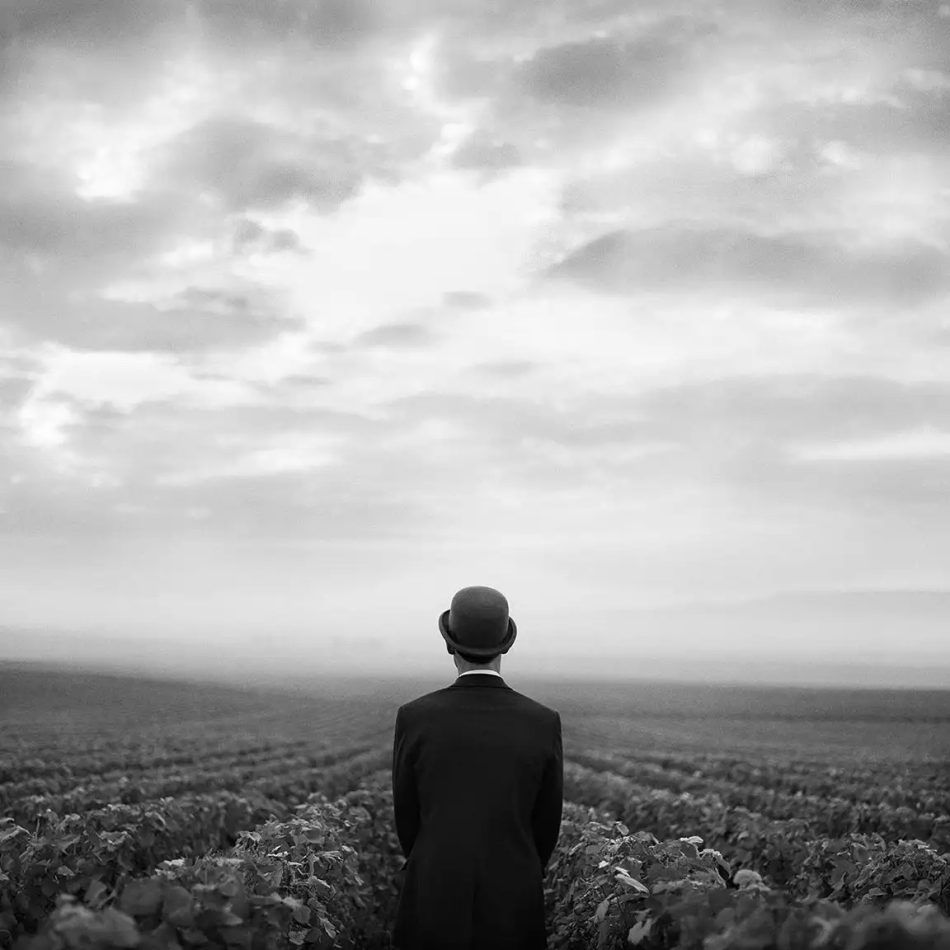
The surreal quality of his work derives partly from the clarity of the unexpected scenes, as in a René Magritte painting but captured on film. “Smith was a master of his craft,” says Stalely, “working with a Hasselblad camera and the larger 2¼-format negative to achieve maximum sharpness.”
The photographer chose the James Burden Mansion on Manhattan’s Upper East Side for Zoe Balancing Teapot. Built in 1905 by Warren and Wetmore (the architects behind Grand Central Terminal), the Beaux Arts home features soaring windows, marble walls and ornate ceilings.
“For Rodney, location was paramount, and he was always in search of natural light,” Smolan says. “Once he found the right setting, everything else followed.”
The model, Zoe Friedman, was one of Smith’s most frequent collaborators. “She always possessed a casual beauty and could step out of a pair of Levi’s and into a ballgown seamlessly,” Smolan notes.
Although the image was originally an outtake from the Barbara Barry gig, it has since become one of Smith’s most recognizable pictures, recalling a real-life Alice in Wonderland tea party.
“Zoe’s calm presence, combined with the architectural dignity of the setting, creates a subtle narrative,” says Smolan, “one that invites viewers to linger and interpret rather than consume the image quickly.”