American Modern Landscape Paintings

to
68
106
137
145
104
70
Overall Width
to
Overall Height
to
2
522
38
1
4
26
97
99
47
38
30
27
11
14,147
8,755
4,950
2,995
2,817
1,187
472
385
346
159
107
52
36
29
417
129
15
181
135
113
85
68
39
39
38
37
37
31
27
25
25
25
22
21
19
18
18
550
416
228
222
112
40
26
15
8
7
386
59
556
Style: American Modern
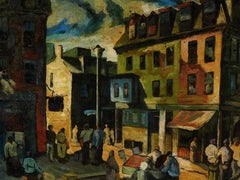
Manayunk Fountain & Silverwood Sts

Manayunk Fountain & Silverwood Sts

Located in Los Angeles, CA

Manayunk Fountain & Silverwood Sts, 1938, oil on canvas board, signed and dated lower right, titled and dated verso, 20 x 16 inches Although Florence Prince Ewing’s paintings ex...

Category

1930s American Modern Landscape Paintings

Materials

Oil, Canvas, Board

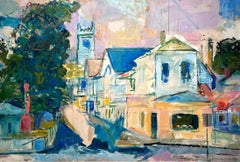
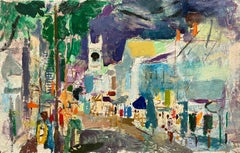
A Charming 1950s Painting of Lisbon, Portugal by Famed Artist Francis Chapin

A Charming 1950s Painting of Lisbon, Portugal by Famed Artist Francis Chapin

By Francis Chapin

Located in Chicago, IL

A Charming, 1950s Painting of Lisbon, Portugal by Famed Chicago Modern Artist Francis Chapin (Am. 1899-1965). Depicting a bustling, colorful view of Lisbon's historic Black Horse Sq...

Category

Mid-20th Century American Modern Landscape Paintings

Materials

Board, Canvas, Oil

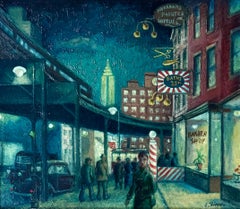
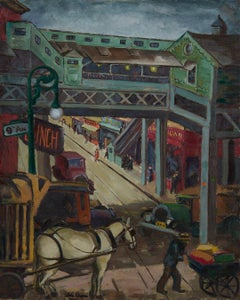
City at Night (Cityscape)

City at Night (Cityscape)

By Abram Tromka

Located in Wilton Manors, FL

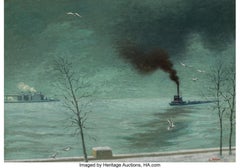
Abram Tromka (1895-1964) City at Night, ca. 1940. Oil on canvas, 16 x 20 inches; 20 x 24 inches in antique oak frame. Signed lower right. Frame is of the period, but probably not ...

Category

1930s American Modern Landscape Paintings

Materials

Canvas, Oil

Untitled (Perhaps New Jersey Factories)

Untitled (Perhaps New Jersey Factories)

Located in Los Angeles, CA

Untitled (perhaps New Jersey Factories), c. 1940s, oil on board, signed lower left, 24 x 28 inches, perhaps exhibited Fifty-First Annual Exhibition, National Association of Women Art...

Category

1940s American Modern Landscape Paintings

Materials

Oil, Board

"Canals in Annecy, France" by Emma Fordyce MacRae (1887-1974) American Framed

"Canals in Annecy, France" by Emma Fordyce MacRae (1887-1974) American Framed

By Emma Fordyce MacRae

Located in Yardley, PA

A lovely scene of the canals in Annecy, France by renowned American artist Emma Fordyce MacRae (1887-1974). This work highlights the geometric nature of the historic architecture al...

Category

Mid-20th Century American Modern Landscape Paintings

Materials

Gesso, Oil, Board

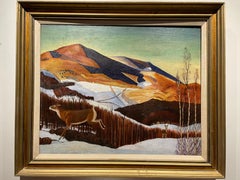
Rabbit Hunters
Rabbit Hunters

Rabbit Hunters

By Roger Medearis

Located in Los Angeles, CA

Rabbit Hunters, egg tempera on Masonite, 12 x 9 inches, 1947, signed and dated lower left, signed, titled and dated verso “Rabbit Hunters Egg Tempera Roger Medearis 1947,” exhibited at Medearis' solo show at Kende Galleries, New York, in 1949 (Medearis’ record book, a copy of which is held by Vose Galleries in Boston, MA, indicates this is painting “No. 23” and that is was completed in 1947 and sold via Kende Galleries (at Gimbel Brothers...

Category

1940s American Modern Landscape Paintings

Materials

Tempera, Board

Vance Kirkland "Tourists" 1942 Watercolor Colorado Landscape Painting

Vance Kirkland "Tourists" 1942 Watercolor Colorado Landscape Painting

By Vance Kirkland

Located in Denver, CO

An exceptional original watercolor painting titled Tourists by renowned American modernist Vance Hall Kirkland (1904–1981), created in 1942 during his celebrated Designed Realism per...

Category

1940s American Modern Landscape Paintings

Materials

Watercolor

Neighbors

Neighbors

By Norman Barr

Located in Los Angeles, CA

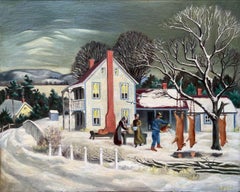
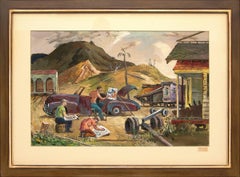
Neighbors, 1939, oil on canvas, signed and dated lower right, 22 x 26 inches Norman Barr was an American Scene painter and muralist known for his poignant depictions of working-clas...

Category

1930s American Modern Landscape Paintings

Materials

Canvas, Oil

Farmhouse in Autumn, Early 20th Century Landscape by Florence Helena McGillivray

Farmhouse in Autumn, Early 20th Century Landscape by Florence Helena McGillivray

Located in Soquel, CA

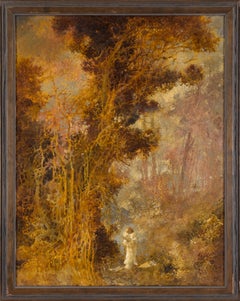
Farmhouse in Autumn, Early 20th Century Landscape by Florence Helena McGillivray A vibrant and colorful late 1920's landscape by Florence Helena McGillivray (Canadian, 1864-1938). This beautiful 1929 landscape depicts a quaint farmhouse in autumn, surrounded by a landscape full of fall foliage in goldenrod yellow, bright orange, and deep red, with soft purple hills receding into the distance. Signed "F. McGillivray" lower left. Displayed in a new Arts & Crafts style giltwood frame. Board size: 16"H x 20"W. Framed size: 19.25"H x 23.25"W x 1"D. McGillivray (1864–1938) garnered admiration for her modern landscape paintings, as well as for her mentorship of young artists, including Tom Thomson. She has been credited in some instances as an influence for what would later be known as the Group of Seven. A prolific sketcher and painter, Florence McGillivray...

Category

1920s American Modern Landscape Paintings

Materials

Oil, Canvas, Illustration Board

The Ditch

The Ditch

By Virginia True

Located in Los Angeles, CA

The Ditch, 1934, oil on board, signed and dated lower right, 18 x 24 inches, label verso has title, artist’s name, Colorado and New York addresses, and original price Virginia True ...

Category

1930s American Modern Landscape Paintings

Materials

Oil, Board

Spring Snowfall Seattle

Spring Snowfall Seattle

By Zama Vanessa Helder

Located in Los Angeles, CA

Spring Snowfall Seattle, 1937, watercolor on paper mounted on panel, signed lower right, 16 ½ x 17 ½ inches (image) 17 x 22 ½ inches (panel), ), title, measurements and Helder’s addr...

Category

1930s American Modern Landscape Paintings

Materials

Watercolor, Illustration Board

Untitled (House in the Hills)

Untitled (House in the Hills)

By Dorothy Sklar

Located in Los Angeles, CA

Untitled (Houses in the Hills), 1946, watercolor on paper, signed and dated lower right, 14 x 20 inches (image), 24 x 30 inches (frame) Dorothy Sklar was a popular and prolific Los ...

Category

1940s American Modern Landscape Paintings

Materials

Paper, Watercolor

Head to Sea, Modernist sailing scene

Head to Sea, Modernist sailing scene

By Ralph Eugene Della-Volpe

Located in New York, NY

A vibrant and yet romantic sailing scene which was a favorite series by Della-Volpe. His compelling colorist approach has made his works desirable as he was one of the few artists post-war to be representative in style like Milton Avery and Wolf Kahn. Head to Sea has the hallmark intense and lovely coloration for which Della-Volpe is known. He came out of Abstract Expressionism in the New York school but then pivoted, like Milton Avery to representational, colorist work. The frame is a silvered gold leaf float frame of quality and has a rubbed, antiqued surface...

Category

Early 2000s American Modern Landscape Paintings

Materials

Oil, Board

WATTS TOWER
WATTS TOWER

WATTS TOWER

By Gloria Stuart

Located in Santa Monica, CA

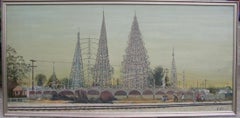
GLORIA STUART (1910 – 2010) WATTS TOWERS, 1971 Oil on canvas, signed lower right, 24” x 50 ½”. Gloria Stuart, an Academy Award nominated actress was also a painter, illustrator and printmaker. She most recently portrayed Rose in the blockbuster film “Titanic”. She was a Santa Monica native. In 2013 The Los Angeles Museum of Art, LACMA exhibited a nearly identical painting looking from the south, the same size and frame. Last 5 photos show the example at LACMA. One shows theirs in a distant room with a major Thomas Hart Benton painting in the foreground A VERY IMPORTANT MULTI-LEVELED DOCUMENT OF LOS ANGELES AND HOLLYWOOD CULTURAL HSTORYi The following is from her obituary in the Los Angeles Times upon her death in September 2010 at the age of 100 Gloria Stuart, a 1930s Hollywood leading lady who earned an Academy Award nomination for her first significant role in nearly 60 years — as Old Rose, the centenarian survivor of the Titanic in James Cameron’s 1997 Oscar-winning film — has died. She was 100. .......She devoted much of her time to designing and printing artists’ books (handmade, letter-press printed books in limited editions, with her own artwork and writing). Her work is in the J. Paul Getty Museum in Los Angeles, the Metropolitan Museum of Art in New York City, the Victoria and Albert Museum in London and other museums. Stuart, a founding member of the Screen Actors Guild who later became an accomplished painter and fine printer, died Sunday night at her West Los Angeles home, said her daughter, writer Sylvia Thompson. Stuart had been diagnosed with lung cancer five years ago. “She also was a breast cancer survivor,” Thompson said, “but she just paid no attention to illness. She was a very strong woman and had other fish to fry.” In July the actress was honored at an “Academy Centennial Celebration With Gloria Stuart” at the Samuel Goldwyn Theater in Beverly Hills. “She was a charming and beautiful leading lady in the ‘30s, and I never understood why her career didn’t go further at that time,” film historian and critic Leonard Maltin, who interviewed Stuart on stage at the event, told The Times on Monday. As for Stuart’s high-profile comeback in “Titanic”: “She was thrilled by the attention that that performance brought her and really wanted to win that Oscar. I thought she hit just the right notes in that performance. She was wry and engaging.” As a glamorous blond actress under contract to Universal Studios and 20th Century Fox in the 1930s, Stuart appeared opposite Claude Rains in James Whale’s “The Invisible Man” and with Warner Baxter in John Ford’s “The Prisoner of Shark Island.” She also appeared with Eddie Cantor in “Roman Scandals,” with Dick Powell in Busby Berkeley’s “Gold Diggers of 1935” and with James Cagney in “Here Comes the Navy.” And she played romantic leads in two Shirley Temple movies, “Poor Little Rich Girl” and “Rebecca of Sunnybrook Farm.” But mostly she played what Stuart later dismissed as “stupid parts with nothing to do” — “girl reporter, girl detective, girl nurse” — and “it became increasingly evident to me I wasn’t going to get to be a big star like Katharine Hepburn and Loretta Young.” After making 42 feature films between 1932 and 1939, Stuart’s latest studio contract, with 20th Century Fox, was not renewed. She appeared in only four films in the 1940s and retired from the screen in 1946. By 1974, “the blond lovely of the talkies” had become an entry in one of Richard Lamparski’s “Whatever Happened to” books. Writer-director Cameron’s $200-million “Titanic” changed that. Stuart played Rose Calvert, the 100-year-old Titanic survivor who shows up after modern-day treasure hunters searching through the wreckage of the sunken ship find a charcoal drawing of her wearing a priceless blue diamond necklace. Stuart’s performance as Old Rose frames the 1997 romantic- drama that starred Leonardo DiCaprio as lower-class artist Jack Dawson...

Category

1970s American Modern Landscape Paintings

Materials

Oil

Park

Park

Located in Los Angeles, CA

Park, 1980, acrylic on canvas, signed and dated lower right, 32 x 48 inches, inscribed verso “Alfred P. Maurice, 2725 A South Michigan Ave, Chicago, IL, 60616, ‘Park”, labeled verso ...

Category

1980s American Modern Landscape Paintings

Materials

Canvas, Acrylic

"Coney Island" Brooklyn NYC Amusement Park Mid-century American Scene WPA Modern

"Coney Island" Brooklyn NYC Amusement Park Mid-century American Scene WPA Modern

By Ludwig Bemelmans, 1898-1962

Located in New York, NY

"Coney Island" Brooklyn NYC Amusement Park Mid-century American Scene WPA Modern Ludwig Bemelmans (1898 – 1962), “Coney Island" 35 x 27 inches Oil on board Signed lower right Orig...

Category

1940s American Modern Landscape Paintings

Materials

Oil, Board

Self Portrait

Self Portrait

By William Ashby McCloy

Located in Los Angeles, CA

Self-Portrait, c. 1940, oil and tempera on Masonite, artist’s name inscribed verso, 30 x 25 inches William Ashby McCloy was an American artist, educator, and clinical psychologist. ...

Category

1940s American Modern Landscape Paintings

Materials

Masonite, Oil, Tempera

A Large, Colorful 1960s Mid-Century Modern Florida Harbor Scene, "Sail Boats"

A Large, Colorful 1960s Mid-Century Modern Florida Harbor Scene, "Sail Boats"

By Charles Turzak

Located in Chicago, IL

A Large, Colorful, 1960s Mid-Century Modern Florida Harbor Scene Painting, "Sail Boats" by Famed Chicago Artist and Printmaker, Charles Turzak (Am. 1899 - 1986). Titled "Sail Boats"...

Category

20th Century American Modern Landscape Paintings

Materials

Canvas, Masonite, Acrylic

Bejeweled Nocturne
Bejeweled Nocturne

Bejeweled Nocturne

By Arthur Meltzer

Located in New York, NY

Arthur Meltzer 

(American, 1893-1989)

 Title: Bejeweled Nocturne
 Medium: Oil on Canvas
 Size: 22 x 32 inches / 28 ¾ x 38 ½ 
Markings: Signed lower left
 Titled and dated 1980 on ...

Category

20th Century American Modern Landscape Paintings

Materials

Canvas, Oil

Downtown New York

Downtown New York

Located in Los Angeles, CA

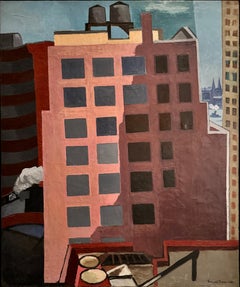
Downtown New York, c. 1930s, oil on canvas, signed lower right, 10 x 12 inches; label verso reads: "Harry Dix / Title Downtown New York / Medium Oil" Harry Dix was a 20th-century p...

Category

1930s American Modern Landscape Paintings

Materials

Canvas, Oil

Atilt

Atilt

Located in Los Angeles, CA

Atilt, 1982, acrylic on canvas, 32 x 48 inches, signed and dated lower right, “Alfred P. Maurice 2725 A South Michigan Ave, Chicago, IL, 60616” inscribed verso, “ATILT” inscribed verso, “Maurice.018” inscribed on frame, exhibited: 1) Alfred P. Maurice Artist in the City Paintings 1979 - 1997, Archer Gallery of Clark College, Vancouver, WA, April 8 – April 30, 1997, #11, and 2) An Artful Life: Celebrating the Life of Creator, Teacher, and Collector Alfred Maurice...

Category

1980s American Modern Landscape Paintings

Materials

Acrylic, Canvas

9:23 am

9:23 am

By Saul Chase

Located in Los Angeles, CA

9:23am, 1969, acrylic on canvas, signed and dated verso, 44 ½ x 50 inches, exhibited: 39th Midyear Show, The Butler Institute of American Art, Youngstown, Ohio, 1972 (label verso), p...

Category

1960s American Modern Landscape Paintings

Materials

Canvas, Oil

Christopher Street (abstract Greenwich Village cityscape)

Christopher Street (abstract Greenwich Village cityscape)

By De Hirsch Margules

Located in Wilton Manors, FL

De Hirsh Margules (1899-1965). Christopher Street, 1939. Watercolor on Arches wove paper. Signed and dated in pencil by artist lower margin. Sheet measures 15.5 x 20 inches. Window in matting measures 15 x 19 inches. Framed measurement: 23 x 30 inched. Bears fragment of original label affixed on verso. Incredibly vibrant and saturated color with no fading or toning of sheet. Provenance: Babcock Galleries, NYC Exhibited: The American Federation of Arts Traveling Exhibition. From the facade of The Waverly at Christopher is depicted One Christopher Street, the 16-story Art Deco residential building erected in 1931. It is not a casual coincidence that the structure appears in this cityscape: 1 Christopher Street is the subject. The original intention of this project was to transform the neighborhood, bring a bit of affluence and make a bid to rival the Upper West Side. Margules, a sensitive aesthete, understood how a massive piece of architecture such as One changes a neighborhood. Sound, scale and focal points are forever altered. A pedestrian's sense of depth and distance becomes pronounced. All of these factors contribute to the intent behind this image. Tall buildings disrupt the human scale, change the skyline and carve up space. In this piece, negative space conforms to the man-made geometries. Clouds become gems fixed in settings. De Hirsh Margules (1899–1965) was a Romanian-American "abstract realist" painter who crossed paths with many major American artistic and intellectual figures of the first half of the 20th century. Elaine de Kooning said that he was "[w]idely recognized as one of the most gifted and erudite watercolorists in the country". The New York Times critic Howard Devree stated in 1938 that "Margules uses color in a breath-taking manner. A keen observer, he eliminates scrupulously without distortion of his material." Devree later called Margules "one of our most daring experimentalists in the medium" Margules was also a well-known participant in the bohemian culture of New York City's Greenwich Village, where he was widely known as the "Baron" of Greenwich Village.[1] The New York Times described him as "one of Greenwich Village's best-known personalities" and "one of the best known and most buoyant characters about Greenwich Village. Early Life De Hirsh Margules was born in 1899 in the Romanian city of Iași (also known as Iasse, Jassy, or Jasse). When Margules was 10 weeks old, his family immigrated to New York City. Both of his parents were active in the Yiddish theater, His father was Yekutiel "Edward" Margules, a "renowned Jewish actor-impresario and founder of the Yiddish stage." Margules' mother, Rosa, thirty-nine years younger than his father, was an actress in the Yiddish theater and later in vaudeville. Although Margules appeared as a child actor with the Adler Family[11] and Bertha Kalich, his sister, Annette Margules, somewhat dubiously continued in family theater and vaudeville tradition, creating the blackface role of the lightly-clad Tondelayo (a part later played on film Hedy Lamarr) in Earl Carroll's 1924 Broadway exoticist hit, White Cargo. Annette herself faced stereotyping as an exotic flower: writing about her publicist Charles Bouchert stated that "Romania produces a stormy, temperamental type of woman---a type admirably fitted to portray emotion." His brother Samuel became a noted magician who appeared under the name "Rami-Sami." Samuel later became a lawyer, representing magician Horace Goldin, among others. A family portrait including a young De Hirsh, a portrait of Rosa and Annette together, and individual photos of Rosa and Edward can be found on the Museum of the City of New York website. At around age 9 or 10, Margules took art classes with the Boys Club on East Tenth Street, and his first taste of exhibition was at a student art show presented by the club. By age 11, he had won a city-wide prize (a box camera) at a children's art show presented by the department store Wanamakers. As a young teenager, Margules was already displaying a characteristic kindness and loyalty. Upon hearing that two friends (one of them was author Alexander King), were in trouble for breaking a school microscope, the nearly broke Margules gave them five dollars to repair the microscope . Margules had to approach a wealthy man that Margules had once saved on the subway from a heart attack. Margules didn't reveal the source of the five dollars to King until twenty-five years later. In his late teens, Margules studied for a couple of months in Pittsburgh with Edwin Randby, a follower of Western painter Frederic Remington. Thereafter he pursued a two-year course of studies in architecture, design and decoration at the New York Evening School of Art and Design, while working as a clerk during the day at Stern's Department Store. He was encouraged in these artistic pursuits by his neighbor, the painter Benno Greenstein (who later went by the name of Benjamin Benno). Artistic career In 1922, Margules began work as a police reporter for the City News Association of New York .Margules then considered himself something of an expert on art, and the painter Myron Lechay is said to have responded to some unsolicited analysis of his work with the remark "Since you seem to know so much about it, why don't you paint yourself?" This led to study with Lechay and a flurry of painting. Margules' first show was in 1922 at Jane Heap's Little Review Gallery. Thereafter Margules began to participate in shows with a group including Stuart Davis, Jan Matulka, Buckminster Fuller (exhibiting depictions of his "Dymaxion house") in a gallery run by art-lover and restaurateur Romany Marie on the floor above her cafe. Jane Heap, left, with Mina Loy and Ezra Pound During the 1920s, Margules traveled outside of the country a number of times. In 1922, with the intent of reaching Bali, he took a job as a "'wiper on a tramp steamer where [he] played nursemaid to the engine." He reached Rotterdam before he turned back. He would return to Rotterdam shortly thereafter. In 1927, Margules took a lengthy leave of absence from his day job as a police reporter in order to travel to Paris, where he "set up a studio in Montmartre's Place du Tertre, on the top floor of an almost deserted hotel, a shabby establishment, lacking both heat and running water." He studied at the Louvre and traveled to paint landscapes in provincial France and North Africa. Margules also joined the "Noctambulist" movement and experimented with painting and showing his artwork in low light.Jonathan Cott wrote that: the painter De Hirsch Margulies sat on the quays of the Seine and painted pictures in the dark. In fact, the first exhibition of these paintings, which could be seen only in a darkened room, took place in [ Walter Lowenfels'] Paris apartment. Elaine de Kooning remarked that studying the works of the Noctambulists confirmed Margules' "direction toward the use of primary colors for perverse effects of heavy shadow." It was also in Paris that Margules initially conceived his idea of "Time Painting", where a painting is divided into sectors, each representing a different time of day, with color choices meant to evoke that time of day. In Paris, his social circle included Lowenfels, photographer Berenice Abbott, publisher Jane Heap, composer George Anthiel, sculptor Thelma Wood, painter André Favory, writer Norman Douglas, writer and editor George Davis, composer and writer Max Ewing, and writer Michael Fraenkel. Upon his return to New York in 1929, Margules attended an exhibition of John Marin's paintings. While at the exhibition, he "launched into an eloquent explanation of Marin to two nearby women", and was overheard by an impressed Alfred Stieglitz. The famous photographer and art promoter invited Margules to dine with his wife, the artist Georgia O'Keeffe, and his assistant, painter Emil Zoler. Stieglitz thereafter became a friend and mentor to Margules, becoming for him "what Socrates was to his friends." Alfred Stieglitz Stieglitz introduced Margules to John Marin, who quickly became the most important painterly influence upon Margules. Elaine de Kooning later noted that Margules was "indebted to Marin and through Marin to Cézanne for his initial conceptual approach - for his constructions of scenes with no negative elements, for skies that loom with the impact of mountains." Margules himself said that Marin was his "father and ... academy." The admiration was by no means unreciprocated: Marin said that Margules was "an art lover with abounding faith and sincerity, with much intelligence and quick seeing." Stieglitz also introduced Margules to many other artistic and intellectual figures in New York. With the encouragement of Alfred Stieglitz, Margules in 1936 opened a two-room gallery at 43 West 8th Street called "Another Place." Over the following two years there were fourteen solo exhibitions by Margules and others, and the gallery was well-respected by the press. It was in this gallery that the painter James Lechay, Myron's brother, exhibited his first painting. In 1936, Margules first saw recognition by major art museums when both the Museum of Modern Art and the Museum of Fine Arts, Boston purchased his works. In 1942, Margules gave up working as a police reporter, and apparently dedicated himself thereafter solely to an artistic vocation. "The Baron of Greenwich Village"[edit] Margules made his mark not only as an artist, but also as an outsized personality known throughout Greenwich Village and beyond. To local residents, Margules was known as the "Baron", after Baron Maurice de Hirsch, a prominent German Jewish philanthropist. Margules was easily recognizable by the beret he routinely wore over his long hair. Writer Charles Norman said that he "dressed with a flair for sloppiness." He was said to "know everybody" in Greenwich Village, to the extent that when the novelist and poet Maxwell Bodenheim was murdered, Margules was the first one the police sought to identify the body. Margules' letters show him interacting with art world figures such as Sacha Kolin, John Marin and Alfred Stieglitz, as well as with prominent figures outside the art world such as polymath Buckminster Fuller and writer Henry Miller. Most of his friends and acquaintances found Margules a generous and voluble man, given to broadly emotionally expressive gestures and acts of kindness and loyalty. In 1929, he exhibited an example of this loyalty and fellow-feeling when he appeared in court to fight what the wrongful commitment of his friend, writer and sculptor Alfred Dreyfuss, who appeared to have been a victim of an illicit attempt to block an inheritance. The Greenwich Village chronicler Charles Norman described the bone-crushing hugs that Margules would routinely bestow on his friends and acquaintances, and speaks of the "persuasive theatricality" that Margules seemed to have inherited from his actor parents. Norman also wrote about Margules' routine acts of kindness, taking in homeless artists, constantly feeding his friends and providing the salvatory loan where needed. Norman also notes that Margules was blessed with a loud and good voice, and was apt to sing an operatic air without provocation. The writer and television personality Alexander King said I think the outstanding characteristics of my friend's personality are affirmation, emphasis, and overemphasis. He chooses to express himself predominantly in superlatives and the gestures which accompany his utterances are sometimes dangerous to life and limb. Of the bystanders, I mean. King also spoke with affectionate amusement about Margules' pride in his cooking, speaking of how "if he should ever invite you to dinner, he may serve you a hamburger with onions, in his kitchen-living room, with such an air of gastronomic protocol, such mysterious hints and ogliing innuendoes, as if César Ritz and Brillat-Savarin had sneaked out, only a moment before, with his secret recipe in their pockets." Margules was such a memorable New York personality that comic book writer Alvin Schwartz imagined him at the Sixth Avenue Cafeteria in a risible yet poignant debate with Clark Kent about whether Superman had the ability to stop Hitler. Margules' entrenchment in the Greenwich Village milieu can be seen in a photograph from Fred McDarrah's "Beat Generation Album" of a January 13, 1961 writers' and poets' meeting to discuss "The Funeral of the Beat Generation", in Robert Cordier [fr]'s railroad flat at 85 Christopher Street. Among the people in the same photograph are Shel Silverstein...

Category

1930s American Modern Landscape Paintings

Materials

Watercolor, Rag Paper

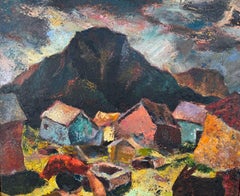
A brooding American modernist landscape painting with a house or outbuilding

A brooding American modernist landscape painting with a house or outbuilding

Located in Colfax, CA

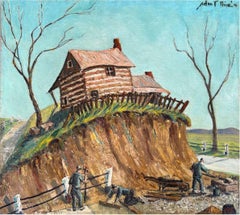
A nice American modernist landscape painting, dating from the 1940s. This work is on the manner of E. Oscar Thalinger, but does not appear to be signed. The work is unframed, as it...

Category

1940s American Modern Landscape Paintings

Materials

Oil

"Hydrangeas, " Walter Inglis Anderson, Mississippi Southern Illustrator, Flowers

"Hydrangeas, " Walter Inglis Anderson, Mississippi Southern Illustrator, Flowers

Located in New York, NY

Walter Anderson ( American, 1903 - 1965) Hydrangeas, circa 1950 Mixed media on paper 11 x 8 1/2 inches Provenance: Luise Ross Gallery, New York Private Collection, New Jersey Acquired from the estate of the above, 2021 Walter Anderson firmly believed that quality art was an important part of life and should be made available to everyone. As he said, "There should be simple, good decorations, to be sold at prices to rival the five-and-ten." Noticing that only poor quality art was available in stores and little was available for children, he resolved to make art which could be reproduced easily and sell inexpensively — linoleum block prints. This technique enabled him to provide affordable, quality art. The technique of linoleum block printing is a simple concept; however, it requires much skill and talent to actually produce memorable art. Anderson purchased surplus "battleship linoleum," thicker than ordinary linoleum with a burlap backing for better support, to create his blocks. During the mid-1940s, he created almost 300 linocuts working in the attic of the sea-side plantation house, Oldfields, his wife's family home in Gautier. Masses of linoleum chips accumulated at the foot of the attic stairs as he often worked night and day. He began with sketching out a design directly on the linoleum. Once he had carved the image into the surface, he used the back of faded, surplus stock wallpaper that a friend sent him, laying long strips on top of the inked linoleum. A roller made of sewer pipe filled with sand served as his press. When the print was completed, he often colored it by hand with bold strokes and vivid colors. The prints were sold at Shearwater Pottery, the family business, for a mere dollar a foot. But "what about a well-designed fairy tale for a child's room?" he asked himself. Since there was a lack of affordable art for children, much of his work with linoleum blocks focused on subjects for children. He depicted fables and fairy tales ranging from Arabian Nights, to Germany and the Grimm Brothers' Rapunzel, to the French story of The White Cat, to the Greek tales such as Europa and the Bull, and to tales from China, India, and other cultures. Anderson also created "mini" books featuring the alphabet and Robinson Cat. The blocks are not only alive with the story being depicted, but they are also filled with designs taken from Best-Maugard's Method for Creative Design. Swirls, half-circles and zig-zag lines fill every available space on the linoleum block making them come alive and capture their audience. But fairy tales, children's verses and the "mini" books, consisting of about 90 blocks, were not the sole subject of Anderson's linoleum block prints. In total, he created approximately 300 linoleum blocks with subjects ranging from coastal flora and fauna, coastal animals, and sports and other coastal activities. Anderson even created linoleum blocks to be used to print tablecloths and clothing, some worn by his own children. Color and subjects of the linoleum block prints were not the only things that got them noticed. In 1945 when Anderson was creating these prints, the standard size of linoleum block prints was only 12 by 18 inches. These small dimensions were due to the common size of the paper available and the restrictions made by national competitions. Since Anderson used wallpaper...

Category

Mid-20th Century American Modern Landscape Paintings

Materials

Paper, Crayon

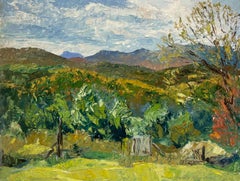
Farm in the Valley - Plein Air California Landscape

Farm in the Valley - Plein Air California Landscape

Located in Soquel, CA

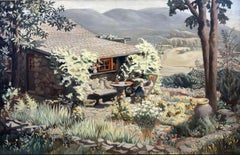
Farm in the Valley - Plein Air California Landscape Beautiful mid century landscape of a California farm by Baumgardner (American, 20th Century). The viewer stands on a dirt road, w...

Category

20th Century American Modern Landscape Paintings

Materials

Canvas, Oil

American Modern landscape paintings for sale on 1stDibs.

Find a wide variety of authentic American Modern landscape paintings available for sale on 1stDibs. Works in this style were very popular during the 21st Century and Contemporary, but contemporary artists have continued to produce works inspired by this movement. If you’re looking to add landscape paintings created in this style to introduce contrast in an otherwise neutral space in your home, the works available on 1stDibs include elements of blue, orange, purple, pink and other colors. Many Pop art paintings were created by popular artists on 1stDibs, including Francis Chapin, Harold Haydon, Frank Wilcox, and Donald Stacy. Frequently made by artists working with Paint, and Oil Paint and other materials, all of these pieces for sale are unique and have attracted attention over the years. Not every interior allows for large American Modern landscape paintings, so small editions measuring 5 inches across are also available. Prices for landscape paintings made by famous or emerging artists can differ depending on medium, time period and other attributes. On 1stDibs, the price for these items starts at $300 and tops out at $800,000, while the average work sells for $5,500.