Ernest Fiene Art

to
1
1
1
1
3
4
Overall Width
to
Overall Height
to
10
3
3
3
5
2
5
5
5
3
3
3
2
2
2
1
1
1
1
1
1
1
1
1
1
1
1
1
9
9
8
8
1
10
10,603
2,826
2,496
1,409
9
10
Artist: Ernest Fiene
original lithograph

original lithograph

By Ernest Fiene

Located in Henderson, NV

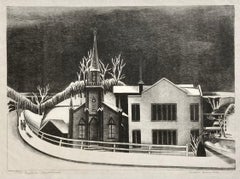
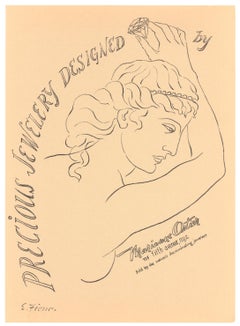
Medium: original lithograph. This lithograph is from the rare 1953 "Improvisations" portfolio, published by the Artists Equity Association of New York on the occasion of the 1953 Spr...

Category

1950s Ernest Fiene Art

Materials

Lithograph

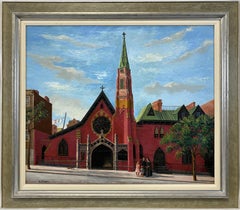
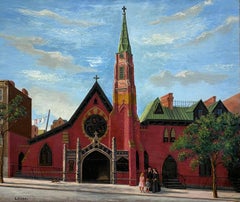
"St. Michael’s in Brooklyn", New York City Street Scene, Cityscape, Brick Church

"St. Michael’s in Brooklyn", New York City Street Scene, Cityscape, Brick Church

By Ernest Fiene

Located in Yardley, PA

“St. Michael’s in Brooklyn, c. 1944” by Ernest Fiene (1894-1965) New York City served as an endless source of inspiration for Fiene, who often captured street scenes like this one i...

Category

1940s American Modern Ernest Fiene Art

Materials

Canvas, Oil

NYC Cityscape American Scene WPA Modern Realism Mid 20th Century Architectural

NYC Cityscape American Scene WPA Modern Realism Mid 20th Century Architectural

By Ernest Fiene

Located in New York, NY

NYC Cityscape American Scene WPA Modern Realism Mid 20th Century Architectural Ernest Fiene (1894-1965) Cityscape 36 x 30 inches Oil on canvas Signed and dated 1930. lower right Provenance Estate of the artist. ACA Galleries, New York Exhibited New York, Frank Rehn Gallery, Changing Old New York, 1931. New York, ACA Galleries, Ernest Fiene: Art of the City, 1925-1955, May 2-23, 1981, n.p., no. 5. BIO Ernest Fiene was born in Elberfeld, Germany in 1894. As a teenager, Fiene immigrated to the United States in 1912. He studied art at the National Academy of Design in New York City from 1914 to 1918, taking day classes with Thomas Maynard and evening classes with Leon Kroll. Fiene continued his studies at the Beaux-Arts Institute of Design in New York from 1916 to 1918, adding classes in printmaking at the Art Students League in 1923. Fiene began his career as an artist in 1919 with his first exhibition of watercolors at the MacDowell Club arranged by his mentor Robert Henri. In 1923 the Whitney Studio Club mounted a large exhibition of his works. The following year he had an exhibition at the New Gallery in New York, which completely sold out all fifty-two works, including paintings, watercolors, drawings, and etchings. With the proceeds of sales from the New Gallery exhibition, Ernest Fiene and his younger brother Paul, a sculptor, built studios in Woodstock, New York in 1925. In the early Twenties Ernest Fiene painted mostly landscapes of Woodstock and both the Ramapo and Hudson River Valleys. The first monograph from the Younger Artists Series was published on Fiene in 1922. Published in Woodstock, the series went on to include Alexander Brook, Peggy Bacon, and Yasuo Kuniyoshi. The book reproduced 1 illustration in color and another 27 reproductions in black and white. Around 1925 Fiene became fascinated with the intensity, excitement, and opportunities for color harmonies New York City offered as a subject. His paintings shifted to urban and industrial themes with architecture, industry, and transportation becoming his subjects. By 1926 Fiene had attracted the dealer Frank K.M. Rehn, who gave him a one-man exhibition that year, which travelled to the Boston Arts Club. C.W. Kraushaar Galleries gave Fiene a one-man exhibition of urban, landscape, portrait, and still life paintings in 1927. Julianna Force, the director of the Whitney Studio Club and first director of the Whitney Museum of American Art, included two of Fiene’s paintings in a fall exhibition in 1928. The Whitney Studio Club showed Fiene’s paintings in a two-man exhibition with Glenn O. Coleman that year and acquired three of Fiene’s paintings. Also in 1928 Fiene became affiliated with Edith Halpert’s Downtown Gallery where he had an exhibition of 20 lithographs in the spring. Fiene sold his house in Woodstock in 1928 to spend more of his time in New York City. With so many successful exhibitions, Fiene returned to Paris in 1928-29 where he rented Jules Pascin's studio and studied at the Académie de la Grande Chaumière. In France, Fiene painted both landscape and urban subjects developed from ideas influenced by Cubist geometry and the use of flat areas of broad color. Upon returning to New York in 1930, Fiene used this new approach to continue to paint New York skyscraper and waterfront subjects, as well as to begin a series of paintings on changing old New York based on the excavations for Radio City Music Hall and the construction of the Empire State Building. Frank K.M. Rehn Galleries exhibited this series, titled “Changing Old New York,” in 1931. Fiene also has solo exhibitions at Rehn Galleries in 1930 and 1932. Fiene’s oil paintings are exhibited at the Chicago Arts Club in 1930 as well. Fiene was included in the Museum of Modern Art’s exhibition Painting and Sculpture by Living Americans in December of 1931. Visiting New York, Henri Matisse saw the exhibition and called Fiene’s Razing Buildings, West 49th Street the finest painting he had seen in New York. Fiene had two mural studies from his Mechanical Progress series exhibited at the Museum of Modern Art’s exhibition Murals by American Painters and Photographers in 1932. Fiene sent View from my Window which depicts Fiene working on a lithograph stone while looking out his window to the newly completed Empire State Building to the Carnegie International in 1931. In 1932 Fiene participated in the first Biennial of American Painting at the Whitney Museum and his prints were included in exhibitions at the Downtown Gallery and the Wehye Gallery. In the same year, Fiene was awarded a Guggenheim fellowship to further study mural painting in Florence, Italy. On his return from Italy in 1933 Fiene re-engaged himself in New York City life and won several public and private mural projects. Fiene resumed his active exhibition schedule, participating in two group exhibitions at the Whitney Museum and a one-man exhibition of recent paintings at the Downtown Gallery in January 1934. In 1933 he purchased a farm in Southbury, Connecticut, which added Connecticut scenes to his landscape subjects. This was also the year Fiene began to spend summers on Monhegan Island, Maine, where he painted seascapes, harbor scenes, and still lifes. Fiene’s landscape paintings attracted numerous commissions as part of the American Scene movement. Through the fall and winter of 1935-36, Fiene took an extended sketching trip through the urban, industrial, and farming areas of Pennsylvania and West Virginia. Most of the twenty-four Pennsylvania urban and rural paintings...

Category

1930s American Modern Ernest Fiene Art

Materials

Canvas, Oil

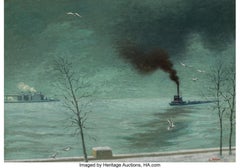
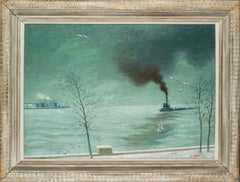
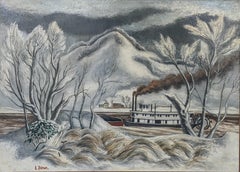
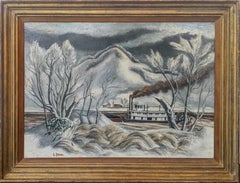
"Along the Kanahawa River, West Virginia, " Ernest Fiene, WPA Coal Steamboat

"Along the Kanahawa River, West Virginia, " Ernest Fiene, WPA Coal Steamboat

By Ernest Fiene

Located in New York, NY

Ernest Fiene Along the Kanahawa River, West Virginia, 1936 Signed lower right Oil on canvas 26 x 36 inches Fiene made a series of paintings, drawings and lithographs which are based on his travels through Pennsylvania and West Virginia during the winter of 1935-36. The industrial areas of Pennsylvania and West Virginia are represented in numerous oils, among which are some of his most well-known. Fiene wrote of the trip, "The increasing snow and atmospheric conditions [in the Kanawha River valley} enhanced this mountainous coal mining country with a majestic beauty." Winter on the River is Fiene's only American Artists Group print and there were only two lithographs produced from the West Virginia trip. The American Artists Group (AAG), under the direction of Carl Zigrosser, who was then working at New York's famed Weyhe Gallery, published ninety-three prints by over fifty artists in 1936 and 1937. Zigrosser's goal was to popularize contemporary American art through original prints offered at the low price of $2.75. The project was also a means to provide income for impoverished artists during the Depression. The prints were featured in many of the leading print exhibitions and publications of the period. The lithograph produced from this image is now in the collection of the Amon Carter Museum, Baltimore Museum of Art, Cleveland Museum of Art, Philadelphia Museum of Art, Pensacola Museum of Art, San Francisco Fine Arts Museum, Syracuse Museum, Yale University Art Museum. Ernest Fiene was born in Elberfeld, Germany in 1894. As a teenager, Fiene immigrated to the United States in 1912. He studied art at the National Academy of Design in New York City from 1914 to 1918, taking day classes with Thomas Maynard and evening classes with Leon Kroll. Fiene continued his studies at the Beaux-Arts Institute of Design in New York from 1916 to 1918, adding classes in printmaking at the Art Students League in 1923. Fiene began his career as an artist in 1919 with his first exhibition of watercolors at the MacDowell Club arranged by his mentor Robert Henri. In 1923 the Whitney Studio Club mounted a large exhibition of his works. The following year he had an exhibition at the New Gallery in New York, which completely sold out all fifty-two works, including paintings, watercolors, drawings, and etchings. With the proceeds of sales from the New Gallery exhibition, Ernest Fiene and his younger brother Paul, a sculptor, built studios in Woodstock, New York in 1925. In the early Twenties Ernest Fiene painted mostly landscapes of Woodstock and both the Ramapo and Hudson River Valleys. The first monograph from the Younger Artists Series was published on Fiene in 1922. Published in Woodstock, the series went on to include Alexander Brook, Peggy Bacon, and Yasuo Kuniyoshi. The book reproduced 1 illustration in color and another 27 reproductions in black and white. Around 1925 Fiene became fascinated with the intensity, excitement, and opportunities for color harmonies New York City offered as a subject. His paintings shifted to urban and industrial themes with architecture, industry, and transportation becoming his subjects. By 1926 Fiene had attracted the dealer Frank K.M. Rehn, who gave him a one-man exhibition that year, which travelled to the Boston Arts Club. C.W. Kraushaar Galleries gave Fiene a one-man exhibition of urban, landscape, portrait, and still life paintings in 1927. Julianna Force, the director of the Whitney Studio Club and first director of the Whitney Museum of American Art, included two of Fiene’s paintings in a fall exhibition in 1928. The Whitney Studio Club showed Fiene’s paintings in a two-man exhibition with Glenn O. Coleman that year and acquired three of Fiene’s paintings. Also in 1928 Fiene became affiliated with Edith Halpert’s Downtown Gallery where he had an exhibition of 20 lithographs in the spring. Fiene sold his house in Woodstock in 1928 to spend more of his time in New York City. With so many successful exhibitions, Fiene returned to Paris in 1928-29 where he rented Jules Pascin's studio and studied at the Académie de la Grande Chaumière. In France, Fiene painted both landscape and urban subjects developed from ideas influenced by Cubist geometry and the use of flat areas of broad color. Upon returning to New York in 1930, Fiene used this new approach to continue to paint New York skyscraper and waterfront subjects, as well as to begin a series of paintings on changing old New York based on the excavations for Radio City Music Hall and the construction of the Empire State Building. Frank K.M. Rehn Galleries exhibited this series, titled “Changing Old New York,” in 1931. Fiene also has solo exhibitions at Rehn Galleries in 1930 and 1932. Fiene’s oil paintings are exhibited at the Chicago Arts Club in 1930 as well. Fiene was included in the Museum of Modern Art’s exhibition Painting and Sculpture by Living Americans in December of 1931. Visiting New York, Henri Matisse saw the exhibition and called Fiene’s Razing Buildings, West 49th Street the finest painting he had seen in New York. Fiene had two mural studies from his Mechanical Progress series exhibited at the Museum of Modern Art’s exhibition Murals by American Painters and Photographers in 1932. Fiene sent View from my Window which depicts Fiene working on a lithograph stone while looking out his window to the newly completed Empire State Building to the Carnegie International in 1931. In 1932 Fiene participated in the first Biennial of American Painting at the Whitney Museum and his prints were included in exhibitions at the Downtown Gallery and the Wehye Gallery. In the same year, Fiene was awarded a Guggenheim fellowship to further study mural painting in Florence, Italy. On his return from Italy in 1933 Fiene re-engaged himself in New York City life and won several public and private mural projects. Fiene resumed his active exhibition schedule, participating in two group exhibitions at the Whitney Museum and a one-man exhibition of recent paintings at the Downtown Gallery in January 1934. In 1933 he purchased a farm in Southbury, Connecticut, which added Connecticut scenes to his landscape subjects. This was also the year Fiene began to spend summers on Monhegan Island, Maine, where he painted seascapes, harbor scenes, and still lifes. Fiene’s landscape paintings attracted numerous commissions as part of the American Scene movement. Through the fall and winter of 1935-36, Fiene took an extended sketching trip through the urban, industrial, and farming areas of Pennsylvania and West Virginia. Most of the twenty-four Pennsylvania urban and rural paintings from this trip were featured in an exhibition held at the First National Bank in Pittsburgh in October of 1937 by the Pittsburgh Commission for Industrial Expansion. Fiene said of these works that he formed rhythm, opportunity for space and color, and integrity in the Pennsylvania mill and furnace paintings. Fiene received the silver medal for one of the Pittsburgh paintings...

Category

1930s American Realist Ernest Fiene Art
Materials

Canvas, Oil

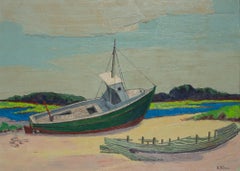
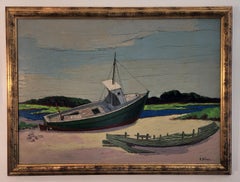
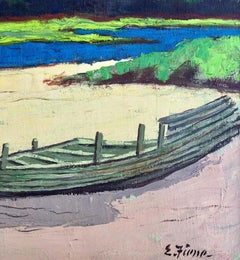
"Low Tide at Noon, Wellfleet, Massachusetts, " Ernest Fiene, WPA, Boat on Beach

"Low Tide at Noon, Wellfleet, Massachusetts, " Ernest Fiene, WPA, Boat on Beach

By Ernest Fiene

Located in New York, NY

Ernest Fiene (1894 - 1965) Low Tide at Noon, Wellfleet, Massachusetts Oil on canvas 26 x 36 inches Signed lower right Ernest Fiene was born in Elberfeld, Germany in 1894. As a teenager, Fiene immigrated to the United States in 1912. He studied art at the National Academy of Design in New York City from 1914 to 1918, taking day classes with Thomas Maynard and evening classes with Leon Kroll. Fiene continued his studies at the Beaux-Arts Institute of Design in Paris from 1916 to 1918, adding classes in printmaking at the Art Students League in 1923. Fiene began his career as an artist in 1919 with his first exhibition of watercolors at the MacDowell Club arranged by his mentor Robert Henri. In 1923 the Whitney Studio Club mounted a large exhibition of his works. The following year he had an exhibition at the New Gallery in New York, which completely sold out all fifty-two works, including paintings, watercolors, drawings, and etchings. With the proceeds of sales from the New Gallery exhibition, Ernest Fiene and his younger brother Paul, a sculptor, built studios in Woodstock, New York in 1925. In the early Twenties Ernest Fiene painted mostly landscapes of Woodstock and both the Ramapo and Hudson River Valleys. He was the subject of the first monograph for the Younger Artists Series in 1922. Published in Woodstock, the series went on to include Alexander Brook, Peggy Bacon, and Yasuo Kuniyoshi. The book reproduced 1 illustration in color and another 27 reproductions in black and white. Around 1925 Fiene became fascinated with the intensity, excitement, and opportunities for color harmonies New York City offered as a subject. His paintings shifted to urban and industrial themes with architecture, industry, and transportation becoming his subjects. By 1926 Fiene had attracted the dealer Frank K.M. Rehn, who gave him a one-man exhibition that year, which travelled to the Boston Arts Club. C.W. Kraushaar Galleries gave Fiene a one-man exhibition of urban, landscape, portrait, and still life paintings in 1927. Julianna Force, the director of the Whitney Studio Club and first director of the Whitney Museum of American Art, included two of Fiene's paintings in a fall exhibition in 1928. The Whitney Studio Club showed Fiene's paintings in a two-man exhibition with Glenn O. Coleman that year and acquired three of Fiene's paintings. Also in 1928 Fiene became affiliated with Edith Halpert's Downtown Gallery where he had an exhibition of 20 lithographs in the spring. Fiene sold his house in Woodstock in 1928 to spend more of his time in New York City. With so many successful exhibitions, Fiene returned to Paris in 1928-29 where he rented Jules Pascin's studio and studied at the Académie de la Grande Chaumière. In France, Fiene painted both landscape and urban subjects developed from ideas influenced by Cubist geometry and the use of flat areas of broad color. Upon returning to New York in 1930, Fiene used this new approach to continue to paint New York skyscraper and waterfront subjects, as well as to begin a series of paintings on changing old New York based on the excavations for Radio City Music Hall and the construction of the Empire State Building. Frank K.M. Rehn Galleries exhibited this series, titled "Changing Old New York," in 1931. Fiene also has solo exhibitions at Rehn Galleries in 1930 and 1932. Fiene's oil paintings are exhibited at the Chicago Arts Club in 1930 as well. Fiene was included in the Museum of Modern Art's exhibition Painting and Sculpture by Living Americans in December of 1931. Visiting New York, Henri Matisse saw the exhibition and called Fiene's Razing Buildings, West 49th Street the finest painting he had seen in New York. Fiene had two mural studies from his Mechanical Progress series exhibited at the Museum of Modern Art's exhibition Murals by American Painters and Photographers in 1932. Fiene sent View from my Window which depicts Fiene working on a lithograph stone while looking out his window to the newly completed Empire State Building to the Carnegie International in 1931. In 1932 Fiene participated in the first Biennial of American Painting at the Whitney Museum and his prints were included in exhibitions at the Downtown Gallery and the Wehye Gallery. In the same year, Fiene was awarded a Guggenheim fellowship to further study mural painting in Florence, Italy. On his return from Italy in 1933 Fiene re-engaged himself in New York City life and won several public and private mural projects. Fiene resumed his active exhibition schedule, participating in two group exhibitions at the Whitney Museum and a one-man exhibition of recent paintings at the Downtown Gallery in January 1934. In 1933 he purchased a farm in Southbury, Connecticut, which added Connecticut scenes to his landscape subjects. This was also the year Fiene began to spend summers on Monhegan Island, Maine, where he painted seascapes, harbor scenes, and still lifes. Fiene's landscape paintings attracted numerous commissions as part of the American Scene movement. From 1935-36 Fiene took an extended sketching trip through the urban, industrial, and farming areas of Pennsylvania and West Virginia. Most of the twenty-four Pennsylvania urban and rural paintings from this trip were featured in an exhibition held at the First National Bank in Pittsburgh in October of 1937 by the Pittsburgh Commission for Industrial Expansion. Fiene said of these works that he formed rhythm, opportunity for space and color, and integrity in the Pennsylvania mill and furnace paintings. Fiene received the silver medal for one of the Pittsburgh paintings...

Category

Mid-20th Century American Realist Ernest Fiene Art

Materials

Canvas, Oil

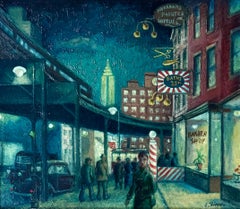
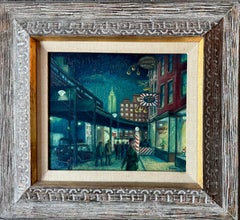
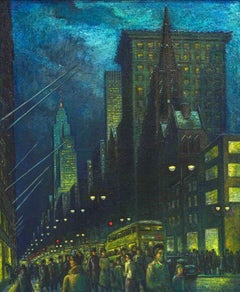
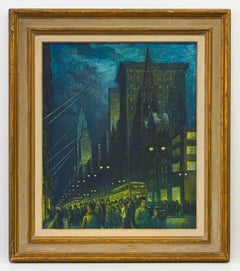
Winter Evening Fifth Avenue Nocturne - New York at Night

Winter Evening Fifth Avenue Nocturne - New York at Night

By Ernest Fiene

Located in Miami, FL

Ernest Fiene depicts Fifth Avenue, looking down from 57th Street, with an unobstructed view of the Empire State Building, as an evocation of night. The artist captures a dark, moody blue sky, with light bouncing back from the clouds. This contrasts with the somewhat haunting yellow glow given to pedestrians and street traffic. The absence of newer glass-and-steel architecture provides the painting with the charm of old New York. The people have a slightly zombie-like quality, akin to George Tooker. Condition: Good/Fair. Best viewed with a top and direct gallery light...

Category

1950s Post-Impressionist Ernest Fiene Art

Materials

Canvas, Oil

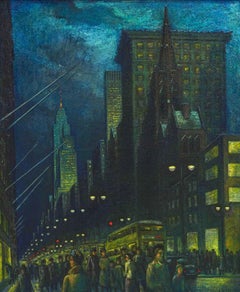
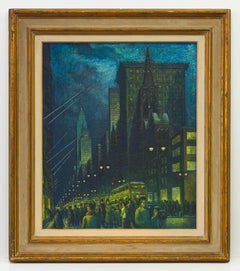
Winter Evening Fifth Avenue - New York at Night - Mid-Century.

Winter Evening Fifth Avenue - New York at Night - Mid-Century.

By Ernest Fiene

Located in Miami, FL

Mid-century New York City is represented as a moment in time. The artist populates his scene with isolated figures that are more shapes of people as opposed to specific individuals....

Category

1950s Post-Impressionist Ernest Fiene Art

Materials

Canvas, Oil

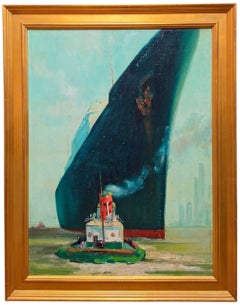
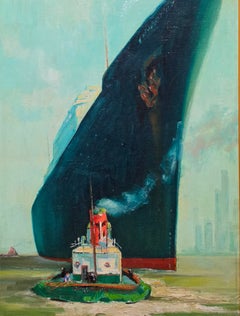
"Tugboat in New York Harbor" Ernest Fiene, Modernist, WPA, Cloudy Horizon

"Tugboat in New York Harbor" Ernest Fiene, Modernist, WPA, Cloudy Horizon

By Ernest Fiene

Located in New York, NY

Ernest Fiene Tugboat in New York Harbor Signed lower right Oil on canvas 24 1/2 x 34 1/2 inches Ernest Fiene was born in Elberfeld, Germany in 1894. As a teenager, Fiene immigrated...

Category

1930s American Modern Ernest Fiene Art

Materials

Oil, Canvas

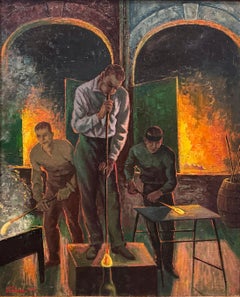
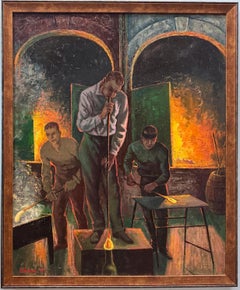
"Glassblowers" American Scene Social Realism Mid-20th Century New York City WPA

"Glassblowers" American Scene Social Realism Mid-20th Century New York City WPA

By Ernest Fiene

Located in New York, NY

"Glassblowers" American Scene Social Realism Mid-20th Century New York City WPA Ernest Fiene (1894-1965) Glass Blowers 28 x 23 inches Oil on canvas board Signed and dated 1944 lower...

Category

1940s American Modern Ernest Fiene Art

Materials

Oil, Canvas

Related Items
Late Afternoon  - Modernist Mid-Century Midwest Oil Painting

Late Afternoon - Modernist Mid-Century Midwest Oil Painting

Located in Marco Island, FL

A quintessential American Scene landscape painted by the Chicago Modernist, William Schwartz. Workers in tilled fields surrounding a farmstead under dramatic skies. Painted in 1935...

Category

1930s American Modern Ernest Fiene Art

Materials

Canvas, Oil

NYC EL American Scene Social Realism Mid 20th Century Modern WPA Era Figurative

NYC EL American Scene Social Realism Mid 20th Century Modern WPA Era Figurative

By Cecil Crosley Bell

Located in New York, NY

NYC EL American Scene Social Realism Mid 20th Century Modern WPA Era Figurative Cecil Bell (1906 – 1970) Street Life Under the EL 22 x 30 inches Oil on canvas, c. 1930s Signed upper...

Category

1930s American Realist Ernest Fiene Art
Materials

Canvas, Oil

A Colorful, Vintage 1950s Mid-Century Modern Martha's Vineyard Harbor Scene

A Colorful, Vintage 1950s Mid-Century Modern Martha's Vineyard Harbor Scene

By Francis Chapin

Located in Chicago, IL

A vibrant, colorful harbor scene of Martha's Vineyard by notable Chicago Modern artist, Francis Chapin (Am. 1899-1965). Depicting a quiet inlet with sandy shoreline, boat houses and...

Category

1950s American Modern Ernest Fiene Art

Materials

Oil, Canvas

Modernist Cityscape
Modernist Cityscape

Modernist Cityscape

By Esther Rollick

Located in Buffalo, NY

An original modernist oil painting by American female artist Esther Rollick.

Category

1940s American Modern Ernest Fiene Art

Materials

Canvas, Oil

Till the Clouds Roll By 1945 Frank Sinatra Mid Century Modern Hollywood Film WPA

Till the Clouds Roll By 1945 Frank Sinatra Mid Century Modern Hollywood Film WPA

By Richard Whorf

Located in New York, NY

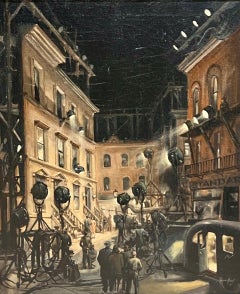
Till the Clouds Roll By 1945 Frank Sinatra Mid Century Modern Hollywood Film WPA TILL THE COULDS ROLL BY (Film Set), oil on canvas, 20 x 24 inches signed “Richard Whorf” lower right and signed and dated on the verso “R. Whorf/ Dec. 21, 1945. Frame by Hendenryk. ABOUT THE PAINTING This painting is from the collection of Barbara and Frank Sinatra, dated December 21, 1945 (just nine days after Frank Sinatra’s 30th birthday), and depicts the Metro-Goldwyn-Mayer Culver City backlot during the filming of Till the Clouds Roll By, the direction of the film having been taking over by Richard Whorf in December 1945. It is not presently clear if Whorf gave the Sinatras this painting as a gift, as the presence of the Dalzell Hatfield Galleries label on the verso indicates the painting may have been sourced there. Frank and Nancy Sinatra acquired a number of works from Dalzell Hatfield Galleries during the 1940’s, or perhaps they framed it for the couple. Sinatra performed “Old Man River’ in the film. Sinatra and June Allyson are depicted in the center of the painting. PROVENANCE From the Estate of Mrs. Nancy Sinatra; Dalzell Hatfield Galleries, Ambassador Hotel, Los Angeles. An image of the Dalzell Hatfield label and the back of the original frame (which we replaced with a stunning Heydenrk frame) are attached. Nancy Sinatra was Fran's first wife. Nancy Rose Barbato was 17 years old when she met Frank Sinatra, an 18-year-old singer from Hoboken, on the Jersey Shore in the summer of 1934. They married in 1939 at Our Lady of Sorrows Church in Jersey City where Frank gave Nancy a recording of a song dedicated to her titled "Our Love" as a wedding present. The young newlyweds lived and worked in New Jersey, where Frank worked as an unknown singing waiter and master of ceremonies at the Rustic Cabin while Nancy worked as a secretary at the American Type Founders. His musical career took off after singing with big band leaders Harry James and Tommy Dorsey...

Category

1940s American Modern Ernest Fiene Art

Materials

Canvas, Oil

"Glassblowers" American Scene Social Realism Mid-20th Century New York City WPA

"Glassblowers" American Scene Social Realism Mid-20th Century New York City WPA

By Ernest Fiene

Located in New York, NY

"Glassblowers" American Scene Social Realism Mid-20th Century New York City WPA Ernest Fiene (1894-1965) Glass Blowers 28 x 23 inches Oil on canvas board Signed and dated 1944 lower...

Category

1940s American Modern Ernest Fiene Art

Materials

Oil, Canvas

1930s Mexican City Scene by Chicago Artist Francis Chapin, City Plaza, Guaymas

1930s Mexican City Scene by Chicago Artist Francis Chapin, City Plaza, Guaymas

By Francis Chapin

Located in Chicago, IL

A charming, vibrant, 1930s Modern Mexican city street scene by famed Chicago Modern artist Francis Chapin (Am. 1899-1965). Depicting a picturesque view of a quiet square in the hist...

Category

1930s American Modern Ernest Fiene Art

Materials

Oil, Canvas

NYC 1939 World's Fair Mural Study American Scene WPA Modern Mid 20th Century

NYC 1939 World's Fair Mural Study American Scene WPA Modern Mid 20th Century

Located in New York, NY

NYC 1939 World's Fair Mural Study American Scene WPA Modern Mid 20th Century Eugene Savage (1883 – 1978) 1939 World’s Fair Mural Study 45 x 30 inches Oil on Canvas Signed lower right The painting is part of a 1,000 piece collection of art and objects from the 1939 World’s Fair. The collection as a whole is available. Savage created the mural for the facade of the Communications Building. An image of the completed mural, along with a published postcard, is part of the listing. Note the center top female figure, she resembles the figure in the offered painting. BIO Eugene Francis Savage was born in Covington, Indiana 1883. He underwent various forms of art training in the early years. He was a pupil of The Corcoran Gallery and The Art Institute of Chicago, and was later awarded a fellowship to study in Rome at The American Academy. While under the spell of that ancient city the young artist began to render historic figures that were suitable for the classic style needed for mural painting in the traditional manor. During this period he was able to study and observe Roman and Greek sculpture, although much of the academic training was accomplished by using plaster casts along with the incorporation of live models. This method survived and was used efficiently throughout Europe and the United States. After leaving the Academy, Savage was commissioned to paint numerous murals throughout the United States and Europe. This artist received acclaim for the works he produced while under commissions from various sources. This young master was a contemporary of Mexican muralists David Alfaro Siqueiros (1896-1974), Jose Clemente Orozco (1883-1949) and Diego Rivera (1886-1957). In this period he was to show the influence of his contemporaries in formulating a modern style. Savage also played a vital role in the WPA Federal Art program, and he was a member of The Mural Art Guild.. Savage was elected an associate member of The National Academy of Design in 1924 and a full member in 1926. From 1947, he held a professorship at Yale University where he taught mural painting, and some of his students went on to significant positions. By this time the artist had painted large-scale murals at Columbia, Yale University, Buffalo N.Y., Dallas, Texas, Chicago, Indiana, along with other commissioned works. He also achieved recognition for a series of murals commissioned by the Matson Shipping Line and completed around 1940. For this commission, Savage made many exacting studies of customs and folkways of the Hawaiian natives. However, the award-winning murals were not installed as planned but were put in storage during the war years when the ships were used for troop transportation and were in danger of attack. However the mural images were reproduced and distributed by the shipping company including nine of the mural scenes that were made into lithographed menu covers in 1948. The American Institute of Graphic Arts awarded certificates of excellence for their graphic production, and the Smithsonian Institute exhibited the works in 1949. Today Savages' Hawaiian Art production is held in high regard by collectors of Hawaiian nostalgia. In later years the artist focused his attention on a theme that dealt with the customs and tribal traditions of the Seminole Indians of Florida. He produced many variations of this theme throughout his lifetime, and the pictures were usually modest scale easel paintings, precise and carefully delineated. Many of these pictures incorporate Surrealistic elements and show some minor stylistic influences of the painters Kay Sage...

Category

1930s American Modern Ernest Fiene Art

Materials

Canvas, Oil

A Charming 1940s Summer Harbor Scene of Saugatuck, Michigan, Bathers & Boathouse

A Charming 1940s Summer Harbor Scene of Saugatuck, Michigan, Bathers & Boathouse

By Francis Chapin

Located in Chicago, IL

A charming, colorful summer harbor scene in Saugatuck, Michigan by notable Chicago Modern artist, Francis Chapin. Dating circa 1945, oil on board, the painting depicts a lively summ...

Category

1940s American Modern Ernest Fiene Art

Materials

Oil, Board

Original Oil Painting American Modern Mediterranean Village Colorful Cityscape

Original Oil Painting American Modern Mediterranean Village Colorful Cityscape

Located in Buffalo, NY

Dorothy Rivo Untitled (Mediterranean Village), c. 1960s–70s Oil on canvas Framed dimensions: 24 in. H × 36 in. W Presented in a contemporary white floater frame In Untitled (Mediter...

Category

Mid-20th Century American Modern Ernest Fiene Art

Materials

Canvas, Oil

Previously Available Items
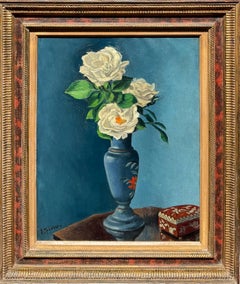
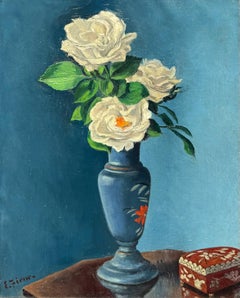
“White Roses in Blue Vase”

“White Roses in Blue Vase”

By Ernest Fiene

Located in Southampton, NY

Original oil on canvas painting of white roses in a blue vase by the well known American artist, Ernest Fiene. Signed lower left by the artist. Titled and signed verso. Condition is...

Category

1930s Cubist Ernest Fiene Art

Materials

Canvas, Oil

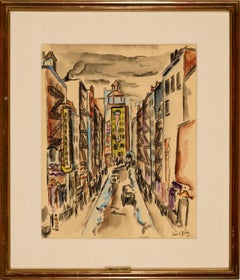
"China Town" Ernest Fiene, 1925 Modernist Watercolor on Paper Chinatown Scene

"China Town" Ernest Fiene, 1925 Modernist Watercolor on Paper Chinatown Scene

By Ernest Fiene

Located in New York, NY

Ernest Fiene China Town, 1925 Signed and dated to lower right ‘Ernest Fiene 1925’. Watercolor on paper 18 1/2 x 14 5/8 inches Ernest Fiene was born in Elberfeld, Germany in 1894. As a teenager, Fiene immigrated to the United States in 1912. He studied art at the National Academy of Design in New York City from 1914 to 1918, taking day classes with Thomas Maynard and evening classes with Leon Kroll. Fiene continued his studies at the Beaux-Arts Institute of Design in New York from 1916 to 1918, adding classes in printmaking at the Art Students League in 1923. Fiene began his career as an artist in 1919 with his first exhibition of watercolors at the MacDowell Club arranged by his mentor Robert Henri. In 1923 the Whitney Studio Club mounted a large exhibition of his works. The following year he had an exhibition at the New Gallery in New York, which completely sold out all fifty-two works, including paintings, watercolors, drawings, and etchings. With the proceeds of sales from the New Gallery exhibition, Ernest Fiene and his younger brother Paul, a sculptor, built studios in Woodstock, New York in 1925. In the early Twenties Ernest Fiene painted mostly landscapes of Woodstock and both the Ramapo and Hudson River Valleys. The first monograph from the Younger Artists Series was published on Fiene in 1922. Published in Woodstock, the series went on to include Alexander Brook, Peggy Bacon, and Yasuo Kuniyoshi. The book reproduced 1 illustration in color and another 27 reproductions in black and white. Around 1925 Fiene became fascinated with the intensity, excitement, and opportunities for color harmonies New York City offered as a subject. His paintings shifted to urban and industrial themes with architecture, industry, and transportation becoming his subjects. By 1926 Fiene had attracted the dealer Frank K.M. Rehn, who gave him a one-man exhibition that year, which travelled to the Boston Arts Club. C.W. Kraushaar Galleries gave Fiene a one-man exhibition of urban, landscape, portrait, and still life paintings in 1927. Julianna Force, the director of the Whitney Studio Club and first director of the Whitney Museum of American Art, included two of Fiene’s paintings in a fall exhibition in 1928. The Whitney Studio Club showed Fiene’s paintings in a two-man exhibition with Glenn O. Coleman that year and acquired three of Fiene’s paintings. Also in 1928 Fiene became affiliated with Edith Halpert’s Downtown Gallery where he had an exhibition of 20 lithographs in the spring. Fiene sold his house in Woodstock in 1928 to spend more of his time in New York City. With so many successful exhibitions, Fiene returned to Paris in 1928-29 where he rented Jules Pascin's studio and studied at the Académie de la Grande Chaumière. In France, Fiene painted both landscape and urban subjects developed from ideas influenced by Cubist geometry and the use of flat areas of broad color. Upon returning to New York in 1930, Fiene used this new approach to continue to paint New York skyscraper and waterfront subjects, as well as to begin a series of paintings on changing old New York based on the excavations for Radio City Music Hall and the construction of the Empire State Building. Frank K.M. Rehn Galleries exhibited this series, titled “Changing Old New York,” in 1931. Fiene also has solo exhibitions at Rehn Galleries in 1930 and 1932. Fiene’s oil paintings are exhibited at the Chicago Arts Club in 1930 as well. Fiene was included in the Museum of Modern Art’s exhibition Painting and Sculpture by Living Americans in December of 1931. Visiting New York, Henri Matisse saw the exhibition and called Fiene’s Razing Buildings, West 49th Street the finest painting he had seen in New York. Fiene had two mural studies from his Mechanical Progress series exhibited at the Museum of Modern Art’s exhibition Murals by American Painters and Photographers in 1932. Fiene sent View from my Window which depicts Fiene working on a lithograph stone while looking out his window to the newly completed Empire State Building to the Carnegie International in 1931. In 1932 Fiene participated in the first Biennial of American Painting at the Whitney Museum and his prints were included in exhibitions at the Downtown Gallery and the Wehye Gallery. In the same year, Fiene was awarded a Guggenheim fellowship to further study mural painting in Florence, Italy. On his return from Italy in 1933 Fiene re-engaged himself in New York City life and won several public and private mural projects. Fiene resumed his active exhibition schedule, participating in two group exhibitions at the Whitney Museum and a one-man exhibition of recent paintings at the Downtown Gallery in January 1934. In 1933 he purchased a farm in Southbury, Connecticut, which added Connecticut scenes to his landscape subjects. This was also the year Fiene began to spend summers on Monhegan Island, Maine, where he painted seascapes, harbor scenes, and still lifes. Fiene’s landscape paintings attracted numerous commissions as part of the American Scene movement. Through the fall and winter of 1935-36, Fiene took an extended sketching trip through the urban, industrial, and farming areas of Pennsylvania and West Virginia. Most of the twenty-four Pennsylvania urban and rural paintings from this trip were featured in an exhibition held at the First National Bank in Pittsburgh in October of 1937 by the Pittsburgh Commission for Industrial Expansion. Fiene said of these works that he formed rhythm, opportunity for space and color, and integrity in the Pennsylvania mill and furnace paintings. Fiene received the silver medal for one of the Pittsburgh paintings...

Category

1920s Modern Ernest Fiene Art

Materials

Paper, Watercolor

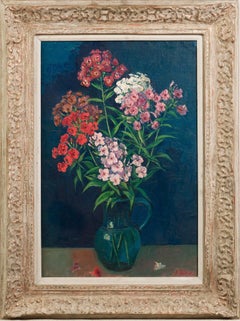
Phlox Flower Still Life Oil Painting Antique Exhibited Large Framed Oil Painting

Phlox Flower Still Life Oil Painting Antique Exhibited Large Framed Oil Painting

By Ernest Fiene

Located in Buffalo, NY

Antique oil on canvas by Ernest Fiene (1894 - 1965) . This work was exhibited at Midtown Galleries. Housed in its original modernist frame as well. Perfect and ready to hang! Tit...

Category

1930s Modern Ernest Fiene Art

Materials

Canvas, Oil

Dyckman Street Church (NYC)

Ernest FieneDyckman Street Church (NYC), 1926

Sold

H 11.13 in W 15.38 in D 0.13 in

Dyckman Street Church (NYC)

By Ernest Fiene

Located in New York, NY

Samuel Thomson was a builder and owner of the property where this church was built. (He also built Portico Place, at 143 West 13th Street, in 1846 --...

Category

1920s American Modern Ernest Fiene Art

Materials

Lithograph

Ernest Fiene (1894-1965) "Oysters" Still Life Oil Painting C.1940

Ernest Fiene (1894-1965) "Oysters" Still Life Oil Painting C.1940

By Ernest Fiene

Located in San Francisco, CA

Ernest Fiene (1894-1965) "Oysters" Still Life Oil Painting c.1940 Original oil on canvas. Dimensions 12" wide x 6" high. The frame measures 20" wide x 14" high. Signed in the lower...

Category

Early 20th Century Impressionist Ernest Fiene Art

Materials

Canvas, Oil

Low Tide
Low Tide

Ernest FieneLow Tide, 1930

Sold

H 35 in W 45 in D 2 in

Low Tide

By Ernest Fiene

Located in Wiscasett, ME

Oil on canvas, signed lower right. Probably the original frame (signed by frame maker on reverse) measuring overall 35" x 45" and canvas measurement of 26" x 36". In overall excellen...

Category

1930s Post-Impressionist Ernest Fiene Art

Materials

Oil

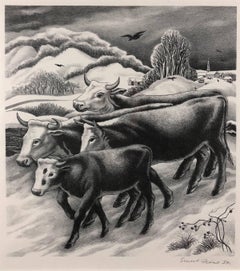
Winter Morning
Winter Morning

Winter Morning

By Ernest Fiene

Located in New Orleans, LA

Ernest Fiene's artwork often focused on bringing out the humanity of a space while simultaneously deconstructing it into abstract shapes. Fiene was born in Elberfeld, Germany in 18...

Category

1930s American Modern Ernest Fiene Art

Materials

Lithograph

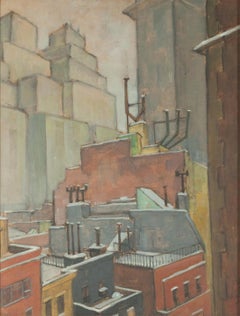
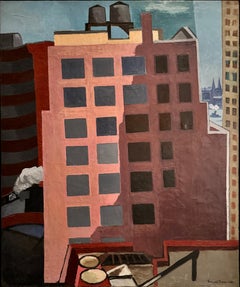
Rooftops, New York

Rooftops, New York

By Ernest Fiene

Located in New York, NY

Signed and dated lower right: E. Fiene ‘30

Category

20th Century American Modern Ernest Fiene Art

Materials

Paper, Gouache, Board

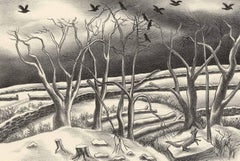
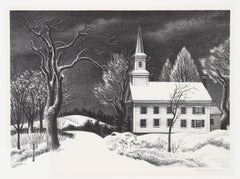
"New Snow", Signed Lithograph by Ernest Fiene

"New Snow", Signed Lithograph by Ernest Fiene

By Ernest Fiene

Located in Long Island City, NY

Artist: Ernest Fiene, German/American (1894 - 1966) Title: New Snow Year: circa 1945 Medium: Lithograph, signed in pencil Image Size: 9.5 x 13 inches Size: 12 in. x 16 in. (30.48 cm ...

Category

1940s American Modern Ernest Fiene Art

Materials

Lithograph

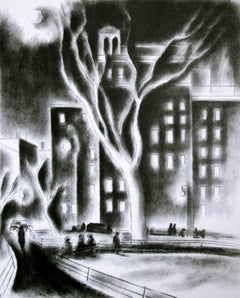
Washington Square, No. 2

Ernest FieneWashington Square, No. 2, 1928

Sold

H 24 in W 20 in D 0.5 in

Washington Square, No. 2

By Ernest Fiene

Located in Plano, TX

Washington Square, No. 2. 1928. Lithograph. Coven 44. 14 3/8 X 11 5/8 (sheet 19 5/8 x 15 5/8). Edition 30, #28. Printed on the full sheet of cream wove paper. Slight wrinkling in the right-hand margin; otherwise fine condition. Signed, dated, titled, and numbered in pencil. A richly-inked impression of this scarce lithograph. Housed in a 24 x 20-inch archival mat, suitable for framing. The "Washington Arch...

Category

1920s American Modern Ernest Fiene Art

Materials

Lithograph

Mid-Winter
Mid-Winter

Ernest FieneMid-Winter, 1939

Sold

H 21 in W 19.75 in

Mid-Winter

By Ernest Fiene

Located in Missouri, MO

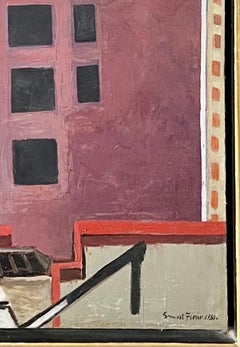
This is a beautiful hand signed and dated lithograph from 1939. He only produced an edition of 250. Beautifully framed and in excellent condition. Ernest Fiene "Mid-Winter&quo...

Category

1930s American Realist Ernest Fiene Art
Materials

Lithograph

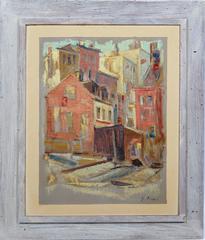
Lower East Side, New York City

Lower East Side, New York City

By Ernest Fiene

Located in Buffalo, NY

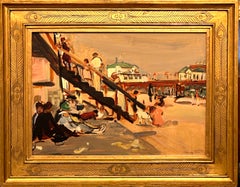
A modernist view of downtown New York City by Ernest Fiene (1894-1965). Oil on board, circa 1930. Signed lower right, "Fiene." Image size, 22"L x 28"H.

Category

1920s American Modern Ernest Fiene Art
Materials

Canvas, Oil

Ernest Fiene art for sale on 1stDibs.
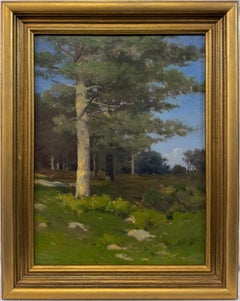
Find a wide variety of authentic Ernest Fiene art available for sale on 1stDibs. You can also browse by medium to find art by Ernest Fiene in oil paint, paint, canvas and more. Much of the original work by this artist or collective was created during the 20th century and is mostly associated with the Post-Impressionist style. Not every interior allows for large Ernest Fiene art, so small editions measuring 9 inches across are available. Customers who are interested in this artist might also find the work of Edwin Georgi, Lorraine Fox, and Cecil Crosley Bell. Ernest Fiene art prices can differ depending upon medium, time period and other attributes. On 1stDibs, the price for these items starts at $100 and tops out at $70,000, while the average work can sell for $10,000.
Artists Similar to Ernest Fiene