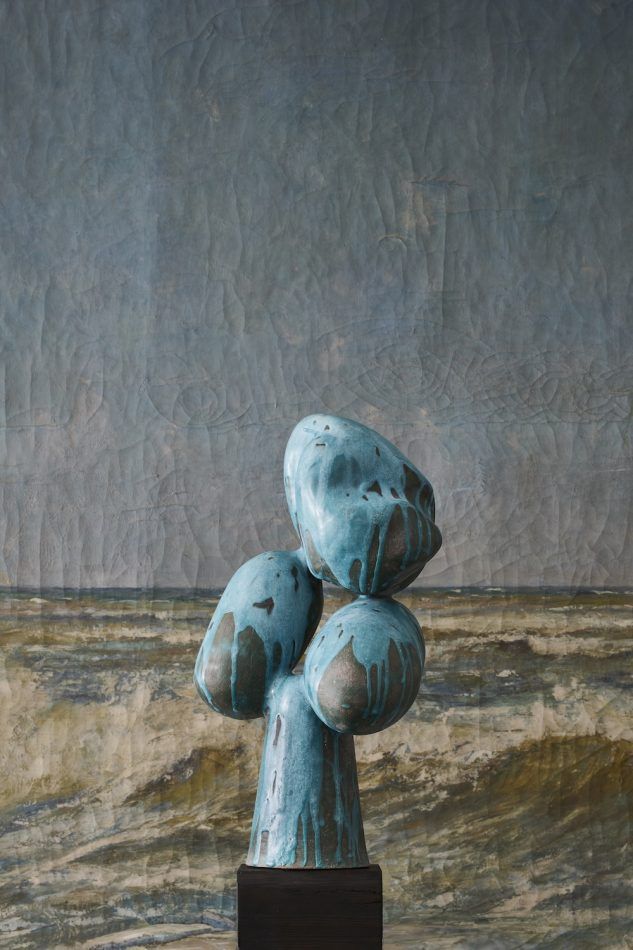
David Haskell’s ceramics challenge the laws of physics and the rules of perception with volumes that press skywards in mind-boggling balancing acts and painstakingly applied glazes that flow down to terra firma. Adding to the canon of abstract modernist sculpture, they exude equal measures of assertiveness and precariousness that resonate with interior designers that include Damon Liss, Rafael de Cárdenas and Thad Hayes, as well as collectors like media mogul Barry Diller.
“I’m often working in a minor key,” the artist says of his totemic constructions. “Anxiety is an interesting emotion to play with, and a piece that reads as structurally unstable is thrilling and sometimes unnerving.”
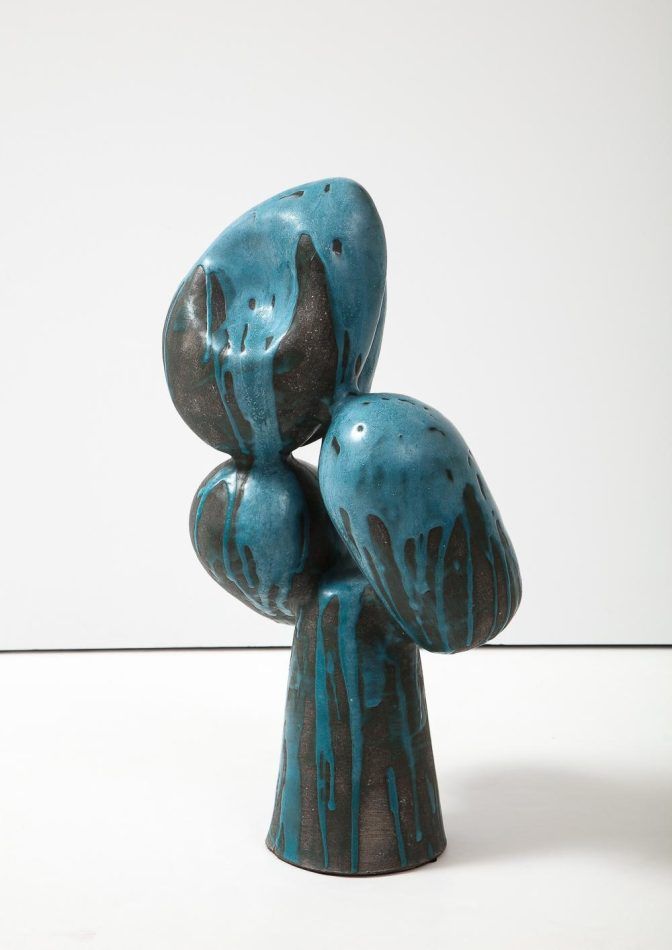
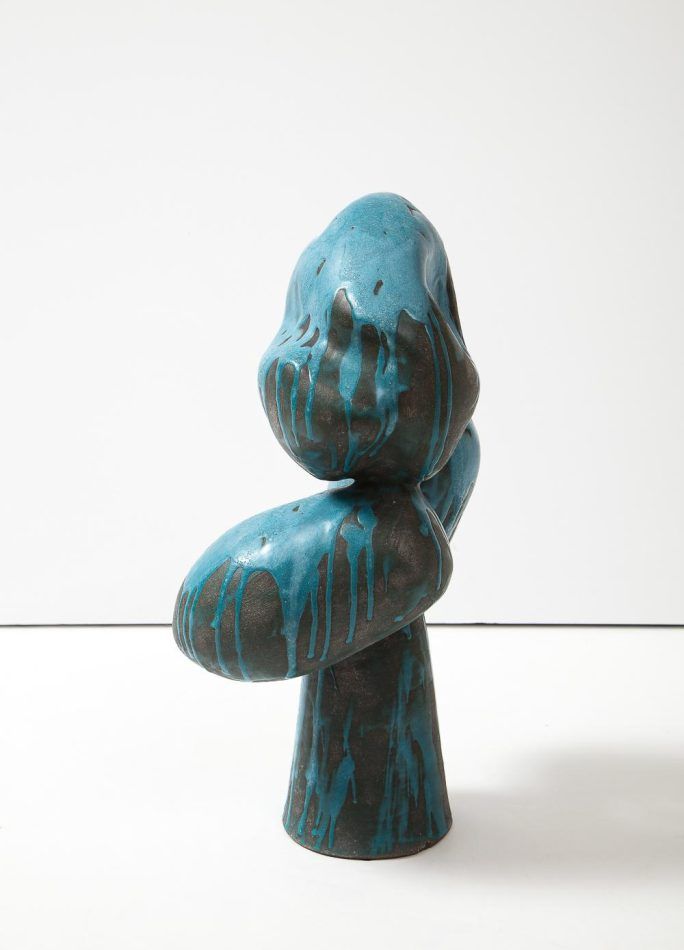
That is undeniably true of Haskell’s 2022 4 Pc. Assemblage Sculpture #3. The black clay work dripping with turquoise glaze is on display, alongside his recent bronze and glass pieces, at Donzella Ltd. in New York City through June 30 in a show titled “David Haskell: Boom Beach,” referring to a stretch of coastline on an island in Maine that has inspired the artist’s work.
“The surfaces are perfectly smooth, and yet they hit me as dented, deflated, almost injured,” Paul Donzella, the founder of the 20th-century-design gallery, says of the wheel-thrown elements in Haskell’s assemblages. “These forms are tumbling and somehow manage to stop at the edge before they fall off, which I find so compelling.” Assemblage Sculpture #3, which measures 19.5 inches tall, served as the inspiration for the exhibition’s hero piece, a six-foot-tall bronze cast at the Chipon Foundry in France. “Three ovoid shapes on a conic base are iconic pieces for David,” Donzella adds. “He’s been making these almost since the beginning.”
Raised in New York City and Connecticut, Haskell began throwing clay as a teenager, getting a kick wheel for his 16th birthday in 1995. After earning a BA at Yale, however, he followed his passion for architectural history, studying at Cambridge University, where he also created Topic magazine. After relocating to New York City, he became the founding executive director of the Urban Design Forum and worked at New York Magazine, where he has been editor in chief since 2019. He also became a partner in the whiskey company Kings County Distillery in 2010.
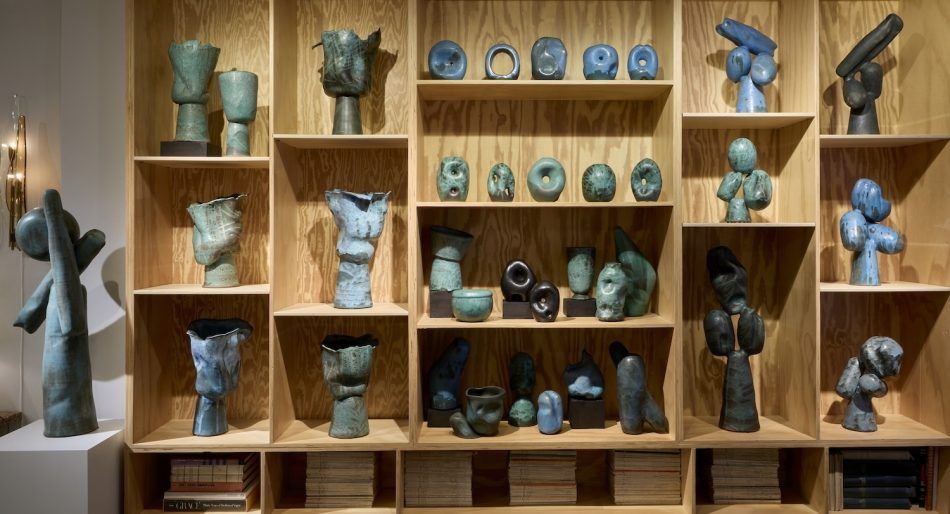
Haskell returned to ceramics in 2013, seeing it as a creative endeavor that was, he explains, “more solitary, my own actual project, a pure exploration of form.” By 2015, he was showing planters paired with cacti at Coming Soon, a home decor store in New York City. Donzella, cursed with a brown thumb, admits he “bought the plants just to get the pots” and encouraged Haskell to create nonfunctional works as part of the gallery’s roster of contemporary ceramic artists, which includes Chris Gustin, Lucien Petit and Rosanne Sniderman.
“From the get-go, I was inspired by the scale of Henry Moore and Barbara Hepworth sculptures and Isamu Noguchi’s relationship to nature,” says Haskell, who cites the Noguchi Museum in Long Island City as his favorite place in New York. “I was interested in what happened as I started pressing the physical limits of wheel-thrown pieces, attaching them together and referencing natural forms — sometimes humans, plants and stacked rocks, like the cairns I used to see when I went hiking. I want the pieces to feel organically old and evoke emotion that comes from experience, like that feeling you have coming up against a mature oak tree planted in the 1800s.”
Haskell’s sculptures scratch Donzella’s itch for organic and architectural ceramics. “I am drawn to strong forms, and they are not wallflowers. They also don’t overpower the pieces they are shown with,” he says, noting that Haskell’s works pair handsomely with Arts and Crafts, Art Deco and Italian modern furniture, Frank Lloyd Wright gentleman’s chests and bronze tables by Philip and Kelvin LaVerne.
“Like so many collectors, I feel an internal aesthetic connection to David’s work,” Donzella adds. “You see it, you walk away, and you’re haunted by it until you have to take it home.”