Gunnel Nyman is remembered, above all, as a glass artist. Her fluid, organic forms for Iittala and Nuutajärvi helped establish Finland’s international reputation for fine glass design, and her work in this medium is represented in the collections of the British Museum, MoMA and the Metropolitan Museum of Art. But Nyman was trained first as a furniture designer, and a rare secretaire she created for the 1937 Paris International Exposition offers a counterpoint to the narrower vision of her legacy.
“What struck me immediately was how organic the piece feels,” says Naomi Verbeek, head of collection at MORENTZ, which is offering the piece on 1stDibs. “Although it’s a relatively compact writing cabinet, it possesses a sculptural presence that goes beyond pure utility. It doesn’t read as a functional object onto which aesthetic decisions were later applied. Rather, it feels like a carefully composed whole in which form, material and detail are inseparable.”
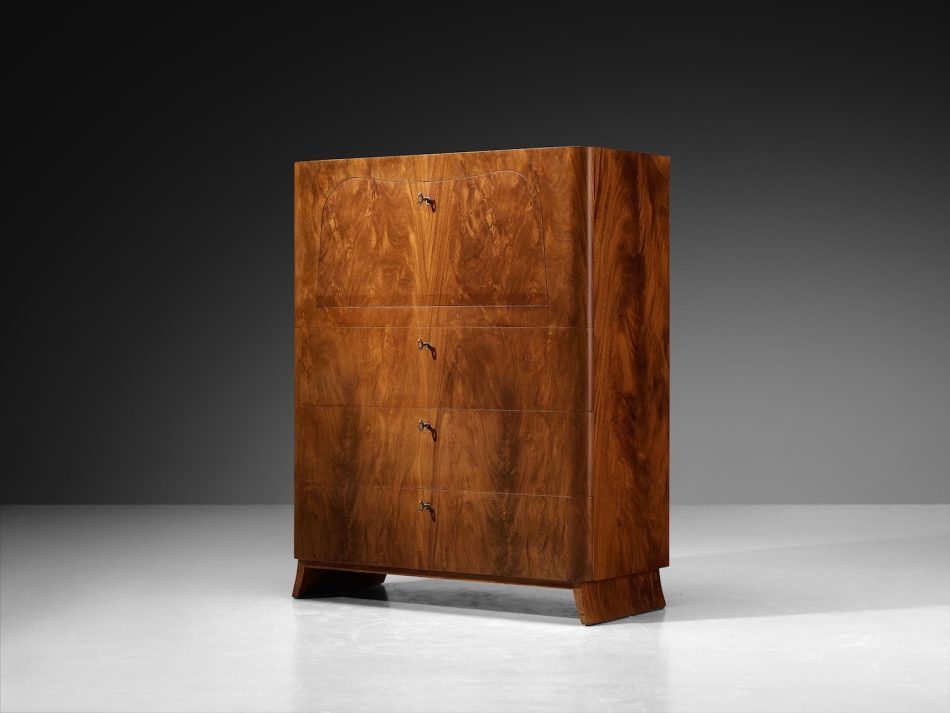
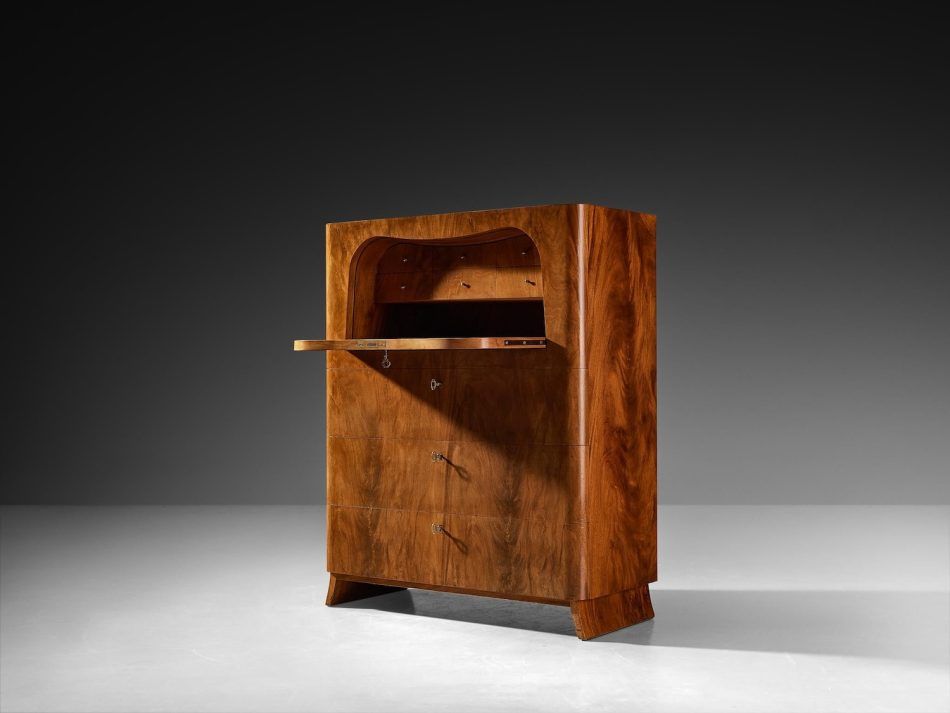
The cabinet was produced in collaboration with Oy Boman Ab, Finland’s oldest furniture manufacturer and one of the country’s most accomplished cabinetmaking houses. Its defining material is pyramid mahogany, a rare veneer cut from the fork where a trunk divides into major branches, resulting in the swirling, mirrored grain patterns that give the material its common name. Nyman and Boman’s craftsmen bookmatched the sheets of veneer across the cabinet’s facade so that the figure radiates outward from the center, producing the impression of a growing, living thing.
“Rather than treating the veneer as a decorative surface applied to an existing structure, Nyman allowed the material itself to become a defining element of the design,” Verbeek says. “There is virtually no applied ornament, yet the piece feels luxurious because the material itself provides all the visual drama that’s needed.”
The secretaire also has historical significance. By 1937, Nordic design was in transition, moving away from the rigors of early functionalism (with its machine aesthetics and geometry) toward something warmer. In Sweden, Josef Frank began expanding the range of modern interiors when he joined Svenskt Tenn, while in Finland, Alvar Aalto showed that modernism and organic form were not mutually exclusive. Nyman’s secretaire exemplifies this shift with its rounded silhouette, dynamic surface and humanistic spirit.
“The Paris exhibition was one of the key stages on which this new, softer interpretation of modern design was presented to an international audience,” says Verbeek. “In many ways, the secretaire embodies that moment: modern in spirit, yet warm, tactile and connected to craftsmanship and materiality. It stands as a beautiful expression of the more humanistic direction that Nordic design would come to represent internationally.”
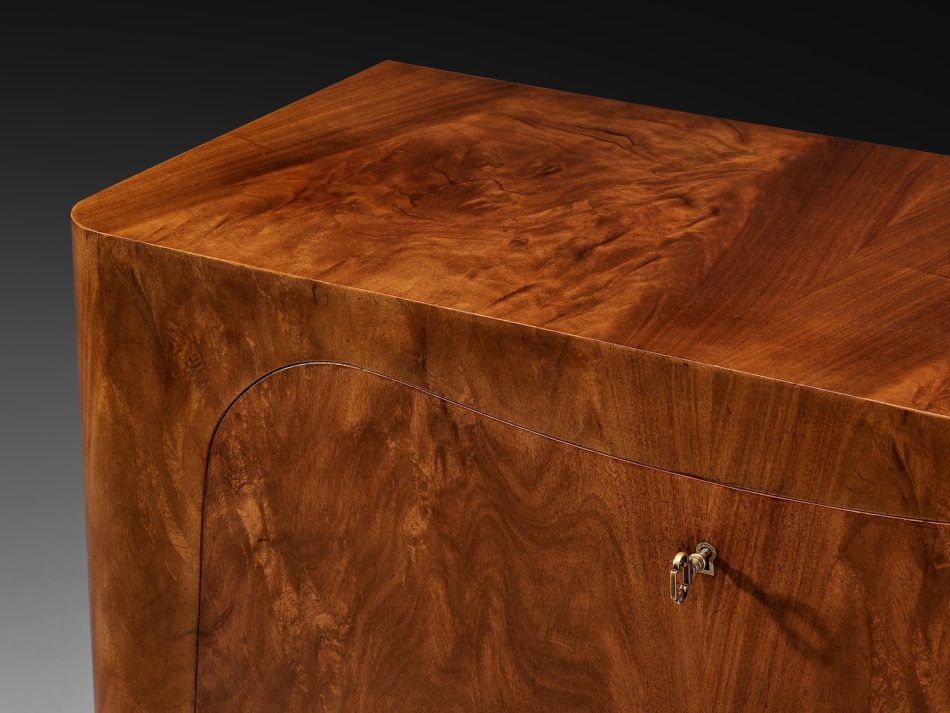
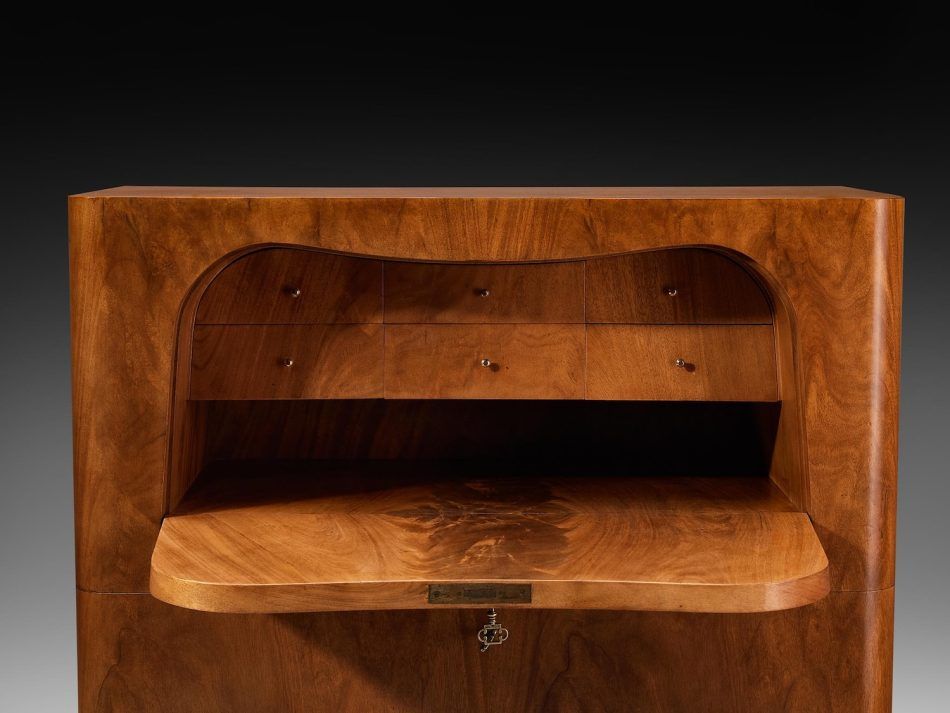
Verbeek notes that the rounded corners allow the grain to flow unbroken around the cabinet. The fall-front writing surface closes along a softly undulating contour rather than a hard geometric line, and the legs taper in a sculptural way. “What is sometimes overlooked is that such apparent simplicity is the result of extraordinary craftsmanship,” she says. “Perfect joints, precise curves, seamlessly smooth surfaces — the meticulously matched veneers and the refinement of every transition reveal the level of expertise for which Boman was renowned.”
Nyman’s furniture appears on the market far less often than her glass, making this secretaire quite rare within her oeuvre. But it exercises a far deeper appeal, demonstrating the cross-genre scope of her sensitivity to material and attunement to natural form. “This secretaire is a particularly compelling example because it reveals Nyman as a complete designer,” Verbeek says, “who is capable of translating her artistic vision across different media.”