Across ancient cultures, malachite was revered as a symbol of feminine energy and transformation. In Egypt, the deep-green stone, with its distinctive swirls, was associated with fertility and regeneration. In Rome, it was linked to the goddess Juno, embodying female power and protection. And, moving to the New World, it was used in the funerary mask of the Mayan Red Queen of Palenque, now in the collection of New York’s Metropolitan Museum of Art.
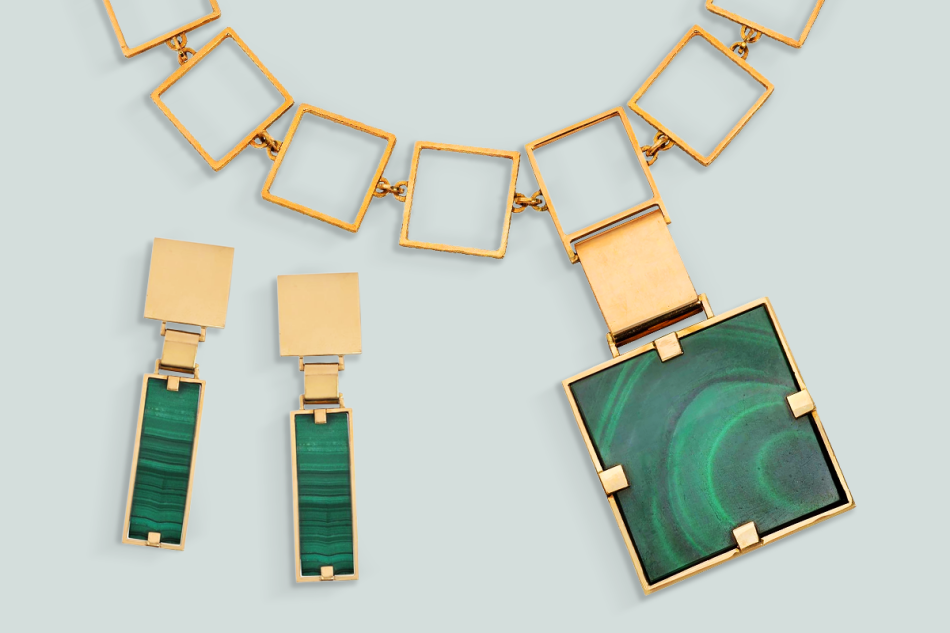
In this distinctly architectural jewelry suite, malachite is cut into large rectilinear plaquettes, which showcase the stone’s intense tonal depth and organic patterning. The metalwork echoes that geometry, the interconnected forms creating a sense of unity.
And the necklace resonates with the mysteries of ancient worlds. Designed in 1970 by the celebrated Canadian jeweler Karl Stittgen (1930–2023), it subtly recalls the broad gold collars worn by Egyptian queens and pharaohs or perhaps a torc of imperial Byzantium. Yet the set is also unmistakably modern. Its finely crafted lines and structural precision embody a pared-back, sculptural modernism and glamour, recalling the work of Frank Lloyd Wright, who influenced Stittgen. It’s easy to imagine a style icon like Bianca Jagger or Marisa Berenson wearing it in the disco ’70s — or even today.
For Mahnaz Ispahani Bartos, the respected collector, curator and founder of New York’s Mahnaz Collection gallery, who is offering the suite on 1stDibs, it belongs to a special category comprising one-of-a-kind pieces that occupy the fertile ground between jewelry and fine art. She is drawn to jewels with an unmistakable presence, that transcend the purely decorative and assert themselves as expressions of artistic imagination. It is this quality that she finds so compelling in Stittgen’s pieces.
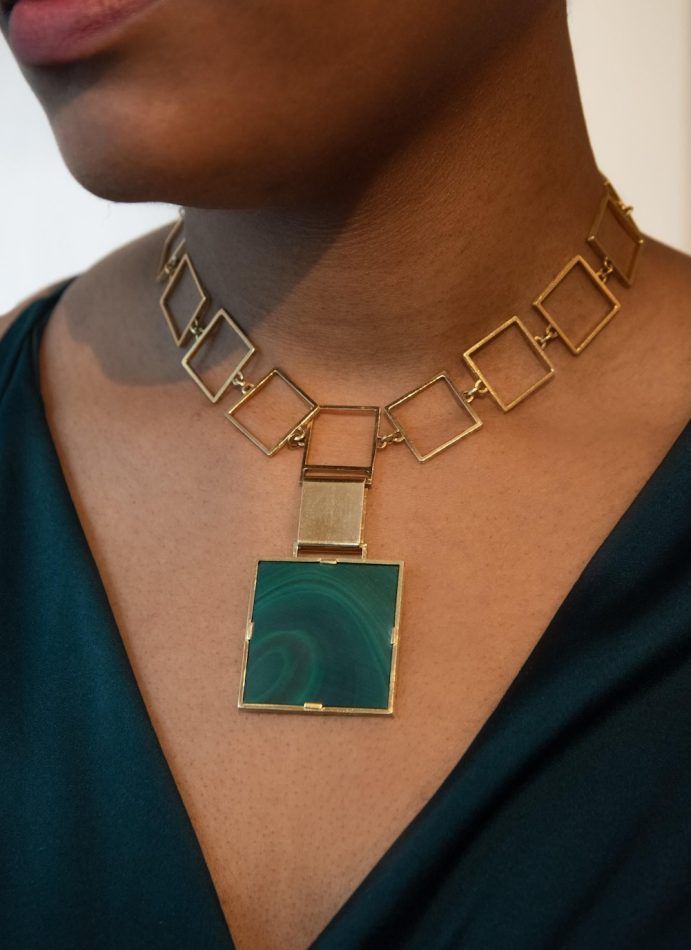
“I’m not sure where his love of Frank Lloyd Wright stemmed from,” says Bartos, “but like him, Stittgen believed in honoring and working in tandem with the natural, organic beauty of the material. For this reason, he rarely worked gemstones like other jewelers, preferring to use their natural forms and cuts. His chains were always as complex as the pendant hanging from them.”
Stittgen, who emigrated from Germany to Vancouver in the early 1950s, was an experimentalist. Beginning his career as a watchmaker, he moved into jewelry with an instinct for the sculptural, creating pieces that resist easy classification. Some resemble fragments of coral — frothy tangles of gold and pearls that appear almost organic — while others, particularly his finely crafted gold brooches, evoke Louise Nevelson assemblages. But he also made pieces displaying an architectural rigor, like this suite, reflecting his devotion to Wright.
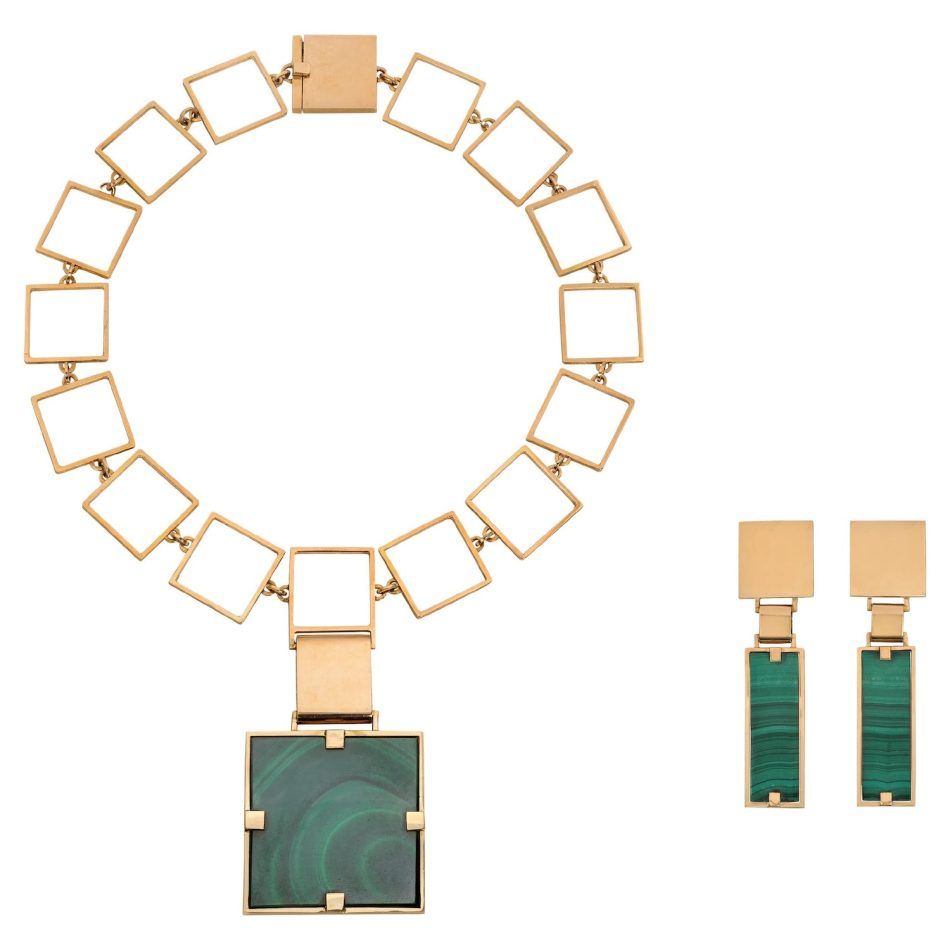
For Bartos, the beauty of Stittgen’s malachite set lies in its modernist sculptural qualities and the way it plays with volume and empty space. “His real passion was metalwork,” she says, “and it is simply exquisite here, with the fine lines and repetitive patterns of the gold geometries. But what’s also wonderful is his use of negative space, which frames the skin and becomes as much a part of the design as the tactile elements themselves. As a design, it looks so pure and simple. And yet, it isn’t simple at all, it’s very determined and intentional.”
Today, jewelry sets are often designed with versatility in mind, their individual elements intended to be separated and recombined in fresh contemporary looks. With this suite, however, Bartos makes a compelling case for wearing the parts together. “The earrings fall precisely above the cutouts and negative spaces of the necklace,” she points out, “neither competing with nor intruding upon its geometry. Instead, they complete it. Worn as a whole, the pieces create an unexpected lightness, with the spaces between the gold and the skin allowing the architecture of the design to breathe.”