Kyra Markham Art

1891-1967

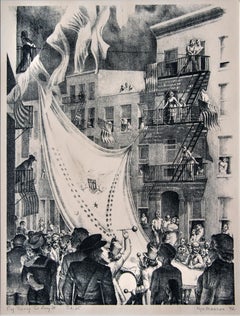
Kyra Markham was an actress, figurative painter and printmaker. Markham was briefly married to the architect Lloyd Wright, and five years later, married the scenographer, David Stoner Gaither. She worked for the Federal Arts Project, creating works of social realism that documented American life in the 1930s. During World War II, her art was focused on the propaganda effort against the Nazis. She produced an interesting body of lithographs, mostly figurative, showing the working class people in an almost otherworldly surrealist manner. She also produced prints under the Works Progress Administration/Federal Art Project as well as paintings. Markham was associated with many in the New York art world.

to
1
3
3
3
2
1
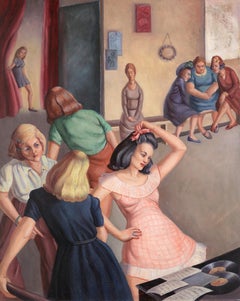
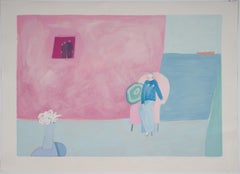
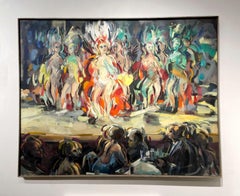
"Sock Hop" Mid-Century American Modernism WPA Female Artist 20th Century Realism

"Sock Hop" Mid-Century American Modernism WPA Female Artist 20th Century Realism

By Kyra Markham

Located in New York, NY

"Sock Hop" Mid-Century American Modernism WPA Female Artist 20th Century Realism. 30 x 24 inches. Oil on canvas. Signed on stretcher, c. 1940s. Frame is likely original to the painting. Realist painter-printmaker Kyra Markham...

Category

1940s American Modern Kyra Markham Art

Materials

Canvas, Oil

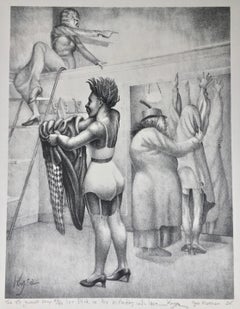
THE FIT YOURSELF SHOP

THE FIT YOURSELF SHOP

By Kyra Markham

Located in Santa Monica, CA

KYRA MARKHAM (1891 – 1967) THE FIT YOURSELF SHOP, 1935 Lithograph, signed, titled, dedicated, dated and no 24/50 in pencil. 12 5/8 x 9 5/8”. Signed in ...

Category

1930s Modern Kyra Markham Art

Materials

Lithograph

Related Items
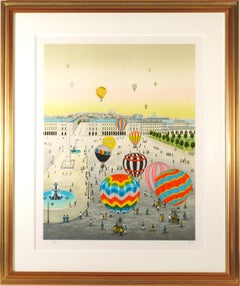
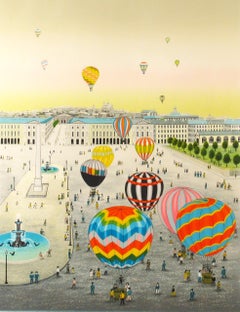
Les Montgolfieres, Place de la Concorde, Paris

Les Montgolfieres, Place de la Concorde, Paris

By Fanch (Francois Ledan)

Located in San Francisco, CA

This artwork titled "Les Montgolfieres, Place de la Concorde, Paris" 1987 is a original colors lithograph on Arches paper by French artist (Fanch, Francois Ledan, born 1949) It is hand signed and numbered 67/250 in pencil by the artist. The image size is 25.25 x 19.5 inches, framed is 37.25 x 31.25 inches. Printed by Atelier d'Art Dejobert, Paris, with their blind stamp at the lower left corner. Custom framed in a wooden gold frame, with off white matting. It is in excellent condition. About the artist: Francois "Fanch" Ledan (b. 1949) is noted for colorful scenes of his native Brittany. In 1968 he abandoned his studies in commercial design for full-time studies in painting and fine art. His talent was quickly recognized and soon he was involved in major European shows. He became involved in printmaking in 1973 when he learned lithography in Paris. Since then he has had numerous one-person shows in Europe, North America and South America. His paintings and lithographs from the 1970's and 1980's display characteristics often associated with "naïve" art. His views of Paris, a city which has embraced naïve art, display the attention to detail, In the 80's he turned to more brightly colored paintings and again a connection to Impressionism. He began to work on paintings that he refers to as "interior...

Category

Late 20th Century Modern Kyra Markham Art

Materials

Lithograph

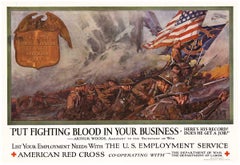
Put Fighting Blood in Your Business

Dan SmithPut Fighting Blood in Your Business, 1919

$798Sale Price|20% Off

H 19.5 in W 28 in D 0.1 in

Put Fighting Blood in Your Business

Located in Spokane, WA

Original WW1 poster. Put Fighting Blood in Your Business. Here’s his record! Does he get a Job? Arthur Woods, Assistant to the Secretary of...

Category

1910s American Realist Kyra Markham Art

Materials

Lithograph

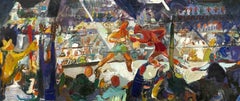
A Dynamic 1930s Boxing Match Painting by Famed Chicago Artist, Francis Chapin

A Dynamic 1930s Boxing Match Painting by Famed Chicago Artist, Francis Chapin

By Francis Chapin

Located in Chicago, IL

A dynamic, colorful 1930s painting of a boxing match in Mexico by famed Chicago Modern artist Francis Chapin. Painted during one of the artist's early trips to Mexico, an exceptional painting showing Chapin's steadfast interest in sporting scenes, particularly boxing matches. Image size: 12 x 28 inches. Framed size: 15 1/2 x 31 1/2 inches. Estate stamped on reverse. Provenance: Estate of the artist. Francis Chapin, affectionately called the “Dean of Chicago Painters” by his colleagues, was one of the city’s most popular and celebrated painters in his day. Born at the dawn of the 20th Century in Bristolville, Ohio, Chapin graduated from Washington and Jefferson College near Pittsburgh, Pennsylvania before enrolling at the Art Institute of Chicago in 1922. He would set down deep roots at the Art Institute of Chicago, exhibiting there over 31 times between 1926 and 1951. In 1927 Chapin won the prestigious Bryan Lathrop Fellowship from the Art Institute – a prize that funded the artist’s yearlong study trip to Europe. Upon his return to the United States, Chapin decided to remain in Chicago, noting the freedom Chicago artists have in developing independently of the pressure to conform to pre-existing molds (as was experienced by artists in New York, for example). Chapin became a popular instructor at the Art Institute, teaching there from 1929 to 1947 and at the Art Institute’s summer art school in Saugatuck, Michigan (now called Oxbow) between 1934 – 1938 (he was the director of the school from 1941-1945). Chapin’s contemporaries among Chicago’s artists included such luminaries as Ivan Le Lorraine Albright...

Category

1930s American Modern Kyra Markham Art

Materials

Canvas, Oil

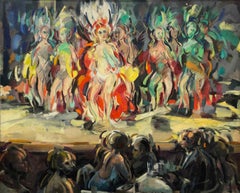
A Large, Fabulous Mid-Century Modern Painting of a Chicago Night Club, Burlesque

A Large, Fabulous Mid-Century Modern Painting of a Chicago Night Club, Burlesque

Located in Chicago, IL

A Fabulous, Large and Dynamic Mid-Century Modern Painting of a Chicago Night Club by Notable Chicago Artist, Rudolph T. Pen (Am. 1918 - 1989). Painted circa 1948, this is a large, a...

Category

Mid-20th Century American Modern Kyra Markham Art

Materials

Canvas, Oil

Un Vase de Fleurs III (Flowers in a Vase)

Un Vase de Fleurs III (Flowers in a Vase)

By Frederic Menguy

Located in San Francisco, CA

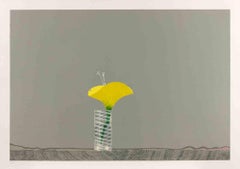
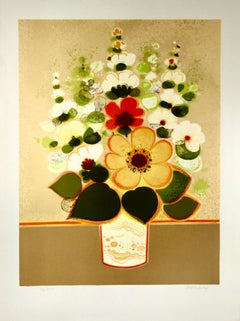
This artwork "Un Vase de Fleurs III (Flowers in a Vase)" c.1980, is an original colors lithograph on watermarked Arches paper by noted French artist Frederic Menguy, 1927-2007. It is...

Category

Late 20th Century Modern Kyra Markham Art

Materials

Lithograph

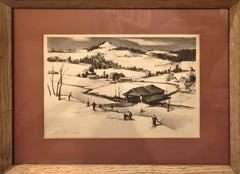
"The Slope Near the Bridge" Paul Sample, Mid-Century, American Snowy Landscape

"The Slope Near the Bridge" Paul Sample, Mid-Century, American Snowy Landscape

By Paul Sample

Located in New York, NY

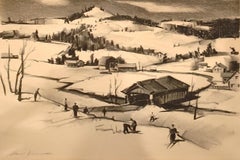
Paul Sample The Slope Near the Bridge, 1950 Signed in pencil lower left Lithograph on wove paper Image 8 15/16 x 12 15/16 inches Sheet 11 5/16 x 15 1/16 inches From the edition of 25...

Category

1950s American Realist Kyra Markham Art

Materials

Paper, Lithograph
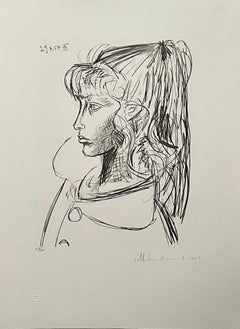
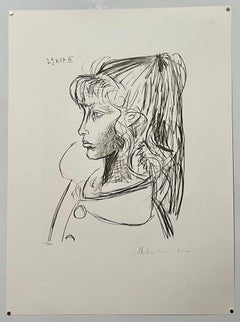
Pablo Picasso Estate Hand Signed Cubist Lithograph Profile Young Woman Portrait

Pablo Picasso Estate Hand Signed Cubist Lithograph Profile Young Woman Portrait

By Pablo Picasso

Located in Surfside, FL

Pablo Picasso (after) "Sylvette De Profil Gauche" limited edition print on Arches paper, Hand signed by Marina Picasso lower right and numbered 329/500 lower left From the estate of...

Category

20th Century Modern Kyra Markham Art

Materials

Lithograph

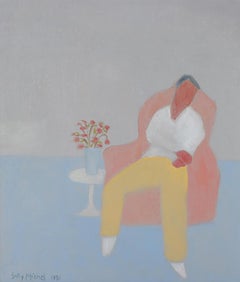
Seated Figure

Sally Michel AverySeated Figure, 1981

$52,000

H 20.5 in W 16.5 in

Seated Figure

Located in Rockland, ME

Sally Michel Biography American, 1902-2003 Sally Michel Avery was an American painter known for her lyrical depictions of everyday life. Though she used techniques and stylized form...

Category

1980s American Modern Kyra Markham Art

Materials

Oil

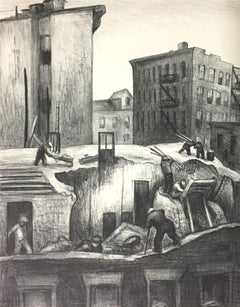
Ann Nooney, (Demolition with Windows, NYC)

Ann Nooney, (Demolition with Windows, NYC)

By Ann Nooney

Located in New York, NY

The dimensions are for the image; there are large margins. This lithograph is signed in pencil. A native New Yorker, Ann Nooney (1900-1970) recorded the urban scene while on the Wo...

Category

1930s American Realist Kyra Markham Art

Materials

Lithograph

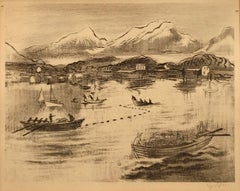
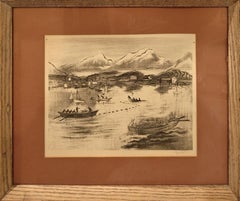
"Fishing Village" Joe Jones, Mid-Century, American Life, Small Town Scene

"Fishing Village" Joe Jones, Mid-Century, American Life, Small Town Scene

By Joe Jones

Located in New York, NY

Joe Jones Fishing Village, 1949 Signed in pencil lower right margin Lithograph on wove paper Image 9 5/16 x 12 9/16 inches Sheet 12 x 15 15/16 inches From the edition of 250 The initial details of Jones' career are sparse, and this is intentional. The young artist was engaged in a process of self-reinvention, crafting a persona. When he submitted a work to the Sixteen Cities Exhibition at New York City's Museum of Modern Art in 1933, he briefly characterized himself: "Born St. Louis, 1909, self-taught. " Jones intentionally portrayed himself to the art community as an authentic working-class figure, backed by a compelling history. He was the youngest of five children in a family led by a one-armed house painter from St. Louis, a Welsh immigrant, and his German American spouse. At the age of ten, Jones found himself in a Missouri reformatory due to authorities' concerns over his graffiti activities. After completing elementary school, he traveled by freight car to California and back, even being arrested for vagrancy in Pueblo, Colorado. Returning to St. Louis, he attempted to settle down by working alongside his father. Yet, Jones felt a profound restlessness and was drawn toward a more elevated artistic pursuit in his late teenage years. He discovered a local collective of budding artists that formed St. Louis’s "Little Bohemia," sharing a studio and providing mutual support until he managed to secure his own modest workspace in a vacant garage. Jones’s initial creations comprised still lifes, landscapes, and poignant portraits of those close to him. These subjects were not only accessible but also budget-friendly, as hiring models was beyond his means. He depicted himself, his father, mother, and eventually, his wife. In December 1930, at the age of 21, Jones wed Freda Sies, a modern dancer and political activist who was four years older than him. By 1933, Jones had started gaining noteworthy local recognition through a solo exhibition at the Artists’ Guild of Saint Louis. Of the twenty-five paintings on display, one, titled River Front (private collection, previously with Hirschl and Adler Galleries), was selected to illustrate a feature article about his show in The Art Digest (February 15, 1933, p. 9). Shortly before this exhibition, a young surgeon named Dr. Robert Elman took an interest in Jones’s art, purchasing several pieces and forming a group of potential patrons committed to providing the emerging artist with a monthly stipend in exchange for art. This group was officially known as the "Co-operative Art Society," but it was informally dubbed the "Joe Jones Club. " Jones became an active participant in the St. Louis artistic scene, particularly within its bohemian segments. He embraced modernism and was a founding member of the "New Hat" movement in 1931, a playful rebellion against the conservative and traditional mainstream art establishment. The summer of 1933 marked a significant shift in Jones’s journey. Sponsored by a dedicated ally, Mrs. Elizabeth Green, Jones, along with Freda and Green, embarked on an eastward road trip. In Washington, D. C., they explored the Corcoran Gallery of Art, the Freer Gallery (part of the Smithsonian Institution), the Library of Congress, and Mount Vernon. Following this whirlwind of art and American culture, they made their way to New York, where they visited various museums and galleries, including a stop at The New School for Social Research, which featured notable contemporary murals by fellow Missourian Thomas Hart Benton and the politically active Mexican artist, José Clemente Orozco. From June through August, Jones and Freda resided in the artist colony of Provincetown, Massachusetts, later returning home via Detroit to see Diego Rivera’s Detroit Industry mural housed at the Detroit Institute of Fine Arts. While Elizabeth Green allegedly hoped that Jones would refine his artistic skills under the guidance of Charles Hawthorne or Richard Miller in Provincetown, Jones followed a different path. Rather than pursuing conservative mentors, he connected with an engaging network of leftist intellectuals, writers, and artists who dedicated their time to reading Marx and applying his theories to the American landscape. Jones's reaction to the traditional culture of New England was captured in his statement to a reporter from the St. Louis Post Dispatch: “Class consciousness . . . that’s what I got of my trip to New England. Those people [New Englanders] are like the Chinese—ancestor worshipers. They made me realize where I belong” (September 21, 1933). The stark social divisions he witnessed there prompted him to embrace his working-class identity even more fervently. Upon returning to St. Louis, he prominently identified himself as a Communist. This newfound political stance created friction with some of his local supporters. Many of his middle-class advocates withdrew their backing, likely influenced not only by Jones’s politics but also by his flamboyant and confrontational demeanor. In December 1933, Jones initiated a complimentary art class for unemployed individuals in the Old Courthouse of St. Louis, the same location where the Dred Scott case was deliberated and where slave auctions formerly took place. Concurrently, the St. Louis Art League was offering paid courses. Emphasizing the theme of social activism, with a studio adorned with Soviet artwork, Jones’s institution operated for just over a year before being removed from the courthouse by local officials. The school’s political focus and unconventional teaching practices, along with its inclusion of a significant number of African American students during a period marked by rigid racial segregation, certainly contributed to its challenges. Under Jones’s guidance, the class created a large chalk pastel mural on board, measuring 16 by 37 feet, titled Social Unrest in St. Louis. Mural painting posed no challenge for the former housepainter, who was adept at handling large wall surfaces. His first significant commission in St. Louis in late 1931 was a mural that celebrated the city’s industrial and commercial fortitude for the local radio station, KMOX. This mural, aimed at conveying optimism amid severe economic hardship, showcased St. Louis's strengths in a modernist approach. When Jones resumed mural work in late 1933, his worldview had evolved considerably. The mural produced for the school in the courthouse, conceived by Jones, featured scenes of modern St. Louis selected to highlight political messages. Jones had observed the technique of utilizing self-contained scenes to craft visual narratives in the murals he encountered in the East. More locally, this compositional strategy was commonly employed by the renowned Missouri artist...

Category

1940s American Realist Kyra Markham Art

Materials

Paper, Lithograph
Previously Available Items
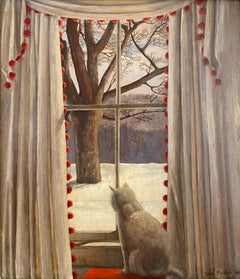
"Looking Out the Window, Vermont" Kyra Markham, Snowy Winter Landscape, Cat

"Looking Out the Window, Vermont" Kyra Markham, Snowy Winter Landscape, Cat

By Kyra Markham

Located in New York, NY

Kyra Markham Looking Out the Window, Vermont, 1947 Signed and dated lower right Oil on board 20 x 16 inches Kyra Markham was an actress, figurative painter and printmaker. Markham was briefly married to the architect Frank Lloyd Wright, and five years later, married the scenographer David Stoner Gaither. She worked for the Federal Arts Project, creating works of social realism that documented American life in the 1930s. During World War II, her art was focused on the propaganda effort against the Nazis. Markham was born Elaine Hyman in Chicago, Illinois. She studied drawing at the Chicago Art Institute from 1907 to 1909, and subsequently worked as a muralist and printmaker. In addition to her work as an artist, Markham was an accomplished actress. She appeared with the Chicago Little Theater from 1909 to the 1920s, with the Provincetown Players from 1916, and in movies in Los Angeles. She lived with the author and playwright Theodore Dreiser in Greenwich Village from 1914-1916, helping him with his writing, editing, and typing. Through Dreiser she became acquainted with H.L Mencken, Edgar Lee Masters, and other writers. Due to Dreiser’s womanizing tendencies, Markham left him in 1916 and moved to Provincetown to escape his desperate pleas of reconciliation. While there, Markham continued acting alongside George Cram Cook, Susan Giaspell, and Eugene O’Neill, who founded the Provincetown Playhouse. During this early stage, Markham supported herself by making bookjackets and illustrations, and later working as an art director for film companies like Fox and Metro. In 1922 she married the architect Lloyd Wright and briefly had Frank Lloyd Wright as a father-in-law. In 1927, she married David Gaither and collaborated with him on the set design for a children's play, The Forest Ring, staged at the Roerich Museum Theatre in 1930. Gaither encouraged Markham to pursue "her first love, painting." Markham returned to the Art Students League in New York City in 1930, where she studied with Alexander Abels. Before the stock market crash, Markham was a successful bathroom muralist. From the 1920s until the Depression she obtained commercial commissions from clubs and restaurants. During the 1930s, Markham's artistic career began to gain momentum, regularly winning prizes for her lithographic work. In 1934, Markham organized her first solo exhibition in Ogunquit, Maine, featuring prints, murals and lithographs. Markham created works of social realism depicting street beggars, musicians, actors and scenes from department stores. In recognition of her work, Markham received the prestigious Mary S. Collins Prize at the Philadelphia Print Club's annual exhibition the following year for her lithograph Elin and Maria (1934). Markham sold work to the Whitney Museum of American Art, the Library of Congress and the Metropolitan Museum of Art. From 1935 to 1937, she worked in the Graphic Arts Division for the Federal Arts Project, a New Deal program designed to provide employment for artists during the Depression. The Hall of Inventions at the 1939 World's Fair in New York included 40 dioramas by Markham. During World War II she created propaganda satirizing the Nazis and promoting patriotism at home. In 1946 Markham and Gaither moved to an old farmhouse in Halifax, Vermont. Markham stopped making prints after moving to her remote Vermont farm...
Category

1940s American Modern Kyra Markham Art

Materials

Oil, Board

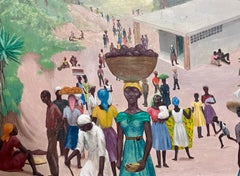
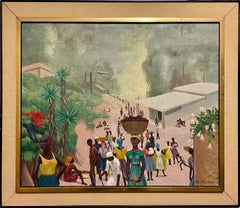
Oil Painting WPA Woman Artist Kyra Markham Haitian Island Scene African American

Oil Painting WPA Woman Artist Kyra Markham Haitian Island Scene African American

By Kyra Markham

Located in Surfside, FL

Kyra Markham (American, 1891-1967) Haitian Scene, 1962, Oil on board, Hand signed and dated. Provenance: Estate of Ethel Confino Size: 20'' x 24'', 51 x 61 cm (board); 25'' x 29'', 64 x 74 cm (framed Kyra Markham (born Elaine Hyman, 1891–1967) was an actress, figurative painter and printmaker. Markham was briefly married to the architect Frank Lloyd Wright Jr, and five years later, married the scenographer David Stoner Gaither. She worked for the Federal Arts Project, WPA creating works of social realism that documented American life in the 1930s. During World War II, her art was focused on the propaganda effort against the Nazis. Markham was born Elaine Hyman in Chicago, Illinois. She studied drawing at the Chicago Art Institute from 1907 to 1909, and subsequently worked as a mural artist and printmaker. In addition to her work as an artist, Markham was an accomplished actress. She appeared with the Chicago Little Theater from 1909 to the 1920s, with the Provincetown Players from 1916, and in movies in Los Angeles. She lived with the author and playwright Theodore Dreiser in Greenwich Village from 1914-1916, helping him with his writing, editing, and typing. Through Dreiser she became acquainted with H.L Mencken, Edgar Lee Masters, and other writers. Due to Dreiser’s womanizing tendencies, Markham left him in 1916 and moved to Provincetown to escape his desperate pleas of reconciliation. While there, Markham continued acting alongside George Cram Cook, Susan Glaspell, and Eugene O’Neill, who founded the Provincetown Playhouse. During this early stage, Markham supported herself by making book jackets and illustrations, and later working as an art director for film companies like Fox and Metro. In 1922 she married the architect Lloyd Wright and briefly had Frank Lloyd Wright as a father-in-law. In 1927, she married David Gaither and collaborated with him on the set design for a children's play, The Forest Ring, staged at the Roerich Museum Theatre in 1930. Gaither encouraged Markham to pursue "her first love, painting." Markham returned to the Art Students League in New York City in 1930, where she studied with Alexander Abels. Before the stock market crash, Markham was a successful muralist. From the 1920s until the Depression she obtained commercial commissions from clubs and restaurants. During the 1930s, Markham's artistic career began to gain momentum, regularly winning prizes for her lithographic work. In 1934, Markham organized her first solo exhibition in Ogunquit, Maine, featuring prints, murals and lithographs. Markham created works of social realism depicting street beggars, musicians, actors and scenes from department stores. In recognition of her work, Markham received the prestigious Mary S. Collins Prize at the Philadelphia Print Club's annual exhibition the following year for her lithograph Elin and Maria (1934). Markham sold work to the Whitney Museum of American Art, the Library of Congress and the Metropolitan Museum of Art. From 1935 to 1937, she worked in the Graphic Arts Division for the Federal Arts Project, a New Deal program designed to provide employment for artists during the Depression. The Hall of Inventions at the 1939 World's Fair in New York included 40 dioramas by Markham. During World War II she created propaganda satirizing the Nazis and promoting patriotism at home. In 1946 Markham and Gaither moved to an old farmhouse in Halifax, Vermont. Markham stopped making prints after moving to her remote Vermont farm, but continued to work in more accessible mediums such as painting, drawing and ceramics. She was a member of the Southern Vermont Artists Association and participated in their annual exhibitions in Manchester. Over the next twenty years she sold her designs to a postcard company, American Arts, Inc., and had her prints published in prestigious publications. Markham also worked as an illustrator for Children’s books during this time. Markham moved to Port-au-Prince in Haiti as a widow in 1960. She was still enthusiastic for her work, and her later work reflected Markham's new home. While living in Haiti, Markham continued to paint and established a salon for local celebrities, American expatriates, and island visitors. Markham died in Port-au-Prince, Haiti in 1967. In the time between the two World Wars, American Scene printmakers, like Markham, opposed the Etching Revival style and instead embraced lithography. During the Great Depression, lithography exploded – the WPA FAP alone published roughly 240,000 prints from 11,285 original images. Like Markham, many other artists working in this style, such as Mabel Dwight, Reginald Marsh, Elizabeth Olds, Caroline Durieux, and Russell Limbach...
Category

1960s American Realist Kyra Markham Art

Materials

Oil, Board

Haitian Scene

Kyra MarkhamHaitian Scene

Sold

H 24 in W 30 in

Haitian Scene

By Kyra Markham

Located in Austin, TX

Artist: Kyra Markham Title: Haitian Scene Medium: Oil on Board Size: 24" x 30" Framing: Framed

Category

Mid-20th Century American Realist Kyra Markham Art

Materials

Oil, Board

Kyra Markham art for sale on 1stDibs.

Find a wide variety of authentic Kyra Markham art available for sale on 1stDibs. You can also browse by medium to find art by Kyra Markham in lithograph, oil paint, paint and more. Much of the original work by this artist or collective was created during the 20th century and is mostly associated with the modern style. Not every interior allows for large Kyra Markham art, so small editions measuring 10 inches across are available. Customers who are interested in this artist might also find the work of Cecil Crosley Bell, August Mosca, and Charles Quest. Kyra Markham art prices can differ depending upon medium, time period and other attributes. On 1stDibs, the price for these items starts at $1,100 and tops out at $25,000, while the average work can sell for $11,000.

Artists Similar to Kyra Markham