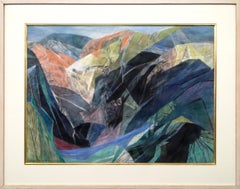
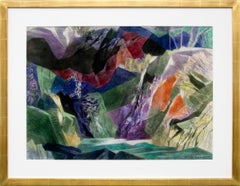
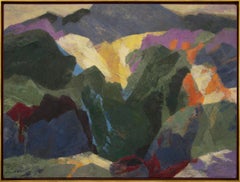
Ethel Magafan Art

American, 1916-1993
Ethel Magafan Born Illinois, 1916 Died New York, 1993 Jenne and Ethel Magafan were identical twins, born in Chicago to a Greek immigrant father and a Polish mother. Due to health concerns about their father, the family moved to Colorado, living first in Colorado Springs and then in Denver. He was a proud supporter of their artistic ambitions but died suddenly 1932, a heavy blow to both of them. They attended East High School in Denver, where they found a mentor in their art teacher Helen Perry. She had studied at the Art Institute of Chicago but had later abandoned a career as an artist, making her all the more determined to help the Magafan twins succeed artistically. While still in high school, the twins impressed artist Frank Mechau, and Helen Perry paid for their lessons with him. He subsequently invited them to apprentice with him at his Redstone studio. In 1936, Jenne won the Carter Memorial Art Scholarship and shared it with her sister so that they both could attend the Broadmoor Art Academy in Colorado Springs. Once they ran out of money, Mechau, now teaching there, hired them as assistants. Through their involvement at the Academy, the twins entered into careers as muralists, working at first with Mechau and then with Peppino Mangravite. From 1937 to 1943, Ethel was commissioned to paint her first of seven government sponsored murals. Located in the US Post Office in Auburn, Nebraska, this commission made Ethel (at age 26) the youngest artist in America to receive such an honor. Denver Art Museum director Donald J. Bear once commented that “[Ethel and Jenne's] study of local detail makes them appear as little Bruegels of ranch genre – natural and unforced.” As mural painting commissions diminished, Ethel began to do more easel painting for which she used a palette knife and tempera paints to great effect. After settling in California for five years, the twins permanently relocated to Woodstock, New York in 1945, where the sisters lived apart for the first time. Ethel developed an increasing focus within her work, particularly for horses and abstract landscapes. She met fellow artist Bruce Currie at an artist’s party, and the two were married in 1946. The twins and their husbands went to Greece and Italy for a year when Jenne’s husband and Ethel were granted Fulbright Scholarships. Upon their return, Jenne died suddenly of a cerebral hemorrhage — a loss that Ethel would mourn deeply. With her sister gone, her landscapes became much more abstract, as she sought out the feeling of the scene rather than an exact representation. During the mid-fifties, she began to make annual trips to Colorado. Her stature within the art world was solidified in 1971 when the United States ©David Cook Galleries, LLC
to
14
14
9
5
4
3
1
1
1
1
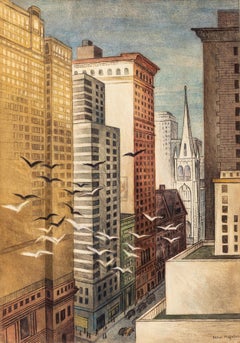
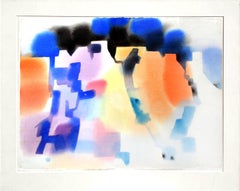
Ethel Magafan “When the Bells Chime” 1939 NYC WPA Era Watercolor

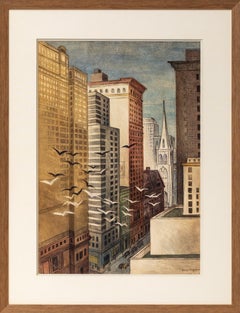
Ethel Magafan “When the Bells Chime” 1939 NYC WPA Era Watercolor

By Ethel Magafan

Located in Denver, CO

“When the Bells Chime” (1939) by Ethel Magafan is a dynamic and historically significant watercolor capturing the energy and vertical rhythm of New York City at the height of the WPA...

Category

1930s American Modern Ethel Magafan Art

Materials

Watercolor

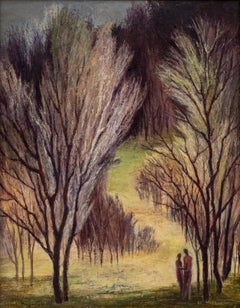
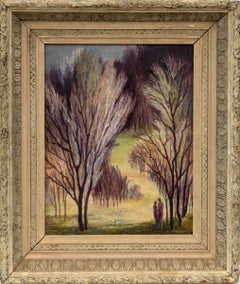
Ethel Magafan Early Spring 1944 Framed Oil Painting, Colorado Regionalism

Ethel Magafan Early Spring 1944 Framed Oil Painting, Colorado Regionalism

By Ethel Magafan

Located in Denver, CO

“Early Spring” is a rare and evocative 1944 original oil painting by celebrated Colorado artist Ethel Magafan, a key figure in American Regionalism and one of the renowned Magafan si...

Category

1940s American Modern Ethel Magafan Art

Materials

Oil

Ethel Magafan “Valley of the World” Colorado Modernist Watercolor Painting

Ethel Magafan “Valley of the World” Colorado Modernist Watercolor Painting

By Ethel Magafan

Located in Denver, CO

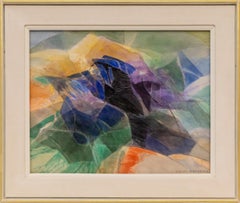
A vibrant modernist watercolor painting by celebrated American artist Ethel Magafan, 'Valley of the World' captures the expressive color, rhythmic composition, and regional sensibili...

Category

Mid-20th Century Abstract Geometric Ethel Magafan Art

Materials

Watercolor

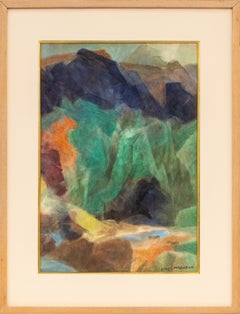
Abstract Colorado Landscape Watercolor Painting, Signed and Framed

Abstract Colorado Landscape Watercolor Painting, Signed and Framed

By Ethel Magafan

Located in Denver, CO

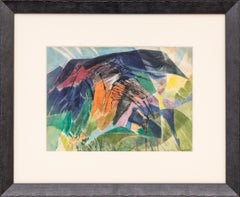
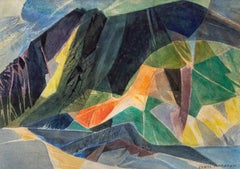
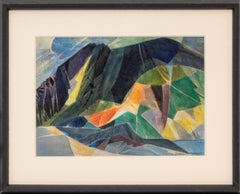
High Above the Valley, original painting by Colorado artist Ethel Magafan. Abstracted Colorado landscape featuring a large mountain rising from the valley below. Rendered in colors o...

Category

1970s Abstract Expressionist Ethel Magafan Art

Materials

Watercolor

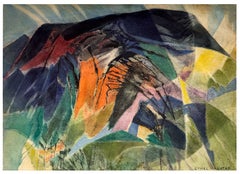
Abstract Colorado Landscape Watercolor Painting, Signed Artwork

Abstract Colorado Landscape Watercolor Painting, Signed Artwork

By Ethel Magafan

Located in Denver, CO

“Above the Plains” is a vibrant original watercolor by renowned Colorado artist Ethel Magafan, showcasing her distinctive modernist approach to the Western landscape. This striking c...

Category

1970s Abstract Expressionist Ethel Magafan Art

Materials

Watercolor

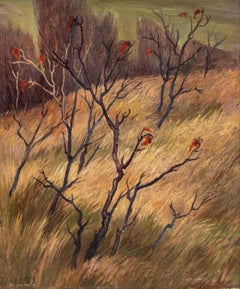
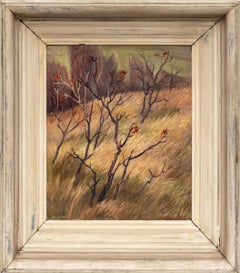
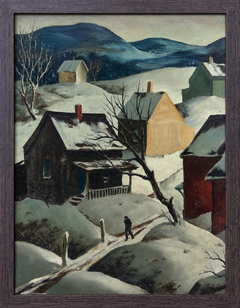
Ethel Magafan 1946 Oil Painting Hillside Colorado Landscape Autumn

Ethel Magafan 1946 Oil Painting Hillside Colorado Landscape Autumn

By Ethel Magafan

Located in Denver, CO

“Hillside” is a beautifully atmospheric original oil painting on canvas board by celebrated Colorado artist Ethel Magafan, created in 1946. This evocative landscape captures the quie...

Category

1940s American Modern Ethel Magafan Art

Materials

Oil

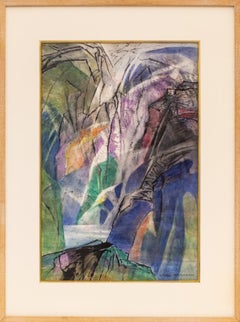
Ethel Magafan “Canyon Morning” 1982 Abstract Colorado Landscape

Ethel Magafan “Canyon Morning” 1982 Abstract Colorado Landscape

By Ethel Magafan

Located in Denver, CO

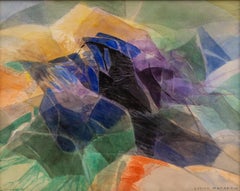
“Canyon Morning” (1982) by Ethel Magafan is a luminous abstract landscape that captures the expansive beauty and atmospheric light of the Colorado canyonlands. Executed in watercolor...

Category

1980s Abstract Expressionist Ethel Magafan Art

Materials

Watercolor

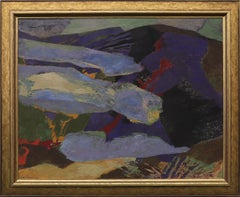
Ethel Magafan Abstract Mountain Watercolor, 1970s Colorado Landscape

Ethel Magafan Abstract Mountain Watercolor, 1970s Colorado Landscape

By Ethel Magafan

Located in Denver, CO

This atmospheric watercolor by Ethel Magafan captures the quiet drama of the Colorado landscape through a refined, semi-abstract lens. Painted in the 1970s, the composition distills ...

Category

1970s Abstract Expressionist Ethel Magafan Art

Materials

Watercolor

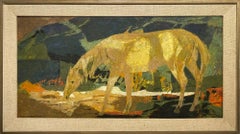
Lone Horse in Abstract Landscape

Lone Horse in Abstract Landscape

By Ethel Magafan

Located in Miami, FL

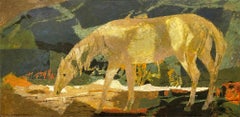
A stylized horse is depicted grazing in an abstract landscape. Most likely, the location is Woodstock, New York, where the artist lived. Signed Lower Right; Framed; Note: titled and signed on verso. Ethel Magafan (August 10, 1916 – April 24, 1993) was an American painter and muralist. Magafan was born in Chicago to Greek parents who had recently immigrated to the U.S. The family soon relocated to Colorado Springs, Colorado, and Magafan's artistic training occurred at the Colorado Springs Fine Arts Center under the tutelage of Peppino Mangravite, Boardman Robinson and Frank Mechau, who hired Magafan and her twin sister, Jenne, to assist on mural projects. In 1937, aEthel won the commission to paint a mural in the U.S. post office in Auburn, Nebraska, making her the youngest recipient of such a commission. It would be the first of seven government-sponsored commissions for the artist. Murals "Andrew Jackson at the Battle of New Orleans, January 8, 1814" E. Magafan, 1943 Under President Franklin Roosevelt's New Deal, several programs were created to employ Americans during the Great Depression. The Magafan twins worked under the New Deal's Section of Painting and Sculpture, a program that hired thousands of artists to paint murals in public spaces, particularly post offices. Ethel and her twin sister, Jenne Magafan, became widely known for their murals painted during the Great Depression. Ethel received her first of seven Government commissions when she was commissioned to produce a painting for the United States post office in Auburn, Nebraska, titled Threshing.Other murals commissioned by the US Government hang in the United States Senate Chamber, the Social Security Building and the Recorder Deeds Building in Washington, D.C., and in post offices in Wynne, Arkansas, titled Cotton Pickers in 1940; in Madill, Oklahoma, titled Prairie Fire in 1941; and Englewood, Colorado, titled The Horse Corral in 1942.Her final mural, entitled Grant in the Wilderness, was installed in 1979 in the Chancellorsville Visitor Center at the Fredericksburg National Memorial Military Park in Virginia, She was a member of the National Academy of Design. Magafan died April 24, 1993, in Woodstock, New York, at the age of 76. References "Collections National Academy Museum". Retrieved 2017-03-08. "Jenne Magafan". Retrieved 2017-03-08. Marlene Park and Gerald E. Markowitz, Democratic Vistas: Post Offices and Public Art in the New Deal. Philadelphia: Temple University Press, 1984. "Browse New Deal projects by State and City". Living New Deal. Retrieved 9 January 2015. "Ethel Magafan Passes Away". New York Times. No. Obituary. April 29, 1993. Opitz, Glenn B, Editor, Mantle Fielding's Dictionary of American Painters, Sculptors & Engravers, Apollo Book...

Category

1960s Contemporary Ethel Magafan Art

Materials

Masonite, Tempera
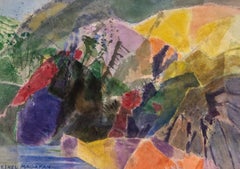
Ethel Magafan Remembered Valley Watercolor Colorado Landscape Painting

Ethel Magafan Remembered Valley Watercolor Colorado Landscape Painting

By Ethel Magafan

Located in Denver, CO

Remembered Valley is an original watercolor painting by acclaimed Colorado artist Ethel Magafan (1916–1993), celebrated for her modernist interpretations of the Western landscape. Th...

Category

1970s American Modern Ethel Magafan Art

Materials

Watercolor

Ethel Magafan Watercolor Horses by Stream, Colorado Regionalist Landscape

Ethel Magafan Watercolor Horses by Stream, Colorado Regionalist Landscape

By Ethel Magafan

Located in Denver, CO

“Horses by the Stream” is a vibrant original watercolor painting by celebrated Colorado artist Ethel Magafan, a prominent figure in American Regionalism and one of the influential Ma...

Category

Mid-20th Century American Modern Ethel Magafan Art

Materials

Watercolor

Ethel Magafan “Riding the Brahmas” Modernist Rodeo Lithograph Signed

Ethel Magafan “Riding the Brahmas” Modernist Rodeo Lithograph Signed

By Ethel Magafan

Located in Denver, CO

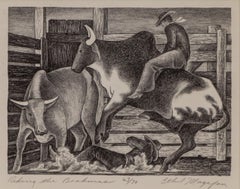
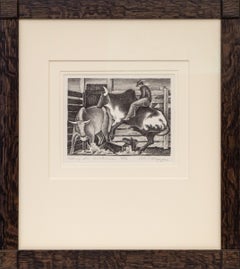
Original mid-century modernist lithograph by celebrated American artist Ethel Magafan (1916–1993), titled Riding the Brahmas. This powerful signed and numbered print captures the explosive energy and drama of a rodeo scene, featuring a cowboy riding a bucking Brahma bull while another figure recoils from the animal’s forceful movement. Executed with bold expressive linework and dynamic composition, the lithograph exemplifies Magafan’s distinctive blend of American Modernism, Western regionalism, and WPA-era artistic influence. A leading figure in 20th-century American art, Ethel Magafan was renowned for her New Deal mural commissions and vivid portrayals of rural and Western American life. Alongside her twin sister Jenne Magafan, she studied at the Colorado Springs Fine Arts Center under influential artists including Boardman Robinson, Peppino Mangravite, and Frank Mechau. Her work earned national recognition for its sophisticated fusion of realism and abstraction, particularly in depictions of horses, rodeos, ranch life, and the American West. Riding the Brahmas is an exceptional example of Magafan’s mature printmaking style, combining rhythmic movement, emotional intensity, and strong graphic design. The composition evokes the grit, danger, and excitement of the rodeo while maintaining the refined aesthetic qualities associated with American Modernist printmaking. Its striking black-and-white tonal contrasts and energetic figural forms make it highly appealing for collectors of Western Americana, equestrian art, vintage rodeo...

Category

Mid-20th Century American Modern Ethel Magafan Art

Materials

Lithograph

Horse and Colt in Abstract Landscape  - Equestrian

Horse and Colt in Abstract Landscape - Equestrian

By Ethel Magafan

Located in Miami, FL

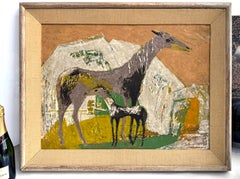
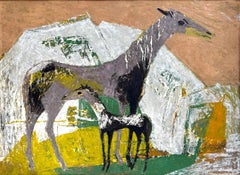
An American Female Artist in her late signature style depicts a Horse and a Colt in an abstract landscape. Ethel Magafan scapes the defining lines with a knife to add to the creative...

Category

1950s American Modern Ethel Magafan Art

Materials

Masonite, Oil

Related Items
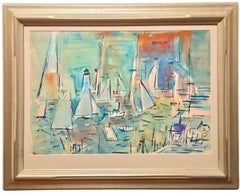
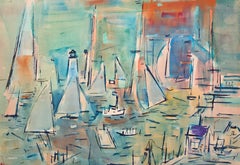
Mid Century Abstracted San Francisco Bay Line Drawing Landscape

Mid Century Abstracted San Francisco Bay Line Drawing Landscape

By Erle Loran

Located in Soquel, CA

Bold abstract geometric landscape, an expressive black and white line drawing done in pastel, by Erle Loran (American, 1905-1999). Unsigned, but was acquired from the artist's estate. Presented in a new black mat with foam core backing. Provenance: Estate of Earle Loran; David Carlson...

Category

Mid-20th Century Abstract Geometric Ethel Magafan Art

Materials

Paper, Pastel

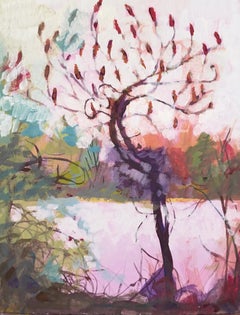
Sumac, colorful Abstract Impressionist landscape gouache

Sumac, colorful Abstract Impressionist landscape gouache

By Sandy Litchfield

Located in New York, NY

Sandy Litchfield found peace and inspiration in regular solitary walks through nature throughout the pandemic. Her most recent body of work diaristically documents her constitutional...

Category

2010s Abstract Impressionist Ethel Magafan Art

Materials

Paper, Gouache

NYC Watercolor Drawing American Modern 20th Century Modernism Mid-Century WPA

NYC Watercolor Drawing American Modern 20th Century Modernism Mid-Century WPA

By David Fredenthal

Located in New York, NY

NYC Watercolor Drawing American Modern 20th Century Modernism Mid-Century WPA. David Fredenthal (1914-1958) "View of New York from New Jersey,"7 x 10 inches. Watercolor on Paper, c. 1948. Signed lower right. David Fredenthal (1914 - 1958) was one ot America's most respected watercolor artists. He was famous for his bold, intensely vigorous and complex paintings and drawings that expressed his deep feeling for excitement with life and living. He was a draftsman with seemingly a special gift for catching anything, physically and emotionally on the spot, and he never went anywhere without three or four loaded pens and a sketchbook in his pocket. As part of the WPA project he executed a number of murals including the Sports Pavilion on the Heinz Building of the New York World's Fair 1939. Some of his fresco and mural techniques were inspired by his friendship with Diego Rivera who had admired and encouraged him in the early 1930's. After he won a traveling scholarship to Europe from The Museum of Modern Art at age 19, he was the recipient of two Guggenheim grants in Painting. He had his first solo exhibition at the Downtown Gallery in New York in 1937 at age 23, and many others after that including the Whitney Museum of American Art in 1947. Because of Fredenthal's prodigious drawing gifts, he was chosen by Erskine Caldwell to illustrate his novel "Tobacco Road...

Category

1940s American Modern Ethel Magafan Art

Materials

Paper, Watercolor

Till the Clouds Roll By 1945 Frank Sinatra Mid Century Modern Hollywood Film WPA

Till the Clouds Roll By 1945 Frank Sinatra Mid Century Modern Hollywood Film WPA

By Richard Whorf

Located in New York, NY

Till the Clouds Roll By 1945 Frank Sinatra Mid Century Modern Hollywood Film WPA TILL THE COULDS ROLL BY (Film Set), oil on canvas, 20 x 24 inches signed “Richard Whorf” lower right and signed and dated on the verso “R. Whorf/ Dec. 21, 1945. Frame by Hendenryk. ABOUT THE PAINTING This painting is from the collection of Barbara and Frank Sinatra, dated December 21, 1945 (just nine days after Frank Sinatra’s 30th birthday), and depicts the Metro-Goldwyn-Mayer Culver City backlot during the filming of Till the Clouds Roll By, the direction of the film having been taking over by Richard Whorf in December 1945. It is not presently clear if Whorf gave the Sinatras this painting as a gift, as the presence of the Dalzell Hatfield Galleries label on the verso indicates the painting may have been sourced there. Frank and Nancy Sinatra acquired a number of works from Dalzell Hatfield Galleries during the 1940’s, or perhaps they framed it for the couple. Sinatra performed “Old Man River’ in the film. Sinatra and June Allyson are depicted in the center of the painting. PROVENANCE From the Estate of Mrs. Nancy Sinatra; Dalzell Hatfield Galleries, Ambassador Hotel, Los Angeles. An image of the Dalzell Hatfield label and the back of the original frame (which we replaced with a stunning Heydenrk frame) are attached. Nancy Sinatra was Fran's first wife. Nancy Rose Barbato was 17 years old when she met Frank Sinatra, an 18-year-old singer from Hoboken, on the Jersey Shore in the summer of 1934. They married in 1939 at Our Lady of Sorrows Church in Jersey City where Frank gave Nancy a recording of a song dedicated to her titled "Our Love" as a wedding present. The young newlyweds lived and worked in New Jersey, where Frank worked as an unknown singing waiter and master of ceremonies at the Rustic Cabin while Nancy worked as a secretary at the American Type Founders. His musical career took off after singing with big band leaders Harry James and Tommy Dorsey...

Category

1940s American Modern Ethel Magafan Art

Materials

Canvas, Oil

"Winter" American Modernism WPA Regionalism Landscape  Mid-Century Magic Realism

"Winter" American Modernism WPA Regionalism Landscape Mid-Century Magic Realism

By Dale Nichols

Located in New York, NY

"Winter" American Modernism WPA Regionalism Landscape Mid-Century Magic Realism. 30 x 40 inches. Oil on canvas, c. 1960s, Signed lower right. As we list the painting now, the work is currently being cleaned, restored and a hand carved frame is being built. Additional photos will be uploaded as soon as possible. Our gallery, Helicline Fine Art, just launched our new digital exhibition: American Art: The WPA and Beyond. Three dozen paintings, works on paper and sculptures which are available here on 1stDibs. In person viewings can be arranged by appointment at our midtown Manhattan gallery. Provenance: "Winter" was originally purchased by Stanley Byer. Mr. Byer owned homes in Key West, New York City, and Washington, D.C. He purchased the painting from Dunning Auction in 1984 in Elgin, Illinois. Mr. Byer was related to Abraham Weiss from Florida. Saul Babbin, now deceased was a cousin of Mr. Weiss. I purchased the painting from Joy Babbin, Mr. Babbin's wife, now living in from New Mexico. Dale Nichols (1905 – 1995) Artist, printmaker, illustrator, watercolorist, designer, writer and lecturer, Nichols did paintings that reflected his rural background of Nebraska where he was born in David City, a small town. Although he did much sketching outdoors, most of his paintings were completed in his studio and often included "numerology, magic squares...

Category

1960s American Modern Ethel Magafan Art

Materials

Canvas, Oil

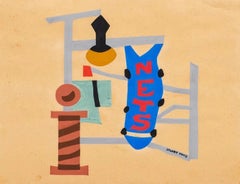
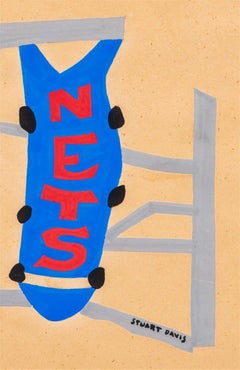
"NY Street Signs" Mid-20th Century WPA 1938 Modernist Abstract Realism Pop Art

"NY Street Signs" Mid-20th Century WPA 1938 Modernist Abstract Realism Pop Art

By Stuart Davis

Located in New York, NY

"NY Street Signs" Mid-20th Century WPA 1938 Modernist Abstract Realism Pop Art Stuart Davis (American, 1892-1964) "Street Signs" Modernist gouache and traces of pencil on paper in the proto-pop art style Davis is celebrated for, 1938, signed to lower right, framed. Image: 11 1/4 x 15 1/4 inches. Frame by Bark: 18 1/2 x 22 inches. LITERATURE: A, Boyajian, M. Rutkowski, Stuart Davis, A Catalogue Raisonne, Vol. 2, New Haven, Connecticut, 2007, vol. II, p. 632, no. 1232, illustrated. EXHIBITIONS: ACA Galleries, New York American Artists' Congress: Group Exhibition of Paintings and Sculpture, Dec. 3-16, 1939 (SDAB I, 12/3/39, p. 129). Outlines Gallery, Pittsburgh, Stuart Davis, Mar. 3-16, 1946. Coleman Art Gallery, Philadelphia, 5 Prodigal Sons: Former Philadelphia Artists: Ralston Crawford, Stuart Davis, Charles Demuth, Julian Levi, Charles Sheeler, Oct 4 - 30, 1947 (pamphlet), no. 12. PROVENANCE: The artist; Mr. and Mrs. Frank Bowles, New York, Apr. 3, 1956; thence by descent, Private Collection, New York. NOTES: According to the Catalogue Raissonne, "the title 'Street Signs' is recorded in the artist's account books...

Category

1930s American Modern Ethel Magafan Art

Materials

Paper, Gouache, Pencil

"6th Avenue El" American Scene Social Realism Mid-20th Century Cityscape Modern

"6th Avenue El" American Scene Social Realism Mid-20th Century Cityscape Modern

By Max Arthur Cohn

Located in New York, NY

"6th Avenue El" American Scene Social Realism Mid-20th Century Cityscape Modern Max Arthur Cohn (1903-1998) 6th Avenue Elevated 19 1/4 x 13 3/4 inches Watercolor on paper Signed an...

Category

1920s American Modern Ethel Magafan Art

Materials

Paper, Watercolor

6th Avenue El at 8th St NYC Cityscape American Scene Social Realism Mid-Century

6th Avenue El at 8th St NYC Cityscape American Scene Social Realism Mid-Century

By Max Arthur Cohn

Located in New York, NY

6th Avenue El at 8th St NYC Cityscape American Scene Social Realism Mid-Century Max Arthur Cohn (1903-1998) 6th Avenue El at 8th Street 13 x 18 inches Watercolor on paper, c. 1930 ...

Category

1930s American Modern Ethel Magafan Art

Materials

Paper, Watercolor

“Middleton Place II, 1974” Wolf Kahn, West Brattleboro, Vermont Barn Oil Canvas

“Middleton Place II, 1974” Wolf Kahn, West Brattleboro, Vermont Barn Oil Canvas

By Wolf Kahn

Located in Yardley, PA

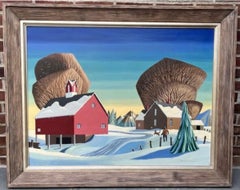
A fantastic early painting from Kahn’s iconic barn series depicting Dr. Middleton’s property in West Brattleboro, VT. Here, Kahn turns a familiar rural motif into something hovering ...

Category

1970s American Modern Ethel Magafan Art

Materials

Canvas, Oil

"War Brides, Wash Sq NYC" American Scene WWII Modernism WPA Mid-Century Oil

"War Brides, Wash Sq NYC" American Scene WWII Modernism WPA Mid-Century Oil

By Georgina Klitgaard

Located in New York, NY

"War Brides, Wash Sq NYC" American Scene WWII Modernism WPA Mid-Century Oil. 30 x 40 inches. Oil on canvas, c. 1942. Signed lower right. Titled on the stretcher. Housed in a sensational Heydenryk frame. Our gallery, Helicline Fine Art...

Category

1940s American Modern Ethel Magafan Art

Materials

Canvas, Oil

"Industrial Cityscape, Chicago" WPA Modernism Mid-Century Cityscape 20th Century

"Industrial Cityscape, Chicago" WPA Modernism Mid-Century Cityscape 20th Century

By Aaron Bohrod

Located in New York, NY

"Industrial Cityscape, Chicago" WPA Modernism Mid-Century Cityscape 20th Century Aaron Bohrod (American 1907 – 1992) Industrial Cityscape 20 x 16 inches Oil on board Signed lower ri...

Category

1930s American Modern Ethel Magafan Art

Materials

Oil, Board

Previously Available Items
Ethel Magafan "Evening Moon" Pen and Ink Drawing

Ethel Magafan "Evening Moon" Pen and Ink Drawing

By Ethel Magafan

Located in New Windsor, NY

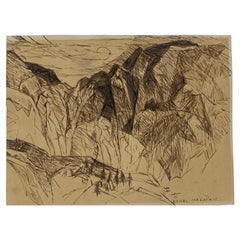
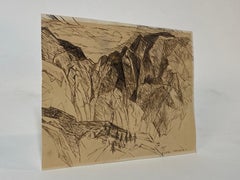
Ethel Magafan (1916-1993) pen and ink sketch drawing entitled "Evening Mood". Signed lower right. Circa 1950. This piece comes from the Estate of Anton Otto Fischer after Magafan moved to Woodstock, NY where his home and studio were. Good overall condition. Wear consistent with age and not being framed. There is obvious darkening of the paper surface due to the piece originally having an old matte surrounding the sight opening. No visible rips, tears or restorations. Soft corners and edges. Approximately 8" wide x 6" high. Bio: After World War II, many people in the US were on the move, and on the advice of older artist friends in Los Angeles, Arnold Blanche...

Category

1950s American Rustic Vintage Ethel Magafan Art

Materials

Paper

Dawn, Semi-Abstract Mountain Landscape, Multi-colored Watercolor Painting

Dawn, Semi-Abstract Mountain Landscape, Multi-colored Watercolor Painting

By Ethel Magafan

Located in Denver, CO

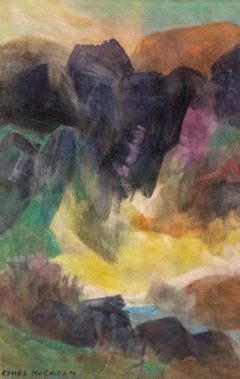
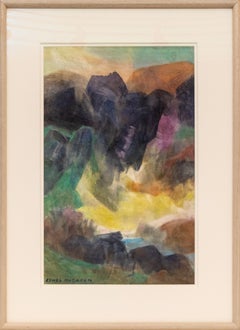
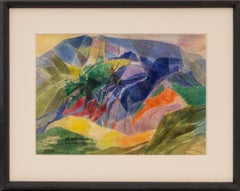
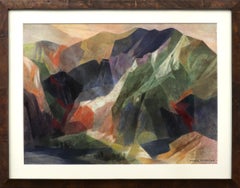
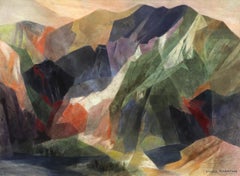
Abstracted mountain landscape, watercolor on paper by Ethel Magafan titled "Dawn". Painting portrays a fractured mountain landscape painted in rich earth tone colors of red, green, b...

Category

Mid-20th Century Abstract Ethel Magafan Art

Materials

Paper, Watercolor

Lone Horse ( Artist Proof), 1940s American Modernist Portrait of Horse Print

Lone Horse ( Artist Proof), 1940s American Modernist Portrait of Horse Print

By Ethel Magafan

Located in Denver, CO

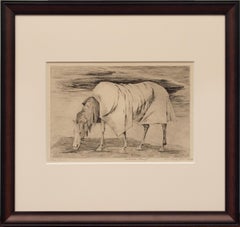
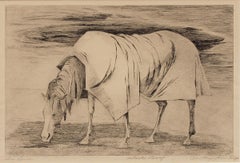
"Lone Horse (Artist Proof)", is an etching on paper by western artist Ethel Magafan (1916-1993) of a single dark horse standing outside eating in a field with a blanket on and dark clouds in the background. Presented in a custom frame, outer dimensions measure 19 x 20 ¼ inches. Image size is 8 x 12 inches. Piece is clean and in very good condition - please contact us for a detailed condition report. Provenance: Estate of the Artist, Ethel Magafan Expedited and international shipping is available - please contact us for a quote. About the Artist: Ethel Magafan Born 1916 Died 1993...

Category

1940s American Modern Ethel Magafan Art

Materials

Paper, Etching

Morning Clouds, 1970s Semi Abstract Mountain Landscape Tempera Painting

Morning Clouds, 1970s Semi Abstract Mountain Landscape Tempera Painting

By Ethel Magafan

Located in Denver, CO

Tempera on board painting by Ethel Magafan (1916-1993) titled "Morning Clouds". Abstracted mountain landscape with clouds painted in jewel tones of green, purple, brown. Presented in...

Category

Mid-20th Century Abstract Ethel Magafan Art

Materials

Tempera, Board

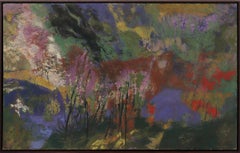
Springtime, 1960s Semi Abstract Modernist Mountain Landscape Tempera Painting

Springtime, 1960s Semi Abstract Modernist Mountain Landscape Tempera Painting

By Ethel Magafan

Located in Denver, CO

"Springtime" is an original tempera on board painting of a Colorado mountain landscape painting by Ethel Magafan circa 1960. Abstracted mountain landscape with trees, painted in colors of green, purple, golden yellow, red, orange, blue, black and white. Presented in a custom hardwood frame, outer dimensions measure 23 ¼ x 50 x 2 inches. Image size is 30 x 48 inches. Provenance: Private collection, Maine Acquired in the early 1960s, by descent through the family to the present owner About the Artist: Jenne and Ethel Magafan were identical twins, born in Chicago to a Greek immigrant father and a Polish mother. Due to health concerns about their father, the family moved to Colorado, living first in Colorado Springs and then in Denver. He was a proud supporter of their artistic ambitions but died suddenly 1932, a heavy blow to both of them. They attended East High School in Denver, where they found a mentor in their art teacher Helen Perry. She had studied at the Art Institute of Chicago but had later abandoned a career as an artist, making her all the more determined to help the Magafan twins succeed artistically. While still in high school, the twins impressed artist Frank Mechau, and Helen Perry paid for their lessons with him. He subsequently invited them to apprentice with him at his Redstone studio. In 1936, Jenne won the Carter Memorial Art Scholarship and shared it with her sister so that they both could attend the Broadmoor Art Academy in Colorado Springs. Once they ran out of money, Mechau, now teaching there, hired them as assistants. Through their involvement at the Academy, the twins entered into careers as muralists, working at first with Mechau and then with Peppino Mangravite. From 1937 to 1943, Ethel was commissioned to paint her first of seven government sponsored murals. Located in the US Post Office in Auburn, Nebraska, this commission made Ethel (at age 26) the youngest artist in America to receive such an honor. Denver Art Museum director Donald J. Bear once commented that “[Ethel and Jenne's] study of local detail makes them appear as little Bruegels of ranch genre – natural and unforced.” As mural painting commissions diminished, Ethel began to do more easel painting for which she used a palette knife and tempera paints to great effect. After settling in California for five years, the twins permanently relocated to Woodstock, New York in 1945, where the sisters lived apart for the first time. Ethel developed an increasing focus within her work, particularly for horses and abstract landscapes. She met fellow artist Bruce Currie...

Category

Mid-20th Century American Impressionist Ethel Magafan Art

Materials

Tempera, Board

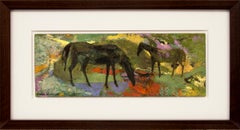
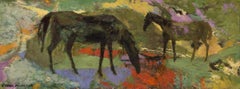
Two Horses, 1960s Framed Semi Abstract Tempera Painting Figural Horses Landscape

Two Horses, 1960s Framed Semi Abstract Tempera Painting Figural Horses Landscape

By Ethel Magafan

Located in Denver, CO

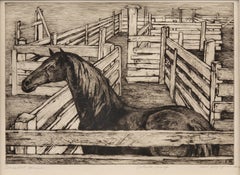
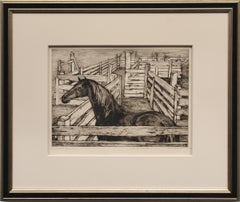
Two Horses, vintage 1960 semi abstract painting by Colorado/Woodstock, NY woman artist, Ethel Magafan (1916-1993). Midcentury modern era original work painted with tempera on board in colors of green, red orange, golden yellow, orange, black and purple. Signed by the artist lower left, signed and titled verso. Presented in a custom frame, outer dimensions measure 10 ½ x 20 ½ x 1 inches. Image size is 5 ¼ x 13 ¾ inches. Painting is clean and in very good vintage condition. Expedited and International Shipping is available; please contact us for an estimate. About the Artist: The daughter of a Greek immigrant father and a Polish immigrant mother who met and married in Chicago, Ethel Magafan, her identical twin sister Jenne and their elder sister Sophie grew up in Colorado to which their father relocated the family in 1919. They initially lived in Colorado Springs where he worked as a waiter at the Antlers Hotel before moving to Denver in 1930 to be head waiter at the Albany Hotel. Two years later during the Great Depression Ethel and Jenne experienced at sixteen the tragic loss of their father who had encouraged their artistic aspirations He was proud when Ethel, a student at Morey Junior High School, won top prizes in student poster contests sponsored by the Denver Chamber of Commerce and the Denver Post. At East High School in Denver she and Jenne contributed their art talents to the school's and by their senior year were co-art editors of the Angelus, the 1933 yearbook. At East they studied art with Helen Perry, herself a student of André Lhote in Paris and the Art Institute of Chicago. Her decision to abandon an arts career to teach high school students served as an important example to Ethel and Jenne, who early on had decided to become artists. In a city-wide Denver competition for high school art students Ethel won an eighteen-week art course in 1932-33 to study at the Kirkland School of Art which artist Vance Kirkland had recently established in the Mile High City. Perry encouraged the Magafan twins' talent, exposing them to the work of Matisse, Picasso and Cézanne and introducing them to local artists and architects like Frank Mechau and Jacques Benedict whom she invited to speak in her high school art classes. She paid the modest tuition for Ethel and Jenne to study composition, color, mural designing and painting at Mechau's School of Art in downtown Denver in 1933-34. In the summer of 1934 and for a time in 1936 they apprenticed with him at his studio in Redstone, Colorado. When they returned to Denver in 1934 with no family breadwinner to support them, their mother insisted that they have real jobs so they worked as fashion artists in a Denver department store. When Jenne won the Carter Memorial Art Scholarship ($90.00) two years later, she shared it with Ethel so that both of them could enroll in the Broadmoor Art Academy (now the Colorado Springs Fine Arts Center) where they studied with Mechau. When the scholarship money ran out after two months, he hired them as his assistants. Along with Edward (Eduardo) Chavez and Polly Duncan, they helped him with his federal government mural commissions. At the Fine Arts Center Ethel also studied with Boardman Robinson and Peppino Mangravite, who hired her and Jenne in 1939 to assist him in his New York studio with two murals commissioned for the post office in Atlantic City, New Jersey. Like their Denver high school art teacher, Robinson also stressed the need to draw from nature in order to "feel" the mountains, which later become the dominant subject matter of Ethel's mature work after World War II. Mechau trained her and her sister in the complex process of mural painting while they studied at the Colorado Springs Fine Arts Center, teaching them the compositional techniques of the European Renaissance masters. This also involved library research for historical accuracy, small scale drawing, and the hand-making of paints and other supplies. Ethel recalled that their teacher "was a lovely man but he was a hard worker. He drove us. There was no fooling around." Her apprenticeship with Mechau prepared her to win four national government competitions, beginning at age twenty-two, for large murals in U.S. post offices: Threshing - Auburn, Nebraska (1938), Cotton Pickers - Wynne, Arkansas (1940), Prairie Fire - Madill, Oklahoma (1940), and The Horse Corral - South Denver, Colorado (1942). In preparation for their commissions Ethel and her sister made trips around the country to pending mural locations, driving their beat-up station wagon, dressed in jeans and cowboy boots with art supplies and dogs in tow. She and Jenne combined their talents in the mural, Mountains in Snow, for the Department of Health and Human Services Building in Washington, DC (1942). A year later Ethel executed her own mural, Andrew Jackson at the Battle of New Orleans, January 8, 1814, for the Recorder of Deeds Building, also in Washington, DC. Her first mural commission, Indian Dance, done in 1937 under the Treasury Department Art Project for the Senate Chamber in the United States Capitol, has since disappeared. Ethel and her sister lived and worked in Colorado Springs until 1941 when their residence became determined by the wartime military postings of Jenne's husband, Edward Chavez. They moved briefly to Los Angeles (1941-42) and then to Cheyenne, Wyoming, while he was stationed at Fort Warren, and then back to Los Angeles for two years in 1943. While in California, Ethel and Jenne executed a floral mural for the Sun Room of the Beverly Hills Hotel and also painted scenes of the ocean which they exhibited at the Raymond and Raymond Galleries in Beverly Hills. While in Los Angeles they met novelist Irving Stone, author of Lust for Life, who told them about Woodstock, as did artists Arnold Blanch and Doris Lee (both of whom previously taught at the Colorado Springs Fine Arts Center school. In summer of 1945 Ethel, her sister and brother-in-law drove their station wagon across the country to Woodstock which became their permanent home. A year later Ethel married artist and musician, Bruce Currie, whom she met in Woodstock. In 1948 with the help of the GI Bill they purchased an old barn there that also housed their individual studios located at opposite ends of the house. The spatial arrangement mirrors the advice she gave her daughter, Jenne, also an artist: "Make sure you end up with a man who respects your work... The worst thing for an artist is to be in competition with her husband." In 1951 Ethel won a Fulbright Scholarship to Greece where she and her husband spent 1951-52. In addition to extensively traveling, sketching and painting the local landscape, she reconnected with her late father's family in the area of Messinia on the Peloponnese peninsula in southern Greece. At the same time, her sister Jenne accompanied Chavez on his Fulbright Scholarship to Italy where they spent a productive year painting and visiting museums. Shortly after returning home, Jenne's career was cut tragically short when she died of a cerebral hemorrhage at age thirty-six. It deeply affected Ethel whose own work took on a somber quality for several years conveyed by a darkish palette, as seen in her tempera painting, Aftermath (circa 1952). In the 1940s Ethel and her sister successfully made the important transition from government patronage to careers as independent artists. Ethel became distinguished for her modernist landscapes. Even though Ethel became a permanent Woodstock resident after World War II, from her childhood in Colorado she retained her love of the Rocky Mountains, her "earliest source of my lifelong passion for mountain landscape." She and her husband began returning to Colorado for annual summer camping trips on which they later were joined by their daughter, Jenne. Ethel did many sketches and drawings of places she found which had special meaning for her. They enabled her to recall their vital qualities which she later painted in her Woodstock studio, conveying her feeling about places remembered. She also produced a number of watercolors and prints of the Colorado landscape that constituted a departure from the American Scene style of her earlier paintings. Her postwar creative output collectively belongs to the category of landscape abstractionists as described by author Sheldon Cheney, although to a greater or lesser degree her work references Colorado's mountainous terrain. She introduced a palette of stronger pastels in her paintings such as two temperas, Evening Mountains from the 1950s and Springtime in the Mountains from the early 1960s. In 1968 she was elected an Academician by the National Academy of Design in New York. Two years later, based on results of her many summer trips to Colorado, the U.S. Department of the Interior invited her to make on-the-spot sketches of the western United States, helping to document the water resources development and conservation efforts by the Department of the Interior. Her sketches were exhibited at the National Gallery in Washington, DC, and then sent on a national tour by the Smithsonian Institution. Similarly, her previous work as a muralist earned her a final commission at age sixty-three for a 12 by 20 foot Civil War image, Grant in the Wilderness, installed in 1979 in the Chancellorsville Visitors Center at the Fredericksburg National Military Park in Virginia. In the 1970s, too, she taught as Artist-in-Residence at Syracuse University and at the University of Georgia in Athens. ©Stan Cuba for David Cook Galleries, LLC Her many awards include, among others, the Stacey Scholarship (1947); Tiffany Fellowship (1949); Fulbright Grant (1951-52, in Greece with her husband); Tiffany Fellowship (1949); Benjamin Altman Landscape Prize, National Academy of Design (1955); Medal of Honor, Audubon, Artists (1962); Henry Ward Granger Fund Purchase Award, National Academy of Design (1964); Childe Hassam Fund Purchase Award, American Academy of Arts and Letters (1970); Silver Medal, Audubon Artists (1983); Champion International Corporation Award, Silvermine Guild, New Canaan, Connecticut (1984); John Taylor Award, Woodstock Artists Association, Woodstock, New York (1985); Harrison Cady...

Category

1960s Abstract Impressionist Ethel Magafan Art

Materials

Tempera

End of the Meadow, 1970s Abstract Colorado Mountain Landscape Tempera Painting

End of the Meadow, 1970s Abstract Colorado Mountain Landscape Tempera Painting

By Ethel Magafan

Located in Denver, CO

End of the Meadow, original vintage 1970s painting by Colorado/Woodstock, NY woman artist, Ethel Magafan (1916-1993), semi Abstract Colorado Mountain Landscape, tempera on masonite in colors of yellow, gold, green, purple, blue, red and orange. Presented in a custom hardwood float frame, outer dimensions measure 30 x 41 ½ x 2 ¼ inches. Image size is 28 ¼ x 40 inches. Painting is clean and in very good vintage condition - please contact us for a detailed condition report. Provenance: Estate of Ethel Magafan About the Artist: The daughter of a Greek immigrant father and a Polish immigrant mother who met and married in Chicago, Ethel Magafan, her identical twin sister Jenne and their elder sister Sophie grew up in Colorado to which their father relocated the family in 1919. They initially lived in Colorado Springs where he worked as a waiter at the Antlers Hotel before moving to Denver in 1930 to be head waiter at the Albany Hotel. Two years later during the Great Depression Ethel and Jenne experienced at sixteen the tragic loss of their father who had encouraged their artistic aspirations He was proud when Ethel, a student at Morey Junior High School, won top prizes in student poster contests sponsored by the Denver Chamber of Commerce and the Denver Post. At East High School in Denver she and Jenne contributed their art talents to the school's and by their senior year were co-art editors of the Angelus, the 1933 yearbook. At East they studied art with Helen Perry, herself a student of André Lhote in Paris and the Art Institute of Chicago. Her decision to abandon an arts career to teach high school students served as an important example to Ethel and Jenne, who early on had decided to become artists. In a city-wide Denver competition for high school art students Ethel won an eighteen-week art course in 1932-33 to study at the Kirkland School of Art which artist Vance Kirkland had recently established in the Mile High City. Perry encouraged the Magafan twins' talent, exposing them to the work of Matisse, Picasso and Cézanne and introducing them to local artists and architects like Frank Mechau and Jacques Benedict whom she invited to speak in her high school art classes. She paid the modest tuition for Ethel and Jenne to study composition, color, mural designing and painting at Mechau's School of Art in downtown Denver in 1933-34. In the summer of 1934 and for a time in 1936 they apprenticed with him at his studio in Redstone, Colorado. When they returned to Denver in 1934 with no family breadwinner to support them, their mother insisted that they have real jobs so they worked as fashion artists in a Denver department store. When Jenne won the Carter Memorial Art Scholarship ($90.00) two years later, she shared it with Ethel so that both of them could enroll in the Broadmoor Art Academy (now the Colorado Springs Fine Arts Center) where they studied with Mechau. When the scholarship money ran out after two months, he hired them as his assistants. Along with Edward (Eduardo) Chavez and Polly Duncan, they helped him with his federal government mural commissions. At the Fine Arts Center Ethel also studied with Boardman Robinson and Peppino Mangravite, who hired her and Jenne in 1939 to assist him in his New York studio with two murals commissioned for the post office in Atlantic City, New Jersey. Like their Denver high school art teacher, Robinson also stressed the need to draw from nature in order to "feel" the mountains, which later become the dominant subject matter of Ethel's mature work after World War II. Mechau trained her and her sister in the complex process of mural painting while they studied at the Colorado Springs Fine Arts Center, teaching them the compositional techniques of the European Renaissance masters. This also involved library research for historical accuracy, small scale drawing, and the hand-making of paints and other supplies. Ethel recalled that their teacher "was a lovely man but he was a hard worker. He drove us. There was no fooling around." Her apprenticeship with Mechau prepared her to win four national government competitions, beginning at age twenty-two, for large murals in U.S. post offices: Threshing - Auburn, Nebraska (1938), Cotton Pickers - Wynne, Arkansas (1940), Prairie Fire - Madill, Oklahoma (1940), and The Horse Corral - South Denver, Colorado (1942). In preparation for their commissions Ethel and her sister made trips around the country to pending mural locations, driving their beat-up station wagon, dressed in jeans and cowboy boots with art supplies and dogs in tow. She and Jenne combined their talents in the mural, Mountains in Snow, for the Department of Health and Human Services Building in Washington, DC (1942). A year later Ethel executed her own mural, Andrew Jackson at the Battle of New Orleans, January 8, 1814, for the Recorder of Deeds Building, also in Washington, DC. Her first mural commission, Indian Dance, done in 1937 under the Treasury Department Art Project for the Senate Chamber in the United States Capitol, has since disappeared. Ethel and her sister lived and worked in Colorado Springs until 1941 when their residence became determined by the wartime military postings of Jenne's husband, Edward Chavez. They moved briefly to Los Angeles (1941-42) and then to Cheyenne, Wyoming, while he was stationed at Fort Warren, and then back to Los Angeles for two years in 1943. While in California, Ethel and Jenne executed a floral mural for the Sun Room of the Beverly Hills Hotel and also painted scenes of the ocean which they exhibited at the Raymond and Raymond Galleries in Beverly Hills. While in Los Angeles they met novelist Irving Stone, author of Lust for Life, who told them about Woodstock, as did artists Arnold Blanch and Doris Lee (both of whom previously taught at the Colorado Springs Fine Arts Center school. In summer of 1945 Ethel, her sister and brother-in-law drove their station wagon across the country to Woodstock which became their permanent home. A year later Ethel married artist and musician, Bruce Currie, whom she met in Woodstock. In 1948 with the help of the GI Bill they purchased an old barn there that also housed their individual studios located at opposite ends of the house. The spatial arrangement mirrors the advice she gave her daughter, Jenne, also an artist: "Make sure you end up with a man who respects your work... The worst thing for an artist is to be in competition with her husband." In 1951 Ethel won a Fulbright Scholarship to Greece where she and her husband spent 1951-52. In addition to extensively traveling, sketching and painting the local landscape, she reconnected with her late father's family in the area of Messinia on the Peloponnese peninsula in southern Greece. At the same time, her sister Jenne accompanied Chavez on his Fulbright Scholarship to Italy where they spent a productive year painting and visiting museums. Shortly after returning home, Jenne's career was cut tragically short when she died of a cerebral hemorrhage at age thirty-six. It deeply affected Ethel whose own work took on a somber quality for several years conveyed by a darkish palette, as seen in her tempera painting, Aftermath (circa 1952). In the 1940s Ethel and her sister successfully made the important transition from government patronage to careers as independent artists. Ethel became distinguished for her modernist landscapes. Even though Ethel became a permanent Woodstock resident after World War II, from her childhood in Colorado she retained her love of the Rocky Mountains, her "earliest source of my lifelong passion for mountain landscape." She and her husband began returning to Colorado for annual summer camping trips on which they later were joined by their daughter, Jenne. Ethel did many sketches and drawings of places she found which had special meaning for her. They enabled her to recall their vital qualities which she later painted in her Woodstock studio, conveying her feeling about places remembered. She also produced a number of watercolors and prints of the Colorado landscape that constituted a departure from the American Scene style of her earlier paintings. Her postwar creative output collectively belongs to the category of landscape abstractionists as described by author Sheldon Cheney, although to a greater or lesser degree her work references Colorado's mountainous terrain. She introduced a palette of stronger pastels in her paintings such as two temperas, Evening Mountains from the 1950s and Springtime in the Mountains from the early 1960s. In 1968 she was elected an Academician by the National Academy of Design in New York. Two years later, based on results of her many summer trips to Colorado, the U.S. Department of the Interior invited her to make on-the-spot sketches of the western United States, helping to document the water resources development and conservation efforts by the Department of the Interior. Her sketches were exhibited at the National Gallery in Washington, DC, and then sent on a national tour by the Smithsonian Institution. Similarly, her previous work as a muralist earned her a final commission at age sixty-three for a 12 by 20 foot Civil War image, Grant in the Wilderness, installed in 1979 in the Chancellorsville Visitors Center at the Fredericksburg National Military Park in Virginia. In the 1970s, too, she taught as Artist-in-Residence at Syracuse University and at the University of Georgia in Athens. ©Stan Cuba for David Cook Galleries, LLC Her many awards include, among others, the Stacey Scholarship (1947); Tiffany Fellowship (1949); Fulbright Grant (1951-52, in Greece with her husband); Tiffany Fellowship (1949); Benjamin Altman Landscape Prize, National Academy of Design (1955); Medal of Honor, Audubon, Artists (1962); Henry Ward Granger Fund Purchase Award, National Academy of Design (1964); Childe Hassam Fund Purchase Award, American Academy of Arts and Letters (1970); Silver Medal, Audubon Artists (1983); Champion International Corporation Award, Silvermine Guild, New Canaan, Connecticut (1984); John Taylor Award, Woodstock Artists Association, Woodstock, New York (1985); Harrison Cady...

Category

Mid-20th Century American Modern Ethel Magafan Art

Materials

Masonite, Tempera
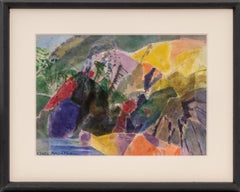
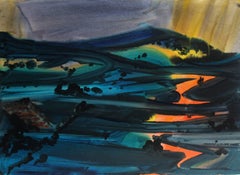
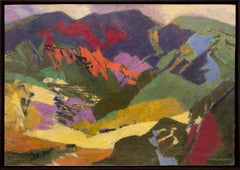
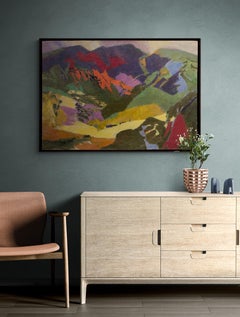
Through the Canyon, Semi-Abstract Colorado Mountain Landscape, Green Blue Orange

Through the Canyon, Semi-Abstract Colorado Mountain Landscape, Green Blue Orange

By Ethel Magafan

Located in Denver, CO

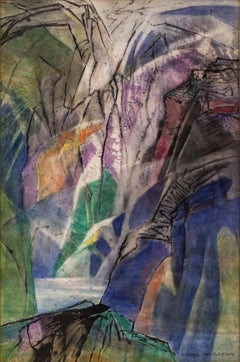
Semi-abstract landscape painting of Colorado mountains by Ethel Magafan (25011). The abstract mountain range is painted in colors of dark green, blue, orange, yellow, white, ink blue, pink, red, teal and purple. Watercolor on paper, signed lower left, titled verso. Presented in a custom frame with archival materials and UV protectant glass, outer dimensions measure 29 ½ x 37 ¼ x 1 ½ inches. Image size is 22 x 30 inches. Provenance: Estate of Ethel & Jenne Magafan Jenne and Ethel Magafan were identical twins, born in Chicago to a Greek immigrant father and a Polish mother. Due to health concerns about their father, the family moved to Colorado, living first in Colorado Springs and then in Denver. He was a proud supporter of their artistic ambitions but died suddenly 1932, a heavy blow to both of them. They attended East High School in Denver, where they found a mentor in their art teacher Helen Perry. She had studied at the Art Institute of Chicago but had later abandoned a career as an artist, making her all the more determined to help the Magafan twins succeed artistically. While still in high school, the twins impressed artist Frank Mechau, and Helen Perry paid for their lessons with him. He subsequently invited them to apprentice with him at his Redstone studio. In 1936, Jenne won the Carter Memorial Art Scholarship and shared it with her sister so that they both could attend the Broadmoor Art Academy in Colorado Springs. Once they ran out of money, Mechau, now teaching there, hired them as assistants. Through their involvement at the Academy, the twins entered into careers as muralists, working at first with Mechau and then with Peppino Mangravite. From 1937 to 1943, Ethel was commissioned to paint her first of seven government sponsored murals. Located in the US Post Office in Auburn, Nebraska, this commission made Ethel (at age 26) the youngest artist in America to receive such an honor. Denver Art Museum director Donald J. Bear once commented that “[Ethel and Jenne's] study of local detail makes them appear as little Bruegels of ranch genre – natural and unforced.” As mural painting commissions diminished, Ethel began to do more easel painting for which she used a palette knife and tempera paints to great effect. After settling in California for five years, the twins permanently relocated to Woodstock, New York in 1945, where the sisters lived apart for the first time. Ethel developed an increasing focus within her work, particularly for horses and abstract landscapes. She met fellow artist Bruce Currie at an artist’s party...

Category

1960s Abstract Ethel Magafan Art

Materials

Watercolor

On Coming Storm, Vintage 1955 Semi-Abstract Colorado Mountain Landscape Painting

On Coming Storm, Vintage 1955 Semi-Abstract Colorado Mountain Landscape Painting

By Ethel Magafan

Located in Denver, CO

On Coming Storm, Vintage 1955 original signed framed modernist watercolor painting by Colorado/Woodstock woman artist, Ethel Magafan (1916-1993). Mid-century semi-abstract painting of Colorado...

Category

Mid-20th Century Abstract Ethel Magafan Art

Materials

Watercolor

Mt. Sopris (Near Aspen and Carbondale, Colorado) semi-abstract painting

Mt. Sopris (Near Aspen and Carbondale, Colorado) semi-abstract painting

By Ethel Magafan

Located in Denver, CO

Original semi-abstract/modernist painting of Mount Sopris by Colorado & Woodstock, NY mid-twentieth century woman artist, Ethel Magafan (1916-1993). Mt. Sopris is located near Aspen...

Category

Mid-20th Century Abstract Ethel Magafan Art

Materials

Masonite, Casein

Quiet Water (Landscape with Pond)

Ethel MagafanQuiet Water (Landscape with Pond)

Sold

H 28.5 in W 38.75 in D 1.5 in

Quiet Water (Landscape with Pond)

By Ethel Magafan

Located in Denver, CO

Quiet Water, original vintage mid-century modern style painting by 20th century Colorado/Woodstock woman artist, Ethel Magafan (1916-1993) of an semi-abstract/impressionist Colorado mountain landscape with a pond in colors of blue, orange, purple, gold, brown, green and ivory. Presented in a vintage frame, outer dimensions measure 28 ½ x 38 ¾ x 1 ½ inches. Image size is 23 x 33 inches The daughter of a Greek immigrant father and a Polish immigrant mother who met and married in Chicago, Ethel Magafan, her identical twin sister Jenne and their elder sister Sophie grew up in Colorado to which their father relocated the family in 1919. They initially lived in Colorado Springs where he worked as a waiter at the Antlers Hotel before moving to Denver in 1930 to be head waiter at the Albany Hotel. Two years later during the Great Depression Ethel and Jenne experienced at sixteen the tragic loss of their father who had encouraged their artistic aspirations He was proud when Ethel, a student at Morey Junior High School, won top prizes in student poster contests sponsored by the Denver Chamber of Commerce and the Denver Post. At East High School in Denver she and Jenne contributed their art talents to the school's and by their senior year were co-art editors of the Angelus, the 1993 yearbook. At East they studied art with Helen Perry, herself a student of André Lhote in Paris and the Art Institute of Chicago. Her decision to abandon an arts career to teach high school students served as an important example to Ethel and Jenne, who early on had decided to become artists. In a city-wide Denver competition for high school art students Ethel won an eighteen-week art course in 1932-33 to study at the Kirkland School of Art which artist Vance Kirkland had recently established in the Mile High City. Perry encouraged the Magafan twins' talent, exposing them to the work of Matisse, Picasso and Cézanne and introducing them to local artists and architects like Frank Mechau and Jacques Benedict whom she invited to speak in her high school art classes. She paid the modest tuition for Ethel and Jenne to study composition, color, mural designing and painting at Mechau's School of Art in downtown Denver in 1933-34. In the summer of 1934 and for a time in 1936 they apprenticed with him at his studio in Redstone, Colorado. When they returned to Denver in 1934 with no family breadwinner to support them, their mother insisted that they have real jobs so they worked as fashion artists in a Denver department store. When Jenne won the Carter Memorial Art Scholarship ($90.00) two years later, she shared it with Ethel so that both of them could enroll in the Broadmoor Art Academy (now the Colorado Springs Fine Arts Center) where they studied with Mechau. When the scholarship money ran out after two months, he hired them as his assistants. Along with Edward (Eduardo) Chavez and Polly Duncan, they helped him with his federal government mural commissions. At the Fine Arts Center Ethel also studied with Boardman Robinson and Peppino Mangravite, who hired her and Jenne in 1939 to assist him in his New York studio with two murals commissioned for the post office in Atlantic City, New Jersey. Like their Denver high school art teacher, Robinson also stressed the need to draw from nature in order to "feel" the mountains, which later become the dominant subject matter of Ethel's mature work after World War II. Mechau trained her and her sister in the complex process of mural painting while they studied at the Colorado Springs Fine Arts Center, teaching them the compositional techniques of the European Renaissance masters. This also involved library research for historical accuracy, small scale drawing, and the hand-making of paints and other supplies. Ethel recalled that their teacher "was a lovely man but he was a hard worker. He drove us. There was no fooling around." Her apprenticeship with Mechau prepared her to win four national government competitions, beginning at age twenty-two, for large murals in U.S. post offices: Threshing - Auburn, Nebraska (1938), Cotton Pickers - Wynne, Arkansas (1940), Prairie Fire - Madill, Oklahoma (1940), and The Horse Corral - South Denver, Colorado (1942). In preparation for their commissions Ethel and her sister made trips around the country to pending mural locations, driving their beat-up station wagon, dressed in jeans and cowboy boots with art supplies and dogs in tow. She and Jenne combined their talents in the mural, Mountains in Snow, for the Department of Health and Human Services Building in Washington, DC (1942). A year later Ethel executed her own mural, Andrew Jackson at the Battle of New Orleans, January 8, 1814, for the Recorder of Deeds Building, also in Washington, DC. Her first mural commission, Indian Dance, done in 1937 under the Treasury Department Art Project for the Senate Chamber in the United States Capitol, has since disappeared. Ethel and her sister lived and worked in Colorado Springs until 1941 when their residence became determined by the wartime military postings of Jenne's husband, Edward Chavez. They moved briefly to Los Angeles (1941-42) and then to Cheyenne, Wyoming, while he was stationed at Fort Warren, and then back to Los Angeles for two years in 1943. While in California, Ethel and Jenne executed a floral mural for the Sun Room of the Beverly Hills Hotel and also painted scenes of the ocean which they exhibited at the Raymond and Raymond Galleries in Beverly Hills. While in Los Angeles they met novelist Irving Stone, author of Lust for Life, who told them about Woodstock, as did artists Arnold Blanch and Doris Lee (both of whom previously taught at the Colorado Springs Fine Arts Center school. In summer of 1945 Ethel, her sister and brother-in-law drove their station wagon across the country to Woodstock which became their permanent home. A year later Ethel married artist and musician, Bruce Currie, whom she met in Woodstock. In 1948 with the help of the GI Bill they purchased an old barn there that also housed their individual studios located at opposite ends of the house. The spatial arrangement mirrors the advice she gave her daughter, Jenne, also an artist: "Make sure you end up with a man who respects your work... The worst thing for an artist is to be in competition with her husband." In 1951 Ethel won a Fulbright Scholarship to Greece where she and her husband spent 1951-52. In addition to extensively traveling, sketching and painting the local landscape, she reconnected with her late father's family in the area of Messinia on the Peloponnese peninsula in southern Greece. At the same time, her sister Jenne accompanied Chavez on his Fulbright Scholarship to Italy where they spent a productive year painting and visiting museums. Shortly after returning home, Jenne's career was cut tragically short when she died of a cerebral hemorrhage at age thirty-six. It deeply affected Ethel whose own work took on a somber quality for several years conveyed by a darkish palette, as seen in her tempera painting, Aftermath (circa 1952). In the 1940s Ethel and her sister successfully made the important transition from government patronage to careers as independent artists. Ethel became distinguished for her modernist landscapes. Even though Ethel became a permanent Woodstock resident after World War II, from her childhood in Colorado she retained her love of the Rocky Mountains, her "earliest source of my lifelong passion for mountain landscape." She and her husband began returning to Colorado for annual summer camping trips on which they later were joined by their daughter, Jenne. Ethel did many sketches and drawings of places she found which had special meaning for her. They enabled her to recall their vital qualities which she later painted in her Woodstock studio, conveying her feeling about places remembered. She also produced a number of watercolors and prints of the Colorado landscape that constituted a departure from the American Scene style of her earlier paintings. Her postwar creative output collectively belongs to the category of landscape abstractionists as described by author Sheldon Cheney, although to a greater or lesser degree her work references Colorado's mountainous terrain. She introduced a palette of stronger pastels in her paintings such as two temperas, Evening Mountains from the 1950s and Springtime in the Mountains from the early 1960s. In 1968 she was elected an Academician by the National Academy of Design in New York. Two years later, based on results of her many summer trips to Colorado, the U.S. Department of the Interior invited her to make on-the-spot sketches of the western United States, helping to document the water resources development and conservation efforts by the Department of the Interior. Her sketches were exhibited at the National Gallery in Washington, DC, and then sent on a national tour by the Smithsonian Institution. Similarly, her previous work as a muralist earned her a final commission at age sixty-three for a 12 by 20 foot Civil War image, Grant in the Wilderness, installed in 1979 in the Chancellorsville Visitors Center at the Fredericksburg National Military Park in Virginia. In the 1970s, too, she taught as Artist-in-Residence at Syracuse University and at the University of Georgia in Athens. Her many awards include, among others, the Stacey Scholarship (1947); Tiffany Fellowship (1949); Fulbright Grant (1951-52, in Greece with her husband); Tiffany Fellowship (1949); Benjamin Altman Landscape Prize, National Academy of Design (1955); Medal of Honor, Audubon, Artists (1962); Henry Ward Granger Fund Purchase Award, National Academy of Design (1964); Childe Hassam Fund Purchase Award, American Academy of Arts and Letters (1970); Silver Medal, Audubon Artists (1983); Champion International Corporation Award, Silvermine Guild, New Canaan, Connecticut (1984); John Taylor Award, Woodstock Artists Association, Woodstock, New York (1985); Harrison Cady...

Category

20th Century American Impressionist Ethel Magafan Art

Materials

Mixed Media, Tempera
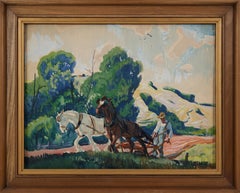
Distant Country (Semi-Abstract Mountain Landscape: Purple, Gold, Green, Brown)

Distant Country (Semi-Abstract Mountain Landscape: Purple, Gold, Green, Brown)

By Ethel Magafan

Located in Denver, CO

Distant Country, original vintage mid-century modern style painting by 20th century Colorado/Woodstock woman artist, Ethel Magafan (1916-1993) of an abstract Colorado mountain landscape in colors of blue, purple, brown, gold, green and ivory. Presented in a vintage frame, outer dimensions measure 22 ¾ x 25 x 1 ¾ inches. Image size 17 x 19 ½ inches. The daughter of a Greek immigrant father and a Polish immigrant mother who met and married in Chicago, Ethel Magafan, her identical twin sister Jenne and their elder sister Sophie grew up in Colorado to which their father relocated the family in 1919. They initially lived in Colorado Springs where he worked as a waiter at the Antlers Hotel before moving to Denver in 1930 to be head waiter at the Albany Hotel. Two years later during the Great Depression Ethel and Jenne experienced at sixteen the tragic loss of their father who had encouraged their artistic aspirations He was proud when Ethel, a student at Morey Junior High School, won top prizes in student poster contests sponsored by the Denver Chamber of Commerce and the Denver Post. At East High School in Denver she and Jenne contributed their art talents to the school's and by their senior year were co-art editors of the Angelus, the 1993 yearbook. At East they studied art with Helen Perry, herself a student of André Lhote in Paris and the Art Institute of Chicago. Her decision to abandon an arts career to teach high school students served as an important example to Ethel and Jenne, who early on had decided to become artists. In a city-wide Denver competition for high school art students Ethel won an eighteen-week art course in 1932-33 to study at the Kirkland School of Art which artist Vance Kirkland had recently established in the Mile High City. Perry encouraged the Magafan twins' talent, exposing them to the work of Matisse, Picasso and Cézanne and introducing them to local artists and architects like Frank Mechau and Jacques Benedict whom she invited to speak in her high school art classes. She paid the modest tuition for Ethel and Jenne to study composition, color, mural designing and painting at Mechau's School of Art in downtown Denver in 1933-34. In the summer of 1934 and for a time in 1936 they apprenticed with him at his studio in Redstone, Colorado. When they returned to Denver in 1934 with no family breadwinner to support them, their mother insisted that they have real jobs so they worked as fashion artists in a Denver department store. When Jenne won the Carter Memorial Art Scholarship ($90.00) two years later, she shared it with Ethel so that both of them could enroll in the Broadmoor Art Academy (now the Colorado Springs Fine Arts Center) where they studied with Mechau. When the scholarship money ran out after two months, he hired them as his assistants. Along with Edward (Eduardo) Chavez and Polly Duncan, they helped him with his federal government mural commissions. At the Fine Arts Center Ethel also studied with Boardman Robinson and Peppino Mangravite, who hired her and Jenne in 1939 to assist him in his New York studio with two murals commissioned for the post office in Atlantic City, New Jersey. Like their Denver high school art teacher, Robinson also stressed the need to draw from nature in order to "feel" the mountains, which later become the dominant subject matter of Ethel's mature work after World War II. Mechau trained her and her sister in the complex process of mural painting while they studied at the Colorado Springs Fine Arts Center, teaching them the compositional techniques of the European Renaissance masters. This also involved library research for historical accuracy, small scale drawing, and the hand-making of paints and other supplies. Ethel recalled that their teacher "was a lovely man but he was a hard worker. He drove us. There was no fooling around." Her apprenticeship with Mechau prepared her to win four national government competitions, beginning at age twenty-two, for large murals in U.S. post offices: Threshing - Auburn, Nebraska (1938), Cotton Pickers - Wynne, Arkansas (1940), Prairie Fire - Madill, Oklahoma (1940), and The Horse Corral - South Denver, Colorado (1942). In preparation for their commissions Ethel and her sister made trips around the country to pending mural locations, driving their beat-up station wagon, dressed in jeans and cowboy boots with art supplies and dogs in tow. She and Jenne combined their talents in the mural, Mountains in Snow, for the Department of Health and Human Services Building in Washington, DC (1942). A year later Ethel executed her own mural, Andrew Jackson at the Battle of New Orleans, January 8, 1814, for the Recorder of Deeds Building, also in Washington, DC. Her first mural commission, Indian Dance, done in 1937 under the Treasury Department Art Project for the Senate Chamber in the United States Capitol, has since disappeared. Ethel and her sister lived and worked in Colorado Springs until 1941 when their residence became determined by the wartime military postings of Jenne's husband, Edward Chavez. They moved briefly to Los Angeles (1941-42) and then to Cheyenne, Wyoming, while he was stationed at Fort Warren, and then back to Los Angeles for two years in 1943. While in California, Ethel and Jenne executed a floral mural for the Sun Room of the Beverly Hills Hotel and also painted scenes of the ocean which they exhibited at the Raymond and Raymond Galleries in Beverly Hills. While in Los Angeles they met novelist Irving Stone, author of Lust for Life, who told them about Woodstock, as did artists Arnold Blanch and Doris Lee (both of whom previously taught at the Colorado Springs Fine Arts Center school. In summer of 1945 Ethel, her sister and brother-in-law drove their station wagon across the country to Woodstock which became their permanent home. A year later Ethel married artist and musician, Bruce Currie, whom she met in Woodstock. In 1948 with the help of the GI Bill they purchased an old barn there that also housed their individual studios located at opposite ends of the house. The spatial arrangement mirrors the advice she gave her daughter, Jenne, also an artist: "Make sure you end up with a man who respects your work... The worst thing for an artist is to be in competition with her husband." In 1951 Ethel won a Fulbright Scholarship to Greece where she and her husband spent 1951-52. In addition to extensively traveling, sketching and painting the local landscape, she reconnected with her late father's family in the area of Messinia on the Peloponnese peninsula in southern Greece. At the same time, her sister Jenne accompanied Chavez on his Fulbright Scholarship to Italy where they spent a productive year painting and visiting museums. Shortly after returning home, Jenne's career was cut tragically short when she died of a cerebral hemorrhage at age thirty-six. It deeply affected Ethel whose own work took on a somber quality for several years conveyed by a darkish palette, as seen in her tempera painting, Aftermath (circa 1952). In the 1940s Ethel and her sister successfully made the important transition from government patronage to careers as independent artists. Ethel became distinguished for her modernist landscapes. Even though Ethel became a permanent Woodstock resident after World War II, from her childhood in Colorado she retained her love of the Rocky Mountains, her "earliest source of my lifelong passion for mountain landscape." She and her husband began returning to Colorado for annual summer camping trips on which they later were joined by their daughter, Jenne. Ethel did many sketches and drawings of places she found which had special meaning for her. They enabled her to recall their vital qualities which she later painted in her Woodstock studio, conveying her feeling about places remembered. She also produced a number of watercolors and prints of the Colorado landscape that constituted a departure from the American Scene style of her earlier paintings. Her postwar creative output collectively belongs to the category of landscape abstractionists as described by author Sheldon Cheney, although to a greater or lesser degree her work references Colorado's mountainous terrain. She introduced a palette of stronger pastels in her paintings such as two temperas, Evening Mountains from the 1950s and Springtime in the Mountains from the early 1960s. In 1968 she was elected an Academician by the National Academy of Design in New York. Two years later, based on results of her many summer trips to Colorado, the U.S. Department of the Interior invited her to make on-the-spot sketches of the western United States, helping to document the water resources development and conservation efforts by the Department of the Interior. Her sketches were exhibited at the National Gallery in Washington, DC, and then sent on a national tour by the Smithsonian Institution. Similarly, her previous work as a muralist earned her a final commission at age sixty-three for a 12 by 20 foot Civil War image, Grant in the Wilderness, installed in 1979 in the Chancellorsville Visitors Center at the Fredericksburg National Military Park in Virginia. In the 1970s, too, she taught as Artist-in-Residence at Syracuse University and at the University of Georgia in Athens. Her many awards include, among others, the Stacey Scholarship (1947); Tiffany Fellowship (1949); Fulbright Grant (1951-52, in Greece with her husband); Tiffany Fellowship (1949); Benjamin Altman Landscape Prize, National Academy of Design (1955); Medal of Honor, Audubon, Artists (1962); Henry Ward Granger Fund Purchase Award, National Academy of Design (1964); Childe Hassam Fund Purchase Award, American Academy of Arts and Letters (1970); Silver Medal, Audubon Artists (1983); Champion International Corporation Award, Silvermine Guild, New Canaan, Connecticut (1984); John Taylor Award, Woodstock Artists Association, Woodstock, New York (1985); Harrison Cady...
Category

20th Century American Modern Ethel Magafan Art

Materials

Tempera, Board

Ethel Magafan art for sale on 1stDibs.

Find a wide variety of authentic Ethel Magafan art available for sale on 1stDibs. You can also browse by medium to find art by Ethel Magafan in paint, tempera, board and more. Much of the original work by this artist or collective was created during the 20th century and is mostly associated with the modern style. Not every interior allows for large Ethel Magafan art, so small editions measuring 21 inches across are available. Customers who are interested in this artist might also find the work of Cecil Crosley Bell, Lena Gurr, and William Clutz. Ethel Magafan art prices can differ depending upon medium, time period and other attributes. On 1stDibs, the price for these items starts at $880 and tops out at $15,000, while the average work can sell for $8,450.

Artists Similar to Ethel Magafan