Francesco Spicuzza Art

Italian, American, 1883-1962
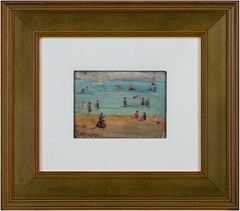
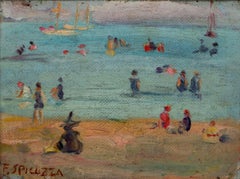
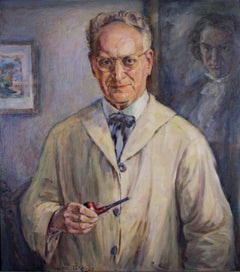
Italian-born Francesco Spicuzza was primarily a Wisconsin painter who did portraits, still-lives and local landscapes. He spent the first part of his life in near-poverty to become a painter. An eternal optimist, in 1917, the artist reported: "I am happy and my only ambition now is to paint better and better until I shall have reached the measure of the best of which I am capable." (Spicuzza, 1917, p. 22). His predilection for beach scenes germinated early: reportedly, the five-year-old boy first drew the outlines of his father's fishing boat in the sand on the seashore near their home in Sicily. After setting himself up as a fruit peddler in Milwaukee, Spicuzza's father sent for his family when Francesco was eight years old. In 1899 or 1900, Spicuzza began studying drawing and anatomy under Robert Schade (1861-1912), a painter of panoramas who had been trained in Munich under Carl Theodor von Piloty. Spicuzza was also taught by Alexander Mueller (1872-1935), a product of the Weimar and Munich academies. The earliest influences in his work appear to be from Edward H. Potthast and Maurice Prendergast, though Spicuzza never mentioned either artist. Already in August 1910, Spicuzza was described in a newspaper as "one of the most talented of Milwaukee's rising workers." He undoubtedly received lasting inspiration from his one summer study period in 1911 with John F. Carlson at the Art Students League's Summer School in Woodstock, New York. Although he executed numerous still-lives and an occasional religious work, Spicuzza is best known for his Milwaukee beach scenes populated with frolicking bathers in multi-colored attire, not unlike the images of Potthast, who used a similar technique. These beach genre scenes reflect the attitude of American impressionists who depicted the more pleasant side of life. Spicuzza manipulated a successful balance of rich pigment applied in varying degrees of impasto texture with subtle nuances of hue. Working all'aperto, he sought "the soft enticing shades of yellow, blue, green, pink and lavender . . . to get the effects of bright glistening summer air." (L.E.S., n.d.). As a painter whose color not only derived from direct observation but also from a personal theory of color symbolism, Spicuzza traded the linear approach of lithography for dynamic patches of brilliant color. Like Prendergast, he would often tilt the angle of the picture plane to bring the viewer's position above the scene. Spicuzza spent a great deal of time painting en plein air and by 1925 he began summering at Big Cedar Lake, near West Bend, Wisconsin to gather his subject matter. During the difficult era of the Depression, patrons came to Spicuzza's aid and during the 40s, he taught housewives, businessmen and students at the Milwaukee Art Institute, the Milwaukee Art Center, and in his studio. In the following decade, although his kind of art was no longer popular in the "make-it-or-break-it" New York gallery world, Spicuzza enjoyed regular patronage and sales. Bio by Richard H. Love and Michael Preston Worley, Ph.D.
to
14
14
8
5
5
2
1
1
1
1
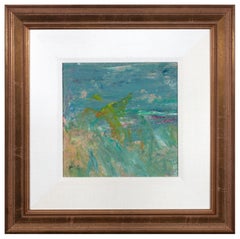
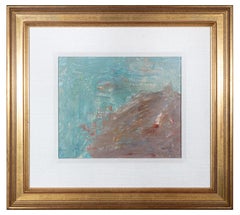
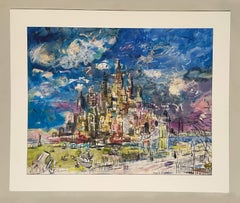
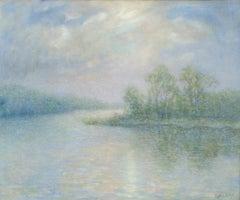
Beautiful large impressionist pastel by Francesco Spicuzza

Beautiful large impressionist pastel by Francesco Spicuzza

By Francesco Spicuzza

Located in New York, NY

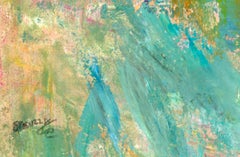
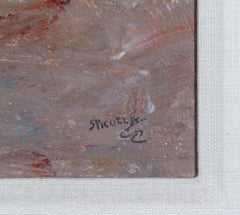
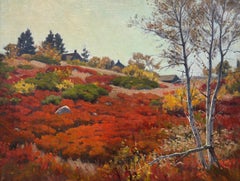
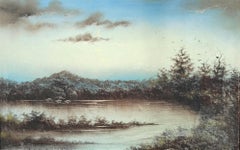
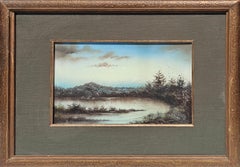
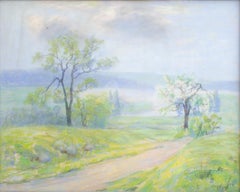
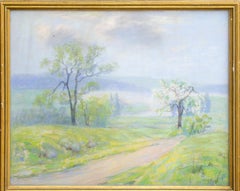
Francesco Spicuzza (American, 1883-1962) Untitled Landscape, 20th century Pastel on paper Sight size: 24 x 30 in. Framed: 26 1/4 x 32 3/8 in. Signed lower right: Spicuzza Italian-born Francesco Spicuzza was primarily a Wisconsin painter who did portraits, still-lives and local landscapes. He spent the first part of his life in near-poverty to become a painter. An eternal optimist, in 1917, the artist reported: "I am happy and my only ambition now is to paint better and better until I shall have reached the measure of the best of which I am capable." (Spicuzza, 1917, p. 22). His predilection for beach scenes germinated early: reportedly, the five-year-old boy first drew the outlines of his father's fishing boat in the sand on the seashore near their home in Sicily. After setting himself up as a fruit peddler in Milwaukee, Spicuzza's father sent for his family when Francesco was eight years old. For the following six years the boy was unable to attend school because of his job in his father's fruit and vegetable business. The poor lad suffered a caved-in shoulder from carrying a heavy wooden crate. The young Spicuzza was aided by moral and financial support from a sympathetic Milwaukee businessman named John Cramer, publisher and editor of the Evening Wisconsin, who raised Spicuzza's salary as a newspaper assembler so that he could attend school. In 1899 or 1900, Spicuzza began studying drawing and anatomy under Robert Schade (1861-1912), a painter of panoramas who had been trained in Munich under Carl Theodor von Piloty. Spicuzza was also taught by Alexander Mueller (1872-1935), a product of the Weimar and Munich academies. Mueller realized Spicuzza was a colorist and encouraged that orientation (Madle, 1961). Spicuzza found it beneficial to accept an apprenticeship in a lithographic studio for $8 a week, which demanded most of his time. During the St. Louis Universal Exposition in 1904, still a struggling student, Spicuzza attended the fair, thanks to Cramer. It was not long before Spicuzza received a twenty-five dollar portrait commission, and this inaugural success led to new commissions and allowed him to continue as a painter. The earliest influences in his work appear to be from Edward H. Potthast and Maurice Prendergast, though Spicuzza never mentioned either artist. Already in August 1910, Spicuzza was described in a newspaper as "one of the most talented of Milwaukee's rising workers." He undoubtedly received lasting inspiration from his one summer study period in 1911 with John F. Carlson at the Art Students League's Summer School in Woodstock, New York. Certainly Spicuzza would have picked up spontaneity in handling the brush from Carlson. Although he executed numerous still-lives and an occasional religious work, Spicuzza is best known for his Milwaukee beach scenes populated with frolicking bathers in multi-colored attire, not unlike the images of Potthast, who used a similar technique. Many of these are small, preparatory works on canvas board executed between 1910 and 1915. Frequently with even greater animation than Potthast, Spicuzza produced moving images of youthful energy and uninhibited child's play. These beach genre scenes reflect the attitude of American impressionists who depicted the more pleasant side of life. Spicuzza manipulated a successful balance of rich pigment applied in varying degrees of impasto texture with subtle nuances of hue. Working all'aperto, he sought "the soft enticing shades of yellow, blue, green, pink and lavender . . . to get the effects of bright glistening summer air." (L.E.S., n.d.). As a painter whose color not only derived from direct observation but also from a personal theory of color symbolism, Spicuzza traded the linear approach of lithography for dynamic patches of brilliant color. Like Prendergast, he would often tilt the angle of the picture plane to bring the viewer's position above the scene. Spicuzza was unable to enter the 1913 Armory Show or the Panama-Pacific International Exposition two years later but he did submit work to the annual exhibitions of the Pennsylvania Academy of the Fine Arts and those of the Art Institute of Chicago. His first important award was the bronze medal presented by the St. Paul Institute in 1913, which was followed by the silver medal two years later. Before long, Spicuzza had acquired a greater sense of security in his profession and was described by a writer in International Studio (April 1917) as "an independent artist with an assured future. His pastels and water-colours are poetic and joyous bits of nature with a genuine out-of-door feeling." In 1918, his Spirit of Youth, exhibited at the National Academy of Design, sold for $112.50. Four years later, the artist achieved his greatest local recognition by winning the gold medal from the Milwaukee Art Institute. Spicuzza spent a great deal of time painting en plein air and by 1925 he began summering at Big Cedar Lake, near West Bend, Wisconsin to gather his subject matter. Easter Morning (1926) owes something to the Symbolist movement, with its figure of Christ appearing over a seascape. During the difficult era of the Depression, patrons came to Spicuzza's aid and during the 40s, he taught housewives, businessmen and students at the Milwaukee Art Institute, the Milwaukee Art Center, and in his private studio. In the following decade, although his kind of art was no longer popular in the "make-it-or-break-it" New York gallery world, Spicuzza enjoyed regular patronage and sales. His beach scenes became more static and he would experiment with modernist techniques. Spicuzza died at the age of seventy-eight. Sources: L.E.S., "Do Colors Change a Person's disposition? Experiments of a Milwaukee Artist...

Category

20th Century American Modern Francesco Spicuzza Art

Materials

Paper, Pastel
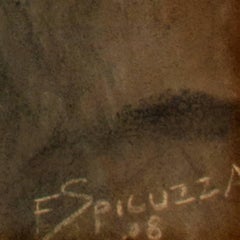
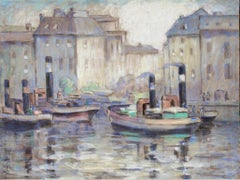
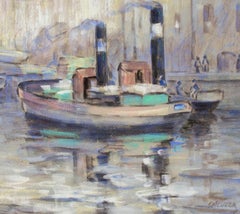
"Boats in Berlin Harbor, " Pastel on Cheesecloth by Francesco Spicuzza

"Boats in Berlin Harbor, " Pastel on Cheesecloth by Francesco Spicuzza

By Francesco Spicuzza

Located in Milwaukee, WI

"Boats in Berlin Harbor" is an original pastel painting on cheesecloth. Small tugboats push across the Berlin harbor as a gauzy cityscape watches from behind. Image: 25" x 33" Frame...

Category

1920s American Modern Francesco Spicuzza Art

Materials

Pastel

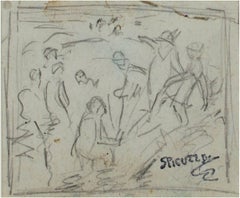
"Lake Michigan Bathers, " Pencil, Reverse, & Photo signed by Francesco Spicuzza

"Lake Michigan Bathers, " Pencil, Reverse, & Photo signed by Francesco Spicuzza

By Francesco Spicuzza

Located in Milwaukee, WI

"Lake Michigan Bathers" is an original pencil sketch by Francesco Spicuzza. The artist signed the piece in the lower right. On the reverse is a silver gelatin photo print...

Category

1910s Francesco Spicuzza Art

Materials

Carbon Pencil, Black and White, Silver Gelatin

20th century oil painting self portrait male subject glasses pipe signed

20th century oil painting self portrait male subject glasses pipe signed

By Francesco Spicuzza

Located in Milwaukee, WI

"Self Portrait" is an original oil painting on masonite board by Francesco Spicuzza. The artist signed the piece in the lower left. It depicts the artist holding a pipe in front of a...

Category

1940s Francesco Spicuzza Art

Materials

Masonite, Oil

Early 20th century colorful seaside landscape pastel figures bench trees signed

Early 20th century colorful seaside landscape pastel figures bench trees signed

By Francesco Spicuzza

Located in Milwaukee, WI

"Couple on Bench at the Beach" is an original pastel drawing on paperboard by Francesco Spicuzza. The artist signed the piece in the lower left. This drawing depicts two figures sitting on a bench in front of a body of water. The artist used mostly pastel colors for this piece. 6 7/8" x 9 7/8" art 18 1/2" x 21 3/8" frame Francesco J. Spicuzza, born in Sicily on July 23, 1883, came to America at the age of 8. He supported himself as a fruit peddler until a newspaperman gave him $4 a week to go to school. He attended classes at the Milwaukee Art Students League, where he studied under Alexander Mueller. There he learned to paint in the then-fashionable "Munich School" technique, with detailed realism in heavy browns and grayed-out hues. Spicuzza completed eight grades in four years, and then in 1911, three businessmen advanced him enough money to allow him to study in New York under artist and teacher John Carlson. It was during this time that Spicuzza changed his style of painting, developing an impressionistic use of color, form and atmospheric renditions. After a period of grinding poverty, one of Spicuzza's pictures won a major New York competition. It was the first of 60 wins, both in the U.S. and Paris. He became a fashionable painter, and many of the leading collections have his work. Spicuzza's typical works were beach scenes, still life, landscapes and portraits done in pastels, oils, ink, charcoal and watercolors. Much of his work traced the history of Milwaukee in the early 1900s. He was probably best known for his scenes of women and children splashing in the waves...

Category

1910s Impressionist Francesco Spicuzza Art

Materials

Paper, Pastel, Board

"Rocky Shore, " Oil on Board Abstract Landscape Signed

"Rocky Shore, " Oil on Board Abstract Landscape Signed

By Francesco Spicuzza

Located in Milwaukee, WI

"Rocky Shore" is an original oil painting on board by Francesco Spicuzza. The artist signed the piece with his signature stamp in the lower right. Land and water are clearly demarcat...

Category

1930s Francesco Spicuzza Art

Materials

Oil, Board

"Cabin on Lake Michigan Shore, " Oil on Board signed by Francesco Spicuzza

"Cabin on Lake Michigan Shore, " Oil on Board signed by Francesco Spicuzza

By Francesco Spicuzza

Located in Milwaukee, WI

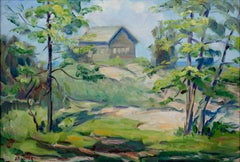
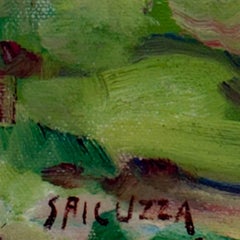
"Cabin on Lake Michigan Shore" is an original oil painting on board by Francesco Spicuzza. The artist signed the piece in the lower left. It depicts a small cabin on the lakeshore surrounded by bright vegetation. 14" x 20" art 22 3/4" x 29" frame Francesco J. Spicuzza, born in Sicily on July 23, 1883, came to America at the age of 8. He supported himself as a fruit peddler until a newspaperman gave him $4 a week to go to school. He attended classes at the Milwaukee Art Students League, where he studied under Alexander Mueller. There he learned to paint in the then-fashionable "Munich School" technique, with detailed realism in heavy browns and grayed-out hues. Spicuzza completed eight grades in four years, and then in 1911, three businessmen advanced him enough money to allow him to study in New York under artist and teacher John Carlson. It was during this time that Spicuzza changed his style of painting, developing an impressionistic use of color, form and atmospheric renditions. After a period of grinding poverty, one of Spicuzza's pictures won a major New York competition. It was the first of 60 wins, both in the U.S. and Paris. He became a fashionable painter, and many of the leading collections have his work. Spicuzza's typical works were beach scenes, still life, landscapes and portraits done in pastels, oils, ink, charcoal and watercolors. Much of his work traced the history of Milwaukee in the early 1900s. He was probably best known for his scenes of women and children splashing in the waves...

Category

1930s Francesco Spicuzza Art

Materials

Oil, Board

Mid 20th century black and white drawing landscape trees houses figures signed

Mid 20th century black and white drawing landscape trees houses figures signed

By Francesco Spicuzza

Located in Milwaukee, WI

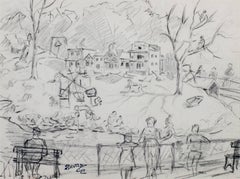
"Monkey Island at Washington Park Zoo" is an original graphite and charcoal drawing on paper by Francesco Spicuzza. It depicts a number of figures gazing out at a monkey enclosure at a zoo. The artist signed the piece in the lower left. 8 1/2" x 11 3/4" art 17 1/4" x 21 1/8" frame Francesco J. Spicuzza, born in Sicily on July 23, 1883, came to America at the age of 8. He supported himself as a fruit peddler until a newspaperman gave him $4 a week to go to school. He attended classes at the Milwaukee Art Students League, where he studied under Alexander Mueller. There he learned to paint in the then-fashionable "Munich School" technique, with detailed realism in heavy browns and grayed-out hues. Spicuzza completed eight grades in four years, and then in 1911, three businessmen advanced him enough money to allow him to study in New York under artist and teacher John Carlson. It was during this time that Spicuzza changed his style of painting, developing an impressionistic use of color, form and atmospheric renditions. After a period of grinding poverty, one of Spicuzza's pictures won a major New York competition. It was the first of 60 wins, both in the U.S. and Paris. He became a fashionable painter, and many of the leading collections have his work. Spicuzza's typical works were beach scenes, still life, landscapes and portraits done in pastels, oils, ink, charcoal and watercolors. Much of his work traced the history of Milwaukee in the early 1900s. He was probably best known for his scenes of women and children splashing in...

Category

1950s Francesco Spicuzza Art

Materials

Paper, Charcoal, Graphite

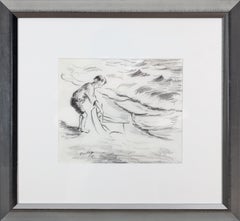
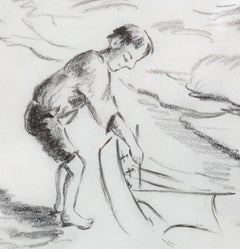
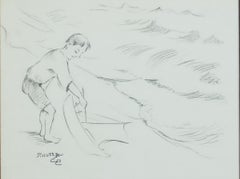
Boy Launching a Sailboat Graphite and charcoal Framed 16.75 x 15.5 Sentimental

Boy Launching a Sailboat Graphite and charcoal Framed 16.75 x 15.5 Sentimental

By Francesco Spicuzza

Located in Milwaukee, WI

Graphite and charcoal on paper signed by the artist. 7.38" x 8.63" 16.75" x 15.5" frame Framed to conservation standards. Float mounted on 100% cotton matboard and glazed in UF5 Plexiglass that filters 99% of UV Rays to ensure the preservation of the piece. All housed in a bold miter jointed bevel frame in distressed silver finish with reflective accents. Francesco J. Spicuzza, born in Sicily on July 23, 1883, came to America at the age of 8. He supported himself as a fruit peddler until a newspaperman gave him $4 a week to go to school. He attended classes at the Milwaukee Art Students League, where he studied under Alexander Mueller. There he learned to paint in the then-fashionable "Munich School" technique, with detailed realism in heavy browns and grayed-out hues. Spicuzza completed eight grades in four years, and then in 1911, three businessmen advanced him enough money to allow him to study in New York under artist and teacher John Carlson. It was during this time that Spicuzza changed his style of painting, developing an impressionistic use of color, form and atmospheric renditions. After a period of grinding poverty, one of Spicuzza's pictures won a major New York competition. It was the first of 60 wins, both in the U.S. and Paris. He became a fashionable painter, and many of the leading collections have his work. Spicuzza's typical works were beach scenes, still life, landscapes and portraits done in pastels, oils, ink, charcoal and watercolors. Much of his work traced the history of Milwaukee in the early 1900s. He was probably best known for his scenes of women and children splashing in the waves...

Category

Mid-20th Century Francesco Spicuzza Art

Materials

Charcoal, Graphite

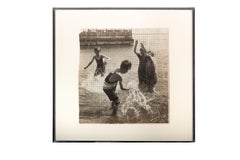
"Children Playing in Water-Lake Michigan (The Splash), " a Siver Gelatin Photo

"Children Playing in Water-Lake Michigan (The Splash), " a Siver Gelatin Photo

By Francesco Spicuzza

Located in Milwaukee, WI

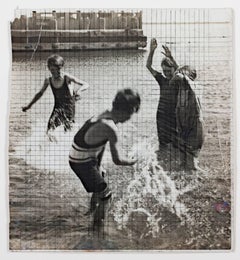
"Children Playing in Water-Lake Michigan (The Splash)" is a black and white silver gelatin photo (with grid) by Francesco Spicuzza. It depicts four children playing and splashing in a lake. 12 1/8" x 11" photo 17 1/4" x 17 1/4" frame Unsigned. This is a gridded reference photo used to produce a finished artwork. Francesco J. Spicuzza, born in Sicily on July 23, 1883, came to America at the age of 8. He supported himself as a fruit peddler until a newspaperman gave him $4 a week to go to school. He attended classes at the Milwaukee Art Students League, where he studied under Alexander Mueller. There he learned to paint in the then-fashionable "Munich School" technique, with detailed realism in heavy browns and grayed-out hues. Spicuzza completed eight grades in four years, and then in 1911, three businessmen advanced him enough money to allow him to study in New York under artist and teacher John Carlson. It was during this time that Spicuzza changed his style of painting, developing an impressionistic use of color, form and atmospheric renditions. After a period of grinding poverty, one of Spicuzza's pictures won a major New York competition. It was the first of 60 wins, both in the U.S. and Paris. He became a fashionable painter, and many of the leading collections have his work. Spicuzza's typical works were beach scenes, still life, landscapes and portraits done in pastels, oils, ink, charcoal and watercolors. Much of his work traced the history of Milwaukee in the early 1900s. He was probably best known for his scenes of women and children splashing in the waves...

Category

Early 20th Century Other Art Style Francesco Spicuzza Art

Materials

Photographic Paper

Related Items
"View of the Empire State NYC in Snow" Impressionistic Ashcan School Style

"View of the Empire State NYC in Snow" Impressionistic Ashcan School Style

By Cindy Shaoul

Located in New York, NY

An impressionistic depiction of a figure in the snow with cars and buildings in the busy City Streets. The Empire State Building is portrayed in the background as the snow filled str...

Category

2010s American Impressionist Francesco Spicuzza Art

Materials

Canvas, Oil, Board

A Captivating 1930s Modern Portrait of a Young Woman by Francis Chapin

A Captivating 1930s Modern Portrait of a Young Woman by Francis Chapin

By Francis Chapin

Located in Chicago, IL

A captivating, 1930s portrait painting of a young woman by famed Chicago artist, Francis Chapin (Am. 1899-1965). A sensitive, skilled portrait of a young female model, most likely h...

Category

1930s American Modern Francesco Spicuzza Art

Materials

Oil, Masonite

Pair of early 20th Century British Impressionist paintings of the beach

Pair of early 20th Century British Impressionist paintings of the beach

Located in Petworth, West Sussex

Attributed to Rowland Wheelwright, 20th Century 'Bather's on the shore' and 'Sunbathing by the Cliffs' Oil on canvas board 9 X 10. 1/4in. (22.8 X 2...

Category

20th Century Impressionist Francesco Spicuzza Art

Materials

Canvas, Oil, Board

"Don't Cry Long" Abstracted and Distorted Self-Portrait, One Crying Eye

"Don't Cry Long" Abstracted and Distorted Self-Portrait, One Crying Eye

Located in Detroit, MI

"Don't Cry Long" is a self-portrait of the artist and an unusual one at that in which the artist portrays herself shedding tears. Perhaps it is an expression of some grief experienced by Ms. Woodlock, but it also admonishes her to not "Cry Long" while at the same time poking fun because of her elongated face and the one lone "long" tear tracing a pattern down her face. In addition to self-portraits, Ethelyn painted commissioned portraits. In this painting her head is cocked and her famous bangs hang down her forehead. Compare two self-portraits, “Up From Under”, and “M’Eyes" to "Don't Cry Long." The major differences are the close facial view and the brilliant blood red paint that fills the entire canvas. This painting is included in the book, "Dreams Have Wings: An Artist's Journey into Magic and Mystery" printed in the United States, 1985. She describes "Don't Cry Long" as showing how funny looking we are, if we cry too long. Ethelyn Woodlock...

Category

Mid-20th Century American Modern Francesco Spicuzza Art

Materials

Oil, Masonite

"Madison Square on 5th Avenue and 23rd Street" Impressionist Winter Street Scene

"Madison Square on 5th Avenue and 23rd Street" Impressionist Winter Street Scene

By Johann Berthelsen, 1883-1972

Located in New York, NY

A truly stunning jewel and pertinent example of Berthelsen's charming New York City winter scenes depicting Madison Square Park on 5th Avenue and 23rd Street. An iconic scene that so...

Category

Mid-20th Century American Impressionist Francesco Spicuzza Art

Materials

Canvas, Oil, Board

"Georgia Moonshiner, c. 1935" by Athos Menaboni (1895-1990) American WPA Era Oil

"Georgia Moonshiner, c. 1935" by Athos Menaboni (1895-1990) American WPA Era Oil

Located in Yardley, PA

A fantastic WPA-era painting of a Georgia moonshiner by famed Italian-American artist Athos Menaboni (1895-1990). This work depicts an older man sporting a brown hat, brown jacket, ...

Category

1930s American Modern Francesco Spicuzza Art

Materials

Masonite, Oil

[Bruce Sargeant (1898-1938)] Man with Ropes and Rings

[Bruce Sargeant (1898-1938)] Man with Ropes and Rings

By Mark Beard

Located in New York, NY

Oil on canvas mounted to Masonite Signed in red, u.r. $7000.00 + $350.00 framing This artwork is offered by ClampArt, located in New York City. “Bruce Sargeant is a mythic figure ...

Category

21st Century and Contemporary Realist Francesco Spicuzza Art

Materials

Canvas, Oil, Masonite

French School, Academic Study (Male Nude)

French School, Academic Study (Male Nude)

$2,735

H 29.14 in W 23.63 in D 0.79 in

French School, Academic Study (Male Nude)

Located in London, GB

Charcoal on paper, 60cm x 42cm, (74cm x 60cm framed). The picture is framed behind museum quality non-reflective UV glass. Drawings and paintings of the nude were central to academ...

Category

19th Century Old Masters Francesco Spicuzza Art

Materials

Paper, Carbon Pencil

"Central Park" Leon Dolice, New York Central Park Scene, Mid-Century

"Central Park" Leon Dolice, New York Central Park Scene, Mid-Century

By Leon Dolice

Located in New York, NY

Leon Dolice Central Park Signed lower left Watercolor on paper 12 x 19 inches The romantic backdrop of Vienna at the turn of the century had a life-long influence upon the young ma...

Category

1930s American Modern Francesco Spicuzza Art

Materials

Paper, Pastel
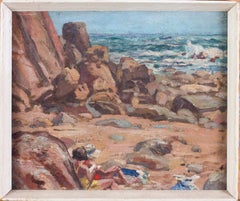
“Eastern White Pines, c. 1910”, New England Landscape, Signed Oil Painting

“Eastern White Pines, c. 1910”, New England Landscape, Signed Oil Painting

By Charles Warren Eaton

Located in Yardley, PA

“Eastern White Pines, c. 1910” by Charles Warren Eaton (American, 1857-1937). A wonderful example of Eaton’s renowned compositions of Eastern white pine trees in his mature style. A...

Category

Early 20th Century American Realist Francesco Spicuzza Art

Materials

Canvas, Oil, Board

A Dynamic Mid-Century Modern Manhattan Scene, New York City by Francis Chapin

A Dynamic Mid-Century Modern Manhattan Scene, New York City by Francis Chapin

By Francis Chapin

Located in Chicago, IL

A Large, Dynamic 1950s Mid-Century Modern Watercolor of Lower Manhattan, New York City by Noted Chicago Artist, Francis Chapin (Am. 1899-1965). The image is watercolor, pastel and c...

Category

Mid-20th Century American Modern Francesco Spicuzza Art

Materials

Watercolor, Archival Paper, Charcoal, Pastel

Previously Available Items
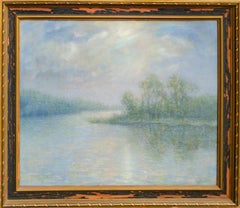
Lovely impressionist landscape in pastel by Francesco Spicuzza

Lovely impressionist landscape in pastel by Francesco Spicuzza

By Francesco Spicuzza

Located in New York, NY

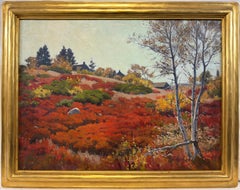
Francesco Spicuzza (American, 1883-1962) Untitled Landscape, 20th century Pastel on paper Sight size: 25 x 29 1/2 in. Framed: 30 3/4 x 35 1/2 in. Signed lower right: Spicuzza Italian-born Francesco Spicuzza was primarily a Wisconsin painter who did portraits, still-lives and local landscapes. He spent the first part of his life in near-poverty to become a painter. An eternal optimist, in 1917, the artist reported: "I am happy and my only ambition now is to paint better and better until I shall have reached the measure of the best of which I am capable." (Spicuzza, 1917, p. 22). His predilection for beach scenes germinated early: reportedly, the five-year-old boy first drew the outlines of his father's fishing boat in the sand on the seashore near their home in Sicily. After setting himself up as a fruit peddler in Milwaukee, Spicuzza's father sent for his family when Francesco was eight years old. For the following six years the boy was unable to attend school because of his job in his father's fruit and vegetable business. The poor lad suffered a caved-in shoulder from carrying a heavy wooden crate. The young Spicuzza was aided by moral and financial support from a sympathetic Milwaukee businessman named John Cramer, publisher and editor of the Evening Wisconsin, who raised Spicuzza's salary as a newspaper assembler so that he could attend school. In 1899 or 1900, Spicuzza began studying drawing and anatomy under Robert Schade...

Category

20th Century American Modern Francesco Spicuzza Art

Materials

Paper, Pastel
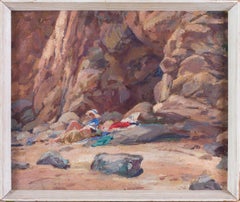
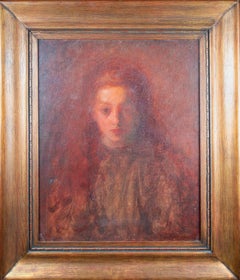
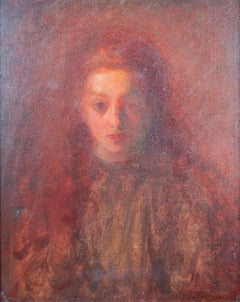
'Little Mary Spicuzza' signed oil painting of the artist's niece

'Little Mary Spicuzza' signed oil painting of the artist's niece

By Francesco Spicuzza

Located in Milwaukee, WI

In this haunting yet adoring portrait, Francesco Spicuzza presents to the viewer his niece Mary. Her young face, probably from when about six years old, emerges from a hazy buildup o...

Category

1910s American Impressionist Francesco Spicuzza Art

Materials

Canvas, Oil

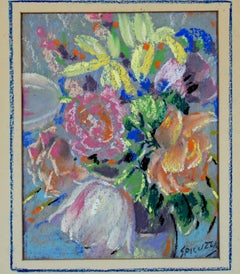
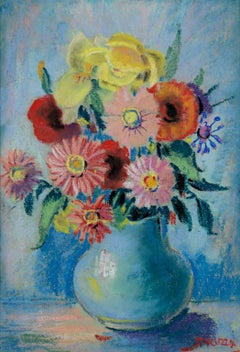
"Floral, " Pastel Vivid Still-life of Flowers signed by Francesco Spicuzza

"Floral, " Pastel Vivid Still-life of Flowers signed by Francesco Spicuzza

By Francesco Spicuzza

Located in Milwaukee, WI

"Floral" is an original pastel drawing on paper by Francesco Spicuzza, signed in the lower right. The piece is a still life, a bouquet of flowers in a vase on the table. The perspec...

Category

1920s Modern Francesco Spicuzza Art

Materials

Paper, Pastel
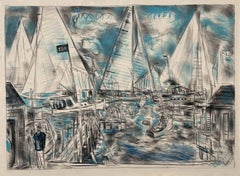
"Flowers in Vase with Handles, " Pastel on Paperboard signed by F. Spicuzza
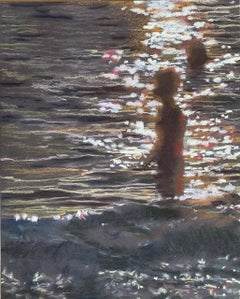
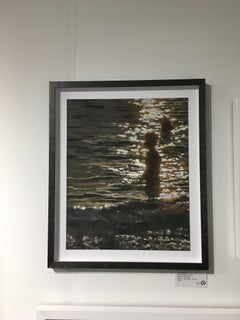
"Flowers in Vase with Handles, " Pastel on Paperboard signed by F. Spicuzza
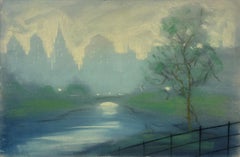
By Francesco Spicuzza

Located in Milwaukee, WI

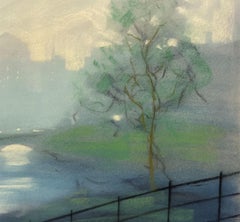
"Flowers in Vase with Handles" is an original pastel drawing on paperboard by Francesco Spicuzza. The artist signed the piece in the lower right. This drawing depicts a bouquet of wa...
Category

1930s Francesco Spicuzza Art

Materials

Paper, Pastel, Board

Flowers in Blue Vase

Flowers in Blue Vase

By Francesco Spicuzza

Located in Milwaukee, WI

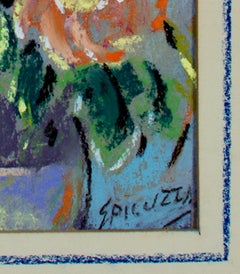
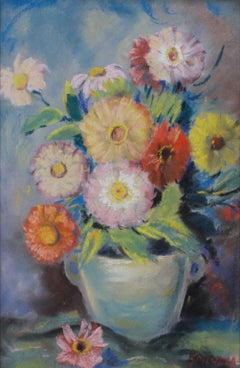
"Flowers in Blue Vase" is an original pastel drawing on paperboard by Francesco Spicuzza. The artist signed the piece in the lower right. This dra...
Category

1930s Francesco Spicuzza Art

Materials

Paper, Pastel, Board

Francesco Spicuzza art for sale on 1stDibs.

Find a wide variety of authentic Francesco Spicuzza art available for sale on 1stDibs. You can also browse by medium to find art by Francesco Spicuzza in oil paint, paint, board and more. Much of the original work by this artist or collective was created during the 20th century and is mostly associated with the modern style. Not every interior allows for large Francesco Spicuzza art, so small editions measuring 13 inches across are available. Customers who are interested in this artist might also find the work of Leon Kelly, Frank Wilcox, and Abraham Walkowitz. Francesco Spicuzza art prices can differ depending upon medium, time period and other attributes. On 1stDibs, the price for these items starts at $2,025 and tops out at $33,000, while the average work can sell for $5,788.
Artists Similar to Francesco Spicuzza