It is an exceptional time to see museum-grade clothing up close. In New York, the Met and the Brooklyn Museum are mounting extensive fashion exhibitions, and major Elsa Schiaparelli, Giorgio Armani, Christian Dior and Azzedine Alaïa retrospectives are running in London, Milan and Paris, respectively.
While runway shows typically spark discussions of how garments look, exhibitions like these often start conversations about how garments were made. The proximity visitors have to museum installations allows an intimate examination of the pieces of clothing displayed, raising questions about their construction and materials and how they came to be. At a time when so much expert tailoring is on view, this ca. 1989 Moschino Couture suit’s whimsical take on the subject seems particularly relevant.
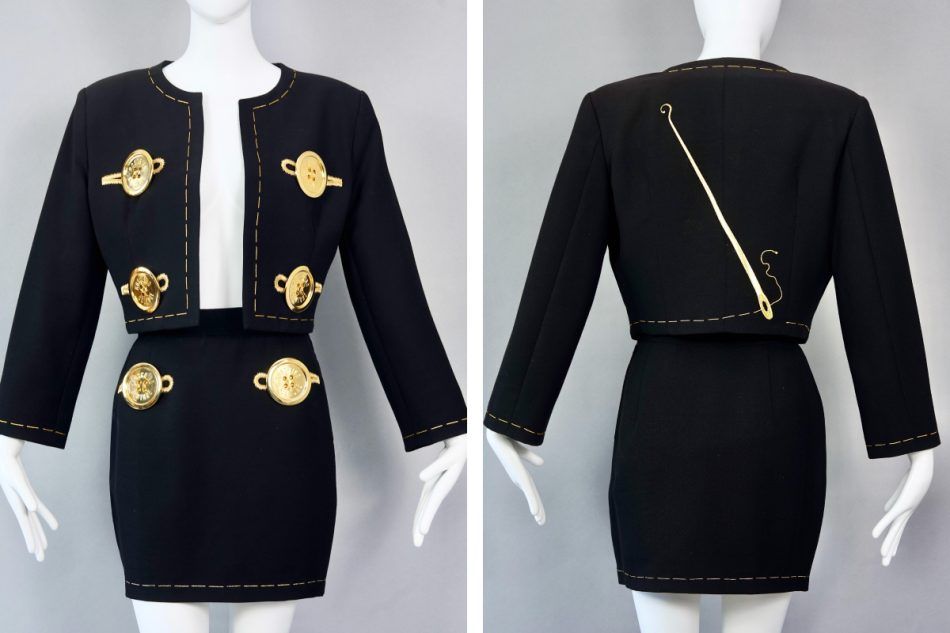
Luckily, up-close examination isn’t necessary to appreciate the garment’s finer details — they’re huge. Six decorative buttons gleam on the front of the suit, each a whopping 2.8 inches in diameter and sitting over a equally large buttonhole finished with gold thread. “This is couture with personality,” says Mia Brender, of VintagEnMode, who is offering the piece on 1stDibs. “Witty, theatrical and irreverent, but refined at the same time. It perfectly embodies Franco Moschino’s playful language at its most iconic.”
The outline of the suit is traced with basting stitches, or tacking. Basting is typically used to hold layers of material together temporarily when testing a silhouette or gathering fabric, the stitches later removed and replaced with more durable ones. But Moschino elevated it to a design element, cheekily highlighting the process of sewing on a couture scale.
The oversize stitches are part of a larger narrative. On the back of the jacket, they run along the bottom edge and through the eye of an embroidered needle so big it makes the other details look restrained. The process of threading is frozen in time, serving not just as an allusion to the act of sewing but as a tableau vivant of a garment being finished. The stitching’s perfectly straight line unravels as it passes through the eye, while the needle’s point curves into a question mark, one of the house’s many fanciful signatures.
Moschino, who died in 1994, made it his mission to disrupt the polished European fashion scene, crafting designs that were eccentric, mischievous and altogether unique. His sharply cut suits and dresses feature mind-bending trompe l’œil tailoring and graphic typography. He riffed on the iconic motifs of contemporaries like Karl Lagerfeld and, as a former artist himself, on artistic predecessors like Piet Mondrian. His work was a witty, loving mockery of the establishment of which he became a fixture. But his parody, like his clothes, was executed with superb skill, making his house beloved for its quality and humor alike.
“Costume Art,” at the Met, is a large-scale exploration of how fashion has functioned throughout millennia as a link tying art, artifacts and clothing together. When it comes to dressing oneself, these connections can be conveyed subtly — or à la Moschino. The designer famously said, “If you can’t be elegant, at least be extravagant.” This suit happens to be both.