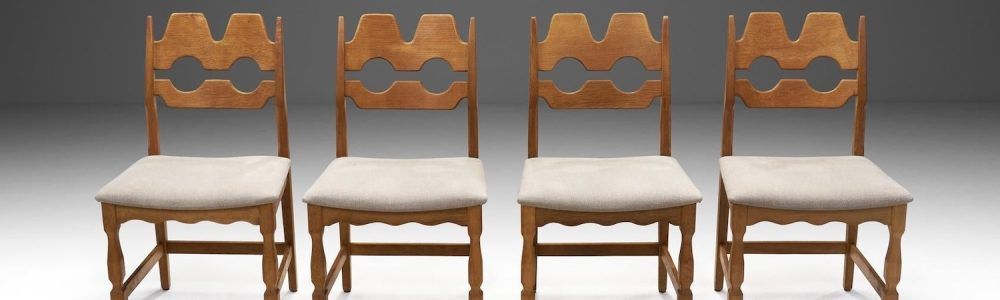
Henning Kjærnulf’s Razorblade chair is constructed of contradictions. Its broad oak frame seems weighty, almost primitive, while the pointed cutouts in its crest rail convey an unexpected delicacy. Depending on the angle you view it from, the back might suggest a crown, a row of gothic arches or the object that inspired the model’s namesake: a double-edged razor blade. The chair has lately become a fixture in design-forward interiors, appearing, for instance, in Catherine Kwong’s room for the 2026 1stDibs 50 and pulled up to the breakfast table in designer Molly Kidd’s Oregon home. Complete sets are highly coveted.
Kjærnulf is an elusive figure in Danish design history. His career is much less well documented than those of such late-20th-century contemporaries as Hans Wegner, Børge Mogensen and Finn Juhl. “Razorblade” even seems to have been a late nickname for the model rather than an original designation.

“Where many Danish designers pursued refinement through simplicity, Kjærnulf wasn’t afraid to embrace ornamentation,” says Benjamin Elias, co-owner of the Denmark-based vintage dealer eliaselias, which has sourced and sold numerous Kjærnulf pieces on its 1stDibs storefront. Elias has noticed interest in Kjærnulf grow over the past few years, especially after the pandemic, as consumers shifted their focus to the home-decor sector and collectors began searching beyond established names for furniture with more individuality. “These pieces have elements of brutalism and traditional craftsmanship, while still fitting naturally into contemporary interiors,” says Elias. “Even from across a room, you know it’s a Kjærnulf chair.”

Those qualities make the model particularly useful to designers. Katie Monkhouse, who first encountered Razorblade chairs at the Round Top Antiques Fair, in Texas, almost a decade ago, likes pairing them with a clean-lined table. “I think they have a lot of character and whimsy without feeling kitschy,” Monkhouse says. “The oak’s neutral, medium tone also distinguishes it from the orange cast associated with many mid-century pieces.”

In Molly Kidd’s breakfast nook, the chairs provide a counterpoint to the plaster walls, linen curtains, rounded forms and rustic reclaimed-wood table. “They have these crisp, graphic lines that act almost like punctuation within an otherwise very relaxed composition,” she says. “I wanted something with a sharper silhouette and durability to keep it from feeling overly precious, especially with my kids.” Elias notes that in other contexts, bouclé, shearling or lambswool upholstery can be used to temper the chairs’ hard geometry with a softer, tactile surface.
Rising demand has made complete sets increasingly difficult to find. Many dining suites were dispersed, and matching groups of 8 or 10 are now especially scarce. Elias advises buyers seeking original models to examine a potential purchase’s joinery, consistency of craftsmanship and age-appropriate wear, along with manufacturer’s labels or stamps.

For Kidd, her chairs’ value has little to do with their rarity or the current demand for them. Her family uses them daily, allowing the oak and finish to age gracefully, gaining character with each passing year. “These chairs are part of our everyday life,” she says. “We have coffee there every morning, my kids climb on them, and friends linger around the table long after dinner is over. That’s what I love most about these vintage pieces. They become more beautiful because they’re lived with.”