Gilt Paintings

to
82
341
156
493
12
9
Height
to
Width
to
26
25
23
22
21
19
9
8
6
5
5
3
2
2
1
1
67
234
192
21
58
58
22
9
2
5
7
2
6
9
3
9
3
463
275
256
177
174
374
155
87
77
73
514
509
513
5
4
3
3
2
Technique: Gilt
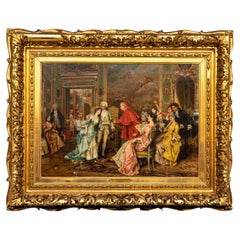
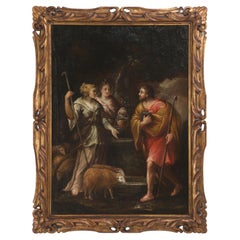
A 19th C. Italian Oil on Canvas "The Cardinal's Present" by Arturo Ricci
By Arturo Ricci
Located in New York, NY
A Marvelous 19th Century Italian Oil on Canvas titled "The Cardinal's Present" by Arturo Ricci. This oil on canvas is truly incredible and one of Ricci's best works of art. The sce...
Category

1880s Italian Louis XVI Antique Gilt Paintings

Materials

Canvas, Wood

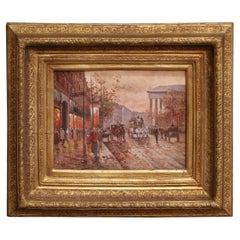
19th Century Paris Street Scene Oil on Panel in Giltwood Frame Signed L. Leje
Located in Dallas, TX
Painted in France circa 1890, this evocative oil on panel depicts a bustling Paris boulevard at dusk. Executed in the manner of Édouard Cortès and Eugene Galien-Laloue, the scene cap...
Category

Late 19th Century French Antique Gilt Paintings

Materials

Giltwood

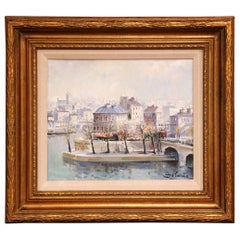
Midcentury Framed Oil Painting "L'Ile Saint-Louis, Paris" Signed L. Delarue
Located in Dallas, TX
Keep a view of Paris in your home with this oil on canvas painting by French painter, Lucien Delarue (circa 1970). Set inside a carved gilt frame, this detailed, architectural painti...
Category

Mid-20th Century French Gilt Paintings

Materials

Canvas, Giltwood

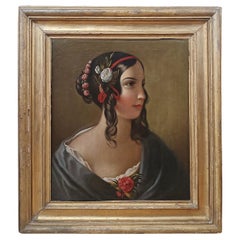
MID-19th CENTURY PORTRAIT OIL ON CANVAS OF A YOUNG GIRL
Located in Firenze, FI
A beautiful painting of modest size, made in oil on canvas and framed in a carved and gilded wooden frame. The painting depicts the portrait of a young woman with her hair gathered a...
Category

Mid-19th Century Italian Antique Gilt Paintings

Materials

Canvas, Wood, Paint

Late 19th Century Romantic Oil Painting After Eduardo Garrido
Located in Casteren, Noord-Brabant
A romantic painting depicting two women sitting on the shore of a lake, looking at the sailboats. It is painted with oil on canvas. The painting is signed with E.L. Garrido. However,...
Category

Late 19th Century French Romantic Antique Gilt Paintings

Materials

Canvas, Plaster

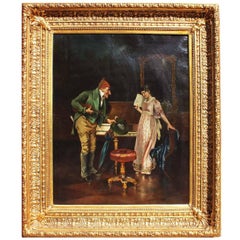
Italian 19th Century Oil on Canvas "The Music Professor" Carlo Sassi
By Carlo Sassi
Located in Los Angeles, CA
Italian 19th century oil on canvas titled "The Music Professor" depicting a mid-19th century music-room scene of an elder man, the music professor, holding his violin, hat and umbrel...
Category

19th Century Italian Other Antique Gilt Paintings

Materials

Gesso, Canvas, Wood

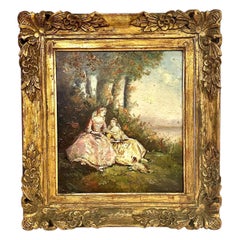
19th Century Romantic Oil Painting of Ladies by the Riverside
Located in LA CIOTAT, FR
This delightful 19th century oil on panel presents an intimate and romantic outdoor scene, capturing two refined ladies dressed in voluminous gowns seated in the countryside, near th...
Category

19th Century French Antique Gilt Paintings

Materials

Giltwood, Paint

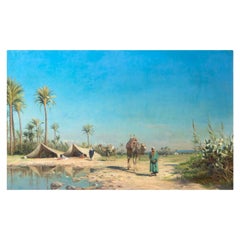
Peder Mønsted, Scene from North Africa, Signed Oil Painting
By Peder Mørk Mønsted
Located in Kastrup, DK
Peder Mønsted, 1859–1941 This atmospheric painting depicts a tranquil North African oasis where Bedouins and camels are gathered beneath towering palm trees. Rendered with Mønsted’s...
Category

Late 19th Century Danish Romantic Antique Gilt Paintings

Materials

Canvas, Wood

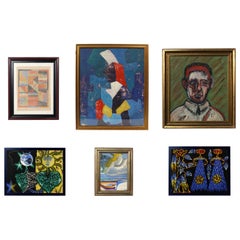
Selection of Colorful Modern Art or Gallery Wall
Located in Atlanta, GA
Selection of colorful modern art or gallery wall, circa 1940s-1970s. They are: Top row, left to right: 1) Color Lithograph by Sonia Delaunay, French, circa 1950s. Pencil signed at lower right. It measures 16.5" H x 13.5" W. 2) Cubist oil painting, probably American, circa 1940s. It has been framed in a vintage gilt frame. Various rubs and wear as seen in photos. It measures 22.75" H x 19" W. 3) Naïve modernist portrait painting, American, circa 1950s. Retains original gilt frame. It measures 21.5" H x 19.5" W. Bottom row, left to right: 4) Color lithograph by Jean Lurcat, French, circa 1950s. It has been professionally framed in a black lacquer gallery frame under UV resistant glass. It measures 15.5" H x 19.5" W. 5) Colorful original painting of beach scene...
Category

1950s French Art Deco Vintage Gilt Paintings

Materials

Glass, Wood

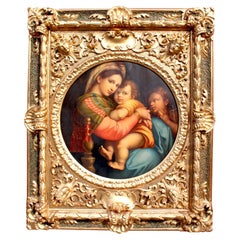
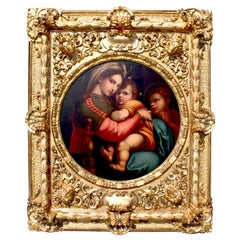
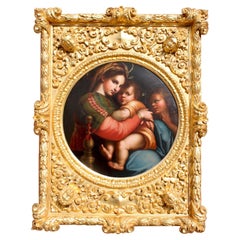
After Raffaello Sanzio 1483-1520 Raphael La Madonna della Seggiola Oil on Canvas
Located in Los Angeles, CA
A Fine Italian 19th Century Oil Painting on Canvas "La Madonna della Seggiola" after Raphael (Raffaello Sanzio da Urbino 1483-1520). The circular painted canvas depicting a seated Madonna holding an infant Jesus Christ next to a child Saint John the Baptist, all within a massive carved two-tone gilt wood, gilt-patinated and gesso frame, which is identical to the frame on Raphael's original artwork. This painting is a 19th Century copy of Raphael's Madonna della Seggiola painted in 1514 and currently exhibited and part of the permanent collection at the Palazzo Pitti, Galleria Palatina, Florence, Italy. The bodies of the Virgin, Christ, and the boy Baptist fill the whole picture. The tender, natural looking embrace of the Mother and Child, and the harmonious grouping of the figures in the round, have made this one of Raphael's most popular Madonnas. The isolated chair leg is reminiscent of papal furniture, which has led to the assumption that Leo X himself commissioned the painting. Circa: 1890-1900. Subject: Religious painting Painting diameter: 28 inches (71.1 cm) Frame height: 55 1/8 inches (140 cm) Frame width: 46 inches (116.8 cm) Frame depth: 5 1/8 inches (13 cm) Raffaello Sanzio da Urbino (Italian, March 28 or April 6, 1483 - April 6, 1520), known as Raphael, was an Italian painter and architect of the High Renaissance. His work is admired for its clarity of form, ease of composition, and visual achievement of the Neoplatonic ideal of human grandeur. Together with Michelangelo and Leonardo da Vinci, he forms the traditional trinity of great masters of that period. Raphael was enormously productive, running an unusually large workshop and, despite his death at 37, leaving a large body of work. Many of his works are found in the Vatican Palace, where the frescoed Raphael Rooms were the central, and the largest, work of his career. The best known work is The School of Athens in the Vatican Stanza della Segnatura. After his early years in Rome much of his work was executed by his workshop from his drawings, with considerable loss of quality. He was extremely influential in his lifetime, though outside Rome his work was mostly known from his collaborative printmaking. After his death, the influence of his great rival Michelangelo was more widespread until the 18th and 19th centuries, when Raphael's more serene and harmonious qualities were again regarded as the highest models. His career falls naturally into three phases and three styles, first described by Giorgio Vasari: his early years in Umbria, then a period of about four years (1504–1508) absorbing the artistic traditions of Florence, followed by his last hectic and triumphant twelve years in Rome, working for two Popes and their close associates. Raphael was born in the small but artistically significant central Italian city of Urbino in the Marche region, where his father Giovanni Santi was court painter to the Duke. The reputation of the court had been established by Federico III da Montefeltro, a highly successful condottiere who had been created Duke of Urbino by the Pope - Urbino formed part of the Papal States - and who died the year before Raphael was born. The emphasis of Federico's court was rather more literary than artistic, but Giovanni Santi was a poet of sorts as well as a painter, and had written a rhymed chronicle of the life of Federico, and both wrote the texts and produced the decor for masque-like court entertainments. His poem to Federico shows him as keen to show awareness of the most advanced North Italian painters, and Early Netherlandish artists as well. In the very small court of Urbino he was probably more integrated into the central circle of the ruling family than most court painters. Federico was succeeded by his son Guidobaldo da Montefeltro, who married Elisabetta Gonzaga, daughter of the ruler of Mantua, the most brilliant of the smaller Italian courts for both music and the visual arts. Under them, the court continued as a centre for literary culture. Growing up in the circle of this small court gave Raphael the excellent manners and social skills stressed by Vasari. Court life in Urbino at just after this period was to become set as the model of the virtues of the Italian humanist court through Baldassare Castiglione's depiction of it in his classic work The Book of the Courtier, published in 1528. Castiglione moved to Urbino in 1504, when Raphael was no longer based there but frequently visited, and they became good friends. He became close to other regular visitors to the court: Pietro Bibbiena and Pietro Bembo, both later cardinals, were already becoming well known as writers, and would be in Rome during Raphael's period there. Raphael mixed easily in the highest circles throughout his life, one of the factors that tended to give a misleading impression of effortlessness to his career. He did not receive a full humanistic education however; it is unclear how easily he read Latin. Early Life and Works His mother Màgia died in 1491 when Raphael was eight, followed on August 1, 1494 by his father, who had already remarried. Raphael was thus orphaned at eleven; his formal guardian became his only paternal uncle Bartolomeo, a priest, who subsequently engaged in litigation with his stepmother. He probably continued to live with his stepmother when not staying as an apprentice with a master. He had already shown talent, according to Vasari, who says that Raphael had been "a great help to his father". A self-portrait drawing from his teenage years shows his precocity. His father's workshop continued and, probably together with his stepmother, Raphael evidently played a part in managing it from a very early age. In Urbino, he came into contact with the works of Paolo Uccello, previously the court painter (d. 1475), and Luca Signorelli, who until 1498 was based in nearby Città di Castello. According to Vasari, his father placed him in the workshop of the Umbrian master Pietro Perugino as an apprentice "despite the tears of his mother". The evidence of an apprenticeship comes only from Vasari and another source, and has been disputed—eight was very early for an apprenticeship to begin. An alternative theory is that he received at least some training from Timoteo Viti, who acted as court painter in Urbino from 1495.Most modern historians agree that Raphael at least worked as an assistant to Perugino from around 1500; the influence of Perugino on Raphael's early work is very clear: "probably no other pupil of genius has ever absorbed so much of his master's teaching as Raphael did", according to Wölfflin. Vasari wrote that it was impossible to distinguish between their hands at this period, but many modern art historians claim to do better and detect his hand in specific areas of works by Perugino or his workshop. Apart from stylistic closeness, their techniques are very similar as well, for example having paint applied thickly, using an oil varnish medium, in shadows and darker garments, but very thinly on flesh areas. An excess of resin in the varnish often causes cracking of areas of paint in the works of both masters. The Perugino workshop was active in both Perugia and Florence, perhaps maintaining two permanent branches. Raphael is described as a "master", that is to say fully trained, in December 1500. His first documented work was the Baronci altarpiece for the church of Saint Nicholas of Tolentino in Città di Castello, a town halfway between Perugia and Urbino. Evangelista da Pian di Meleto, who had worked for his father, was also named in the commission. It was commissioned in 1500 and finished in 1501; now only some cut sections and a preparatory drawing remain. In the following years he painted works for other churches there, including the Mond Crucifixion (about 1503) and the Brera Wedding of the Virgin (1504), and for Perugia, such as the Oddi Altarpiece. He very probably also visited Florence in this period. These are large works, some in fresco, where Raphael confidently marshals his compositions in the somewhat static style of Perugino. He also painted many small and exquisite cabinet paintings in these years, probably mostly for the connoisseurs in the Urbino court, like the Three Graces and St. Michael, and he began to paint Madonnas and portraits. In 1502 he went to Siena at the invitation of another pupil of Perugino, Pinturicchio, "being a friend of Raphael and knowing him to be a draughtsman of the highest quality" to help with the cartoons, and very likely the designs, for a fresco series in the Piccolomini Library in Siena Cathedral. He was evidently already much in demand even at this early stage in his career. Influence of Florence Raphael led a "nomadic" life, working in various centres in Northern Italy, but spent a good deal of time in Florence, perhaps from about 1504. Although there is traditional reference to a "Florentine period...
Category

Early 1900s Italian Baroque Antique Gilt Paintings

Materials

Canvas, Giltwood

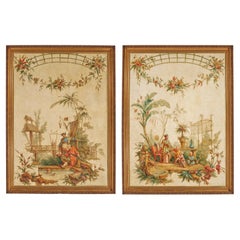
Pair French 18th-19th Century Chinoiserie Circle of Jean B. Pillement
By Jean-Baptiste Pillement
Located in Los Angeles, CA
A fine pair of French 18th-19th century whimsical rococo style chinoiserie oil on canvas, circle of Jean-Baptiste Pillement. (French, 1728-1808). One oil painting depicting an outdoor patio scene of a standing young mother, holding a fan, with her three young children playing with a horse-toy, a parrot and a cat, all surrounded by flowers, plants, trees, planters and flanked by a dragon fountain...
Category

Late 18th Century French Chinoiserie Antique Gilt Paintings

Materials

Canvas, Giltwood

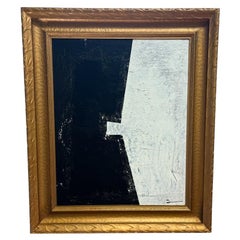
Original B&W Abstract Painting in Antique Frame
Located in Houston, TX
Original B&W Abstract Painting in Antique gilt Frame by Shannon Weir, acrylic on panel
Category

21st Century and Contemporary American Modern Gilt Paintings

Materials

Acrylic, Masonite

French Oil Painting c1700's Biblical Story of Rebekah and Abraham's Servant
Located in Chicago, IL
Our French Oil Painting is from the 1700's depicts the Biblical Story of Rebekah and Abraham's Servant, Rebekah is seen offering water to the servant and his camels as a true test of...
Category

1750s French Rococo Antique Gilt Paintings

Materials

Canvas, Wood, Paint

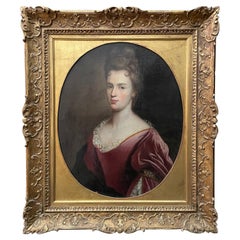
18th century Portrait of Lady Oil on Canvas in Giltwood Frame
Located in Savannah, GA
English oil on canvas portrait dating from the late 1700s painted in the manor of Joshua Reynolds. We believe the giltwood frame could be the original as it is right for the period. ...
Category

1790s English Rococo Antique Gilt Paintings

Materials

Canvas, Wood

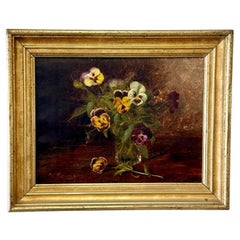
19th Century Oil Painting of Pansies in Glass Vase with Giltwood Frame
Located in LA CIOTAT, FR
This delicate still life captures a vibrant bouquet of pansies in full bloom, arranged informally in a simple glass vase. Rendered in oil on canvas, the composition celebrates the fr...
Category

19th Century French Antique Gilt Paintings

Materials

Canvas, Giltwood, Paint

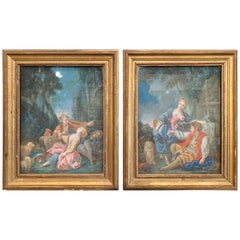
Pair of 18th Century Louis XVI Watercolors in Original Giltwood Frames
Located in Dallas, TX
These antique colorful watercolors were crafted in France circa 1780, set in the original giltwood frames with glass protection, each art work depicts a courting scene with a young g...
Category

Late 18th Century French Louis XVI Antique Gilt Paintings

Materials

Glass, Giltwood, Paper

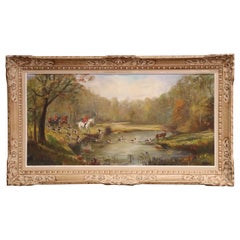
Mid-Century French Stag Hunt Oil Painting in Carved Frame Signed M. Pol
Located in Dallas, TX
Bring a sense of countryside tradition into your space with this dynamic French hunting scene. Painted circa 1920 and signed lower left by M. Pol, the oil on canvas is titled “La Vén...
Category

Early 20th Century French Gilt Paintings

Materials

Canvas

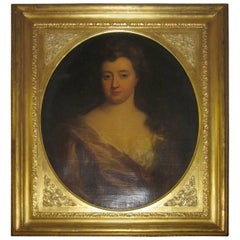
Portrait of a Young Lady, 18th Century
Located in Norwood, NJ
18th century continental portrait of a young lady, unsigned. Oil on canvas, oval painting and stretcher set in rectangular gilt frame.
Category

18th Century French Antique Gilt Paintings

Materials

Gold Leaf

19th Century French Landscape Painting Signed Corot in Original Giltwood Frame
By Jean-Baptiste-Camille Corot
Located in Dallas, TX
Decorate a study or dining room with this elegant French oil on canvas landscape, set in its original carved giltwood frame. Painted circa 1870 and signed “Corot” in red at the lower...
Category

Mid-19th Century French Antique Gilt Paintings

Materials

Canvas, Giltwood

After Raffaello Sanzio 1483-1520 Raphael La Madonna della Seggiola Oil on Canvas
Located in Los Angeles, CA
A Fine Italian 19th Century Oil Painting on Canvas "La Madonna della Seggiola" after Raphael (Raffaello Sanzio da Urbino 1483-1520). The circular painted canvas depicting a seated Madonna holding an infant Jesus Christ next to a child Saint John the Baptist, all within a massive carved gilt wood and gesso frame, which is identical to the frame on Raphael's original artwork. This painting is a 19th Century copy of Raphael's Madonna della Seggiola painted in 1514 and currently exhibited and part of the permanent collection at the Palazzo Pitti, Galleria Palatina, Florence, Italy. The bodies of the Virgin, Christ, and the boy Baptist fill the whole picture. The tender, natural looking embrace of the Mother and Child, and the harmonious grouping of the figures in the round, have made this one of Raphael's most popular Madonnas. The isolated chair leg is reminiscent of papal furniture, which has led to the assumption that Leo X himself commissioned the painting. A retailer's label reads " Fred K/ Keer's Sons - Framers and Fine Art Dealers - 917 Broad St. Newark, N.J." - Another label from the gilder reads "Carlo Bartolini - Doratore e Verniciatori - Via Maggio 1924 - Firenze". Circa: 1890-1900. Subject: Religious painting Canvas diameter: 28 inches (71.1 cm) Frame height: 54 inches (137.2 cm) Frame width: 42 1/2 inches (108 cm) Frame depth: 5 1/2 inches (14 cm) Raffaello Sanzio da Urbino (Italian, March 28 or April 6, 1483 - April 6, 1520), known as Raphael, was an Italian painter and architect of the High Renaissance. His work is admired for its clarity of form, ease of composition, and visual achievement of the Neoplatonic ideal of human grandeur. Together with Michelangelo and Leonardo da Vinci, he forms the traditional trinity of great masters of that period. Raphael was enormously productive, running an unusually large workshop and, despite his death at 37, leaving a large body of work. Many of his works are found in the Vatican Palace, where the frescoed Raphael Rooms were the central, and the largest, work of his career. The best known work is The School of Athens in the Vatican Stanza della Segnatura. After his early years in Rome much of his work was executed by his workshop from his drawings, with considerable loss of quality. He was extremely influential in his lifetime, though outside Rome his work was mostly known from his collaborative printmaking. After his death, the influence of his great rival Michelangelo was more widespread until the 18th and 19th centuries, when Raphael's more serene and harmonious qualities were again regarded as the highest models. His career falls naturally into three phases and three styles, first described by Giorgio Vasari: his early years in Umbria, then a period of about four years (1504–1508) absorbing the artistic traditions of Florence, followed by his last hectic and triumphant twelve years in Rome, working for two Popes and their close associates. Raphael was born in the small but artistically significant central Italian city of Urbino in the Marche region, where his father Giovanni Santi was court painter to the Duke. The reputation of the court had been established by Federico III da Montefeltro, a highly successful condottiere who had been created Duke of Urbino by the Pope - Urbino formed part of the Papal States - and who died the year before Raphael was born. The emphasis of Federico's court was rather more literary than artistic, but Giovanni Santi was a poet of sorts as well as a painter, and had written a rhymed chronicle of the life of Federico, and both wrote the texts and produced the decor for masque-like court entertainments. His poem to Federico shows him as keen to show awareness of the most advanced North Italian painters, and Early Netherlandish artists as well. In the very small court of Urbino he was probably more integrated into the central circle of the ruling family than most court painters. Federico was succeeded by his son Guidobaldo da Montefeltro, who married Elisabetta Gonzaga, daughter of the ruler of Mantua, the most brilliant of the smaller Italian courts for both music and the visual arts. Under them, the court continued as a centre for literary culture. Growing up in the circle of this small court gave Raphael the excellent manners and social skills stressed by Vasari. Court life in Urbino at just after this period was to become set as the model of the virtues of the Italian humanist court through Baldassare Castiglione's depiction of it in his classic work The Book of the Courtier, published in 1528. Castiglione moved to Urbino in 1504, when Raphael was no longer based there but frequently visited, and they became good friends. He became close to other regular visitors to the court: Pietro Bibbiena and Pietro Bembo, both later cardinals, were already becoming well known as writers, and would be in Rome during Raphael's period there. Raphael mixed easily in the highest circles throughout his life, one of the factors that tended to give a misleading impression of effortlessness to his career. He did not receive a full humanistic education however; it is unclear how easily he read Latin. Early Life and Works His mother Màgia died in 1491 when Raphael was eight, followed on August 1, 1494 by his father, who had already remarried. Raphael was thus orphaned at eleven; his formal guardian became his only paternal uncle Bartolomeo, a priest, who subsequently engaged in litigation with his stepmother. He probably continued to live with his stepmother when not staying as an apprentice with a master. He had already shown talent, according to Vasari, who says that Raphael had been "a great help to his father". A self-portrait drawing from his teenage years shows his precocity. His father's workshop continued and, probably together with his stepmother, Raphael evidently played a part in managing it from a very early age. In Urbino, he came into contact with the works of Paolo Uccello, previously the court painter (d. 1475), and Luca Signorelli, who until 1498 was based in nearby Città di Castello. According to Vasari, his father placed him in the workshop of the Umbrian master Pietro Perugino as an apprentice "despite the tears of his mother". The evidence of an apprenticeship comes only from Vasari and another source, and has been disputed—eight was very early for an apprenticeship to begin. An alternative theory is that he received at least some training from Timoteo Viti, who acted as court painter in Urbino from 1495.Most modern historians agree that Raphael at least worked as an assistant to Perugino from around 1500; the influence of Perugino on Raphael's early work is very clear: "probably no other pupil of genius has ever absorbed so much of his master's teaching as Raphael did", according to Wölfflin. Vasari wrote that it was impossible to distinguish between their hands at this period, but many modern art historians claim to do better and detect his hand in specific areas of works by Perugino or his workshop. Apart from stylistic closeness, their techniques are very similar as well, for example having paint applied thickly, using an oil varnish medium, in shadows and darker garments, but very thinly on flesh areas. An excess of resin in the varnish often causes cracking of areas of paint in the works of both masters. The Perugino workshop was active in both Perugia and Florence, perhaps maintaining two permanent branches. Raphael is described as a "master", that is to say fully trained, in December 1500. His first documented work was the Baronci altarpiece for the church of Saint Nicholas of Tolentino in Città di Castello, a town halfway between Perugia and Urbino. Evangelista da Pian di Meleto, who had worked for his father, was also named in the commission. It was commissioned in 1500 and finished in 1501; now only some cut sections and a preparatory drawing remain. In the following years he painted works for other churches there, including the Mond Crucifixion (about 1503) and the Brera Wedding of the Virgin (1504), and for Perugia, such as the Oddi Altarpiece. He very probably also visited Florence in this period. These are large works, some in fresco, where Raphael confidently marshals his compositions in the somewhat static style of Perugino. He also painted many small and exquisite cabinet paintings in these years, probably mostly for the connoisseurs in the Urbino court, like the Three Graces and St. Michael, and he began to paint Madonnas and portraits. In 1502 he went to Siena at the invitation of another pupil of Perugino, Pinturicchio, "being a friend of Raphael and knowing him to be a draughtsman of the highest quality" to help with the cartoons, and very likely the designs, for a fresco series in the Piccolomini Library in Siena Cathedral. He was evidently already much in demand even at this early stage in his career. Influence of Florence Raphael led a "nomadic" life, working in various centres in Northern Italy, but spent a good deal of time in Florence, perhaps from about 1504. Although there is traditional reference to a "Florentine period...
Category

Early 1900s Italian Baroque Antique Gilt Paintings

Materials

Canvas, Giltwood

19th Century Oil on Canvas Hunting Dogs Painting in Gilt Frame Signed H Schouten
Located in Dallas, TX
Decorate a study or a den with this antique hunt setters painting composition. Created in Belgium circa 1890, and set in the original thick carved giltwood frame, this large painting...
Category

Late 19th Century Belgian Antique Gilt Paintings

Materials

Canvas, Giltwood

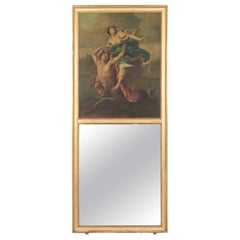
18th Century French Trumeau Mirror with Greek Myth Painting
Located in Winter Park, FL
An 18th century French Louis XVI style trumeau mirror with a large oil painting depicting The Abduction of Deianira after Guido Reni. Gilded wood frame with bright gilt finish is in ...
Category

Late 18th Century French Louis XV Antique Gilt Paintings

Materials

Canvas, Mirror, Giltwood

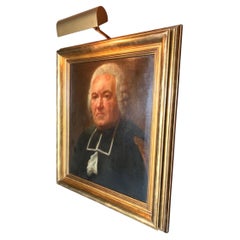
18th C. Portrait of a Lawyer Circle of Jacques Aved French School Oil on Canvas
Located in West Hollywood, CA
18th C. Portrait of a Lawyer Circle of Jacques Aved French School Oil on Canvas . Circle of Jacques-Andre-Joseph-Camelot Aved Portrait of a lawyer 1702-1766 French school mid-18th c...
Category

18th Century French Antique Gilt Paintings

Materials

Canvas, Wood, Paint

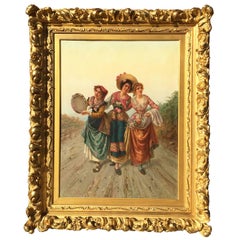
Pietro Gabrini Large Oil on Canvas "Three Singing Italian Beauties on The Road"
Located in Los Angeles, CA
Pietro Gabrini (Italian, 1856-1926) a very fine and large oil on canvas "Three Singing Italian Beauties on The Road" depicting three cheerful Village young maidens walking through a ...
Category

Late 19th Century Italian Baroque Revival Antique Gilt Paintings

Materials

Canvas, Wood

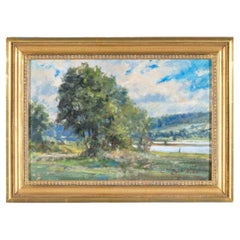
John Neale (British, B. 20th Century) Signed Oil On Board, Summer Landscape
Located in Bridgeport, CT
Oil on board depicting a summer landscape with a leafy tree in the center, a figure fishing in the lower right, blue rolling hills in the distance and set against a cornflower blue c...
Category

20th Century English Adirondack Gilt Paintings

Materials

Wood

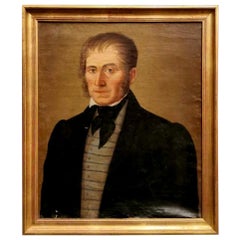
Old French Painting Portrait Of A Nobleman With Golden Frame
Located in Prato, Tuscany
We kindly suggest you read the whole description, because with it we try to give you detailed technical and historical information to guarantee the authenticity of our objects. Old French painting...
Category

Mid-19th Century French Napoleon III Antique Gilt Paintings

Materials

Canvas, Wood

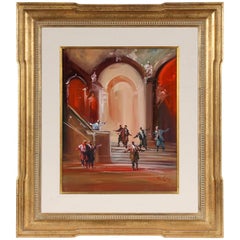
M.L. Monteith, Signed Modern Oil on Panel, Scene from Verdi's Opera "Othello"
Located in Bridgeport, CT
A dramatic and colorful Oil on Board in a custom Gilt wood frame. Figures on a monumental staircase. Signed lower right, labelled and dedicated on verso. In a fine gilt frame. Panel ...
Category

20th Century Grand Tour Gilt Paintings

Materials

Wood

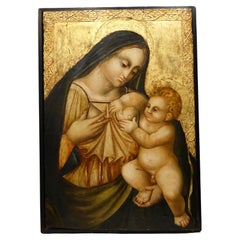
Madonna Lactans , Gold Background , Quattrocento Attributed to Sano di Pietro
Located in PARIS, FR
-Madonna Lactans, Gold Background Quattrocento Our painting is on poplar wood, characteristic of Italian Quattrocento works. The gold background is stuccoed and engraved. Our Madonna Lactans is a variation on the theme of the Madonna and Child. In Christian iconography, this subject is depicted at a moment of great intimacy, as the Virgin Mary delicately takes Christ's foot. When cleaning the work, small jets of milk can be seen ... Sano di Pietro...
Category

15th Century and Earlier Italian Renaissance Antique Gilt Paintings

Materials

Wood

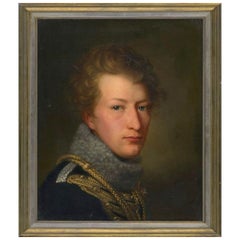
19th Century Military Oil Painting of Prussian Hussar by August Von Der Embde
Located in London, GB
Antique Military Oil Painting, Antique Military Portrait Painting, Military Antique Painting, Prussian Hussar, Prussian Military Painting. Early 19th Century Military Oil Painting...
Category

1810s German Regency Antique Gilt Paintings

Materials

Canvas, Wood, Paint

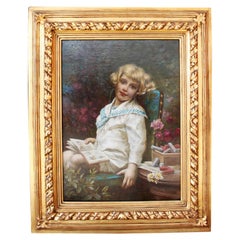
Hans Zatzka, Austrian (1859-1945) Oil on Canvas "Young Girl in a Sailor's Suit'
Located in Los Angeles, CA
Hans Zatzka, Austrian (1859-1945) A Fine Oil on Canvas "Portrait of Haunz Javorasky Als Knabe Dressed as a Sailor" within a carved gildwood frame. The charming portrait depicts a sea...
Category

Early 1900s Austrian Belle Époque Antique Gilt Paintings

Materials

Canvas, Giltwood

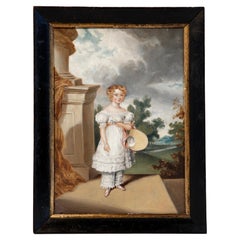
19c Naive Oil Painting of a Young Girl in an Architectural Scene
Located in Cheltenham, GB
A 19c naive oil painting on a thin wooden panel of a young girl in an architectural and wooded landscape in a black painted frame with gilt slip. A regency period portrait...
Category

Mid-19th Century British Regency Antique Gilt Paintings

Materials

Paint

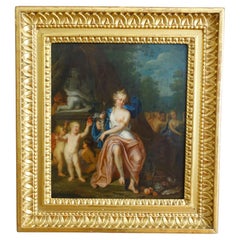
18th century Dutch school attributed to Mattheus Terwesten : allegory of wealth
Located in GRENOBLE, FR
A fine early 18th century Flemish school circa 1730, oil on panel attributed to Mattheus Terwesten (a partial signature next to the pedestal) set into its gold leaf gilt carved wood....
Category

Early 18th Century Dutch Neoclassical Antique Gilt Paintings

Materials

Oak

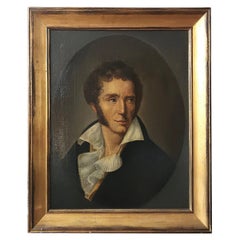
LATE 18th-EARLY 19th CENTURY PORTRAIT OF A YOUNG POET
Located in Firenze, FI
Magnificent almond-shaped portrait of a young poet, painted in oil on canvas and framed in a fine carved and gilded wooden frame. At the cente...
Category

Late 18th Century Italian Antique Gilt Paintings

Materials

Canvas, Wood, Paint

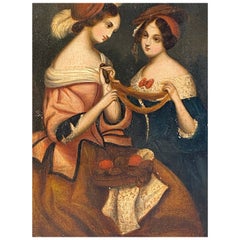
Oil Painting Ladies on Zinc Panel 19th C Victorian
Located in Cheltenham, GB
Oil Painting Ladies on Zinc Panel 19th C Victorian A continental zinc metal painted panel of two well attired ladies gathering yarns of wool into small bundles in period gilt frame...
Category

19th Century French Victorian Antique Gilt Paintings

Materials

Zinc

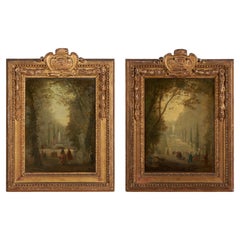
Two Fête Galante Scenes, French School, 19th Century
Located in Toronto, CA
Two exquisite Fête Galante scenes from France, painted in the early 19th century in Rococo style. The first depicts various groups of figures as they gather in a park, with classica...
Category

Early 19th Century French Rococo Antique Gilt Paintings

Materials

Canvas, Giltwood, Paint

Antique Mini Neoclassical Grand Tour Style Oil Painting On Board of A Landscape
Located in Swedesboro, NJ
Dimensions: (FRAME)-H: 7 3/4in W: 9 1/8in D: 1 3/4in (PAINTING)- H: 4 1/2in W: 5 7/8in D: 1 3/4in This Miniature Antique Neoclassical Grand Tour Style Oil Painting On Board of A ...
Category

Early 20th Century German Neoclassical Gilt Paintings

Materials

Wood, Paint

European Landscape Oil Painting signed Maurice Braun
Located in Haddonfield, NJ
Oil Painting on Canvas signed Maurice Braun, 1902 Listed Artist A very lifelike rendering of a European street scene with houses. This early 20th Century painting features houses ...
Category

Early 1900s French Romantic Antique Gilt Paintings

Materials

Wood, Paint

Agnes Slott-Møller, Summer Residence "Villa Nostra", Signed
Located in Kastrup, DK
Agnes Slott-Møller, 1862-1937. Summer Residence "Villa Nostra," oil on canvas, in a contemporary gilded wooden frame designed by the artist. Signed: Agnes Slott-Møller 1909-11. "Vi...
Category

Early 20th Century European Other Gilt Paintings

Materials

Canvas, Wood

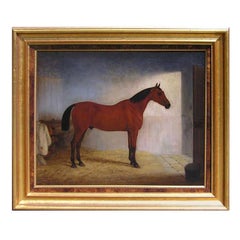
English Oil on Canvas Horse Portrait in Burl Walnut Gilt Frame, Signed. C. 1866
Located in Charleston, SC
English oil on canvas horse portrait in burl walnut giltwood and beaded molded edge frame. Signed & Dated by Artist "J. Brown Coventry 1866"
Category

1860s English William IV Antique Gilt Paintings

Materials

Canvas, Wood, Giltwood, Paint

After Raffaello Sanzio 1483-1520 Raphael La Madonna della Seggiola Oil on Canvas
Located in Los Angeles, CA
A fine Italian 19th century oil painting on canvas "La Madonna della Seggiola" after Raphael (Raffaello Sanzio da Urbino 1483-1520) The circular canvas depicting a seated Madonna holding an infant Jesus Christ next to a child Saint John the Baptist, all within a massive carved gilt wood and gesso frame (all high quality gilt is original) which is identical to the frame on Raphael's original artwork. This painting is a 19th Century copy of Raphael's Madonna della Seggiola painted in 1514 and currently exhibited and part of the permanent collection at the Palazzo Pitti, Galleria Palatina, Florence, Italy. The bodies of the Virgin, Christ, and the boy Baptist fill the whole picture. The tender, natural looking embrace of the Mother and Child, and the harmonious grouping of the figures in the round, have made this one of Raphael's most popular Madonnas. The isolated chair leg is reminiscent of papal furniture, which has led to the assumption that Leo X himself commissioned the painting, circa 1890-1900. Subject: Religious painting Measures: Canvas height: 29 1/4 inches (74.3 cm) Canvas width: 29 1/4 inches (74.3 cm) Painting diameter: 28 1/4 inches (71.8 cm) Frame height: 57 7/8 inches (147 cm) Frame width: 45 1/2 inches (115.6 cm) Frame depth: 5 1/8 inches (13 cm).   Raffaello Sanzio da Urbino (Italian, March 28 or April 6, 1483 - April 6, 1520), known as Raphael, was an Italian painter and architect of the High Renaissance. His work is admired for its clarity of form, ease of composition, and visual achievement of the Neoplatonic ideal of human grandeur. Together with Michelangelo and Leonardo da Vinci, he forms the traditional trinity of great masters of that period. Raphael was enormously productive, running an unusually large workshop and, despite his death at 37, leaving a large body of work. Many of his works are found in the Vatican Palace, where the frescoed Raphael Rooms were the central, and the largest, work of his career. The best known work is The School of Athens in the Vatican Stanza della Segnatura. After his early years in Rome much of his work was executed by his workshop from his drawings, with considerable loss of quality. He was extremely influential in his lifetime, though outside Rome his work was mostly known from his collaborative printmaking. After his death, the influence of his great rival Michelangelo was more widespread until the 18th and 19th centuries, when Raphael's more serene and harmonious qualities were again regarded as the highest models. His career falls naturally into three phases and three styles, first described by Giorgio Vasari: his early years in Umbria, then a period of about four years (1504–1508) absorbing the artistic traditions of Florence, followed by his last hectic and triumphant twelve years in Rome, working for two Popes and their close associates. Raphael was born in the small but artistically significant central Italian city of Urbino in the Marche region, where his father Giovanni Santi was court painter to the Duke. The reputation of the court had been established by Federico III da Montefeltro, a highly successful condottiere who had been created Duke of Urbino by the Pope - Urbino formed part of the Papal States - and who died the year before Raphael was born. The emphasis of Federico's court was rather more literary than artistic, but Giovanni Santi was a poet of sorts as well as a painter, and had written a rhymed chronicle of the life of Federico, and both wrote the texts and produced the decor for masque-like court entertainments. His poem to Federico shows him as keen to show awareness of the most advanced North Italian painters, and Early Netherlandish artists as well. In the very small court of Urbino he was probably more integrated into the central circle of the ruling family than most court painters. Federico was succeeded by his son Guidobaldo da Montefeltro, who married Elisabetta Gonzaga, daughter of the ruler of Mantua, the most brilliant of the smaller Italian courts for both music and the visual arts. Under them, the court continued as a centre for literary culture. Growing up in the circle of this small court gave Raphael the excellent manners and social skills stressed by Vasari. Court life in Urbino at just after this period was to become set as the model of the virtues of the Italian humanist court through Baldassare Castiglione's depiction of it in his classic work The Book of the Courtier, published in 1528. Castiglione moved to Urbino in 1504, when Raphael was no longer based there but frequently visited, and they became good friends. He became close to other regular visitors to the court: Pietro Bibbiena and Pietro Bembo, both later cardinals, were already becoming well known as writers, and would be in Rome during Raphael's period there. Raphael mixed easily in the highest circles throughout his life, one of the factors that tended to give a misleading impression of effortlessness to his career. He did not receive a full humanistic education however; it is unclear how easily he read Latin. Early Life and Works His mother Màgia died in 1491 when Raphael was eight, followed on August 1, 1494 by his father, who had already remarried. Raphael was thus orphaned at eleven; his formal guardian became his only paternal uncle Bartolomeo, a priest, who subsequently engaged in litigation with his stepmother. He probably continued to live with his stepmother when not staying as an apprentice with a master. He had already shown talent, according to Vasari, who says that Raphael had been "a great help to his father". A self-portrait drawing from his teenage years shows his precocity. His father's workshop continued and, probably together with his stepmother, Raphael evidently played a part in managing it from a very early age. In Urbino, he came into contact with the works of Paolo Uccello, previously the court painter (d. 1475), and Luca Signorelli, who until 1498 was based in nearby Città di Castello. According to Vasari, his father placed him in the workshop of the Umbrian master Pietro Perugino as an apprentice "despite the tears of his mother". The evidence of an apprenticeship comes only from Vasari and another source, and has been disputed—eight was very early for an apprenticeship to begin. An alternative theory is that he received at least some training from Timoteo Viti, who acted as court painter in Urbino from 1495.Most modern historians agree that Raphael at least worked as an assistant to Perugino from around 1500; the influence of Perugino on Raphael's early work is very clear: "probably no other pupil of genius has ever absorbed so much of his master's teaching as Raphael did", according to Wölfflin. Vasari wrote that it was impossible to distinguish between their hands at this period, but many modern art historians claim to do better and detect his hand in specific areas of works by Perugino or his workshop. Apart from stylistic closeness, their techniques are very similar as well, for example having paint applied thickly, using an oil varnish medium, in shadows and darker garments, but very thinly on flesh areas. An excess of resin in the varnish often causes cracking of areas of paint in the works of both masters. The Perugino workshop was active in both Perugia and Florence, perhaps maintaining two permanent branches. Raphael is described as a "master", that is to say fully trained, in December 1500. His first documented work was the Baronci altarpiece for the church of Saint Nicholas of Tolentino in Città di Castello, a town halfway between Perugia and Urbino. Evangelista da Pian di Meleto, who had worked for his father, was also named in the commission. It was commissioned in 1500 and finished in 1501; now only some cut sections and a preparatory drawing remain. In the following years he painted works for other churches there, including the Mond Crucifixion (about 1503) and the Brera Wedding of the Virgin (1504), and for Perugia, such as the Oddi Altarpiece. He very probably also visited Florence in this period. These are large works, some in fresco, where Raphael confidently marshals his compositions in the somewhat static style of Perugino. He also painted many small and exquisite cabinet paintings in these years, probably mostly for the connoisseurs in the Urbino court, like the Three Graces and St. Michael, and he began to paint Madonnas and portraits. In 1502 he went to Siena at the invitation of another pupil of Perugino, Pinturicchio, "being a friend of Raphael and knowing him to be a draughtsman of the highest quality" to help with the cartoons, and very likely the designs, for a fresco series in the Piccolomini Library in Siena Cathedral. He was evidently already much in demand even at this early stage in his career. Influence of Florence Raphael led a "nomadic" life, working in various centres in Northern Italy, but spent a good deal of time in Florence, perhaps from about 1504. Although there is traditional reference to a "Florentine period...
Category

19th Century Italian Baroque Antique Gilt Paintings

Materials

Gesso, Canvas, Wood

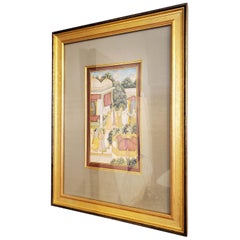
Mid-18th Century Indian Court Painting of Krishna and Radha, Gouache with Gold
Located in Middleburg, VA
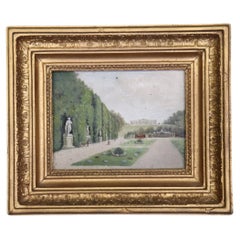
A superbly detailed mid-18th-century Indian miniature court painting, executed in gouache heightened with gold on handmade paper. Originating from Rajasthan circa 1760, this exquisite artwork captures a serene palace scene featuring the Hindu deity Krishna with Radha and accompanying Gopis in a lush, architectural setting. The composition is rich in symbolism, narrative depth, and emotional subtlety, hallmarks of classical Rajput painting. The figures are adorned with traditional garments, rendered in delicate pastel tones with intricate patterns and gilt accents. The architectural elements, marble pavilions, domes, carved screens, and floral gardens, are meticulously executed, offering a vivid impression of royal leisure and divine romance. Set against a tree-lined courtyard with peacocks and floral motifs, the visual rhythm is both vibrant and harmonious. The painting is professionally mounted in a deep tan linen mat and presented in an elegant gold-gilt frame with black detailing, complementing the composition's refined warmth and historic gravitas. A rare and captivating example of classical Indian court painting...
Category

Mid-18th Century Indian Antique Gilt Paintings

Materials

Gold Leaf

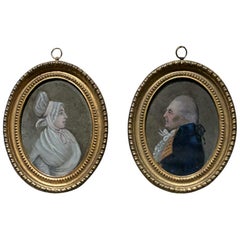
Pair of Miniature Portraits in Giltwood Frames
Located in Huntington, NY
2 portraits, late 18th century, oil on board.
Category

1790s English George III Antique Gilt Paintings

Materials

Pine, Giltwood

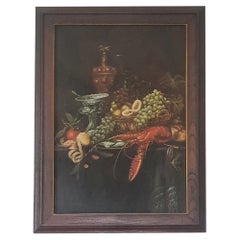
A Large imposing Edwardian still life Oil Painting in original Mahogany frame
Located in London, GB
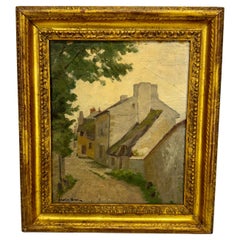
This is a beautiful, elegant and striking still life oil painting of a Lobster with fruit on an overflowing laid table with silverware, basket or fruit, foliage an upturned crab and ...
Category

Early 1900s European Edwardian Antique Gilt Paintings

Materials

Canvas, Mahogany, Giltwood, Paint

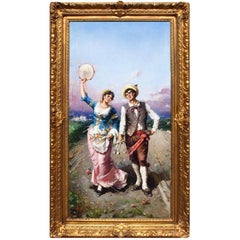
Francesco Peluso (Italian, 1836-1916) An Oil on Canvas "The Village Celebration"
Located in Los Angeles, CA
Francesco Peluso (Italian, 1836-1916) a fine Italian 19th-20th century oil on canvas "The Village Celebration" depicting a young couple of villagers dressed for Spring festivities and walking through a dirt road while playing musical instruments. The girl playing a tambourine and the boy a wooden noise maker...
Category

Late 19th Century Italian Country Antique Gilt Paintings

Materials

Gesso, Canvas, Wood

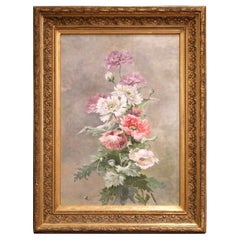
19th Century French Oil on Canvas Floral Painting in Carved Gilt Wood Frame
Located in Dallas, TX
Celebrate the timeless beauty of florals with this refined 19th-century French still life painting, rendered in oil on canvas and presented in its original carved and giltwood frame....
Category

Mid-19th Century French Antique Gilt Paintings

Materials

Giltwood

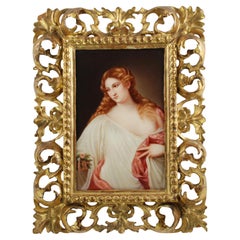
19th Century Hand-Painted Porcelain Plaque, "Flora" after Titian Signed by Rau
Located in Cincinnati, OH
Antique hand-painted porcelain plaque, "Flora" after Titian signed by Rau. This beautifully executed 19th century porcelain plaque has been hand-painted with a luminous version of Renaissance painter Tiziano Vecellio's famous oil painting...
Category

Late 19th Century German Renaissance Antique Gilt Paintings

Materials

Porcelain, Wood

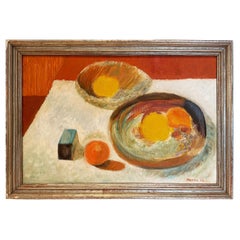
1974 French Impressionist Abstract Still-life Painting by Farmor
Located in Miami, FL
1974 French Impressionist Abstract Still-life Painting by Farmor Offered for sale is a signed 1974 abstract French impressionist table-scape still life painting signed Farmor. The p...
Category

1970s Vintage Gilt Paintings

Materials

Giltwood, Paint

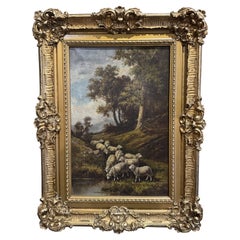
19th Century Italian Sheep Oil Painting in Carved Gilt Frame Signed G. Milone
Located in Dallas, TX
Decorate an office or study with this beautiful antique pastoral painting. Hand painted in Italy circa 1870, the painting depicts a tranquil ...
Category

Mid-19th Century Italian Antique Gilt Paintings

Materials

Giltwood, Canvas

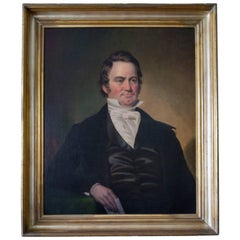
19th century American Southern Portrait by Benoni Irwin
By Benoni Irwin
Located in Savannah, GA
Oil on canvas portrait entitled:Mr. Bowles of Kentucky, painted by Benoni Irwin (1840-1896) an American portraitist born in new market, Ontario, Canada. He moved to New York as a you...
Category

Late 19th Century American American Classical Antique Gilt Paintings

Materials

Wood

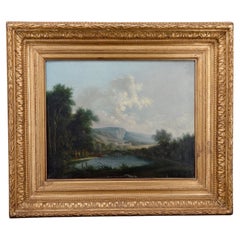
Italian painting, lake scene, 19th century
Located in VÉZELAY, FR
In the foreground, a lake surrounded by vegetation. On the left bank, several figures, some in a boat. In the background, a building that resembles a fortified castle, in a hilly lan...
Category

19th Century Italian Grand Tour Antique Gilt Paintings

Materials

Canvas, Wood, Paint

Large Painting By Francisco Bores - "La Ferme"
Located in Kastrup, DK
Francisco Bores – "La Ferme" (The Farm) A remarkable and highly collectible painting by the celebrated Spanish modernist Francisco Bores (1898-1972). "La Ferme" is a prime example of...
Category

Mid-20th Century Spanish Modern Gilt Paintings

Materials

Canvas, Wood

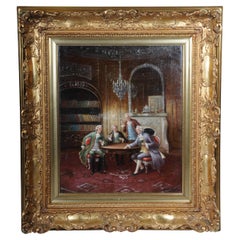
Rococo Oil Painting Signed Bruno Blatter Around 1890
Located in Berlin, DE
Rococo oil painting signed Bruno Blätter around 1890 Oil on canvas painting. Rococo scene. Three gentlemen seated at the table, playing cards a...
Category

1890s German Rococo Revival Antique Gilt Paintings

Materials

Canvas, Wood

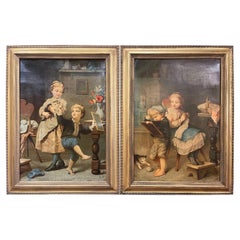
Pair of 19th Century French Signed Chromo Lithographs in Gilt Frames
Located in Dallas, TX
These elegant antique chromo lithographs were created in Normandy circa 1880. Set in a carved gilt frame from later addition, each artwork depicts joyful children at play; both scene...
Category

Late 19th Century French Antique Gilt Paintings

Materials

Giltwood, Paper

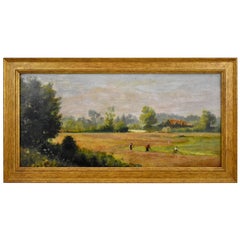
English Afternoon Pastoral Farm Scene Oil on Linen Painting Gold Leaf Wood Frame
Located in Philadelphia, PA
An early 19th century painting, oil on linen, showing an English pastoral farm scene, artist unknown. The right foreground shows three farm workers clearing hay in a meadow. Other figures can be seen in the mid-ground along with a hay laden wagon harnessed to horses. A thatched roof cottage is painted in the distance. In the central background, two horses are grazing in front of split rail fence...
Category

Early 19th Century English Romantic Antique Gilt Paintings

Materials

Linen, Giltwood

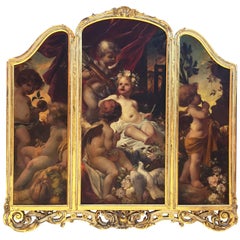
German 19th Century Oil on Canvas Triptych of Cherubs by Ferdinand Wagner II
Located in Los Angeles, CA
Ferdinand Wagner II (German, 1847-1927) A very fine and charming triptych group of three oil on canvas laid on board titled "An Allegory to Spring" each panel depicting different playful and joyous scenes of putti and a cherubs reminiscent of spring, love and peace. The center panel depicting a seated putto, crowned with flowers, a standing putto behind him holding a sack of arrows and a seated cherub facing him next to a watchful peace dove on top resting of a flower bouquet. The left panel depicting a seated putto next to a standing putto with a freshly harvested apple. The right side panel depicting a standing cherub holding a fig branches with leaves. All three-in-one panels within individually carved giltwood frames. All panels signed at the lower left: Ferd. Wagner, circa 1890. Ferdinand Wagner II (German, 1847-1927) was the son of Passau Ferdinand Wagner Senior, a teacher at a vocational art school who began training him professionally at a young age. After traveling to Italy in 1867-1868, he continued with his art studies at The Munich Academy of Arts led by Peter Von Cornelius and Julius Schnorr...
Category

Late 19th Century German Rococo Revival Antique Gilt Paintings

Materials

Canvas, Wood

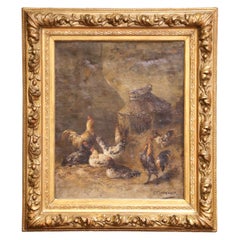
19th Century Oil on Canvas Chicken Painting in Gilt Frame Signed E. Coppenolle
Located in Dallas, TX
Bring rustic charm to your interior with this intimate and richly textured barnyard scene painted by Edmond van Coppenolle. Executed circa 1880, likely during the artist’s time in Fr...
Category

Late 19th Century French Antique Gilt Paintings

Materials

Wood, Giltwood, Paint

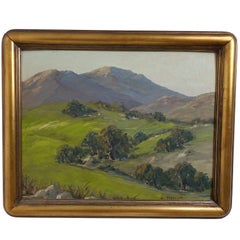
Landscape Painting Signed H. Mueller, Oak Gulch, 1950
Located in San Francisco, CA
Landscape painting, oil on artist board in giltwood frame. Titled oak gulch and dated 1950.
Category

Mid-20th Century American Gilt Paintings

Materials

Wood, Paint

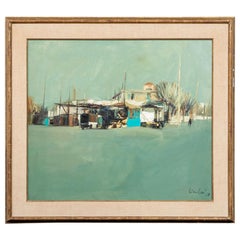
Nicola Simbari (Italian, 1927-2012) Oil On Canvas Depicting A Landscape
Located in Bridgeport, CT
Nicola Simbari, Italian painter of semi-abstract impressionist works known for using colors and favoring brilliant tones, especially with a palette knife. Considered by many to be It...
Category

20th Century Italian Mid-Century Modern Gilt Paintings

Materials

Canvas, Wood

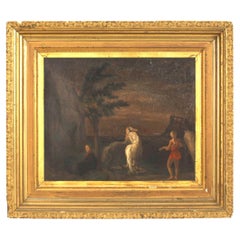
Italian Neo-Classic Landscape with Horses
Located in Queens, NY
Italian Neo-classic oil on canvas of a dark landscape with horses and figures in the foreground with a gilt frame. Chips on frame
Category

20th Century Italian Neoclassical Gilt Paintings

Materials

Canvas

Pair of Noble Portraits, Late 18th Century
Located in Kastrup, DK
A distinguished pair of noble portraits Likely painted by Hans Hansen (1769–1829) or another artist from Circle of Jens Juel. These portraits are masterfull...
Category

Late 18th Century Danish Louis XVI Antique Gilt Paintings

Materials

Canvas, Wood

Recently Viewed

View All