Early 1900s Art

to
228
908
463
292
188
162
Overall Width
to
Overall Height
to
7,460
21,347
163,724
232,448
2,270
4,930
6,506
5,805
15,019
20,728
25,792
18,686
14,130
5,303
327
235
115
99
10
9
9
5
4
4
1
1,024
816
50
1,122
642
394
343
332
176
108
105
95
94
86
83
78
77
76
75
75
74
70
63
926
652
475
374
365
57
45
27
25
18
857
227
1,073
886
Period: Early 1900s
Mistinguett au Moulin Rouge Fan Design, Gouache on Paper, Circa 1908

Mistinguett au Moulin Rouge Fan Design, Gouache on Paper, Circa 1908

Located in PARIS, FR

Cecil de Blaquière Howard, known as Cecil Howard (Clifton, Canada, 1888 - New York, 1956) Mistinguett and Max Dearly dancing the waltz at the Moulin Rouge Fan design Circa 1908 Gouac...

Category

Art Deco Early 1900s Art

Materials

Gouache

Painting 'Vela' P. Fragiacomo, circa 1910s

Painting 'Vela' P. Fragiacomo, circa 1910s

By Pietro Fragiacomo

Located in Vicenza, VI

Oil painting on panel by artist P. Fragiacomo, dating from the 1910s. The work, titled "Sail," depicts a small sailboat in the middle of the sea with a figure on board seen from behi...

Category

Modern Early 1900s Art

Materials

Canvas, Oil

Whaling – Vintage Monumental Zoology Lithograph

Whaling – Vintage Monumental Zoology Lithograph

Located in Myrtle Beach, SC

Joseph Fleischmann, 'Whaling' (Hartingers Wandtafeln: Zoologie T. XXXII), monumental vintage color lithograph, 1900. Signed in the matrix, lower right. A superb, beautifully nuanced impression, on cream wove paper, the full sheet with margins (1 1/2 to 2 3/16 inches), in very good condition. Sheet size 28 x 38 1/2 inches (711 x 978 mm). The full sheet, unmounted and unmatted—shipped carefully rolled and protected. Rendering by A. Berger after Joseph Fleischmann. Published by Carl Gerold’s Son, Vienna, 1900. This Artic whaling scene depicts a Greenland whale in the foreground pursued by whalers. A whaling ship is seen in the background and at right, another whale among icebergs with seagulls overhead. The print by Albert Berger...

Category

Naturalistic Early 1900s Art

Materials

Lithograph

"La rue de la Paix" original etching

"La rue de la Paix" original etching

By Tony Minartz

Located in Henderson, NV

Medium: original etching. This impression on laid paper was printed in 1909 and published in Paris for the Revue de l'art ancien et moderne. Plate size: 9 1/2 x 6 3/8 inches (241 x 1...

Category

Early 1900s Art

Materials

Etching

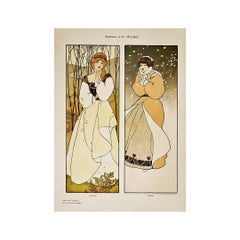
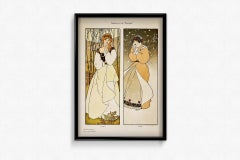
Art nouveau style poster by Lewis Baumer

Art nouveau style poster by Lewis Baumer

Located in PARIS, FR

Beautiful art nouveau style poster by Lewis Baumer illustrating the seasons of Spring and Summer Lewis Christopher Edward Baumer is best known as an Engl...

Category

Art Nouveau Early 1900s Art

Materials

Paper, Lithograph

Les Gros Prunes, plums still life

Les Gros Prunes, plums still life

By Adam Lehr

Located in New York, NY

This still life of Plums is a top notch example of 19th century still life painting! Beautiful quality and striking but also spare and honest in nature which is what typified Americ...

Category

American Realist Early 1900s Art

Materials

Canvas, Oil

Early 20th Century Signed Italian Painting

Early 20th Century Signed Italian Painting

Located in Roma, IT

A beautiful and evocative oil painting on wood by the great Italian artist who lived between the late nineteenth and early twentieth centuries. It depicts with rare effectiveness a...

Category

Italian School Early 1900s Art

Materials

Oil, Wood Panel

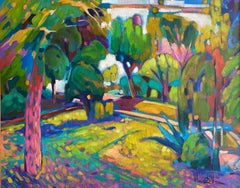
Expressionist Colorful Landscape Oil Paint : San Antonio

Expressionist Colorful Landscape Oil Paint : San Antonio

By Chico Montilla

Located in Segovia, ES

San Antonio . Oil on canvas by Spanish artist Chico Montilla. Measurements: (H) 65 x (W) 81 x 2 (D) cm. Framed 85 x 101 x 5 cm. San Antonio, another expressionist view of the countr...

Category

Expressionist Early 1900s Art

Materials

Canvas, Oil

Antique Western Oil on Canvas Painting Native American "The Captive" 1901

Antique Western Oil on Canvas Painting Native American "The Captive" 1901

By Frank Paul Sauerwein

Located in Portland, OR

A large American Western, Native American oil on canvas landscape, by Frank Paul Sauerwein (1871-1910), "The Captive", 1901. This large oil on canvas depicts a Native American brave captively tied to a tree stump and being viewed by a rival tribe, who are evidently deciding his fate. Behind the collected tribe of elders, braves and children are a pair of conical tipi dwellings, to the background are grazing horses and another group of native people in a tree lined setting. The painting is indistinctly signed lower left, condition is good, the painting is housed in the original frame with a giltwood rabbet, the painting at sight is 40" x 26". Provenance; From a lifelong collection of 19th & early 20th Century Western Art, Portland, Oregon. Frank Sauerwein was a respected painter of western landscapes, Indian portraits, Indian genre scenes, and California missions. His promising career was cut short by his death of tuberculosis at age thirty-nine. The son of European-trained artist, Charles D. Sauerwein, Frank took his first art lessons from his father before studying at the Philadelphia School of Industrial Art, the Pennsylvania Academy of Fine Art, the Art Institute of Chicago and, finally, the Philadephia Museum School of Art. In 1891 he moved to Denver in hope of improving his health. In 1893, Sauerwein accompanied the artist Charles Craig on a trip to the Ute reservation in southwestern Colorado. This began Sauerwein's unyielding fascination with the Southwest and its Native inhabitants. After a trip to Europe, he returned to the American West, visiting Taos in 1899 and Santa Fe in 1900. That same year, Sauerwein visited the Navajo reservation, becoming good friends with trading post entrepreneur, Lorenzo Hubbell. He also spent time at Keam's Canyon on the Hopi reservation where he sketched local inhabitants. Sauerwein moved to Los Angeles in 1901, and then to Pasadena in 1902, but he maintained his contacts in the Southwest with Summer trips to the Grand Canyon, New Mexico Indian Pueblos, Taos, Santa Fe and Albuquerque. He especially loved the Grand Canyon which is the subject of a large number of his paintings. Rendered in a tight, academic style, Sauerwein's paintings clearly show the influence of German...

Category

Early 1900s Art

Materials

Canvas, Oil

"Corner of my Garden" Leon Foster Jones, Impressionist, Blooming Spring Flora

"Corner of my Garden" Leon Foster Jones, Impressionist, Blooming Spring Flora

Located in New York, NY

Leon Foster Jones Corner of my Garden, 1902 Signed and dated lower left Oil on canvas 26 x 25 inches Provenance Goldfield Galleries, Los Angeles, California Private Collection, Virginia Beach, Virginia Leon Foster Jones was a painter of landscapes, an etcher, a lithographer, and an educator. He was born in Manchester, New Hampshire, his father held the position of overseer in one of the hosiery mills in the Manchester area. In approximately 1901, he married Josephine Currier. During the initial years of their marriage, the couple resided in Concord, New Hampshire. They made Port Jefferson, Long Island, New York their permanent home in 1910, although the artist had begun working there as early as 1907. Numerous sources indicate that throughout his life, Jones gained recognition primarily for his paintings and etchings featuring historical sites across Long Island. His artistic education included four years at the Cowles Art School in Boston, Massachusetts, where he studied under Joseph Rodefer DeCamp...

Category

American Impressionist Early 1900s Art

Materials

Canvas, Oil

Le parc du Chateau - Post Impressionist Landscape Oil by Gustave Cariot

Le parc du Chateau - Post Impressionist Landscape Oil by Gustave Cariot

By Gustave Camille Gaston Cariot

Located in Marlow, Buckinghamshire

Signed and dated oil on canvas landscape by French post impressionist painter Gustave Cariot. The piece is set in Perigny-sur-Terres and depicts a view of a long path leading through...

Category

Post-Impressionist Early 1900s Art

Materials

Oil, Canvas

Portrait of Melanie Schiele: Study for Danaë (cat. no. D196a)

Portrait of Melanie Schiele: Study for Danaë (cat. no. D196a)

By Egon Schiele

Located in Palm Beach, FL

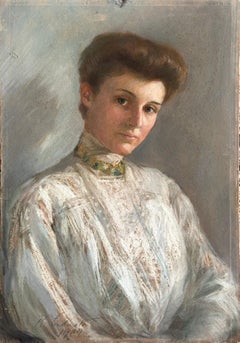
Signed "Schiele Egon 08" This work was reviewed by will be Jane Kallir, Kallir Research Institute, New York on August 19, 2021 and has confirmed its authorship. The work will be inc...

Category

Vienna Secession Early 1900s Art

Materials

Paper, Gouache, Pencil

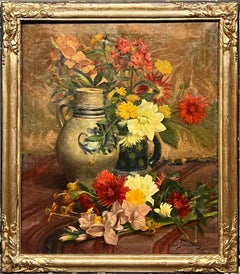
Oil Painting by Henry Schouten "A Vase of Flowers"

Oil Painting by Henry Schouten "A Vase of Flowers"

By Henry Schouten

Located in Mere, GB

Oil Painting Pair by Henry Schouten "A Vase of Flowers" 1857 -1927 Using his psuedonym 'Jos Klaus' which he used for his flower paintings Belgian painter who studied under Alfred Ven...

Category

Early 1900s Art

Materials

Oil

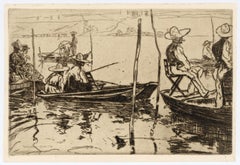
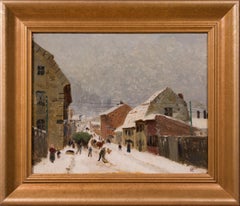
'Bridge, Venice' — Turn of the Century American Impressionism

'Bridge, Venice' — Turn of the Century American Impressionism

By John Marin

Located in Myrtle Beach, SC

John Marin, 'Bridge, Venice', etching, 1907, Zigrosser 59. Signed in pencil. Signed and dated 'Marin 07' in the plate, lower center; titled 'Le Pont Venezia' in the plate lower right. A superb, delicately inked impression, on antique cream laid paper, the full sheet with margins (5/8 to 3/4 inches); slight lightening to the paper within the original mat opening, otherwise in excellent condition. Printed by George Haskell, New York. Matted to museum standards, unframed. Image size 5 x 7 1/16 inches; sheet size 6 5/8 x 8 11/16 inches. Literature: 'John Marin: Peintre Graveur', Charles Saunier, L' Art Décoratif, Paris, January, 1908 (illustrated). 'The Complete Etchings of John Marin', Carl Zigrosser, Philadelphia Museum of Art, 1969 (illustrated). Impressions of this work are in the following museum collections: Art Institute of Chicago (Stieglitz Collection), Cleveland Museum of Art, Fine Arts Museums of San Francisco, Metropolitan Museum of Art, and the Philadelphia Museum of Art. ABOUT THE ARTIST "How to paint the landscape: First, you make your bow to the landscape. Then you wait, and if the landscape bows to you, then, and only then, can you paint the landscape." —John Marin “I would say to a person who thinks he wants to paint, go and look at the way a bird flies, a man walks, the sea moves. There are certain laws, certain formulae. You have to know them. They are nature's laws and you have to follow them just as nature follows them... You don't create the formulae... You see them." —John Marin, conversation with Dorothy Norman...

Category

American Impressionist Early 1900s Art
Materials

Etching

Parisienne /// Art Nouveau French Lithograph Impressionist Figurative Lady Woman

Parisienne /// Art Nouveau French Lithograph Impressionist Figurative Lady Woman

By Maurice Eliot

Located in Saint Augustine, FL

Artist: Maurice Eliot (French, 1862-1945) Title: "Parisienne" Portfolio: Revue de l'Art Ancien & Moderne *Issued unsigned, though signed by Eliot in the plate (printed signature)...

Category

Post-Impressionist Early 1900s Art

Materials

Lithograph

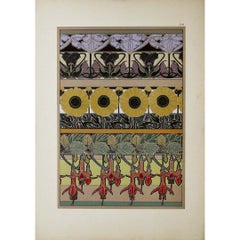
H.O. Miethke Das Werk folio "Sunflower" collotype print

H.O. Miethke Das Werk folio "Sunflower" collotype print

Sunflower, no. 10 from the third installment of Das Werk Gustav Klimts Created during his residency in Litzlberg on Attersee, where Klimt and the Floge family summered from 1900-1907, Klimt explores nature’s transcendental qualities. His single sunflower is human-like, it’s golden halo is like a ring of sun-kissed hair surrounding a bald pate. It’s known that at the same time Klimt was creating this image, he was also at work on a photo essay about the Floge sisters’ clothing from their fashion salon. Their fashion house was best known for its “reform dresses” which featured loose-fitting long robes which billowed at the arms and torso. Viewed with this in mind, it is not a hard leap to imagine the lone sunflower as a self-portrait from reverse. Klimt’s balding head crowned in a golden corona forms the apex of a pyramidal flowing gown of foliage and flowers. By orienting the anthropomorphic flower at the garden’s central foreground and adorning it with repetitive motifs of round flowers of varying sizes, Klimt’s sunflower...

Category

Vienna Secession Early 1900s Art

Materials

Paper

Paul Berthon - Sarah Bernhardt La Princesse Lointaine " The Faraway Princess "

Paul Berthon - Sarah Bernhardt La Princesse Lointaine " The Faraway Princess "

By Paul Berthon

Located in PARIS, FR

Paul Emile Berthon ( 1872- 1909 ), was a French decorative artist. He began studying painting in Villefranche. From 1893, he moved to Paris, where he attended the École normale d'enseignement du dessin. Among the courses taken at the time, those of the professor of decorative art Eugène Grasset had the greatest impact on him. The first works of Paul Berthon (around 1896) show a style close to that of Grasset. By freeing himself from the style of his master, his own style develops based on a palette of autumnal pastels with sharp lines and contours. This is his most famous lithograph, a portrait of Sarah Bernhardt in the title role of "La Princesse Lointaine...

Category

Art Nouveau Early 1900s Art

Materials

Linen, Paper, Lithograph

" Summer Evening Southwest Texas "   1909  Texas Hill Country Julian Onderdonk

" Summer Evening Southwest Texas " 1909 Texas Hill Country Julian Onderdonk

By Julian Onderdonk

Located in San Antonio, TX

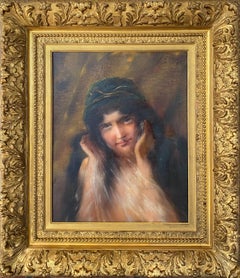
Julian Onderdonk "Summer Evening S. W. Texas" Texas Hill Country (1882 - 1922) San Antonio Artist Image Size: 9 x 12 Frame Size: 15 x 18 Medium: Oil on panel Dated 1909 "Summer Evening S. W. Texas" "A Texas Painter Worked Under the Radar in New York," By Eve M. Kahn, March 6, 2014, The New York Times Onderdonk, a San Antonio native who died of an intestinal ailment in 1922, at 40, is best known for painting swaths of Texas bluebonnets. Those canvases can bring more than $500,000 each, while his New York scenes usually end up in the five-figure range. Onderdonk’s parents were painters in San Antonio, and in 1901, when he was a teenager, they sent him to New York for training. Through 1909, he lived in various Manhattan apartments and Staten Island houses. He then returned to Texas, but continued to spend months at a time in New York. In 1902 he had married a Manhattan teenage neighbor, Gertrude Shipman. While she focused on raising their daughter, Adrienne, and worrying about their strained finances, “he created more than 600 works of art, often producing a painting or two a day,” Eyewitnesses recorded his prolific pace in New York, but Onderdonk works bearing those dates rarely turn up. The puzzling gap in his productivity is explained in family correspondence that the Bakers uncovered: The artist admits that he was signing pieces with pseudonyms. He mostly used Chas. Turner and Chase Turner and occasionally resorted to Elbert H. Turner and Roberto Vasquez. Julian Onderdonk was the son of the important Texas landscapist, Robert Onderdonk. He was the father's pupil at age 16. Sponsored by a Texas patron, he studied at the Art Students League in New York when he was 19, the pupil of Kenyon Cox, Frank DuMond, and Robert Henri. He also studied with William Merritt Chase on Long Island. In 1902, having lost his Texas patron because he married, he asked $18 for 12 paintings at a Fifth Avenue dealer in New...

Category

Impressionist Early 1900s Art
Materials

Oil

French Landscape With River, Impressionist Oil on Canvas 1904, Framed

French Landscape With River, Impressionist Oil on Canvas 1904, Framed

Located in Lake Worth Beach, FL

Landscape With A River And Trees Artist signed and dated 1904 lower right, canvas 16x26 inches. Painting previously relined and restored, antique frame. Eugéne REGAGNON (1875-1957) ...

Category

Impressionist Early 1900s Art
Materials

Oil, Cotton Canvas

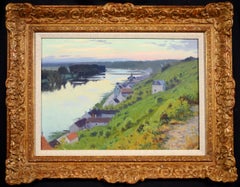
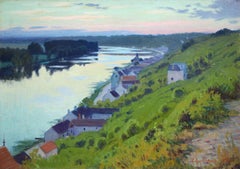
La Colline Saint Catherine - Post Impressionist Landscape Oil by Robert Pinchon

La Colline Saint Catherine - Post Impressionist Landscape Oil by Robert Pinchon

By Robert Antoine Pinchon

Located in Marlow, Buckinghamshire

Signed fauvist oil on canvas riverscape c.1908 by French post impressionist painter Robert Antoine Pinchon. The work depicts a view of the River Seine in Rouen, with Saint Catherine'...

Category

Post-Impressionist Early 1900s Art
Materials

Oil, Canvas

Sankt Matteus Church in Stockholm, 1907

Sankt Matteus Church in Stockholm, 1907

By Erik Tryggelin

Located in Stockholm, SE

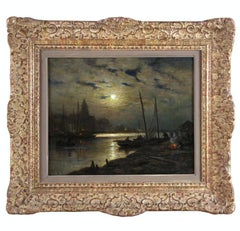
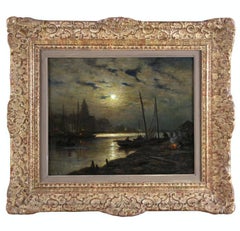
The painting we are offering for sale, executed by Swedish artist Erik Tryggelin on May 3, 1907, presents a striking and atmospheric view of Sankt Matteus Church in Stockholm. It sta...

Category

Post-Impressionist Early 1900s Art
Materials

Oil, Board

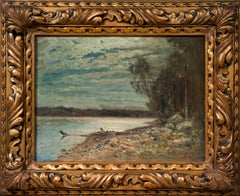
Rocky Landscape at Sunset, Oil on Canvas, Signed, Circa 1900

Rocky Landscape at Sunset, Oil on Canvas, Signed, Circa 1900

Located in Stockholm, SE

This sunset landscape by Hans Agersnap presents a quiet and ccontemplative view of the Danish countryside at the close of day. The composition is dominated by undulating hills, bathe...

Category

Romantic Early 1900s Art

Materials

Canvas, Oil

Fra Åsgårdstrand (Schiefler 260; Woll 289), Edvard Munch

Fra Åsgårdstrand (Schiefler 260; Woll 289), Edvard Munch

By Edvard Munch

Located in Southampton, NY

Drypoint on gewöhnlichem aber holzfreiem vélin paper. Unsigned and unnumbered, as issued. Good Condition. Notes: From the album, Verzeichnis Des graphischen Werks Edvard Munchs Bis 1...

Category

Expressionist Early 1900s Art
Materials

Drypoint

Circa 1900 Art Nouveau advertising poster for Fumar el papel JOB

Circa 1900 Art Nouveau advertising poster for Fumar el papel JOB

Located in PARIS, FR

This circa 1900 Art Nouveau advertising poster, designed by Peruvian-born artist Daniel Hernández, is a stunning example of early 20th-century luxury brand marketing. Created for JOB cigarette rolling papers, the advertisement reflects the era’s elegant aesthetics and sophisticated lifestyle appeal. The slogan, "Fumar el papel JOB o dejar de fumar" ("Smoke JOB paper or stop smoking"), emphasizes the brand’s prestige and superior quality, making it seem indispensable for tobacco connoisseurs. The artwork features a sensual and dreamlike composition, characteristic of the Belle Époque. A radiant red-haired woman, partially draped in sheer fabric, lounges in a relaxed pose, smiling seductively as she delicately holds a lit cigarette. The soft pastels, golden hues, and fluid lines create a warm, ethereal atmosphere, reinforcing the romantic and luxurious associations of the JOB brand. The swirling wisps of smoke, artistically integrated into the design, echo the organic, flowing forms typical of Art Nouveau illustration. The ornate green decorative border further enhances the visual richness, framing the central figure like a jewel in an exquisite setting. At the turn of the century, tobacco advertising was at its peak, and brands relied on opulent, aspirational imagery to captivate consumers. JOB, a French rolling paper company founded in the 1830s, became known for collaborating with renowned artists to create highly collectible posters. This particular piece, executed with remarkable softness and luminosity, reflects Hernández’s mastery of portraiture and classical technique, which he refined during his studies in Europe. His ability to capture the sensuality and grace of the female form made him a sought-after artist for both fine art and commercial illustration. Beyond its commercial function, this poster is an important example of the fusion between fine art and advertising, a defining feature of Art Nouveau poster design. It demonstrates how companies in the early 20th century elevated advertising into an art form, commissioning celebrated painters to craft exquisite promotional imagery. Today, original JOB posters...

Category

Early 1900s Art

Materials

Paper, Lithograph

“Lady of the Lake”
“Lady of the Lake”

“Lady of the Lake”

By Jean Beauduin

Located in Southampton, NY

Oil on canvas. Condition is very good. Signed lower left. Inscribed Paris and dated 1904. Overall with gold leaf over wood frame frame 28 1/2 x 34 1/2 inches. There is a second f...

Category

Romantic Early 1900s Art

Materials

Canvas, Oil

Norwegian Pine Grove - The inner glow of the trees -

Norwegian Pine Grove - The inner glow of the trees -

Located in Berlin, DE

Themistokles von Eckenbrecher (1842 Athens - 1921 Goslar), Norwegian pine grove, 1901. Watercolor on blue-green paper, 30 x 22 cm. Signed, dated and inscribed in his own hand "TvE. Fagermes [i.e. Fagermes]. 26.6.[19]01." - Slight crease throughout at left margin, otherwise in good condition. About the artwork Themistokles von Eckenbrecher often traveled to Norway to study the nature that fascinated him there. On June 26, 1901, near the southern Norwegian town of Fagernes, in the summer evening sun, he saw a small pine grove, which he immediately captured in a watercolor. He exposed the trees growing on a small hill in front of the background, so that the pines completely define the picture and combine to form a tense motif. The tension comes from the contrast of form and color. The trunks, growing upward, form a vertical structure that is horizontally penetrated by the spreading branches and the pine needles, which are rendered as a plane. This structural tension is further intensified by the color contrast between the brown-reddish iridescent trunks and branches and the green-toned needlework. Themistokles von Eckenbrecher, however, does not use the observed natural scene as an inspiring model for a dance of color and form that detaches itself from the motif and thus treads the path of abstracting modernism. Its inner vitality is to be brought to light and made aesthetically accessible through the work of art. It is precisely in order to depict the inner vitality of nature that von Eckenbrecher chooses the technique of watercolor, in which the individual details, such as the needles, are not meticulously worked out, but rather a flowing movement is created that unites the contrasts. The trees seem to have formed the twisted trunks out of their own inner strength as they grew, creatingthose tense lineations that the artist has put into the picture. The inner strength continues in the branches and twigs, culminating in the upward growth of the needles. At the same time, the trunks, illuminated by the setting sun, seem to glow from within, adding an almost dramatic dimension to the growing movement. Through the artwork, nature itself is revealed as art. In order to make nature visible as art in the work, von Eckenbrecher exposes the group of trees so that they are bounded from the outside by an all-encompassing contour line and merge into an areal unity that enters into a figure-ground relationship with the blue-greenish watercolor paper. The figure-ground relationship emphasizes the ornamental quality of the natural work of art, which further enforces the artwork character of the group of trees. With the presentation of Themistokles von Eckenbrecher's artistic idea and its realization, it has become clear that the present watercolor is not a study of nature in the sense of a visual note by the artist, which might then be integrated into a larger work context, but a completely independent work of art. This is why von Eckenbrecher signed the watercolor. In addition, it is marked with a place and a date, which confirms that this work of nature presented itself to him in exactly this way at this place at this time. At the same time, the date and place make it clear that the natural work of art has been transferred into the sphere of art and thus removed from the time of the place of nature. About the artist Themistocles' parents instilled a life of travel in their son, who is said to have spoken eleven languages. His father, who was interested in ancient and oriental culture, was a doctor and had married Francesca Magdalena Danelon, an Italian, daughter of the British consul in Trieste. During a stay in Athens - Gustav von Eckenbrecher was a friend of Heinrich von Schliemann and is said to have given him crucial clues as to the location of Troy - Themistokles saw the light of day in 1842. After an interlude in Berlin, where Themistokles was educated at the English-American School, the journey began again. From 1850 to 1857 the family lived in Constantinople, after which the father opened a practice in Potsdam, where Themistokles, who wanted to become a painter, was taught by the court painter Carl Gustav Wegener. In 1861 the von Eckenbrechers left Potsdam and settled in Düsseldorf. There Themistokles received two years of private tuition from Oswald Aschenbach, who greatly admired the talented young artist. After his artistic training, he undertook extensive travels, often accompanied by Prince Peter zu Sayn-Wittgenstein, which took him to northern and eastern Europe, but above all to the Middle East and even to South America. The paintings that resulted from these journeys established his artistic reputation and led to his participation in large panoramas such as the 118 x 15 metre Entry of the Mecca Caravan into Cairo, painted for the City of Hamburg in 1882. 1882 was also the start of a total of 21 study trips to Scandinavia, most of them to Norway, and the unique Norwegian landscape with its rugged fjords became a central motif in his work. Along with Anders Askevold and Adelsteen Normann...

Category

Naturalistic Early 1900s Art

Materials

Watercolor

Le Village de Crozant - Impressionist Landscape Oil - Baptiste Armand Guillaumin

Le Village de Crozant - Impressionist Landscape Oil - Baptiste Armand Guillaumin

By Jean Baptiste-Armand Guillaumin

Located in Marlow, Buckinghamshire

Signed impressionist landscape oil on canvas by French painter Jean Baptiste Armand Guillaumin. This stunning piece depicts a view of Crozant a commune located in the department of C...

Category

Impressionist Early 1900s Art
Materials

Canvas, Oil

Portrait of an Edwardian Lady - British 1900 art female portrait oil painting

Portrait of an Edwardian Lady - British 1900 art female portrait oil painting

By Ralph Peacock

Located in Hagley, England

This stunning British Edwardian portrairt oil painting is by noted 19th century born portrait painter Ralph Peacock .Painted circa 1900 it is a seated portrait of a lady in a black dress with shiffon sleeves and beautiful pink flowers in her lap. She is wearing considerable jewellery suggesting her wealth; an ornate ring, fleur de lys broach, a long string of pearls...

Category

Realist Early 1900s Art

Materials

Oil

Original Carlsberg Pilsner vintage Danish beer poster.   Drink All Round

Original Carlsberg Pilsner vintage Danish beer poster. Drink All Round

Located in Spokane, WA

CARLSBERG PILSNER, artist: Carsten Ravn. This professional archival linen-backed lithograph is ready to frame. Carlsberg is synonymous with quality and tradition in the brewing world. Condition A-. Touched-up pin holes in the four corners. Minor touch-up near the bottom left crown emblem. Green is more of an old army green, and lettering is natural, unbleached, tan colored. Carlsberg Pilsner DRINK ALL YEAR ROUND The horizontal poster shows four scenes of people enjoying their beer: a skier, a cycling woman, a dandy, and a hunter. Above them is the inscription “Carlsberg Pilsner“ and below it “DRIKKES AARET RUNDT.” The latter makes it clear that you can drink it all year round. The four scenes also show the four seasons and that you can always drink Carlsberg Pilsner. (Text is in Danish). Carlsberg’s first brewery was just outside Copenhagen and was opened in 1847. However, it wasn't until 1904 that Carlsberg pilsner is brewed for the first time This 1908 poster...

Category

Art Nouveau Early 1900s Art

Materials

Lithograph

Nature Morte - Post Impressionist Still Life Oil Painting by Georges D'Espagnat

Nature Morte - Post Impressionist Still Life Oil Painting by Georges D'Espagnat

By Georges d'Espagnat

Located in Marlow, Buckinghamshire

Signed oil on canvas still life circa 1902 by French post impressionist painter Georges D'Espagnat. The work depicts a table covered in a white cloth with red stripes. On top sit two...

Category

Post-Impressionist Early 1900s Art
Materials

Canvas, Oil

Early 20th Century Plein Air Study for Homesteader Colorado Mountain Painting

Early 20th Century Plein Air Study for Homesteader Colorado Mountain Painting

By Frank Tenney Johnson

Located in Soquel, CA

Robert Azensky Fine Art is pleased to offer original 1909 sketch study of oil painting "Homesteader Colorado Mountain" painting by Frank Tenney Johnson. It's always special to see the evolution of a painting through the plein air sketches ("studies") by the artist prior to its painting. Frank Tenney Johnson traveled throughout the Colorado Rockies sketching and painting western landscapes and native American and cowboy figurative art. Medium: Charcoal on paper Signature: Lower left corner Date: "1909" below signature Condition: Tonal aging and minor edge wear consistent with age and use. See images. Presented in black painted wood frame Mat size: 14"H x 11"W Paper size: 9"H x 6"W Image size (visible with mat): 8"H x 5.25"W Frank Tenney Johnson was born in Coucil Bluffs, Iowa, in 1874 not far from the Overland Trail. During his childhood, he saw the steady stream of people heading west in all forms of horse-drawn conveyance. This early exposure to the American West was critical in leading Johnson towards the Western landscape as an inspiration for his work. The resulting body of work is a moody and romantic depiction of a long-gone America, rendered in a style that has become practically a genre all its own. At the age of ten, Johnson moved from Iowa to Milwaukee, WI. There, he took an apprenticeship with F.W. Heinie, a prominent panoramic painter. After a year with Heinie, Johnson apprenticed for Richard Lorenz, a painter and former Texas Ranger who specialized in depictions of horses and western scenes. It was probably during his time with Lorenz that Johnson decided to focus on western subjects himself. He also started illustrating for regional papers and publications, in order to save money for further training. Further training, as with many of the artists who populated New Mexico in the early twentieth century, took place at the Art Students League in New York, where Robert Henri, William Merritt Chase, John Twachtman, Kenneth Hayes Miller and F. Louis Mora were in the process of teaching perhaps the last great batch of pre-modernists. Though highly stimulated by the training, Johnson was only able to stay for five months, after which he returned to Milwaukee to work and save money in an effort to return to New York. He was able to do so after a time and, upon returning, established an important professional relationship with Emerson Hough, the editor of "Field & Stream" magazine. At Hough's urging (and on Hough's dime), Johnson traveled to Hayden, Colorado, where he tagged along with a group of cowpunchers in order to sketch their way of life. Though primarily an artist, Johnson also wrote accounts of his time in Colorado for "Field & Stream." After Colorado came Cheyenne, Wyoming, where Johnson attended a "Frontier Days" celebration; after Wyoming, Johnson traveled to New Mexico, where he observed the Navajos and their threatened way of life. This trip changed Johnson from an academic artist with an appreciation for the west to a truly western artist. Of particular interest to him, in stark contrast to other western artists of the time like Frederic Remington and C.M. Russell, were the more quotidian scenes of the West. Specifically, Johnson focused upon scenes featuring horses, especially at night. Johnson painted a great number of pieces that featured horses tied up outside of saloons, inns or trading posts for the night, the moonlit night punctuated by the warm glow from the lamps inside. In this, he can be considered a pioneer, as his night pieces still serve as the archetype for such work in western art. Johnson became quite successful through his work for "Field & Stream." He was chosen to illustrate books by the prominent writer Zane Grey, and his gallery shows sold briskly. In fact, one particular show, at the Grand Central Art Galleries at the Biltmore Hotel in New York, sold out opening night. In fact, one man had bought out the entire show: Amon Carter. Having achieved financial security and comfort, Johnson followed his good friend Clyde Forsythe to Alhambra, CA, where the two established residency and shared a studio. California treated Johnson well. He and Forsythe founded the gallery at the Los Angeles Biltmore...

Category

Hudson River School Early 1900s Art
Materials

Oil Crayon, Laid Paper