Early 1900s Art

to
260
887
438
285
179
164
Overall Width
to
Overall Height
to
7,539
21,275
158,966
232,545
2,243
4,929
6,410
5,814
13,295
19,739
25,675
18,297
13,577
5,382
298
241
117
101
11
9
7
5
4
4
1
1
1,015
783
49
1,111
632
393
340
329
184
107
105
102
91
85
79
77
76
75
74
72
72
66
62
888
625
450
359
356
58
45
29
25
18
803
233
1,022
871
Period: Early 1900s
Original Jules Cheret Antique Poster Musee Grevin Paris 1900
Located in Boca Raton, FL
Musee Grevin Avant La Lettre (Before Text), created in 1900, is one of the best known images by the great French artist, Jules Chéret. The poster advertises a show performance at the...
Category

Early 1900s Art

Materials

Lithograph

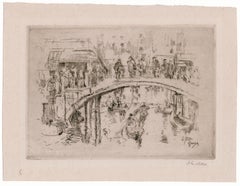
Old Houses, Milbank Grosvenor Road London 1906
Located in Soquel, CA
Old Houses, Milbank Grosvenor Road London 1906 This an etching of Grosvenor Road Old Houses, done in 1906 by American printmaker and Whistler biographer Joseph Pennell (American, 18...
Category

American Impressionist Early 1900s Art

Materials

Handmade Paper, Etching

Loch Eck, Scotland - Scottish Edwardian art landscape oil painting
Located in Hagley, England
This breath taking Scottish Edwardian landscape oil painting is by much exhibited landscape artist William Young RSW. Entitled Loch Eck and painted circa 1908...
Category

Realist Early 1900s Art

Materials

Oil

POLSTER (The Cushion)
Located in Santa Monica, CA
MAXIMILLIAN KURZWEIL (Austrian 1867-1916) DER POLSTER / THE CUSHION, 1903. Color woodcut printed on laid japon paper, affixed as usual to a support sheet from its upper sheet edge...
Category

Vienna Secession Early 1900s Art

Materials

Woodcut

Peste Dessous Peste Dessus Peste Partout!-Original Etching by James Ensor-1900s
Located in Roma, IT
Etching on zinc plate, realized in 1904 on japan paper. It is signed in plate in small letters at the bottom right. On the lower right margin, it is signed also in pencil. Not dated...
Category

Modern Early 1900s Art

Materials

Etching

The Gentlemen - Drawing by Gabriele Galantara - 1907
Located in Roma, IT
China ink drawing and white lead on cardboard realized by Galantara in 1907 for L'Asino". Published on "L'Asino on 22-12-1907, p. 5. Not signed.
Category

Modern Early 1900s Art

Materials

Paper, Ink

Outside the Inn
Located in Wiscasett, ME
An oil on panel signed and dated in the lower left depicting two riders on horseback sharing a drink outside a country inn. The painting measures 17.75" x 21.75" including the frame. Provenance: Private collection CT Bradbury Art and Antiques, Wiscasset, ME Heywood Hardy (25 November 1842 – 20 January 1933) was a British artist, in particular an animal painter and painter of horse riding scenes. He also painted landscapes and portraits, especially equestrian portraits. Horses and horse riding were the subjects of much of Hardy’s later work. His pictures of horse riding by the seashore...
Category

Victorian Early 1900s Art

Materials

Oil

"Bead-Stringers, Venice" lithograph 1905
Located in Henderson, NV
Medium: lithograph (after the pastel). The lithography was executed by Whistler's friend and fellow artist Thomas Way, and published in London by The Studio in 1905 for a rare deluxe...
Category

Early 1900s Art

Materials

Lithograph

Barbizon Fontainebleau region Impressionist French summer landscape with figure
Located in Norwich, GB
A wonderful view of the heartbreakingly beautiful Fontainebleau/Barbizon region, which was home to some of the greatest painters of the 19th and early 20th Century. The particular spot presented here is the river Loing at Montigny-sur-Loing, where Cezanne and Sisley loved to paint. The village is just a short walk away from Grez-sur-Loing, where John Singer Sargent, Francis Brooks Chadwick, Robert Vonnoh, Edward Simmons...
Category

Impressionist Early 1900s Art

Materials

Canvas, Oil

Parc Bagatelle - Fauvist Landscape Oil Painting by Louis Valtat
Located in Marlow, Buckinghamshire
Signed fauvist landscape oil on canvas by French painter Louis Valtat. This stunning piece depicts a view of Bagatelle Park in the north of France in summer. The trees and the flower...
Category

Fauvist Early 1900s Art

Materials

Oil, Canvas

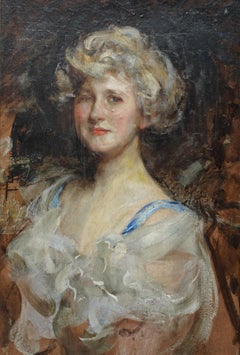
Portrait of a Young Woman - British Edwardian art female portrait oil painting
Located in Hagley, England
An original oil on canvas on panel by Sir James Jebusa Shannon. The portrait dates to the Edwardian period and depicts a bold British Impressionist painting of a beautiful young woma...
Category

Impressionist Early 1900s Art

Materials

Oil

French Landscape With River
Located in Lake Worth Beach, FL
Landscape With A River And Trees Artist signed and dated 1904 lower right, canvas 16x26 inches. Painting previously relined and restored, antique frame. Eugéne REGAGNON (1875-1957) ...
Category

Impressionist Early 1900s Art

Materials

Cotton Canvas, Oil

Arthur Severn - Walna Scar - 19th Century British landscape watercolour
Located in London, GB
JOSEPH ARTHUR PALLISER SEVERN (1842-1931) Sun Effect - above Waldney Scar, Coniston Signed and dated l.l.: Arthur Severn/1906; signed and inscribed with title and the artist’s addr...
Category

Pre-Raphaelite Early 1900s Art

Materials

Watercolor, Paper

"Le Cafe de Paris" original etching
Located in Henderson, NV
Medium: original etching. Printed in 1904 at the Chardon Wittmann atelier and published in Paris by the Revue de l'art ancien et moderne. Plate size: 9 x 6 5/8 inches (230 x 168 mm)....
Category

Early 1900s Art

Materials

Etching

Flowers
Located in PARIS, FR
Alphonse MUCHA (1860-1939) "Flowers" Variante 2 Rare original lithograph Each flower, carnation, iris, lily and rose, is signed at the lower part of the plate "Mucha". This lithogra...
Category

Art Nouveau Early 1900s Art

Materials

Handmade Paper

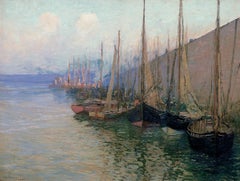
'Pittenweem Evening' Scottish Coastal Village circa 1909
Located in Hillsborough, NC
Impressionist oil painting of Scotland's Pittenweem harbor at twilight, title 'Pittenweem Evening' East Neuk of Fife, by Scottish artist John McGhie. Signe...
Category

Impressionist Early 1900s Art

Materials

Canvas, Oil

Portrait of Brian de Lolme Bullock - British Edwardian art oil painting
Located in Hagley, England
This absolutely charming Edwardian portrait oil painting is by noted artist Edward Francis Wells. Painted in 1908, the sitter is Brian de Lolme Bullock as a six year old boy. (See hi...
Category

Realist Early 1900s Art

Materials

Oil

Man on Persian Rug, Orientalist Bronze Sculpture by Franz Bergmann
Located in Long Island City, NY
Franz Bergmann, Austrian (1861 -1936) - Man on Persian Rug, Year: circa 1900, Medium: Cold painted Bronze sculpture, stamp signed on bottom, Size: 4.5 x 10 x 7 in. (11.43 x 25.4 x...
Category

Romantic Early 1900s Art

Materials

Bronze

19th century English landscape with a Mail coach and Horses on a road
Located in Woodbury, CT
J.A.Terry, A scene of the London to Exeter Mail Coach and a road in a landscape. This charming oil painting of the iconic London to Exeter mail coach, by English painter J.A. Terry ...
Category

Victorian Early 1900s Art

Materials

Canvas, Oil

"In Port"
Located in Lambertville, NJ
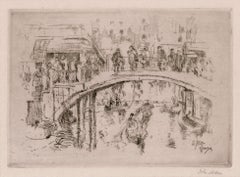
Jim’s of Lambertville is proud to offer this artwork by: Edward Willis Redfield (1869 - 1965) Edward W. Redfield was born in Bridgeville, Delaware, moving to Philadelphia as a young child. Determined to be an artist from an early age, he studied at the Spring Garden Institute and the Franklin Institute before entering the Pennsylvania Academy from 1887 to 1889, where he studied under Thomas Anshutz, James Kelly, and Thomas Hovenden. Along with his friend and fellow artist, Robert Henri, he traveled abroad in 1889 and studied at the Academie Julian in Paris under William Bouguereau and Tony Robert-Fleury. While in France, Redfield met Elise Deligant, the daughter of an innkeeper, and married in London in 1893. Upon his return to the United States, Redfield and his wife settled in Glenside, Pennsylvania. He remained there until 1898, at which time he moved his family to Center Bridge, a town several miles north of New Hope along the Delaware River. Redfield painted prolifically in the 1890s but it was not until the beginning of the twentieth century that he would develop the bold impressionist style that defined his career. As Redfield’s international reputation spread, many young artists gravitated to New Hope as he was a great inspiration and an iconic role model. Edward Redfield remained in Center Bridge throughout his long life, fathering his six children there. Around 1905 and 1906, Redfield’s style was coming into its own, employing thick vigorous brush strokes tightly woven and layered with a multitude of colors. These large plein-air canvases define the essence of Pennsylvania Impressionism. By 1907, Redfield had perfected his craft and, from this point forward, was creating some of his finest work. Redfield would once again return to France where he painted a small but important body of work between 1907 and 1908. While there, he received an Honorable Mention from the Paris Salon for one of these canvases. In 1910 he was awarded a Gold Medal at the prestigious Buenos Aires Exposition and at the Panama-Pacific Exposition of 1915 in San Francisco, an entire gallery was dedicated for twenty-one of his paintings. Since Redfield painted for Exhibition with the intent to win medals, his best effort often went into his larger paintings. Although he also painted many fine smaller pictures, virtually all of his works were of major award-winning canvas sizes of 38x50 or 50x56 inches. If one were to assign a period of Redfield’s work that was representative of his “best period”, it would have to be from 1907 to 1925. Although he was capable of creating masterpieces though the late 1940s, his style fully matured by 1907 and most work from then through the early twenties was of consistently high quality. In the later 1920s and through the 1930s and 1940s, he was like most other great artists, creating some paintings that were superb examples and others that were of more ordinary quality. Redfield earned an international reputation at a young age, known for accurately recording nature with his canvases and painting virtually all of his work outdoors; Redfield was one of a rare breed. He was regarded as the pioneer of impressionist winter landscape painting in America, having few if any equals. Redfield spent summers in Maine, first at Boothbay Harbor and beginning in the 1920s, on Monhegan Island. There he painted colorful marine and coastal scenes as well as the island’s landscape and fishing shacks. He remained active painting and making Windsor style furniture...
Category

American Impressionist Early 1900s Art
Materials

Canvas, Oil

1909 original poster for The Conquest of the Air published by Le Petit Journal
Located in PARIS, FR
The 1909 original poster for "La Conquête de l'Air" (The Conquest of the Air), published by Le Petit Journal, celebrates the 1er Meeting Aérien de Reims (the First Aerial Meeting in ...
Category

Early 1900s Art

Materials

Linen, Paper, Lithograph

Floral Bouquet - French circa 1900 Impressionist art oil painting of flowers
Located in Hagley, England
This superb Edwardian floral oil painting is by noted French Impressionist artist Jacques-Emile Blanche. From 1884 Blanche spent a lot of time in England and regularly exhibited at the Royal Academy...
Category

Impressionist Early 1900s Art

Materials

Oil

Jardin des Tuileries - Impressionist Landscape Oil by William Samuel Horton
Located in Marlow, Buckinghamshire
Signed and dated oil on panel landscape by American impressionist painter William Samuel Horton. The piece depicts a view of the Tuileries Garden in Paris, France. It's a winter scen...
Category

American Impressionist Early 1900s Art
Materials

Oil, Panel

"The View Of Jerusalem" 19th-century Realism Orientalist Oil on Panel
By Anna Richards Brewster
Located in Jacksonville, FL
Provenance: Private Collection, Palm Beach, Fl. AB Levy Gallery, October, 2019 Description: Experience the captivating artistry of Anna Richards Brewster (1870...
Category

Realist Early 1900s Art

Materials

Canvas, Oil

Complete Set of Stations of the Cross Oil Paintings by Völkel
Located in London, GB
Complete set of Stations of the Cross oil paintings by Völkel German, 1909 Canvas: Height 80cm, width 82cm Frame: Height 134cm, width 111c...
Category

Old Masters Early 1900s Art

Materials

Oil

Antique Bronze Dog Portrait of a Cavalier King Charles "Thigley" circa 1905
Located in SANTA FE, NM
Antique Bronze Dog Portrait of a Cavalier King Charles "Thigley" French School (possibly Franck Burty Haviland) Lost wax bronze casting Circa 1910 5 7/8 x 9 x 3 1/4 A sophisticated bronze casting of a Cavalier King Charles spaniel made in lost wax casting (cire perdue) from the beginning of the 20th century by Valsuani Foundry. This an unusual bronze approached in its aesthetic that’s reminiscent of the work of great animal sculptors of the second half of the 19th century except in this presentation which is more avant-garde for the time with a much looser, more impressionistic execution. The patina is a superb bronze color, brown and slightly greenish, going in places towards a more antique green. The attitude of the dog is extremely well and sensitively rendered with the placement of material unlike the renderings of a bronze by Barye...
Category

French School Early 1900s Art

Materials

Bronze

Belle Époque poster by the artist F. Garric - La Yetta
Located in PARIS, FR
This captivating Belle Époque poster by the artist F. Garric presents an alluring image of the dancer La Yetta, captured mid-performance in an exotic and theatrical pose. Dressed in ...
Category

Early 1900s Art

Materials

Paper, Lithograph

Henri Matisse Crayon Drawing Direct from Matisse Estate
Located in Dallas, TX
Henri Matisse (French 1869-1954) Pencil Drawing Of A Working Horse Catalogued as Number Z 548 in the Artist Archives Pencil on paper, c. 1900, signed with initials 'HM' lower right....
Category

Modern Early 1900s Art

Materials

Paper, Crayon

"The Purple Cap" lithograph 1905
Located in Henderson, NV
Medium: lithograph (after the pastel). The lithography was executed by Whistler's friend and fellow artist Thomas Way, and published in London by The Studio in 1905 for a rare deluxe...
Category

Early 1900s Art

Materials

Lithograph

Butterflies, English antique natural history Lepidoptera chromolithograph print
Located in Melbourne, Victoria
English butterfly chromolithograph, circa 1900. Plate number top right. From an English series of illustrations of butterflies and moths. Butterflies / moths are numbered and there i...
Category

Art Nouveau Early 1900s Art

Materials

Lithograph

"Les deux miroirs" original etching
Located in Henderson, NV
Medium: original etching. Printed in 1906 at the Alfred Porcabeuf atelier and published in Paris by Gazette des Beaux-Arts. Image size: 6 1/2 x 5 7/8 inches (165 x 149 mm). Signed in...
Category

Realist Early 1900s Art

Materials

Etching

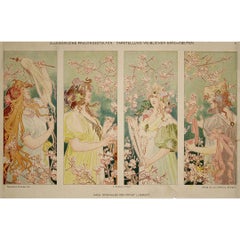
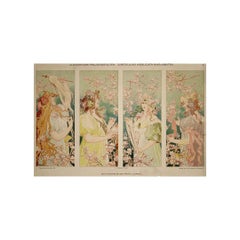
1900 Original poster by Louis Lemoine-Maudet Affiche Artistiques en couleurs
Located in PARIS, FR
In 1900, Louis Lemoine-Maudet created a vibrant and captivating poster titled "Affiches Artistiques en Couleurs." This piece showcases the artist's talent in lithography and highligh...
Category

Early 1900s Art

Materials

Linen, Paper, Lithograph

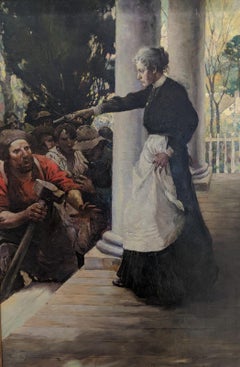
STREET ACAPULCO
Located in Santa Monica, CA
JOSEPH PENNELL (1857 - 1926) STREET ACAPULCO 1901-08. Color pastel and gouache drawing on blue paper. Signed and titled in pencil in his early signature. Image, 10 x 14 inches to j...
Category

American Impressionist Early 1900s Art
Materials

Pastel, Mixed Media, Gouache

Boy Smoking Pipe, Orientalist Bronze Sculpture by Franz Bergmann
Located in Long Island City, NY
Franz Bergmann, Austrian (1861 -1936) - Boy Smoking Pipe, Year: circa 1900, Medium: Cold painted Bronze sculpture, Size: 2 x 6 x 2 in. (5.08 x 15.24 x 5.08 cm)
Category

Romantic Early 1900s Art

Materials

Bronze

Portrait of a Young Girl in a White Dress - British Edwardian art oil painting
By Robert Edward Morrison
Located in Hagley, England
This lovely British Edwardian portrait oil painting is by noted Liverpool artist Robert Edward Morrison. Born on the Isle of Man, Morrison moved to Liv...
Category

Pre-Raphaelite Early 1900s Art

Materials

Oil

Nicely Framed 19th C European Coastal Cityscape Signed Impressionist Painting
Located in Buffalo, NY
Large and impressive early European impressionist painting. Housed in a great gold giltwood frame. Oil on canvas. Signed. Image size, 20H by 30L.
Category

Impressionist Early 1900s Art

Materials

Canvas, Oil

Antique Autumnal Still Life -- Persimmons & Jug
Located in Soquel, CA
Gorgeous early 20th Century still life with classic autumnal fruit persimmons and a brown jug by A. Thompson (American 19th/20th Century), circa 1900. Signe...
Category

American Impressionist Early 1900s Art
Materials

Linen, Oil

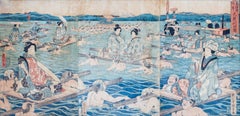
'Moss Beach, Monterey, California', Pacific Coastal Landscape, ASL NYC, Benezit
By Elmer Wachtel
Located in Santa Cruz, CA
An early-20th-century, landscape showing a view of the coastline at Moss Beach in Monterey County with slate-blue skies overhead and a view towards a stand of windswept Monterey Cypress with a view of the cobalt blue ocean beyond. A particularly fresh and bright example, kept until recently in a portfolio. Monogrammed lower right, "EW", dated "X-mas 1909", signed verso, "Elmer Wachtel", and inscribed lower left, "Moss Beach, Monterey County, California". A prominent California landscape painter of the late 19th and early 20th-century, Elmer Wachtel specialized in panoramic coastal scenes and desert and mountain landscapes using impressionist brushstrokes. His early works were tonalist in mood, and his later paintings were more decorative and light hearted. Elmer Wachtel was an American artist who holds a high place in the early California school of Impressionism. He was born in Baltimore, Maryland on January 21, 1864 -- he received his artistic training at the Art Students' League of New York under William Merritt Chase, and the Art School in London 1901-02. While in California he resided and maintained studios in Los Angeles and Pasadena. In 1904 Elmer Wachtel married the artist Marion Kavanaugh (1876-1954) in Chicago. Husband and wife were frequently seen painting the Southern California landscape -- they were known to have traveled by horseback over the San Marcos Pass to the Santa Inez Valley -- they traversed and painted the coastline between Gaviota and Conception Lighthouse (just north of Santa Barbara, California), the Cooper Ranch (north of Santa Barbara), Matilija Canyon and Ojai, California. Venturing south the couple made it to the San Luis Rey River (near present day Oceanside) and the Cerisa Loma Ranch (near San Diego). In 1908 they trekked to the arid deserts of Arizona and New Mexico painting...
Category

American Impressionist Early 1900s Art
Materials

Paper, Watercolor, Gouache

Antique Art Nouveau Female Carrara Marble Gilt Bronze Bust Statue Sculpture 1900
Located in Portland, OR
A very beautiful antique Art Nouveau bronzed Carrara marble sculpture bust of a young maiden circa 1900, by Gustave Van Vaerenbergh (1871-1927). The sculpture portrays a beautiful young maiden made from Cararra marble, she is wearing a laurel wreath in her hair. She wears a bronzed bodice with leaf decoration in relief and is raised on a varigated grey & white socle base. The sculpture is signed to the rear " G. V. Vaerenbergh" and numbered "1173", the bust is in excellent condition. Gustave Van Vaerenbergh attended classes at the Academy of Fine Arts in Ghent, Belgium from 1888 to 1890. Like many artists from a modest background (he was the son of a shoemaker) , Gustave Van Vaerenbergh went to work in companies where he could use his artistic talent and education for commercial purposes. In 1901 he moved to Saint-Josse-ten-Noode , and a year later to Schaerbeek where he would live for the rest of his life. He went to work there as a " mouleur en plâtre " (modeller or maker of matrices for plaster statues) at the company A. Carli Frères in the L'Olivierstraat in Schaerbeek, a company that produced commercial statues. This successful company, which was active from the beginning to the middle of the twentieth century , initially had about 20 employees and at its peak about 100 employees. The statues were distributed worldwide. Antonio Carli, a sculptor, was the founder of the Atelier A. Carli Frères, together with family members. They came from Bagni di Lucca...
Category

Art Nouveau Early 1900s Art

Materials

Marble

'Young Girl Sewing' Paris, Universal Exposition, Danish Oil, Pont Aven, Brittany
Located in Santa Cruz, CA
Signed lower right, 'Find' for Ludvig Find (Danish, 1869-1945) and painted circa 1900. Ludvig Find first attended Copenhagen's School of Fine Arts and Kroyer's school (1888) before ...
Category

Impressionist Early 1900s Art

Materials

Oil, Board

Omegas Død (Omega's Death) /// Edvard Munch Alpha and Omega Expressionist Litho
Located in Saint Augustine, FL
Artist: Edvard Munch (Norwegian, 1863-1944) Title: "Omegas Død (Omega's Death)" Portfolio: Alfa og Omega (Alpha and Omega) *Signed by Munch in pencil lower right Year: 1908-1909 Medi...
Category

Expressionist Early 1900s Art

Materials

Lithograph

Circa 1900 Art Nouveau advertising poster for Fumar el papel JOB
Located in PARIS, FR
This circa 1900 Art Nouveau advertising poster, designed by Peruvian-born artist Daniel Hernández, is a stunning example of early 20th-century luxury brand marketing. Created for JOB cigarette rolling papers, the advertisement reflects the era’s elegant aesthetics and sophisticated lifestyle appeal. The slogan, "Fumar el papel JOB o dejar de fumar" ("Smoke JOB paper or stop smoking"), emphasizes the brand’s prestige and superior quality, making it seem indispensable for tobacco connoisseurs. The artwork features a sensual and dreamlike composition, characteristic of the Belle Époque. A radiant red-haired woman, partially draped in sheer fabric, lounges in a relaxed pose, smiling seductively as she delicately holds a lit cigarette. The soft pastels, golden hues, and fluid lines create a warm, ethereal atmosphere, reinforcing the romantic and luxurious associations of the JOB brand. The swirling wisps of smoke, artistically integrated into the design, echo the organic, flowing forms typical of Art Nouveau illustration. The ornate green decorative border further enhances the visual richness, framing the central figure like a jewel in an exquisite setting. At the turn of the century, tobacco advertising was at its peak, and brands relied on opulent, aspirational imagery to captivate consumers. JOB, a French rolling paper company founded in the 1830s, became known for collaborating with renowned artists to create highly collectible posters. This particular piece, executed with remarkable softness and luminosity, reflects Hernández’s mastery of portraiture and classical technique, which he refined during his studies in Europe. His ability to capture the sensuality and grace of the female form made him a sought-after artist for both fine art and commercial illustration. Beyond its commercial function, this poster is an important example of the fusion between fine art and advertising, a defining feature of Art Nouveau poster design. It demonstrates how companies in the early 20th century elevated advertising into an art form, commissioning celebrated painters to craft exquisite promotional imagery. Today, original JOB posters...
Category

Early 1900s Art

Materials

Paper, Lithograph

WINDMILL AND WORKERS (Large Pastel)
Located in Santa Monica, CA
B.J.O. NORDFELDT (Swedish/American 1878 – 1955) (WINDMILL AND WORKERS). c.1900. Color pastel on colored paper, unsigned. 22 ¼ x 15”. Sheet: 24 ½ x 18 ¼”. In 1900 Nordfeldt studied ...
Category

Modern Early 1900s Art

Materials

Pastel

Saint Malo - Post Impressionist Seascape Watercolor by Maurice Prendergast
Located in Marlow, Buckinghamshire
Signed watercolour on paper landscape by American post impressionist painter Maurice Brazil Prendergast. The work depicts children playing on the beach in Saint Malo, France as boats sail in the blue sea and white clouds role through the sky overhead. This work has remained in the Prendergast family for 3 generations and depicts a rare view of Saint-Malo executed during Prendergast's visit to the french coastal town in 1907 Signature: Signed lower left Dimensions: Framed: 21"x22" Unframed: 13'x14" Proveance: The collection of Charles Prendergast (1863-1948) The collection of Eugénie Prendergast-Van Kemmel (1895-1994) -wife and inheritor of the estate of Charles Prendergast The collection of Henri Van Kemmel (Lille, 1903-1963) - cousin of Eugenie Prendergast
- Madame Henri Van Kemmel Maurice Prendergast came with his family to Boston in 1861. Working in a textile store, Maurice Prendergast was at first self-taught in painting, making souvenir cards and shop signs. He went to Britain in 1886, then to Paris in 1891 and registered at the Académie Julian with Jean-Paul Laurens, Benjamin-Constant, and Charles Blanc as teachers, working also with Gustave Courtois at the Académie Colarossi. More importantly he saw the Impressionists’ paintings and the Nabis at the Galerie Durand-Ruel. He returned to the United States in 1895, settling in Winchester (Massachusetts) and went frequently to New York. In 1898 he again went to Europe where he stayed until 1900, visiting Paris, Florence, Siena, Rome, Capri, and Venice, where he spent six months. Between 1907 and the beginning of World War I he went again four times to Europe but never returned there after the war. In New York where he finally settled, with William Glackens, Robert Henri, and John Sloan among others, Prendergast was one of the members ofThe Eight, gathered by Robert Henri to counter the pervading academicism. The group exhibited in 1908 at the Macbeth Galleries and took part in the Armory Show of 1913. After that Prendergast did not exhibit again with the group. In 1914 he left Boston definitively for New York. Prendergast was in his thirties before he began to devote himself to painting. In his late beginnings he painted in the open air as the Impressionists did, mainly in watercolours with clear brushstrokes and an elegant virtuosity recalling his then admiration for James Whistler and Claude Monet. Between 1892 and 1905 he carried out two hundred monotypes, a technique of which he was the undisputed master in America at that time and which expressed the influence of Japanisme. During his stays in France he painted views of Paris, but also Brittany and Normandy. In this period, in 1896, he was chosen to illustrate My Lady Nicotine by Matthew Barrie. During his third stay in Europe, from 1898 to 1900, he painted in Paris, at Saint-Malo, and mainly in Venice, where, influenced by Vittore Carpaccio he introduced brightly coloured banners into his animated compositions. In oils he painted slowly, touching up his paintings by superimposed brushstrokes, sometimes over several years. He chose to use the divided stroke in an early period, a technique which had similarities with Post-Impressionism. After his travels in Europe and his discovery of Paul Cézanne, he evolved in the direction of the neo-Impressionism of Georges Seurat, placing little dots of colours with a knife, then of the Nabis and even later Fauvism, painting large brushed surfaces in bright colours. After 1899, his Ponte della Paglia in Venice freed itself from strict divisionism, adopting the dense composition in vertically superimposed planes of the Nabis. Like the members of the group of eight, he took his subjects from the daily life of ordinary people, in scenes in the parks or on the beaches of New England, picnics or sometimes circuses. Nevertheless the happy vision that he had of the world separated him strongly from the evolution that led his companions to paint the most miserable and populous milieus, which gave them the name of The Ashcan School. His compositions are arranged in surfaces superimposed vertically, without depth; while the Impressionists and Post-Impressionists were influenced by the layout of Japanese prints, Prendergast was inspired more by Persian miniatures. The decorative elements and the build-up of characters in crowds are placed frontally, like garlands on a tapestry, particularly as he seeks a texture effect, covered entirely by the subject without any empty spaces. His attraction to colours caused him to research all the motifs that he introduced into these compositions: umbrellas, parasols, balloons, draperies. In 1911–1912, he experimented with pastel and treated new subjects, nudes and still-lifes. After 1913, in sympathy with the Symbolists, he put nude figures and everyday characters side by side in the same composition. In his last years, and above all in the watercolours, he discarded the divided stroke and applied larger brushstrokes, similar to the technique of Henri Matisse. Fidelity to the leisurely settings and elegant grooming of the period gave his works, apart from their artistic value, a charming sociological aspect. Singular, almost marginal in his time, his paintings stand out by the density of their composition, in form and colouring, characterised by the accumulation of detail, minutiae of scenery, the serried ranks of people that animate them, the chromatic polyphony of elegance, umbrellas, parasols, and flags. He is a complete painter, particularly generous, who would never be happy to provide only samples of his art. Following Whistler and Mary Cassatt, Maurice Prendergast is one of the most interesting and original Post-Impressionist American painters, and perhaps marks exactly the boundary between the 19th and the 20th centuries. He was considered to be an ‘old master’ from 1920 on, and his works appeared in very many exhibitions of modern American painting. He had his first solo exhibition in 1897 at the Chase Gallery of Boston, where his works were noticed by Madame Montgomery Sears, who made a collection, taking the advice of Mary Cassatt. In 1915 six paintings and watercolours exhibited at the Carroll Gallery of New York established his success and drew the great collectors to him, among whom were Albert Barnes and John Quinn. Group Exhibitions 1974, Ten Americans, Andrew Crispo Gallery, New York 1976, Art of Impulse and Color, University of Maryland Art Gallery, College Park (Maryland) 1982, American Impressionists, Smithsonian Institution, Washington, DC (also presented at the Musée du Petit Palais, Paris) 1999, Town and Country: American Artists, 1870–1920 (Ville et campagne: les artistes américains, 1870–1920), Musée d’Art Américain, Giverny 2002, Japonisme in America: Works on Paper, 1880–1930 (Le Japonisme en Amérique: œuvres sur papier, 1880–1930), Musée d’Art Américain/Terra Foundation for the Arts, Giverny 2007, American Impressionists: Painters of Light and the Modern Landscape, Phillips Collection, Washington, DC 2008, Coming of Age: American Art 1850–1950, Paintings from the Addison Gallery of American Art, Massachusetts, Dulwich Picture Gallery, London 2008, Portrait of a Lady: Paintings and Photographs of American Women in France 1870–1915, Musée des Beaux-Arts, Bordeaux Solo Exhibitions 1934, Maurice Prendergast Memorial Exhibition, Whitney Museum of American Art, New York 1938, Retrospective Exhibition of the Work of Maurice and Charles Prendergast, Addison Gallery of American Art, Andover, MA 1960, Maurice Prendergast, 1859–1924, Museum of Fine Arts, Boston 1990, Art Institute of Chicago 2009, Prendergast in Italy, Peggy Guggenheim Collection, Venice Museum and Gallery Holdings Andover, MA (Addison Gal. of American Art): At the Shore, St. Malo No. 1 and 2 (c. 1907, watercolour and graphite on wove paper, 2 works); Along the Cove (1910–1913, oil on canvas); seven sketches of Paris (1893, oil on wood) Chicago (AI): In the Park (1918–1919) Chicago (Terra Foundation for American Art Collection): Festa del redentore (c. 1899, monotype); The Opera Cloak...
Category

Post-Impressionist Early 1900s Art

Materials

Paper, Watercolor

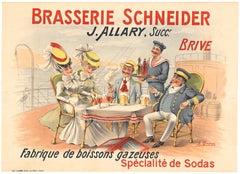
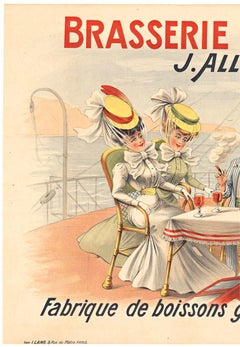
Original "Brasserie Schneider" vintage French poster art nouveau
Located in Spokane, WA
Original “Brasserie Schneider” horizontal vintage poster. Professional archival linen backed in very good to excellent condition. Art no...
Category

Art Nouveau Early 1900s Art

Materials

Lithograph

"At the Annual Fair", an early 20th Century oil on canvas by Alberto Plá Rubio
Located in Madrid, ES
ALBERTO PLA Y RUBIO Spanish, 1867 - 1937 AT THE ANNUAL FAIR signed & dated "Pla Rubio, 909" (lower right) oil on canvas 14 X 25-5/8 inches (35.5 X 65 cm.) ...
Category

Post-Impressionist Early 1900s Art

Materials

Canvas, Oil

OLD CHINATOWN - SAN FRANCISCO
Located in Santa Monica, CA
CHILDE HASSAM (1859 – 1935) OLD CHINATOWN - SAN FRANCISCO 1904 (Cortissoz 95 i/iii?) Etching, 5 ¼ “ x 5”. Signed and dated in the plate and with his cypher in pencil. An early state before additional work as in the example at Cornell University. Very Scarce print. On old ledger paper. Sheet 9 5/8” x 7”. Pre San Francisco earthquake. Based on a rare photograph by Arnold Genthe...
Category

American Impressionist Early 1900s Art
Materials

Etching

original lithograph
Located in Henderson, NV
Medium: original lithograph. Printed in Paris in 1902 for the special Felix Vallotton issue of L'Assiette au Beurre on the theme of Crimes et Chatiments (Crime and Punnishment). Size...
Category

Early 1900s Art

Materials

Lithograph

Rosella, Romantic Portrait circa 1900 by Francesco Paolo Michetti
By Francesco Paolo Michetti
Located in Long Island City, NY
Artist: Francesco Paolo Michetti, Italian (1851 - 1929) Title: Rosella Year: circa 1900 Medium: Oil on Canvas, Signed Size: 30 x 20 inches [76.2 x 50.8 cm] Framed: 40 x 30 inches [10...
Category

Impressionist Early 1900s Art

Materials

Canvas, Oil

Late 19th Century Landscape - "After The Snow"
Located in Soquel, CA
Gorgeous late 19th-century snowscape titled "After the Snow," by artist Constantin Alexandrovitch Westchiloff (1877-1945) Signed on the bottom right corner and titled on edge (the color differences in the signature letters are original to the painting prior to cleaning, and have not been modified or augmented). Unframed. Image size: 14.25"H x 20.25"W Westchiloff is an American-Russian artist. He was born in Russia in 1877, and studied at the Academy of Fine Arts in St. Petersburg; as an artist, he traveled extensively in Europe and in the USA. He finally settled in New England, where he died in 1945. He is probably best-known for seascapes (particularly of the New England coastline) but was also well regarded for his landscapes, portraits and figures, and genre subjects. His work, especially after his travels in Europe and then in America, is closest to Impressionist in style. His favored medium was oil, which was well suited to his confident and strong technique. This, in turn, imbued his paintings of the rugged landscapes and seascapes of New England...
Category

American Impressionist Early 1900s Art
Materials

Oil, Canvas

L’entrée d’un village animé de paysans en Artois
By Leon Lhermitte
Located in PARIS, FR
1905 Pastel on paper mounted on canvas Signed lower left “L. Lhermitte”
Category

Realist Early 1900s Art

Materials

Paper, Pastel

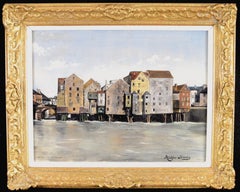
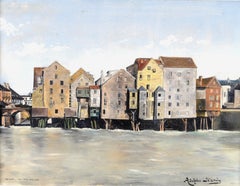
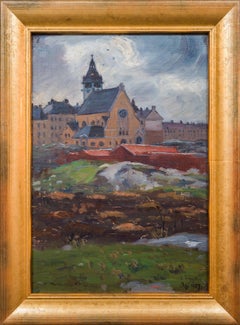
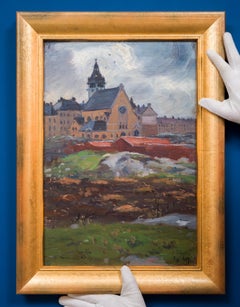
Canal Scene, Possibly Paris. Painted Early 1900s
Located in Stockholm, SE
For sale is a captivating painting by the Swedish artist, Rikard Lindström (1882-1943). Depicting a picturesque water canal, with charming houses lini...
Category

Post-Impressionist Early 1900s Art

Materials

Oil, Laid Paper

Vase "Marquetry with Water lilies"
Located in PARIS, FR
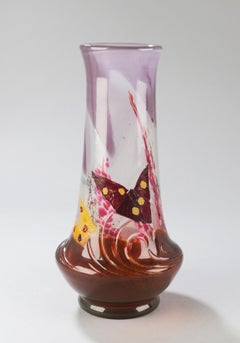
Vase "Marquetry with Water lilies" by Emile GALLE (1846-1904) A rounded vase with a narrow neck, Multi-layered blown-molded glass, An inlaid decor of Water lilies, then finely work...
Category

Art Nouveau Early 1900s Art

Materials

Blown Glass

Two Men - Drawing by Gabriele Galantara - 1909
Located in Roma, IT
Two men is a modern artwork realized by Gabriele Galantara (1865-1937) in 1909. Watercolor, ink, tempera and pencil on paper. Good conditions and aged with foxing. Gabriele Galant...
Category

Modern Early 1900s Art

Materials

Ink, Tempera, Watercolor, Pencil

"Concarneau's old market" by Georges Riom - Oil on canvas 55x38 cm
Located in Geneva, CH
Work on canvas sold with frame Total size with frame 59x74 cm Georges RIOM is a French artist born in 1877 and died in 1969. The net lists 7 works by the artist presented for sale ...
Category

Impressionist Early 1900s Art
Materials

Oil

"Composition with Blue Gentians and Chrysanthemums" Jean Fournet (French 1878-?)
Located in SANTA FE, NM
"Composition with Blue Gentians and Chrysanthemums" Jean Fournet (French 1878-?) Oil on canvas on wood panel 13 1/2 x 11 1/2 frame size Signed front and back While little is known ...
Category

Art Nouveau Early 1900s Art

Materials

Wood, Oil

Alphonse Mucha's 1902 Documents décoratifs - Planche 57 - Art et décoration
Located in PARIS, FR
Alphonse Mucha's name shines like that of a visionary artist who left an indelible mark on the aesthetics of the early 20th century. The year 1902 saw the publication of "Documents d...
Category

Art Nouveau Early 1900s Art

Materials

Paper, Lithograph

Nude Study (Nude) Etude de nu (Nu) - Cubism Nude
Located in London, GB
This original etching is hand signed in pencil by the artist "G Braque" at the lower right margin. It is also hand numbered in pencil from the edition of 25, at the lower left margin...
Category

Cubist Early 1900s Art
Materials

Etching

H.O. Miethke Das Werk folio "Sunflower" collotype print
Located in Palm Beach, FL
Sunflower, no. 10 from the third installment of Das Werk Gustav Klimts Created during his residency in Litzlberg on Attersee, where Klimt and the Floge family summered from 1900-1907, Klimt explores nature’s transcendental qualities. His single sunflower is human-like, it’s golden halo is like a ring of sun-kissed hair surrounding a bald pate. It’s known that at the same time Klimt was creating this image, he was also at work on a photo essay about the Floge sisters’ clothing from their fashion salon. Their fashion house was best known for its “reform dresses” which featured loose-fitting long robes which billowed at the arms and torso. Viewed with this in mind, it is not a hard leap to imagine the lone sunflower as a self-portrait from reverse. Klimt’s balding head crowned in a golden corona forms the apex of a pyramidal flowing gown of foliage and flowers. By orienting the anthropomorphic flower at the garden’s central foreground and adorning it with repetitive motifs of round flowers of varying sizes, Klimt’s sunflower...
Category

Vienna Secession Early 1900s Art

Materials

Paper

The Evening of Life - Interior Portrait - British 1906 Newlyn Sch oil painting
Located in Hagley, England
This stunning, large British Edwardian Newlyn School interior portrait oil painting is by much noted and exhibited artist Walter Langley. Originally from Birmingham, Langley and his family moved to St Ives in 1881. He was one of the first artists to settle and painted the local fishermen and their families. Painted in 1906 and entitled The Evening of Life, the painting is a full length seated portrait of an elderly lady in a cottage interior. She is sat by a table on which she has a bible, jug of flowers and her sewing equipment. Across her lap she has a large patchwork quilt to mend but is lost in thought. In fact the same sitter and quilt can be seen in Memories, also painted in 1906 and in the Ferens Art Gallery, Hull. Memories includes more of the cottage interior but the sitter's head is bowed towards her hands. The Evening of Life is more vibrant and the sitters face is much more visible as are the lovely colours of the quilt. The painting has fantastic detail, great brushwork and the Newlyn school palette of colours. The provenance is excellent, having been kept in the same family ownership so fresh to market. The painting appeared in the artist's catalogue Raisonne and was also in 1997 biography by Langely's grandson, Roger Langley, entitled Walter Langley: Pioneer of the Newlyn Art Colony. This a superb example of Langley's work, a good size and composition and a pleasure to gaze upon. Signed lower left and dated (19)06. Provenance. : Ford, 1906 (£63). Long in the previous family ownership and sold by the executors of the estate. Thomas Wood and Sons label verso. Literature: Langley (R) - Walter Langley Pioneer of the Newlyn Art Colony 1997, catalogue raisonne p.170 (under 1906). Condition. Oil on canvas, 40 inches by 30 inches unframed, in good condition and unlined canvas. Frame. Housed in a gilt frame 47 inches by 37 inches and in good condition. Walter Langley (8 June 1852 – 21 March 1922) was an English painter and founder of the Newlyn School of plein air artists. He was born in Birmingham and his father was a journeyman tailor. At 15 he was apprenticed to a lithographer. At 21 he won a scholarship to South Kensington and he studied designing there for two years. The sometimes highly ornate work is mainly in gold and silver and in a Renaissance style. He returned to Birmingham but took up painting full-time, and in 1881 was elected an Associate of the Royal Birmingham Society of Artists. In the same year he was offered £500 for a year's work by a Mr Thrupp (a Birmingham photographer). With this money he and his family moved to Newlyn where he was one of the first artists to settle and began recording the life of the fishing community. Politically left wing for his era, he was noted for his social realist portrayals of working class figures, particularly fishermen and their families. He was a supporter of Charles Bradlaugh, a radical socialist politician. His own working-class background enabled him to identify with the villagers and the hardships they endured, many of his paintings reflect this sympathy with the working-class fisher-folk amongst whom he lived. One of the best known works is the watercolour For Men Must Work and Women Must Weep (1883; Birmingham Museum and Art Gallery) based on Charles Kingsley's poem The Three Fishers (1851). Another is Between The Tides (1901; Warrington Museum & Art Gallery). Although one of the first to settle in the Newlyn artists' colony Newlyn School, Langley initially benefited little from its growing fame, partly because of his working-class origins and partly because until 1892 he painted largely in watercolour rather than the more prestigious medium of oils. His early training in lithography gives his paintings a detail and texture that show his technical skills. In 1884, Langley was elected a member of the RBSA and continued to exhibit widely throughout the UK and abroad. Later in his career his reputation grew. One of Langley's paintings was singled out as "a beautiful and true work of art" by Leo Tolstoy in his book What is Art?, while in 1895 Langley was invited by the Uffizi to contribute a self-portrait to hang alongside those of Raphael, Rubens and Rembrandt in their collection of portraits of great artists. Today his work is considered "vital to the image of the Newlyn School" and "alongside Stanhope Forbes ... the most consistent in style and substantial in output". Exhibited: Royal Society of Artist Birmingham 57, Dudley Gallery 4, Dowdeswell Gallery 17...
Category

Realist Early 1900s Art
Materials

Oil

Still Thinking About These?
All Recently Viewed