Edward Willis Redfield Art

to
1
2
Overall Width
to
Overall Height
to
1
2
2
3
3
3
1
1
3
3
3
3
3
11,259
2,855
2,494
1,458
3
3
Artist: Edward Willis Redfield
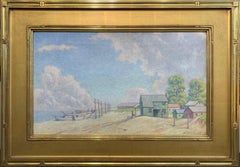
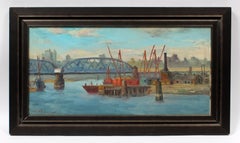
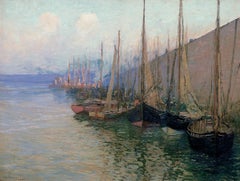
"In Port"
"In Port"

"In Port"

By Edward Willis Redfield

Located in Lambertville, NJ

Jim’s of Lambertville is proud to offer this artwork by: Edward Willis Redfield (1869 - 1965) Edward W. Redfield was born in Bridgeville, Delaware, moving to Philadelphia as a young child. Determined to be an artist from an early age, he studied at the Spring Garden Institute and the Franklin Institute before entering the Pennsylvania Academy from 1887 to 1889, where he studied under Thomas Anshutz, James Kelly, and Thomas Hovenden. Along with his friend and fellow artist, Robert Henri, he traveled abroad in 1889 and studied at the Academie Julian in Paris under William Bouguereau and Tony Robert-Fleury. While in France, Redfield met Elise Deligant, the daughter of an innkeeper, and married in London in 1893. Upon his return to the United States, Redfield and his wife settled in Glenside, Pennsylvania. He remained there until 1898, at which time he moved his family to Center Bridge, a town several miles north of New Hope along the Delaware River. Redfield painted prolifically in the 1890s but it was not until the beginning of the twentieth century that he would develop the bold impressionist style that defined his career. As Redfield’s international reputation spread, many young artists gravitated to New Hope as he was a great inspiration and an iconic role model. Edward Redfield remained in Center Bridge throughout his long life, fathering his six children there. Around 1905 and 1906, Redfield’s style was coming into its own, employing thick vigorous brush strokes tightly woven and layered with a multitude of colors. These large plein-air canvases define the essence of Pennsylvania Impressionism. By 1907, Redfield had perfected his craft and, from this point forward, was creating some of his finest work. Redfield would once again return to France where he painted a small but important body of work between 1907 and 1908. While there, he received an Honorable Mention from the Paris Salon for one of these canvases. In 1910 he was awarded a Gold Medal at the prestigious Buenos Aires Exposition and at the Panama-Pacific Exposition of 1915 in San Francisco, an entire gallery was dedicated for twenty-one of his paintings. Since Redfield painted for Exhibition with the intent to win medals, his best effort often went into his larger paintings. Although he also painted many fine smaller pictures, virtually all of his works were of major award-winning canvas sizes of 38x50 or 50x56 inches. If one were to assign a period of Redfield’s work that was representative of his “best period”, it would have to be from 1907 to 1925. Although he was capable of creating masterpieces though the late 1940s, his style fully matured by 1907 and most work from then through the early twenties was of consistently high quality. In the later 1920s and through the 1930s and 1940s, he was like most other great artists, creating some paintings that were superb examples and others that were of more ordinary quality. Redfield earned an international reputation at a young age, known for accurately recording nature with his canvases and painting virtually all of his work outdoors; Redfield was one of a rare breed. He was regarded as the pioneer of impressionist winter landscape painting in America, having few if any equals. Redfield spent summers in Maine, first at Boothbay Harbor and beginning in the 1920s, on Monhegan Island. There he painted colorful marine and coastal scenes as well as the island’s landscape and fishing shacks. He remained active painting and making Windsor style furniture...

Category

Early 1900s American Impressionist Edward Willis Redfield Art

Materials

Canvas, Oil
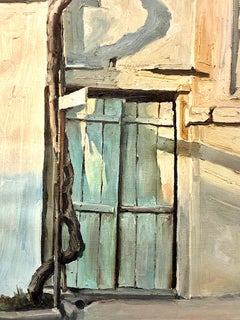
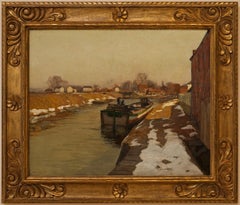
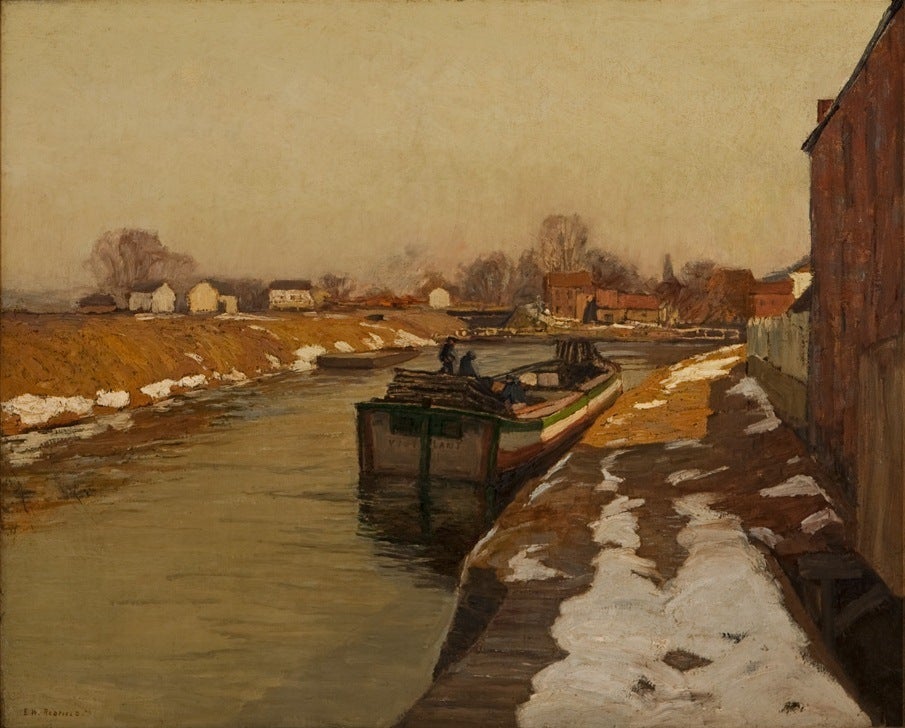
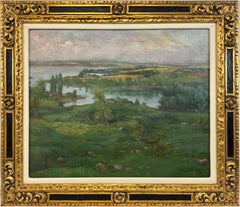
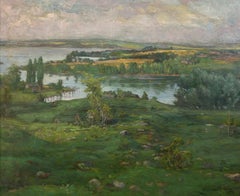
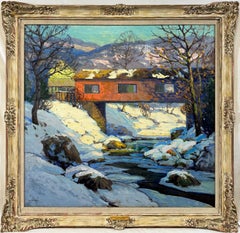
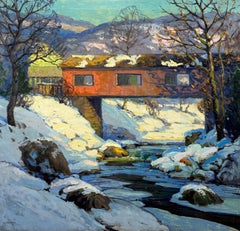
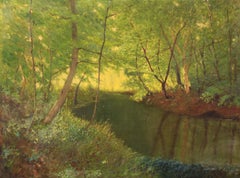
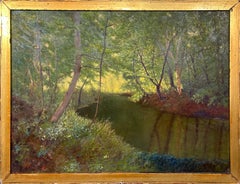
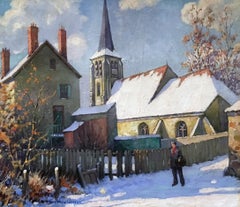
"The Canal"
"The Canal"

"The Canal"

By Edward Willis Redfield

Located in Lambertville, NJ

Jim’s of Lambertville is proud to offer this artwork. Signed lower left. Complemented by a hand carved and gilt frame. Illustrated in "Edward Redfield: Just Values and Fine Seeing" by Constance Kimmerle and the Pennsylvania Academy of the Fine Arts's Exhibition of Paintings by Edward Redfield (April 17 to May 16, 1909) brochure Edward Willis Redfield (1869 - 1965) Edward W. Redfield was born in Bridgeville, Delaware, moving to Philadelphia as a young child. Determined to be an artist from an early age, he studied at the Spring Garden Institute and the Franklin Institute before entering the Pennsylvania Academy from 1887 to 1889, where he studied under Thomas Anshutz, James Kelly, and Thomas Hovenden. Along with his friend and fellow artist, Robert Henri, he traveled abroad in 1889 and studied at the Academie Julian in Paris under William Bouguereau and Tony Robert-Fleury. While in France, Redfield met Elise Deligant, the daughter of an innkeeper, and married in London in 1893. Upon his return to the United States, Redfield and his wife settled in Glenside, Pennsylvania. He remained there until 1898, at which time he moved his family to Center Bridge, a town several miles north of New Hope along the Delaware River. Redfield painted prolifically in the 1890s but it was not until the beginning of the twentieth century that he would develop the bold impressionist style that defined his career. As Redfield’s international reputation spread, many young artists gravitated to New Hope as he was a great inspiration and an iconic role model. Edward Redfield remained in Center Bridge throughout his long life, fathering his six children there. Around 1905 and 1906, Redfield’s style was coming into its own, employing thick vigorous brush strokes tightly woven and layered with a multitude of colors. These large plein-air canvases define the essence of Pennsylvania Impressionism. By 1907, Redfield had perfected his craft and, from this point forward, was creating some of his finest work. Redfield would once again return to France where he painted a small but important body of work between 1907 and 1908. While there, he received an Honorable Mention from the Paris Salon for one of these canvases. In 1910 he was awarded a Gold Medal at the prestigious Buenos Aires Exposition and at the Panama-Pacific Exposition of 1915 in San Francisco, an entire gallery was dedicated for twenty-one of his paintings. Since Redfield painted for Exhibition with the intent to win medals, his best effort often went into his larger paintings. Although he also painted many fine smaller pictures, virtually all of his works were of major award-winning canvas sizes of 38x50 or 50x56 inches. If one were to assign a period of Redfield’s work that was representative of his “best period”, it would have to be from 1907 to 1925. Although he was capable of creating masterpieces though the late 1940s, his style fully matured by 1907 and most work from then through the early twenties was of consistently high quality. In the later 1920s and through the 1930s and 1940s, he was like most other great artists, creating some paintings that were superb examples and others that were of more ordinary quality. Redfield earned an international reputation at a young age, known for accurately recording nature with his canvases and painting virtually all of his work outdoors; Redfield was one of a rare breed. He was regarded as the pioneer of impressionist winter landscape painting in America, having few if any equals. Redfield spent summers in Maine, first at Boothbay Harbor and beginning in the 1920s, on Monhegan Island. There he painted colorful marine and coastal scenes as well as the island’s landscape and fishing shacks. He remained active painting and making Windsor style furniture...

Category

Early 1900s American Impressionist Edward Willis Redfield Art

Materials

Canvas, Oil
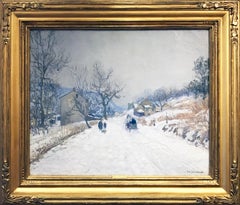
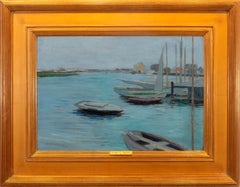
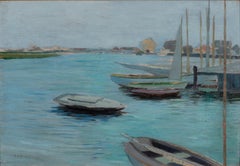
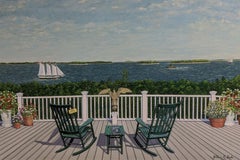
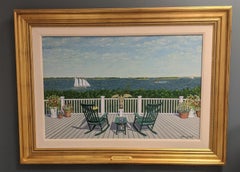
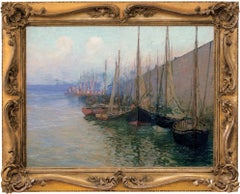
"Sail Boats in Harbor"

"Sail Boats in Harbor"

By Edward Willis Redfield

Located in Lambertville, NJ

Jim’s of Lambertville is proud to offer this artwork by: Edward Willis Redfield (1869 - 1965) Edward W. Redfield was born in Bridgeville, Delaware, moving to Philadelphia as a youn...

Category

1890s American Impressionist Edward Willis Redfield Art

Materials

Canvas, Oil
Related Items
"Soft Yellow Sunset" contemporary impressionist oil painting, abstract seascape

"Soft Yellow Sunset" contemporary impressionist oil painting, abstract seascape

By Ben Fenske

Located in Sag Harbor, NY

"Soft Yellow Sunset" is a contemporary impressionist oil painting of the sun setting over Noyack Bay in Sag Harbor, New York. Fenske works in a loose-im...

Category

2010s American Impressionist Edward Willis Redfield Art

Materials

Linen, Oil, Canvas

Devon Farm
Devon Farm

Walter Elmer SchofieldDevon Farm

$125,000

H 40 in W 48 in

Devon Farm

By Walter Elmer Schofield

Located in Bryn Mawr, PA

Devon Farm Oil on canvas, 40 x 48 inches (101.6 x 121.9 cm) Framed dimensions 52 1/2 x 44 3/4 inches Signed lower right: Schofield Provenance Private collection, New York, until 202...

Category

Early 20th Century American Impressionist Edward Willis Redfield Art

Materials

Canvas, Oil
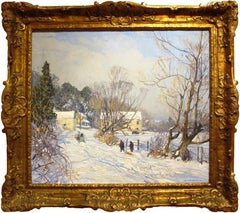
Landscape with a Cart Path

Landscape with a Cart Path

By Theodore Victor Carl Valenkamph

Located in Milford, NH

A fine New England landscape with a cart path and birch tree by Swedish-American artist Theodore Victor Carl Valenkamph (1868-1924). Valenkamph was born in Stockholm, Sweden, and emi...

Category

Early 1900s American Impressionist Edward Willis Redfield Art

Materials

Canvas, Oil
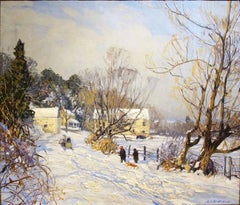
Mount Helix, California, Mountain, Town, Western Landscape

Mount Helix, California, Mountain, Town, Western Landscape

By Guy Gaylor Clark

Located in Wiscasset, ME

Born in Brooklyn, New York in 1882, artist Guy Gaylor Clark was trained as a painter under Francis Luis Mora, George Bellows, William Merritt Chase, Frank Vincent DuMond and Robert H...

Category

20th Century American Impressionist Edward Willis Redfield Art

Materials

Canvas, Oil, Board

"Windy Day" Dennis Sheehan, Atmospheric, Tonalist Forest Stream, Green Sky

"Windy Day" Dennis Sheehan, Atmospheric, Tonalist Forest Stream, Green Sky

By Dennis Sheehan

Located in New York, NY

Dennis Sheehan Windy Day, circa 2025 Signed lower right Oil on canvas 20 x 24 inches Dennis Sheehan was born in Boston in 1950. His work is based upon the Barbizon School with fait...

Category

2010s American Impressionist Edward Willis Redfield Art

Materials

Oil, Canvas

A New Season
A New Season

Richard HumphreyA New Season

$6,500

H 24.375 in W 28.375 in D 1.875 in

A New Season

By Richard Humphrey

Located in Pasadena, CA

Provenance Acquired by American Legacy Fine Arts directly from the artist Signed "R Humphrey" on lower left Artist Statement "A red bougainvillea marks a small memorial near the top of the trail. A warm spring breeze moves through the newly flowered grass." — Richard Humphrey...

Category

2010s American Impressionist Edward Willis Redfield Art

Materials

Oil, Canvas

"Peeking Light" Dennis Sheehan, Impressionist, Sunset Reflections in Stream

"Peeking Light" Dennis Sheehan, Impressionist, Sunset Reflections in Stream

By Dennis Sheehan

Located in New York, NY

Dennis Sheehan Peeking Light, circa 2025 Signed lower right Oil on canvas 12 x 16 inches Dennis Sheehan was born in Boston in 1950. His work is based upon the Barbizon School with ...

Category

2010s American Impressionist Edward Willis Redfield Art

Materials

Canvas, Oil
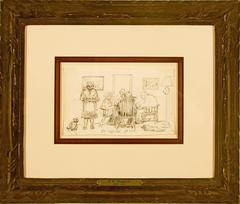
In the Park, American Impressionist, Mother and Child, Landscape, Figures, Oil
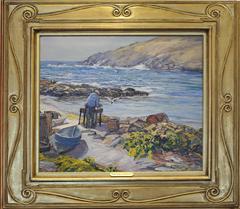
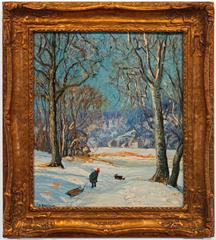
In the Park, American Impressionist, Mother and Child, Landscape, Figures, Oil
Located in Wiscasset, ME

Born in Philadelphia John Hamilton was known for portraits, figure paintings and illustrations. He studied at the Pennsylvania Academy of the Fine Arts with Christian Schuessel and Thomas Eakins and then traveled to Europe where he studied in Paris with Jean-Léon Gerome at the Ecole des Beaux-Arts and at the Royal Academy of Fine Arts in Antwerp. He lived abroad, mostly in London, for many years, although he maintained a Philadelphia address. He was the official painter to the English Prime Minister, William...

Category

Late 19th Century American Impressionist Edward Willis Redfield Art

Materials

Canvas, Oil
Farm in the Mist, Giverny

Theodore Earl ButlerFarm in the Mist, Giverny, 1891

$75,000

H 31.5 in W 35.5 in D 3.5 in

Farm in the Mist, Giverny

By Theodore Earl Butler

Located in Milford, NH

An exceptional impressionist landscape of a farm in the mist in Giverny, France by American artist Theodore Earl Butler (1891-1936). Butler was born in Co...

Category

1890s American Impressionist Edward Willis Redfield Art

Materials

Canvas, Oil
Chauncey Foster Ryder Impressionist Landscape Oil Painting with Trees

Chauncey Foster Ryder Impressionist Landscape Oil Painting with Trees

By Chauncey Foster Ryder

Located in Milford, NH

A fine New England impressionist landscape with trees in tones of brown by American artist Chauncey Foster Ryder (1868-1949). Ryder grew up in New Haven, Connecticut, studied in Chic...

Category

Early 20th Century American Impressionist Edward Willis Redfield Art

Materials

Canvas, Oil

Roadside Eucalyptus Trees, Mid Century Vertical Landscape by Jon Blanchette

Roadside Eucalyptus Trees, Mid Century Vertical Landscape by Jon Blanchette

By Jon Blanchette

Located in Soquel, CA

Roadside Eucalyptus Trees, Mid Century Vertical Landscape by Jon Blanchette Gorgeous mid-century plein air landscape painting of a tall Eucalyptus tree along a California road side...

Category

1960s American Impressionist Edward Willis Redfield Art

Materials

Canvas, Masonite, Oil

Calm Winds - Peaceful California Seascape

Calm Winds - Peaceful California Seascape

Located in Soquel, CA

Peaceful landscape of sand dunes along a California beach with seagulls drifting overhead in a soft gray-blue sky, by a California artist. Signed "Noland" lower right. Presented in a...

Category

Late 20th Century American Impressionist Edward Willis Redfield Art

Materials

Canvas, Oil

Previously Available Items
Road to New Hope
Road to New Hope

Road to New Hope

By Edward Willis Redfield

Located in Lambertville, NJ

Ashley John is proud to offer this artwork by: Edward Willis Redfield (1869 - 1965) Edward W. Redfield was born in Bridgeville, Delaware, moving to Philadelphia as a young child. D...

Category

20th Century American Impressionist Edward Willis Redfield Art

Materials

Canvas, Oil

"The Road to the Mill"

"The Road to the Mill"

By Edward Willis Redfield

Located in Lambertville, NJ

Signed lower right. Complemented by animi original period Newcomb Macklin frame. Edward Willis Redfield (1869 - 1965) Edward W. Redfield was born in Bridgeville, Delaware, moving...

Category

1920s American Impressionist Edward Willis Redfield Art

Materials

Canvas, Oil

"88 Club"

"88 Club"

By Edward Willis Redfield

Located in Lambertville, NJ

Signed and titled lower center. Complemented by a hand carved and gilt frame. Edward Willis Redfield (1869 - 1965) Edward W. Redfield was born in Bridgeville, Delaware, moving to Philadelphia as a young child. Determined to be an artist from an early age, he studied at the Spring Garden Institute and the Franklin Institute before entering the Pennsylvania Academy from 1887 to 1889, where he studied under Thomas Anshutz, James Kelly, and Thomas Hovenden. Along with his friend and fellow artist, Robert Henri, he traveled abroad in 1889 and studied at the Academie Julian in Paris under William Bouguereau and Tony Robert-Fleury. While in France, Redfield met Elise Deligant, the daughter of an innkeeper, and married in London in 1893. Upon his return to the United States, Redfield and his wife settled in Glenside, Pennsylvania. He remained there until 1898, at which time he moved his family to Center Bridge, a town several miles north of New Hope along the Delaware River. Redfield painted prolifically in the 1890s but it was not until the beginning of the twentieth century that he would develop the bold impressionist style that defined his career. As Redfield’s international reputation spread, many young artists gravitated to New Hope as he was a great inspiration and an iconic role model. Edward Redfield remained in Center Bridge throughout his long life, fathering his six children there. Around 1905 and 1906, Redfield’s style was coming into its own, employing thick vigorous brush strokes tightly woven and layered with a multitude of colors. These large plein-air canvases define the essence of Pennsylvania Impressionism. By 1907, Redfield had perfected his craft and, from this point forward, was creating some of his finest work. Redfield would once again return to France where he painted a small but important body of work between 1907 and 1908. While there, he received an Honorable Mention from the Paris Salon for one of these canvases. In 1910 he was awarded a Gold Medal at the prestigious Buenos Aires Exposition and at the Panama-Pacific Exposition of 1915 in San Francisco, an entire gallery was dedicated for twenty-one of his paintings. Since Redfield painted for Exhibition with the intent to win medals, his best effort often went into his larger paintings. Although he also painted many fine smaller pictures, virtually all of his works were of major award-winning canvas sizes of 38x50 or 50x56 inches. If one were to assign a period of Redfield’s work that was representative of his “best period”, it would have to be from 1907 to 1925. Although he was capable of creating masterpieces though the late 1940s, his style fully matured by 1907 and most work from then through the early twenties was of consistently high quality. In the later 1920s and through the 1930s and 1940s, he was like most other great artists, creating some paintings that were superb examples and others that were of more ordinary quality. Redfield earned an international reputation at a young age, known for accurately recording nature with his canvases and painting virtually all of his work outdoors; Redfield was one of a rare breed. He was regarded as the pioneer of impressionist winter landscape painting in America, having few if any equals. Redfield spent summers in Maine, first at Boothbay Harbor and beginning in the 1920s, on Monhegan Island. There he painted colorful marine and coastal scenes as well as the island’s landscape and fishing shacks. He remained active painting and making Windsor style furniture...

Category

1950s American Impressionist Edward Willis Redfield Art

Materials

Paper, Ink

"Fisherman Beach, Monhegan"

"Fisherman Beach, Monhegan"

By Edward Willis Redfield

Located in Lambertville, NJ

Signed and dated lower right. Complemented by a hand carved and gilt frame. Edward Willis Redfield (1869 - 1965) Edward W. Redfield was born in Bridgeville, Delaware, moving to Philadelphia as a young child. Determined to be an artist from an early age, he studied at the Spring Garden Institute and the Franklin Institute before entering the Pennsylvania Academy from 1887 to 1889, where he studied under Thomas Anshutz, James Kelly, and Thomas Hovenden. Along with his friend and fellow artist, Robert Henri, he traveled abroad in 1889 and studied at the Academie Julian in Paris under William Bouguereau and Tony Robert-Fleury. While in France, Redfield met Elise Deligant, the daughter of an innkeeper, and married in London in 1893. Upon his return to the United States, Redfield and his wife settled in Glenside, Pennsylvania. He remained there until 1898, at which time he moved his family to Center Bridge, a town several miles north of New Hope along the Delaware River. Redfield painted prolifically in the 1890s but it was not until the beginning of the twentieth century that he would develop the bold impressionist style that defined his career. As Redfield’s international reputation spread, many young artists gravitated to New Hope as he was a great inspiration and an iconic role model. Edward Redfield remained in Center Bridge throughout his long life, fathering his six children there. Around 1905 and 1906, Redfield’s style was coming into its own, employing thick vigorous brush strokes tightly woven and layered with a multitude of colors. These large plein-air canvases define the essence of Pennsylvania Impressionism. By 1907, Redfield had perfected his craft and, from this point forward, was creating some of his finest work. Redfield would once again return to France where he painted a small but important body of work between 1907 and 1908. While there, he received an Honorable Mention from the Paris Salon for one of these canvases. In 1910 he was awarded a Gold Medal at the prestigious Buenos Aires Exposition and at the Panama-Pacific Exposition of 1915 in San Francisco, an entire gallery was dedicated for twenty-one of his paintings. Since Redfield painted for Exhibition with the intent to win medals, his best effort often went into his larger paintings. Although he also painted many fine smaller pictures, virtually all of his works were of major award-winning canvas sizes of 38x50 or 50x56 inches. If one were to assign a period of Redfield’s work that was representative of his “best period”, it would have to be from 1907 to 1925. Although he was capable of creating masterpieces though the late 1940s, his style fully matured by 1907 and most work from then through the early twenties was of consistently high quality. In the later 1920s and through the 1930s and 1940s, he was like most other great artists, creating some paintings that were superb examples and others that were of more ordinary quality. Redfield earned an international reputation at a young age, known for accurately recording nature with his canvases and painting virtually all of his work outdoors; Redfield was one of a rare breed. He was regarded as the pioneer of impressionist winter landscape painting in America, having few if any equals. Redfield spent summers in Maine, first at Boothbay Harbor and beginning in the 1920s, on Monhegan Island. There he painted colorful marine and coastal scenes as well as the island’s landscape and fishing shacks. He remained active painting and making Windsor style furniture...

Category

1920s American Impressionist Edward Willis Redfield Art

Materials

Canvas, Oil

"Winter Sports"

"Winter Sports"

By Edward Willis Redfield

Located in Lambertville, NJ

Signed Lower Left Period Newcomb Macklin Frame Edward W. Redfield was born in Bridgeville, Delaware, moving to Philadelphia as a young child. Determined to be an artist from a...

Category

20th Century American Impressionist Edward Willis Redfield Art

Materials

Canvas, Oil

Lumberville

Lumberville

By Edward Willis Redfield

Located in Lambertville, NJ

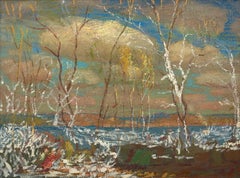
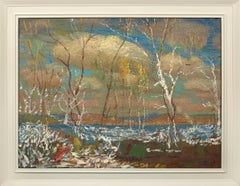
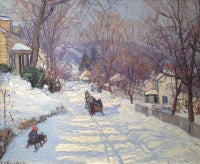
Winter village sleigh Landscape town snow

Category

20th Century Edward Willis Redfield Art

Materials

Oil, Canvas

Edward Willis Redfield art for sale on 1stDibs.

Find a wide variety of authentic Edward Willis Redfield art available for sale on 1stDibs. You can also browse by medium to find art by Edward Willis Redfield in canvas, fabric, oil paint and more. Much of the original work by this artist or collective was created during the early 1900s and is mostly associated with the Impressionist style. Not every interior allows for large Edward Willis Redfield art, so small editions measuring 37 inches across are available. Customers who are interested in this artist might also find the work of Edward Henry Potthast, Irving Ramsey Wiles, and Henry Bacon. Edward Willis Redfield art prices can differ depending upon medium, time period and other attributes. On 1stDibs, the price for these items starts at $61,875 and tops out at $781,250, while the average work can sell for $531,250.

Artists Similar to Edward Willis Redfield