Agathon Léonard Art

to
2
2
4
Overall Width
to
Overall Height
to
1
5
5
5
4
4
3
2
2
2
1
1
1
1
4
2

Use search to find more

9
12,131
2,900
2,541
1,667

Use search to find more

Artist: Agathon Léonard
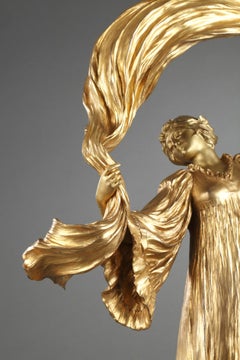
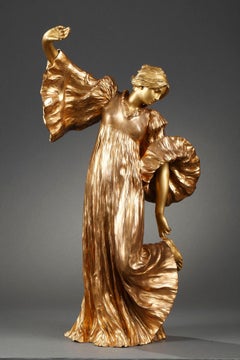
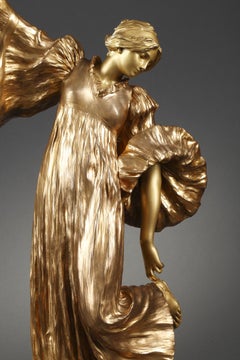
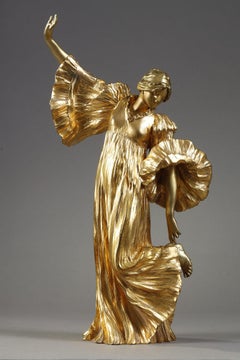
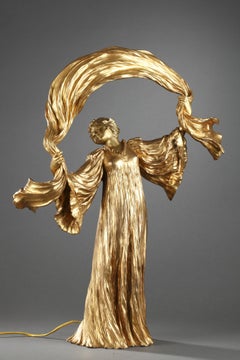
"Dancer with the scarf" lamp

"Dancer with the scarf" lamp

By Agathon Léonard

Located in PARIS, FR

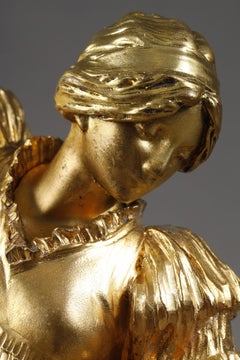
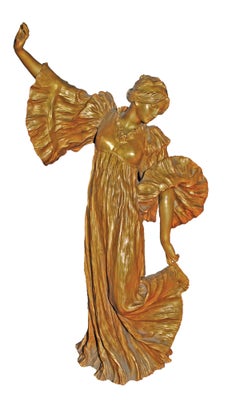
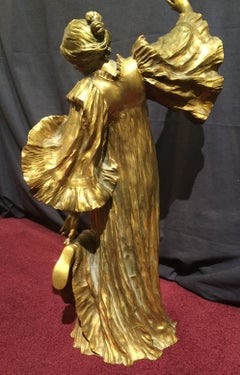
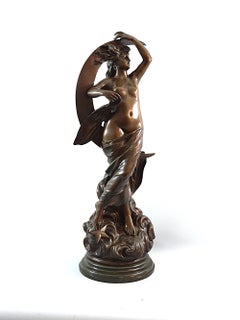
Agathon LÉONARD (1841–1923) Lamp "Danseuse à L'Écharpe" "Dancer with the scarf" lamp A very rare sculpture forming a table lamp, made in gilded bronze The scarf hides the light bulb Signed on the side of the dress "A. Léonard Sclp" Cast by Susse Frères (with founder stamp) France circa 1905 height 60 cm A similar model is reproduced in "Les bronzes du XIXe siècle", P. Kjellberg, Les éditions de l'amateur, 2005, page 460. Biography: Léonard Agathon Van Weydeveldt, said Agathon Léonard (1841-1923) was a sculptor of Belgian origin naturalized French. After studying art at the Lille Academy of Fine Arts and then at the École des Beaux-Arts in Paris, Agathon Léonard settled in Paris for a long time, where after having exhibited at the Salon of 1868, he joined the Society of French artists in 1887, then to the National Society of Fine Arts in 1897. Very involved in the artistic movement of the Art Nouveau style, he exhibited many pieces (medallions, bronze statuettes and ceramics) finely worked. Following an order from the Manufacture Nationale de Sèvres, dating from 1898, Agathon Léonard exhibited at the Universal Exhibition of 1900 in Paris his famous table centerpiece "Game of the scarf" in porcelain biscuit, composed of fifteen statuettes representing dancers with pleated dresses reminiscent of Loïe Fuller's choreographies or Neo-Greek dancers...

Category

Early 1900s Art Nouveau Agathon Léonard Art

Materials

Bronze

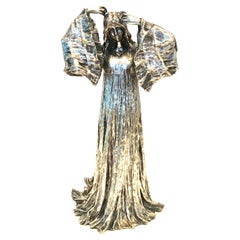
Agathon Leonard Silvered Bronze Of Marguerite

Agathon Leonard Silvered Bronze Of Marguerite

By Agathon Léonard

Located in Dallas, TX

Agathon Leonard (French, 1841 - 1923) Art Nouveau Silvered Bronze A French Art Nouveau gilt bronze sculpture, "Marguerite", by Agathon Léonard of Margeruite, placing a flower in her...

Category

1890s Art Nouveau Agathon Léonard Art

Materials

Bronze

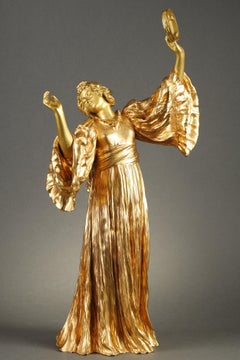
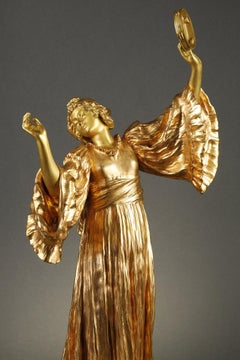
Dancer with a tambourine

Dancer with a tambourine

By Agathon Léonard

Located in PARIS, FR

"Dancer with a tambourine" by Agathon LÉONARD (1841–1923) Rare sculpture made in gilded bronze Signed on the dress "A. Léonard Sclp" Cast by Susse Frères (with founder stamp) Stamped with a foundry reference letter "M" France circa 1905 height 57 cm Biography: Léonard Agathon Van Weydeveldt, said Agathon Léonard (1841-1923) was a sculptor of Belgian origin naturalized French. After studying art at the Lille Academy of Fine Arts and then at the École des Beaux-Arts in Paris, Agathon Léonard settled in Paris for a long time, where after having exhibited at the Salon of 1868, he joined the Society of French artists in 1887, then to the National Society of Fine Arts in 1897. Very involved in the artistic movement of the Art Nouveau style, he exhibited many pieces (medallions, bronze statuettes and ceramics) finely worked. Following an order from the Manufacture Nationale de Sèvres, dating from 1898, Agathon Léonard exhibited at the Universal Exhibition of 1900 in Paris his famous table centerpiece "Game of the scarf" in porcelain biscuit, composed of fifteen statuettes representing dancers with pleated dresses reminiscent of Loïe Fuller's choreographies or Neo-Greek dancers...

Category

Early 1900s Art Nouveau Agathon Léonard Art

Materials

Bronze

Dancer with platform shoes

Dancer with platform shoes

By Agathon Léonard

Located in PARIS, FR

Dancer with platform shoes by Agathon LÉONARD (1841–1923) Sculpture made in gilded bronze Signed on the dress "A. Léonard Sclp" Cast by " Susse Frères éditeurs Paris " (with the fo...

Category

Early 1900s Art Nouveau Agathon Léonard Art

Materials

Bronze

Dancer with platform shoes

Dancer with platform shoes

By Agathon Léonard

Located in PARIS, FR

Dancer with platform shoes by Agathon LÉONARD (1841–1923) Sculpture made in gilded bronze Signed on the dress "A. Léonard Sclp" Cast by Susse Frères (with founder stamp) Stamped wit...

Category

Early 1900s Art Nouveau Agathon Léonard Art

Materials

Bronze

La Cothurne
La Cothurne

La Cothurne

By Agathon Léonard

Located in Missouri, MO

"La Cothurne" 1901 Gilt Bronze Approx 21.5" High (to raised hand) Signed and Dated Foundry Mark "Susse Freres" Originally modeled in white biscuit porcelain this Greek dancer is a from a set of eight created for a dining table. They were immediately successful when they were exhibited in the Sevres pavilion at the 1900 Exhibition. Individual figures could be ordered and "La Cothurne" proved the most popular. Their success led to the firm of Susse buying the right to cast versions in metal. Agathon Leonard (1841-1923) is one of the well-known French Art Nouveau sculptors. Born in Lille in 1841, he first studied there before moving to Paris where he studied at the Ecole des Beaux Arts under Eugene Delaplanche. He gained recognition at the annual Expositiones Universelles, winning a Silver Medal there in 1889 and gold in 1900. His most important piece, Jeu L'echarpe, was the best known series of Sevres production at the turn of the century and sold out at the 1900 Expo in Paris and later was given as a gift by the French Gov't to Nicholas II at the Hermitage. His bronzes were cast at the Susse Freres Editeurs Foundry. He worked also in marble, quartz and ivory. He also produced Art Nouveau medallions...

Category

Early 1900s Art Nouveau Agathon Léonard Art

Materials

Bronze

Related Items
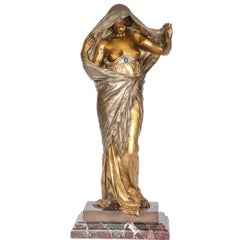
Louis Ernest Barrias Nature Revealing Herself

Louis Ernest Barrias Nature Revealing Herself

By Louis Ernest Barrias

Located in Dallas, TX

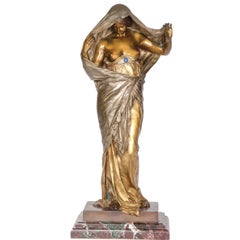
Louis Ernest Barrias (French 1841-1905) Nature Revealing Herself La Nature se dévoilant devant la Science Gilt, and silver patinated bronze with blue glass scarab Signed on base “E...

Category

Early 1900s Art Nouveau Agathon Léonard Art

Materials

Bronze

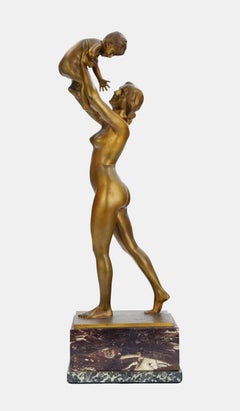
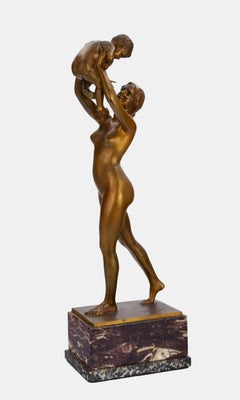
Mother Happiness / - The ecstasy of maternal joy -

Mother Happiness / - The ecstasy of maternal joy -

Located in Berlin, DE

Johannes Boese (1856 Ostrog - 1917 Berlin), Mutterglück, um 1910. Goldbraun patinierte Bronze auf gegossener rechteckiger Plinthe, montiert auf zweifarbigem Marmorsockel (9,5 cm Höhe...

Category

1910s Art Nouveau Agathon Léonard Art

Materials

Bronze

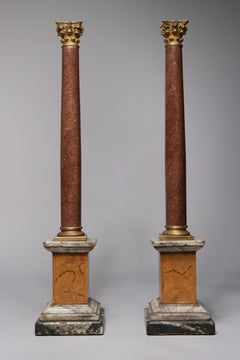
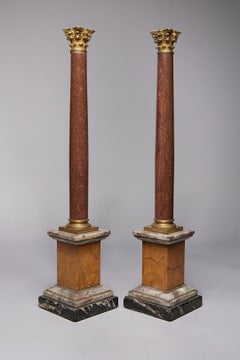
Pair of Porphyry Marble Columns with Gilt Bronze Capitals, 19th Century

Pair of Porphyry Marble Columns with Gilt Bronze Capitals, 19th Century

Located in Beachwood, OH

Pair of Porphyry Marble Columns with Gilt Bronze Capitals, 19th Century Porphyry marble & gilt bronze 20 x 4.25 x 4.25 inches Porphyry is an igneous rock, not marble, known for its...

Category

19th Century Agathon Léonard Art

Materials

Marble, Bronze

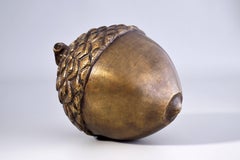
Bellota 7
Bellota 7

María José de la MacorraBellota 7, 2018

$1,890

H 5.88 in W 4.75 in D 4.75 in

Bellota 7

By María José de la Macorra

Located in Mexico City, CDMX

María José de la Macorra (México, D.F., 1964) realizó sus estudios en la Escuela de Cerámica y Porcelana de Toluca, Mokichi Okada Association,...

Category

2010s Naturalistic Agathon Léonard Art

Materials

Bronze

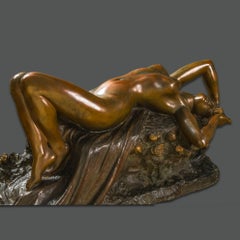
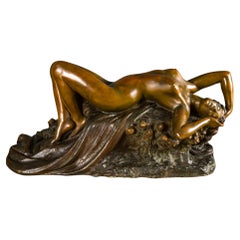
Art Nouveau Italian Signed Dated and Inscribed Original Bronze

Art Nouveau Italian Signed Dated and Inscribed Original Bronze

By Constantino Barbella

Located in Roma, IT

Wonderful Art Nouveau "Ebrezza" bronze sculpture of a woman lying on a bed of roses. It bears at the base the signature Barbella and the wording “Rome Palm Sunday 31 III 1912” Brand...

Category

Early 20th Century Art Nouveau Agathon Léonard Art

Materials

Bronze

Bust of a young woman / - The Opulence of Beauty -

Bust of a young woman / - The Opulence of Beauty -

Located in Berlin, DE

Anton Nelson (i.e. Antoine Joseph van den Kerckhoven) (1849 Brussels - after 1910 ibid.), Bust of a young woman, c. 1890. Patinated bronze on cast base, 30 cm (total height) x 20 cm ...

Category

1890s Art Nouveau Agathon Léonard Art

Materials

Bronze

"Danza dei Flori", Art Nouveau Patinated Bronze Sculpture, 1910

"Danza dei Flori", Art Nouveau Patinated Bronze Sculpture, 1910

By Giorgio Ceragioli

Located in Astoria, NY

Giorgio Ceragioli (Italian, 1861-1947) "Danza dei Flori" [Dance of the Flowers] Patinated Bronze Sculpture, 1910, the draped standing figure clutching a rose, on a circular base, tit...

Category

Early 20th Century Art Nouveau Agathon Léonard Art

Materials

Bronze

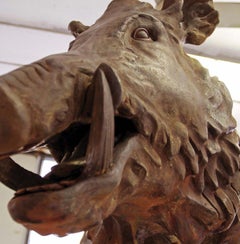
"Wild Boar" contemporary realist bronze cinghiale sculpture, life-size, Fenske

"Wild Boar" contemporary realist bronze cinghiale sculpture, life-size, Fenske

By Ben Fenske

Located in Sag Harbor, NY

‘Wild Boar’, the striking new bronze sculpture by Ben Fenske and Richard Zinon, vibrantly illustrates the ‘new’ Renaissance currently under way. Ferocio...

Category

21st Century and Contemporary American Realist Agathon Léonard Art

Materials

Bronze

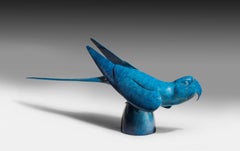
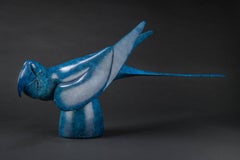
'Macaw' Solid Bronze Exotic Bird sculpture in Vibrant Electric Blue Patina

'Macaw' Solid Bronze Exotic Bird sculpture in Vibrant Electric Blue Patina

By Richard Smith b.1955

Located in Shrewsbury, Shropshire

'Macaw' is a stunningly elegant Bronze sculpture - what balance! Richard Smith conveys so much character in such simple lines, exemplifying a truly wonderful talent. The fantastic ri...

Category

21st Century and Contemporary Contemporary Agathon Léonard Art

Materials

Bronze

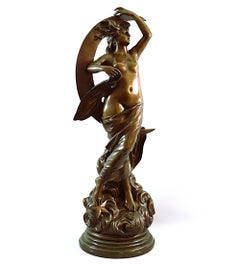
Hebe Sculpture by E. Drouot (1859-1945) Art Nouveau Bronze, Signed, 19th Century

Hebe Sculpture by E. Drouot (1859-1945) Art Nouveau Bronze, Signed, 19th Century

Located in Berlin, DE

Fine 19th Century Bronze Art Signed Édouard Drouot Bronze Authentic Drouot Bronze Figurine Fine Art Bronze Sculpture Mythology French Salon Br...

Category

Late 19th Century Art Nouveau Agathon Léonard Art

Materials

Bronze

“Art Nouveau Female”

“Art Nouveau Female”

Located in Southampton, NY

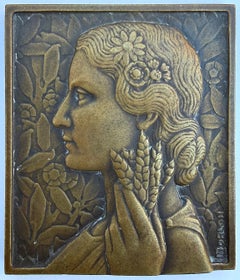
Beautiful bronze plaque of a young woman with flowers in her hair and holding wheat sheaths by the well known French sculptor, Pierre-Alexandre Morlon. Art Nouveau period. Circa 1900. Signed lower right “Morlon”. The reverse of the plaque shows one planting of the crops scene with a harvesting scene on the bottom of the plaque. Condition is very good. Original patina. Provenance: A New York collector. Pierre-Alexandre Morlon (June 4, 1878, Mâcon – 1951), sculptor and medalist, French school. A student of Falguière and Mercié, the artist made his debut at the 1900 Salon. He was an *hors-concours* (exempt from jury selection) member of the *Salon des Artistes Français* and served as a jury member. He is known for creating the commemorative war medals...

Category

Early 1900s Art Nouveau Agathon Léonard Art

Materials

Bronze

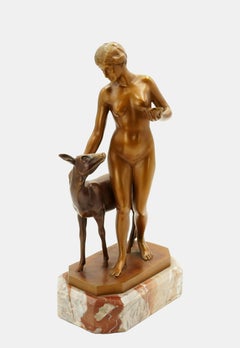
Forest idyll / - Soulmate -

Rudolf KaesbachForest idyll / - Soulmate -, c. 1915

$4,674

H 14.18 in W 6.7 in D 4.73 in

Forest idyll / - Soulmate -

By Rudolf Kaesbach

Located in Berlin, DE

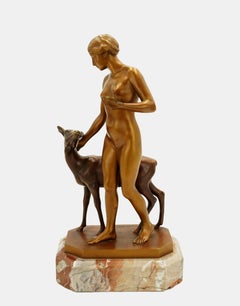
Rudolf Kaesbach (1873 Gladbach - 1955 Berlin), Forest idyll, around 1915. Bronze, gold and golden brown patina, with cast plinth, mounted on a marble base (5 cm high), total height 36 cm, dimensions of the bronze: 31 cm (height) x 17 cm (length) x 12 cm (width). Weight 4,6 kg, signed on the plinth "R.[udolf] KAESBACH". - a few rubbed areas, overall in excellent condition for its age - Soulmate - The bronze sculpture depicts a young woman in an intimate exchange with a deer that accompanies her. The animal pauses to turn toward her, while the nude beauty slows her pace to look into the deer's eyes and tenderly caress it with her hand. The woman and the deer are in inner harmony. Even though her lips remain motionless, she speaks the language of the animal with which she is deeply connected. The golden patina, which contrasts with the more naturalistic coloring of the deer, gives the young woman the appearance of a saint, even if she cannot be identified as such. At the same time, she evokes memories of Diana, the goddess of the hunt, or a nymph. But she lacks the ferocity. In her innocent naivety, she is more like a vestal virgin, who is not at home in the solitude of the forest. And yet, the young beauty, moving unclothed in the heart of nature, looks like a priestess with her hair tied up and a carefully carried bowl on her way to a sacred grove. In order to open up the above-mentioned associations, Kaesbach deliberately designed the female figure in such a way that she cannot be identified as a specific person. He has created an allegory of natural femininity, characteristic of Art Nouveau, in which the deer is far more than a companion animal. It displays the same gracefulness as the young woman, and the inner resemblance between the two makes the deer appear as her other self. In animal terms, it embodies her inner being, which also gives the deer an allegorical character. About the artist Rudolf Kaesbach studied sculpture at the Hanau Academy and worked in a bronze foundry in Paris in 1900. In order to work as an independent artist, he opened a workshop in Düsseldorf, where he cast bronzes from models he designed. In 1902 he made his debut at the German National Art Exhibition in Düsseldorf. The following year Kaesbach went to the academy in Brussels. There he was inspired by contemporary Belgian sculpture, especially the work of Constantin Meunier. He moved to Berlin, where he opened a studio in the villa district of Grunewald and devoted himself to life-size marble sculptures and the design of bronzes. From 1911, he regularly presented his works at the major art exhibitions in Berlin, as well as in Düsseldorf and Malmö. Between 1936 and 1939, he also created models for the Rosenthal porcelain factory. From 1939 to 1944, Kaesbach was represented at the major German art exhibitions in Munich. GERMAN VERSION Rudolf Kaesbach (1873 Gladbach - 1955 Berlin), Waldidyll, um 1915. Gold und goldbraun patinierte Bronze mit gegossener Plinthe, auf einem Marmorsockel montiert (5 cm Höhe), Gesamthöhe 36 cm, Maße der Bronze: 31 cm (Höhe) x 17 cm (Länge) x 12 cm (Breite). Gewicht 4,6 kg, auf der Plinthe mit „R.[udolf] KAESBACH“ signiert. - vereinzele beriebene Stellen, insgesamt in einem altersgemäß ausgezeichneten Zustand - Seelenverwandtschaft - Die Bronzeplastik veranschaulicht eine junge Frau im innigen Austausch mit einem sie begleitenden Reh. Das Tier hält inne, um sich zu ihr hochzuwenden, während die nackte Schönheit ihren Schritt verlangsamt, um dem Reh ebenfalls in die Augen zu schauen und es zärtlich mit der Hand zu liebkosen. Die Frau und das Reh sind in einem inneren Gleichklang. Auch wenn ihre Lippen unbewegt bleiben, spricht sie die Sprache des Tieres, mit dem sie auf eine tief empfundene Weise verbunden ist. Die im Kontrast zur naturalistischeren Einfärbung des Rehs aufstrahlende goldfarbene Patina lässt die junge Frau wie eine Heilige erscheinen, auch wenn sich nicht als Heilige identifizierbar ist. Zugleich ruft sie Erinnerungen an die Jagdgöttin Diana oder eine Nymphe hervor. Dafür fehlt ihr allerdings die Wildheit. In ihrer unschuldigen Naivität gemahnt sie vielmehr an eine Vestalin, die freilich nicht in der Waldeinsamkeit zu Hause ist. Und doch wirkt die sich unbekleidet im Herzen der Natur bewegende junge Schönheit wie eine Priesterin, die sich mit hochgebundenem Haar und der vorsichtig getragenen Schale und dem Wege zu einem Heiligen Hain befindet. Um die gennannten Assoziationen zu eröffnen, hat Kaesbach die Frauenfigur bewusst so gestaltet, dass sie nicht als konkrete Person identifizierbar ist. Damit hat er eine für den Jugendstil charakteristische Allegorie natürlicher Weiblichkeit geschaffen, bei der das Reh weit mehr als ein Begleittier ist. Es weist dieselbe grazile Anmut wie die junge Frau auf und der innere Gleichklag der beiden lässt das Reh als ihr anderen Ich erscheinen. Es verkörpert – ins Animalische übertragen - ihr inneres Wesen, wodurch auch dem Reh ein allegorischer Charakter zukommt. zum Künstler Rudolf Kaesbach studierte an der Akademie Hanau Bildhauerei und war im Jahr 1900 in einer Pariser Bronzegießerei tätig. Um sich als eigenständiger Künstler betätigen zu können, eröffnete er in Düsseldorf eine Werkstatt, in der er Bronzen nach selbstentworfenen Modellen goss. 1902 debütierte er auf der Deutschen Nationalen Kunstaustellung in Düsseldorf. Im Folgejahr ging Kaesbach an die Akademie nach Brüssel. Dort wurde er von der zeitgenössischen belgischen Bildhauerei, insbesondere vom Werk Constantin Meuniers, inspiriert. Zurückgekehrt zog er nach Berlin, wo er im Villenviertel Grunewald ein Atelier eröffnete und sich neben dem Entwurf für Bronzen der lebensgroßen Marmorbildhauerei widmete. Ab 1911 präsentierte er seine Werke regelmäßig auf den Großen Berliner Kunstausstellungen, aber auch in Düsseldorf und Malmö. Zwischen 1936 und 1939 fertigte er zudem Modelle für die Porzellan-Manufaktur Rosenthal an. Von 1939 bis 1944 war...

Category

1910s Jugendstil Agathon Léonard Art

Materials

Bronze

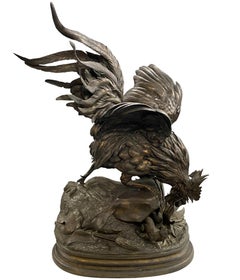
Rooster & Ermine
Rooster & Ermine

Rooster & Ermine

By Jules Moigniez

Located in Milford, NH

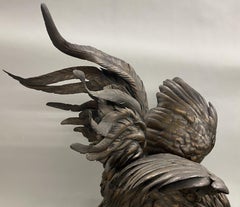
A monumental 19th century patinated animalier cast bronze of a rooster & ermine (weasel), with varying titles including "Coq Guettant," "Coq Attaquant une Belette," and "Cockerel and...

Category

19th Century Agathon Léonard Art

Materials

Bronze

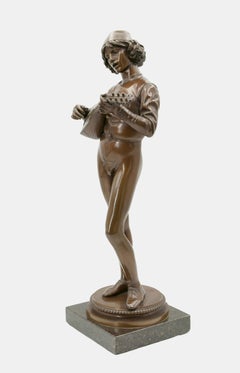
Florentine singer / - The Renaissance of the Renaissance -

Florentine singer / - The Renaissance of the Renaissance -

By Paul Dubois

Located in Berlin, DE

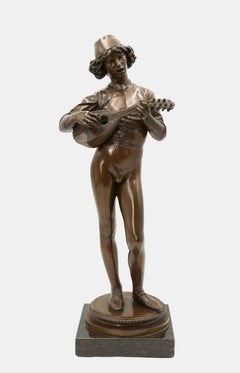
Paul Dubois (1829 Nogent-sur-Seine - 1905 Paris), Florentine singer, 1865. Light brown patinated bronze with cast round plinth mounted on a square marble base (3.5 cm high). Total height 53 cm. Bronze dimensions: 49.5 cm (height) x 20 cm (length) x 10 cm (width), weight 5.6 kg. Inscribed on the plinth "P.[aul] DUBOIS", dated "1865", with the foundry's mark "F. BARBEDIENNE FONDEUR" and the signet "REDUCTION MECANIQUE A. COLLAS". - Patina very occasionally darkened, lute with loss of one tuning peg, otherwise in excellent condition. - The renaissance of the Renaissance - The bronze is a precisely executed and masterfully cast contemporary reduction of Paul Dubois 155 cm tall masterpiece "Florentine Singer", which is exhibited in the Musée d'Orsay and for which the artist was awarded the Medal of Honor at the Paris Salon in 1865. The work acted as a beacon, and was followed by a plethora of depictions of juveniles. Inspired by Donatello and Luca della Robbia, but also by painters such as Piero della Francesca, Benozzo Gozzoli, and Pinturicchio, the "Florentine Singer" is not an epigonal work that pays homage to a vanished era, but a successful attempt to draw vitality from the art of the past and thus give it new life. The effect of vitality is the core of Italian Renaissance art theory. In order to fulfill itself as art, art had to appear like nature. This naturalism also characterizes the "Florentine Singer". The young man appears to have been taken from life, which is reinforced by the momentary nature of his action. He has just struck a now fading chord. In addition, the natural appearance is enhanced by the detailed shaping of the figurative details, such as the laces with the slightly curved leather of the shoes, the belt buckle, or the ornamentation on the body of the lute. Even the fingernails are clearly defined. Unlike the Renaissance, however, the effect of liveliness here is not based on the "discovery" of nature and the human body, but primarily on the rediscovery of the art of the Quattrocento. The liveliness of the artwork is therefore at the same time a revitalization of this art, so that we can speak of a Renaissance of the Renaissance, just as the Pre-Raphaelites in England at the same time transferred the Quattrocento to contemporary art. Dubois takes on the most difficult of all subjects, the depiction of singing through silent sculpture. He was preceded in this by Luca della Robbia and Donatello with their pulpits of singers created in the 1430s in the Museo dell'Opera del Duomo in Florence. Compared to these works, the physiognomy of Dubois singer is far less animated, yet he also depicts singing in a convincing manner. He uses the whole body. He takes the ancient contrapposto, which was essential to Renaissance sculpture, and transforms the standing leg-playing posture into a late medieval S-swing, giving the body an elegant beauty and at the same time setting it in melodic motion. In the equally elegant finger position, the music is expressed in a much more literal way with the beating of the lute. Finally, the musicality of the sculpture culminates in the face with the mouth open to sing. Through the act of singing, which is a great challenge to the artistic will to depict perfect beauty, the gracefulness of the classical face is not diminished, but enhanced. Starting from the face with the singing mouth and the gaze absorbed by the sounds, the inner vitality spreads, giving the bronze sculpture an intense aura, enhanced by the music. Dubois transfers the beauty of the Renaissance to the musical, sublimating the visible sculpture to the invisible of music. He took up the challenge of transcending the Renaissance with the Renaissance, thus responding to the Querelle des Anciens et des Modernes, which arose at the end of the 17th century around the French Academy and remained virulent into the 19th century, in which antiquity was regarded either as an unattainable ideal or as a standard to be surpassed. With his work, Dubois proved that the Renaissance, which had championed the art of the ancients, could lead to a new renaissance of art. About the artist Paul Dubois' great-uncle was the famous French Baroque sculptor Jean-Baptiste Pigalle, in whose footsteps the talented great-nephew followed. When he debuted at the Paris Salon in 1858, he signed his work "Dubois-Pigalle". At his father's request, however, he first studied law before devoting himself to sculpture under the tutelage of François Christophe Armand Toussaint in 1856 and entering the École des Beaux-Arts in 1858. From 1859 to 1863, he lived in Rome and traveled to Naples and Florence. Inspired by Florentine art of the quattrocento, Dubois initiated a school-forming neo-Florentine style that combined the elegantly simple forms of youthful grace with a precise wealth of detail.Two purchases by the French state (“envois de Rome”) were made during his stay in Rome, which brought him recognition in Paris. After his return there, he quickly became an internationally sought-after artist. Dubois was also active as a creator of monuments. His most famous work is the equestrian statue of Joan of Arc (1896) on the forecourt of Reims Cathedral. He was also a sought-after portraitist who produced around 50 busts and - Dubois was also a passionate painter - around 100 portraits in oil. From 1873 to 1878 he was curator of the Museum du Luxembourg, in 1876 he became a member of the Institut de France and from 1878 to 1905 he was director of the École des Beaux-Arts. In 1865, Dubois was awarded the Paris Salon Medal of Honor for his “Florentine Singer”. In 1867 he became Chevalier, in 1874 Officier, in 1886 Commandeur of the Légion d'honneur, which awarded Dubois the Grande Croix in 1896. Selected Bibliography Stole, Elmar: Paul Dubois. In: Saur. Allgemeines Künstlerlexikon, vol. 30, Munich - Leipzig 2001, pp. 677-678. GERMAN VERSION Paul Dubois (1829 Nogent-sur-Seine - 1905 Paris), Florentinischer Sänger, 1865. Hellbraun patinierte Bronze mit gegossener runder Plinthe auf quadratischem Marmorsockel montiert (3,5 cm Höhe). Gesamthöhe 53 cm. Maße der Bronze: 49,5 cm (Höhe) x 20 cm (Länge) x 10 cm (Breite), Gewicht 5,6 kg. Auf der Plinthe mit „P.[aul] DUBOIS“ bezeichnet, auf „1865“ datiert, mit dem Gießereistempel „F. BARBEDIENNE FONDEUR“ und dem Signet „REDUCTION MECANIQUE A. COLLAS“ versehen. - Patina sehr vereinzelt nachgedunkelt, Laute mit Verlust eines Stimmwirbels, ansonsten ausgezeichnet erhalten. - Die Renaissance...

Category

1860s Realist Agathon Léonard Art
Materials

Bronze

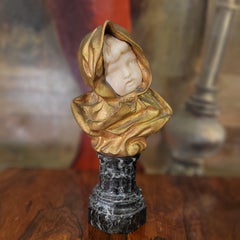
Art Nouveau Bust of a child chrysoelephantine marble, after G. de Thouin France

Art Nouveau Bust of a child chrysoelephantine marble, after G. de Thouin France

Located in Valladolid, ES

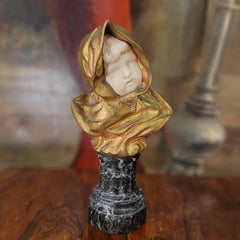
One of a kind and very refined chrysoelephantine sculpture depicting the bust of a child wrapped in a hooded gilded cloak. The work combines carved ivory for the face, which emerges ...

Category

Early 1900s Art Nouveau Agathon Léonard Art
Materials

Marble, Bronze, Gilding

Agathon Léonard art for sale on 1stDibs.
Find a wide variety of authentic Agathon Léonard art available for sale on 1stDibs. You can also browse by medium to find art by Agathon Léonard in bronze, metal and more. Not every interior allows for large Agathon Léonard art, so small editions measuring 6 inches across are available. Customers who are interested in this artist might also find the work of Emile Gallé, Emmanuel Villanis, and Charles Schneider. Agathon Léonard art prices can differ depending upon medium, time period and other attributes. On 1stDibs, the price for these items starts at $70,391 and tops out at $91,413, while the average work can sell for $80,902.
Artists Similar to Agathon Léonard