Alfred Reth
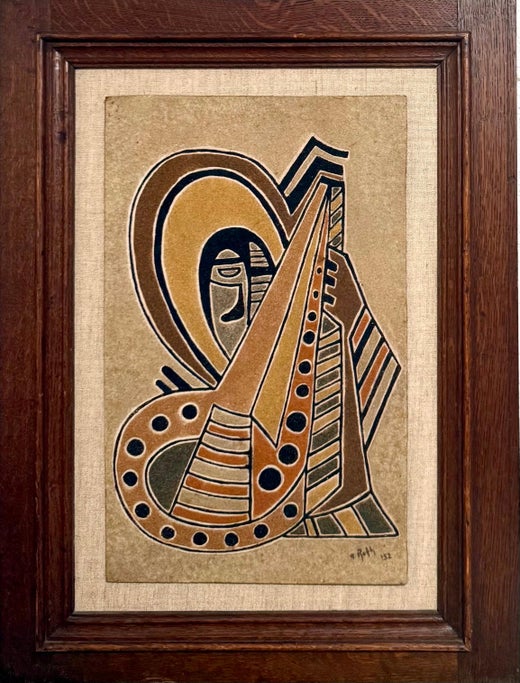
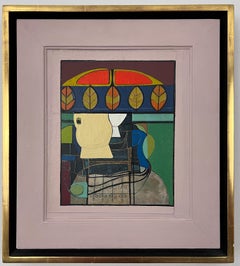
Born Alfred Roth February 29, 1884 in Budapest and died in September 1966 in Paris was a Hungarian painter, naturalized French, considered one of the main figures of the Avant-garde and the School of Paris. Is the eighth child of a modest Hungarian family. At the end of his schooling, he became a bank employee, as his father wished. From his childhood, Alfréd got to know István Farkas and László Mednyánszky. He befriends the first and the second teaches him to paint. This is where his interest in Buddhism and oriental art was born. In 1903, he binds with the colony of painters of Nagybánya and begins to work under the direction of Károly Ferenczy. In 1905, he left for Paris with József Egry. In France, he worked in the studio of J. E. Blanche in Montmartre. He met the orientalist Jean Buchot through Mednyánszky and developed his interest in Hindu and Khmer art which he discovered at the Musée Guimet. He discovered Cézanne at Ambroise Vollard then at the Salon d'Automne in 1907; he did not join the Fauve group but was part of the cubist movement from 1911. He exhibited 3 paintings at the Salon des Indépendants, hung between those of Matisse and Rouault, and reiterated in 1911: his paintings rubbed shoulders with those of Braque, to whom he would be close later, Léger, Lhote, Metzinger, de Segonzac. He is one of the many so-called painters of the School of Paris. In 1913, he was invited to participate in an exhibition devoted to Cubism in Berlin by the Galerie der Sturm, where he represented French contemporary art with 80 paintings and drawings. Also in 1913, his works were presented in Budapest during a Cubist exhibition. In 1914, with the outbreak of the First World War, he was interned as a citizen of a country enemy of France. The end of the war marked the beginning of the Roaring Twenties, the return of foreign collectors and their large purchases of modern works, an intense, creative and worldly life in a Paris that wanted to compete with Berlin. He is one of the first to embark on the path of abstraction, in the 1920s his paintings are games of lines and planes, curves and strangely figurative. Member of the Abstraction group - creation: Non-figurative art in 1931 with Arp, Georges Valmier, Herbin, Kupka, etc. whose goal is to disseminate abstract art and organize exhibitions, which will be active until 1936. In 1946, after the Second World War, the Salon des Réalités Nouvelles is formed with which he will exhibit. At the end of his life, Réth will always be in the abstract movement, but he will also return to figuration and the collages he had started in 1906, with paper and adding collage of colored printed fabrics. The materials that captivated him then were a major axis in his work until 1960. The year of his death in 1966, it was in Chicago that a retrospective was given to him.